Showing posts with label Van Heflin. Show all posts

Monday, 10 October 2022

Movie Review: Patterns (1956)

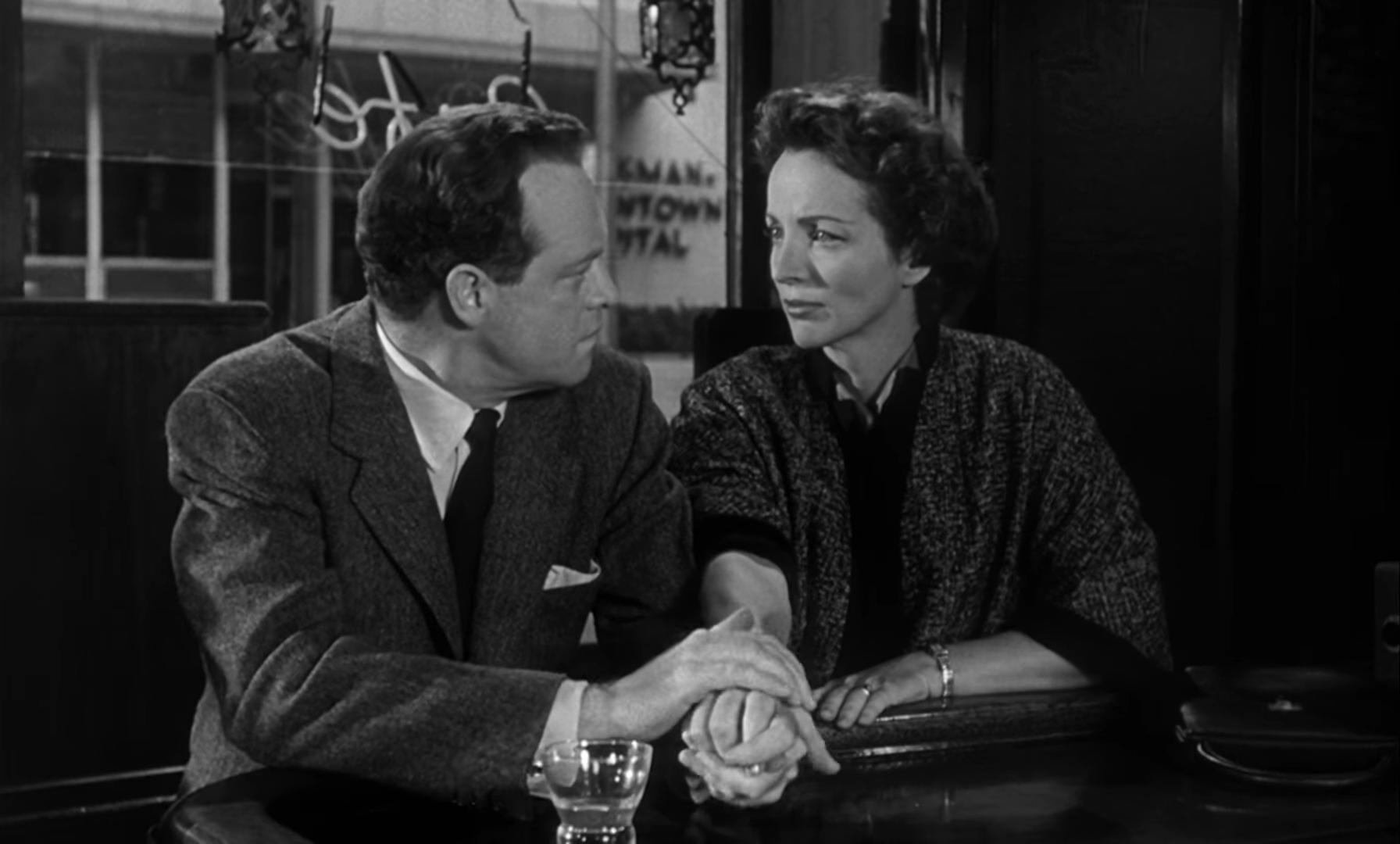
A corporate boardroom drama, Patterns (also known as Patterns Of Power) reveals ruthless dynamics among men at capitalism's highest echelons.

Engineer Fred Staples (Van Heflin) and his wife Nancy (Beatrice Straight) relocate from Ohio to Manhattan, where Fred is joining the executive team at the massive Ramsey & Co industrial conglomerate. The firm is run with an iron fist by Walter Ramsey (Everett Sloane), and he sees Fred as a replacement for William Briggs (Ed Begley), a senior executive with 40 years of experience, but now in failing health.

Ramsey no longer trusts Briggs' judgment, and does all he can to humiliate him into resigning. Staples is caught between the two men. He admires Briggs' common touch and concern for workers, but is also ambitious. A showdown looms when Ramsey refuses to acknowledge Briggs' contributions to an important report.

Staples: I just hope Mr. Ramsey remembers hiring me.
Briggs: Mr. Ramsey rarely forgets anything.

A cinematic adaptation of a teleplay written by Rod Serling, Patterns infiltrates the penthouse level of a New York highrise to uncover the jungle rules of corporate backstabbing and ladder climbing. Clocking in at an efficient 84 minutes, director Fielder Cook keeps the drama at the theatrical scale of intimacy, but allows his cameras to roam among several locations, including the Staples home, the building lobby, and most impressively, the lavish hallway connecting the senior executive offices, where secretaries with their own hierarchy dutifully follow orders.

Within the short running time, Serling focuses on one net zero theme - Briggs' downfall coinciding with Staples' rise - and is quick to resort to plenty of agitated arguments, escalating into some tedious shouting matches. And for a smart man, Staples is often slow to read the room and discern his trajectory.

Ramsey: Name your terms. All terms are negotiable.

But the background contexts are still impactful. Briggs laments the loss of an era when bosses knew their workers by name, and growth came from productivity and innovation rather than acquiring bankrupt companies. Staples starts to understand why he was hand-picked by Ramsey, and what it takes to be a leader at a mammoth corporation.

The three leads rise to the challenge in dominant performances. Everett Sloane shines in conveying an unshakeable belief that Ramsey is the smartest man in the room, berating others to catch up. Ed Begley embodies Briggs' final stand, and Van Heflin straddles the middle, the drama seen through his eyes. Beatrice Straight as Nancy reveals the depth of Serling's writing, her character demonstrating calm agility at moments of highest stress.

Staples: I don't want the job. I'm through, I'm quitting, I resign as of now.
Ramsey: Why?
Staples: Because I hate your guts. You used Bill Briggs for a whipping boy. You made him knuckle under, then you beat him to death. You wouldn't try anything like that with me because I'd kill you first.
Ramsey: I'm not a nice human being. What else?

Offering no easy answers but plenty of brutal reality checks, Patterns merges dark and light into a cross-cutting perspective.


All Ace Black Movie Blog reviews are here.

Sunday, 5 April 2020

Movie Review: Airport (1970)


A grand multi-story disaster epic, Airport helped formulate the genre template. A star-studded cast and multiple overlapping emergencies sustain the thrills over one long night.

The setting is Chicago's Lincoln International Airport during a snowstorm. Airport Manager Mel Bakersfeld (Burt Lancaster) is struggling to keep the airport functional, an objective made difficult when a taxiing airplane gets stuck in the snow and blocks the airport's main Runway 29. The alternative Runway 22 is shorter and impacts a surrounding community. Mel calls upon chief maintenance mechanic Patroni (George Kennedy) to help unwedge the Boeing 707.

Mel's brother-in-law is womanizing pilot Vernon Demerest (Dean Martin), who is about to take charge of an overnight flight to Rome. Vernon is having an affair with stewardess Gwen (Jacqueline Bisset), and she reveals her pregnancy just before departure. Mel's marriage to his wife Cindy (Dana Wynter) is falling apart, allowing him to evolve his relationship with airline customer service representative Tanya Livingston (Jean Seberg).

Meanwhile Tanya has to deal with the elderly Ada Quonsett (Helen Hayes), who is apprehended as a serial stowaway but anyway boards Vernon's flight. But most worrisome is depressed businessman D. O. Guerrero (Van Heflin), who plans to kill himself with a briefcase bomb in order for his wife Inez (Maureen Stapleton) to benefit from insurance money. As Vernon deals with in-flight emergencies, Mel and Patroni frantically work to reopen Runway 29, now an urgent matter of life and death.

The adaptation of Arthur Hailey's 1968 book is brought to the screen by director George Seaton, who also wrote the surprisingly taut screenplay. The film created the blueprint for a decade-long cycle of disaster movies, spawned three direct but lesser sequels, and inspired several parodiesAirport also heralded the blockbuster era to come, well-produced but easy-to-digest escapism loved by audiences and generating mass profits on a previously unimaginable scale.

And despite the stiff dialogue, lack of any narrative depth beyond the here and now, and some cringe-worthy corporate boosterism, there is no denying the film's appeal. The cast members are stereotyped but in good form, Lancaster, Martin, Kennedy and Heflin playing to their pre-established strengths, while Seaton fills the screen with activity, inside the terminal, on the tarmac, and on-board the flights, all in gorgeous technicolor. Frequent use of split screens, relatively accurate technical jargon, and a packed agenda of colliding personal and work emergencies easily occupy the 136 minutes of running time.

With action and events moving briskly, the memorable moments are plentiful. Helen Hayes earns many of them, and claimed a Best Supporting Actress Academy Award for a delicately funny turn as the unlikely stowaway Ada. Her repertoire of tricks to get past every checkpoint plus a disarming charm and conversational gifts are put to good use on the ground and in the air.

Dean Martin makes the most of the cocky Vernon coming to terms with Gwen's pregnancy, and gets another well-crafted highlight in his attempt to talk down Guerrero.

As the man in the middle of it all, Mel's agitation with bureaucrats and politicians comes to a satisfying boil when a clueless Commissioner chooses the worst possible time to suggest the airport's closure. And after a few rounds of bickering, Mel and Cindy as a husband and wife presiding over a wrecked marriage carve out a surprisingly adult resolution.

And finally George Kennedy creates the Patroni legend with his full-throttled attempt to prod the stranded Boeing 707 into motion, the irresistible force of one man determined to triumph over a mammoth immovable object. The night will not be over until the cigar is well and truly chomped.


All Ace Black Movie Blog Reviews are here.

Wednesday, 6 March 2019

Movie Review: The Three Musketeers (1948)


A swashbuckling adventure, The Three Musketeers is reasonably entertaining but undeniably frazzled.

It's the 1600s in France and young d'Artagnan (Gene Kelly) leaves the countryside and heads to Paris seeking to join the elite Musketeers, who form the King's guard. He proves his swordsmanship in a battle alongside Athos (Van Heflin), Porthos (Gig Young) and Aramis (Robert Coote) and joins them as they defend the King (Frank Morgan) from evil plots. The main threat is posed by the nefarious Prime Minister Richelieu (Vincent Price), who wants to trigger a war with England and regularly conspires with Milady, Countess de Winter (Lana Turner).

d'Artagnan meets and falls in love with Constance (June Allyson), one of the maidens of Queen Anne (Angela Lansbury). The Musketeers set off on a mission to England to retrieve jewels from the Duke of Buckingham (John Sutton), but that is just the start of many adventures to try and thwart the persistent Richelieu.

A disorganized mess of a film, The Three Musketeers just about scrapes through. The energy level is admirably high and athletic swordplay setpieces erupt at regular intervals. Yet a lack of tonal cohesion, weird casting choices, characters rotating in and out of the movie with no explanation, plot points that border on incomprehensible, and plenty of seemingly important action occurring off-screen all combine to create a disconcerting experience.

Most of the trouble originates within a lazy script intent on thoughtlessly cramming too much of Alexandre Dumas' episodic stories into a two hour movie. With no appreciation for the need to focus to achieve depth or cohesion, the film thrashes around in shallow waters gasping from one side quest to the next, barely explaining why everyone is running around, or even who everyone is or why they matter.

Director George Sidney cobbles together enough swashbuckling sword fights to paper over most of the cracks, with Gene Kelly's athleticism put to great use. The lavish sets, locations and costumes often look gorgeous in technicolor, and a certain level of joie de vivre helps hustle the film along.

Gene Kelly as d'Artagnan and Van Heflin as Athos seem to be acting in two different movies. Kelly is all smiles as he peddles a light hearted attitude and half-threatens to break out into a song-and-dance routine at every opportunity. Heflin is dour, reflective and dramatic as he pauses often to drone on about his lost love.

Porthos and Aramis barely register as the other two musketeers, but the ladies fare worst of all. Lana Turner is top billed but her role is almost incidental, June Allyson as Constance is both mis-cast and underwritten, and Angela Lansbury's Queen Anne is detached from most of the various plots.

The Three Musketeers gallops across the landscape with impressive bravado, but forgets to bring along any sense of structured significance.


All Ace Black Movie Blog reviews are here.

Tuesday, 11 December 2018

Movie Review: East Side, West Side (1949)


A marriage, infidelity and murder story, East Side, West Side is a star-laden drama with a decidedly weak script.

In New York City, couple Jessie and Brandon Bourne (Barbara Stanwyck and James Mason) have patched up their marriage a year after he had an affair. She is a calm and patient housewife, while he is a playboy businessman unable to control his lust. Now his mistress Isabel Lorrison (Ava Gardner) has returned to town, and Brandon is quickly back under her trance and succumbing to his philandering instincts.

As Jessie struggles to decide whether she can ever trust Brandon again, she befriends department store model Rosa Senta (Cyd Charisse), and through her meets former police officer and now international investigator Mark Dwyer (Van Heflin). He immediately senses Jessie's inherent loneliness. Their lives are thrown into turmoil when a murder is committed, with no shortage of suspects with motives.

A glossy MGM production designed to showcase the sordid secrets of the rich elites, East Side, West Side features current and future stars in every meaningful role. The talented cast cannot save a feeble by-the-numbers script by Isobel Lennart, based on the Marcia Davenport novel. The dialogue is stiff, most of the actors go about their business in a mechanical trance, and director Mervyn LeRoy adds little to the drama.

With Stanwyck in particularly subdued form and Mason struggling to convince as a playboy not in control of his libido, the will-she-or-won't-she-leave-him dilemma never gains traction. Only Gardner adds some heat as the other woman, but her smoldering mannerisms land flat opposite Mason's lethargy. Heflin and Stanwyck are supposed to create an undercurrent of potential romance in the final act, but the absence of chemistry means they come across as friends at best.

The murder sub-plot arrives really late, suddenly lurching the film into a police procedural. A couple of hitherto barely seen marginal characters in the form of hoodlum Dawning (Douglas Kennedy) and icy blonde Felice (Beverly Michaels) become involved. And just as quickly, the case is tidied up, having contributed little to the central drama.

The film's title refers to the two halves of New York, upper class and working class. A brief sojourn by Mark and Jessie to his neighbourhood roots is thrown in to justify the reference, but like the rest of the movie, it's a perfunctory gesture.


All Ace Black Blog Movie Reviews are here.


Friday, 14 October 2016

Saturday, 24 September 2016

Movie Review: Five Branded Women (1960)


An independent war film with a unique perspective, Five Branded Women is a thought-provoking drama delving into the human cost of war, and the warped values that emerge in a world consumed by an endless conflict.

The setting is a small town in Yugoslavia under German occupation in 1943. Womanizing German officer Sergeant Keller (Steve Forrest) is simultaneously seducing five local women. Members of the local anti-Nazi partisan militia, led by Velko (Van Heflin), soon catch up with Keller and summarily extract revenge. The five women are punished for sleeping with the enemy: the partisans forcibly cut their hair short to visibly humiliate them. The embarrassed Nazis evict the disgraced women out of town.

The women are Jovanka (Silvana Mangano), Ljuba (Jeanne Moreau), Daniza (Vera Miles), Marja (Barbara Bel Geddes), and Mira (Carla Gravina). Jovanka perceives war, rather than the Germans, as the enemy interrupting her lust for life. Ljuba is the innocent shop girl looking for an ideal man. Daniza never actually slept with Keller, but was swept up in the roundup of the women. The widow Marja was desperately trying to get pregnant with Keller, while Mira is already carrying his child.

The women have to fend for themselves in the unforgiving war-torn countryside. Jovanka assumes the group's leadership as they sleep rough and steal food to survive. Before long they witness partisan attacks on German convoys and make contact with Velko's militia, which includes the charismatic fighter Branco (Harry Guardino), who has difficulty controlling his libido. The women prove themselves in combat, and even capture the German Captain Reinhardt (Richard Basehart) as a prisoner. But the war is long, and the strain begins to tell.

A Dino De Laurentiis production directed by Martin Ritt, Five Branded Women carries a European sensibility towards the war. Traversing territory devoid of heroes and villains, the Yugoslavian countryside contains mostly victims trying to carve out a path to survival. While there are some cringe-worthy moments of wooden acting and melodramatic dialogue, the film thrives in an environment of humanity shorn of civility and stripped down to the basics of endurance.

Ritt alternates his characters' musings about the war with sharp action scenes, mostly consisting of noisy ambushes as the partisans deploy classic hit and run tactics to make life miserable for the occupying Germans. But the film's impact is carried by the strong-held beliefs of Jovanka and Velko. Jovanka does not care who is at war with whom; she just resents the war for disrupting her quest for a full life, and seeks the opportunities to strike back at the tide of misery. Velko is resigned to becoming a killer, and has parked his soul to the side, fully accepting that his embrace of brutality creates little functional separation between him and the occupiers. Silvana Mangano and Van Heflin bring these two memorable characters to life with a welcome facade of dour determination.

The grim black and white cinematography adds to the appropriately depressed tone: the lush countryside may be beautiful, but now is not the time to admire nature's colours. And in the unhinged reality of a land ravaged by war, ironies prevail. Daniza is punished once for a sin she did not commit with the enemy; she will be punished again for consorting with an ally. Ljuba establishes a relationship with the prisoner Reinhardt. He helps bring life to a countryside filled with death unleashed by his army before presenting Ljuba, who has long been waiting for a decent man, with a stark choice.

War resets the rules of sex, and Five Branded Women is unflinching in dealing with a topic that Hollywood movies typically avoided. The town is obsessed with the liaisons perpetrated by the womanizing Keller. Out in the fields, Branco's first instinct is to rape Jovanka; there is barely a difference between occupiers and freedom fighters in claiming women as trophies. Velko insists that the first rule of his militia is no fraternization between men and women, a goal both noble and impossible.

And although Velko and Jovanka avoid getting romantically entangled, they finally connect intellectually. He wants to free his country at all cost, she wants the freedom to embrace all that a miserable life can offer, and after an audacious militia attack their interests finally intersect, machine gun at the ready, Nazis in pursuit.


All Ace Black Movie Blog reviews are here.

Sunday, 17 April 2016

Movie Review: Shane (1953)


A classic Western, Shane perfectly blends all the genre elements into a monumental package. The story of a mysterious gunman helping homesteaders defend their land against evil cattlemen captures the mythology of a changing landscape, with one lifestyle expiring and another setting down roots.

In rural Wyoming, Joe and Marian Starrett (Van Heflin and Jean Arthur) are working hard to create a home for themselves and their young son Joey (Brandon deWilde). A soft-spoken loner known only as Shane (Alan Ladd) passes by and witnesses the Starretts being intimidated by cattleman Rufus Ryker (Emil Meyer) and his rough band of cowboys, including Chris Calloway (Ben Johnson). Rufus believes that homesteaders are unwelcome invaders, opportunistic latecomers to land tamed by cattlemen, disrupting the landscape with fences and crops.

Shane is attracted to the life of domesticity, and accepts Joe's offer of a job. He hangs up his gun and tries to adapt to life helping out on the farm. Young Joey quickly sees Shane as a hero and starts idolizing him. Ryker tries all combinations of threats and promises to scare off the Starretts and the other homesteaders including the particularly headstrong Frank 'Stonewall' Torrey (Elisha Cook Jr.), but the stubborn Joe does not yield and repeatedly inspires the others to stand firm. In desperation Ryker brings in notorious gunslinger Jack Wilson (Jack Palance) to threaten the farmers with abrupt violence, setting off a seminal confrontation.

Meticulously directed by George Stevens with exquisite care to achieve perfect framing and perspective, Shane is an engaging story presented as a feast for all the senses. The tension is introduced early on through the eyes of young Joey, and the confrontation between two lifestyles underpins an exploration of manhood and contrasting visions of the future.

The themes are grand and given suitable room to evolve in the breathtakingly beautiful landscape. Shane is based on a 1949 novel by Jack Schaefer and inspired (although it is not mentioned) by the infamous Johnson County War. Joe Starrett and Rufus Ryker cannot both thrive in the future, and no less than the destiny of a nation is represented in their struggle of wills. Starrett represents hope that there is room for families, children, settlements and a lifestyle not governed by guns and violence. Ryker is threatened by fences, rows of crops, limits on where and when he can drive his cattle, and cannot fathom a West parcelled off and sold out to farming families.

The one thing Shane is sure of is that gunmen like himself and Wilson will have no role to play in whichever future unfolds. The days of disputes being settled by gunfights are drawing to an end, and Shane is already making his way to nowhere when the film opens. He desperately tries to fit into the Starrett's way of life, enjoying Joe's friendship, Joey's hero-worship and Marian's more coy but also unmistakable signals of attention. But he also sees his negative influence on Joey, the boy naturally attracted to gunmanship and violence, and in his own way Shane is just as incompatible with Joe Starrett as Ryker is.

Shane: What's your offer, Ryker?
Ryker: To you, not a thing.
Shane: That's too bad.
Ryker: Too bad?
Shane: Yeah, you've lived too long. Your kind of days are over.
Ryker: My days! What about yours, gunfighter?
Shane: The difference is I know it.

The action set-pieces are magnificently staged. Shane's opening entrance and Wilson's later first appearance are brilliant examples of men drifting across the landscape to impose their will on the winds of destiny. There is a memorable bar fight between Shane and Chris Calloway that expands into a brawl. Stonewall trudges through the mud of a barely defined civilization with Wilson towering over him. And the final stand-off to settle the conflict once and for all is an echo from the past that will cascade into the future.

Alan Ladd as the gunman with a conscience and Van Heflin as the homemaker with an intractable dedication to his land deliver career defining performances, while Jack Palance creates quite an intimidating, almost soulless villain. Through no fault of his own, the performance of youngster Brandon deWilde has not aged well. The script saddled him with annoying lines of dialogue and endless whiny questions, with almost every single phrase out of his mouth containing Shane's name. In his one miscalculation Stevens includes endless reaction shots of young Joey's face, and the child actor was simply not up to the task.

Otherwise, Stevens' direction and editing is masterful. Filming near Jackson Hole, Wyoming with the imposing Grand Tetons providing a stunning backdrop, the film is filled with spectacular scenery. The choice of perspective is frequently dazzling, with the camera often placing seemingly peripheral children, wives and faithful family dogs at the centre of the screen while heated adult confrontations unfold. The men are settling the future, but it is the families who will live and die with the outcomes.

The audio effects are equally impressive. There are few shots fired in the film, but Stevens carefully recreated the deafening aural impact of every single shot, a rare instance where the startling impact of each bullet is emphasized to drive home the implications of life and death at the mercy of a gun.

Shane: I gotta be goin' on.
Joey: Why, Shane?
Shane: A man has to be what he is, Joey. You can't break the mold. I tried it and it didn't work for me.
Joey: We want you, Shane.
Shane: Joey, there's no living with, with a killing. There's no going back from it. Right or wrong, it's a brand, a brand that sticks. There's no going back. Now you run on home to your mother and tell her, tell her everything's alright, and there aren't any more guns in the valley.

Shane is the perfect ode to a remote west emerging from lawlessness, where a clash of ambitions defined the soul of a fledgling nation.


All Ace Black Blog Movie Reviews are here.


Thursday, 17 September 2015

Movie Review: Tomahawk (1951)


An early progressive western, Tomahawk is an underrated and compact film. The story of a territorial conflict between the U.S. army and the Sioux Indians is culturally sensitive and features an excellent Van Heflin performance.

Gold has been discovered in Montana, and the U.S. government attempts to strong arm Sioux Chief Red Cloud (John War Eagle) out of the way by offering to negotiate another worthless treaty. Frontier scout Jim Bridger (Heflin), who travels with a Cheyenne woman called Monahseetah (Susan Cabot), understands the value of the land to the Sioux, and uncovers a secret plan for the army to build a new fort under the command of Colonel Carrington (Preston Foster), regardless of the negotiation outcomes.

The fort is built, and army troops start to escort white travelers along a new road through Sioux territory. Lieutenant Tob Dancy (Alex Nicol) is Carrington's top deputy, and Bridger recognizes Dancy as having a history of extreme violence towards Indians. When traveling entertainers Dan (Tom Tully) and Julie (Yvonne De Carlo) are attacked by the Sioux, they take refuge at the new fort, and tensions rise both inside and outside the walls.

Directed by George Sherman and loosely based on real events, Tomahawk is one the earliest westerns re-examining relations between natives and settlers, and offering a much more balanced view of history. Along with efforts like Broken Arrow and Devil's Doorway (both from 1950), Tomahawk offers a nuanced representation of the cultural conflict on which the Unites States was built. The Indians are portrayed as victims, deceived by a succession of treaties and resorting to violence only in the face of the latest naked land grab.

The film is assembled on a modest budget, and clocks in at just 82 minutes. In most aspects Sherman produces an experience that exceeds expectations. While the dialogue is straightforward, the emotions often obvious and the supporting cast bland, the film weaves in an unusual number of interconnected threads as sources of tension, evolution and discovery. Jim and Tob Dancy are connected through a violent past, Carrington represents a promising new breed of army commander, his wife and the other ladies at the fort have a decision to make on how to treat Monahseetah, while Julie quickly learns what civility means in the presence of a man like Jim Bridger. The film provides rich grounds for personal growth and interaction, and thoughtfully exploits the opportunities for narrative progression.

Van Heflin and Yvonne De Carlo also help to elevate the material. Heflin sinks his teeth into the role of Jim Bridger and delivers a thoughtful, distinguished performance, finding the keen dilemma of a white man who has fully internalized the suffering of Indians. De Carlo provides able back-up as a privileged woman provided with the circumstance to interact with Jim and Monahseetah at close quarters, and therefore the opportunity to question everything she took for granted about Indian culture. Deep in the cast, Rock Hudson appears in an early role as an army soldier.

Filmed in bright colours and drenched in sunshine, Tomahawk boasts a vivid aesthetic to match its brutal honesty. From form to function, this is a small western that rides with dignity and casts a long shadow.


All Ace Black Movie Blog reviews are here.

Sunday, 5 January 2014

Movie Review: 3:10 To Yuma (1957)


A taut psychological western, 3:10 To Yuma thrives on an asymmetrical battle of wills between two men.

The notorious Ben Wade (Glenn Ford) leads his gang in a violent stagecoach hold-up witnessed by rancher Dan Evans (Van Heflin). Ben and his wife Alice (Leora Dana) are struggling financially due to a severe drought. At the small town of Bisbee, Ben seeks the comfort of barmaid Emmy (Felicia Farr), but a ragtag posse financed by stagecoach owner Mr. Butterfield (Robert Emhardt) catches up with him, and Ben is arrested. For extra money, Dan and the town drunk Alex (Henry Jones) volunteer to escort the captive Ben to Contention City, where the outlaw will be placed on the 3:10 train to Yuma to face justice.

Dan, Alex and the handcuffed Ben stop over at Dan's ranch in a ruse to throw Ben's gang off their trail. Ben meets Alice and Dan's two boys, who are proud of their Dad for helping to capture the fugitive. Dan and Alex then escort Ben to Contention City, where they take refuge in a hotel room waiting for the train departure time. As Ben's men close in to try and rescue their leader, Butterfield desperately tries to recruit additional man power, and Ben gets to work on Dan, probing for a way to convince the rancher to set him free as the clock ticks towards 3:10.

In the tradition of High Noon (1952), 3:10 to Yuma establishes a tense countdown to a violent confrontation, and a lone hero who has to do the right thing in the face of everyone else's fear. 3:10 To Yuma adds a delicate psychological struggle between a confident gang leader and a vulnerable rancher. In a compact 92 minutes, with not a scene or word wasted, director Delmer Daves pushes well past the confines of the genre to explore the limits of honour in the face of danger and temptation.

The Halsted Welles screenplay, based on a story by Elmore Leonard, establishes Ben and Dan as two men who crave what the other has. Ben has money, the adventurous life, and the respect of his men. Dan is penniless, scraping a living by chasing after cattle, and has to withstand the quizzical stares of his kids and wife when he does not intervene to try and stop the stagecoach robbery. But Dan does have stability and the love of his family, while Ben is reduced to life on the run and liaisons with anonymous barmaids.

When the balance of power tilts towards Dan, wielding a shotgun and escorting Ben to Contention City, Ben resorts to a relentless series of low-key mind games, threats and enticements to try and get the upper hand. He finally exploits Dan's financial misery, and makes an offer that Dan will find difficult to refuse. As the clock creeps towards 3:10 and a death-inviting walk from the hotel to the station beckons, even Mr. Butterfield urges Dan to walk away from the mission, and the journey to justice hangs in the balance.

In a fine performances, Glenn Ford humanizes the outlaw Ben Wade without betraying his criminal essence. Ford ensures that Ben always remains a cold-hearted gangster willing to kill as needed, but he also makes him a person, ready to communicate, negotiate and capable of appreciating his own emotions. Van Heflin provides an excellent counterpoint as Dan Evans, carrying in his expression the pain of a rancher unexpectedly swept up by the challenging confluence of financial need and the call for justice. The melancholy title song by Frankie Lane adds a layer of sad fatalism to the unfolding drama.

3:10 To Yuma is the hour of truth, two men who want nothing to do with each other unexpectedly forced to share a common destiny.


All Ace Black Blog Movie Reviews are here.