All Ace Black Movie Blog reviews are here.
Reviews of Classic and Current Movies


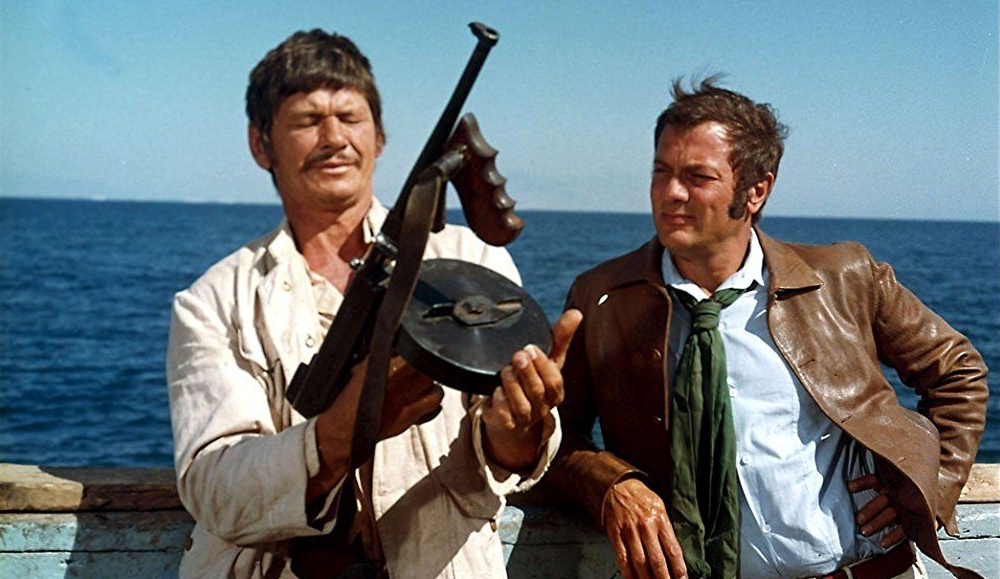
In 1922, American adventurers Adam Dyer (Tony Curtis) and Josh Corey (Charles Bronson) meet in the Aegean Sea. Josh is looking to profit from the ongoing Greco-Turkish War and internal Turkish strife by selling the services of his well-armed mercenary unit. Adam wants to reclaim a ship seized from his family during the Great War.
Colonel Elci (Fikret Hakan), acting on behalf of local governor Osman Bey (Gregoire Aslan), hires the two men to escort a train carrying undisclosed precious cargo, with Adam hoping to secure the release of his ship as part of the deal. Adam and Josh soon learn they are helping to transport the governor's daughters along with their guardian Aila (Michele Mercier), plus gold bars and precious jewels. Numerous skirmishes with various enemies await.
You Can't Win 'Em All is a series of highlights in search of a cause. The set-pieces are well-staged and reasonably rousing, including an old fashioned bar brawl, a noisy battle around a train enhanced by machine-guns, another shooting free-for-all on a boat, plus the bonus of an air raid on an army camp.
The problem for director Peter Collinson is all the bits in-between. Intended as an old-fashioned buddy adventure in foreign lands, the Leo V. Gordon script proceeds in fits and starts, contains long stretches of nothingness, and quickly unravels into incomprehensible territory. The myriad factions competing for cheap labour in the form of uniformed extras include the Turkish army, Turkish rebels, Greek invaders, and American meddlers. Combined with multiple shifting personal agendas and everyone lying all the time, it's never clear who is trying to do what to whom or why.Collinson does not help matters by wasting endless shots on travelogue-style Turkish scenery. A train moving through the countryside, mounted armies galloping through the terrain, and colourful grand halls full of festive food and belly dancers are all very pretty, but ultimately betray the lack of content. Bronson (proficient profiteer) and Curtis (weasley womanizer) appear interested, share decent rapport, trade one-liners, and exude well-earned charisma, but they are defeated by the wayward plotting. You Can't Win' Em All can't fill the empty spaces between punctuations.
All Ace Black Movie Blog reviews are here.
New-in-town Luke Welch (Charles Bronson) is a combination Marshall and bounty hunter, emotionally intimidated by his lack of physical stature. He guns down popular fugitive Con Maynor, but cannot claim the $200 bounty because the resentful townsfolk refuse to confirm the dead man's identity. Luke has to wait around the town facing local hostility whipped up by businessman Sloane (Robert Hutton), who admired Maynor.
The local doctor/barber Doc Weber (John Carradine) sympathizes with Luke's predicament and offers abstract words of advice. Luke attempts to initiate a romance with hesitant hotel server Sally Crane (Fintan Meyler), who prefers a plain lifestyle in contrast to her saloon madame mother Jill (Carole Mathews). With Luke's prolonged presence upping tensions, more violence is threatened.
An early starring role for Charles Bronson, Showdown At Boot Hill is more odd than good. Louis Vittes' story and Gene Fowler Jr.'s directing are both clearly inspired by the man-against-town theme of High Noon, but here budget and talent limitations truncate any ambitions of profundity. So while it's interesting that Luke has an inferiority complex, Charles Bronson can never look uncomfortable in his skin. And the town closing ranks by refusing to certify a dead man's identity is a flimsy source of tension, not helped by a failure to expand on the context of outlaw Con Maynor's popularity.
As a result, the meagre running time of 71 minutes feels longer, as the lonely hearts romance between Luke and Sally gets bogged down in circular conversations about confidence and assertiveness. The plot meanders towards the debris of the relationship between Sally and her mother Jill, and men who enjoy saloon girls and are keen to test themselves against fast guns like Luke. The central bounty hunting story and the town's loyalty towards a fallen gangster are all but forgotten until the dead man's brother appears for the burial, setting up an unusual - if not confusing - confrontation.The lanky John Carradine is an indomitable presence and the most prominent supporting character, a patient seen-it-all veteran with a bullet-in-the-knee story. The rest of the secondary cast members fail to rise above stock representations. Showdown At Boot Hill stumbles onto some quirks, but lacks both quality and cohesion.
All Ace Black Movie Blog reviews are here.
In the late 1800s, the outlaw Graham Dorsey (Charles Bronson) rides with the little-known Buck Bowers gang. On the night before they rob the bank in Gladstone, Graham has a prophetic nightmare that the gang will be annihilated. The next morning he lies his way out of the robbery and waits for his colleagues at the grand house of the wealthy and beautiful widow Amanda Starbuck (Jill Ireland).
Amanda is initially fearful and resentful of Graham, but he artfully worms his way into her heart with elaborate lies, and they become lovers over three idyllic hours. The rest of the gang is killed or captured, and Graham is forced to flee a chasing posse. When Amanda is vilified for consorting with an outlaw, she unexpectedly takes control of her fate, creating a legend in the process.
Written and directed by Frank D. Gilroy (adapting his own novel), From Noon Till Three is uneven in pacing and tone, but dares to be different while still respecting traditional western constructs. The plot features familiar components, including the outlaw gang, bank robbery, and chasing posse, all infused with subversive twists. The two central characters are worthwhile adversaries and both undoubtedly whip-smart, but outlaw Graham Dorsey is also a womanizing liar (if not an outright coward), and despite her blazing red dress, Amanda's true colours are cold and opportunistic.The entire second act is an elaborate romance. The real-life husband and wife team of Charles Bronson and Jill Ireland have rarely been better together on the screen, and here engage in flirtatious theatre covering the spectrum from lust and hostility to the grandest love. Gilroy stages their affair at a mysteriously majestic mansion jutting out of the barren landscape, and allows star chemistry to flourish. An idyllic waltz in the music room provides an appropriate highlight.
Once the lovers are separated, Gilroy injects plenty of humour into the widening chasm between selling a story and gritty facts. The afternoon of love is propelled into the sphere of swoon-worthy legend with searing commentary on the power of marketing, celebrity worship, and the public thirst to believe in the fantastic. The myths of the west are built on tall tales, real people consumed by inflated retellings of ultimately outsized exploits.
All Ace Black Movie Blog reviews are here.
In 1746, Mexico is ruled by Spain, with both local revolutionaries and Yaqui Indians resisting European rule. On the run from the army, atheist outlaw Leon Alastray (Anthony Quinn) takes refuge in the church of the kindly Father Joseph (Sam Jaffe), who is promptly banished to the remote parish of San Sebastian for harbouring a fugitive. Alastray joins Joseph on the arduous journey across the desert, and they then find San Sebastian abandoned, revolutionary leader Teclo (Charles Bronson) insisting the local peasants hide in the mountains to deter Yaqui raids.
Through a series of misunderstandings, the locals, including the passionate Kinita (Anjanette Comer), believe Alastray is a new priest and village saviour. The community rallies and Alastray helps them build a dam to rejuvenate the corn fields. But Teclo and local Yaqui leader Golden Lance don't want to see San Sebastian thrive, forcing Alastray to plan for a big battle to come.
Maybe because it is directed by Frenchman Henri Verneuil and adapted from a book by an actual priest, Guns For San Sebastian sits just to the side of both spaghetti and mainstream westerns. The fundamentals are familiar: a time of revolution, peasants caught in the middle, Indians fighting for their land, half-breeds with divided loyalties, a stranger shaking things up, and above it all the spectral role of religion simultaneously uniting and dividing a community. A bit of sly humour and a rough romance add dashes of hot spice.Although the attitude is scrappy, spaghetti western trademarks like close-ups and excessive gleeful violence are missing. Similarly, by placing an atheist outlaw in the role of a community's religious inspiration, the film avoids traditionally delineated good against evil conflicts. The outcome is a relatively unique curiosity in the form of a narrative that borrows but does not imitate.
The production values are good. Verneuil creates a believable stand-alone community within a harsh sun-blazed environment, but the fundamentals of life are nearby and can be harnessed with some ingenuity. The Mexico locations are bright, barren, and sometimes spectacular, while Ennio Morricone contributes a subdued score. The film runs for under two hours but with deliberate, sometimes slow, pacing. The first two thirds invest in defining characters, outlining tensions, and creating a sense of place, before the arrival of the more action-packed final act.
Anthony Quinn creates a sturdy presence and side-steps most of his hammy tendencies. Charles Bronson is reduced to a relatively small role, leaving Quinn relatively isolated without a worthy counterpart. Sam Jaffe makes a great impression as Father Joseph, but only in the opening chapter. As the most prominent of the villagers, Anjanette Comer could have benefited from expanded influence.
Guns For San Sebastian playfully critiques religious fervour and counters with the imperative for personal responsibility. The debate rages on, as guns, bullets, explosives, and a canon are commissioned in the name of a saint.
All Ace Black Movie Blog reviews are here.
In Los Angeles, Arthur Bishop (Charles Bronson) is a methodical hitman working for a mysterious criminal syndicate. After eliminating a target by staging a gas leak explosion, Bishop receives orders to terminate Harry McKenna (Keenan Wynn), an elderly friend of Bishop's deceased father and an ousted member of the syndicate.
McKenna's 24-year-old son Steve (Jan-Michael Vincent), who never liked his father, enjoys the party lifestyle and also displays cold-blooded comfort around death. Bishop starts experiencing health issues, and takes Steve under his wing as a potential successor, teaching him the tricks of the assassination trade. But the syndicate is unhappy Bishop is making unilateral decisions, and the next few assignments for Bishop and Steve, including a rushed job in Naples, will be challenging.
Written by Lewis John Carlino and directed with panache by Michael Winner, The Mechanic is a career highlight for Charles Bronson and a superlatively economical thriller. The opening 15 minutes feature no dialogue: Bishop carefully plans and executes a hit, no words needed as Winner introduces the protagonist through deliberately efficient scenes. The final act is packed full of breathless action and twisty revelations, ending with a memorably abrupt triple punctuation mark.
In between, unique character traits are allowed to surface. Bishop has a romantic partner (Jill Ireland), but only in the morning does their interlude expose corners of his psychology. Carlino is also interested in exploring the core theme of surrogate father-son dynamics. Both Bishop and Steve had troubled relationships with their dads, and Bishop finds a personal reason to make amends bundled within professional succession planning objectives. In this world of violence of course nothing will go according to plan, but the thoughtful human context infuses The Mechanic with unexpected depth.Despite enjoying numerous locations ranging from Bishop's elegant bachelor's pad to plenty of learning-the-trade settings (including a small plane flight), the film is edited for bold brevity. When the time comes for action scenes, Winner excels with a deft touch, building tension in sharp strokes to keep the energy on edge. The stuntmen enjoy their moments of glory in a motorcycle chase on hillside trails and a car chase on twisty Italian coastal roads. The explosions are plentiful and spectacular, and the one shootout is suitably noisy. Using finely crafted tools, The Mechanic delivers the fix.

All Ace Black Movie Blog reviews are here.
In Washington DC, senior Secret Service agent Jay Killian (Bronson) returns to work after some sick leave. With a new President about to the sworn in, Killian is disappointed to learn he is tasked with protecting the First Lady Lara Craig (Jill Ireland). Nevertheless, he gets down to work with his partner agent Charlotte Chang (Jan Gan Boyd).
Lara is opinionated and refuses to follow Killian's security advice. They clash frequently, but then a series of dangerous incidents convince Killian that Lara's life is being targeted. Her unusual relationship with the President also raises questions. Soon Lara and Killian are on the run, evading several attempts on her life.
Produced by Cannon Films and featuring the penultimate Jill Ireland screen performance, Assassination does a few (very few) things right. The spiky dynamic between the husband and wife pairing of Bronson and Ireland is easygoing and fairly enjoyable. The if it moves, it explodes scientific principle is staunchly applied. The explosions are never necessary, but always three times as big as they need to be. And the casting of Jan Gan Boyd as Killian's feisty partner (in more ways than one) is progressive, although she never comes close to convincing as a Secret Service agent.
Otherwise, the plot is beyond ridiculous, character definitions are non-existent, the wooden supporting actors are laughably inept, the villains are barely identified, the editing is often painfully amateurish, and the directing by Peter Hunt is distracted. Once Killian and Lara go on the run (in planes, trains, and automobiles, plus motorbikes), the film unravels into an endless series of escapes and near-misses strung together with no context. The movie becomes a boring playground for stunt performers and the pyrotechnic crew.
Assassination has no shortage of big bangs, but fizzles into a whimper.
All Ace Black Movie Blog reviews are here.
Jeb Maynard (Charles Bronson) is the senior agent in charge of a US border patrol station located in the rough terrain between San Diego and Tijuana. With the amount of human smuggling activity increasing rapidly, agent Jimmy Fantes (Bruno Kirby) arrives to bolster Jeb's team, which also includes veteran agent Scooter Jackson (Wilford Brimley).
Local rancher Carl Richards (Bert Remsen) hides behind a facade of respectability but is part of an elaborate for-profit human smuggling enterprise. Ex-Marine Hotchkiss (Ed Harris) manages all the dirty field logistics for Richards. Late at night on a desolate stretch of highway, Jackson stumbles upon a truckload full of illegal migrants, and is killed by Hotchkiss. Jeb has few clues to go by, but is determined to bring the murderer to justice.
A modest Charles Bronson vehicle directed and co-written by Jerrold Freedman, Borderline benefits by staying within itself. The action scenes are brief and restrained, with emphasis instead on following the evidence (in this case, distinctive footprints). Jeb tries different angles to uncover the conspirators, including going undercover to join a group of migrants being smuggled across the border.The lure of profits from shifting "units" across the border is huge, and the plot follows the money to the swanky offices of tycoon Henry Lydell (Michael Lerner). He is interested in maximizing revenues by scaling up the business, pushing Richards to do more in a cold-blooded demonstration of supply and demand dynamics.
Bronson breezes through the drama with his usual unflappable presence, Freedman always finding refuge in his star's craggy face and squinty eyes. In his first notable big screen role, Ed Harris makes for an effective stony-faced villain, a Vietnam veteran now finding a money-making outlet for his military skills. The ever-dependable Wilford Brimley further enhances the cast.
The migrants themselves are reduced to faceless and nameless individuals sprinting across the desert terrain in search of a better future. The sole exception is one bright-eyed teenager who is provided a name and sketch story, but he drops out early to provide Jeb with an interaction pathway. Borderline never claims to possess big answers or narrative sophistication, but does complete the crossing with minimal fuss.
All Ace Black Movie Blog reviews are here.