Showing posts with label Tom Berenger. Show all posts

Saturday, 2 May 2026

Movie Review: Sliver (1993)


Genre: Erotic Thriller  
Director: Phillip Noyce  
Starring: Sharon Stone, William Baldwin, Tom Berenger, Martin Landau  
Running Time: 107 minutes  

Synopsis: In New York City, book editor Carly Norris (Sharon Stone) is recovering from a failed marriage. She moves into an apartment in the "Sliver" building, and learns that the previous occupant died after falling from the balcony. Carly meets other tenants including fitness fan Zeke (William Baldwin), famous author Jack (Tom Berenger), model Vida (Polly Walker), and a kindly older man. With all the apartments under secret surveillance, both Zeke and Jack pursue a relationship with Carly, leading to jealousy and murder.

What Works Well: Following up on her breakout success in Basic Instinct, Sharon Stone projects both vulnerability and strength as a building newcomer uncovering sordid secrets and willing to reignite her seductive tendencies. The voyeuristic obsession with snooping on ordinary people's lives turns the Rear Window premise inwards as prescient commentary on a forthcoming privacy-free society. 

What Does Not Work As Well: With only two viable suspects, director Phillip Noyce fails to generate any suspense, the mood further undermined by one-dimensional performances from William Baldwin and Tom Berenger. Zeke is immediately creepy and Jack is proudly boorish, crippling any investment in the outcome and raising serious questions about Carly's judgement. The shallow character motivations are matched by incompetent police work, and the dull Joe Eszterhas script is incapable of exploiting the surveillance theme implications.

Key Quote:
Zeke (to Carly): Real life, Carly. It's better than any book. Better than any movie. It's a soap opera. It's real life. It's a tragedy, it's funny, it's sad, it's unpredictable.


All Ace Black Movie Blog reviews are here.

Sunday, 29 May 2022

Movie Review: Betrayed (1988)

A crime drama, romance, and thriller, Betrayed ventures into the sub-culture of white supremacists corroding American society.

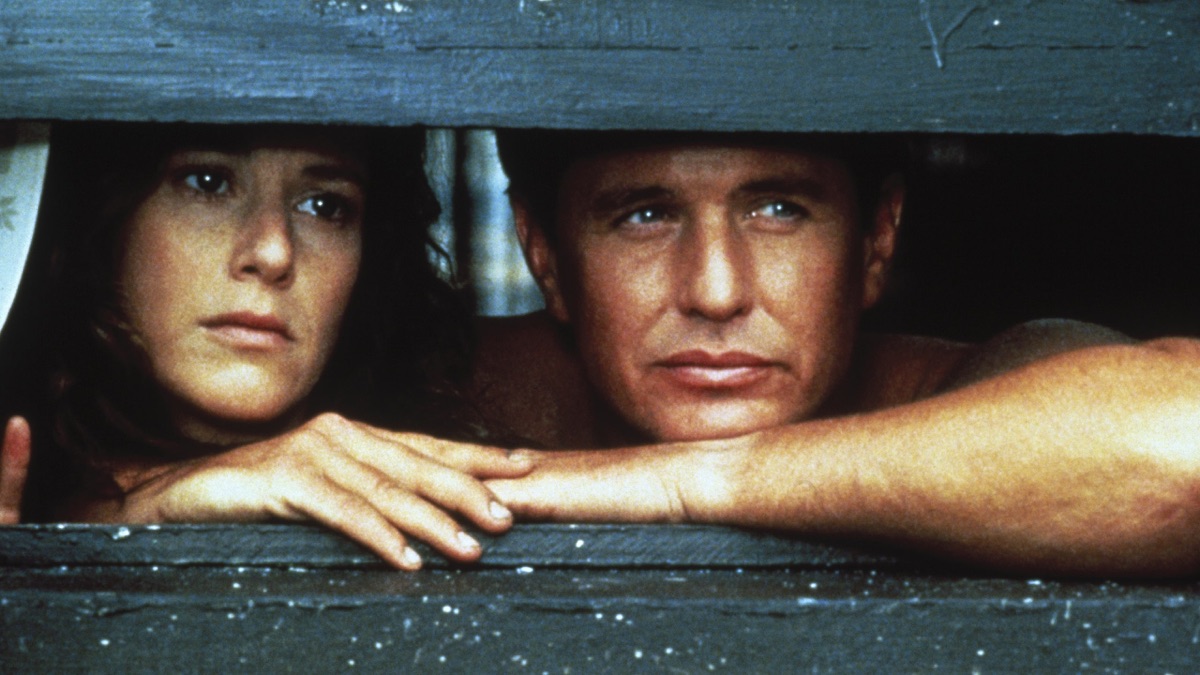
In Chicago, controversial Jewish radio talk show host Sam Kraus (Richard Libertini) is gunned down. In America's rural farmland, undercover FBI Agent Cathy Weaver (Debra Winger) gets close to farmer Gary Simmons (Tom Berenger), who is suspected of involvement in Kraus's murder. Cathy and Gary fall in love, and she insists to her boss and ex-lover Mike Carnes (John Heard) that Gary is a wholesome family man with no crime connections.

But then Gary introduces Cathy to his secret life as a white supremacist leader. He leads midnight hunts of Black men, and is plotting bank robberies and terrorist activities in the name of defending whites against Jews and Blacks. Meanwhile, a thinly veiled racist politician is running for President and seeking support from men like Gary. With Mike pressuring her to delve deeper and find more evidence, Cathy is alone and stranded with dangerous men.

Written by Joe Eszterhas and directed by Costa-Gavras, Betrayed is a remarkably prescient exploration of a toxic belief system quietly undermining a nation. But despite shining a necessary spotlight on violent racism hiding in plain sight, the film is only average. The problems reside with the investigative half of the narrative, Eszterhas paying scant attention to basic discipline and procedures. 

Cathy's assignment is reduced to being thrown into the field, left on her own, and badgered to gather more evidence, her ex-lover of a boss Mike abusing his authority like a jilted bully child. And as she uncovers a group of terrorists plotting multiple atrocities, Mike remains bizarrely fixated on the talk show host murder. The conspiracy elements are also patchy, leading to a rushed and contrived climax. Costa-Gavras holds onto secrets for too long, then fails to adequately explain why they matter or how various terrorist acts and crimes are intended to fit together. 

Which is unfortunate. The rest of the drama works well, demonstrating evil's easy charm, Cathy falling for a wholesome image and in love with a rugged man who appears to be a good father and dedicated farmer. The veil is lifted once Gary introduces her to his secret life of hunting Black men, conspiring over computer networks with other supremacist cells, indoctrinating children, and plotting violent crimes. This is the Ku Klux Klan functioning in the slightest shadows, exploiting fear of the "other" while plotting with far-reaching ambition and activating the political machine to place a white supremacist in the White House. The horror is obscene, and all too real.

Debra Winger and Tom Berenger do their parts without stretching. She buys into Cathy's naivete and he encourages Gary's singular expression to make the plot work. Sloppiness undermines the intention to deliver a taut dramatic thriller, but Betrayed is nevertheless shockingly relevant.


All Ace Black Movie Blog reviews are here.

Wednesday, 1 December 2021

Movie Review: Shoot To Kill (1988)

A crime thriller, Shoot To Kill (also known as Deadly Pursuit) is a picturesque adventure chase, lacking character depth but packed with literal cliffhangers.

In San Francisco, FBI agent Warren Stantin (Sidney Poitier) attempts to negotiate with a ruthless criminal holding a hostage as part of a diamond theft. The incident ends badly, with the hostage dead and the suspect fleeing with the diamonds towards rural Washington State near the Canadian border. With Stantin in pursuit, the killer joins a small adventure group exploring the mountains with guide Sarah Renell (Kristie Alley).

Stantin teams up with Sarah's boyfriend Jonathan Knox (Tom Berenger), himself a rugged mountain guide, and the two men head into the wilderness to give chase. Stantin is out of his element and dependent on Knox, who would rather be on his own than dragging an FBI agent around. Meanwhile, Sarah and her group of tourists are unaware a barbarous murderer is in their midst.

The return of Sidney Poitier to the big screen after an eleven year absence enlivens Shoot To Kill. The veteran star is in good form, mixing gravitas with decent athleticism and traces of humour, bouncing off rugged co-star Tom Berenger to good effect. 

Director Roger Spottiswoode centres his attention on the two actors and uses a couple of anchor themes to ensure continuous entertainment. The partners-as-opposites buddy movie elements between Stantin (urban, Black, cars, restaurants) and Knox (rural, white, horses, marmot-on-a-stick) are sustained and well-developed. In parallel, the who-is-the-killer guessing game within Sarah's group adds a clever sub-mystery to the typical action dynamics. The antagonist's cold-blooded brutality contributes a spiky layer of venom.

With the mountains providing a majestic backdrop, Spottiswoode captures memorable scenes of endurance and danger, including a climb up a vertical cliff wall, blizzard survival in a snow cave, and a breathtaking misadventure above a steep gorge. A stubborn horse, a bear and a moose add semi-comic distractions.

Less impressive are the shallow charecterizations. 109 minutes come and ago and barely anything is revealed about Stantin, Knox, Sarah and the killer beyond the broadest superficialities. In particular, significant opportunities are missed in the interactions between the criminal and Sarah, when his survival depends on her expert know-how. And once the drama moves out of the mountains and into Vancouver on the Canadian side of the border, the run-and-shoot showdowns quickly become contrived and routine. 

Despite Sidney Poitier's preference for a suit and a city, Shoot To Kill demonstrates better aim in the crisp mountain air.


All Ace Black Movie Blog reviews are here.

Tuesday, 2 February 2021

Movie Review: The Substitute (1996)

A far-fetched crime action movie, The Substitute offers a mishmash of sometimes interesting ideas but defaults to lowest common denominator resolutions.

Professional mercenary Jonathan Shale (Tom Berenger) leads his team of independent soldiers on a botched mission in Cuba and finds himself unemployable. His girlfriend Janet Hetzko (Diane Venora) is a Miami-based inner city high school teacher. Although the principal Claude Rolle (Ernie Hudson) is a former police officer with political ambitions, the school is beset by gang problems. Top thug Juan Lacas (Marc Anthony), a student in Janet's class, is the head of the KoD (Kings of Destruction) gang.

Janet tangles with Lacas and gets knee-capped for her trouble. Shale replaces her by pretending to be substitute teacher "James Smith" and notices signs of big money and possible drug distribution activity centred at the school. His mercenary crew set up surveillance to uncover what Lacas is up to while Shale attempts to disrupt the gangsters and help the students who actually want to learn.

Even before the over-the-top action bursts through the school door, The Substitute demands plenty of leaps of faith. The logic challenges include a noble teacher who accepts a cold-blooded mercenary as her boyfriend, a professional soldier suddenly deciding to care about the quality of education, and a principal overseeing a violent jungle of a school believing he can be elected to city council (but maybe corruption really runs that deep).

Director Robert Mandel rumbles over all the inconsistencies with the admirably oblivious torque of a tank advancing over rough terrain, and seeks the charm of a scarred and stone-faced Tom Berenger donning a necktie and heading into the combat zone of an inner city classroom. His Vietnam War experiences and a few broken bones are all it takes to subdue the unruly kids, The Substitute taking every shortcut it can find on the way to the real business of killing on an industrial scale.

And once Mandel arrives at the final 30 minutes, new characters are introduced or reintroduced in a rush, all to create two well-armed groups of square-jawed men to partake in a grand firefight at the high school. The resultant battle would not have been out of place in Stalingrad circa 1942, but the Miami law authorities see no reason to inquire about all the noise.

In the interludes between incidents of violence Shale helps some of the wayward but salvageable school kids (all are Black or Hispanic) gain perspective on a better path in life, Mandel well-intentioned but not skirting the white saviour trope. The Substitute offers lessons in life while dishing out death, never convincing but certainly cacophonous.


All Ace Black Movie Blog reviews are here.

Friday, 3 May 2019

Movie Review: Sniper (1993)


A covert military action film, Sniper offers basic macho entertainment in a slick enough package.

Based in Panama, veteran Sergeant Beckett (Tom Berenger) of the U.S. Marines is a sniper specializing in covert missions. After a successful assassination, the extraction is botched and Beckett's spotter is killed. The next mission teams Beckett with the inexperienced Miller (Billy Zane), a civilian trained as a sniper, to terminate the rogue General Alavarez, who is planning a coup.

Beckett and Miller traverse the jungle towards Alavarez's hacienda. Along the way they tangle with the ruthless El Cirujano, an ex-CIA agent and expert in torture. When Miller bungles a shot, Beckett is more convinced he cannot trust his partner in combat situations. The mission is compromised before Beckett and Miller even arrive at their target destination, but despite the danger Beckett is determined to seize the opportunity to eliminate the General and an elusive Colombian drug lord funding the rebels.

A sweaty expedition through the jungle punctuated by moments of tense and well-executed action, Sniper is better than it needs to be. The plot is a crumpled sketch, the dialogue is crude and the acting limited to alpha males hissing at each other, but director Luis Llosa works with what he has and delivers decent entertainment.

The thoughtful pacing is a plus. Llosa avoids the temptation to go into the jungle with all guns blazing, and the foundational premise of patient snipers who kill quietly forces the film into calm patches and build-up sequences. The moments of reflection between Beckett and Miller contain nuggets of humanity, never quite enough to elevate the film much above routine but also sufficient to define the characters beyond the blockhead level.

Despite cruising through the entire film with a singular pissed-off expression, Tom Berenger capitalizes on his Platoon jungle master persona and infuses Sniper with credibility. Billy Zane is either miscast or perfectly cast, depending on whether his character Miller is a fraud soldier out of his element in a combat zone or an efficient killing machine (the film offers both, without much explanation). The only other notable cast member is J.T. Walsh in a small role.

The action scenes are ultimately where it's at, and Llosa constructs taut set-pieces as snipers play cat and mouse games with each other and use the hostile elements to their advantage. Bullets are often captured and traced by the cameras mid-flight, and while Sniper doesn't hit every target, most of the shots are close enough.


All Ace Black Blog Movie Reviews are here.


Sunday, 22 October 2017

Movie Review: The Dogs Of War (1980)


A war drama and thriller, The Dogs Of War explores the murky world of mercenaries but despite some good moments lacks suspense, depth, and action.

After barely escaping from a chaotic Central American war zone, mercenary James Shannon (Christopher Walken) is hired by go-between Roy Endean (Hugh Millais) to conduct a reconnaissance mission in Zangaro, an African country rich in natural resources. The business interests behind Endean want to know if Zangaro's dictator General Kimba can be overthrown. Pretending to be a bird photographer, Shannon travels to the capital city of Clarence to gather intelligence, and there he meets documentarian Alan North (Colin Blakely).

But Shannon soon falls foul of Kimba's security men and is captured and brutally tortured. In prison he meets Dr. Okoye (Winston Ntshona), a principled leader and ex-Presidential candidate. After being thrown out of the country Shannon recuperates and tries to reconcile with his wife Jessie (JoBeth Williams). Endean reappears, this time offering a lot of money for the overthrow of Kimba. Shannon turns to his long-time colleague Drew (Tom Berenger) and together they start assembling the men and equipment needed for the mission.

After the international success of The Day Of The Jackal (1973), author Frederick Forsyth's other conspiracy-laced thrillers trickled into movie adaptations. The Odessa File arrived in 1974, The Dogs Of War in 1980 and The Fourth Protocol in 1987. None of the films were able to replicate the success of The Day Of The Jackal, as Forsyth's style of quick-frying character depth in favour of meticulous mission planning details proved difficult to translate to the screen.

Forsyth allegedly participated in real-life coup planning targeting Equatorial Guinea (here translated to the fictional Zangaro), either as book research or as a genuine enterprise, so he more than knows what goes into covert private military adventurism. The Dogs Of War contains a few highlights, but generally suffers in a void of drama and tension.

A directed by John Irvin, the film arrives at the nuts and bolts of planning the coup in bad shape: Shannon is a robotic, annoyed presence, unable to hold the film's centre. His colleagues and cohorts are faceless and totally undefined, a bunch of men transacting deals for weapons and ammunition across Europe with other shady businessmen involved in the underworld of the armament trade. The film is a mechanical, uninvolving experience, mildly curious but too emotionally cold.

The better moments include the opening sequence, an impressive disorganized escape from a raucous Central American battlefield. The climax, about 90 tired minutes later, is a noisy battle as Shannon and his men assault Kimba's compound. Although the final spike in action is generally well handled, all the firing is in one direction, sapping away the tension of the attack, and the battle tactics are never explained.

Cinematographer Jack Cardiff does his best to elevate the visuals: both firefights jump off the screen with kinetic energy and some artistic zing, but even more impressive is the ramshackle appearance of the capital city Clarence (actually Belize City), Irvin and Cardiff capturing the chaos and menace of a sweaty third world city convulsing under the untrained guns of a dictator's amateur army and his security agents.

Christopher Walken is not well served, neither by the script nor by the directing. His line delivery is strained, overly clipped, and aggressive. For a man who is supposed to live in the shadows, his combative behaviour is perfect for attracting the wrong attention. Colin Blakely adds support as a filmmaker growing tired of hellhole assignments, but the rest of the cast is too ill-defined to matter.

The Dogs Of War only rarely wags its tails, and lacks both bark and bite.


All Ace Black Movie Blog reviews are here.

Thursday, 2 March 2017

Saturday, 25 October 2014

Movie Review: Training Day (2001)


A pounding police thriller, Training Day dives into the dark cesspool where criminals and detectives all begin to look alike. The film is a polished, high energy character study, with an enthralling central performance by Denzel Washington.

Los Angeles police officer Jake Hoyt (Ethan Hawke) is taking the initial steps towards becoming a detective on the anti-narcotics squad. Paired with veteran detective Alonzo Harris (Washington), Jake embarks on his first day of training as a passenger in Alonzo's car, cruising the streets of LA on the lookout for criminal activity. Alonzo knows his way around the streets and gives Jake a constant stream of advice about survival skills and what a real life of fighting crime is all about. But Jake quickly learns that Alonzo operates way outside normal procedures. Before the morning is out, Alonzo forces Jake to smoke drugs, and after Jake intervenes to disrupt a street rape, he allows the potential rapists to walk away.

Alonzo also has a personal agenda for the day. He has upset some Russian mobsters and needs to raise a million dollars by midnight to avoid their wrath. Alonzo steals cash from a drug dealer named Sandman, and uses the money to pay off his police superiors (known as the Three Wise Men) in exchange for receiving the go-ahead to raid and shake-down master criminal Roger (Scott Glenn). That operation goes badly in many different ways, creating a huge rift between Jake and Alonzo. Before the end of the day Jake will need to learn quickly in order to stay alive and decide on what kind of future he wants.

Directed by Antoine Fuqua and written by David Ayer, Training Day walks along the blurred line between right and wrong and finds plenty of dead bodies. Alonzo inhabits a ruthless world of powerful dealers and brutal gangsters, and has long since decided that no amount of proper policing will make an iota of difference. So he has adopted more effective and less traditional methods, stretching the definition of his badge to act as judge, jury and executioner in addition to law officer. The results justify the means in his mind, and no one really seems to care, because all others on the side of the law are at least as corrupt.

Until Jake comes along. With an outsider's view Jake is horrified by Alonzo's methods, but initially accepting that maybe this is what it takes to fight drugs on the front lines. But Jake has caught Alonzo on a really challenging day, and Alonzo has plans to use the naive Jake in his elaborate scheme to extricates himself from the target hairs of the Russian mob. Jake's education will proceed at fast-forward, his training day packed with a lifetime's worth of incidents. He will need to learn quickly or die trying.

Filmed on location is some of the worst neighbourhoods in Los Angeles, Training Day has the surreal look of a decaying social landscape. Fuqua and cinematographer Mauro Fiore recall the downtrodden feel of 1970s crime movies, with Alonzo cruising through gritty neighbourhoods dominated by desperation, unemployment and gang members. It does not need to be said: the idea that justice will ever penetrate into this world is visually incongruous.

Denzel Washington became the second black man (after Sidney Poitier) to win the Best Actor Academy Award. Washington creates in Alonzo Harris a smooth talking and supremely confident puppet master, convinced that he can talk his way into any situation and talk his way out of any problem. And when the time for talking is done, he does not hesitate to whip out the guns to emphasize his demands. Washington is appropriately larger than life, effortless and exhausting, a police officer so far past the line that he forgot the line even exists.

Ethan Hawke provides the perfect foil as Jake Hoyt, an unspoiled idealist exposed head-on to Alonzo's crazy world. The supporting cast also includes Tom Berenger in one scene as a member of the Three Wise Men, and Eva Mendes as Alonzo's mistress.

Packed with the power, fury and conviction of two men committed to their conflicting beliefs, Training Day is one intense inauguration.


All Ace Black Blog Movie Reviews are here.


Friday, 5 July 2013

Movie Review: The Big Chill (1983)


Baby Boomers hit early middle age, and they sit down to talk about where all their dreams have gone. The Big Chill is an engaging talkathon, but much like the generation itself, the film does drift into self-obsession.

A group of thirtysomethings who used to be close friends in college gather for the weekend at the house of married couple Harold (Kevin Kline) and Sarah (Glenn Close), to mourn the suicide of their common college friend Alex. Sam (Tom Berenger) is now a TV series action star. Michael (Jeff Goldblum) is a low-level journalist with dreams of opening a night club. War veteran Nick (William Hurt) is barely concealing numerous drug addictions that help him cope with injuries sustained in combat. Meg (Mary Kay Place) is a corporate lawyer, having sold out her principles, single but desperate to get pregnant. And Karen (JoBeth Williams) is a stay-at-home mom, having abandoned hopes of a writing career. With them is the cheerfully naive Chloe (Meg Tilly), Alex's much younger girlfriend and a stranger to the group.

As the former friends get reacquainted, they reminisce about the past, including Karen having a crush on Sam, Michael sleeping with Meg, and Sarah having an affair with Alex. Harold, now an established business owner with prospects of getting rich, tries to urge them to look to the future, but they all wonder where the idealistic dreams and ambitions of their youth went, now that they are all mostly unsatisfied with life in the mainstream. And they do their best to probe the tragedy of Alex taking his own life with no explanation.

A tableau of broken dreams resulting from the idealism of youth crashing against the realities of adult responsibilities, The Big Chill paints a stark picture of grown ups struggling with the concept. Like any group, the seven friends have mixed achievements, from television stardom (Sam) to useless drughead (Nick), but all carry the angst of having drifted far from the grand goals established in the lofty days of college. The generation that was supposed to change the world ended up conforming like any other, the difference being that the Baby Boomers need a lot of talking to work through the hurt.

And talk they do, The Big Chill a gabfest of self-examination and group think, co-written by director Lawrence Kasdan as a weekend-long therapy session filled with confessions, accusations, reflection, reconciliation, and reawakening. It is a tender examination of the human condition, filled with revelations, humour and pathos. But the film also gets tiresome, as none of the seven are necessarily intelligent or likable, and inward-focused intellect combined with a love of opining is not necessarily a stunning combination.

The ensemble cast is accomplished, Kasdan giving them all good opportunities to shine and develop as rounded characters. While there are no stand-out performances, Meg Tilly is excellent as Chloe, initially a fish out of water but possessing the strongest connection to Alex and finally surprising herself by both grieving and reconnecting with Alex through his friends.

The Big Chill boasted a nostalgic soundtrack of 1960s favourites including the likes of Marvin Gaye, The Temptations, Aretha Franklin, Smokey Robinson, Procul Harum and The Beach Boys, and the film re-ignited interest and sales in the music enjoyed by Boomers in their youth.

The Big Chill does not reach any big conclusions, nor is it meant to. Instead it becomes clear that aspirations are useless without the discipline to make good decisions. This group will still drink too much, still do drugs, still break the rules (Harold engaging in insider trading), and still seek sex to satisfy selfish urges, and still they will wonder where it all went wrong.


All Ace Black Blog Movie Reviews are here.


Thursday, 29 March 2012

Movie Review: Born On The Fourth Of July (1989)


The story of Vietnam war veteran turned peace activist Ron Kovic, Born On The Fourth Of July asks all the right questions about a sordid conflict and the reasons for war. Director Oliver Stone carves a compelling human drama that encapsulates the struggle of a nation to understand its role in the world.

Coming of age in the 1960s, Kovic (Tom Cruise) was captivated by President Kennedy's call for youth to serve their country, and entranced by the recruitment Marines (including Tom Berenger in a one-scene role) who swung by his High School in Massapequa, New York. Idealistic and patriotic, Kovic buys the fable about the need to stop the communist threat and enlists at the earliest opportunity.

By 1967 Kovic is on his second tour of duty in Vietnam, where he witnesses US troops slaughtering innocent villagers, and in a chaotic gunfight, he inadvertently kills a fellow marine. Caught in a fire fight on open ground, Kovic is shot through the spine and heroically saved by a fellow soldier under fire. He endures a harrowing recuperation at a filthy veteran's hospital before returning home, permanently paralysed from the waist down.

Emotionally traumatized, Kovic is still initially loudly supportive of the war, and spends time feeling sorry for himself in Mexico, where he meets other disabled veterans including the ornery Charlie (Willem Dafoe). But gradually, and with help from childhood sweetheart Donna (Kyra Sedgwick), the anti-war sentiment begins to resonate, and he embarks on a remarkable transformation into an impassioned leader of the anti-war protest movement.

Tom Cruise gives one of his most accomplished performances as Ron Kovic, carrying the film single-handedly and deservedly earning an Academy Award nomination. From the bright-eyed, short-haired teenager eager to be among the first wave of marines landing on the shores of Vietnam to the jaded, damaged, depressed, angry, long-haired, guilt-stricken and wheelchair-bound anti-war protester, Cruise captures Kovic's evolution and what it means to survive the war but lose part of the body and all of the innocence.

Oliver Stone co-wrote the screenplay with Kovic, and they take their time with the story, Born On The Fourth Of July dragging a bit at 145 minutes. The hospital and Mexico passages overstay their welcome well after making their point, and both could have benefited from sharper editing. Otherwise, Stone is respectful of the strength of the material, and along with cinematographer Robert Richardson paints some beautiful tableaux, both in idyllic Massapequa and the tragedy-laden Vietnamese landscape.

While Kovic's journey is certainly epic, Born On The Fourth Of July as a movie suffers from the lack of any other major counterweight characters. Berenger and Dafoe add little other than curiosity by reuniting with their Platoon director. Sedgwick is game but has the slightest of roles, while the likes of Frank Whaley as Kovic's friend and Raymond J. Barry as Mr. Kovic drift in and out of the story leaving only local impressions.

As much as Born On The Fourth Of July is the story of one man, it is also a reflection of a country undergoing a remarkable transformation in one decade. From a position of invincibility to a humiliating defeat, and from blind patriotism to more thoughtful questioning of foreign policy, Ron Kovic holds up a mirror to the United States, and the view is one of both horror and hope.


All Ace Black Blog Movie Reviews are here.


Sunday, 18 September 2011

Movie Review: Platoon (1986)


An intense front-line view of a most muddled conflict, Platoon is a close-up examination of the human damage caused by war, and also one of the best war movies ever made. Director Oliver Stone wrote the story based on his personal experiences in Vietnam, and his narrative is unblinking in its portrayal of all that is wrong with war, from politicians sacrificing the lower classes to the resultant irreparable emotional devastation of those who do the killing.

Chris Taylor (Charlie Sheen) is a college student who has willingly enlisted in the army, and he arrives for combat duty in Vietnam of 1967. Oppressive heat, low morale, disgruntled troops, ineffective jungle patrols and clueless commanders are just some of the challenges that he immediately faces, and this is before any enemy encounters.

Chris learns that two fearless sergeants are the de facto leaders of his Bravo Company: Sergeant Elias (Willem Dafoe) stands up for his men and encourages a loose attitude and plenty of camaraderie. Sergeant Barnes (Tom Berenger) is all intensity, having long since adopted a kill'em all individualistic attitude. The men of Bravo Company are divided, with some supporting Elias and others idolizing Barnes. Elias and Barnes are on an inevitable collision course, and after Barnes loses all discipline during a raid on a Vietnamese village, they become mortal enemies.

Chris witnesses the intensifying conflict between the men and survives skirmishes of ever increasing ferocity with the North Vietnamese Army, culminating in a massive gory and desperate battle, during which Chris has to apply all that he has learned from both Elias and Barnes just to try and live for another day.

Stone enriches Platoon by not glossing over the little details that dominate a soldier's experience: the insatiable bugs feeding on human flesh; the endless marching in the impenetrable jungle; digging trenches in the energy-sapping heat; the devastating fatigue causing soldiers to fall asleep at critical moments; and the endless, tense waiting for encounters with the enemy.

And when these enemy encounters do occur, Stone, cinematographer Robert Richardson, and editor Claire Simpson emphasize the overwhelming chaos and confusion. Platoon's battle scenes play out in limited light, the enemy mostly seen as shadows, tactics and strategies utterly lost in the anarchy of the battlefield.

The central theme of Platoon is the contrast in the education of Chris at the hands of Elias and Barnes. Both are exceptional warriors, but while Elias has retained his humanity and is still killing for a greater purpose, Barnes has adopted killing for the sake of killing and no longer cares to delve into the subtleties of when should the killing be justified.

Both men have their followers, and Platoon poses the question as to which form of soldier is needed to win a war. At the personal level, Stone ends the film with Chris standing at the most important fork in his life, having absorbed and internalized characteristics from both Elias and Barnes. Whether he becomes more like Elias or more like Barnes will determine which part of Chris will die, and when.

Tom Berenger and Willem Dafoe lead the testosterone drenched cast, both diving into their roles as jungle combatants with stone-faced relish. Charlie Sheen, with a successful future career still in his hands should he choose not to snort it, finds the balance between the bewilderment of the new recruit thrown into battle and the grim determination of a smart soldier willing to learn and survive. A large supporting cast of at-the-time relative unknowns includes the likes of Forest Whitaker, Johnny Depp and Kevin Dillon.

Platoon condemns war by staring at its horror, a reminder that while the dead represent the tragedy, the survivors and those who do the killing are plunged into the same universe of infernal misery.


All Ace Black Blog Movie Reviews are here.


Thursday, 24 February 2011

Movie Review: Inception (2010)


A near-future science fiction thriller that is a breath of fresh air in terms of new ideas, writer and director Christopher Nolan demonstrates in Inception that originality is alive and well, and action movies need be neither derivative nor interpretations of obscure comics.

Dom Cobb (Leonardo DiCaprio) specializes in modern industrial espionage: stealing ideas by invading the dreams of executives. Dom has unresolved emotional issues related to the death of his wife Mal (Marion Cotillard); as a result her image frequently appears and disrupts his progress at critical points in his invasive work.

Businessman Mr. Saito (Ken Watanabe) hires Dom for a special assignment: conduct an inception by invading the dreams of rival executive Robert Fisher (Cillian Murphy) and planting an idea that will benefit Mr. Saito's business interests. An inception is the opposite of a theft, and is rarely successful, but Cobb assembles a crack team to pull it off. His associates include architecture student Ariadne (Ellen Page), a couple of other expert thieves, and a chemist specializing in dream-related sedation.

The inception operation will require an elaborate dream within a dream within a dream structure, and the whole team may be forever lost in limbo if the plan fails. An extra complication for Dom is dealing once and for all with his emotions surrounding Mal's death.

Inception is both challenging and complex to follow, but in an era of cookie-cutter sequelitis, a movie that demands attention is a good thing. Nolan spent 10 years developing the script, and it shows. Inception has an elaborate structure resembling Matryoshka nesting dolls, with fine threads connecting events happening in several dream dimensions at once. Knowing what is real and what is a dream is a challenge for both the characters and the viewers.

The main heist involves three dream levels, and when things go wrong an unscheduled descent into a fourth dream level becomes necessary. All events in each of the levels are interrelated, and it's not an easy task to keep all the action straight. Nolan pulls this off with a combination of slick editing and sheer bravado, helped by a dedicated Leonardo DiCaprio performance.

The movie does suffer from some routine, prolonged, and unconvincing shoot-out sequences, as Dom's team unexpectedly encounter heavily armed defenders in the dreams of Robert Fisher. The sequences revealing Dom's history with his wife Mal are better, and that is where the film finds it's emotional high points.

Inception is a showcase for some incredible modern movie special effects, but in addition to being justified as part of various dream worlds, they are placed at the service of a fascinating story and engaging characters. Demonstrating an appreciation for old-school film elements, Nolan also brings in Michael Caine for a few scenes to add acting depth as DiCaprio's father-in-law.

Inception inspires awe and head-scratching in equal measures, and the best proof of its impact is that it demands to be viewed again, as soon as it ends.


All Ace Black Blog Movie Reviews are here.