Showing posts with label Rod Steiger. Show all posts

Monday, 17 August 2026

Movie Review: Breakthrough (1979)


Also Known As: Sergeant Steiner-Cross Of Iron 2  
Genre: World War 2 Action  
Director: Andrew V. McLaglen  
Starring: Richard Burton, Robert Mitchum, Curd Jurgens, Rod Steiger, Michael Parks, Helmut Griem  
Running Time: 93 minutes (original version: 115 minutes)  

Synopsis: After the German defeat at Stalingrad, the legendary Sergeant Steiner (Richard Burton) tangles with his careerist superior Captain Stransky (Helmut Griem). Instead of a reprimand, General Hoffman (Curd Jurgens) grants Steiner a Paris vacation. After the Normandy landings, Steiner is assigned to the French village of St. Bologne, where Stransky is organizing a defence. Leading the planned American assault are Colonel Rogers (Robert Mitchum) and General Webster (Rod Steiger). With the battle looming, Hoffman reveals to Steiner the plot to kill Hitler, asking him to arrange a surrender negotiation with the Americans to avoid a bloodbath.

What Works Well: This lower-budget sequel to Cross Of Iron benefits from a gritty and grimy front-line aesthetic that captures the German army in retreat, packed with soldiers in full cynical mode. Although they are mostly too old for their roles, the grizzled presence of Richard Burton, Robert Mitchum, Rod Steiger, and Curd Jurgens adds a suitable layer of war weariness.

What Does Not Work As Well: The truncated version is action oriented, with anti-war philosophy reduced to a few glib comments. The editing is clunky (some footage is recycled from Cross Of Iron), the music uninspired, and the plot points border on ridiculous, including amateurish treatment of the Hitler assassination sub-plot and potential surrender negotiations. The messy staging of combat scenes reveals the budget limitations, director Andrew V. McLaglen mainly concerned with shuffling his aging stars away from danger and failing to generate any momentum. 

Key Quote:
General Hoffman (to Steiner): I don't think it's escaped your attention that our situation on this front is rather fluid. That's military jargon for chaotic.


All Ace Black Movie Blog reviews are here.

Tuesday, 4 November 2025

Movie Review: The Amityville Horror (1979)


Genre: Supernatural Horror  
Director: Stuart Rosenberg  
Starring: James Brolin, Margot Kidder, Rod Steiger, Don Stroud, Murray Hamilton, Helen Shaver, Val Avery  
Running Time: 118 minutes  

Synopsis: Newlyweds George and Kathy Lutz (James Brolin and Margot Kidder) stretch the family finances and buy a dream Long Island house, priced at a discount because it was previously the scene of a murderous rampage. Father Delaney (Rod Steiger) arrives to bless the house but is chased away by an evil presence, while George becomes sullen and obsessed with wood chopping and axe sharpening. Other strange phenomena include a self-locking closet, the front door blowing off its hinges, the dog clawing at the base of a brick wall, and young daughter Amy developing an unhealthy attachment to an unseen entity she calls Jody. 

What Works Well: Initially believed to be based on actual events (the predecessor multiple murders did happen), this adaptation of the Jay Anson novel does develop a sense of dread. The theme of a family's financial stress threatening tranquility underpins the premise, while the more traditional bump-in-the-night scenes are capably staged by director Stuart Rosenberg, who finds the best angles to turn a house into a threat. James Brolin and Margot Kidder make for an appealing couple, and the rest of the cast features capable talent. 

What Does Not Work As Well: A lot seems to happen, but nothing of plot substance actually happens, exposing the underlying narrative weakness. Rod Steiger's priest fumbles around to no effect, Don Stroud and Murray Hamilton are two other priests with little to contribute, and Val Avery's frumpy detective does...what, exactly? Helen Shaver as a psychic family friend seems to have all the answers to questions that are never asked, and there is an awkward wedding sub-plot that never gels. Finally a muddle of theories encompassing Satanism and the gateway to Hell are trotted out in context-free desperation to create something out of nothing.

Key Quote:
The House (to Father Delaney): GET OUT! 


All Ace Black Movie Blog reviews are here.

Tuesday, 7 July 2020

Movie Review: Cry Terror! (1958)


A ransom and hostage drama, Cry Terror! has a good cast and a smattering of good ideas, but also distracted focus.

After an airline receives multiple anonymous bomb threats, electronics and detonations expert Jim Molner (James Mason) realizes he was duped into building miniature bombs by ex-army buddy Paul Hoplin (Rod Steiger). Now Hoplin demands a $500,000 ransom from the airline and holds Jim's family hostage, including wife Joan (Inger Stevens) and young daughter Patty.

Paul's gang includes Eileen Kelly (Angie Dickinson), the high-strung Vince (Jack Klugman) and unstable ex-con Steve (Neville Brand). With the FBI desperately searching for the perpetrators, Joan is dispatched to collect the ransom money, with any wrong move resulting in harm to the family.

Written, produced and directed by Andrew L. Stone with big assists from his wife and editor Virginia, Cry Terror! is filled with intrigue and promise. Stone predicts the coming age of terrorism targeting airlines with difficult-to-find small bombs, built using military-grade explosives and smuggled into either the passenger or luggage compartments. The film starts with the threat of big bangs and mass casualties, only avoided because smooth criminal Paul is less interested in murder and more focused on demanding the coveted half a million dollars.

Unafraid to experiment, Cry Terror! features alternating narration, Joan and Jim taking turns describing their thoughts and emotions as they maneuver through the hostage experience. With Inger Stevens delivering the film's standout performance, Joan stars in the highlight sequence, a stressful time-limited courier ordeal where being late means harm to Jim and Patty. Later, a more disinterested James Mason gets to describe his attempted escape through an elevator shaft, an altogether less logical chapter.

The film's second half goes searching for tense Hitchcockian moments with varying success but at the expense of rational plotting. The supposed evil genius of mastermind Paul Hoplin (with Rod Steiger menacing but restrained) is parked as the script just pauses his plan and waits for Joan, Jim and the FBI to make their moves. Stone is engrossed in the minutiae of specific actions, while the big picture gets quite blurry.

But crisp black and white cinematography, interesting camera placements, extreme close-ups and a variety of sets help overcome the rough moments. Cry Terror! never quite soars, but it does barrel down the runway with engines revving.


All Ace Black Blog Movie Reviews are here.

Tuesday, 19 November 2019

Movie Review: Love And Bullets (1979)


A bungled chase thriller, Love And Bullets wastes a good cast on a ridiculous plot and lacklustre execution.

Phoenix detective Charlie Congers (Charles Bronson) is coerced by the FBI into traveling to a remote Switzerland ski resort to extract mobster floozy Jackie Pruit (Jill Ireland) from the clutches of the goons guarding her. She is the long-term lover of crime boss Joe Bomposa (Rod Steiger), and the FBI agents believe she will testify against him.

Joe reluctantly orders Jackie killed, and cold-blooded assassins Vittorio Farroni (Henry Silva) and Huntz (Paul Koslo) team up to try and terminate both Jackie and Charlie. A chase across Switzerland ensues, with Charlie forced to improvise an escape to Geneva. Along the way, he and Jackie start to fall in love.

Most of Love And Bullets consists of Charlie and Jackie getting on and off trains going up and down mountains, or trundling in the snow, all in an attempt to avoid faceless killers. The husband and wife team of Charles Bronson and Jill Ireland are pre-equipped with a natural ease, but even they appear skeptical a romance can blossom between a craggy Phoenix cop and a mobster's vacuous moll.

Meanwhile the film around them is an unconvincing mess, lacking depth, characterization, and sophistication. Rod Steiger's Bomposa is a cartoon-level villain, and Henry Silva ghosts through the movie as the imagined personification of intimidating evil, because he never wears his expensive overcoat; he just places it over his shoulders.

Cast members Strother Martin, Bradford Dillman, Michael V. Gazzo and Val Avery get to stand around and do not much of anything as the body count mounts, including a massacre of innocent civilians at a train stop, and not a single Swiss authority figure bothers to show up and investigate.

Director Stuart Rosenberg (a replacement for originally intended director John Huston) ensures the travelogue aspects in picturesque Switzerland are well covered, but finds the blandest escapes to keep Charlie and Jackie alive for 100 minutes, including improvising a most implausible blowgun weapon. Then a rushed climax manages to undo most of the preceding action for the sake of a final large explosion. When nothing works, forget the love and the bullets; just make way for the bomb.


All Ace Black Blog Movie Reviews are here.


Thursday, 29 August 2019

Movie Review: Duck, You Sucker! (1971)


A sprawling spaghetti (or more specifically, Zapata) western about reluctant revolutionaries, Duck, You Sucker! is Sergio Leone's most complex commentary on the futility of chasing a cause.

In Mexico circa 1913, Juan Miranda (Rod Steiger) is a peasant bandit leading a gang made up of his family members in robbing and raping society's elite. Juan meets John (Seán) Mallory (James Coburn), an ex-Irish revolutionary wanted for murder back in England. John is an explosives expert, a skillset that appeals to Juan, who dreams of robbing the Mesa Verde bank. The two men initially clash, Juan driven by personal greed and John haunted by memories of his failed exploits in Ireland.

Although neither man is interested in the rumbling Mexican revolution, they team up with Pancho Villa supporters led by Dr. Villega (Romolo Valli). John cajoles Juan into freeing a large number of political prisoners, and Juan becomes a hero of the revolution. With their friendship growing, the two men ambush a convoy of government troops commanded by the stone-faced Colonel Reza (Antoine Saint-John). Retribution is swift and Juan pays a high price as the countryside is soaked in the blood of massacres and reprisals, which only leads to more violence.

An awe-inspiring yet flawed and sometimes awkward 157 minutes about friendship, regret, cynicism, and small personal agendas caught up in bigger events, Duck, You Sucker! (also known as A Fistful Of Dynamite and Once Upon A Time...The Revolution) marks Leone's first departure from the warmth of western mythology. This time war is a useless and bloody hell, and no individuals can escape the horror. A friendship can be forged under fire, but ultimately countless poor people will be slaughtered, and not much will change.

After having directed four films in the five years between 1964 and 1968, Leone took three years off and returned with a new and ambitious agenda to juxtapose the ideological winds of change sweeping through the streets of 1960s Europe with the brutalist Fascist imagery of the 1930s through the story of a simple friendship. Choosing a more modern western setting of early 20th century Mexico also brought Duck, You Sucker! closer to modern themes of struggle against corrupt regimes, and Leone set out to de-romanticize the concept of revolution.

Opening with a quote from Mao Tse-tung through to an impassioned speech by Juan asserting that the poor die and nothing really changes in revolutionary upheaval, Duck, You Sucker! is a jaundiced view of political change. The enemies of Juan and John in the form of Colonel Reza (Antoine Saint-John) and Governor Don Jaime (Franco Graziosi ) are poorly drawn and barely defined, either as a narrative weakness or intentionally because the real enemy is the resilient system of corruption where the faces and names at the top can be replaced but the suffering of the masses continues.

Again either as harsh cinematic shorthand or as an intentional intellectual challenge, Leone counteracts the film's length with several jarring scene transitions, jumping from the epic bridge ambush to the aftermath of a devastating cave massacre and then an act of gross betrayal overworking a firing squad under the rain. Each one of the three scenes is a tense emotional steamroller delivered with lyrical barbarism, and they mercilessly follow each other, demanding that viewers actively and quickly fill the gaps between the euphoria of victory and ravages of reprisals.

And just when it seems there is no more emotional toxicity to unleash, Leone conjures up a scene straight out of Fascist hell. Impossibly fluid overhead camera work witnesses soldiers slaughtering hundreds of peasants in a series of parallel concrete death channels. By all means have your revolution, but please witness the large scale butchery unleashed against the innocent.

But at its heart Duck, You Sucker! is also a story about an unlikely friendship between two men brought to life by fine if chequered performances. One or both of the two lead actors are in every scene, and they create two enduring characters. Rod Steiger channels his inner Tuco and over emotes his way through the film as the talkative and frequently sputtering Juan, struggling as much against excessive sweat as he does against poverty. James Coburn provides balance with a laid back performance as John, but both men struggle with inconsistent accent application.

The turmoil of Duck, You Sucker! is set to one of Ennio Morricone's most innovative music scores, the main "Sean, Sean, Sean" (John's Irish name) theme melding into a soulful and regretful melody carrying the echo of lost idealism. Throughout his Mexico adventure John has soft-focus flashbacks to his time in Ireland, where a convoluted romance and friendship turned sour, with outcomes that forever changed his attitudes about honour and sacrifice.

Fed up with the high personal cost of chasing causes, now he just wants to simplify his life's work to blowing up whatever obstacles come in his way. As John is inexorably drawn into his next revolution, this time he is under no illusions. He will dispassionately help others make progress towards upheaval and agony using the biggest explosions he can wire up, his soul already blissfully exhausted.


All Ace Black Movie Blog reviews are here.

Saturday, 13 May 2017

Movie Review: End Of Days (1999)


A supernatural horror thriller, End Of Days finds Arnold Schwarzenegger delving into unusually dark territory. The film is laden with over-the-top special effects, but nevertheless strangely compelling.

With midnight on December 31 1999 approaching, the spirit of the devil infiltrates the body of a nameless New York City investment banker (Gabriel Byrne). The devil's plan is to mate with a pre-ordained woman by the stroke of midnight to conceive satan's child and fulfill Biblical end of days prophecies. Christine York (Robin Tunney) is the 20 year old intended victim, and the Vatican has been searching for her since her birth. The Papal faction of the church wants to protect her, but the rogue Vatican Knights believe that she should be killed.

Ex-cop Jericho Cane (Arnold Schwarzenegger) is a private security expert still grieving the murder of his wife and child. Along with his partner Bobby Chicago (Kevin Pollack), they think they are doing their jobs by foiling the murder of the banker by a deranged priest. Jericho investigates further and finds Christine unknowingly protected by satanists, awaiting the arrival of the mating hour. With Father Kovak (Rod Steiger) and the murderous Vatican Knights also looking for Christine and the devil closing in, Jericho has to find a way to protect the young woman from all threats while figuring out who can be trusted and sorting out his own demons.

End Of Days is an extrapolation of Rosemary's Baby and The Omen for the Schwarzenegger international fanbase. After a two year hiatus, the action superstar returns and resets with one of his darkest outings, both in subject and style. As directed by Peter Hyams, End Of Days is frequently gloomy and brooding, with many scenes claustrophobically located in poorly-lit settings. The grim aesthetic is punctuated by over-the-top but still impressive supernatural special effect extravaganzas courtesy of the devil's antics. The Arnold super-sized action scenes are of the unnecessarily spectacular variety.

What stands out most in End Of Days is that beyond the ridiculous premise, the film adopts a somber tone. The Bobby Chicago character wisecracks on the sidelines, but Arnold's Jericho is depressed and near suicide as the film starts, and then sucked into a battle with the devil himself, leaving no opportunity for irony or satire. By avoiding self-awareness the film demands to be treated seriously, and generally overcomes its own silliness with large doses of uncompromising violence.

In the body of Gabriel Byrne, the devil is given a decent opportunity to make his case. And insofar as these who-should-be-in-charge-of-humanity debates go, a prolonged scene with the devil offering Jericho attractive inducements to side with him is much better that it needed to be. The exchange straddles the line between absurd and existential and lands just on the right side of explaining human propensity to sell out in favour of selfishness.

And credit to Hyams, Schwarzenegger and screenwriter Andrew W. Marlowe for conjuring up and then sticking with a bittersweet ending. The special effects may consume most of the budget, but amidst the rampant destruction at the End Of Days happiness is found in a serene reunion.


All Ace Black Blog Movie Reviews are here.


Tuesday, 28 March 2017

Movie Review: The Hurricane (1999)


A boxing, prison and court room drama, The Hurricane is based on the real-life of champion boxer Ruben Carter. Thanks to a potent story, a committed central performance by Denzel Washington and agile directing by Normal Jewison, the film is a dominant viewing experience.

It's the mid 1960s, and Ruben "The Hurricane" Carter is a top ranked middleweight boxer, having risen from a poor childhood including long stints in juvenile detention. With Hurricane at the peak of his abilities and fame, a triple murder is committed in a Paterson, New Jersey bar, with three patrons shot dead. Ruben and a friend happen to be in the area; they are arrested, convicted and sentenced to life in prison. Ruben insists that he is innocent and from his cell writes an autobiography.

With Ruben incarcerated a parallel story features Lesra Martin (Vicellous Reon Shannon), a young black man from Brooklyn being raised by a foster family in Toronto. Lesra takes an interest in Ruben after reading his book, and communicates with the boxer first through letters then visits. Eventually Lesra's guardians decide to investigate Ruben's case, and relocate to New Jersey to agitate for a legal review of his conviction.

Many other key characters from Hurricane's story also come to life. Featured prominently are Lesra's foster family Lisa Peters (Deborah Kara Unger), Sam Chaiton (Liev Schreiber) and Terry Swinton (John Hannah); Ruben's lifelong pursuer Detective Sargent Della Pesca (Dan Hedaya), Ruben's wife Mae Thelma (Debbi Morgan) and compassionate prison guard Jimmy Williams (Clancy Brown). Late in the film, David Paymer and Harris Yulin make important contributions as Ruben's long-term lawyers, while Rod Steiger has a short but memorable turn as a judge.

Directed by Norman Jewison as an adaptation of Carter's autobiography and the book by Chaiton and Swinton, The Hurricane is a powerful story about the search for justice. Set partially in the world of boxing and mostly behind prison walls, the film is a carefully crafted experience, covering close to 20 years of Carter's life and charting his unwavering dignity in the face of larger forces of racism, conspiracy and discrimination.

As with many biographical but non-documentary features, The Hurricane does portray Carter in the most favourable light, and his opponents come across as seething villains. The film rises above any such simplifications thanks to the intensity of its central performance. The Hurricane is quite possibly Denzel Washington's finest on-screen moment. He embodies the role and disappears into it, the actor leaving no trace as Ruben Carter comes to life, driven by rage, personal determination and quiet resistance. Whether in the ring or in prison, Washington is superb at finding the man smirking at a system that can defeat his body but never his soul, and expressing his emotions with a combination of lyricism and cutting critique.

The film runs for 145 minutes, but does not feel long. Especially in the first half Jewison keeps the energy level high and jumps across time to capture various episodes from Carter's life. Snippets from childhood through to life in prison are presented out of sequence but nevertheless logically, to establish the full scope of Ruben's life experience. The second half settles down and is more focused on attempts to secure Hurricane's release, and the film finds a new but still compelling groove as an amateur detective story seeking to lift the lid off decades of deception.

The Hurricane encapsulates rage in all its colours: a child's rage to survive, a boxer's rage to win, and a prisoner's rage to secure freedom. And it's the battles fought without weapons and boxing gloves that are ultimately most effective.


All Ace Black Blog Movie Reviews are here.


Sunday, 13 March 2016

Movie Review: The Harder They Fall (1956)


A powerful boxing drama, The Harder They Fall examines the sport's sordid underbelly and finds nothing but sleazy profiteers and clueless victims. The film is dark, compelling and boasts two excellent performances from Humphrey Bogart and Rod Steiger.

A New York syndicate run by shady businessman Nick Benko (Steiger) recruits unknown Argentinian boxer Toro Moreno (Mike Lane) into the United States. Toro is a powerfully built hulk of a man, but stiff and quite clueless as a boxer. Undeterred, Nick hires washed-up sports reporter Eddie Willis (Bogart) as a full-time press agent to promote the boxer and build-up his career through a series of fixed fights. Nick could not care less about Toro and his manager and interpreter Agrandi (Carlos Montalban); he just sees Toro as an investment to be milked all the way to a money-spinning championship bout, and then discarded.

Eddie desperately needs the money and so sells his soul and accepts the assignment, despite the reservations of his wife Beth (Jan Sterling). He forms a tentative friendship with Toro, and starts the process of manufacturing fake publicity and lining up fixed fights with corrupt promoters across the country to build-up Toro's reputation as a fearsome fighter. With out of control egos inside and outside the ring, the stakes get dramatically higher as Toro gets closer to his unearned title shot.

Directed by Mark Robson and written by Philip Yordan (who also produced), The Harder They Fall is unofficially inspired by the career of real-life boxer Primo Carnera, and features actual former boxers, including Jersey Joe Walcott and Max Baer, in small but important roles. This is a gritty, pessimistic and hard-hitting drama, featuring three types of men: those who have long since sold their soul, others on the way to selling out, and the saps in the middle of the ring who are used to generate box office and gambling revenue and then unceremoniously abandoned.

Robson bypasses any semblance of glamour, honour, or sports heroism. The film is concerned primarily with the hard-nosed business end of the sport as built on a solid foundation of fraud. From the nondescript gyms and hotel rooms where deals are made and parties held, passing through the dressing rooms and all the way to the ring itself, the odour of sweat and dishonesty jumps off the screen. Nick accounts for every cent in his business and Eddie uses his smooth-talking, persuasive skills to keep the fix on track and overcome every obstacle. These are not stupid men; just smart operators making good money by manipulating the undeniable appeal of pugilism.

The corruption is presented factually; only a few characters care enough to raise the alarm, and they are the annoying outsiders to the game. Although Eddie's character is portrayed as struggling with the morality of his choices, there is no doubting that the culture has grown bigger than any man: boxing has its own twisted rules, its soul long since hijacked and beyond salvation. Men like Eddie have to either participate in the graft or bail out altogether. Yordan takes the time to highlight the real victims of the sport, former two-bit fighters dumped onto the scrapheap of society, damaged goods who never even knew they never stood a chance.

There are several scenes in the ring, and they are doubly painful: the fight is where all the planning pays off, but in this version of the sports world, sportsmanship is irrelevant. The agony comes from watching the clueless Toro lumbering around, haplessly believing he is boxing his way to stardom, while frantic efforts are underway in the opposite corner to ensure his opponents uphold their end of the deal to take a dive at the appropriate moment.

In his screen last role, Bogart brings down the curtain on a stellar career with a nuanced, relatively low key performance, Eddie an observer, an insider, a participant and a victim all at once. Money talks, and Bogart allows Eddie to succumb to the lure of an easy payday just as easily as he demonstrates why he is so good at his job. Steiger gets the showier, more intense role as Nick, and finds a man on the edge, running a business, racking up expenses, and never losing sight of the ultimate goal: a championship bout, the big payoff, all victims be damned as long as he is a winner.

Uncompromising and pessimistically grim, The Harder They Fall packs a knock-out punch.


All Ace Black Blog Movie Reviews are here.

Wednesday, 9 March 2016

Movie Review: Doctor Zhivago (1965)


An epic love story set against the backdrop of the communist revolution in Russia, Doctor Zhivago pits the passionate individual against the oppressive system, but is also too long, and its main protagonist is more a spectator rather than an instigator.

The film is told in flashback, and starts in the Soviet era at a hydroelectric dam with Lieutenant General Yevgraf Zhivago (Alec Guinness) questioning innocent-looking worker Tanya Komarova (Rita Tushingham) to determine whether she is the daughter of his half-brother Dr. Yuri Zhivago (Omar Sharif). Yevgraf recounts Yuri's story, starting when he was orphaned at a young age and taken in by the well-to-do Moscow-based family of the kindly Alexander Gromeko (Ralph Richardson). Yuri grows up to be a doctor and a poet, and eventually marries Gromeko's daughter Tonya (Geraldine Chaplin).

In parallel and also in Moscow, the beautiful 17 year old Lara Antipova (Julie Christie) is from a working class family and the unwilling mistress of Victor Komarovsky (Rod Steiger), a member of the elite classes with shadowy connections to both the Czarist government and the Bolshevik revolutionaries. Lara eventually marries her real love Pasha Antipov (Tom Courtenay), an idealistic young man advocating for workers' rights and actively supporting the revolution.

The Great War erupts, Pasha is lost on the battlefield and Yuri meets Lara at a front-line hospital where they work together for 6 months. The revolution interrupts the war and turns Russia upside down. Yuri returns to Tonya in Moscow, but they soon embark on an arduous train ride beyond the Ural mountains to try and start a new life. With the country gripped by civil war, Yuri will reconnect with Lara under unexpected but dangerous circumstances.

An adaptation of the celebrated Boris Pasternak novel directed by David Lean, Dr. Zhivago is epic in scale and scope. The film clocks in at close to 200 minutes and features a large cast of characters, stunning landscapes, scenes of battle, revolution, and lavish parties, and a gruelling train ride that seems to unfold in real time, complete with a surreal and irrelevant Klaus Kinski appearance. This is an impressive and engrossing experience, but it is also tiresome. It is difficult to justify the turgid running time and the slow pacing, with everything appearing to happen in slow motion.

More troublesome is the rather passive central character. Yuri Zhivago is an ultimately peripheral character who witnesses great events happening around him. On several occasions he is swept up by history, his life trajectory altered by others. Even the central theme of love and infatuation is unfulfilling. Zhivago's dubious feat is trapping himself into a love triangle, Tonya wholly undeserving of his betrayal and Lara gaining his affection through mere presence. Yuri gets a few brief scenes as a doctor, and no meaningful demonstrations of his talents as a poet.

The film succeeds better in depicting the struggle between the individual and the collective. The post-revolution scenes in Moscow are a brilliantly grey portrayal of the all the failures of communism quickly rising to the surface, the rabble believing that their time has come, oblivious that the country's functionality is grinding to a halt and intellectual starvation and physical exhaustion await. Zhivago remains consistent in expressing his doubt about communism's logic before, during and after the revolution, opinions that will force him to leave Moscow when he clearly becomes a misfit.

Omar Sharif almost sleepwalks through the film but finds a few moments of genuine emotion. Christie matches him with a docile, low-key performance that does not convince as muse. Rod Steiger delivers the most energetic role, and on more than one occasion single-handedly pumps sweat, conviction and passion to jump-start the languid proceedings. Victor Komarovsky emerges as potentially the most interesting and complex character in the story, perhaps more deserving of his own book and movie.

The film's weaknesses do not diminish Doctor Zhivago as a grand technical marvel, an ambitious and unconstrained artistic achievement, with an iconic Maurice Jarre music score used in proper doses. But it is also a film with not quite enough happening at its core to justify all the impressive packaging.


All Ace Black Movie Blog reviews are here.

Sunday, 19 October 2014

Movie Review: In The Heat Of The Night (1967)


A simmering murder mystery overheated to the boiling point by racial tensions, In The Heat Of The Night is a seminal cinematic achievement, a turning point in the portrayal of blacks on the screen and a riveting small town thriller.

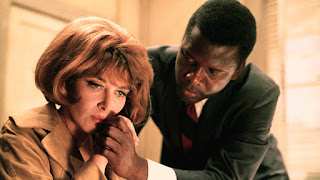
In the small southern backwater of Sparta, Mississippi, night patrolman Sam Wood (Warren Oates) finds wealthy businessman Mr. Colbert dead in the street, killed with a blow to the head. The local redneck police chief Bill Gillespie (Rod Steiger) orders a sweep of the town, and Wood picks up Virgil Tibbs (Sidney Poitier) at the train station. Black, well-dressed and very much a stranger, Tibbs is immediately a suspect, and Gillespie treats him with racist contempt. But Gillespie is stunned to learn that Tibbs is a Philadelphia police detective, passing through Sparta while visiting his mother.

Through a combination of pressure from his superior and his personal pride, Tibbs stays in Sparta to help solve the murder, while Gillespie is grudgingly convinced by Sparta's mayor (William Schallert) to accept Tibbs' help. Tibbs and Gillespie never really get along, but start to tolerate each other as they track down persons of interest including Mrs. Colbert (Lee Grant), small-time drifter Harvey (Scott Wilson), Colbert's business rival Endicott (Larry Gates), and late night diner counterman Ralph (Anthony James). Sam Wood also emerges as a suspect, as well as being implicated in a sordid unwanted pregnancy involving a 16 year old local girl. With Mrs. Colbert threatening to pull her late husband's investment out of town and Tibbs attracting an increasing number of enemies, the pressure mounts to catch the murderer.

Directed by Norman Jewison and written by Stirling Silliphant based on the John Ball book, In The Heat Of The Night draws one of the most distinct before-and-after lines in Hollywood movie history. Poitier's Guess Whose Coming To Dinner, also from 1967, portrayed a black man being accepted into a white liberal educated family. In The Heat Of The Night has no such acceptance: Virgil Tibbs is a qualitatively better law officer than Gillespie; and through his sheer force of conviction, Tibbs will prove to Sparta and all its bigoted residents that a black man will overcome deep-rooted racism and serve the cause of justice.

For all its redefining of racial relations, In The Heat Of The Night is also a fine, complex murder mystery. In sweltering heat made worse by prevailing hot winds of xenophobia, plenty of suspects emerge as the potential killer, and Tibbs gathers personal enemies by focusing the investigation in unexpected directions. He is convinced the drifter Harvey is innocent when plenty of evidence points to his guilt, and Tibbs rocks the town to its core by suspecting Endicott and then getting involved in the unwanted pregnancy case. The film's climax does feel rushed, and Jewison would have done better to provide some of the secondary characters a bit more room to breathe.

In The Heat Of The Night maintains its tension by not caving in to any easy moments of reconciliation. To the bitter end, Gillespie just barely finds a way to work with Tibbs, and never misses an opportunity to make Tibbs' life harder than it needs to be. The film avoids becoming a buddy movie, as Gillespie's respect grows by barely perceptible increments. It's only in the final scene that Tibbs gets the benefit of the slightest kind gesture and phrase, and even then, Gillespie wraps his gratitude with a tinge of relief that the two are finally parting ways.

Two moments from the film stand out and earn their place in movie history. In the first, when Gillespie, who has been callously referring to Tibbs as "boy", asks Tibbs what they call him in Philadelphia, he roars back "They call me MISTER Tibbs!."  And in the second, Endicott is insulted that he is considered a suspect in the Colbert murder and slaps Tibbs hard. Tibbs returns the slap, just as hard. It's a shocking, time-stands-still moment, a black man striking a respected white cotton magnate deep in the south.

The two central performances are perfect, primarily because they don't stray from the essence of the two characters. Poitier emphasizes Tibbs' pride, confidence and hints of justified arrogance. Steiger keeps Gillespie true to a small-town cop, refusing to admit he is in over his head, furiously chewing his gum to compensate for the absence of any useful detective skills, while eyeing Tibbs with a combination of suspicion and contempt.

In The Heat Of The Night the movies encountered an inflection point. A murder was committed, and race relations on the big screen changed forever.


All Ace Black Movie Blog reviews are here.

Thursday, 17 October 2013

Movie Review: On The Waterfront (1954)


A masterpiece delving into union corruption and the power of the individual, On The Waterfront is a potent drama with a peerless Marlon Brando performance and an outstanding supporting cast.

Union boss Johnny Friendly (Lee J. Cobb) rules his waterfront district by intimidation, lining his pockets by running rackets and relying on the working men adhering to the "D and D" (deaf and dumb) code of conduct. Terry Malloy (Brando) hovers on the outer edge of Friendly's circle of corruption, and unwittingly finds himself used to lure informant Joey Doyle to his death. Joey's sister Edie (Eva Marie Saint) demands that the perpetrators be identified and brought to justice, and she shames Father Barry (Karl Malden) into action: he tries to encourage the men into testifying, but Friendly's goons are quick to beat-up anyone who breaks the code of silence.

Terry makes advances towards Edie, and gradually they become close, although she does not know Terry had a role Joey's death. As more men are violently silenced, Terry is influenced by Edie and Father Barry, and starts to consider testifying against Friendly. But his brother Charley (Rod Steiger) is one of Friendly's closest associates, and turning against the union boss and his henchmen will carry a high personal cost.
On The Waterfront carries the ominous tones of director Elia Kazan's own struggles. In 1952 he testified before the House Committee on Un-American Activities, naming names and identifying communist sympathizers from years past. In the movie, Terry Malloy is caught between doing what he is being told is the right thing to do, and loyalty to his "group", the organization of Johnny Friendly. Testifying against Friendly means betraying his friends and family, but remaining silent means letting down Edie and Father Barry, and allowing a rotten situation to get worse.

Alternating between an emerging unlikely love and the power of the fist down at the docks, On The Waterfront is full of energy. Friendly and his goons run a tight ship, controlling who gets to work and who does not, who gets the cushy job and who gets to toil, all determined according to favours afforded and gained. The men chafe under a regime imposed by violence and facilitated by their own acquiescence.

The Budd Schulberg script allows plenty of time for the romance between Edie and Terry to develop, and the measured pace contributes to the air of authenticity. Edie initially appears too good and too smart for Terry, and time is needed for her to find the charm and humanity within the self-described "bum". Once they start to care for each other, Edie offers a moral compass and a road to salvation, and Terry starts to understand that he may have something to gain by standing up for what is right. The film's beating heart is found in Terry's transformational journey from dim witted hanger-on to an inspirational leader of men.

Brando is surrounded by the triangle of Cobb (loyalty), Steiger (family) and Malden (conscience), and the four actors create an electric dynamic. Brando is brutally brilliant as a man suddenly being pulled in three different directions at once, the bum-like tendencies of a boxer who long-since sold-out now overburdened by unfamiliar responsibilities and demands.

Terry Malloy, speaking with his brother Charley: You don't understand. I coulda had class. I coulda been a contender. I coulda been somebody, instead of a bum, which is what I am.

Cobb is all fiery rule-by-fear, while once awakened, Malden is a tentative force for pure good. It is left to Steiger to provide the most textured supporting performance, Charley smart enough to see the writing on the wall, but hoping his brother would fully enter Friendly's fold before he can be convinced to testify. As much as Terry has a dilemma, Charley has a real problem, since he is all-in with Friendly and subject to potentially humiliating punishment should his brother talk.

All four men were nominated for Academy Awards, with Brando receiving his first statue at the fourth attempt. Eva Marie Saint, in her film debut at age 30, also won the Academy Award as Best Supporting Actress. Her turn as Edie is tenacious in the pursuit of justice and enlightened enough to explore a relationship with Terry.

Filled with heart, sweat, agony, blood and triumph, On The Waterfront rocks the docks.


All Ace Black Blog Movie Reviews are here.