Showing posts with label Laura Linney. Show all posts

Monday, 9 May 2022

Movie Review: Absolute Power (1997)

A thriller swirling near the pinnacle of politics, Absolute Power features an outlandish plot and uneven pacing but slick-enough execution.

While robbing the lavish Washington DC mansion of billionaire power broker Walter Sullivan (E.G. Marshall), aging professional thief Luther Whitney (Clint Eastwood) secretly witnesses a rough sex session between US President Alan Richmond (Gene Hackman) and Sullivan's much younger wife Christy (Melora Hardin). When the roughness boils over into violence and Christy threatens Richmond with a letter opener, Secret Service agents Burton (Scott Glenn) and Collin (Dennis Haysbert) shoot and kill her. The President's Chief of Staff Gloria Russell (Judy Davis) orchestrates the cover-up.

Detective Seth Frank (Ed Harris) leads the investigation into Christy's death. Luther has a fraught relationship with his daughter Kate (Laura Linney), and is content to leave town before Frank catches up with him. But when Richmond nauseatingly pretends to grieve Sullivan's loss on national television, Luther decides to stick around and expose the President's hypocrisy.

An adaptation of a David Baldacci novel with a screenplay by William Goldman, Absolute Power boasts a strong cast and a glitzy coat of polish. Director and star Clint Eastwood allows the charismatic central character of Luther Whitney to anchor the action, and the aging, laid-back career thief occupies the eye of the storm with veteran ease. Gene Hackman is a welcome foil, but his role as the smarmy President Richmond is almost too easy.

The plot is preposterous and requires a quick surrender to park-your-brain impulses. The peak arrives early: Luther hiding in a secret chamber and watching through a one-way mirror as the President's secret sex liaison starts badly then just gets worse. Eastwood's reaction shots are terrific, and the resulting mess of overlapping crimes is a great jumping-off point for a convoluted cover-up. 

Thanks to the talent involved and high production values, the follow-through is never less than engaging, but also riddled with dead-ends and logic gaps. Richard Jenkins appears as a hit-man then disappears just as mysteriously; the two secret service agents pursue their own agendas leading to nowhere; and Judy Davis' Chief of Staff starts strong then dwindles to irrelevance. Meanwhile, Eastwood unnecessarily prolongs most scenes, then loses rhythmic control in the final 15 minutes. The film ends in a jumbled rush of barely coherent events and actions inconsistent with the careful build-up.

Elsewhere, the father-daughter dynamics between Luther and Kate are decent, Eastwood finding ways to tease out Luther's essence while avoiding most cliches. The stuttering would-be romance between detective Frank and Kate is less impressive and never grinds out of the awkward gear. Absolute Power does not fulfill all its promises, but still provides passable potency.


All Ace Black Movie Blog reviews are here.

Sunday, 19 December 2021

Movie Review: Primal Fear (1996)

A crime and courtroom drama, Primal Fear boasts a satisfyingly convoluted case brought to life by a terrific cast and one spectacular debut.

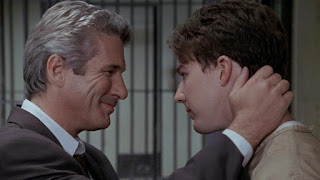
In Chicago, the respected Archbishop Rushman (Stanley Anderson) is brutally murdered. The police quickly arrest altar boy Aaron Stampler (Edward Norton) as he is escaping from the scene covered in blood. Celebrity defence lawyer Martin Vail (Richard Gere) offers his services to Aaron pro bono. Prosecutor Janet Venable (Laura Linney), one of Martin's ex-lovers, is assigned to the case, with a mandate from her boss District Attorney John Shaughnessy (John Mahoney) to secure a conviction and the death penalty.

The prosecution's case against Aaron is strong but lacks a motive. Martin interviews the stuttering, soft-spoken Aaron, and determines the simple young man from Kentucky is incapable of murder. Martin recruits psychologist Dr. Molly Arrington (Frances McDormand) to evaluate Aaron, while his team uncover several plots swirling around the Archbishop, including a politically-driven land development deal and evidence of sexual impropriety. In the courtroom of Judge Shoat (Alfre Woodard), Martin and Janet square off, but in an already complicated and high-profile case, surprises await them both. 

An adaptation of the William Diehl novel directed by Gregory Hoblit, Primal Fear is a richly textured drama. Packed with revelations, the plot finds new twists at regular intervals, and despite plenty of artistic freedoms stays just on the right side of cinematically credible. The Archbishop's murder is only the starting point, and before long sub-plots related to corrupt business deals, pedophilia, and personality disorders merge into a grand, multi-faceted mystery.

Of course some of the detours are elaborate distractions to cast doubt and open new avenues of potential guilt and innocence, prolonging the fundamental guessing game around Aaron's role. The altar boy as an innocent victim caught in the wrong place at the wrong time is Martin's thesis for the defence, but Aaron could also have been a pawn in much larger game, or holding his own difficult-to-uncover motive. 

In his big screen debut, Edward Norton's performance as the hesitant, deferential, and scared Aaron is a stunning bolt of lightning. But then Martin and Dr. Arrington delve further into the defendant's psyche and reveal much more to his character, and Norton moves to a higher level of dominance, evolving into a formidable and unpredictable presence.

The rest of the cast is packed with talent, Richard Gere infusing Martin Vail with plenty of depth and arrogant confidence in the central role. In contrast Laura Linney struggles with a choppy definition of prosecutor Janet Venable, often caught in unconvincing demonstrations of tough mannerisms.

At 130 minutes, Primal Fear goes on, and along with writers Steve Shagan and Ann Biderman, Hoblit could have tightened the pacing. A foot race involving another alter boy with something to hide is wholly unnecessary, some of the courtroom shenanigans could have been truncated, and the sexual tension between Martin and Janet is overplayed and loops in repetitive circles.

But Primal Fear is an overall gripping legal thriller. The courtroom manoeuvres maintain a pointed level of drama as intersecting battles of wits and wills play out, some plain to see, others just plain devious.


All Ace Black Movie Blog reviews are here.
Monday, 4 November 2019

Movie Review: The Exorcism Of Emily Rose (2005)


A courtroom drama and supernatural horror movie, The Exorcism Of Emily Rose combines two genres with decent results.

Father Richard Moore (Tom Wilkinson) is arrested and accused of causing the death through neglect of a young woman named Emily Rose (Jennifer Carpenter), who died from malnutrition and self inflicted wounds after she entrusted Moore with her care and stopped taking medication. Moore refuses a plea bargain and insists the case go to court. His archdiocese retain Erin Bruner (Laura Linney) as his defence lawyer. Ethan Thomas (Campbell Scott) is the hard nosed prosecutor, with Judge Brewster (Mary Beth Hurt) presiding.

Through witness testimony Emily's story is revealed in flashback. Originally from a devout rural family, she was in her college dorm when she felt attacked and invaded by a malevolent spirit. Diagnosed with epilepsy, episodes of severe body contortions and hallucinations persisted despite medical intervention. In desperation her family turned to Moore, who believed Emily was possessed. As the trial proceeds, Erin starts to experience disturbing late night incidents.

Based on the true story of German woman Anneliese Michel, The Exorcism Of Emily Rose is a reasonably effective exploration of a collision between science and religion, with generous doses of outright horror. Director and co-writer Scott Derrickson efficiently merges two familiar genres that rarely share the same space.

Half the film is a fairly robust courtroom debate, with the expected cut and thrust between prosecution and defence under the watchful gaze of a patient judge. The other half features plenty of straightforward horror, Emily's descent into a hell of either possession or disease played for maximum shock, plus the bonus of Erin confronting spooky after-midnight scares of her own once she takes the case.

Because the movie opens with Emily already dead and Moore on trial for neglect, the scenes documenting her trauma carry a relatively contained threat level. Derrickson therefore uses extreme physical angularity to amplify shock value, with actress Jennifer Carpenter pulling off some creative contortionist moves. The tension is marginally elevated when Erin and Moore start to experience things going bump in the night in her apartment and his prison cell respectively, the present-day scares occurring concurrently with the trial and carrying the menace of an undefined outcome.

Back in the courtroom, the mechanics of the trial are often suspect with plenty of hurried evidence and new witnesses introduced haphazardly. But Derrickson manages to provide a balanced view of the charges. Prosecutor Thomas presents a forthright case of a desperately sick girl taken off her medication and allowed to suffer due to ill-informed and unscientific religious intervention. Erin counters by introducing doubt as to whether the diagnosis of epilepsy was ever accurate to begin with, and brings in an expert on global incidents of possession to back-up Moore's beliefs.

Emily's exorcism is notionally both the beginning and the end of the film, a harrowing fight between good and evil erupting over an innocent young woman's body. She was either saved or destroyed by religion, the definitive conclusion a matter of imperfect evidence and degrees of belief.


All Ace Black Blog Movie Reviews are here.


Saturday, 12 January 2019

Movie Review: The Mothman Prophecies (2002)


A supernatural horror movie, The Mothman Prophecies offers flashy execution of a hopelessly muddled premise.

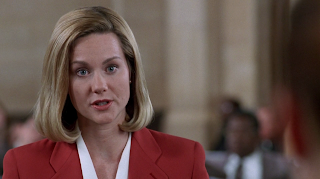
Washington Post reporter John Klein (Richard Gere) loses his wife Mary (Debra Messing) after she succumbs to a brain tumour in the aftermath of a car crash. Before she dies, she scribbles demonic images of a winged creature. Two years later and while on a business road trip, the still-grieving John inexplicably finds himself in the small town of Point Pleasant at the border between West Virginia and Ohio. He tangles with the highly-strung Gordon (Will Patton), and meets sympathetic local police officer Connie (Laura Linney).

Connie explains the townsfolk are reporting unusual events. Gordon claims to be communicating with a supernatural presence predicting future disasters. Others report sightings of a demon-like creature. John starts receiving garbled phone messages, as well as contact from the dead Mary. He reaches out to paranormal expert Alexander Leek (Alan Bates), who warns of a dire disaster to come.

Author John Keel published his book The Mothman Prophecies in 1975, claiming to be an investigation of real events and featuring a hodgepodge of supernatural phenomena including a winged Mothman creature and UFOs. It all culminates in the real 1967 collapse of the Silver Bridge across the Ohio River.

The book is brought to the screen by director Mark Pellington with a script by Richard Hatem, who tries but fails to make some sense of the book, and at least takes out the UFO elements. The movie is all over the place and no place at the same type, literally and figuratively, playing with inexplicable time and geographic jumps. Spooky graphics and creatures make brief appearances but never quite enter the story, and strange voices issue doomsday warnings over distorted phone messages.

With the material unraveling quickly due to abject incoherence, Pellington leans heavily on style. The Mothman Prophecies at least looks good, with the supernatural elements poking in and out with pizzazz and sharp camera movement. In terms of mood the film never quite descends to all out horror, and settles more in unnerving territory.

Richard Gere is engaged enough to maintain a basic level of interest. Laura Linney is given precious little to do as the local police, and indeed hands over the investigative work to Klein, a stranger in her town. Will Patton is suitably unhinged as Gordon, always one wrong twitch away from harming someone.

The Mothman Prophecies chooses to explain almost nothing, leaving multiple interpretations available. The most likely explanation is dubious source material playing fast and loose with fact and fiction.


All Ace Black Movie Blog reviews are here.
Saturday, 8 September 2018

Movie Review: The Life Of David Gale (2003)


A mystery and drama about capital punishment, The Life Of David Gale stimulates debate, but easily manages to outsmart itself.

In a Texas prison, death row convict David Gale (Kevin Spacey) selects reporter Bitsey Bloom (Kate Winslet) for a series of exclusive interviews in the three days leading up to his execution. Sentenced to die for murdering fellow anti-capital punishment activist Constance Harraway (Laura Linney), he recounts his story in flashback. Gale was a respected university professor of philosophy, and along with Constance, a member of DeathWatch, a group advocating for the end of capital punishment.

Gale's fiery and argumentative personality made him a perfect spokesperson, and he debated capital punishment with the Governor on television. But Gale's marriage was in trouble, and he succumbs to a quickie with ex-student Berlin (Rhona Mitra), who promptly accuses him of rape. He loses his family and his career, but continues helping Constance. As Bitsey learns more about Gale, she notices a mysterious stranger in a pick-up truck tailing her every movement, and starts to suspect there is more to Gale's story than meets the eye.

Directed by Alan Parker and written by Charles Randolph, The Life Of David Gale glances off its target. Intended as a stunning winning hand to demonstrate the vulnerability of government-sanctioned killing, the story builds towards a couple of well-telegraphed twists that are nowhere near as clever as Parker and Randolph believe them to be. The Life Of David Gale ties itself up in a moral pretzel of its own making, unintentionally sparking in wild-eyed fashion distracting debates and comprehensively diluting any impact.

And yet there is no denying the craftsmanship on show. Parker constructs a solid drama, wrapping the mystery of Constance's death around a flawed man trying too hard. Spacey and Winset are in decent form, and the film does suffer from her absence in the flashback scenes. The grim rain-lashed grey aesthetics around the prison and the nearby town add to the film's appropriately dour mood, and provide a contrast with the slick academic milieu occupied by Gale in better days.

Bitsey and her sidekick, chain smoking intern Zack Stemmons (Gabriel Mann), enjoy some amateur detective moments, and stumble upon Nico (Melissa McCarthy), the wacky yet opportunistic current resident of the house where Constance died. The puzzle of the cowboy stranger in the pickup truck (an almost silent Matt Craven) adds just a touch of personal danger before weaving into the convoluted explanation of Constance's demise. Unfortunately for David Gale and all others involved, the closer The Life Of David Gale gets to the moment of death, the quicker it unravels.


All Ace Black Blog Movie Reviews are here.


Saturday, 3 February 2018

Movie Review: The Squid And The Whale (2005)


A social drama with biting humour, The Squid And The Whale is a clear-eyed look at the devastating consequences of middle-class divorce.

It's the 1980s in Brooklyn, and the marriage of Bernard (Jeff Daniels) and Joan (Laura Linney) finally disintegrates. He is a middle-aged and already has-been pompous academic who can no longer find a publisher, while she is an emerging writer. Their 16 year old son Walt (Jesse Eisenberg) idolizes his dad and quickly takes his side, particularly when he learns that Joan has been carrying on a long-term affair. The younger twelve year old Frank (Owen Kline) is simply traumatized and starts to act out in all the wrong directions.

Bernard moves out of the family house and rents a derelict place of his own, and the boys are forced to shuttle between parents. Walt finds a girlfriend in sweet Sophie (Halley Feiffer), but his father's advice interferes with their relationship. The sexual tension amps up when Bernard's college student Lili (Anna Paquin) moves in and stirs the pot with both Bernard and Walt. Meanwhile Joan finds herself a new lover, accelerating Frank's anxiety.

Written and directed by Noah Baumbach, The Squid And The Whale is an adept 81 minutes of cutting social commentary. The semi-autobiographical script never blinks: this is a small family thrust into a full-blown crisis, four members running in different directions, doing their best to hurt each other, lives broken and altered forever.

And as ugly as the debris looks, Baumback also finds the dry humour. Bernard wallows in a legend of his stature that exists only in his mind. He pontificates about literature several leagues above his capabilities, only for Walt to mimic his father with even less credibility. Joan is no better, having long since given up on her husband, wrecking the marriage with her affairs and quickly moving on to the next lover, this one even more damaging to the family, as soon as Bernard moves out.

Underneath the daily anguish is a prevailing sense of sadness and waste as two boys are led astray. Walt is quick to internalize his father's fake arrogance, with consequences both at his school music competition and with potential girlfriend Sophie. The more sensitive Frank's dissolution borders on tragedy, his cries of help emerging in the form of alcohol consumption and uncontrolled sexual exhibitions.

The four lead cast members are all excellent, but Jeff Daniels deserves the most credit. His take on Bernard as a failed husband, failed father and failed author who still thinks he is somehow superior to everyone else is a classic example of unchecked egotism.

Baumbach struggles to elegantly land his film, which ends with partial resolutions but enough abruptness to suggest that money, time or ideas ran out. But The Squid And The Whale is nevertheless an impressive peek at the often overlooked carnage caused by broken domesticity.


All Ace Black Blog Movie Reviews are here.

Sunday, 22 October 2017

Movie Review: The Fifth Estate (2013)


A biographical technology drama, The Fifth Estate delves into the chaotic formative years of WikiLeaks and the profound questions caused by the sudden public availability of state secrets.

The film briefly starts in 2010, with The Guardian, The New York Times and Der Spiegel about to co-publish The Afghan War Logs, derived from thousands of United States secret government cables leaked to WikiLeaks by Bradley Manning. The story then shifts back to 2008, when German tech whiz Daniel Domscheit-Berg (Daniel Brühl) meets and agrees to help WikiLeaks founder Julian Assange (Benedict Cumberbatch). Assange is passionate about providing an unfiltered anonymous platform for whistleblowers to reveal hidden corporate and government information.

The popularity of WikiLeaks grows with revelations about tax evasion on a grand scale at a Swiss Bank. Daniel is captivated by Julian, who is enigmatic but also obsessed with his own version of the truth and not beyond twisting facts for his benefit. The worldwide scoops multiply, and WikiLeaks becomes a thorn in the US government's side. Daniel's relationship with girlfriend Anke (Alicia Vikander) suffers, and more tension lies ahead as Assange seems oblivious to the individual harm that could be caused by the release of unredacted data.

Directed by Bill Condon, The Fifth Estate is only a few years removed from the events depicted. Both a biography of Assange and a commentary on the rapidly shifting world of no secrets, the film is always dynamic, sometimes frantic, and often resembles the chaotic no-one-is-in-control reality of information in the citizen journalist world.

The Fifth Estate is based on two 2011 books: Inside WikiLeaks: My Time with Julian Assange at the World's Most Dangerous Website by Domscheit-Berg, and WikiLeaks: Inside Julian Assange's War on Secrecy by David Leigh and Luke Harding. And this is not a hero-worship story: the film presents Assange as a deeply flawed man living in his own world, charismatic enough to dominate a room and attract ardent followers but also blinkered in pursuing a self-defined mission. It's an attractive proposition for a biography to pursue, and allows screenwriter Josh Singer to chase the various shades of grey morality in the WikiLeaks story.

Aware that the film is treating history too close to the source, Condon expands the breadth and triangulates numerous issues, rather than diving too deeply into any one aspect. The Fifth Estate takes pains to cover the people, the technology, the profession of journalism, the actual historical events, and the implications both intended and not, and never dwells for too long in one place. There is something here from every angle, and while none of it is perfect or fully satisfying, it is all rich fodder for thoughtful discussion.

Through the sub-story of a trio of State Department and White House officials (played by Laura Linney, Stanley Tucci and Anthony Mackie) struggling to cope with the sensitive state secrets suddenly detonating on WikiLeaks, Condon takes a stab at reflecting the information age's unexpected consequences. He also throws in a sub-sub-story of an American informant in the Libyan government, whose identity is potentially exposed in the leaks.

Elsewhere traditional journalists at The Guardian, already struggling with the digital revolution, now have to contend with defending their professional standards as a tsunami of astounding information is about to be unleashed on an unsuspecting world in unfiltered format. Are the rules being rewritten, or is this the reason the tried and tested rules exist in the first place?

Benedict Cumberbatch delivers a chilling performance as Assange, self-assured, emotionally domineering and steely-eyed, his shock of white hair working to his advantage. Daniel Brühl gets plenty of screen time, and the film is as much the Domscheit-Berg story as it is about Assange, and this is not necessarily always a good thing. Alicia Vikander cannot do much with the role of the token girlfriend.

The Fifth Estate doesn't contain any great revelations, yet it's a stylish point-in-time marker, a chronicle of an inflection point in privacy's death march. Governments are also losing the right to keep any secrets, and all it took was one determined man and one website to make it happen.


All Ace Black Blog Movie Reviews are here.


Sunday, 6 November 2016

Movie Review: Kinsey (2004)


A biographical drama about the scientist who revolutionized the understanding of sexuality, Kinsey treats its subject with well-rounded respect, revealing the man's determination and faults. The film is an efficient recounting of a unique career, suffering only slightly from some character repetitiveness.

At Indiana University in the 1930s, insect researcher Professor Al Kinsey develops an interest in researching human sexuality. In flashback, Kinsey's background is revealed. Born to a strict father (John Lithgow), Kinsey refuses to follow the path of engineering and chooses biology instead. He pursues an interest in the migration and evolution of gall wasps, and meets and marries Clara McMillen (Laura Linney). His early sexual experiences with his wife as well as his bisexuality contribute to his curiosity about human sexuality as a science. The current texts in circulation are religious and moralistic nonsense disguised as fact.

Kinsey recruits his students including Clyde Martin (Peter Sarsgaard), Wardell Pomeroy (Chris O'Donnell) and Paul Gebhard (Timothy Hutton) to form the core of a research team. Supported by university president Herman Wells (Oliver Platt) and funded by the Rockefeller Foundation represented by Alan Gregg (Dylan Baker), Kinsey and his researchers fan out across the country interviewing thousands. The research findings, first published in the late 1940s, shake the foundations of American society. The former insect professor becomes a celebrity and household name. But a backlash also awaits, and Kinsey's singular obsession with the pure science of sexuality takes a personal and professional toll.

Directed and written by Bill Condon, Kinsey clocks in at under two hours and wastes no time on padding. This is a disciplined, focused film, stylishly divulging the man, the mission and the consequences. Enough background is added to create context without getting lost in side quests. Condon captures the clever simplicity of Kinsey's observational and interview methods, and then the ground shift of awakening unleashed by the resultant research.

Al Kinsey is presented as a visionary, a pioneer and a flawed man, inheriting a lot of more from his intolerable father than he wishes to admit. The scenes of Kinsey's early life are interspersed throughout the film with a light touch, colouring childhood influences in subtle shades. Kinsey the adult becomes dogmatic about his science the way his father was about his brand of religion. After demonstrating a propensity for diving deeply into a narrow topic with his improbable gall wasp obsession, he locks onto sexuality as pure science, reducing human intercourse to a subject stripped of emotional, psychological or societal resonance.

Liam Neeson contributes to the film's appeal, owning the role and settling quickly to embody the scientist as beady-eyed, stubborn and sure of his stance as others recoil in shock when the covers are thrown off to reveal exactly what is going on in the national bedroom. Neeson's intensity helps to ride out the more repetitious scenes, Condon overemphasizing his main character's obtusely stubborn traits. Laura Linney excels as his wife Clara "Mac" McMillan, first astounded by her husband's liberal views of sexuality and then embracing what freedom may mean to her and her marriage. Peter Sarsgaard as Clyde Martin is the most prominent of the researchers who bring Kinsey's research methods to life both professionally and personally.

Kinsey emerges as a dispassionately cold proponent of understanding human coupling for the sake of reckless exploration and personal satisfaction, and eventually pushes too hard and too fast. For all the good that the research achieved, this is a story of the quixotic renegade shoving society two steps forward but one step very much backwards: support seeps away, damage is caused within the team, and a shocked nation reaches the point of too much information. Scientific advancement can be a messy and imperfect path.


All Ace Black Blog Movie Reviews are here.


Saturday, 17 September 2016

Movie Review: Sully (2016)


A dramatization of the 2009 miraculous landing of a civilian airliner on the Hudson River, Sully delves into the aftermath at the personal level, as the captain is thrust into a maelstrom of attention from an astounded world and befuddled officials.

It's January 2009 in New York City. Veteran airline Captain Chesley "Sully" Sullenberger (Tom Hanks) and First Officer Jeffery Skiles (Aaron Eckhart) are dealing with the chaotic immediate aftermath of the "Miracle on the Hudson", where Sully landed an Airbus A320 on the Hudson River after losing both engines due to a bird strike soon after takeoff from LaGuardia airport. All 155 passengers and crew on-board were saved relatively unharmed, plucked from the aircaft wings by boats that rushed to the rescue within minutes.

While Sully is being feted as a hero and the media is in full frenzy mode, the National Transportation Safety Board (NTSB) launches an investigation. There are whispers that one of the engines was maybe still functional, and that Sully could have made it safely back to LaGuardia instead of attempting a dangerous water landing. Meanwhile back home Sully's wife Lorraine (Laura Linney) can only communicate with Sully over the phone and is dealing with the media camped on her driveway. Sully starts to question whether he did the right thing, as the enormity of his achievement sinks in and the investigation escalates with some surprising simulation results.

Directed by Clint Eastwood and based on Sullenberger's book, Sully is a compact 96 minute story-behind-the-story drama focusing on the personal impact of an astonishing event that made global headlines. The safe water landing on the Hudson is stranger than fiction, so Eastwood and screenwriter Todd Komarnicki wisely focus on the emotional burden that comes with an unexpected and overwhelming achievement.

The landing itself is recreated with care and presented with marvelous timing, key moments interspersed with the unfolding post-event confusion. Without delving into melodrama, Eastwood finds the awe-inspiring power of quiet heroism as Sully, the passengers and the rescuers come together and play their unscripted parts to make unintended history on the Hudson River.

Beyond the events on the river, the film tackles themes related to what makes a hero, and society's facile rush to attach simple labels to complex situations. Sully is keenly aware that a lifetime of flying experience came together in a few seconds in the air, his instincts kicking in to do the right things in the right order at the right time. But his self-awareness is such that he equally recognizes the thin line between success and failure.

The film does stretch to find pseudo-villains, and unfairly maligns NTSB officials into confrontational and adversarial roles. This is Eastwood unfortunately seeking the black hats in a story that did not need them, in the process taking away from the strength of the event itself and its already immense psychological aftermath.

Tom Hanks finds another perfect fit in the role of Chesley Sullenberger, a well-respected man able to rise above a situation that can easily crush the psyche. Hanks brings forth Sully's reserved dignity, never descending into any level of cheap engagement, and remaining grounded as he grapples with self-reflection. Aaron Eckhart has to decide whether the river landing or a bushy mustache represents the greater threat, but nevertheless provides solid support.

Sully never stops questioning his own actions, while sharing the credit with Skiles, the flight attendants, the passengers who remained mostly calm, and the rescuers who rushed to the scene. While the captain played the most prominent role, ultimately it took the efforts and actions of a group to create a real life miracle on a freezing cold January day.


All Ace Black Blog Movie Reviews are here.


Monday, 28 March 2016

Movie Review: The Truman Show (1998)


An astute commentary on television culture's evolution, The Truman Show also explores the limits of human tolerance for the ordinary. The film is an engrossing examination of the societal condition, and as fascinating as its central show.

Television producer Christof (Ed Harris) has created a monstrously successful live, perpetual television show, tracking the minute-by-minute life of Truman Burbank (Jim Carrey), the only non-actor. Inserted from birth into a custom-built community of Seahaven, which is one humongous dome-enclosed and climate-controlled film set, Truman has no idea that every second of his life is being broadcast live to millions of viewers, using more than 5,000 hidden cameras.

Truman think he works as an insurance agent, and believes he is married to Meryl (Laura Linney, as actress Hannah Gill), that his best friend since school is Marlon (Roland Emmerich, as actor Louis Coltrane), and that his father died in a boating accident. Over the show's remarkable 30 years of continuous broadcast, various outside activists have tried to infiltrate the set to free Truman. He has never forgotten Lauren (Natascha McElhone, as actress Sylvia), an extra hired to play a high school student who tried to help him escape before she was bundled off the set. When the actor who played his father unexpectedly reappears in his life, Truman starts to suspect that something is not quite right and starts to question the world around him.

Directed by Peter Weir and written by Andrew Niccol, The Truman Show expands the reality television concept to an unsettling edge, and in the process contemplates human boundaries of control, comfort and compliance. The film is thoughtful, often profound, but also tackles its serious issue with humour. The act of viewing and enjoying Truman's story is itself part of the societal guilty-pleasure dilemma. The film is also unsettling enough to raise doubts about any life: if Truman is so deluded about his reality, who is to say what is defined as real and what is not?

Everything in Seahaven is designed to be idyllic, and to convince Truman that he has no reason to want to leave. Ironically, Christof's attempts to instill the emotional fear of leaving and segregate Truman from the outside world create the most compelling moments of drama for the viewers of the show. And once Truman starts to suspect that everything is too perfect, it becomes increasingly difficult to convince him to settle for his artificial surroundings.

The film plays on the parallel themes of obsession with other people's lives, and the essence of the human condition. The viewers of the show are transfixed, immobile, living their lives vicariously through the television set and following Truman's ups and downs rather than getting on with creating their own memories. The further Truman pushes to escape his sad life, the more entrenched the viewers are in front of the television. It's a sad indictment of the culture, where society cares more about an artificial world labelled as reality than actual existence.

Also permeating through the film is Christof's relationship with Truman, presented as a surrogate for the mysteries of the bond between God and man. Christof loves Truman like a son, and wants him to be safe and content. But Truman has free will, and eventually learns to use it. As much as Christof will try and send cosmic signals about what may be the appropriate path, it will ultimately be man's actions that will govern his fate.

The Truman Show is one of Jim Carrey's most complete performances. Staying as far as he can from the elastic mugging and physical comedy which made him famous, Carrey as Truman conveys innocence, curiosity and ultimately a willingness to question and confront. In addition to excellent supporting performances from Ed Harris, Laura Linney, Noah Emmerich and Natascha McElhone, the cast also includes Paul Giamatti as Christof's chief control room manager.

What is comfortable is not what is necessarily right. The Truman Show finds the spirit of a simple man yearning for a challenge, part of the never ending quest to self-define happiness.


All Ace Black Blog Movie Reviews are here.


Tuesday, 28 April 2015

Movie Review: Love Actually (2003)


Featuring nine loosely-connected vignettes about love as London counts down to Christmas, Love Actually achieves its modest objectives by risking a variety of outcomes and allocating almost enough time for each story to breathe and develop.

With five weeks to go until Christmas, several tales of love and romance unfold concurrently:

  • Aging and washed-up rock star Billy Mack (Bill Nighy) attempts an unlikely comeback by re-recording one of his old songs and promoting it as the Christmas hit of the season. Much to the horror of his long-suffering manager Joe (Gregor Fisher), Billy embarks on a crass, foul-mouthed marketing campaign which remarkably starts to work.
  • The newly elected British Prime Minister (Hugh Grant), an eligible bachelor, moves into 10 Downing Street and is immediately attracted to Natalie (Martine McCutcheon), a junior staff member.
  • Karen (Emma Thompson) is the Prime Minister's sister. She is married to Harry (Alan Rickman), but the passion has seeped out of their relationship. At Harry's office, Mia (Heike Makatsch) sets her eyes on sexually devouring Harry. 
  • Also at Harry's office, the dowdy Sarah (Laura Linney) has a deep crush on co-worker Karl (Rodrigo Santoro), but she cannot find the courage to act upon it. Sarah's life seems to be controlled by her cell phone, as she frequently receives calls from someone who desperately needs her.
  • Writer Jamie (Colin Firth) discovers his girlfriend sleeping with his bother. He resets his life in the country and meets Portuguese housekeeper Aurélia (Lúcia Moniz). They have a huge language barrier between them, but nevertheless grow close.
  • Jamie's friend Peter (Chiwetel Ejiofor) marries his long-term girlfriend Juliet (Keira Knightley). Peter's best friend Mark (Andrew Lincoln) harbours a deep, silent crush on Juliet.
  • Karen's friend Daniel (Liam Neeson) is recently widowed. His young stepson Sam (Thomas Sangster) is experiencing his first schoolboy crush, falling under the spell of flashy American classmate Joanna (Olivia Olson).
  • John (Martin Freeman) and Judy (Joanna Page) are movie set body doubles who meet while simulating hot sex scenes. Although both are comfortable fully naked, both are also painfully shy in their private lives.
  • After repeatedly striking out while trying to chat up women, Colin (Kris Marshall) decides that he needs to head off to the United States, where he is convinced there would be plenty of stunning girls waiting to fall into bed with him, mainly due to his British accent.
Directed and written by Richard Curtis, who had previously found success as the writer and producer of Four Weddings And A Funeral, Notting Hill and Bridget Jones's Diary (all with Hugh Grant), Love Actually is simply sweet. With an ambitious running time of 136 minutes, the film hops between the various stories with admirably agility, never lingering for too long and returning to every sketch just in time to catch up with the latest developments. Curtis' main achievement resides in creating about 25 characters who are all memorable in their own way, despite not spending much more than 15 minutes on each of the romances.

As can be expected, not all the stories fully hit their targets. Body doubles John and Judy are perhaps the most short-changed in terms of narrative development, while wannabe womanizer Colin's escapades are played purely for laughs. The progression and resolution of Mark's crush on best-friend's-wife Juliet misses the mark completely. Sam's grade school crush on Joanna is overextended, and falls victim to a sugar overdose. 

Better and more engaging, the language-challenged affair between struggling writer Jamie and housekeeper Aurélia emerges as the most romantic story, while the Karen/Harry/Mia triangle is a serious peek at a marriage drifting sideways and falling victim to middle aged ennui. Grant brings the best aspects of his arrogant self-doubter persona to the Prime Minister's office, and gets to deliver a punchy speech to the American President (Billy Bob Thornton) that has become legendary in British political circles.

Curtis demonstrates courage to find endings that are a mixed bag of happy, sad and unresolved, and extends the definition of love to some unexpected places, particularly with singer Billy Mack and office worker Sarah. Love Actually is about the connections formed by the human spirit, and sometimes the sparks are brightest in the most unlikely places.


All Ace Black Blog Movie Reviews are here.