Showing posts with label Edward G. Robinson. Show all posts

Saturday, 13 January 2024

Movie Review: Larceny, Inc. (1942)


Genre: Crime Comedy  
Director: Lloyd Bacon  
Starring: Edward G. Robinson, Broderick Crawford, Edward Brophy, Jane Wyman, Jack Carson, Anthony Quinn  
Running Time: 95 minutes  

Synopsis: In New York, professional thief J. Chalmers "Pressure" Maxwell (Edward G. Robinson) claims he wants to go straight for the sake of his adopted daughter Denny (Jane Wyman). But to do so he needs to raise funds, so Pressure and his buddies Jug (Broderick Crawford) and Weepy (Edward Brophy) buy a struggling luggage store and secretly plan to break into the next-door bank through the cellar. Meanwhile luggage salesman Jeff (Jack Carson) is invested in the store's success, while ruthless criminal Leo (Anthony Quinn) wants to break into the same bank, both disrupting Pressure's agenda.

What Works Well: Sharp writing, a trio of lovable rogues, and a fast-moving plot about tripping over a good thing make for an entertaining romp. Edward G. Robinson has a blast as an ex-convict with a kind heart, and he is ably supported by Broderick Crawford and Edward Brophy as two loyal but non-too-bright sidekicks. Within the compact running time director Lloyd Bacon inserts a breezy romance between adopted daughter Denny and hustling luggage merchant Jeff, plus commentary about street politics and Christmas season sales tactics. Anthony Quinn is the one serious presence as the gnarling goon with a perpetual chip on his shoulder.

What Does Not Work As Well: The first act is slow, and some of the comedy slips into repetitive silliness. 

Conclusion: Nothing succeeds like excess baggage.


All Ace Black Movie Blog reviews are here.

Saturday, 16 December 2023

Movie Review: The Woman In The Window (1944)


Genre: Noir Crime Drama
Director: Fritz Lang
Starring: Edward G. Robinson, Joan Bennett, Dan Duryea, Raymond Massey
Running Time: 99 minutes

Synopsis: With his family on vacation, stodgy Professor Richard Wanley (Edward G. Robinson) meets alluring model Alice Reed (Joan Bennett), who invites him for drinks at her place. Before long another man bursts in, a struggle ensues, and Richard kills the stranger in self defence. Fearing his life will be ruined if he calls the police, Richard plots with Alice to dump the body and tell no one. But District Attorney Frank Lalor (Raymond Massey), who is also Richard's friend from their social club, starts to assemble the clues, and the threat level rises when crooked ex-cop Heidt (Dan Duryea) shows up with blackmail on his mind.

What Works Well: Playing on classic noir themes of an innocent man who succumbs - just once - to a temptress and tumbles into a pile of trouble, director Fritz Lang and writer Nunnally Johnson accentuate the details. Richard is a studious professor of crime, and therefore attempts to carefully think his way out of his predicament. But in a study of unintended consequences, his every step and every statement expose him to self-incriminating risks. Edward G. Robinson is a perfect bourgeois in over his head, Joan Bennett sells dangerous allure, and Dan Duryea arrives in the second half with bags of oleaginous ill intent.

What Does Not Work As Well: The District Attorney is very quick to connect the dots, and while cleverly delivered, the ending chooses a safe pathway over edgier alternatives.

Conclusion: One mistake is all it takes.


All Ace Black Movie Blog reviews are here.

Friday, 30 September 2022

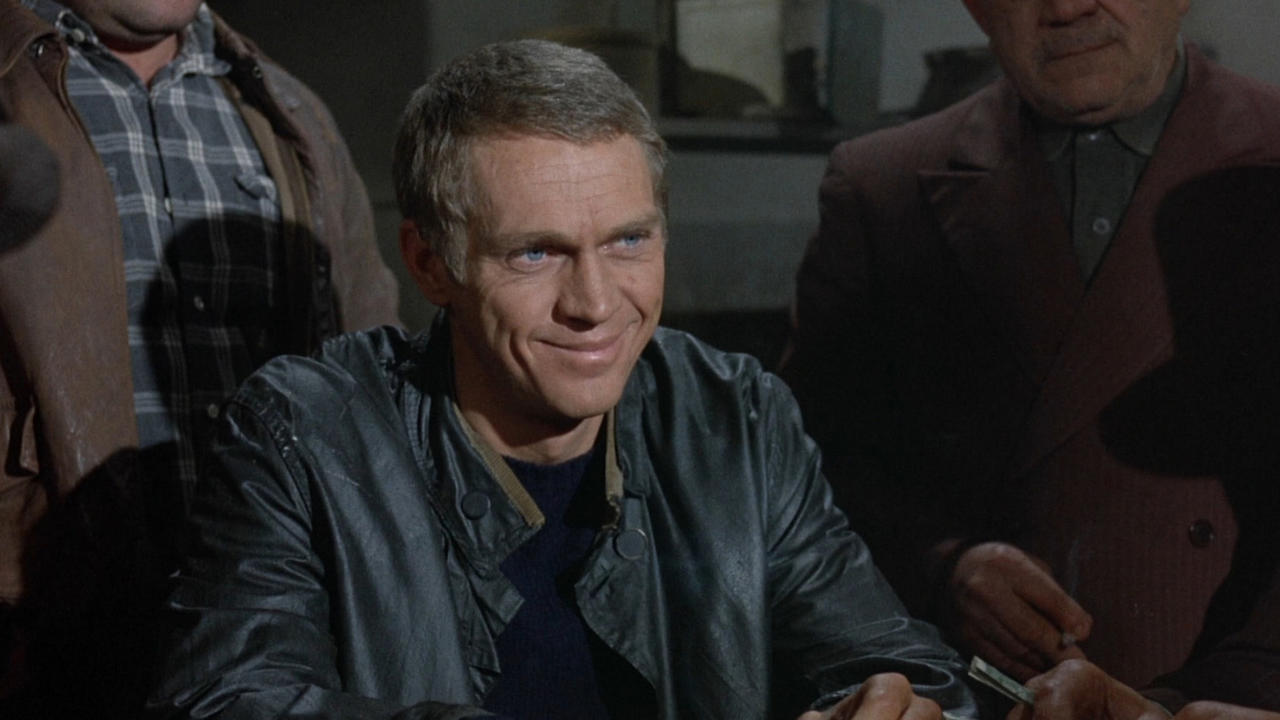
Movie Review: The Cincinnati Kid (1965)

A poker drama, The Cincinnati Kid mixes high-stakes card action with less impressive romantic entanglements and some muddled era representations.

In New Orleans of the 1930s, Eric "the Cincinnati Kid" Stoner (Steve McQueen) is the hottest up-and-coming poker player. His mentor and friend is the aging Shooter (Karl Malden), who is married to the much younger Melba (Ann-Margret). The Kid's girlfriend Christian (Tuesday Weld) is growing disgruntled that she does not get much of his attention.

The revered Lancey "The Man" Howard (Edward G. Robinson) arrives in town with a well-earned reputation as the best poker player alive and promptly defeats wealthy businessman Slade (Rip Torn). Next up is a much anticipated showdown between Lancey and the Kid, with Shooter and Lady Fingers (Joan Blondell) recruited as dealers. The Kid has to contend with Christian's sour attitude and Melba's unconstrained lust, while Shooter comes under pressure to influence the game's outcome.

With The Hustler swinging open the door to grim smoke-filled backroom duels, The Cincinnati Kid arrives with a similar formula of the hot young talent (McQueen) challenging the veteran reigning champion (Robinson). Writers Ring Lardner Jr. and Terry Southern adapt the Richard Jessup novel with verve, and Norman Jewison directs with a sweaty immediacy to wring maximum tension out of men sitting around the table, encouraging McQueen and Robinson to naturally match actors with characters.

And when Jewison stays close to the poker table, the energy level buzzes. The audience is trusted to know the five card stud rules or quickly catch up, and regardless, the strategy propelled by bluffing, gamesmanship, and penetrating personality traits registers through facial expressions and body language. The showdown between Lancey and the Kid extends for several days and occupies the entire third act, and despite breaks for sleeping and eating, the pressure only builds towards the legendary final pair of hands.

The scenes without cards being dealt are comparatively limp. The Kid and Melba attend an entirely superfluous cockfight, the romance between The Kid and Christian stutters into painfully strained territory, and all three of Steve McQueen, Tuesday Weld, and Ann-Margret are dressed and styled according to 1960s fashions, despite the 1930s setting. Nothing substantive is revealed about The Kid's earlier days, and no explanation provided for the odd pairing of the vivacious Melba with boring has-been Shooter.

The dream cast makes up for plenty of deficiencies. While McQueen is adequate playing his usual nervy-cool persona, veterans Robinson and Malden provide superb senior heft, Rip Torn is suitably oily, and Joan Blondell breezes in as a dealer riding a flamboyant past. Ann-Margret (openly zesty) and Weld (quietly smoldering) embody classic opposites, while Jack Weston and Cab Calloway make up the numbers around the table with restless colour.

Although some of the cards have questionable value, The Cincinnati Kid deals from a crisp deck.


All Ace Black Movie Blog reviews are here.

Sunday, 25 October 2020

Movie Review: The Prize (1963)

A drama, comedy, romance and spy thriller rolled into one, The Prize is beyond far-fetched but nevertheless mindlessly entertaining.

The Nobel Prize winners are announced, and the shock is American author Andrew Craig (Paul Newman) winning for literature. He has not published in five years, his first few books never sold well, and his life now consists of drinking, womanizing, and writing pulp detective novels under a pseudonym. Upon arriving in Stockholm for the grand ceremony, Inger Lisa Andersson (Elke Sommer) of the Swedish Foreign Office is assigned as his handler to keep him out of trouble.

The winners also include American physicist Dr. Max Stratman (Edward G. Robinson), who fled Germany after the war and in Stockholm reunites with his niece Emily (Diane Baker). The medicine prize is shared by American Dr. Garrett (Kevin McCarthy) and Italian Dr. Farelli (Sergio Fantoni), although Garrett believes Farelli stole his work. The chemistry winners are the French husband and wife team of Claude and Denise Marceau (Gerard Oury and Micheline Presle). The passion has dissolved out of their marriage, and Claude's mistress Monique (Jacqueline Beer) accompanies them in Stockholm.

Max Stratman is summarily kidnapped by evil East German agents and replaced by his twin brother Walter (also Robinson), with Emily complicit in the plot. The observant Craig is the only person to suspect something is amiss and starts investigating. His life is soon in danger, but Inger Lisa and others dismiss his concerns as stemming from the imagination of an alcoholic. Nevertheless he persists in trying to save Stratman, and unintentionally also helps the other Nobel winners resolve their issues.

An adaptation of the Irving Wallace book, The Prize oscillates between the heights of an intellectual gathering of the world's smartest people to the lows of bumbling agents unable to eliminate the threat of an alcoholic author playing at amateur detective. Along the way Ernest Lehman's script features no shortage of plot holes as director Mark Robson chases, with patchy success, the Hitchcockian vibe of North By Northwest (also written by Lehman).

At 134 minutes, the film is padded and longer than it needs to be. Some of the scenes are just too obviously derivative and unnecessarily prolonged. Running for his life, Andrew Craig stumbles into a nudists' meeting and makes a fool of himself to get arrested, an homage bordering on rip-off of Cary Grant at the auction. A foot chase through the streets of Stockholm and a nighttime visit to a hospital both provide a limited return on investment. And on a couple of occasions the jumps in continuity are jarring.

But with suspension of disbelief set to high, fun can be found. Elke Sommer sparkles whether pouty or seductive, and the slow-cooked romance between Craig and Inger Lisa sizzles. Character introductions are one area where Robson does invest time to good effect, and the travails of the other award winners emerge as worthwhile sub-quests, cleverly tied together by Craig's inadvertent investigation. The dialogue crackles with wit, and the international cast finds the right groove between humour and spy action, with Leo G. Carroll hovering on the edges to underline the Hitchcock connection.

The Prize does not win plausibility points, but earns plaudits for perky playfulness.


All Ace Black Movie Blog reviews are here.

Sunday, 14 June 2020

Movie Review: Scarlet Street (1945)


A drama and tragic romance with pricks of humour, Scarlet Street applies noir touches to a story of calamitous naivete and deception.

In New York City, Christopher Cross (Edward G. Robinson) is a meek cashier and amateur painter stuck in a loveless marriage with Adele (Rosalind Ivan). On his way home from a dinner marking his 25 years of employment, he stumbles upon part-time actress and model Katherine "Kitty" March (Joan Bennett) being assaulted by her boyfriend Johnny Prince (Dan Duryea). Chris chases Johnny away and is awestruck by Kitty's apparent sophistication. She mistakes him for a rich artist. 

But Kitty and Johnny are a despicable duo. He is a leach always looking to make a quick buck without working for it, and he convinces Kitty to milk Chris for all he is worth, believing his paintings sell for thousands. Kitty leads Chris along and convinces him to rent a studio for her, forcing him to start pilfering funds from his employer. Johnny next attempts to sell Chris' unremarkable paintings, leading to events spiralling out of control.

Scarlet Street travels to the merciless gorge at the bottom of the slippery slope formed by desperation meeting false assumptions. Director Fritz Lang and writer Dudley Nichols adapt the French novel and play La Chienne (literally The Bitch) into a mesmerizing noir, teasing out the ironies inherent in the ill-advised human desire for overreach.

Chris, Kitty and Johnny are three deeply flawed individuals not satisfied with their lot in life. Chris is 25 years into an invisible career, barely scraping a modest living and married to a nightmare. Yet he dreams of romance with a beautiful young woman, and suddenly Kitty falls into his life. He overlooks all her obvious conniving and just formulates an idyllic love in his head, leaving himself vulnerable for exploitation.

Oblivious to her own plight, Kitty is confined to her own version of hell with the less than useless Johnny. He abuses her physically, emotionally and financially, and yet she loves him, her self-esteem shattered beyond believing she can do better. From her moral gutter underlined by lethargy (her nickname is "lazy legs") she assumes Chris is a rich and famous artist (he is dressed the part for his 25 year celebration dinner), a case of two people blinded by their own failings.

And finally Johnny is an utter heel one step away from being defined as a pimp, a man whose big talk crumbles next to his miserable non-achievements. A serial exploiter, he pressures Kitty into giving him anything she has, then moves onto Chris.

Lang finds immense joy in taking the second half of Scarlet Street to unexpected destinations. Chris' artwork suddenly becomes the focus, and ever so briefly, vicarious happiness is in reach. But layers of lies make for an exceptionally poor foundation for bliss, and a tragic trajectory is reestablished.

The film features two magnificent performances. Joan Bennett sparkles in the role of a woman using basic seductive charms to weasel her way into a fool's heart, her best moments coming in the flashes when Kitty realizes, to her brief astonishment, just how gullible Chris is. Meanwhile Edward G. Robinson is almost heartbreaking as a tentative sad man, hanging onto pride and an unlikely dream of finding a soulmate, quickly sinking into the swamp prepared for him by two scoundrels.

When Chris encounters Kitty on Scarlet Street everything is briefly possible for both of them, but some streets are deceptive dead-ends.


All Ace Black Movie Blog reviews are here.

Sunday, 14 October 2018

Movie Review: Two Weeks In Another Town (1962)


A film industry drama, Two Weeks In Another Town idles in place, choking on an emotional void.

Former superstar film actor Jack Andrus (Kirk Douglas) has spent three years in a sanitarium after suffering a nervous breakdown. He caught his wife Carlotta (Cyd Charisse) cheating, resorted to alcoholism, and intentionally crashed his car into a wall. Now almost recovered, he accepts an invitation from director Kruger (Edward G. Robinson) to shoot a few scenes for good money in Rome.

Kruger and Andrus collaborated on seven previous features when they were both hugely successful. Now Kruger's career is also in decline, working for a cut-rate Italian producer and constantly nagged by his wife Clara (Claire Trevor). Jack steps in to help complete the film, including straightening out wayward star Davie Drew (George Hamilton), who is suffering from the sudden onset of stardom. Jack also starts a relationship with Veronica (Daliah Lavi), but Carlotta's presence in Rome complicates matters and re-triggers Jack's insecurities.

Ten years after the brilliant The Bad And The Beautiful, director Vincente Minnelli reteams with star Kirk Douglas for another inside-Hollywood story. They need not have bothered. This adaptation of the Irwin Shaw novel is a miserable screen experience, wasting a good cast and made worse by a CinemaScope format intended to showcase Rome but instead dwarfing what is intended as a character study.

As soon as Jack arrives in Rome the film stalls and drifts sideways with no apparent purpose and then starts to inch backwards into unintentional satirical territory. A romance with Veronica drops in from another movie, a miscast George Hamilton tries in vain to generate intensity, and Cyd Charisse as Carlotta appears to exist for the sole purpose of aggravating Jack.

In the meantime any sense of drama is supposed to be generated by Jack overseeing the dubbing process and then taking over directing duties: his techniques include kicking his star lady in the butt to get her to perform. Only Edward G. Robinson as once-celebrated director Kruger trying to reverse a precipitous career slide emerges with any credit.

By the time Jack emotionally regresses into a crazed driver mode both Douglas' wild-eyed over-the-top acting and Minnelli's equally bungled rear projection staging threaten to turn the film into bad comedy. Two Weeks In Another Town should have just stayed home.


All Ace Black Blog Movie Reviews are here.

Monday, 25 December 2017

Movie Review: The Ten Commandments (1956)


A religious epic, The Ten Commandments is the story of Moses recounted on an impressively massive scale.

In ancient Egypt, the Hebrews are enslaved people, used primarily for the arduous task of constructing massive monuments and new cities. The Pharaoh hears of prophecies that a newborn will grow up to lead the slaves to freedom, and orders the death of all male Hebrew babies. Slave Yochabel (Martha Scott) packs her infant son in a basket and sets him adrift on the Nile to spare him from death. He is picked up and adopted by the Pharaoh's daughter Bithiah (Nina Foch), and she names the baby Moses. Only Bithiah's servant Memnet (Judith Anderson) knows that the baby is the son of Hebrew slaves.

Moses (Charlton Heston) grows up vying with Rameses (Yul Brynner) for the right to succeed Pharoah Sethi (Cedric Hardwicke) to the throne, a prize that comes with marriage to the ambitious Nefretiri (Anne Baxter). Rameses recruits the services of Hebrew collaborator Dathan (Edward G. Robinson) to try and uncover the identity of the Deliverer who will free the slaves.

Moses is more capable and more resourceful than Rameses, and also more empathetic to the plight of the Hebrews. He demonstrates mercy to stonecutter Joshua (John Derek) and Joshua's love interest and water carrier Lilia (Debra Paget). But before Moses ascends to the throne, Memnet intervenes, forcing Moses to face his true destiny. Spared from death, he marries Bedouin shepherd's daughter Sephora (Yvonne De Carlo) before embarking on a monumental battle of wills with Rameses.

Producer and director Cecil B. DeMille's crowning achievement (and his second crack at the story after a 1923 silent version), The Ten Commandments is three hours and 40 minutes of grand storytelling, old-fashioned Hollywood at its extravagant best. The cast features a galaxy of stars, the extras in some scenes number in the thousands, the sets are numerous and impressively crafted, and the film bursts with the colours of abundant and imaginative costumes.

The popular Moses and Exodus stories are probably amalgams of people and events composed from legends, fractured oral histories and religious texts. To his credit DeMille cites several books as sources for the film, and benefits by steering away from Bible-in-pictures territory. The long story unfolds in four manageable parts: Moses' rise to prominence as a military leader, city builder and potential future Pharoah; his awakening to his true origins and acceptance of his destiny; the struggle to free the Hebrews; and finally the arduous Exodus out of Egypt and towards the new challenges beyond.

The narrative is punctuated by several memorable setpieces. The scenes of mass motion and human activity feature outstanding choreographed artistry, and DeMille always maintains a strong hold on what his cameras are capturing. The city-building, rock-making and Exodus sequences make use of extras in every corner of the VistaVision screen, conveying a profound sense of open space, ongoing industry and masses on the move.

The latter parts of the film scale some unforgettable heights. Moses and his close allies sheltering during the haunting passover night is a quiet but immensely powerful moment in the shadow of creeping horror. The pillar of fire halting an army, the extraordinary parting of the Red Sea, and the Ten Commandments being carved in stone by mystical flames are innovative visual achievements representing the era's state of the art.

And despite all the theatricality on display, The Ten Commandments generally avoids the pitfall of overstated reverence. This is a movie that tries hard to represent real people displaying naked ambition, conspiracy, sensuality, doubt, mixed emotions, and fallibilities. The script does not try to sound as if every spoken word needs to be enshrined on a hallowed wall.

A story this big needs sturdy acting shoulders to stand on, and DeMille assembled an impressive cast, with the luxurious length affording substantive screen time for several performers. Charlton Heston rises to the challenge of portraying Moses with plenty of authoritative presence, whether as a strapping young man earning his way towards the Pharoah's chair or as the grizzled prophet leading his people to freedom with supernatural winds in his sails.

Heston needed a robust foil to shine, and Yul Brynner delivers as Rameses, Moses' rival for leadership and subsequently his existential foe in the struggle to free the Hebrews. Until late in the film Brynner remains a strong presence representing the Egyptian viewpoint. Edward G. Robinson, Anne Baxter, John Derek, Nina Foch, Martha Scott, Yvonne DeCarlo, Debra Paget and Cedric Hardwicke all provide sustained and animated support, DeMille wisely introducing most of the key characters early in the story and then coming back to them repeatedly in different contexts as Moses' life evolves.

Bold and grandiose in breadth and scope, The Ten Commandments is a domineering and engrossing cinematic achievement.


All Ace Black Movie Blog reviews are here.

Friday, 25 December 2015

Movie Review: Manpower (1941)


A romantic triangle drama set in the rough and tumble world of electric power line crews, Manpower boasts a terrific cast and some gritty locations and cinematography. But the human conflicts at the centre of the film are often contrived and less than convincing.

In California, Hank McHenry (Edward G. Robinson) and Johnny Marshall (George Raft) are best friends on a power line installation and maintenance crew that includes fellow workers Jumbo (Alan Hale) and Omaha (Frank McHugh). Hank likes women but is hopelessly incompetent when it comes to romantically wooing them. When he suffers a serious leg injury and is no longer able to climb the towers, Hank is promoted to foreman.

Pop Duval is a popular member of Hank's crew, but dies in a accident involving iced power lines. Hank is immediately attracted to Pop's troubled daughter Faye (Marlene Dietrich). She has served time in prison for theft, and upon her release has defaulted to life as a trashy hostess at a sleazy clip joint. Johnny doesn't trust Faye's intentions, but Hank is undeterred and ignoring Johnny's advice, proposes marriage. Faye never professed to love Hank but anyway tries to make a go of their marriage, but an injury suffered by Johnny signals the start of trouble ahead.

A rather uneven mix of drama, comedy, romance and conflict, Manpower is good but leaves the impression that it could have been better. Certainly the trio of Robinson, Raft and Dietrich is potent, and the performers generate and maintain an admirable level of intensity and engagement. Director Raoul Walsh is less successful when it comes to the comic relief, with the continuous stream of humour supplied by the numerous sidekick characters sometimes threatening to take over the film.

Primarily this is a dramatic love triangle set in a unique context, and the background of the men as members of a power line maintenance crew provides an undercurrent of danger that is well-exploited by Walsh. Setting aside atrocious worker safety practices, there are some quite effective scenes portraying the men getting on with their work on the high towers in inclement weather conditions including severe rain storms, thick fog (near an airport with planes landing nearby), and grappling with iced wires.

Also good is the smoky, sordid atmosphere at the Midnight Club, the clip joint where Faye washes up after her stint behind bars. The club is filled with desperate women hoping for one last break in life but instead being taken advantage of by both the club's disreputable management and the scuzzy customers. If working on the power lines is dangerous for Hank, Johnny and their men, working at the Midnight Club is just as precarious for Faye and her friends.

The tension that emerges in the relationships between Hank, Faye and Johnny is adequate without properly resonating. Only Robinson as Hank has enough character material to play with, and his naive, generally pleasant but easily combustible personality rings true. George Raft as Johnny has less of an arc and hides behind a cogent if ultimately predictable wise-cracking stoic persona. Faye is almost too easy for Dietrich, as she gets the shortest of scenes to reveal some background but otherwise plays the jaundiced victim of fate with barely any effort. The cast also includes Eve Arden and Ward Bond in small roles.

The film is famous in Hollywood lore for a couple of incidental reasons. Apparently Raft and Robinson came to blows on the set. Some sources attribute the tension between the men to arguments about Dietrich, while others mention Raft resenting Robinson's late addition to the cast, which diminished Raft's profile. Manpower is also known as the film Raft elected to appear in rather than The Maltese Falcon, which proved to be a classic and Humphrey Bogart's biggest career break.

Regardless of the background stories, Manpower is a decent effort. It never fully lights up, but does occasionally sparkle.


All Ace Black Blog Movie Reviews are here.


Wednesday, 11 June 2014

Movie Review: The Stranger (1946)


A sparkling film noir about the hunt for an elusive Nazi hiding in plain sight, The Stranger is a dazzling Orson Welles achievement, combining small town innocence with international intrigue.

At the United Nations War Crimes Commission, Wilson (Edward G. Robinson) authorizes the release of tweedy small-time Nazi prisoner Meinike (Konstantin Shayne). Wilson is hoping that Meinike will lead him to the wanted war criminal Franz Kindler (Welles), who has erased all evidence of his previous life and created a new identity. The plan works: with Wilson in pursuit, Meinike makes his way to the idyllic small town of Harper, Connecticut, where Kindler has assumed the persona of school teacher Charles Rankin, and is just about to marry the sweet Mary (Loretta Young), daughter of a Supreme Court Justice.

Meinike has a brief meeting with Mary, but Kindler is most unhappy that the little man has potentially revealed his whereabouts, and so Meinike pays the price. With Wilson closing in on his prey, Kindler is on guard to keep his real identity a secret, and the dangerous business of uncovering a Nazi in hiding will require Mary to question her judgement about the man who is now her husband.

A powerful study of opposing forces, The Stranger creates tight tension between the hunter, the hunted and the victims caught in the middle. Wilson and Kindler are similar men, determined, smart and resourceful, and their games of accusation and denial, hide and seek grow ever more serious. Robinson and Welles are worthy on-screen adversaries, two heavyweight actors facing off in a mighty battle of wills.

Meinike, Mary and her little town are the collateral damage, Meinike selfishly used by Wilson, Mary recruited by Kindler to complete his assimilation, and Harper unknowingly serving as a post-war battleground. Wilson's interaction with the townsfolk brings out the character of Harper, with the local grocer and jack of all trades Mr. Potter (Billy House) at the hub of everything including gossipy innocence. The church gradually emerges as the central node where good and evil will have a final confrontation, Kindler's obsession with fixing clocks the one part of his past that he is unable to delete.

Welles packs The Stranger with shadows, close-ups, dangerous camera angles and stark contrasts, creating the perfect film noir aesthetic. And he infects Harper with a spreading evil in the form of Kindler, a man quickly establishing himself as a teacher of children and son-in-law of a Supreme Court judge. It does not take long for villainy to take hold, and Kindler represents the threat posed to an open society by a tenacious enemy with a dark but now erased past.

Compact and compelling, The Stranger is a devious fugitive and an impeccable movie.


All Ace Black Blog Movie Reviews are here.


Tuesday, 18 June 2013

Movie Review: Soylent Green (1973)


A dark imagining of a grim future, Soylent Green is science fiction at its best: alarming, artistic, astute and yet neither absurd nor artificial.

It's the year 2022, and in an overpopulated and overheated planet, New York City is crammed with 40 million people. For the masses, food and water are hard to find, and the Soylent Corporation controls much of the food supply by providing pre-packaged dried meals. The latest version, Soylent Green, is purportedly harvested from ocean plankton, but is in short supply. Meanwhile, the rich live in walled-off compounds and enjoy luxuries including fresh fruits, wine, and running water.

When William Simonson (Joseph Cotten), a member of the elite, is found bludgeoned to death in his swanky apartment, detective Robert Thorn (Charlton Heston) investigates, with help from his side-kick, old timer Solomon Roth (Edward G. Robinson). Thorn learns that Simonson was a director of Soylent, and that Simonson's bodyguard Fielding (Chuck Connors) may be an accomplice in the murder. Thorn also gets romantically involved with Shirl (Leigh Taylor-Young), Simonson's live-in sex pet. The more Roth digs into the Soylent Corporation, the less he likes it, and the closer he and Thorn get to uncovering a devastating secret.

Based on the 1966 science fiction novel Make Room! Make Room! by Harry Harrison, Soylent Green is packed with thought provoking, and often disturbing, ideas. New York is overcrowded to the point of people sprawled on every building staircase. Armed civilians guard each landing to separate the desperate from the more desperate.  "Scoops" are used for crowd control. A despondent Roth eventually decides to go "home", where a resplendent visual journey into Earth's past awaits. Shirl is a sex slave referred to as "furniture" and provided by the apartment building for the pleasure of the rich residents. And mysterious researchers known as "The Exchange" are perhaps the last hope for intellectual curiosity.

With an efficient running time of less than 100 minutes, director Richard Fleischer does not allow a dull moment to intrude into Soylent Green, and keeps both the action and the process of discovery boiling at the temperature of a sweltering New York. The film is a journey into an intimidating dystopia, made more chilling by its inherent feasibility. The Stanley R. Greenberg screenplay combines three potential horrors: overpopulation, the greenhouse effect, and unfettered corporate dominance, and the resulting nightmare is not easy to dismiss, adding to the movie's power.

The three central characters are drawn with handsome details. Thorn is not beyond helping himself to a bagful of luxuries in Simonson's apartment, even as the dead body is still oozing blood. Roth is reaching the bottom of his reservoir of motivation, the memories of the good old days calling him more strongly to move along. Shirl is not in the least bit perturbed by her profession, the death of Simonson, or Thorn's lust. She's just worried that her next master may not like her, which may jeopardize her life in the lap of luxury. Charlton Heston, Edward G. Robinson (in his last role) and Leigh Taylor-Young create three memorable, unpredictable people, doing what they can to navigate an ugly future.

In a twin-peaked climax, Soylent Green ends with Roth making a drastic decision and Thorn arriving at a shocking realization. Even within a hopelessly bleak future, some things can yet prove to be a lot worse than they seem.


All Ace Black Blog Movie Reviews are here.


Tuesday, 16 April 2013

Movie Review: Good Neighbor Sam (1964)


A romantic farce about neighbours swapping spouses, Good Neighbor Sam stretches a single joke almost to the breaking point. An engaging cast provides just enough momentum to avoid disconcertion.

In San Francisco, Sam Bissell (Jack Lemmon) is a lowly employee at a large advertising firm, but a dedicated husband to wife Minerva (Dorothy Provine) and an attentive father to their daughters. Minerva reconnects with friend Janet (Romy Schneider), who takes up residence as the new next-door neighbour of the Bissells. At the company where Sam works, trouble is brewing when big-shot but old-fashioned client Simon Nurdlinger (Edward G. Robinson) threatens to pull his large account due to the lack of family values among the firm's executive team members. The company turns to the dependable Bissell to save the day, handing him responsibility for the Nurdlinger account and an instant promotion. It works: Nurdlinger takes a liking to Sam, believing him to be a true family man.

Janet suddenly finds out that she is about to inherit $15 million, but she will only receive her inheritance if she can prove that she is happily married. In fact, she is in the midst of divorcing husband Howard (Mike Connors). Desperate to fool snooping relatives who are trying to muscle in on her new millions, Janet frantically recruits Sam to be her pretend happy husband. The charade unfolds in front of Nurdlinger, who believes Janet to be Sam's wife, triggering a prolonged case of mistaken identity and obfuscation which only gets more complicated when Howard shows up to regain the love of his wife.

Good Neighbor Sam twists itself into a tight knot in search of hard-earned laughs. Two unlikely narratives are set in motion and allowed to collide to set up the film's premise. Both Nurdlinger's sudden interest in the morality of the company's executives and Janet's sudden inheritance of $15 million stretch the bounds of  movie reality. Even then, the intervention of another contrived plot device is required to set the humour in motion, in the form of Janet's relatives blatantly invading her privacy, forcing her to hurriedly find a surrogate husband.

Once the film arrives in comedy territory, it is pleasant enough and draws some sharp laughs. Lemmon is dependably good, the role of Sam perfectly suited to his screen persona of the meek everyman manipulated by others and plunged into situations larger than he can handle. Here his eccentricities are coloured-in, Sam provided with a hobby as a junk sculptor, as well as two quacky ducks as household pets.

The ladies provide hearty support, Romy Schneider effervescent and radiating understated euro-chic, while Dorothy Provine provides pragmatic All American balance with sturdy and only slightly malicious resolve. Edward G. Robinson gets just a few scenes but is memorable as the crusty Simon Nurdlinger, chewing out anyone who disagrees with his version of morality.

Good Neighbor Sam does stumble in its final 20 minutes, Sam and Janet racing unconvincingly around town all night to erase evidence of their fake union. Director David Swift is unable to resist an onerous city tour, and bloats the buffoonery to billboard size as the search for happy endings all round gets a bit desperate. Sam may be a good neighbour, but he is not as good in recognizing the limits of a single joke.


All Ace Black Movie Blog reviews are here.