Sunday, 14 December 2008

Movie Review: Volcano: Fire on the Mountain (1997)


A fledgling California ski resort is built on a long-dormant volcano that has not seen an eruption in 200 years, but things are about to change.

As made-for-TV movies go, this one ticks-off all the boxes. Not a single character has more than one dimension. Check. The only geologist in the United States to forecast the eruption is the former boyfriend of the local mountain ranger. Check. The local mayor does not want to cause panic during tourist season and has never seen Jaws. Check. The heartless local entrepreneur is desperate to sign a business deal with a rich investor to develop the resort into something beyond a couple of shacks. Check. The local sheriff's wife is pregnant and about to give birth amidst the chaos. Check. The re-united lovers will cheat death a half-dozen times, including having to walk across a thin log with a raging lava inferno below them. Check. And a local boy will become a man by committing a heroic deed. Check.

The acting is reassuringly wooden, the script (five different story-writers or teleplay authors are listed, which is five too many) appears oblivious to the amount of dripping cheese around the edges, and the directing by Graeme Campbell is devoid of any flair or creativity.

Dan Cortese is the geologist who overnight becomes an expert mountaineer, and Cynthia Gibb is his former and once-again girlfriend mountain ranger. Together they spend a good chunk of the movie trudging through the wilderness, exchanging glib one-liners as they somehow avoid incineration or even dehydration while all the snow around them melts instantaneously as the volcano erupts.

This TV movie passes the time as it touches all the routine bases, but it's not necessarily time well spent.


Sunday, 7 December 2008

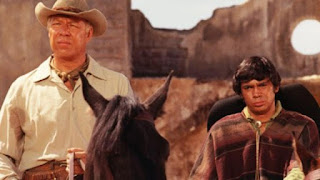
Movie Review: Guns Of The Magnificent Seven (1969)

The second sequel to 1960's The Magnificent Seven re-treads the by now tired story of seven loner mercenaries with special skills, in this case assembling to help Mexican rebels free their captured leader from a well-defended evil-army fort.

All the characters wander in from other, better movies where they were played by other, better actors. The leader of the seven is still Chris Adams, portrayed here by George Kennedy. He is supported by six mercenaries who bring their luggage along, including physical and mental frailties. The one-handed quick-draw with a racist attitude of course clashes with the black strong-man in the group. The old guy who is good with a knife wants to put the violent life behind him and focus on his family, while the fading gun-fighter suffers from a persistent cough. They are brought to life by the likes of James Whitmore, Joe Don Baker, Reni Santoni, and Michael Ansara, sturdy actors all, but a significant downgrade in star power.

The good Mexican villagers believe in their revolutionary cause, the ugly Mexicans drink a lot and pretend they are rebels, and the bad Mexicans run the army and torture the good villagers. The film builds up to the final assault on the army fort, which is a reasonable climax but hampered by startling inconsistencies (we just found all this dynamite!). Overly dramatic death scenes fail to inspire any emotion as the seven gradually dwindle to a number much less than seven.

At least the well-worn music survives from the original, and is one of the better reasons to endure this sequel. Directed by Paul Wenkos from a colour-by-numbers Herman Hoffman script, Guns of the Magnificent Seven mildly entertains but never ventures into challenging territory.


All Ace Black Movie Blog reviews are here.

Thursday, 4 December 2008

Movie Review: Prom Wars (2008)

Back in the early 1980's, a sub-genre of the teenage movie featured nerds and jocks one-upping each other for 90 minutes before the nerds inevitably triumphed and proved that smarts defeat brawn. This built-in bias is understandable since real-life nerds are much more likely than real-life jocks to become movie producers, directors and script-writers. 

Revenge of the Nerds (1984) and a host of sequels and imitators kept easily amused teens entertained and personified the era. Someone forgot to tell the makers of the Canadian production Prom Wars that this is 2008. Even the movie's tag-line "Love is a Battlefield", is stuck in decades past. 

Screenwriter Myles Hainsworth and Director Phil Price dust-off the concept of nerds facing off against jocks (mixed-up with preppies, in this case) from the nearby school, this time set against the framework of a half-baked competition to win the right to take the girls from yet another nearby school to the prom. 

A cast of relatively unknown young actors, lead by Ricky (Raviv) Ullman and Alia Shawkat, work hard to re-create ancient stereotypes and a positive impression that would hopefully lead to much better roles, to no avail. The usual assortment of characters is here: the really rich and snobby kid; the cool nerd; the girl-obsessed nerds; the pretty but snooty girl; and the less pretty but smarter girl; the strict headmistress; and the requisite black character. 

There is also a lame and unconvincing romance rattling around somewhere among all the heavily recycled ideas. If Prom Wars had been made twenty years ago, it would have been stale. In 2008, it positively reeks.


Wednesday, 3 December 2008

Movie Review: Get Smart (2008)


It's always quite painful when a movie is desperately trying to be funny, and yet nothing is working. There were maybe two moments in Get Smart that were funny enough to crack a small smile. The rest of the movie is just sad, because watching blatant failure unfold over a long 110 minutes just hurts.

It actually does not matter what the plot is, but here goes, for the record. Intelligence analyst Maxwell Smart (Steve Carell), working for the super-secret agency Control, is pressed into action as a field agent and is teamed up with super Agent 99 (Anne Hathaway) to thwart the latest dastardly plot by the evil KAOS. If this sounds extremely tired, that's because it is, and unless you bring something new to the table, why exactly is everyone bothering?

So what goes wrong here? Let's start with a script by Tom Astle and Matt Ember that has almost no comedic wit, cleverness or sharpness. Maxwell Smart is somehow both inept and brilliant. Agent 99 is supposed to be the best field agent but yet needs to be saved by the inexperienced Smart more than once. The romance that supposedly develops between Smart and Agent 99 is contrived enough to cause inadvertent puking. And let's add one of the worst collection of bad guys ever assembled: each one has been swiped from another movie. In fact, Get Smart shamelessly rips off an entire parachute scene from James Bond's Moonraker movie. Finally, the movie falls into the infantile trap of believing that Big Scenes with Lots of Action will cover for the complete lack of interesting characters or any semblance of believable plot developments.

Carell seems to realize the script is nowhere near good enough for him to play Smart straight and come across as funny, and he is right. There is nothing that any of the cast members can do to rescue this dog, and Hathaway in particular will hopefully have learned to steer away from such stinky material next time she is sent a role for the "sexy super secret agent with a troubled past who falls in love with the bumbling nerd in a laugh-out-loud comedy".

Old famous faces like Alan Arkin, James Caan, Terence Stamp, and Dwayne "The Rock" Johnson (ok, some not so old nor famous) are rattling around in the background of this movie, and hopefully they enjoyed their pay cheques because they will not enjoy having this title on their resume.

Director Peter Segal demonstrates no deft touches, and just hustles the action along as the movie lurches from one set piece to another, stitched together with awkward tin-eared dialogue. He may as well have phoned in his instructions.

Get Smart is a movie that makes you appreciate other movies, you know the ones, where the action scenes are actually exciting and the comedy scenes are actually funny.


All Ace Black Blog Movie Reviews are here.


Sunday, 23 November 2008

Movie Review: Recount (2008)


Can the world's leading superpower be unhinged by a Presidential election that is too close to call?

The United States had to face this scenario in the 2000 election, when the decision between Republican candidate George W. Bush and Democratic Vice President Al Gore came down to literally a handful of votes in Florida.

Recount, an HBO production, re-examines the events that transpired, starting on election night with Gore first conceding and then dramatically un-conceding the election as the vote counting in Florida tightens to a statistical dead heat. The film then follows the two campaigns as they mobilize for a bare-knuckled, old-fashioned political fight involving public opinion, the press, overwhelmed local county officials, the Florida Secretary of State Katherine Harris (Laura Dern), the Florida Supreme Court and finally the Supreme Court of the United States.

Bush and Gore are peripheral characters in the movie, mostly appearing as voices over the phone. The story is mainly told from the perspective of Ron Klain (Kevin Spacey), the lawyer who ends up leading the Gore team through the legal battles, and former United States Secretary of State James Baker (Tom Wilkinson), who leads the Republican team. Klain and Baker match wits and strategize against each other throughout the 5 weeks of controversy, and only meet at the end of the movie in a symbolic airport encounter.

The film tilts slightly and apologetically in favour of the Democratic party. The Gore team is portrayed as the more sympathetic scrambly bunch, out-gunned and fighting uphill against a slicker, better organized and better financed Republican team fighting on home turf. Florida's Governor is Jeb Bush, the candidate's brother, and Secretary Harris was the Florida campaign co-chair for the Republicans.

The film does an excellent job of recreating the period of uncertainty that prevailed, and of providing an insider's view of the controlled chaos behind the scenes as two massive campaigns maneuver through uncharted waters to try and claim the ultimate political prize. Given that the outcome is well known, director Jay Roach, and the cast of actors, working from a script by Danny Strong, are able to brilliantly inject emotion and drama as the sequence of events unfold, with each new surprise forcing a re-evaluation of strategy.

There are two notables sub-themes that the movie crystallizes: the first is the portrayal of Katherine Harris as an administrator thrust into a history-defining leadership role that is far beyond her capabilities by events that are far out of her control. The second is the examination of an electoral system that is designed to deal well with large numbers where small errors are irrelevant and tolerable. What happens when such a system is forced to deal with very small numbers where every vote becomes important? In both these sub-themes there are good lessons and topics of discussion about leadership and system design that add significant long-term value to the film.

While Recount for the most part recreates real events and portrays real characters, an understandable amount of artistic licence is also exercised. This really only matters to the few individuals who passionately care about extreme accuracy. For the rest of us, the film is a tight and controlled look into one of the most dramatic political events in the history of the United States.


All Ace Black Movie Blog reviews are here.

Saturday, 22 November 2008

Movie Review: Swing Vote (2008)


Interesting premise. Horrible execution.

Sometimes, Hollywood just seems to forget what the word "subtle" means, or how powerful it can be to deliver a message with cleverness and gentle prodding. Instead, the brash "in your face" delivery method is unleashed to carpet bomb any trace of soul that tries to poke itself out of the ground.

Swing Vote, directed by Joshua Michael Stern and written by Stern and Jason Richman, has Kevin Costner as the blue collar uneducated beer-loving single dad who is the beneficiary of a computer malfunction and gets to cast his vote again in the US Presidential election. And on his vote rides the outcome of the entire tight election between the Republican incumbent (Kelsey Grammer) and the Democratic challenger (Dennis Hopper). Interesting premise, and a clever idea that could have delivered compelling drama, comedy, or both. But in the hands of Stern and Richman, the film is a pure colour-by-crayons disaster that seems to run backwards into every imaginable cul-de-sac.

The international press descends onto Costner's tiny town and creates a media circus that the film overcooks to a charred crisp. Then both the Republicans and the Democrats wade into the mess in an attempt to win his vote, and proceed to immediately chuck overboard all that they stand for in response to every off-handed remark made by Costner's clueless character. So for example, overnight, the Republicans become pro-environment, the Democrats become pro-life, with the two candidates bowing to every whim of their driven campaign managers.

In the middle of the farce is Costner's idealistic, precocious daughter (Madeline Carroll, the only watchable thing in the movie), who despite having two substance-abusing losers as parents is somehow growing up to be the smartest kid in all of New Mexico. And let's not forget to throw in the ambitious local female TV reporter who wants this story to be her stepping stone to national prominence, and her boss the local station executive who works hard to define the word stereotype.

The film must win recognition for strictly limiting every character to one dimension; not avoiding any cliches; and not delivering a single intelligent, memorable or reflective moment.

And if the first 110 minutes were not bad enough, the film out-does itself in the last 10 minutes. All of sudden, Costner gets a brain, and starts to care; a character who could not stop thinking about beer suddenly contrives to deliver a painful monologue about the importance of being a good citizen, working hard, contributing to society, and voting. The two candidates just as suddenly seem to find a conscience, although even this transformation is hopelessly flubbed in the case of the Democrat, who needs a full-face whacking from his wife to rediscover his values (did we mention the lack of subtlety?).

Swing Vote is witless, boring and simply awful, for its entire overblown length.


All Ace Black Blog Movie Reviews are here.


Thursday, 2 October 2008

Film Review: Bluff (2007)


Bluff is an engaging piece of film-making from Quebec. In the tradition of weaving several unrelated stories around one inanimate object (famous examples being 1965's The Yellow Rolls Royce and 1998's The Red Violin), Bluff presents an apartment unit that is slated for destruction. At the final walkthrough before the bulldozers move in, the demolition foreman makes a startling discovery inside the apartment, the exact nature of which remains a secret until the film's final few scenes. The foreman is soon joined by the doomed apartment's superintendent, who calls the police to investigate the discovery, and as they wait for the authorities to arrive, we are taken back in time to see the stories of five sets of tenants who previously occupied the apartment.

A young man preparing for a job interview; an infertile couple seeking the help of a friend to get pregnant; an old man who was briefly a boxer and wants to re-live his glory by trading punches with his daughter's latest boyfriend; a couple who are about to celebrate a birthday just as soon they sell a set of horrid paintings to a mysterious buyer; and an aging thief who is staging a final heist in the hopes of enhancing his legacy. The stories are presented through inter-mingled scenes, and while the stories start innocently enough, they all start to head towards a threat of violence or unexpected misfortune, while always maintaining a low-key streak of humour. Meanwhile, back in the present, the construction foreman and the apartment superintendent are also discovering that all is not what it seems.

An ensemble cast of actors does a terrific job of bringing all the characters to life, which is no small achievement given that each actor is effectively creating one sixth of a movie. Co-directors Simon-Olivier Fecteau and Marc-Andre Lavoie manage to quickly introduce us to the unique dynamics of each story, and effectively weave the various threads into compelling vignettes that may or may not be heading to a variety of unwelcome endings.

With a suitably nifty soundtrack, Bluff is proof that a small, low-budget film can provide clever and thoughtful entertainment through tight storytelling, deft acting and efficient directing.


Film Review: Notre Univers Impitoyable (2008)


Two lawyers on the fast-track to success at a private law-firm, Margot and Victor, work as a team and are also a loving couple. When a senior partner drops dead and creates an opening for a new senior position, only one out of Margot and Victor will get the promotion, and the other will have to settle for a supporting role.

Notre Univers Impitoyable (meekly titled What If? in English) cleverly explores both possible scenarios: Margot as the new senior partner, breaking down gender barriers and becoming the new glamour star of the firm, while Victor labours in her shadow. Or Victor as the hard-driving new senior partner, with Margot relegated to serving coffee and caring for the children.

The film consists of inter-cut scenes that alternate between the two possible realities. There are parallels and contrasts between the two, and director Lea Fazer has fun with the interplay. She effectively and seamlessly introduces the switches between the two stories by embedding "what if" questions into the script, as cues for the role reversal scenes that follow. In both story lines, the couple's relationship is rocked by infidelity, feelings of neglect, family versus career conflicts, and questions about true values. A strong common theme emerges between the two stories, addressing the impact on a relationship that is thrown out of a comfortable balance.

Alice Taglioni as Margot and Jocelyn Quivrin as Victor (a real-life couple) are both excellent. They have an obvious chemistry together, and they establish a high degree of empathy for their characters in both story lines. Taglioni and Quivrin effortlessly pull-off three roles, depending on the scene: equals, superiors and subordinates. The film is enriched with many well-rounded supporting characters: Thierry Lhermitte as one of the principles of the firm, who makes the decision about who gets the promotion and then manipulates the consequences to his advantage; Pascale Arbillot as Margot's recently-dumped sister; Scali Delpeyrat as another lawyer at the firm; and Julie Ferrier as the law firm's resident paralegal / mistress.

The film is brisk, helped along by a catchy music score and clever but not pretentious camerawork. An entertaining, thoughtful and well-executed film.


Monday, 1 September 2008

Movie Review: First Blood (1982)


There was a time when action movies could deliver entertainment without resorting to a cartoonish computer-generated special-effects laden climax every 10 minutes. First Blood is a reminder that an action movie can be remarkably low key in its setting and character development, and yet deliver a strong punch when based on a message inspired by real events and memorable personalities.

Sylvester Stallone, when he was famous but not yet a joke, is John Rambo, a Vietnam war veteran back in the US who is devastated to find out at the beginning of the film that the sole other combat survivor from his Special Forces unit has succumbed to cancer.

In a representation of the poor welcome home afforded to most Vietnam vets, Rambo is treated badly by the Sheriff (Brian Dennehy, who puts in an excellent but slightly exaggerated performance) and police force of a small local northwest town. The maltreatment triggers the soldier to revert back to war mode in the surrounding hills and forests (the movie is filmed in and around the town of Hope, British Columbia), and soon the war expands to include the clueless local contingent of the National Guard, who are as over-matched as the police, and Rambo gradually draws the conflict back to a final showdown within the town.

Richard Crenna arrives as Rambo's field commander and mentor, and as the police and National Guard are scurrying around pretending to know something about warfare in the forest, Crenna delivers the classic line to Dennehy: "I don't think you understand. I didn't come to rescue Rambo from you. I came here to rescue you from him."

First Blood is part of Hollywood's thoughtful post-Vietnam war examination of the conflict, an era that resulted in large scale epics like Deer Hunter (1978) and Apocalypse Now (1979), as well as smaller scale films like Coming Home (1978) and Platoon (1986).

Stallone would subsequently achieve stratospheric commercial success with Rambo: First Blood Part II (1985), which while undeniably entertaining, unfortunately sacrificed nuance in favour of a jingoism.

In First Blood, Rambo is a hero who feels pain both emotional and physical, bleeds, has to tend to his wounds, tries to stop the conflict before it escalates, and spares the life of most of his enemies. Directed by Ted Kotcheff and running an efficient 96 minutes, First Blood delivers its message with uncommon integrity.


All Ace Black Blog Movie Reviews are here.


Movie Review: Gunfight At The OK Corral (1957)


Burt Lancaster is lawman Wyatt Earp, Kirk Douglas is gunfighter / gambler / dentist Doc Holliday, and together they forge an unlikely alliance to clean up lawlessness in Tombstone.

Gunfight At The OK Corral is based on true events and real characters, but of course the Hollywood treatment is lathered on in great quantities to create fiction and fact at least in equal doses. In reality the actual Gunfight took a matter of seconds. In the movie, it is a solid 10 minute battle, but with unquestionable entertainment value.

Directed by John Sturges, this is a classic western where good and evil are clearly defined but with intriguing shades of moral ambiguity. These mostly revolve around Doc Holliday, by far the most interesting of the main characters and made more so by Douglas' shifty performance. Holliday is a man one step ahead of death, and it's coming at him both from the disease eating away at him, and from the next gunslinger to challenge him. In the meantime he focuses on gambling, drinking, womanizing and finding the thin path that will keep him alive one more day.

In contrast Lancaster's Wyatt Earp is for the most part the prototypical and somewhat boring lawman with a strong moral compass who believes in the righteousness of his actions, and is presented in the film as representative of the type of leader who transitioned the West from rampant lawlessness to a more civilized era.

That Earp forges some sort of friendship with Holliday morally weakens the lawman but strengthens his firepower. And when the bullets start flying in the excellent but historically inaccurate final showdown, firepower is definitely the way to go.

To the film's credit, Earp also has to make a decision to transform the dispute with the cattle rustlers into a personal family feud rather than follow due legal process. In reality, after the OK Corral showdown, Earp became an uncontrollable law unto himself, and embarked on an almost mythical quest to clean up the West without concerning himself too much with the nuances of the law, events that are more fully explored in Tombstone (1993).

Sturges does a fine job steering the film to its climax, introducing a rich tapestry of characters, events, and locations. At just over two hours in length, the story is provided relaxed room to breathe and develop, accompanied by Dimitri Tiomkin's evocative soundtrack. 


All Ace Black Blog Movie Reviews are here.