Showing posts with label Winona Ryder. Show all posts

Sunday, 27 July 2025

Movie Review: The House Of The Spirits (1993)


Genre: Drama  
Director: Bille August  
Starring: Meryl Streep, Jeremy Irons, Glenn Close, Vanessa Redgrave, Winona Ryder, Antonio Banderas  
Running Time: 146 minutes  

Synopsis: The setting is Chile, starting in the 1920s and spanning three generations. Esteban (Jeremy Irons) works hard to earn his fortune, and after his intended bride tragically dies, he marries her psychic sister Clara (Meryl Streep). Esteban rises to become an influential landowner and then a politician, but his sexually repressed spinster sister Ferula (Glenn Close) is a source of constant irritation. With socialism threatening Esteban's conservative ruling class, his daughter Blanca (Winona Ryder) falls in love with peasant revolutionary leader Pedro (Antonio Banderas), adding strife to the household.

What Works Well: This adaptation of Isabel Allende's novel is a never-dull gallop through 50 years of a family's ups-and-downs. A country's evolution and the rise of the working class provide a crackling context for Esteban's trajectory from hardworking labourer to powerful landlord, culminating in an unexpected encounter with humility. The women in his life are a source of tragedy, love, pleasure, frustration, joy, and anger, converging into difficult-to-learn lessons about what matters. Clara's subtle supernatural abilities provide a magic sparkle in an otherwise grounded milieu, while the visuals capture both beautiful landscapes and meticulous indoor sets.

What Does Not Work As Well: The South American soul of the story is degraded by the Anglo-American dominated cast, while the packed-in incidents allow limited opportunities for reflection. The narrative flow appears initially unsure whether to place Clara or Esteban at the drama's centre.

Key Quote:
Ferula: I set my curse on you, Esteban! You will always be alone! Your body and soul will shrivel up and you'll die like a dog!


All Ace Black Movie Blog reviews are here.

Friday, 15 April 2022

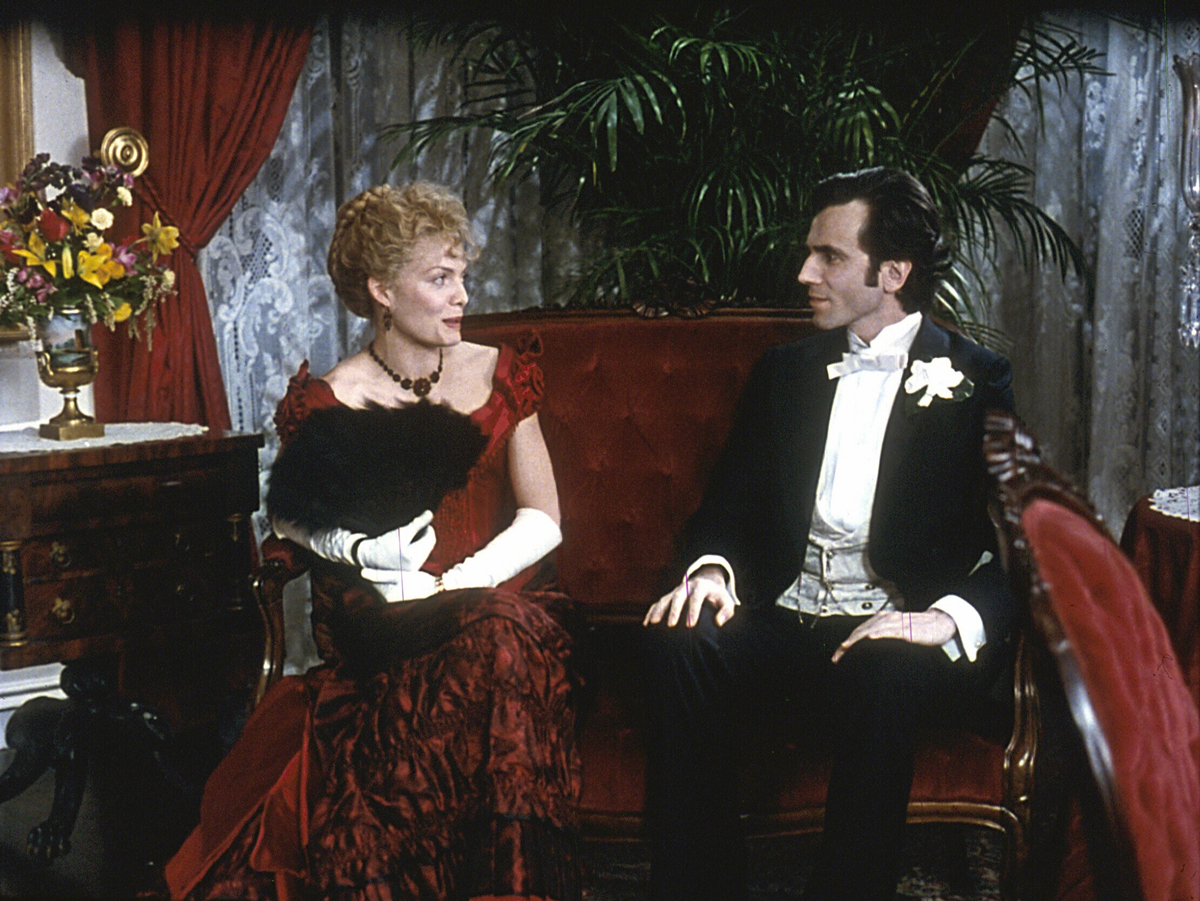
Movie Review: The Age Of Innocence (1993)

A romantic costume drama, The Age Of Innocence wallows within a tepid love triangle.

The setting is New York City in the 1870s, and the social circles inhabited by elite families. With every gesture observed, scrutinized, and judged according to behaviour codes, respected lawyer Newland Archer (Daniel Day-Lewis) announces his engagement to May Welland (Winona Ryder), a union that will bring together two influential families.

But May's jovial cousin Countess Ellen Olenska (Michelle Pfeiffer) is back in town, and immediately catches Newland's eye. Ellen carries the whiff of scandal, because her marriage to a European aristocrat fell apart and she was rumoured to have had an affair. With the rest of New York's society shunning her, Newland becomes her one defender and confidant, and a passionate love develops between them.

While undoubtedly gorgeous to look at with lavish period sets, immaculate costumes and make-up, grand opera houses, and high-society balls, The Age Of Innocence cannot overcome a lifeless script and pure lethargy. Director Martin Scorsese is out of his element, and falls victim to a standard story of misplaced affections as Newland becomes yet another man jeopardizing his standing in pursuit of the alluring but flawed independent woman.

Scorsese and co-writer Jay Cocks adapt the Edith Wharton book and infuse the script with critiques about social norms and expectations, with nods to women like Ellen yearning for more autonomy but encountering a wall of judgment. Newland is more enlightened and eager to argue for a society that does not solely punish a woman for her husband's awful behaviour. Throughout are unsubtle references by both Ellen and May about seeking safety, here used as code for economic security and social status.

But the film flounders on glacial pacing, repressed dialogue suppressing displays of initiative. Multiple scenes invest in various characters discussing the planned length of Newland's engagement to May, and whether this should be shortened. Another topic of obsessive discussion is whether Ellen should or should not relocate back to Europe. Meanwhile Newland and Ellen engage in repetitive scenes circling the same conversations and arguments about their impossible love. 

Other weaknesses include forgettably bland secondary characters, and excessive narration (by Joanne Woodward) that more resembles a book reading. Daniel Day-Lewis, Michelle Pfeiffer, and Winona Ryder are suitably coiffed but sink into the prevailing staidness, their predictable emotions disappearing into the candle-lit sets. The Age Of Innocence is a tranquil descent into the age of drowsiness.


All Ace Black Movie Blog reviews are here.

Saturday, 24 July 2021

Movie Review: Reality Bites (1994)

A life-after-college drama, Reality Bites grapples with friendship, romance and the travails of adulthood. The challenge of pursuing dreams gradually gives way to a bland romantic triangle.

In Houston, a group of college friends venture into the real world. Class valedictorian Lelaina (Winona Ryder) is an aspiring documentarian and is filming the lives of her friends Troy, Vickie and Sammy. Handsome musician Troy carries a too-cool attitude and a perpetual cigarette but is happy to generally do nothing. Vickie (Janeane Garofalo) is terrified of commitment, sleeping with a different stranger every night while working at The Gap. Sammy is gay but has not yet come out to his parents.

Navigating adulthood gets harder when Lelaina is fired from her job as an intern on a cheesy morning television show and Troy is fired from his twelfth menial job. Vickie is promoted to store manager, but has a health scare. Lelaina meets television producer Michael (Ben Stiller) and they start a relationship, but she always harboured a crush on Troy, and now finds herself torn between a stable boyfriend and a dreamy but shiftless hunk.

A companion piece to 1992's Singles, Reality Bites tracks members of Generation X as they step out of their cocoons. Written by Helen Childress and directed by Stiller, the stories of Lelaina, Troy, Vickie and to a lesser extent Sammy check off all the expected themes: student debt, the difficulty of landing a job with no experience, the monthly drama of paying rent, the dilemma between striving for a dream or settling for what's available, and the mortal fear of turning into their parents.

Of course every generation faces similar tests, but Childress and Stiller tease out some Gen X specifics, including the broken homes they all come from. Lelaina possesses the self confidence and fortitude to at least try and stick to her vision, in terms of both career and artistry. Troy's deeply ingrained idealism mixes with cynicism to translate into an overriding sense of ennui. Vickie embraces her McJob but fences with relationship insecurities and the lingering threat of the disease of the 1980s. Finally, and to the detriment of the character's prominence, Sammy's sexuality is a non-issue among his friends.

In the first two acts Childress maintains a fine balance between empathizing with her protagonists and rolling her eyes, despite Stiller the director leaning too heavily on montages and a choppy, overstuffed soundtrack. But the ideas run out in the final third, and Reality Bites devolves into traditional love triangle territory, Lelaina caught between the grounded Michael and floaty Troy. Here the narrative unravels, Troy never demonstrating even the promise of any future redeeming values as a worthy partner.

Winona Ryder brings her full sparkle to Lelaina even if at times she is too perky. Ethan Hawke is the other stand-out performer, convincingly creating in Troy a character who probably peaked in high school. Faced with a biting reality, some bite back while others just sulk and lick their wounds.


All Ace Black Movie Blog reviews are here.

Saturday, 27 February 2021

Movie Review: Homefront (2013)

A basic action drama about an ex-government agent tangling with small-town drug pushers, Homefront brawls through predictably satisfactory territory. 

In a messy operation, New Orleans-based Drug Enforcement Agency (DEA) undercover officer Phil Broker (Jason Statham) disrupts the methamphetamine lab of gangster Danny T (Chuck Zito). Disillusioned with unnecessary bloodshed, Phil retires to the small rural Louisiana town of Rayville to raise his young daughter Maddy (Izabela Vidovic) in peace.

Maddy tangles with the school bully, and Broker humiliates the bully's parents Cassie and Jimmy Klum (Kate Bosworth and Marcus Hester). Cassie turns to her brother and local meth manufacturer "Gator" Bodine (James Franco) to settle scores. Gator and his girlfriend Sheryl Marie (Winona Ryder) uncover Broker's background and conspire with the imprisoned Danny T to cause more trouble for Broker and Maddy.

A solid, unspectacular, and eminently calculable drama, Homefront delivers exactly what should be expected from a film starring Jason Statham with a screenplay by Sylvester Stallone. Regardless of the plot's progress, about every 10 minutes Broker gets to display his superior combat skills, taking on one or many foes with a near-certain outcome: Broker standing tall, everyone else crumpled in a heap. It's an almost comforting level of normalcy in action film making.

Stallone adds enough notes of humanity between Broker and his daughter Maddy to surround the skull bashing with familial warmth. And the character of drug addicted redneck mama bear Cassie, with Kate Bosworth in excellent form, injects a welcome variability.

But otherwise director Gary Fleder manages to bungle many of the action scene with barely rational angles and lazy editing, while the plot fills several cliche bingo cards: father and daughter lamenting the loss of the idyllic wife/mother, the horse-riding child placed in harms way, the pet in peril, the Black sidekick (Omar Benson Miller), the corrupt local cop (Clancy Brown), and the hints of a romance between the tough protagonist and the perky school psychologist (Rachelle Lefevre, way too perky for this backwater of a little town). 

Star charisma helps navigate the routine terrain, Jason Statham's stoic heroism and Dave Franco's slimy villainy creating worthy adversaries. Winona Ryder is too good for the fast-fried role of a trashy errand girl on the cusp of finding a conscience. Homefront wins no awards for originality, but is too busy breaking bones to care.


All Ace Black Movie Blog reviews are here.

Friday, 15 January 2021

Movie Review: The Iceman (2012)

A crime drama based on actual events, The Iceman recounts the remarkable story of a mob enforcer who killed dozens of victims. While the events portrayed are astonishing, the central character remains necessarily aloof.

In New Jersey of 1964, brooding, large-framed and quiet Ritchie Kuklinski (Michael Shannon) marries the winsome and innocent Deborah (Winona Ryder). He holds a lowly job dubbing underground porn films, and commits a murder to avenge a petty insult. Local mobster Roy DeMeo (Ray Liotta) is impressed with Ritchie's coolness under pressure and hires him as an enforcer. Over the next ten years Ritchie proves to be ruthlessly efficient at eliminating Roy's enemies.

Killing is his business, business is good, and the money rolls in. The family moves to a large house and Ritchie enrolls his two daughters in private school as they grow up clueless about their father's criminal endeavours. The good times are threatened when first Ritchie refuses to kill an innocent witness, then rival mobster Leonard Marks (Robert Davi) pressures Roy to clean house after a botched drug deal. Ritchie's income is cut off, forcing him to team up with independent assassin-for-hire Pronge (Chris Evans), who operates out of an ice cream truck.

An adaptation of a book by Anthony Bruno with a screenplay by Morgan Land and director Ariel Vromen, The Iceman is a trip to the dark business of transactional death among gangsters. Beautifully recreating the 1960s/1970s era, the film almost, but not quite, succeeds in humanizing a man capable of snuffing out life with startling ease. And while Kuklinski's story is nothing short of extraordinary, his soulless responsibility for countless abhorrent acts in a repugnant underworld envelops the narrative.

Vromen seeks hints of normalcy on the home front, and the separation between family and "work" provides moments of relief from all the gangland atrocities. Wife Deborah and daughters Betsy and Annabelle go through life with Kuklinski blissfully unaware of his profession. With Winona Ryder confined to a thankless role, Deborah's naivete reflects poorly on a woman simpleminded enough to never delve into her husband's reality (he easily sells her the fiction of being a currency trader). 

A few morsels of background are offered to explain the psychology of a taciturn assassin. Vromen uses one scene of Ritchie visiting his incarcerated brother to briefly expose the abuse he suffered as a child at the hands of a Polish immigrant father. Otherwise, it is left to Michael Shannon to occasionally express anguished love for his family with theatrical emotional outbursts.

The final act is an almost incomprehensible jumble of death. Ritchie is surrounded by threats from all sides, allies become double-crossing foes, and every scene features someone expiring. The carnage may accurately represent Ritchie's violent life, but as a cinematic experience, the impact is numbing.

The Iceman kills with metronomic regularity, his heart forever frigid.


All Ace Black Movie Blog reviews are here.

Sunday, 2 February 2020

Movie Review: Little Women (1994)


An amiable adaptation of the 1868 Louisa May Alcott novel, Little Women strives for a cozy tone of sisterly bonding.

Concord, Massachusetts during the Civil War. The March family's financial fortunes take a downturn when father goes off to serve in the war. Marmee (Susan Sarandon) nevertheless stays calm as she instills charitable values in her daughters Jo (Winona Ryder), Meg (Trini Alvarado), Amy (Kirsten Dunst) and Beth (Claire Danes).

The girls meet next-door neighbour Theodor Laurence (Christian Bale). Despite coming from wealth he becomes a constant companion of the sisters and starts to fall in love with Jo. But she is an aspiring writer more interested in starting a career than settling down. With Meg attracting the interest of Theodor's tutor John Brooke (Eric Stoltz), Jo sets off to New York where she meets professor Friedrich Bhaer (Gabriel Byrne), while the grown-up Amy (Samantha Mathis) heads to Paris with the elderly Aunt March (Mary Wickes).

45 years after the 1949 version starring June Allyson, Hollywood returned with the fifth big screen adaptation of the classic story, and the first to be directed by a woman. Gillian Armstrong aims for and generally achieves a Normal Rockwell-inspired mood, the script by Robin Swicord structured as a mostly quaint and family-oriented coming-of-age story.

Which is both an asset and a burden. Little Women never threatens to evolve into anything other than charming storytelling, often flirting with antiquated. The film always looks gorgeous, but also emit the whiff of staginess and almost perfect posing into just the right angle with fireplace lighting to achieve the nostalgic painting resonance.

Armstrong effectively uses the two hours of running time, every incident in the ups and downs of the March family given its due, but without bursting through a fairly narrow band of emotional involvement. The four girls remain short of memorable, just missing a cutting edge or breakout moment, all in favour of calm whimsy.

The talented young cast perform admirably within the confines of the material. Winona Ryder's Jo deserves more bite than provided by Swicord's script, while Christian Bale glides through the film with an appropriate reserve, a young man caught in love with a woman deciding her potential career matters more.

Capable but less than notable, Little Women is faithfully decorous.


All Ace Black Blog Movie Reviews are here.


Monday, 19 November 2018

Movie Review: The Dilemma (2011)


A comedy-drama-buddy movie, The Dilemma creates a narrative mountain out of a molehill.

In Chicago, Ron (Vince Vaughn) and Nick (Kevin James) are business partners and long-time friends. Ron is a smooth salesman and Nick is a brilliant engineer, and they secure a lucrative but time-constrained contract to develop a high-powered electric engine for Chrysler. Nick is seemingly happily married to Geneva (Winona Ryder) while Ron, a recovering gambling addict, is in a long-term relationship with Beth (Jennifer Connelly) and thinking of proposing.

With all the pressure on Nick to deliver the innovative new engine, Ron spots Geneva in a lovers' embrace with hunky Zip (Channing Tatum). Ron is caught in a dilemma, not sure if and when he should tell his already frazzled friend that his wife appears to be cheating. The secret starts weighing on Ron, affecting his own relationship with Beth.

Incongruously directed by Ron Howard and written by Allan Loeb, The Dilemma may have worked as a 90 minute independent feature with a light and quirky touch. Instead, here it is bloated into two hours of torment, with an overpowering star name in every underwritten role as Howard strains every muscle to stretch the flimsy premise into an event. Even Queen Latifah shows up as a preposterous auto industry consultant.

The entire film hinges on Ron suppressing a "your wife is cheating" conversation with Nick, and none of the surrounding fluff makes any difference: Ron's background as a gambling addict; his college-days romantic adventures; Nick's extracurricular massage parlour habits; Beth's parents' anniversary; the electric engine project and even the non-entity of Zip's character. All are undeveloped idea fragments sprayed around to pad the running time and obscure the paucity of substance.

The marginal positives include a few laughs and chuckles when Vaughn finds some form in his monologues. But ever here Loeb somehow introduces a borderline homophobic remark, and the continuous faux-macho football-infused banter between Ron and Nick is juvenile and tiresome. Other than being a wife and a girlfriend respectively, Geneva and Beth are provided with no exposition.

Despite all the available talent on both sides of the camera, The Dilemma wallows in an exaggerated quandary of its own making.


All Ace Black Blog Movie Reviews are here.


Saturday, 30 December 2017

Movie Review: How To Make An American Quilt (1995)


An anthology about women's diverse experiences and perspectives, How To Make An American Quilt weaves a loose narrative about a young woman at the emotional crossroads spending the summer with her great aunt's circle of friends.

Finn (Winona Ryder) is in her mid-twenties, struggling to finish her Master's thesis and engaged to be married to carpenter Sam (Dermot Mulroney). She spends the summer at the country home of her great aunt Glady (Anne Bancroft), who is part of a quilting group led by housekeeper Anna (Maya Angelou). As the lazy days unfold and the friends gets to work on a wedding quilt for Finn, she learns their personal stories.
  • Finn's grandmother Hy (Ellen Burstyn) has a strained relationship with her sister Glady, stemming from a moment of weakness when Hy's husband was on his deathbed.
  • Sophia (Lois Smith) is now cranky and bitter. As a young woman (played by Samantha Mathis) she was a sublime diver who fell in love and married geologist Preston (Loren Dean), but her married life did not unfold as she expected.
  • Em (Jean Simmons) is married to artist Dean (Derrick O'Connor), who has always had a wandering eye.
  • Constance (Kate Nelligan) first lost her dog and then her husband; her subsequent behaviour means that she is now a bit of a misfit in the group.
  • As a young black servant Anna was seduced by her boss' son Beck (Jared Leto); during the resulting pregnancy she became close with Glady.
  • Anna's daughter Marianna (Alfre Woodard) is a sophisticated free spirit who refused to commit to any man, but she carries one regret.
  • Finn's mother Anna (Kate Capshaw) has long been divorced, but she arrives late in the summer with a new surprise.
During the summer Finn also meets the extremely hunky Leon (Johnathon Schaech), and has to decide how much the potential long term commitment to Sam means to her.

An adaptation of the Whitney Otto book directed by Jocelyn Moorhouse, How To Make An American Quilt enjoys relaxed pacing and a soulful perspective. Breathing deeply from the almost resigned stance of older women looking back, often with plenty of regret, the film offers plenty of themes and talking points. The Jane Anderson script avoids pat answers and easy resolutions; this is a compendium of several lives, women defined by their decisions as life's surprises rarely align with expectations.

The film's compilation structure is both its strength and its weakness. How To Make An American Quilt never lingers in one place for too long, as no fewer than eight stories share less than two hours of screen time. Proving that every person has a good tale to tell, Moorhouse gives equal due to each vignette, and the chapters creates and hold individual mystique.

At the same time the patchwork composition is what it is: sequential short stories told with expediency, tending to emphasize melodrama to quickly get to the point. It's not a stretch to imagine all eight stories as potential material for good full length features, but here only the headlines are on display.

The performances are uniformly good from a dream cast featuring veterans Burstyn, Bancroft, Simmons, and Nelligan, as well as poet and civil rights activist Angelou. Ryder holds her own, her relative lack of subtlety finding an understandable home as an emotive young woman a generation removed from all her companions.

Ultimately the convergent narrative is the collective wisdom that Finn will take away from her summer, and How To Make An American Quilt hits a solid target with an emphasis on the unconventional. The beauty of a quilt knitted by many hands is in its lack of coherent precision, the emotions seeping across the borders achieving imperfect perfection.


All Ace Black Blog Movie Reviews are here.


Wednesday, 10 June 2015

Movie Review: Edward Scissorhands (1990)


A dark fantasy drama with a mean streak of humour, Edward Scissorhands is a fiercely original treatment of the comfortably familiar fitting-in theme.

The film is set in a suburban subdivision located at the base of a mountain, with a Gothic mansion on top looming over the quaint houses. On a snowy night, an old lady tucks her granddaughter in and recounts a story that happened years ago, triggering a film-long flashback. Avon lady Peg (Dianne Wiest), a subdivision resident, is having a bad day, and with nothing to lose decides to head up to the mansion to try and make a sale. Inside she finds the place empty except for a frightened young man called Edward (Johnny Depp), with large scissors for hands. Edward was created by The Inventor (Vincent Price), who died before he could complete Edward and provide him with proper hands. Peg feels sorry for Edward and takes him home. Peg's husband Bill (Alan Arkin) and son Kevin are initially stunned but accept Edward as a new member of the family.

Edward is scared and his massive scissor hands cause plenty of accidents, but with Peg's help he slowly starts to adapt to suburban life. The gossipy neighbours, including the over-sexed Joyce (Kathy Baker), are fascinated, and Edward becomes a local celebrity when he demonstrates artistic talent for sculptural hedges, trimming the fur of pet dogs, and providing the women with stylish hair cuts. When Peg's daughter Kim (Winona Ryder) returns from a camping trip, she is initially horrified to find Edward in her room, but gradually Kim and Edward develop feelings for each other, which is bad news for Kim's aggressive boyfriend Jim (Anthony Michael Hall).

Directed and co-produced by Tim Burton and written by Caroline Thompson, Edward Scissorhands is a dark masterpiece. With brisk pacing Burton unleashes his irresistible fantasy on a comically idealized suburban world stuck in an undefined hybrid of the 1950s and 1970s, with every house sporting a bright monochrome paint job. The mansion on the hill, of course, stands in stark contrast, the brooding outsider bathed in black, dark blues and darker greys.

Peg and her neighbours go about their business of pursuing the American dream, the women left at home during the day to gossip and cause mischief while the men drive to work in the morning and come back in the evening with army-like discipline. Edward is dropped into this immaculately manicured world, and his dream is just to be part of the human family. Not too tall and definitely not superficially handsome, Edward is pasty but enigmatic. Remarkably, he is generally accepted as is, and only the complications caused by affairs of the heart cause him grief.

The central themes of belonging, finding a home, and stumbling upon love run through the film. Once Kim makes her appearance the candle of romance flickers to life, but the darkness also seeps in, with Edward causing unintended grief by wanting to love and be loved. The film suggests that the ability to care and love is fundamentally human, and a non-human invention such as Edward can live alongside humans but will struggle to share in the true fulfillment brought upon by mutual passion.

Burton makes use of plenty of clever point-of-view shots, particularly from Edward's perspective, to highlight the experience of the newcomer with an incomplete skill set. Whether it's Peg being excessively nice with her make-up kit or Edward trying to capture any vegetable to eat at dinner, Burton frequently invites the viewer to live in Edward's shoes, dramatically enhancing the film's impact even in the smallest moments daily life.

Johnny Depp launched his career with his portrayal of Edward. It's an unforgettable performance centred on almost silent pathos. Depp's understated expressions convey sadness, fear, panic, bewilderment, anger and sometimes happiness, and later on he captures what it means to find wistful infatuation and a potential first romance. Wiest represents middle America's capacity to display a big and welcoming heart, while Ryder does well in a quick transition from callous to caring. Kathy Baker plays neighbour Joyce for broad laughs, as intended.

Edward Scissorhands delivers on all its multi-genre promises, mixing drama, humour, fantasy and romance with an emotionally satisfying cutting edge.


All Ace Black Blog Movie Reviews are here.


Monday, 2 June 2014

Movie Review: Heathers (1988)


A dark high school revenge comedy, Heathers takes peer pressure to dangerous corners where violent fantasies become real and the consequences are deadly, all with a dose of acrid humour.

Heather Chandler (Kim Walker), Heather Duke (Shannon Doherty), and Heather McNamara (Lisanne Falk) form the most uppity clique of girls at Westerburg High School in Sherwood, Ohio. Chandler is the conceited and dominant leader, Duke the bulimic and bookish brunette, and McNamara the tentative cheerleader. Veronica Sawyer (Winona Ryder) is trying to join the Heathers, but often finds herself the target of their insults instead. J.D. Dean (Christian Slater) is the new kid in school, and is both too cool and too quick to resort to the threat of violence.

Veronica and J.D. start a romance, but when Veronica runs out of patience with the Heathers and out of frustration wishes that Heather Chandler was dead, J.D. is happy to oblige. Chandler's death is disguised as a suicide, and ironically she becomes even more popular after her death. Soon Veronica finds herself in a maelstrom of multiplying murders and pseudo suicides, as J.D. runs amok, the school is thrown into turmoil, and another Heather simply moves up the hierarchy to once again traumatize the uncool kids.

Heathers turns the awkwardness of high school into a tragic comedy. Peer pressure, abject meanness, the bullies and the bullied, the need to fit in, outcasts in the corners, jocks and hunks all come to life in a bizarre pantomime. But rather than chase after the usual themes of celebrating individuality through sarcasm and broad humour, the Daniel Waters script veers off into uncharted territory. Here the reveries born from typical grievances become all too real, people die, murder and suicide grip the school community. Everything seems to change, and yet nothing really does change.

Released eleven years before the Columbine High School shootings changed the discourse about violence at schools, Heathers is free to explore violence and its consequences through the warped lens of sarcasm. Metaphorically, J.D. represents Veronica's dark side taking control and acting on her most evil impulses, and Heathers is ultimately about the resilience of the well established high school culture. No matter how disruptive J.D.'s actions are, he is no match for the prevailing order. The school's ecosystem adjusts and rearranges itself, the popular kids become more popular, the losers remain losers, and life continues. The violence creates a ripple effect but ultimately consumes itself, leaving a trail of victims but achieving little.

Working with a miniscule budget of $2 million, Michael Lehmann keeps the production simple, with a focus on the characters and Waters' sharp words. Winona Ryder is perfectly cast as Veronica, her brooding yet mischievous persona acting as both instigator and observer of the pandemonium. Christian Slater gives J.D. an ice cold stance, an emotionless killer disconnected from the reality of his actions. The actresses portraying the Heathers do a fine job of creating three unique profiles united in their desire to demean everyone else.

Heathers is challenging, charming and unsettling. Narcissistic girls can be hell to deal with, but unleashing violence in response just makes hell that much hotter.


All Ace Black Blog Movie Reviews are here.


Thursday, 7 November 2013

Movie Review: Beetlejuice (1988)


An afterlife comedy, Beetlejuice takes the side of a ghostly couple haunting their own home, and the new perspective generates plenty of clever laughs.

Adam and Barbara Maitland (Alec Baldwin and Geena Davis) are spending an idyllic vacation in their gorgeous but slightly spooky Victorian New England home. An unfortunate car accident leaves them both dead. They return to haunt their home, but their placid ghostly existence is disrupted by new owners. Bickering couple Delia and Charles Deetz (Catherine O'Hara and Jeffrey Jones) and their daughter Lydia (Winona Ryder) are an annoying presence, and Adam and Barbara start the process of learning how to create enough of a nuisance to drive away the new arrivals.

Beetlejuice (Michael Keaton) is a hyper-kinetic rogue ghost, and he offers his services to the Maitlands as a specialist in scaring off the living. Delia starts to redecorate the place with the help of her insufferable interior designer Otho (Glenn Shadix), while Charles just wants to be left alone to relax. Lydia despises her parents and is into the dark scene, and this allows her to see and befriend Adam and Barbara. With scare tactics not really working, Adam and Barbara have to decide whether Beetlejuice is more of an asset or a liability, while Lydia has to accommodate two friendly ghosts into her lonely life.

Beetlejuice is briskly paced, funny, and with just enough self depreciation to maintain a light-hearted mood. Director Tim Burton creates a vivid alternative reality where ghosts are the rightful tenants and the living are the intruders, the ghosts experiencing their own sense of entrapment with massive earthworms preventing their leaving. Adam and Barbara also discover that the world of impenetrable user manuals and bureaucracy follows them to the afterlife, with the most imaginative scenes unveiling the world of the dead clogged with paperwork, bored secretaries, overburdened case workers and crowded waiting rooms experiencing long wait times.

Alec Baldwin and Geena Davis make for a cute couple, and their transition into ghosts is handled with a dry matter-of-factness. Winona Ryder steals the film as the dark, curious goth teen, her willingness to explore new dimensions allowing her to see spirits invisible to others. Ryder acts with eyes that are defiant, questioning and brave, and she gives Lydia the inner steel needed to tolerate her parents. Compared to the aggravating Charles and Delia, a couple of ghosts are easy.

Michael Keaton lets loose with a high energy, berserk role as Beetlejuice, a wound-up ghost covered with layers of decaying make-up and powered by the uniquely irritating sensibility of a desperate used car salesman. Beetlejuice's antics are the driving force behind most of the special effects in the film, state of the art for 1988 and still impressive in a modern context. A gigantic snake headed by Beetlejuice is the slithery highlight. He may be a loudmouthed and unmannered boor of a ghost, but Beetlejuice knows how to have fun among the living.


All Ace Black Blog Movie Reviews are here.


Sunday, 5 February 2012

Movie Review: Girl, Interrupted (1999)


A tale of depression, Girl, Interrupted loses momentum by unnecessarily lingering on every scene and celebrating its self-indulgence. Winona Ryder and Angelina Jolie are excellent, but a relatively simple and personal story is overblown into a sometimes tiresome melodrama.

Based on the memoire of author Susanna Kaysen, the film is set in the 1960s. Susanna (Ryder) is detached from her parents and depressed, although the causes are only vaguely hinted at. After attempting suicide and under pressure from a psychiatrist, Susanna signs herself into Claymoore Hospital, a facility to treat mental illness. Run by the aloof Doctor Wick (Vanessa Redgrave), the other patients at Claymoore include the hyperactive and rebellious Lisa (Angelina Jolie) and the vulnerable but stoic Daisy (Brittany Murphy).

Lisa has made a habit out of regularly leaving and returning to Claymoore, treating the facility as a home base to run back to whenever her aggressive attitude to life catches up with her. Daisy is working towards being released and living on her own, but is emotionally vulnerable and prone to cutting herself. Nurse Owens (Whoopi Goldberg) is the main link between the patients and the outside world, in turns berating them for breaking the rules and encouraging them to edge closer to dealing with reality. After a series of encounters with the other girls, some exhilarating and others tragic, Susanna starts to find her long way back to better mental health.

Stretched out for more than two hours, Girl, Interrupted often struggles to make its point. In a demonstration of more is less, each one of Susanna's memories and escapades extends well beyond its useful value. While director James Mangold succeeds in painting a picture of a mostly supportive mental illness facility, little else is accomplished. Girl, Interrupted does not attempt to properly explore the triggers for depression or any of the other behaviours on display, nor are the pathways to treatment seriously investigated.

In amongst the long stares, Winona Ryder and Angelina Jolie do deliver memorable performances. Ryder's dark glare hints at both the demons tormenting Susanna, and the surprise at landing in a mental facility without fully understanding why. Jolie's Lisa is all about pushing hard against life to avoid staring at her own responsibilities. Replacing glamour with a wiry intensity and radiating menace especially towards those least capable of handling it, Jolie deservedly won the Academy Award for Best Supporting Actress.

In support and representing the forces of mostly well-intentioned authority, Whoopi Goldberg and Vanessa Redgrave mail in quite predictable performances.

Girl, Interrupted works in patches. Much like a brain drifting in and out of depression, it offers both prescient and dull moments, with the medications generally functioning but not quite in perfect balance.


All Ace Black Blog Movie Reviews are here.