Showing posts with label Michelle Pfeiffer. Show all posts

Wednesday, 24 December 2025

Movie Review: Oh. What. Fun. (2025)


Genre: Christmas Comedy  
Director: Michael Showalter  
Starring: Michelle Pfeiffer, Felicity Jones, Chloë Grace Moretz, Denis Leary, Jason Schwartzman, Eva Longoria  
Running Time: 108 minutes  

Synopsis: Every year, Houston housewife Claire (Michelle Pfeiffer) hosts the perfect Christmas family gathering, but she does all the work and feels under-appreciated, including by her husband Nick (Denis Leary). Eldest daughter Channing (Felicity Jones) has a family of her own and is emotionally neglected by her mom. Middle daughter Taylor (Chloë Grace Moretz) cannot sustain a relationship, while youngest child Sammy (Dominic Sessa) has just been dumped. Claire's family ignore her hints to nominate her for a "mother of the year" television show award, and when they all rush to a Christmas event and leave her behind, she snaps.

What Works Well: The focus on the often unsung work that mothers do to organize and host family events is laudable, and a few laughs work their way into this dysfunctional family's antics. The high quality cast is well above the bland material.

What Does Not Work As Well: The script leans into multiple vacuous cliches, from "keeping up with the Joneses" (Claire has impossibly perfect neighbours) to a grown woman craving recognition on a cheesy television show (Eva Longoria is the host). The family members cannot communicate without arguing, shouting, or insulting each other, and the absence of any genuine warmth or love undermines all the pat and predictable "hug it out" resolutions.

Key Quote:
Claire: Why does Saint Nick get all the credit?


All Ace Black Movie Blog reviews are here.

Saturday, 14 September 2024

Movie Review: Ladyhawke (1985)


Genre: Fantasy Romantic Drama  
Director: Richard Donner  
Starring: Rutger Hauer, Michelle Pfeiffer, Matthew Broderick, Leo McKern, John Wood, Alfred Molina  
Running Time: 121 minutes  

Synopsis: In a medieval setting, pickpocket Phillipe "The Mouse" Gaston (Matthew Broderick) escapes the dungeon of the evil Bishop of Aquila (John Wood). With guards in hot pursuit, Phillipe is saved by mysterious swordsman Etienne of Navarre (Rutger Hauer), who is often accompanied by a hawk. Phillipe learns that the Bishop's vindictive curse turns Etienne into a wolf from dusk to dawn, just as his lover Isabeau (Michelle Pfeiffer) turns from hawk to woman, so they can never meet. Phillipe and the old monk Imperious (Leo McKern) join forces to help the lovers break the curse.

What Works Well: The unique vision of a doomed romance carries a serious but lively tone, and unfolds under brooding skies. Director Richard Donner and cinematographer Vittorio Storaro wrap an evil regime within beautiful countryside vistas and dominant citadels to create a grounded aesthetic pierced by rays of legend and magic. Rutger Hauer and Michelle Pfeiffer are suitably morose, while the action scenes are rationally edited and arrive at regular intervals courtesy of the Bishop's dogged guards and mercenary pursuit agents. Alfred Molina makes an appearance as a weathered wolf hunter. 

What Does Not Work As Well: The inability of the romantic couple to interact as humans is a natural barrier to passion, leaving the less inspiring Matthew Broderick as the go-between. His conversations with God are fun and his strained relationship with the truth adds personality zing, but Phillipe Gaston is clearly a tertiary character thrust into a lead role. The synthesizer-dominated music soundtrack by Andrew Powell and Alan Parsons is an unfortunate anachronistic flop.

Key Quote:
Phillipe: Are you flesh, or are you spirit?
Isabeau: I am sorrow.


All Ace Black Movie Blog reviews are here.

Sunday, 26 May 2024

Movie Review: The Russia House (1990)


Genre: Espionage Drama Romance  
Director: Fred Schepisi  
Starring: Sean Connery, Michelle Pfeiffer, Klaus Maria Brandauer, James Fox, Roy Scheider, J.T. Walsh, John Mahoney  
Running Time: 122 minutes  

Synopsis: Go-between widow Katya Orlova (Michelle Pfeiffer) transmits notebooks filled with USSR nuclear weapons secrets to British book publisher "Barley" Scott Blair (Sean Connery), an admirer of Russian culture. As British and American security agencies probe the veracity of the intelligence, Barley suspects the notebooks originated from a literary acquaintance known only as Dante (Klaus Maria Brandauer). MI6 agent Ned (James Fox) presses Barley into service as an amateur spy to connect with Katya and uncover Dante's identity and motives.

What Works Well: Filmed predominantly in Russia, this adaptation of John le Carré's book enjoys lavish institutional scenery and methodical pacing. The absence of overt threats reflects the end of the Cold War era and the impact of glasnost and perestroika. Despite frequent time and location jumps, the plot remains accessible and largely coherent. Michelle Pfeiffer masters a Russian accent, and Sean Connery transitions from inebriated and frumpy to polished and intrepid. Klaus Maria Brandauer adds the soulful notes of a romantic trapped within militarized science.

What Does Not Work As Well: The 28 year difference between Connery and Pfeiffer obliviates any screen chemistry despite the script insisting on a languid romance. An interchangeable army of British and American intelligence officers portrayed by the likes of James Fox, Roy Scheider, J.T. Walsh, and John Mahoney frequently gathers to listen-in on wiretaps and await intelligence updates, but adds precious little in terms of value. The absence of any visible antagonist or potential for jeopardy defangs the drama into grey irrelevance.

Conclusion: Distinguished but stodgy.


All Ace Black Movie Blog reviews are here.

Saturday, 6 January 2024

Movie Review: Tequila Sunrise (1988)


Genre: Crime Drama  
Director: Robert Towne  
Starring: Mel Gibson, Michelle Pfeiffer, Kurt Russell, J.T. Walsh, Raul Julia  
Running Time: 115 minutes  

Synopsis: Los Angeles narcotics detective Nick Frescia (Kurt Russell) is pressured by Federal Agent Hal Maguire (J.T. Walsh) to bring evidence against Dale "Mac" McKussic (Mel Gibson), a former drug dealer who now claims to be straight. Nick and Mac are former high school buddies and maintain a strained friendship, but now Nick uses restaurant owner Jo Ann Vallenari (Michelle Pfeiffer) to try and uncover Mac's secrets. A love triangle develops just as notorious drug lord Carlos arrives in town, seeking Mac's help to move a big shipment.

What Works Well: In the first act, director and writer Robert Towne delivers some sharp dialogue and makes excellent use of vivid colours and sharp silhouettes to paint an intriguing context. A stellar cast features stars Gibson, Pfeiffer, and Russell radiating charisma, ably supported by J.T. Walsh.

What Does Not Work As Well: Once the premise is established, the drama bogs down in repetitive and tiresome character dynamics. Dubious romance elements dominate, Jo Ann disintegrates from cool and collected to a shuffling puddle of scattered emotions, and many scenes hammer away at the same themes of mistrust and lies. The third act arrival of an over-animated Raul Julia signals the disintegration of narrative coherence into a mess of bewildering motivations and unlikely actions.

Conclusion: Starts with fizz but rapidly fizzles.


All Ace Black Movie Blog reviews are here.

Saturday, 29 April 2023

Movie Review: The Story Of Us (1999)


Genre: Romantic Dramedy
Director: Rob Reiner
Starring: Bruce Willis, Michelle Pfeiffer
Running Time: 95 minutes

Synopsis: Ben and Katie Jordan (Bruce Willis and Michelle Pfeiffer) are caught in a disintegrating marriage. He resents her for no longer being spontaneous, while she is angry at him for being self-centered and not appreciating all she does for their family. They keep up appearances for the sake of their two teenaged kids as flashbacks reveal their history together. With the children now about to return from summer camp, Ben and Katie have to decide on their future.

What Works Well: It's not easy to find the soul of a romantic comedy within the carnage of a failing relationship, but director Rob Reiner finds the right balance between poignancy and humour. The script (by Alan Zweibel and Jessie Nelson) does not sugarcoat the pain suffered by two caring adults, Bruce Willis and Michelle Pfeiffer bringing winning personas into the complexities of a union buckling under diverging personal evolution. A rich supporting cast features Reiner himself, plus Rita Wilson, Tim Matheson, Julie Hagerty, Red Buttons and Betty White.

What Does Not Work As Well: This is not a universe where job demands ever seem to play a serious role in the couple's life. Some of the emotional displays are repetitive, and the resolution, while effective, is hurried. 

Conclusion: The rigours of couplehood reflected in tears and smiles.


All Ace Black Movie Blog reviews are here.

Saturday, 22 April 2023

Movie Review: The Wizard Of Lies (2017)


Genre: Biographical Crime Drama
Director: Barry Levinson
Starring: Robert De Niro, Michelle Pfeiffer, Alessandro Nivola, Hank Azaria
Running Time: 132 minutes

Synopsis: The story of infamous financial fraudster Bernie Madoff (Robert De Niro) is revealed through flashbacks from his prison interview with journalist Diana B. Henriques (as herself). During the 2008 economic crisis, Madoff's private investment fund collapses. He admits to masterminding a decades-long $65 billion Ponzi scheme and is sentenced to 150 years. Investors' lives are ruined, while his sons (Alessandro Nivola and Nathan Darrow) and wife Ruth (Michelle Pfeiffer), who all claim no knowledge of the fraud, deal with the fallout.

What Works Well: Director Barry Levinson crafts a textured depiction of fake grandeur within a greed-dominated world where one charismatic swindler fooled many people for a long time. The stylistic mosaic mixes documentary-style interviews with fly-on-the-wall family revelations and public episodes of the FBI descending and dismantling Madoff's house of cards, all propelled by a captivating Robert De Niro performance.

What Does Not Work As Well: Despite the long running time, Madoff's internal drivers remain frustratingly elusive. While Levinson does well to portray the fraud victims, the balance in the final third tilts towards Madoff's sons, who as (purportedly) clueless scions are ultimately uninteresting. In contrast, more compelling characters including Madoff's right-hand associate Frank (Hank Azaria) are unceremoniously abandoned.

Conclusion: A potent portrait of carnage resulting from unchecked avarice colliding with unbridled deception.


All Ace Black Movie Blog reviews are here.

Saturday, 18 March 2023

Movie Review: French Exit (2020)


Genre: Dramedy
Director: Azazel Jacobs
Starring: Michelle Pfeiffer, Lucas Hedges, Imogen Poots
Running Time: 110 minutes

Synopsis: Independent-minded New York socialite Frances Price (Michelle Pfeiffer) has been running out of money ever since her husband died, and is now forced to sell all her remaining belongings. Along with her grown son Malcolm (Lucas Hedges) and the family cat, Frances retreats to the Paris apartment of a friend, with Malcolm leaving behind girlfriend Susan (Imogen Poots). In Paris, an uneasy circle of thorny friends and acquaintances forms around Frances, as she grapples with the past and plots her future.

What Works Well: The wacky Frances is one-of-a-kind, entitled, unpleasant, but fascinating nonetheless. Michelle Pfeiffer shines without stretching as Frances luxuriates in a singular zone of quietly standing up to a world unappreciative of individuality. The cat's emergence as a central catalyst underlines an off-centre sensibility, director Jacobs and writer Patrick deWitt merrily introducing bizarre elements into the dreamy Parisian milieu. A psychic, a lonely expatriate, a private investigator, and the new boyfriend of the ex-girlfriend contribute to a motley crew of supporting characters.

What Does Not Work As Well: Everyone here stays close to original definitions, with hints of smug knowingness in the mostly low-key performances. The sober entwinement of supernatural elements could be off-putting in an otherwise grounded narrative.

Conclusion: When fierce self-defined autonomy is the only goal, weird is normal.


All Ace Black Movie Blog reviews are here.

Saturday, 5 November 2022

Movie Review: What Lies Beneath (2000)

A ghost story, What Lies Beneath offers adequate but unsustained suspense as spectral incidents threaten a seemingly perfect marriage.

Claire (Michelle Pfeiffer) gave up her career as a concert cellist to marry genetics doctor Norman Spector (Harrison Ford). They now live an ideal life in leafy Vermont, although Norman is under pressure to complete a research paper in time for a conference. With their daughter off to college, Claire is often alone and senses a ghostly presence in the house. New neighbours Warren and Mary Feur (James Remar and Miranda Otto) also appear to be hiding something.

After Mary disappears, Claire starts to see visions of a young woman reflected in the bathtub water, and stumbles upon clues pointing to a never-solved missing woman case. She turns to her mystic friend Jody (Diana Scarwid) for help in contacting the dead. With his wife increasingly frantic, Norman has to evaluate his next move.

Directed by Robert Zemeckis and written by Clark Gregg, What Lies Beneath combines traditional low-key supernatural genre elements (doors opening by themselves, picture frames falling off the shelf) with a few well-placed jump scares and an undertone of psychological distress. The result is not bad: glossy production values contribute to tense enjoyment, and enough past and present secrets and red herrings are thrown into the tub to ensure engagement.

Claire's mental state and strained everything-is-fine exterior cast doubt on the reality of her experiences. Resentment over a lost career, her one daughter now out of the house, a car accident, a memory loss episode, and a distracted husband all contribute to fragility. The opening hour pokes at her insecurities, resulting in a promising build-up. 

The second half resorts to familiar scares and many muddled symbols (a lock of hair, a necklace, a jewelry box, possession) and is less impactful, with a final act stretched beyond the point of exhaustion. However, as the showdown plays out, Zemeckis does craft an excellent Hitchcockian sequence in the form of a desperate struggle against rising water in a bathtub.

Michelle Pfeiffer is an icy presence as a woman trying to hold her life together and rationalize the irrational. In an unusual role, Harrison Ford is marginalized for long stretches, but moves into the spotlight as the climax approaches. The impressive star power helps, but What Lies Beneath remains a bit damp.


All Ace Black Movie Blog reviews are here.

Saturday, 29 October 2022

Movie Review: The Deep End Of The Ocean (1999)

A missing child drama, The Deep End Of The Ocean explores the impacts of profound loss but dilutes into bland emotional notes.

In 1988, married couple Beth and Pat Cappadora (Michelle Pfeiffer and Treat Williams) live in Madison, Wisconsin with their three kids Vincent (seven), Ben (three), and newborn Kerry. Beth takes the kids to her high school reunion in Chicago. In the hotel lobby she momentarily leaves the two boys alone, and Ben goes missing. The subsequent months-long investigation by Detective Candy Bliss (Whoopi Goldberg) fails to uncover any clues. The burden of guilt transforms Beth into a cold and angry wife and mother, and her marriage suffers.

Nine years later the family moves to Chicago. Beth meets 12-year-old Sam, the son of her neighbour George Karras (John Kapelos) from two blocks away, and is immediately sure that Sam is actually Ben. Candy and the police investigate to confirm the boy's identity, but reassembling the Cappadora family will be exceptionally difficult.

An adaptation of the book by Jacquelyn Mitchard, The Deep End Of The Ocean offers an intriguing premise but slipshod execution. The production values and emotional depth rarely rise above television movie-of-the-week material, and the plot machinations and character arcs are unconvincing. Nondescript friends and family members clutter the drama as colourless secondary characters, entering then exiting the stage with minimal impact. Daughter Kerry is impressively neglected into another but unintended child disappearing act.

The first half is marginally better, offering a realistic nightmare scenario of a lost child and a mother turning from calm to frantic then anguished, with Michelle Pfeiffer elevating a couple of scenes above the mundane. The warning signs starts when Stephen Schiff's script demonstrates no interest in any police work, and reduces Whoopi Goldberg's Detective Bliss to a token woman/black/lesbian character with no other meaningful contribution.

The second half suffers from a severe lack of identity. Director Ulu Grosbard flounders within ridiculous plot gyrations and starts randomly dividing his attention among numerous characters, unable to decide on a path and achieving little more than surface scratches. Beth and Pat bicker then bicker again, Vincent (Jonathan Jackson) is now a moody teenager carrying his own guilt luggage, Ben/Sam is unsure which household he belongs to, and George, the father who raised him, suffers through no fault of his own. 

Helped by burrowed performances from Jackson and John Kapelos, Vincent and George emerge from the sidelines as the two most interesting characters, but they are not afforded time to expand because no one is. With emotional oscillations trading for a discount, The Deep End Of The Ocean wades into disappointingly shallow waters.


All Ace Black Movie Blog reviews are here.

Sunday, 10 July 2022

Movie Review: I Am Sam (2001)

A parenting drama with legal sparring, I Am Sam is sentimental but also well-intentioned and brilliantly acted.

Starbucks employee Sam Dawson (Sean Penn) has an intellectual disability and a mental age of seven. A homeless woman gives birth to his child and immediately walks out on him. Sam manages to raise his daughter Lucy through the infant years with the help of his reclusive neighbour Annie (Dianne Wiest), and a group of friends with disabilities.

Once Lucy (Dakota Fanning) reaches the age of eight, she experiences bullying and becomes aware of her father's condition. She starts to hold back her academic development to avoid embarrassing her dad. Social services move in and declare Sam incapable of parenting his daughter. He turns to high-powered lawyer Rita Williams (Michelle Pfeiffer) to fight the decision. Rita is initially not interested, but eventually accepts the case pro-bono, while Lucy is placed in the foster home of Miranda Carpenter (Laura Dern).

Asking questions about what defines good parenting, I Am Sam is comfortable offering a range of answers. The script by Kristine Johnson and director Jessie Nelson ponders whether love is enough, and the role of intellectual capacity in determining the need for state intervention. The narrative evolution is careful to avoid villains in this debate: everyone is kind, including the lawyer arguing Sam is ill equipped to help Lucy's growth into an adult. To maintain balance, Sam is portrayed as loving and good natured but also often overwhelmed and childlike.

As a result, Nelson is drawn towards a saccharine tone. Almost every scene and all the main characters are propelled by a purity of purpose designed to elicit sympathy. Sam and Lucy are immensely likeable, and lawyer Rita starts on the frantic partner track but is always moving towards her destiny of heroically representing the underdog. All the secondary characters including neighbour Annie, Sam's friends, and foster parent Miranda are manicured into ideal versions.

Sean Penn delivers an unforgettable performance, combining elements of Tom Hanks from Forrest Gump with Dustin Hoffman from Rain Man to create an affecting child-man in Sam. He can function as a coffee shop table server and does just enough to get by, the songs of the Beatles and the movie Kramer vs. Kramer significant influences on his behaviour. Susceptible to awkward tantrums when frustrated, he can read at the level of Dr. Seuss's I Am Sam, but struggles when Lucy's school assignments move beyond the rudimentary.

The supporting cast is stellar, particularly bright-eyed Dakota Fanning as Lucy. She enhances every scene without descending into irony or precociousness. 

At 132 minutes I Am Sam does go on, and the final act features some unnecessary back and forth nighttime trips instigated by Lucy. Any actual parent at any intellectual level would have immediately clamped down on such nonsense. But here all actions stem from love and goodness, positive light allowed to overwhelm any hints of darkness.


All Ace Black Movie Blog reviews are here.

Friday, 15 April 2022

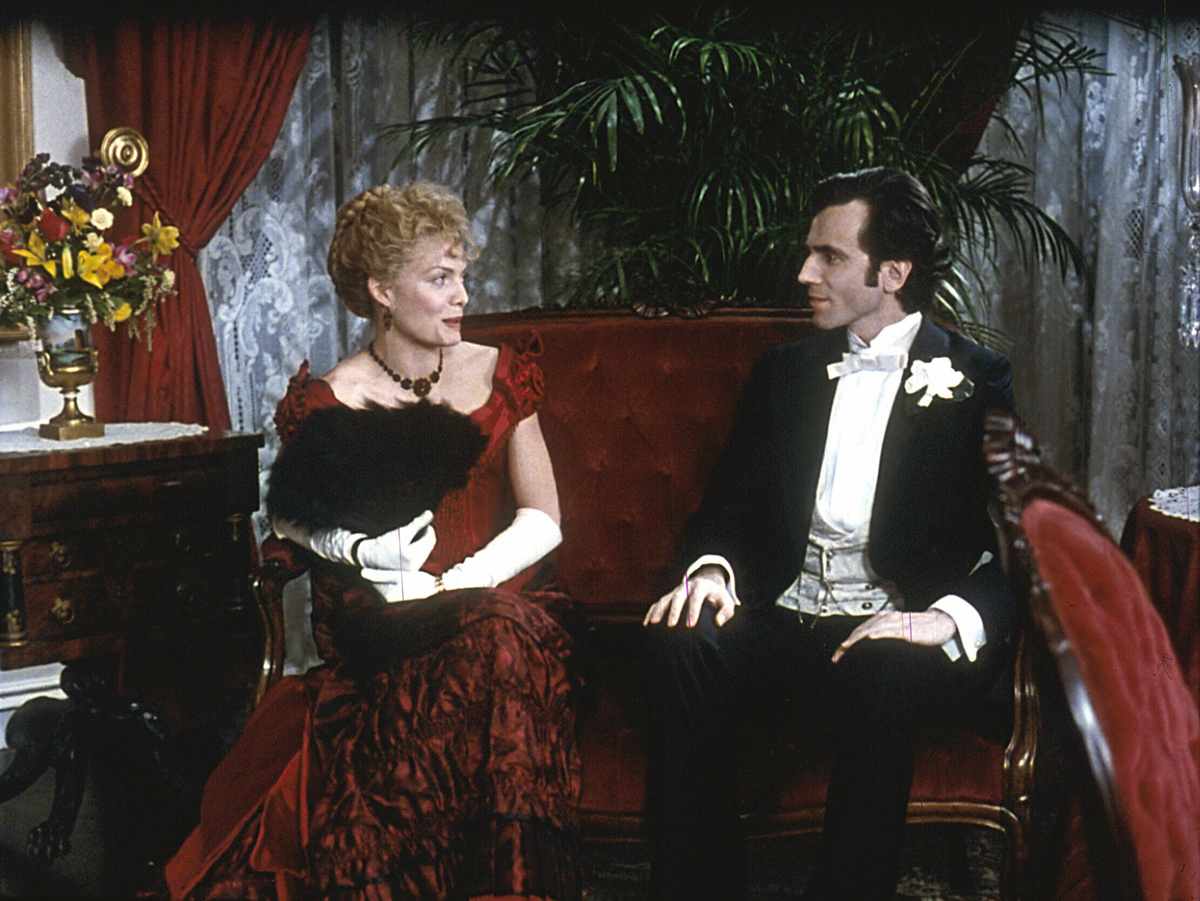
Movie Review: The Age Of Innocence (1993)

A romantic costume drama, The Age Of Innocence wallows within a tepid love triangle.

The setting is New York City in the 1870s, and the social circles inhabited by elite families. With every gesture observed, scrutinized, and judged according to behaviour codes, respected lawyer Newland Archer (Daniel Day-Lewis) announces his engagement to May Welland (Winona Ryder), a union that will bring together two influential families.

But May's jovial cousin Countess Ellen Olenska (Michelle Pfeiffer) is back in town, and immediately catches Newland's eye. Ellen carries the whiff of scandal, because her marriage to a European aristocrat fell apart and she was rumoured to have had an affair. With the rest of New York's society shunning her, Newland becomes her one defender and confidant, and a passionate love develops between them.

While undoubtedly gorgeous to look at with lavish period sets, immaculate costumes and make-up, grand opera houses, and high-society balls, The Age Of Innocence cannot overcome a lifeless script and pure lethargy. Director Martin Scorsese is out of his element, and falls victim to a standard story of misplaced affections as Newland becomes yet another man jeopardizing his standing in pursuit of the alluring but flawed independent woman.

Scorsese and co-writer Jay Cocks adapt the Edith Wharton book and infuse the script with critiques about social norms and expectations, with nods to women like Ellen yearning for more autonomy but encountering a wall of judgment. Newland is more enlightened and eager to argue for a society that does not solely punish a woman for her husband's awful behaviour. Throughout are unsubtle references by both Ellen and May about seeking safety, here used as code for economic security and social status.

But the film flounders on glacial pacing, repressed dialogue suppressing displays of initiative. Multiple scenes invest in various characters discussing the planned length of Newland's engagement to May, and whether this should be shortened. Another topic of obsessive discussion is whether Ellen should or should not relocate back to Europe. Meanwhile Newland and Ellen engage in repetitive scenes circling the same conversations and arguments about their impossible love. 

Other weaknesses include forgettably bland secondary characters, and excessive narration (by Joanne Woodward) that more resembles a book reading. Daniel Day-Lewis, Michelle Pfeiffer, and Winona Ryder are suitably coiffed but sink into the prevailing staidness, their predictable emotions disappearing into the candle-lit sets. The Age Of Innocence is a tranquil descent into the age of drowsiness.


All Ace Black Movie Blog reviews are here.

Thursday, 16 December 2021

Movie Review: Into The Night (1985)

A crime comedy, Into The Night is an uneven mix of cool vibe, slapstick humour, and violence.

In Los Angeles, aerospace engineer Ed Okin (Jeff Goldblum) is suffering from severe insomnia. Already unhappy at work and unsatisfied in his marriage, he finds out his wife is cheating on him. Taking the advice of work colleague Herb (Dan Aykroyd), Ed heads to the airport in the middle of the night to catch a flight to Las Vegas for some unwinding.

But at the airport parkade, the frantic Diana (Michelle Pfeiffer) bursts into his car as she flees a group of assassins. Ed helps her escape, and gets embroiled in her wild adventure of stolen emeralds involving rich Hollywood executive Jack Caper (Richard Farnsworth) and his wife Joan (Vera Miles), French crime boss Monsieur Melville (Roger Vadim) and his ruthless henchman Colin Morris (David Bowie), Iranian intelligence officer Shaheen (Irene Papas) and her four incompetent assassins, and an FBI agent (Clu Gulager).

Directed by John Landis and written by Ron Koslow, Into The Night offers plenty to enjoy. Sparkling nighttime cinematography by Robert Paynter captures glistening Los Angeles locations, while the smooth Ira Newborn music soundtrack featuring B.B. King is excellent. The overall mood is of why-not absurdity, the fakery of the city and the artifice of the movie industry a metaphorical justification for anything goes.

Jeff Goldblum and Michelle Pfeiffer also nail their roles, shallow as they are. Goldblum embraces the zonked-out-by-insomnia stance and rides it well from start to finish, while Pfeiffer keeps Diana's effervescence just far enough away from irritating to remain sympathetic. And one cool Cadillac elegantly graces the screen.

The plot is less impressive. The emerald theft triggering all the running around is a rudimentary device, and the strain of prolonging the adventure is obvious as ever more random villains and characters are thrown into the pile. Landis and Koslow struggle to find reasons for Ed and Diana to continue their madcap escapades together, Ed in particular oscillating with an exasperating lack of logic between bailing and getting deeper involved.  

If the narrative goes stale, a distracting spot-the-celebrity-cameo game is available. Almost every minor role is occupied by a well-known movie director, the likes Paul Mazursky, David Cronenberg, Jonathan Demme, Don Siegel, Amy Heckerling, Jim Henson, Colin Higgins and Daniel Petrie all making appearances. 

Co-existing sometimes uncomfortably, bursts of humour and violence provide jolts of energy. The comedy is low-brow and the murders bloody, as Into The Night meanders between bright lights and muddled shadows.


All Ace Black Movie Blog reviews are here.

Wednesday, 14 April 2021

Movie Review: White Oleander (2002)

A mother-daughter drama, White Oleander is full of spiky surprises, excellent performances, and heartache.

In New York, budding artist Astrid Magnussen (Alison Lohman) recalls her childhood in flashback. She never knew her father, and was raised in California by her fiercely independent mother Ingrid (Michelle Pfeiffer), a somewhat famous visual artist. Astrid is just 15 years old when Ingrid is arrested and convicted for the murder of her lover. 

Astrid becomes a ward of the state and lives in foster homes with stints at the McKinney Children's Centre. Her character is shaped by foster mothers including Jesus-loving former stripper Starr (Robin Wright), fading actress Claire (Renée Zellweger), and Russian thrift market hustler Rena. Throughout, Astrid keeps visiting Ingrid in prison, and gradually starts to understand the level of control and manipulation her mother is capable of.

An adaptation of the Janet Fitch book, White Oleander weaves an impressive tapestry of complex human interactions. The screenplay by Mary Agnes Donoghue does at times strike the episodic tones of book chapters, but director Peter Kosminsky charts a course towards a cohesive narrative packed with the painful but also realistic travails of an adolescent dangerously close to falling through the cracks.

The film's strength is derived from the gradual unveiling of Ingrid's core, and the corresponding impact on Astrid. Ingrid starts as a role model for the liberated and successful single mom raising her daughter to be just as strong. Her arrest for murder arrives early and is just the first of many shocks to rock Astrid's life. Subsequently, and despite the prison walls separating them, Ingrid's remarkable character traits are exposed through the eyes of her daughter. Astrid develops a distaste towards the dark side of individualism and starts to question, rather than simply accept, her mother's uncompromising and self-centred actions. Eventually, themes of loneliness, betrayal, narcissism, and despondency merge into a complex definition of a woman determined to confront the world on her own terms.

Meanwhile Astrid evolves under the influence of foster mothers. She discovers the power of her own sexuality, and in Starr and Claire finds common traits of superficial domesticity obscuring churning dissatisfaction. Love lost or sought is always part of the fuel mix driving the mothers' behaviour, and the exceptional power of love to cause hurt and initiate healing emerges as an overarching arc.

With men a sideshow, the women-dominated cast is excellent with two stand-out performances. From her prison courtyard Michelle Pfeiffer radiates chilling levels of emotional domination and an immense capacity to scorch the earth around her daughter's life. And in her breakthrough role Alison Lohman is a revelation, navigating Astrid's frequently tragic journey with convincing transitions towards adulthood and assertiveness. Robin Wright and Renée Zellweger provide memorable support, but their different-but-the-same foster mothers are more predictable.

Emotive without descending into sentimentality, White Oleander seeks the tenacious pursuit of individual growth despite life's lurking poisons.


All Ace Black Movie Blog reviews are here.

Saturday, 23 November 2019

Movie Review: Dangerous Liaisons (1988)


A costume drama set in the haughty world of the ridiculously wealthy, Dangerous Liaisons is a visually gorgeous story of immoral activity fueling gender wars among the idle rich.

It's pre-revolution Paris in the late 1700s, and Marquise Isabelle de Merteuil (Glenn Close) is a rich and conniving widow who gets her pleasure by manipulating others. She attempts to convince notorious seducer Vicomte de Valmont (John Malkovich) to sleep with her young and innocent niece Cécile de Volanges (Uma Thurman), a covenant-educated virgin, as revenge against Isabelle's former lover Bastide, who abandoned Isabelle and is now set to marry Cécile.

Vicomte refuses, as he is focused on enhancing his reputation by seducing Madame Marie de Tourvel (Michelle Pfeiffer), a married woman with morals beyond reproach. Isabelle is impressed with the bravado of his quest, and promises to sleep with Vicomte if he succeeds in corrupting Marie and provides a written letter as proof. But Vicomte's pursuit of Marie is compromised by the gossipy Madame de Volanges (Swoosie Kurtz), Isabelle's cousin and Cécile's mother. As revenge, a furious Vicomte agrees to deflower Cécile and redoubles his efforts to have Marie fall in love with him.

As an incendiary exposé to support peasant revolutions, Dangerous Liaisons serves its purpose. The adaptation of Christopher Hampton's play, based on the Pierre Choderlos de Laclos book, is singularly obsessed with vindictive and lustful elites, idle and libidinous women and men with no better purpose than to plot sexcapades. Hampton's script is brought to life by director Stephen Frears in a lavish production, and the stellar cast shines amidst ostentatious costumes, cleavage and castles.

While none of the principal characters are remotely likeable, the dialogue exchanges between Isabelle and Vicomte reveal two sides of one coin, a female and male version of the same surreptitious behaviour trading in sex and deploying bribery, blackmail and subterfuge as needed. Vicomte can flaunt his reputation and indeed publicly work to enhance it, while by nature of women's social stature Isabelle is more discreet. She works by influencing others and nudging them towards ruin. At her most vulnerable moment Cécile turns to Isabelle for advice, and the aunt encourages her niece to embrace rape as a learning experience and seek multiple lovers.

Despite the seemingly frivolous attitude towards seduction, the film steers towards unexpected love intruding on intrigue. Vicomte can only break through Marie's barriers by falling in love with her, a condition he labels temporary, but Isabelle knows better. And Isabelle herself is sideswiped by intense jealousy, her facade penetrated upon learning another woman can emotionally preoccupy her man. The outcomes are well deserved, as Frears revels in moving his two protagonists towards emotional troughs of their own making.

Glenn Close occupies the centre of chicanery with an impressive performance, her sly smiles, pregnant pauses and sideways glances riding the line between outward social respectability and continuous conspiring. She is matched by John Malkovich riding through the field of conquests on nothing but unshakeable confidence in his seductive powers.

Although the scenes of verbal sparring between Marie and Vicomte are unconvincing and repetitive, Michelle Pfeiffer is surprisingly affecting as prey, while Uma Thurman is a doe eyed victim. In addition to Kurtz, Keanu Reeves as a naive artist caught up in the sex plots and Mildred Natwick as Vicomte's aunt round out the cast.

Dangerous Liaisons is an irresistible study of virtue making way for subversion, with predictably calamitous consequences.


All Ace Black Blog Movie Reviews are here.


Saturday, 19 January 2019

Movie Review: I Could Never Be Your Woman (2007)


A standard romantic comedy, I Could Never Be Your Woman has plenty of incomplete ideas and is predictably unable to cobble together a decent package.

In Los Angeles, Rosie (Michelle Pfeiffer) is a television producer in her early forties, battling against her age and having conversations with Mother Nature (Tracey Ullman) about the natural order of things. Rosie is divorced from the still amiable Nathan (Jon Lovitz), and raising her precocious daughter Izzie (Saoirse Ronan), who is just entering puberty.

Rosie's tween-oriented female empowerment show You Go Girl is struggling in the ratings, but new young-ish actor Adam (Paul Rudd) has plenty of charisma and gives the show a big boost. Rosie and Adam are attracted to each other and start a relationship, but she is gravely concerned about the age difference between them. Rosie's snarky assistant Jeannie (Sarah Alexander) has her own eyes on Adam, while Izzie is experiencing her first crush on a boy at school.

From the clumsy title to Rosie's corny conversations with Mother Nature, the incessant inside-Hollywood satirical jabs, the flimsy basis for the central relationship and the overall shallow characters, most parts of I Could Never Be Your Woman demonstrate a smidgen of promise but then don't work so well. The film cannot shake the sense that writer and director Amy Heckerling, returning after a seven year hiatus, is trying too hard to assemble a hip movie out of inherently defective parts.

Despite offering a few good laughs, the movie too often busies itself taking cheap shots at the shallow youth-obsessed Los Angeles culture fueling the plastic surgery industry. The Mother Nature interludes are interruptive and mostly twee in tone rather than witty or profound. As a result insufficient time is invested in Rosie and Adam, and they remain stock characters with no meaningful arcs. While Pfeiffer at 49 is radiant playing a character nearly 10 years younger and Rudd adds plenty of amusing free-spirited energy, both deserved a better script.

Jeannie as the perfunctory antagonist suffers most, her character existing for the sole purpose of antagonizing the central romance. It is left to young Saoirse Ronan, in her film debut, to try and rescue proceedings, and she nearly pulls it off. Heckerling saves her best lines for Izzie's character, and while the precocious kid can be a tired cliche, Ronan adds sufficient budding maturity and a droll world weariness to make it work, in the process stealing every scene she's in.

I Could Never Be Your Woman was eventually released straight to DVD in most markets. It's not bad enough to have deserved such a fate, but it's still a film that misses too many of the simple targets it aims for.


All Ace Black Blog Movie Reviews are here.


Sunday, 10 June 2018

Movie Review: Murder On The Orient Express (2017)


An ensemble murder mystery set on board a train, Murder On The Orient Express assembles plenty of talented performers and strands them in the snow.

It's 1934, and after finishing an assignment in Jerusalem, celebrated Belgian detective Hercule Poirot (Kenneth Branagh) travels to Istanbul and boards the Orient Express on the way to London. Businessman Edward Ratchett (Johnny Depp) is also on the train, and tries to hire Poirot as a bodyguard, but the detective finds Ratchett distasteful and refuses. Ratchett is soon found dead in his compartment, stabbed multiple times. With the train stuck in the snow and awaiting a rescue crew, Poirot has to investigate and solve the murder.

The suspects from among the fellow passengers include the stern Princess Dragomiroff (Judi Dench) and her traveling companion Pilar (Penélope Cruz), society lady Caroline Hubbard (Michelle Pfeiffer), Doctor Arbuthnot (Leslie Odom Jr.), rude German Gerhard Hardman (Willem Dafoe) and governess Mary Debenham (Daisy Ridley). Poirot discovers that Ratchett is really the criminal known as Cassetti, who was involved in the shocking abduction and killing of the child Daisy Armstrong years prior, a murder that shocked America. Plenty of people want Cassetti dead, including many who happen to be on the train.

Directed by Branagh with a script by Michael Green, the adaptation of the celebrated Agatha Christie novel is old fashioned, out of touch and out of place. A far cry from the classic 1974 version, this unnecessary remake never finds a groove and stumbles around searching for the right platform. Devoid of drama, tension, mood or memorable characters, the film falls flat.

The large cast is remarkably underutilized, the actors and actresses reduced to glorified cameos. With too much time spent on Poirot's introspective angst, the plot details are often pulled from nowhere, the detective regularly making sweeping discoveries and conclusions based on very little. Too many facts and explanations are then crammed into an unsatisfying ending, any emotional impact behind the murder and the motive well and truly lost in the snowy Yugoslav mountains.

Branagh deploys fluid camera movement to try and break out of the train's confines, but the CGI for the external shots of the train snaking through the terrain is cheesy and overused.

Poirot’s over-elaborate moustache, featuring multiple waves on either end, is disconcerting, and wedges itself as an annoying traveling companion. Among the many crimes on display, the obtrusive facial hair is most deserving of painful plucking.


All Ace Black Blog Movie Reviews are here.

Saturday, 4 March 2017

Movie Review: Married To The Mob (1988)


A mobster comedy for adults, Married To The Mob mixes violence with laughs. The film achieves a steady level of caricaturish entertainment but is generally overbaked.

In New Jersey, Angela (Michelle Pfeiffer) is getting tired of life as the wife of mob contract killer Frank "The Cucumber" de Marco  (Alec Baldwin). She demands a divorce, but Frank laughs it off. Everything changes when mob boss Tony "The Tiger" Russo (Dean Stockwell) kills Frank because he dared to share the same mistress. Tony immediately turns his attention to seducing Angela, much to the disgust of Tony's wife Connie (Mercedes Ruehl).

FBI Agents Michael Downey (Matthew Modine) and Ed Benitez (Oliver Platt) are tailing Tony and spot an opportunity to get to him through Angela. She moves with her young son to a derelict New York City apartment to try and start a new life, but Angela can't shake off the attentions of Tony, the FBI, or a furious Connie.

Directed by Jonathan Demme, Married To The Mob hits the notes it aims for, but this is a film that goes for dissonance. Roughly equivalent to Gloria on dubious amounts of laughing gas, Married To The Mob tries to do too much, but also does enough to generate occasionally satisfying madcap energy.

Demme often appears to be working from a hodgepodge script with too many ideas and not enough focus. Cold blooded assassinations and shootouts, a human story about a woman and child seeking a new start, a satirical look at the garish styles of the wives of gang goons, a tentative romance between the widow Angela and the agent Downey, an unexplained war between rival mob gangs, and finally over the top comedy mainly driven by Connie's rage are all thrown together into one mixing bowl. The result cannot be taken seriously in any context, and the film survives on the strength of committed performances.

Pfeiffer, Stockwell and Ruehl play it loud, which is the only way to compete with the sound of material splattering all over the screen. The big 1980s era hair gives the ladies licence to crash through all lines of subtlety. While Pfeiffer tries to maintain some level of serious drama, Ruehl just abandons all pretense and fully invests in wild antics and wide-eyed fury. Stockwell contributes the best moments as he fluctuates between oily mob boss and smarmy lecher pursuing the one woman who dares to resist him. Matthew Modine is just too blank to register, despite several disguises.

Married To The Mob reaches an appropriately wild and bloody climax in Miami, the vivid seaside colours adding a final flourish to the pop-off-the-screen intentions.


All Ace Black Blog Movie Reviews are here.

Monday, 1 February 2016

Movie Review: One Fine Day (1996)


A good quality romantic comedy, One Fine Day enjoys star power in the form of Michelle Pfeiffer and George Clooney, and settles into a pleasant if entirely predictable story of an unlikely romance developing between two stressed single parents.

In New York City, businesswoman Melanie Parker (Pfeiffer) is divorced and raising her young son Sammy on her own. Sammy's dad is a rock band drummer who frequently misses family events. Jack Taylor (Clooney) is a popular newspaper columnist, also divorced, and sharing parenting duties for his young daughter Maggie, who is Sammy's classmate. One frantic morning Jack's lack of organization results in both Sammy and Maggie missing the bus and then the boat for a day-long school trip. Jack and Melanie are stuck with their kids on a working day, and Melanie is immediately hostile towards Jack.

A further mix-up results in Melanie and Jack switching mobile phones, further complicating their schedules. Eventually they are both forced to agree to trade-off caring for the two children. Melanie tries to prepare for a big presentation at her office despite Sammy's disruptive presence, while the more laid back Jack tries to untangle a big political corruption scandal that may cost him his job, while caring for Maggie and sometimes Sammy. As the day rolls on, Melanie and Jack move from animosity to romance.

Directed by Michael Hoffman, One Fine Day is a small notch above standard rom-com fare. Most of the shine comes from the two leading actors lending their considerable charisma to the principal roles. Michelle Pfeiffer and George Clooney both possess high wattage, and they turn on the charm to good effect, allowing the sparks of love to emerge slowly from the mess of a chaotic day spent chasing kids and fulfilling work duties. Pfeiffer is comfortable and assured as an established star, while Clooney is on the cusp of finding his big-screen groove, and together they make for an attractive couple.

The film offers one relatively fresh angle by presenting both protagonists as divorced single parents, juggling high-stress careers and child care, their work routines easily thrown into disarray when the kids' plans are disrupted. Melanie and Jack are on an equal social footing, extending to an equivalent level of mutual cynical mistrust due to still-healing scars from failed marriages. The jaded realism adds a welcome wrinkle to the couple's evolving dynamic.

Not surprisingly, there is little else in One Fine Day that is even remotely original as the film moves through all the usual gears. The laughs are mild, the kids are cute, the office bosses are crusty, the moments of crisis are never too threatening, the dash to the climax (appropriately, the destination is a kids' soccer pitch) is frantic, and the ending is as preordained as the sun setting at the end of the day. Of course, the locations are scrubbed clean and the music is dreamy.

The running time unnecessarily creeps towards two hours, and the film outstays its welcome well after it is apparent that Melanie and Jack will find a way to end their fine day on a positive note. The relatively under-used supporting cast does not help. While the kids (Alex D. Linz and Mae Whitman) are sound and avoid descending into an overdose of cutesiness, Charles Durning as Jack's boss and Amanda Peet as an office vamp get very few scenes to make an impact.

One Fine Day delivers exactly what the genre demands in the form of a far-fetched meet-cute come true, with the bonus of luminous leads investing enough talent to tilt the balance towards enjoyment rather than tediousness.


All Ace Black Blog Movie Reviews are here.



Sunday, 24 May 2015

Movie Review: Wolf (1994)


The story of an American werewolf in corporate New York, Wolf shows promise as a metaphor for adults, but then loses its edge by insisting on following the childish werewolves-on-the-loose path.

Respected book editor-in-chief Will Randall (Jack Nicholson) is bitten by a wolf after a car accident in the snowy Vermont mountains. Back in New York, Will finds himself a victim of a corporate shuffle. Tycoon Raymond Alden (Christopher Plummer) is the new publishing house owner, and he demotes Will and assigns young and hungry marketing executive Stewart Swinton (James Spader) into his position. Will's life hits rock bottom when he discovers his wife Charlotte (Kate Nelligan) having an affair with Stewart.

But Will also starts to feel the after-effects of the wolf bite: his senses are amplified, he feels younger, more vigorous, and more aggressive. He meets Alden's daughter Laura (Michelle Pfeiffer), an aloof heiress, and starts to plot his revenge to reclaim his job and make Stewart and Charlotte suffer. But then Will starts to lose control of what is happening to him at night, when the werewolf within him emerges and goes hunting for blood and adventure. A brutal murder is then committed, and Will emerges as a suspect.

Directed by Mike Nichols, Wolf tries to appeal to two distinct audiences and by doing so fails them both. The first half displays promise as an analogy of the need for an emotional rebirth to survive middle age trauma, as Nichols explores the symbolism of Will discovering and then adopting wolf-like tactics to fight for his patch of the corporate and relationship jungle.

But once the film transitions in its second half to actual werewolf adventures, howlings in the night, wolves hunting deer and eventually murder and mayhem in Central Park, it veers sharply away from its intellectual premise. With this heavyweight cast there is nothing to be gained chasing special effects, blood, gore and werewolves battling each other, complete with incompetent detectives attempting to solve murder-by-wolf.

Mayhem caused by werewolves has of course been done before many times, and with much better horror and special effects, including in 1981's An American Werewolf In London. By insisting on chasing the thrill-seeking audience Wolf loses its purpose and surrenders the cerebral advantage.

Casting Jack Nicholson as a wolf is almost too easy, but he does a fine job adopting a more-is-less philosophy. Nicholson keeps Will sharp but low-key, and remains remarkably calm even when the werewolf transformations start. Laura Alden is an interesting but underwritten role, and Pfeiffer can't do much with it. More effective is Spader as the power-hungry Stewart Swinton, a shrewd natural wolf in man's clothing.

Wolf ends up being not scary enough, not gory enough, and not smart enough, as it howls at the moon of confused objectives.


All Ace Black Blog Movie Reviews are here.