Showing posts with label Ellen Burstyn. Show all posts

Saturday, 25 January 2025

Movie Review: Resurrection (1980)


Genre: Drama  
Director: Daniel Petrie  
Starring: Ellen Burstyn, Sam Shepard  
Running Time: 103 minutes  

Synopsis: Edna Mae (Ellen Burstyn) is a passenger in the car crash that claims her husband's life. She experiences a near-death episode but survives, although her legs are paralyzed. After relocating to the family farm in Kansas to recuperate, she discovers newly acquired healing powers. She regains the ability to walk and starts healing others, including preacher's son Cal (Sam Shepard). They start a romance, but Edna Mae's remarkable powers also attract controversy. 

What Works Well: The tricky topic of supernatural events free of religious fervor receives brisk and thoughtfully human-centred treatment. Ellen Burstyn as Edna Mae represents a flaws-and-all everyday woman not seeking any attention, but suddenly thrust into the role of community healer. Love as the thread that binds is the only explanation she is comfortable articulating, with consequences among those insisting on attaching names and attributions onto extraordinary acts. Sam Shepard takes her boyfriend Cal on a dangerously complex journey, while Edna Mae's father (Roberts Blossom) never veers far from his stodgy version of right and wrong. As middle-of-nowhere gas station attendant Esco Brown, Richard Farnsworth contributes an epic single scene rich with heart and foreshadowing.

What Does Not Work As Well: Within the modest running length, many interesting narrative avenues and characters are introduced but then left undeveloped. The nature of death, spirituality, religion's role in belief and healing, scientific discovery, and most of the secondary characters cross Edna Mae's orbit without achieving traction.

Key Quote:
Esco Brown: Go carefully, with peace in your heart, with love in your eyes, and with laughter on your tongue. And if life don't hand you nothing but lemons, you just make you some lemonade. That's from Book Brown, Chapter One, Verse One.


All Ace Black Movie Blog reviews are here.

Friday, 30 August 2024

Movie Review: The Age Of Adaline (2015)


Genre: Romantic Drama  
Director: Lee Toland Krieger  
Starring: Blake Lively, Michiel Huisman, Harrison Ford, Ellen Burstyn, Kathy Baker  
Running Time: 113 minutes  


Synopsis: In 1937, 29 year-old Adaline Bowman (Blake Lively) was trapped in frozen water and struck by lightning, causing her to stop aging. To avoid intense scrutiny, she consequently relocated every decade and assumed a series of fake identities. In 2014, Adaline is in San Francisco and preparing for another move when she attracts the romantic attention of wealthy literature benefactor Ellis Jones (Michiel Huisman). Her daughter Flemming (Ellen Burstyn), who is now in her 80s, encourages her mom to take a chance on love. But when Adaline meets Ellis' father William (Harrison Ford), her history catches up to her present.

What Works Well: The fantasy dream of eternal youth is explored through a dreamy romance, delving into the complications of not growing old as time moves on and all others age. Co-writers J. Mills Goodloe and Salvador Paskowitz expose the difference between surviving for eternity and living towards an end with welcome pragmatism, allowing the sad loneliness of a life unsynched from society to surface within an unusual love triangle. Harrison Ford is the standout presence in a talent-rich cast, and attractive San Francisco locations (with some Vancouver subbing) add the necessary gloss. 

What Does Not Work As Well: The second act romance elements meander into languid territory, and what should have been a climactic conversation occurs off-screen.

Key Quote: 
Adaline: Tell me something I can hold on to forever and never let go.
Ellis: Let go.


All Ace Black Movie Blog reviews are here.

Saturday, 9 March 2024

Movie Review: Queen Bees (2021)


Genre: Geriatric Romantic Comedy  
Director: Michael Lembeck  
Starring: Ellen Burstyn, James Caan, Jane Curtin, Ann-Margret, Christopher Lloyd, Loretta Devine, Elizabeth Mitchell  
Running Time: 100 minutes  

Synopsis: Helen Wilson (Ellen Burstyn) is in her golden years and insists on maintaining her independence. She enjoys the company of her grandson (Matthew Barnes), but has a difficult relationship with her daughter Laura (Elizabeth Mitchell). A house fire forces Helen to temporarily relocate to a retirement home, where she tangles with a clique of residents led by the unfriendly Janet (Jane Curtin). She is also wooed by Dan (James Caan), who is seeking a late-life romance.

What Works Well: The friction between Helen and her career daughter Laura is built upon stubbornness, mutual impatience, and miscommunication, sharply capturing common frustrations between the elderly and their grown children.

What Does Not Work As Well: The bland script unconvincingly re-imagines the retirement home as the second coming of high school, with the aesthetics and energy levels of middling television fare. Tired rom-com cliches including petty jealousies and conniving behaviour are transposed to mature adults who should know better, emotions are transmitted with all the authenticity of plastic, and the attempts at humour are a cringey demonstration of ineptitude.

Conclusion: Screen legends deserve more dignified late-career material than this.


All Ace Black Movie Blog reviews are here.

Monday, 10 January 2022

Movie Review: The Ambassador (1984)

A politics-and-blackmail drama, The Ambassador strides into the Middle East conflict and makes a messy situation much worse.

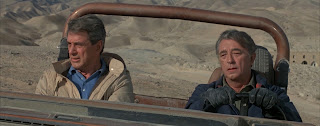
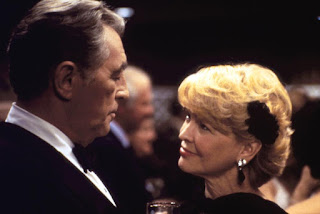
Peter Hacker (Robert Mitchum) is the idealistic US Ambassador to Israel, on a personal quest to start peace talks in the region. After a meeting in the desert with the Palestinian Liberation Organization (PLO) goes wrong, Hacker and his chief of security Frank Stevenson (Rock Hudson) learn that Hacker's bored and boozy wife Alex (Ellen Burstyn) is having an affair. Her infidelity has been caught on film and Hacker is blackmailed for $1 million.

The blackmail plot gets more convoluted when Stevenson uncovers the identity of Alex's lover as Mustapha Hashimi (Fabio Testi), a souvenir shop owner but also an influential PLO member. With a KGB assassin on the prowl, the Mossad pursuing its own agenda, and Israeli Defense Minister Eretz (Donald Pleasence) trying to keep a lid on the situation, Hacker shrugs off the blackmail and doggedly pursues talks between Palestinian and Israeli students.

A Cannon Group B-movie production filmed in Israel, The Ambassador collects an impressive list of stars eager to claim an easy pay cheque. Director J. Lee Thompson, at this stage churning out schlocky movies for undiscerning action fans, is saddled with an inane script by Max Jack, and the outcome never rises above the level of a cheap flick out of its depth in pretending to tackle a complex geopolitical crisis. 

The ludicrous events start early and never subside. The action starts with the US ambassador personally arranging and attending a meeting outside diplomatic channels in the middle of the desert; continues with Hacker shrugging off a blackmail attempt that could end his career and embarrass his government; and ends with the diplomat engaging in a punch-up with an AK-47 wielding terrorist in the middle of a massacre. The climax is a gore-fest inserted to satisfy blood-thirsty action aficionados doubtlessly bored by the confusing politics.

The cast members spout their lines with no conviction, Mitchum registering a new level of going-through-the-motions. Hudson, in his final big-screen role, represents the beginning and the end of security for the ambassador, and spends most of the movie chasing after a smut reel on the assumption no one is capable of making more copies. Pleasence and Testi take their roles more seriously and must be thankful their screen time is relatively limited. At 51 years old, Burstyn bravely participates in a sex scene, but is otherwise confined to the stock role of unsatisfied wife. 

Commendably, The Ambassador presses a message for peace and dialogue. Unfortunately, good intentions are steamrolled by outstanding incompetence.


All Ace Black Movie Blog reviews are here.

Friday, 3 September 2021

Movie Review: Lucy In The Sky (2019)

A mental stress drama, Lucy In The Sky explores trauma prompted by a literal out-of-this-world experience. The film evokes a mood of psychological bewilderment but frustratingly fails to follow through.

NASA astronaut Lucy Cola (Natalie Portman) returns to Earth after a space shuttle mission, feeling exhilarated but disoriented. Suddenly her old life with perpetually cheerful husband Drew (Dan Stevens), a space program marketing specialist, appears small and insignificant. All her life Lucy was driven to overachieve by her Nana (Ellen Burstyn), and now all she can think of is qualifying for a future mission and returning to space. 

She starts a torrid affair with fellow astronaut Mark Goodwin (Jon Hamm), who understands her feelings but may also just be looking after his own needs. Lucy is competing with younger astronaut Erin Eccles (Zazie Beetz) for a spot on a future mission, but program director Frank Paxton (Colman Domingo) notices Lucy's increasingly erratic behaviour, leading to a crisis.

Inspired by the true story of astronaut Lisa Nowak, Lucy In The Sky is perhaps overly constrained by real-life events. The screenplay by Brian C. Brown, Elliott DiGuiseppi, and director Noah Hawley contains tantalizing hints of a compelling drama, and Hawley plays with aspect ratios and weaves trance-like imagery into Lucy's daily life to capture her memories of space and sense of loss amidst earthly minutia. Natalie Portman contributes with a gritty and committed performance.

And yet with all the raw material in place to explore a brilliant overachieving mind going to pieces after exposure to space's grandeur, the film refuses to step into the difficult conversations. Crucially, the script never allows Lucy to express herself, leaving it to others to explain what she is experiencing. She remains stranded in a manic search for meaning, while Joe Hamm as Mark Goodwin gets a couple of scenes to eloquently describe the disconnect between the thrill of riding a rocket and the pettiness of day to day life. 

Most tellingly, Mark's repeated viewing of a seminal disaster tape on the eve of his next mission provides a blood-chilling emotional highlight. By sidelining the protagonist from any such moments, Lucy In The Sky appears to lack conviction in its own core.

Instead Lucy spirals towards a poorly defined Quixotic cross-country journey with her niece Blue Iris (Pearl Amanda Dickson) in tow. Her lunatic drive does represent a mind in the throes of crashing and burning, but Lucy In The Sky is satisfied with demonstrating a mental collapse, but not genuinely discussing it.


All Ace Black Movie Blog reviews are here.

Wednesday, 14 July 2021

Movie Review: Pieces Of A Woman (2020)

A drama about infant loss, Pieces Of A Woman traces a mother's attempt to pick up life's shattered fragments after unspeakable trauma.

In Boston, office worker Martha Weiss (Vanessa Kirby) is expecting her first child with her partner Sean (Shia LaBeouf), a bridge construction foreman. They are planning a home birth, but when Martha goes into labour her midwife Barbara is occupied with another delivery. Back-up midwife Eva (Molly Parker) arrives to help. After a difficult labour the baby is born, but dies in Martha's arms within minutes.

The anguish of losing the child impacts the relationship between Martha and Sean, who cope in different ways. Martha's wealthy and strong-willed mother Elizabeth (Ellen Burstyn) exerts her influence and further drives a wedge between the couple. Meanwhile Eva faces criminal charges, with Martha's cousin Suzanne (Sarah Snook) prosecuting, but Martha appears uninterested in redress through the courts.

An adaptation of the play by Kornél Mundruczó and Kata Wéber, who wrote from their experience after a miscarriage, Pieces Of A Woman visits places of disorienting emotional pain. Wéber wrote the screenplay and Mundruczó takes on directing duties, and together they create every parent's nightmare, a one-way trip to sudden, destroyed expectations.

The film salutes its stage origins without falling victim to them. In the indoor scenes Mundruczó deploys long, fluid takes with elegant camera motion. The birth sequence is a remarkable continuous shot lasting 24 minutes, starting with Martha's increasingly painful contractions and ending with the arrival of the ambulance, underlining the unidirectional nature of the childbirth experience. Once the process starts Martha and Sean have no exit ramps away from whatever outcome awaits.

The emotional focus is on Martha, and the stabs of agony she experiences every time she spots a child, or worse, a young child with a parent. But her deeply personal experience is also shaped by those closest to her. After the baby's death, Martha and Sean can agree on little. She wants to donate the baby to science; he is not so sure. He wants to pursue a civil court case; she is not convinced. She grieves in silence; he is more talkative. He resorts to drinking; she develops a fascination with apple seeds. And finally the physical intimacy seeps out the marriage, and Sean goes looking for someone else and somewhere else. Vanessa Kirby and Shia LaBeouf create a relatable ordinary couple thrust into a dark new reality they are ill equipped to navigate.

To make matters worse Elizabeth never really liked Sean, and now starts manipulating him to poke at her perceptions of Martha's weaknesses. Ellen Burstyn shines as a grandmother channelling her grief into anger and a determination to pin the blame on Eva, because someone simply must be responsible for her hurt.

A speechy ending reaches for a tidy resolution to an untidy tragedy. But Pieces Of A Woman succeeds in portraying with honest sensitivity the shock of death crashing through the door when only a new life was expected.


All Ace Black Movie Blog reviews are here.

Sunday, 23 August 2020

Movie Review: Requiem For A Dream (2000)

A journey into the abyss of addiction, Requiem For A Dream combines dazzling style with morbid subject matter for a triumphantly exhausting experience.

In Brooklyn, Sara Goldfarb (Ellen Burstyn) is an elderly widow with not much to live for. She spends her days watching television, in particular a crass self-help infomercial. Her son Harry (Jared Leto) is into drugs, along with his girlfriend Marion (Jennifer Connelly) and best friend Tyrone (Marlon Wayans). Sara is ecstatic to receive a phone call then a mail package promising her an appearance on television. She is determined to lose weight to fit into a red dress and look dashing on camera. 

She starts to diet, then resorts to a prescribed cocktail of weight loss pills. Harry and Tyrone go into business reselling hard drugs and start to make a lot of money, with Harry helping Marion start a small business and buying a new television for his mother. But the diet pills start eroding Sara's mind, and a turf war among drug gangs disrupts the street supply, forcing Harry, Tyrone and Marion into desperate measures.

An adaptation of the book by Hubert Selby Jr., who co-wrote the screenplay with director Darren Aronofsky, Requiem For A Dream is at once daring and depressing. Using split screens, rapid editing, hypnotically repetitive representations of drug ingestion and a dizzying array of camera tricks, Aronofsky visually portrays lives on the rollercoaster of addiction. In stark terms remarkably laced with dark humour, the film charts harrowing descents to obvious outcomes, and Requiem For A Dream is eventually terrifying in drawing obvious parallels to broader societal carnage. And while heroin, cocaine and diet pills are the obvious dependency sources, Aronofsky is also interested in broader themes of a society addicted to various self-destruction pathways.

Sara is hypnotized by trash television, which morphs into a weight loss addiction and an obsession with a promise of 15 minutes of small screen fame. The doctor who prescribes her pills is a victim of the all-consuming rush to profits: he barely looks at his patient before scrawling out his ruinous prescriptions. Meanwhile, Harry and Tyrone are inexorably drawn to the get-rich-quick lifestyle offered by unchecked capitalism. Later, sexual addictions crash through the door, money and sex interchangeable currency in the rush to satisfy here-and-now cravings.

In other contexts Aronofsky's flashy style would be deemed over-the-top and bordering on conceited. But here the restless editing, phenomenal sound effects, and masterful alterations of time and space capture the psychotic high and lows, the film's pacing mimicking the characters' wild rides. The seminal Clint Mansell music score is apocalyptically grandiose, amplifying the demolition of four small lives to Wagnerian tragedy.

All four of the lead performances are fully invested, with Burstyn a particular stand out. Enduring everything from fat suits to elecrtoconvulsive therapy, she combines the pathos of an old lonely woman with the trials and tribulations a chemical ride from hell.

Requiem For A Dream is ultimately exceptionally sad. Despite a society brimming with positive opportunity, for some the race to oblivion is unrelenting.


All Ace Black Blog Movie Reviews are here.

Sunday, 15 March 2020

Movie Review: The Calling (2014)


A serial killer drama, The Calling benefits from a frigid rural aesthetic and a good cast, but never quite grabs an enigmatic emotional hold.

In the small community of Fort Dundas, Ontario, hard-drinking Hazel Micallef (Susan Sarandon) is the local Sheriff, suffering from back pain and not over the breakup of her marriage and loss of an unborn child years prior. Hazel and fellow law enforcement officer Ray Green (Gil Bellows) are stunned to confront the community's first murder in years, an elderly woman found nearly decapitated. Soon another murder is committed and in both cases the victims' faces and mouths were contorted post-death.

Detective Ben Wingate (Topher Grace) relocates to Fort Dundas from Toronto and starts researching cases from across the country, uncovering other victims, all terminally ill, Catholic, and poisoned to death. Hazel connects with the elderly Father Price (Donald Sutherland), who suggests the murders may be related to an ancient prayer and the sacrifice of disciples in anticipation of resurrection. Meanwhile creepy fake healer Simon (Christopher Heyerdahl) is roaming the land, promoting his brand of unconventional herb-based medicine.

A Canadian production overlaying echoes of a gloomier Fargo with murderous carnage inspired by twisted interpretations of religious doctrine, The Calling succeeds in creating a chilly evil-roams-the-land vibe. Hazel is a deeply flawed protagonist spurred into action despite the fog of pain and alcohol, while Simon is the personification of the grim reaper cloaked in ancient Catholicism. Together they create two decent bookends, and the film wisely stays away from cheap thrills and instead derives momentum from characters inhabiting an isolated community.

Scott Abramovitch wrote the screenplay as an adaptation of the book by Inger Ash Wolfe, and director Jason Stone recognizes the locale as one of the narrative strong points, capturing the natural beauty and grounded resilience of a snow-covered small town. No one is surprised when every rumour instantaneously spreads through the community, all residents are on a first name basis, and they all know each other's history and emotional baggage.

As much as the film's strengths are apparent, so are the mushier components. Some of the police work falls through plot holes, and pieces of background between Simon and Father Price are sketched-in at best. Hazel's mother Emily (an underused Ellen Burstyn) putters around the house seeking a purpose, while the marriage break-up and baby loss tragedy never evolve past plastic plot devices.

But with Sarandon in the crunchiest of crusty form and Heyerdahl weaving a spell of death with dreamy eyes and marvellous oral delivery punctuated with unhitched pauses, The Calling makes it through the winter.


All Ace Black Blog Movie Reviews are here.

Saturday, 30 December 2017

Movie Review: How To Make An American Quilt (1995)


An anthology about women's diverse experiences and perspectives, How To Make An American Quilt weaves a loose narrative about a young woman at the emotional crossroads spending the summer with her great aunt's circle of friends.

Finn (Winona Ryder) is in her mid-twenties, struggling to finish her Master's thesis and engaged to be married to carpenter Sam (Dermot Mulroney). She spends the summer at the country home of her great aunt Glady (Anne Bancroft), who is part of a quilting group led by housekeeper Anna (Maya Angelou). As the lazy days unfold and the friends gets to work on a wedding quilt for Finn, she learns their personal stories.
  • Finn's grandmother Hy (Ellen Burstyn) has a strained relationship with her sister Glady, stemming from a moment of weakness when Hy's husband was on his deathbed.
  • Sophia (Lois Smith) is now cranky and bitter. As a young woman (played by Samantha Mathis) she was a sublime diver who fell in love and married geologist Preston (Loren Dean), but her married life did not unfold as she expected.
  • Em (Jean Simmons) is married to artist Dean (Derrick O'Connor), who has always had a wandering eye.
  • Constance (Kate Nelligan) first lost her dog and then her husband; her subsequent behaviour means that she is now a bit of a misfit in the group.
  • As a young black servant Anna was seduced by her boss' son Beck (Jared Leto); during the resulting pregnancy she became close with Glady.
  • Anna's daughter Marianna (Alfre Woodard) is a sophisticated free spirit who refused to commit to any man, but she carries one regret.
  • Finn's mother Anna (Kate Capshaw) has long been divorced, but she arrives late in the summer with a new surprise.
During the summer Finn also meets the extremely hunky Leon (Johnathon Schaech), and has to decide how much the potential long term commitment to Sam means to her.

An adaptation of the Whitney Otto book directed by Jocelyn Moorhouse, How To Make An American Quilt enjoys relaxed pacing and a soulful perspective. Breathing deeply from the almost resigned stance of older women looking back, often with plenty of regret, the film offers plenty of themes and talking points. The Jane Anderson script avoids pat answers and easy resolutions; this is a compendium of several lives, women defined by their decisions as life's surprises rarely align with expectations.

The film's compilation structure is both its strength and its weakness. How To Make An American Quilt never lingers in one place for too long, as no fewer than eight stories share less than two hours of screen time. Proving that every person has a good tale to tell, Moorhouse gives equal due to each vignette, and the chapters creates and hold individual mystique.

At the same time the patchwork composition is what it is: sequential short stories told with expediency, tending to emphasize melodrama to quickly get to the point. It's not a stretch to imagine all eight stories as potential material for good full length features, but here only the headlines are on display.

The performances are uniformly good from a dream cast featuring veterans Burstyn, Bancroft, Simmons, and Nelligan, as well as poet and civil rights activist Angelou. Ryder holds her own, her relative lack of subtlety finding an understandable home as an emotive young woman a generation removed from all her companions.

Ultimately the convergent narrative is the collective wisdom that Finn will take away from her summer, and How To Make An American Quilt hits a solid target with an emphasis on the unconventional. The beauty of a quilt knitted by many hands is in its lack of coherent precision, the emotions seeping across the borders achieving imperfect perfection.


All Ace Black Blog Movie Reviews are here.


Thursday, 23 July 2015

Movie Review: Dying Young (1991)


A romantic drama that advertises its premise in the title and proceeds to under-deliver, Dying Young is an irritating film that occupies the space between phony and awkward.

In San Francisco, Hilary (Julia Roberts) is a young woman who catches her boyfriend cheating and immediately dumps him and flees to the house of her dotty mother (Ellen Burstyn). With a vague background as a nursing student, Hilary responds to an ad for a live-in care giver, and is hired by cancer patient Victor (Campbell Scott), the 28 year old scion of a very wealthy family. Victor wants Hilary by his side as he goes through chemotherapy treatment for his leukemia.

Hilary learns to cope with the horrid aftermath of the chemotherapy sessions, and helps Victor through difficult days and nights as his body reacts to the chemicals. Soon he is feeling better, declares himself healthy, and scoops Hilary off to Mendocino, where they rent an old house and settle down to life as a couple. They make friends, including the hunky Gordon (Vincent D'Onofrio) and his mother Estelle (Colleen Dewhurst). Hilary and Victor start to fall in love, but reality will eventually catch up with them.

Directed by Joel Schumacher, Dying Young never rings true. What may have worked as a sappy novel by Marti Leimbach falls flat on the screen, with neither the events nor the characters leaving any kind of impression. The romance never catches fire, the motivations of Hilary and Victor come across as plain idiotic, and their actions farcical. Their relationship is based on the outright lies that Victor feeds to Hilary, and a ridiculously make-believe life in a rural cottage. As a side note, Victor's family seems unwilling or hopelessly inept when it comes to finding the missing and very sick heir to a fortune.

Julia Roberts is the only thing worth watching in Dying Young, and despite the poor material she almost saves the film. Hilary is not far removed from Pretty Woman's Vivian, and Roberts gives her some depth and background as an under-educated Oakland girl feeling very much out of her depth in the company of money and privilege. The few scenes that work benefit from Roberts finding nuances of frustration and anger as she adjusts to the opportunities offered by her growing attachment to a sick man. Schumacher's cameras clearly love Roberts, and the director finds every opportunity to linger on his star.

In contrast Campbell Scott (George C.'s son) limits his acting to staring into the mid-distance and sometimes breaking into a goofy smile, and several passages of his dialogue are delivered in an inaudible whisper. Both Ellen Burstyn and Colleen Dewhurst are wasted, while Vince D'Onofrio appears unsure as what his role is supposed to be: friend, handyman or wannabe lover. The scenes of banter involving Hilary, Gordon and Victor are beyond contrived. Hilary's girlfriend Shauna (A.J. Johnson) is unceremoniously dumped on the side of the movie early on and never heard from again.

Despite Roberts' effervescent presence, with an agonizingly prolonged running time of close to two hours Dying Young doesn't die soon enough.


All Ace Black Blog Movie Reviews are here.


Sunday, 12 July 2015

Movie Reviews: Alice Doesn't Live Here Anymore (1974)


A single-mom drama directed by Martin Scorsese, Alice Doesn't Live Here Anymore earned Ellen Burstyn a Best Actress Academy Award. The film is a compelling if uneven look at a determined woman tackling life below the poverty line.

In New Mexico, Alice (Burstyn) has to deal with her difficult husband Donald, a delivery driver. Their preteen son Tommy (Alfred Lutter) cannot stand Donald and shows him no respect. But as bad as things are, life gets worse when Donald dies in a car crash. Left with no source of income, Alice packs up Tommy and their meager belongings into the car and heads to Monterey, with a vague plan to relaunch a long abandoned singing career.

Forced to make money along the way they stop in Phoenix, where Alice finds work singing in a decrepit bar and gets involved with the seemingly charming Ben (Harvey Keitel). But he also turns out to be bad news. On to Tucson, where Alice accepts a demeaning job as a waitress at Mel's Diner. She gradually makes friends with fellow servers Flo (Diane Ladd), a sharp-tongued survivor, and Vera (Valerie Curtin), who is meek and clumsy. Meanwhile, the long suffering Tommy falls under the influence of tomboy and trouble-seeker Audrey (Jodie Foster). When Alice meets David (Kris Kristofferson), she has to decide whether she can ever again invest in a relationship with a man.

A relative oddity in Scorsese's portfolio, Alice Doesn't Live Here Anymore is a woman's perspective on America's oft-forgotten underbelly of poverty, where life is a daily struggle and the trade-offs often reside between domestic strife and starvation. The film mixes road trip drama with some comedy and plenty of humanity. Not all the scenes work, and there are clunky passages with vaguely unconvincing fluctuations in mood and emotions. But overall, this is an emotionally satisfying story fueled by genuine passion.

This is also a quintessential 1970s film, where every scene is given its due, the focus is on the reality of settings, movements and actions. When Alice pounds the sidewalk to find a job, Scorsese pounds the sidewalk with her, and every shady character she meets, every bar she enters, and every door that slams in her face is coloured in. With the Arizona sun bathing the unattractive locales a sickly yellow and orange, the result is a film that burns its way into the memory.

Far from Scorsese's typical world of gangsters and male camaraderie, Alice is underpinned by just the one genuine relationship: Alice and her son. Tommy is forced to grow up in a hurry, and his incessant and perceptive questions challenge Alice to explain her actions, and more poignantly, her feelings. And every decision that Alice makes has an impact on Tommy. When her choices are bad or she stretches herself too thin, it is Tommy who suffers. Audrey's confident audacity becomes Tommy's refuge, and a potential gateway to a world of trouble.

Burstyn initiated the project and brought it to up-and-comer Scorsese, and Alice became his first major studio production. With the success of The Exorcist having confirmed her status among the top echelon of actresses, Burstyn commands the film and funnels the various societal implications of the women's movement into her character. Alice is resourceful, determined and indeed indomitable. But in a society quick to take advantage of the seemingly weak, she is also vulnerable and often forced to decide between unappealing options to stave off loneliness or financial ruin.

At the unlikely destination of Mel's Diner Alice finally starts to find a semblance of the community she is desperately looking for. The crusty Flo, the sympathetic Mel himself, and the intriguing David are not necessarily easy to like. But with the passage of time Alice starts to form the meaningful bonds needed to evolve from individual to society. Alice may still not be sure where she is living, but she at last begins to understand what makes a home.


All Ace Black Blog Movie Reviews are here.


Tuesday, 16 December 2014

Movie Review: The King Of Marvin Gardens (1972)


A low-key character study set in Atlantic City, The King Of Marvin Gardens celebrates early 1970s minimalism but toils to create drama around a small group of dreamers and drifters.

David Staebler (Jack Nicholson) works as an overnight talk show host at a Philadelphia radio station, entertaining his audience with long-winded fictional stories. David lives in a large house with his grandfather and seems to be sleepwalking through life in a state of minor depression.  At the request of his brother Jason (Bruce Dern), David travels to Atlantic City, where he meets Jason's girlfriends Sally (Ellen Burstyn) and Jessica (Julia Anne Robinson).

Jason is a perpetual dreamer, always on the lookout for the next big deal, and is involved with some unsavoury Atlantic City criminal types including crime boss Lewis (Scatman Crothers). Jason's latest vague scheme is to build a casino resort on a tiny island off the coast of Hawaii, and he wants David's support. The naïve Sally and Jessica dream of joining Jason in Hawaii, while engaging in their own competition to be Jason's prime play mate. With Jason full of ambition but utterly lacking in focus or ability, David has to decide how close he wants to be to his brother, while Sally and Jessica head towards a resolution of their own.

Directed by Bob Rafelson in one of six collaborations with Nicholson, The King Of Marvin Gardens zooms in on four people and stays there. With a rudimentary story that never intends to go anywhere, the script (by Jacob Brackman and Rafelson) takes its time to delve into the shifting emotions of David, Jason, Sally and Jessica. While the foursome are interesting enough, it is an undoubted struggle to sustain attention even for the shortish 104 minute running time.

It is clear early that David is carrying emotional wounds and is repressing his life to guard against any shocks. It's a different role for Nicholson, allowing him to stay deep within himself and express annoyance with minimal expressions and gestures. Jason is equally easy to categorize: a small time hustler who will always end up on the losing side of any deal. Jason is introduced in a jail cell, and he never does anything to suggest that his half-baked schemes will help him find better outcomes. Bruce Dern grabs the role and runs with it, making a splash but falling short of finding a glimmer of pathos that may have helped the film glow. Neither David nor Jason undergo much of a transformation as the two brothers bump up against each other and find little willingness for change.

Sally and Jessica are both potentially compelling characters, but the film only offers piecemeal hints about their backstory, and they are never rounded out into people. It's a wasted opportunity to expand the film into a wider circle. The movie is Julia Ann Robinson's one major film credit before her tragic death in 1975.

To make up for the relative leanness of the material, The King Of Marvin Gardens boasts plenty of style. The opening scene is a classic close up of a Nicholson monologue in dark surroundings, Rafelson revealing the setting and context ever so slowly and with a large dose of cleverness. The rest of the film is full of compelling Atlantic City scenery from the early 1970s, when old glories had well and truly faded and a thick sense of defeatism hung heavy over the boardwalk. Rafelson also takes several surreal side trips into dreamlike scenes that are fascinating in their non sequitur state. One such sequence features the foursome staging a simulated Miss America pageant, while other scenes suddenly transpose the characters to unusual settings on the beach.

The King Of Marvin Gardens is an adequate curiosity, never achieving regal status but presenting a worthwhile stroll in the company of conflicted brothers.


All Ace Black Blog Movie Reviews are here.