Showing posts with label Daniel Day-Lewis. Show all posts

Friday, 15 April 2022

Movie Review: The Age Of Innocence (1993)

A romantic costume drama, The Age Of Innocence wallows within a tepid love triangle.

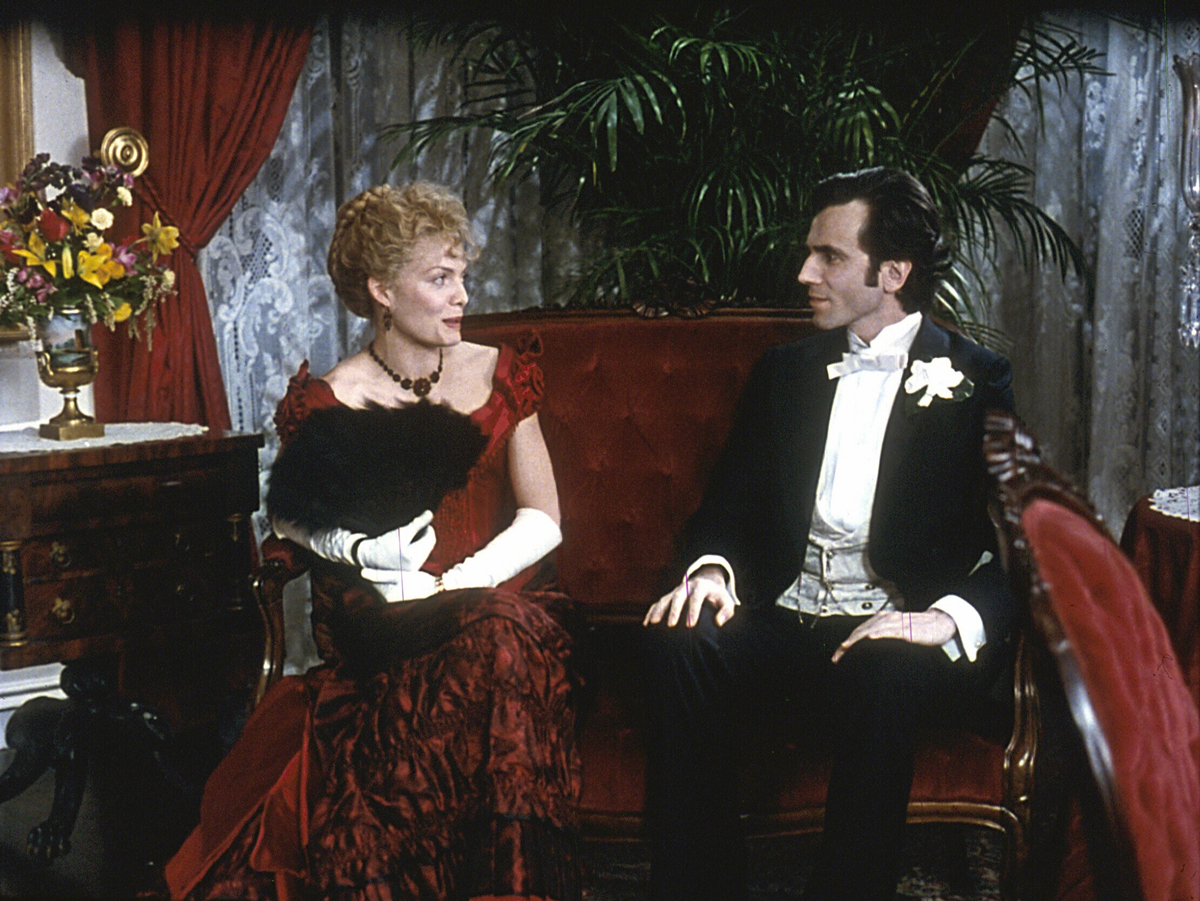
The setting is New York City in the 1870s, and the social circles inhabited by elite families. With every gesture observed, scrutinized, and judged according to behaviour codes, respected lawyer Newland Archer (Daniel Day-Lewis) announces his engagement to May Welland (Winona Ryder), a union that will bring together two influential families.

But May's jovial cousin Countess Ellen Olenska (Michelle Pfeiffer) is back in town, and immediately catches Newland's eye. Ellen carries the whiff of scandal, because her marriage to a European aristocrat fell apart and she was rumoured to have had an affair. With the rest of New York's society shunning her, Newland becomes her one defender and confidant, and a passionate love develops between them.

While undoubtedly gorgeous to look at with lavish period sets, immaculate costumes and make-up, grand opera houses, and high-society balls, The Age Of Innocence cannot overcome a lifeless script and pure lethargy. Director Martin Scorsese is out of his element, and falls victim to a standard story of misplaced affections as Newland becomes yet another man jeopardizing his standing in pursuit of the alluring but flawed independent woman.

Scorsese and co-writer Jay Cocks adapt the Edith Wharton book and infuse the script with critiques about social norms and expectations, with nods to women like Ellen yearning for more autonomy but encountering a wall of judgment. Newland is more enlightened and eager to argue for a society that does not solely punish a woman for her husband's awful behaviour. Throughout are unsubtle references by both Ellen and May about seeking safety, here used as code for economic security and social status.

But the film flounders on glacial pacing, repressed dialogue suppressing displays of initiative. Multiple scenes invest in various characters discussing the planned length of Newland's engagement to May, and whether this should be shortened. Another topic of obsessive discussion is whether Ellen should or should not relocate back to Europe. Meanwhile Newland and Ellen engage in repetitive scenes circling the same conversations and arguments about their impossible love. 

Other weaknesses include forgettably bland secondary characters, and excessive narration (by Joanne Woodward) that more resembles a book reading. Daniel Day-Lewis, Michelle Pfeiffer, and Winona Ryder are suitably coiffed but sink into the prevailing staidness, their predictable emotions disappearing into the candle-lit sets. The Age Of Innocence is a tranquil descent into the age of drowsiness.


All Ace Black Movie Blog reviews are here.

Saturday, 25 January 2020

Movie Review: Nine (2009)


A musical drama, Nine explores middle age creative block in a story about a film director and the women in his life.

Rome, 1965. Famed Italian director Guido Contini (Daniel Day-Lewis) is supposed to start shooting his next movie, but has no script and no ideas. Haunted by the failure of his two most recent films, he escapes to an Anzio hotel to try and find inspiration. He lies to his wife Luisa (Marion Cotillard) and is joined by his mistress Carla (Penélope Cruz). Costume designer Liliane (Judi Dench) tries to help, while Guido has visions of his mother (Sophia Loren) and memories of his childhood, when he was entranced by prostitute Saraghina (Fergie).

After reporter Stephanie (Kate Hudson) tries to seduce Guido, the last opportunity for a creative boost may be his regular leading lady Claudia Jenssen (Nicole Kidman). But with Luisa's patience with her philandering husband finally running out, salvaging Guido's latest project will prove difficult.

An adaptation of the play by Arthur Kopit which in turn was inspired by Fellini's (1963), Nine enjoys a stellar cast but is hampered by uninspired music and a consistently dour tone. The songs by Maury Yeston feature lyrics where clunky competes with obvious, and while Rob Marshall directs with panache, the script co-written by Michael Tolkin and Anthony Minghella gives him limited material to work with.

The film is entirely bogged down by Guido's doldrums and never generates narrative momentum. The tone is set early, the film structured as one-woman-at-a-time singing about her influence over the deeply flawed and egotistical director. Mistress, wife, confidant, mother, prostitute-from-childhood, muse: nothing helps him gain traction on his latest project, but he never misses an opportunity to light another cigarette.

The cast members bring a mix of interesting accents to the singing, for example Day-Lewis singing in an Italian clip, raising curious questions as to why anyone would sing in a language other than their mother tongue when entirely alone.

But despite several structural weaknesses, Nine benefits from a sparkling cast in good form. Guido is probably one of Day-Lewis' easier characters to embody, but he brings his reliable depth and dedication to the role. The many women rotating in his orbit are brought to life by energetic performances from Penélope Cruz, Marion Cotillard, Nicole Kidman, and Judi Dench, although none of them receive substantial screen time.

In an awkward role obviously bolted on to the movie adaptation, Kate Hudson appears unsure what her character is supposed to be doing, but delivers Cinema Italiano with plenty of verve. The better musical numbers also include Cruz's seductive A Call From The Vatican and Cotillard's angry Take It All.

Nine carries a haughty self-rating, but is more of a middling effort.


All Ace Black Blog Movie Reviews are here.


Tuesday, 15 January 2019

Movie Review: The Unbearable Lightness Of Being (1988)


A three-way grand romance set against the Prague Spring, The Unbearable Lightness Of Being explores life's profound choices through tumultuous personal relationships.

It's 1968, and the winds of political freedom appear to sweep through Prague. Tomas (Daniel Day-Lewis) is a charismatic doctor and an irresistible sexual magnet to all women, although he is closest to Sabina (Lena Olin), a free-spirited artist. Neither of them are interested in commitment, although they are soul mates in every other way.

Tomas: I must go.
Sabina: Don't you ever spend the night at the woman's place?
Tomas: Never!
Sabina: What about when the woman's at your place?
Tomas: I tell her I have insomnia... anything. Besides, I have a very narrow bed.
Sabina: Are you afraid of women, Doctor?
Tomas: Of course.

On a trip to a countryside spa to perform surgery, Tomas is entranced by young and innocent waitress Tereza (Juliette Binoche). The feeling is mutual, she follows him to Prague and they are soon married. She finds work as a photographer and he quickly resumes his philandering ways. Just as Tereza is reaching her tolerance breaking point Soviet tanks rumble into the city, crushing any hopes of liberty. First Sabina and then Tomas and Tereza relocate to Geneva. Sabina meets and starts a relationship with married professor Franz (Derek de Lint), but starting a new life in a foreign country will not be easy and Prague will exert a powerful pull.

Milan Kundera's novel was published in 1984, and four years later director Philip Kaufman brought it to the screen with a script by Jean-Claude Carrière. While Kundera did not approve of the adaptation, The Unbearable Lightness Of Being is a masterful cinematic achievement, a dreamy composition drenched in European sensibility and perfectly deploying the classic romance within upheaval template. Running close to three hours, the pace is luxurious and the visuals rich with the texture of Prague, politics and personal passions.

Through the story of Tomas' love for both Sabina and Tereza and the women's mutual appreciation of their roles in his life, Kaufman draws out the essentials for each character. For Tomas the pursuit of sexual pleasure with a succession of partners is an absolute. As he cycles through cities, careers and circumstances, his eyes will always wander.

Tomas (many times): Take off your clothes.

For Sabina unfettered freedom matters, and her jagged artistry and love of mirrors combines easily with a distaste for ever allowing anyone else to share her reflection. And Tereza is a model of patience and sacrifice, willing to do anything to stand by the one man she loves, no matter how many times he strays. Her dedication leads to sordid dead-ends in trying to emulate his emotional detachment from sexual adventurism. Tomas thrives within the carefree lightness of his being, Tereza finds it unbearable, and yet they deeply love each other.

Tereza, speaking to Tomas: I know I'm supposed to help you, but I can't. Instead of being your support I'm your weight. Life is very heavy to me, but it is so light to you. I can't bear this lightness, this freedom... I'm not strong enough.

Kaufman weaves a broader search of happiness theme seamlessly into the lovers' travails. Choices about where to live, whether to conform or resist, and tests of commitment to each other and to independent thought are interjected throughout the film. Places matter and influence well-being: Prague is the warmth of home first with the exciting freedom of expression then with the steel boot of communism, while Geneva offers cold safety in a foreign land. Late in the film an unexpected locale and the opportunity for a new lifestyle is presented, allowing the activist urbanites to explore a surprisingly attractive dynamic.

Daniel Day-Lewis, Lena Olin and Juliette Binoche are unforgettable in their roles, and create three compelling people well worth spending time with.

With frequent scenes featuring lovemaking and nudity, The Unbearable Lightness Of Being targets mature audiences willing to invest the time to soak up its tender brilliance. All three characters carry their affections alongside their faults, and they are all also endearingly human in their uncompromising search for a life worth living.

Tereza: Tomas, what are you thinking?
Tomas: I'm thinking how happy I am.


All Ace Black Blog Movie Reviews are here.


Thursday, 1 February 2018

Movie Review: Phantom Thread (2017)


A whimsical romance set in the world of fashion, Phantom Thread examines mischievous relationship dynamics churning below the surface.

The setting is London in the 1950s. Meticulous batchelor Reynolds Woodcock (Daniel Day-Lewis) runs his distinguished fashion design house creating dresses for women in the upper echelons of society. His sister Cyril (Lesley Manville) is his constant companion and main support, and she helps manage his moodiness. On one of his emotional downswings Reynolds takes a trip to the countryside where he meets waitress Alma Elson (Vicky Krieps). An instant attraction develops, and Alma joins Reynolds in London as his new muse and lover.

Alma has to quickly learn how to navigate around Reynolds' strict habits and expectations. But she refuses to simply yield to the docile role Reynolds has predefined for her, and she probes at his psyche to get to know the man behind the legend. When a Belgian princess commissions Reynolds to create a wedding dress, Alma senses his attention drifting away from her, and starts to search for a way to redress the balance.

After the mediocre The Master and disastrous Inherent Vice, Phantom Thread represents a return to form for writer and director Paul Thomas Anderson. Day-Lewis and Anderson previously teamed on the epic There Will Be Blood, and here actor and director again delve into the soul of a driven men determined to bend every detail of life to suit his idiosyncrasies.

But Reynolds Woodcock is wholly dependant on others for his success, in need of a dedicated sister to keep a watchful eye over his state of mind and a rotating muse to spark artistry. The clash between genius and dependency lays the foundation for a baroque romantic drama with a sprinkling of humour. With the classical music of Jonny Greenwood perfectly capturing the mood of sly behaviour hidden behind the facade of formality, an intricate triangle is assembled between the designer, the sister and the new lover.

And the relationship dynamics are the throbbing heart of Phantom Thread. While Reynolds is presumably the main protagonist, Alma ever so softly moves to centre stage in the second half of the film. The 1950s setting is a strictly male-centred world, but Anderson's story is about a woman quietly shaking the status quo of societal expectations. While Cyril has long accepted her role as doing whatever is necessary to enable Reynolds' success, Alma wants more, and will have to conjure up unconventional methods to get what she needs while still playing within the rules of the day.

Anderson crafts every scene with perfectionist fluidity, the filmmaker echoing the dressmaker's love for profound creativity based on customized attention to detail. Phantom Thread is a visual banquet, Anderson taking up residence in Reynolds' superficially staid house and uncovering a cauldron of activity and emotions.

The three central performances are delicately balanced and strike perfect tones throughout. Day-Lewis, in what may be his final pre-retirement role, brings the intensity of a coddled creative genius to the screen. Reynolds is far from easy to love, and Day-Lewis seeks out the conflicts between his need for human warmth and a natural tendency for aloofness. Lesley Manville projects coldness borne out of Cyril's lifelong commitment to her brother, a pact that means she has a comfortable life but not of her own.

The revelation is Vicky Krieps, who matches Day-Lewis and indulges in the silent interludes where a woman needs to do all the work to see the path ahead and quietly change it. Krieps allows Alma's subtle actions to speak loudly, a woman challenging her man's obtuse needs and daring to recast her role in his perfectly organized world.

Phantom Thread weaves a complex dress, full of intriguing details and delightful use of luxurious fabrics.


All Ace Black Blog Movie Reviews are here.


Monday, 2 May 2016

Movie Review: There Will Be Blood (2007)


An epic oilman drama, There Will Be Blood is an engrossing character study with an astonishing subject matter. The fictional story of Daniel Plainview delves into the psyche of men brilliant enough and mad enough to independently create new industries out of nothing.

The film starts in 1898, with Plainview (Daniel Day-Lewis) mining a single hole in the New Mexico desert, looking for any precious mineral. By 1902, with a few men now working with him, he discovers oil in California. One of his men is a single dad and dies in a work accident. Daniel adopts the infant, known only as D.W., as his own. By 1911 Daniel is travelling the state and expanding his burgeoning oil business by persuading farmers to sell their land. Daniel uses D.W. to portray a wholesome family-man image.

Acting on a tip Daniel sets his sights on the rugged, rocky and remote property owned by the Sunday family near Little Boston. He reaches a deal with the patriarch Abel, but finds his son Eli (Paul Dano) quite a handful. Eli wants proceeds from the land sale to start his own church, and gets his way. Daniel ties up all the land around the Sunday property and is soon running a major drilling operation, looking for the elusive first oil strike.


Eli gets his church up and running as well. The two men don't get along, but both are eventually successful. Daniel does suffer several tragedies, and Eli attributes the mishaps to Daniel's refusal to respect Eli's church. With the oil business booming, Daniel remains fiercely independent, and his stubbornness will both help and hinder his prospects of getting his enormous oil supplies to market.

Directed and written by Paul Thomas Anderson as an adaptation of the Upton Sinclair book Oil!, There Will Be Blood is an audacious story of crooked business and suspect religion, nation building by deceit and soul seduction by chicanery, two sides of the same coin inspiring the transformation of rural America.

The film clocks in at 158 minutes, and its a continuously enthralling viewing experience. Anderson moves through the years quickly, and punctuates the film with powerful landmark events, including frequent, sudden work site mishaps as the rudimentary oil industry gets off the ground. An innovative Jonny Greenwood soundtrack contributes to the mood of civilization evolving into the industrial age where hitherto unimaginable riches are possible, and souls are now in need of more impassioned cleansing to wipe away the creeping greed.

The film uses an economy of words and the majesty of image, courtesy of cinematographer Robert Elswit, to create an astounding aesthetic. There Will Be Blood is about wide open spaces ready to be subjugated by men with grand ambition and the ability to sweet talk others out of land, money and the future. Anderson allows Daniel Plainview and Eli Sunday to represent themselves with no added commentary, and in the process avoids passing judgement. Neither the obsession with oil as a new business nor the creeping influence of pseudo religion as a vehicle for controlling the impressionable are presented as good or bad.

Plainview's traits include steely determination, a deep reservoir of stubbornness, and a talent for sweet-talking. He is a force of nature unleashed on the landscape, and neither the people nor the natural resources will be the same once Plainview and his ilk roll through. Anderson allows Eli Sunday fewer scenes to make his mark, but these are enough. Eli gets into his groove with passionate sermons complete with wide-eyed theatrics to represent devil banishment and fake healing, and his congregation eats up his babble as quickly and easily as they follow Plainview to the dream of riches.

Daniel Day-Lewis devours the film in one of his outstanding performances. His aura is dominant and overpowering, and Day-Lewis ensures that what Plainview doesn't gain by persuasion he obtains through intimidation. Remarkably, Day-Lewis is matched by Paul Dano, who was a late replacement for the role of Eli Sunday. Dano creates a low-key, surreptitious presence, erupting into life in his sermons but otherwise claiming the fake moral high ground in Eli's own pursuit of building wealth through worship.

There Will Be Blood ends with a confrontation for the ages, a scene of magnificent score settling and retribution, two ruthless men locking horns and representing the ultimate battle between the brain and the heart. Both happen to be corrupted beyond salvation, but that will not stop plenty of blood from being spilled.


All Ace Black Movie Blog Reviews are here.

Saturday, 6 February 2016

Movie Review: Gangs Of New York (2002)


A raucous story of revenge among the rabble, Martin Scorsese's Gangs Of New York is impressive but also overwrought, more a visual treat than a cerebral triumph.

New York City, 1846. At Paradise Square in the poor and crime-ridden Five Points neighbourhood, rival gangs square off for a grand battle with rudimentary but lethal weapons. The Natives are led by William "Bill the Butcher" Cutting (Daniel Day-Lewis), and consider themselves rightful residents and true Americans. The Dead Rabbits are more recent Irish Catholic immigrants, inspired by "Priest" Vallon (Liam Neeson). The Natives win the battle, and Bill kills the Priest. Vallon's son witnesses his father's death and escapes.

16 years later, the grown-up Amsterdam Vallon (Leonardo DiCaprio) returns to the old neighbourhood, seeking revenge. Bill The Butcher is now the undisputed king of Five Points, controlling all crime activities, as well as the law in the form of officer Jack Mulraney (John C. Reilly). Bill, who still despises new immigrants, has also forged an uneasy alliance with politician Boss Tweed (Jim Broadbent), who is more welcoming of new arrivals as potential voters.

Amsterdam starts a relationship with professional thief Jenny Everdeane (Cameron Diaz) and becomes a trusted advisor to Bill even as he plots to kill him. But with the civil war raging and a military conscription draft about to be imposed, there is growing unrest on the streets of New York City, and Amsterdam's quest for Bill's blood will encounter some surprising twists.

Gangs Of New York delves into a slice of history almost lost in the shrouds of time. The social anarchy of Manhattan's poor neighbourhoods between 1846 and 1862 is now all but erased from collective memory, socially and metaphorically eradicated, built upon and transformed into a modern multicultural metropolis teaming with tourists.

But this is where Scorsese goes looking for the origins of American civility and democracy, and identifies Five Points as ground zero for cultural accommodation, a place where natives and newcomers (both relative terms) squared up to each other and literally engaged in slaughter before concepts of civilized discourse seeped down to street level. In parallel the nation was defining its soul in the bloody Civil War, a conflict that may as well have been occurring on another planet as far as Five Points residents were concerned. Eventually the national and local civil wars intersect in the orgy of violence known as the Draft Riots, and the bloodletting nudges the City towards understanding its future destiny.

The film boils down the intriguing social context to a simple story of revenge, and while compelling in its intensity, the story goes marginally too far in personalizing history. Amsterdam's lust for vengeance is a relatively small story to carry a 160 minute film, and other than the magnificent sets, Scorsese cannot build much around it. Amsterdam is dour and Bill The Butcher is larger than life, but otherwise the film is surprisingly devoid of any memorable secondary characters, sub-plots, or even noteworthy incidents. The likes of Cameron Diaz, John C Reilly and Jim Broadbent are too often reduced to shallow representations, and Liam Neeson's seemingly interesting Father Vallon is knocked-off early.

But when the story gets bogged down, there is always something compelling to look at. Gangs Of New York is extraordinary as a set design feast. Recalling the lavish era of Hollywood reproducing history on sound stages, the imagined New York City of the 1860s was recreated at Rome's Cinecittà studios. The film looks gorgeous, a cross between theatrical set-piece and crime-infested but irresistible Les Misérables inspired nightmare.

Diplomacy only prevails when thugs get tired of killing, and even the Gangs Of New York start to understand that a history of greatness will only be achieved when the blood-letting ceases, and other, still imperfect tools, like voting, start to take hold. The one spectacular celebration of violence arrives early in the form of the blood thirsty rumble in the square. Once victory is proclaimed and the bodies are cleaned up, the film settles down to a long, drawn-out and colourful story of a young man seeking self-defined justice but also finding himself in danger of falling under the spell of his prey. DiCaprio and Day-Lewis, moody and flamboyant respectively, are more than capable of carrying the film, and Gangs Of New York rides their talent to a rousing ending that, while still victimized by indiscriminate violence, carries echoes of a personal and national history finally taking shape.


All Ace Black Blog Movie Reviews are here.

Thursday, 12 June 2014

Movie Review: A Room With A View (1985)


An adaptation of the E.M. Forster novel about a young British woman falling in love with a free-spirited man, A Room With A View is a gorgeous coffee-table movie, with beautiful costumes, scenery and performances making up for a thin plot and slow pacing.

It's the early 1900s. On a trip to Florence with her chaperon and older cousin Charlotte (Maggie Smith), the young and curious Lucy Honeychurch (Helena Bonham Carter) meets fellow British vacationer George Emerson (Julian Sands), a rather strange and passionate young man traveling with his talkative father Mr. Emerson (Denholm Elliott). Lucy and George witness a scuffle between two local men that turns into a murder, and George comes to Lucy's assistance when she faints from the excitement. They are gradually attracted to each other, and on a subsequent trip to the Italian countryside they share a spontaneous and sexy kiss, much to Charlotte's horror.

Upon returning home to the English countryside, Lucy has a suitor waiting in the stuffy form of Cecil Vyse (Daniel Day-Lewis). Lucy is content to go down the road of marrying Cecil, until fate intervenes and the Emersons move in as tenants at a nearby house in Lucy's neighbourhood, reigniting the potential for romance between Lucy and George.

One of the biggest successes for the duo of director James Ivory and producer Ismail Merchant, A Room With A View is a lush exercise in visually rich romance. Ivory makes almost every scene an idyllic painting to remember, with opulent colours, breathtaking views and lavish costumes. From the plazas of Florence to the fields of rural Italy and onto the English countryside, A Room With A View is as much an artistic feast for the eyes as it is a narrative for the heart.

The plot itself is slight, and unfolds at a leisurely pace. The romance between Lucy and George is based on little except coincidence and the thrill of the illicit, and there is nothing in the script by Ruth Prawer Jhabvala to explain why the feisty Lucy and the rather distracted George should actually enjoy each other's company.

More interesting are the three secondary characters. Charlotte carries a look of perpetual mild panic, unable to control Lucy and witnessing an eruption of lust. The senior Mr. Emerson always has something to say and is never shy about saying it, occupying the centre of every conversation. And Cecil Vyse is the definition of stuffiness, the antithesis of Lucy and an easy man to discard in the chase for adventurous romance.

With an undercurrent of dry humour, A Room With A View pokes fun at Victorian attitudes towards morality lingering in the early part of the 20th century. Lucy and Charlotte agree to never mention the kiss between Lucy and George, no so much to protect Lucy's character but rather Charlotte's reputation for allowing the kiss to happen. And the film outlines British haughtiness towards Italians, who are perceived by Charlotte and her fellow older aged travellers as little better than wild natives.

The performances are note perfect, Helena Bonham Carter providing a bright spark of rebellion for Lucy to play with, while Maggie Smith finds every possible expression of worry, given that Charlotte needs them all. Judi Dench makes a relatively brief appearance as English author Eleanor Lavish, touring Italy for inspiration.

A Room With A View is distinguished entertainment, making up with decorum what it lacks in excitement.


All Ace Black Blog Movie Reviews are here.


Monday, 17 February 2014

Movie Review: In The Name Of The Father (1993)


Based on a true story, In The Name Of The Father delves into the Northern Ireland conflict, and through the story of one struggling family finds frightening failures that threaten the essence of the justice system.

It's the early 1970s, and Northern Ireland is gripped by sectarian violence. Gerry Conlon (Daniel Day-Lewis) is a petty thief in Belfast, but his brushes with the law have the unintended consequences of unleashing British Army fury on Catholic strongholds. Gerry's father Giuseppe (Pete Postlethwaite) has to rescue his son from IRA retaliation. Eventually Gerry and his friend Paul Hill (John Lynch) relocate to London, falling in and then falling out with a group of squatting hippies.

With Gerry and Paul close to homeless, the IRA bomb a popular pub in Guildford, killing five people. The politicians use the public anger to ram through powers of detention without charge, and both Gerry and Paul are picked up and harshly interrogated for days before agreeing to sign whatever statements are placed in front of him. Not only is Gerry convicted of the bombing, but Giuseppe and several other family members are also found guilty of enabling the bombing. Gerry and Giuseppe are left to rot in prison, until finally British solicitor Gareth Peirce (Emma Thompson) starts to probe the case.

A lesson on how quickly a democracy can fall into the traps of a police state, In The Name Of The Father shines the spotlight on police officers desperate to show results in the face of public outrage, and resorting to intimidating interrogations to wrest confessions out of the innocent. The film is at its best when the forces of authority are at their worst, and Gerry as an individual is all but crushed by the weight of an angry nation desperate for a conviction.

In The Name Of The Father does, however, suffer from an excessive length. Once Gerry and Giuseppe land in prison, the pacing slows down, and director Jim Sheridan looks for ways to pass the time. The plodding scenes do convey the stillness of life wasting away behind bars, but a running time of 133 minutes is a long time to invest in the story.

But the first and final acts are excellent. The early scenes in a tense Belfast and then London, as a shiftless Gerry heads towards a wasted life, capture a youth spiralling into the nothingness of the socially depressed 1970s, and then caught in the wrong place at the wrong time. The climax of the film, with Pierce delving into the case, uncovering the flawed police tactics and powerfully presenting them in court, rebuilds momentum and achieves the desired emotional peak.

The two central performances are both magnetic. Daniel Day-Lewis brings his profound intensity to the role of Gerry, although the character only steps out to carve his own space late in the narrative. Even more impressive is Pete Postlethwaite in one of his most prominent screen roles. Giuseppe is caught between protecting his son and protecting his family, a balancing act that fails spectacularly and threatens his very existence. Postlethwaite brings to the role the calm presence of a man who never expects to be understood by his wayward son, but who nevertheless will soldier on to do his best for all the family. Both Day-Lewis and Postlethwaite received Academy Award nominations.

Emma Thompson is underutilized, Gareth Peirce only becoming relevant in the final twenty minutes. While Thompson displays passionate conviction in the courtroom scenes, her Academy Award nomination has to be classified as a surprise.

In The Name Of The Father is a cry to protect the principles of justice at the darkest of times, a fundamental concept that is all too regularly ignored.


All Ace Black Blog Movie Reviews are here.


Saturday, 31 August 2013

Movie Review: My Left Foot (1989)


My Left Foot boasts a bravado acting performance by Daniel Day-Lewis, but the biopic of Irish artist Christy Brown is an otherwise laboriously episodic exercise, hampered by often incomprehensible dialogue.

Born to a poor family in Dublin in the early 1930s, Christy Brown (Day-Lewis) suffered from severe cerebral palsy that left him with almost no communication or motor skills. His father Paddy (Ray McAnally) deems him an imbecile, but his mother Bridget (Brenda Fricker) believes that there is a human being trying to function within the tangle of uncontrollable body parts. Christy eventually trains himself to write and express himself with his left foot, the only limb that he can manipulate with some success. Also using only his left foot, he starts to paint.

Always struggling against poverty and discrimination due to his physical condition, Christy finally gets help from therapist Dr. Eileen Cole (Fiona Shaw). She improves the clarity of his speech, spots his painting talent, and helps to introduce him to the art world, where a gallery showcases his work. But there are more troubles to come, as Christy's search for love collides with a combative, often explosive, personality.

Daniel Day-Lewis earned his first Best Actor Academy Award for an intense, physically demanding role. Contorted into impossible postures, squeezed into tight angles, forced to crawl just to move and then thrown into makeshift wheelbarrows because the family is too poor to afford a wheelchair, Day-Lewis delivers a staggering performance, exhausting just to watch.

And for all of the movie he talks like a man afflicted with cerebral palsy, but here My Left Foot starts to run into some trouble. Christy Brown's dialogue is less than fifty percent comprehensible, the combination of speech impediment and Irish accent creating an often impenetrable barrier. Authentic, perhaps, but a difficult and less than engaging movie experience.

My Left Foot also struggles to create any narrative tension or story arc. Once the premise and background contexts are set, the film settles into sequential "episodes from the life", director Jim Sheridan unable to conjure up more than routine biographical instalments. Boredom creeps in, despite the efficient 100 minute running length. There is an attempt to book-end the movie with a now-successful Brown wooing Mary Carr, a nurse tending to his needs at a social function. While this unconventional romance relieves the dreariness of the earlier-life poverty and anguish stories, it does not add momentum.

The supporting performances are sound, Brenda Fricker perhaps surprisingly winning the Best Supporting Actress Academy Award for her staid turn as Brown's always hopeful mother, while Ray McAnally saturates the screen with old-fashioned Irish paternalism as the naturally gruff but tender-deep-inside father.

With the help of a terrific central performance, My Left Foot does chart the unblinking course of a remarkable man overcoming immense physical challenges. However, the quest for realism also steers the movie towards the dryness of biographical documentaries.


All Ace Black Blog Movie Reviews are here.


Thursday, 17 January 2013

Movie Review: The Boxer (1997)


A look inside the tired twilight of the troubles in Northern Ireland, The Boxer is a fictional story of one man caught in the shifting political and paramilitary sands. The third collaboration between Daniel Day-Lewis and Jim Sheridan yields a powerful drama, if hampered somewhat by an accent barrier and the overall opaque nature of the conflict.

After serving 14 years in prison, Danny Flynn (Day-Lewis) is released back into a fractured Belfast. Still only 32, his crime is never fully fully revealed, but involved participating in an Irish Republican Army (IRA) operation under the leadership of local commander Harry (Gerard McSorley). Although he has the opportunity to relocate to England, Flynn decides to stay in Belfast, eschew politics, and focus on reviving his boxing career. He teams up with friend and trainer Ike (Ken Stott), and they re-open a non-sectarian training gym.

Flynn also reconnects with his old flame Maggie (Emily Watson), although she is now married to another still-imprisoned IRA operative, and she has to be seen to remain loyal. Maggie's father Joe Hamill (Brian Cox) is a senior figure in the Republican cause involved in negotiating an end to the troubles. Although a deal appears tantalizingly close, it is not yet final. Harry does not agree with the peace process, causing a rift between him and Joe. Harry is also unhappy with Danny's attempts to foster non-sectarian relations and the increasing heat emanating from Danny's rekindled relationship with Maggie.

The Boxer is not necessarily an easy film to watch. The Irish accents are only slightly tempered, creating a hurdle in understanding a talk-heavy narrative in which most of the characters already speak in the hushed tones of a city simmering with unconcealed resentment. And the script, co-written by Sheridan, assumes a basic understanding of not only the background of the Irish troubles, but also the fractured politics of factions within the IRA heading to a stand-off as the possibility of peace approaches.

Within these constraints, the human drama is commanding. Danny, Joe and Harry represent the three points of the Republican triangle, Danny wanting to get on with life, Joe trying to create a context for a new future, and Harry eager to continue the violent struggle. The tension between the three increases in delicate increments as realization grows that their individual objectives may be mutually exclusive. There is a continuous current of dread running underneath each man's actions, Danny risking his life in pursuit of normalcy and to regain Maggie's love, Joe hoping that men who have sacrificed everything will march with him from war to peace, and Harry convinced that the British understand only the language of violence.

The performances are uniformly excellent, Day-Lewis, Cox, and McSorley continuously eyeing each other to determine the depth of allegiance and to which cause, where any miscalculation could mean death. Ken Stott adds unbridled natural passion for boxing as a way out for children of the troubles, and throws in undisguised disgust at the futility of violence. Emily Watson as Maggie walks the tightrope between falling in love with Danny all over again and remaining faithful to the role of stoic prisoner's wife.

In the relatively brief outdoor scenes, Sheridan recreates a Belfast buckling under the weight of a decades-long conflict. A divided city filled with watching eyes and watchful soldiers, populated by angry men, widows, wives of prisoners, grieving parents, and children growing up without fathers, where everyone has reasons to fear and better reasons to hate. All walls are covered with sectarian graffiti, and the sound of deadly explosions causes only the briefest of pauses among the exhausted population.

The Boxer has blood inside and outside the ring, brutality reigning everywhere Danny turns, but at least the rules of his chosen sport are clear. In the chaos of his city, death follows no logic except to widen the spiral of violence.


All Ace Black Blog Movie Reviews are here.


Tuesday, 8 January 2013

Movie Review: Lincoln (2012)


Steven Spielberg gently wraps his arms around one of the most critical moments in the history of the United States: in the four month period between Abraham's Lincoln re-election and his assassination, slavery was abolished and the Civil War ended, clearing the decks for a unified country to find its footing, and a future superpower to emerge. Lincoln is the story of a dignified President leading his country out of the abyss and onto the road towards glory.

It's January 1865, Lincoln has been re-elected, and a meat-grinder of a Civil War is still rumbling, although it now appears that the Union has the upper hand and the rebels of the Confederate south are exhausted. To the surprise of his Secretary of State William Seward (David Strathairn), Lincoln (Daniel Day-Lewis) decides that now is the moment to push the 13th Amendment, abolishing slavery, through Congress.  Lincoln's reasoning is challenging yet simple: when the war ends, congressmen will lose the courage to support the Amendment.

Members of his own Republican party, including long-time slavery opponent Thaddeus Stevens (Tommy Lee Jones), line up behind Lincoln, but not before some congressmen, prodded by the influential Francis Preston Blair (Hal Holbrook) demand that the President make overtures to a Confederate delegation wishing to negotiate an end to the war.

The tantalizing prospect that there may be a deal in the making for the fighting to end places the passage of the Amendment in jeopardy, particularly as Lincoln needs 20 Democrats to defect from their party ranks and support the vote. Seward deploys operative William Bilbo (James Spader) and his crew to do what is necessary to secure the Democrat votes. As the clock ticks down towards a history-defining showdown in Congress, Lincoln has to also deal with his son Robert (Joseph Gordon-Levitt) wanting to joint the army, much to the horror of First Lady Mary Todd Lincoln (Sally Field), still traumatized by the earlier loss of another son.

Lincoln is a commanding talk fest, the movie a series of mostly tense encounters between men arguing over the future of a nation. Spielberg and screenwriter Tony Kushner (adapting portions of the book Team of Rivals: The Political Genius of Abraham Lincoln by Doris Kearns Goodwin) keep the drama moving by mixing national with domestic politics, Mrs. Lincoln humanizing Lincoln by forcing him to deal with family issues while the country teeters on the edge of destiny. Sally Field's performance is rather obvious, as the first lady often gets in the way of the business of nation building.

The political discourse is necessarily complicated: securing the passage of an Amendment through a Congress filled with men pursuing diverse agendas was never going to be easy, and Kushner's script does not shy away from the more convoluted machinations that churn away beneath the factory of politics. Spielberg keeps the narrative on the safe side of comprehensible, and there is always the sage presence of Lincoln to smooth over the rough patches and patiently remind his foes and friends alike that the country will only ever move forward when he scourge of slavery is forever consigned to history.

Daniel Day-Lewis embodies Lincoln in a performance for the ages. The bent posture, the patient demeanour, the paternalistic smile, the slow, deliberate movements, and the always thoughtful eyes mapping out an ingenious approach to every encounter: Day-Lewis becomes Lincoln, easily switching from father to commander, from listener to story-teller, and from educator to mentor. He polishes the role to a shine that sets the new standard against which all future portrayals of the man will be evaluated, and none are ever likely to measure up. David Strathairn, Tommy Lee Jones and Hal Holbrook provide strong support in a cast of characters dominated by men of power and purpose.

At 150 minutes, the film carries plenty of weight. And with every phrase from the man's mouth delivered with grace and distinction, he threatens to transform into a faultless divine entity rather than a man. But Spielberg finds the ways to demonstrate that even Lincoln was less than perfect, an unintended confrontation with his son Robert spiralling in an unfortunate direction.

Ultimately Lincoln is leadership at its purest: forming the vision of what is needed; finding the fortitude to proceed despite severe opposition and the methods to succeed when none were obvious; and most crucially, determining the right moment to act. Lincoln is about a man seizing the moment, forging history, and launching the future.


All Ace Black Blog Movie Reviews are here.