Showing posts with label Jeremy Irons. Show all posts

Sunday, 27 July 2025

Movie Review: The House Of The Spirits (1993)


Genre: Drama  
Director: Bille August  
Starring: Meryl Streep, Jeremy Irons, Glenn Close, Vanessa Redgrave, Winona Ryder, Antonio Banderas  
Running Time: 146 minutes  

Synopsis: The setting is Chile, starting in the 1920s and spanning three generations. Esteban (Jeremy Irons) works hard to earn his fortune, and after his intended bride tragically dies, he marries her psychic sister Clara (Meryl Streep). Esteban rises to become an influential landowner and then a politician, but his sexually repressed spinster sister Ferula (Glenn Close) is a source of constant irritation. With socialism threatening Esteban's conservative ruling class, his daughter Blanca (Winona Ryder) falls in love with peasant revolutionary leader Pedro (Antonio Banderas), adding strife to the household.

What Works Well: This adaptation of Isabel Allende's novel is a never-dull gallop through 50 years of a family's ups-and-downs. A country's evolution and the rise of the working class provide a crackling context for Esteban's trajectory from hardworking labourer to powerful landlord, culminating in an unexpected encounter with humility. The women in his life are a source of tragedy, love, pleasure, frustration, joy, and anger, converging into difficult-to-learn lessons about what matters. Clara's subtle supernatural abilities provide a magic sparkle in an otherwise grounded milieu, while the visuals capture both beautiful landscapes and meticulous indoor sets.

What Does Not Work As Well: The South American soul of the story is degraded by the Anglo-American dominated cast, while the packed-in incidents allow limited opportunities for reflection. The narrative flow appears initially unsure whether to place Clara or Esteban at the drama's centre.

Key Quote:
Ferula: I set my curse on you, Esteban! You will always be alone! Your body and soul will shrivel up and you'll die like a dog!


All Ace Black Movie Blog reviews are here.

Sunday, 9 March 2025

Movie Review: The Beekeeper (2024)


Genre: Action Thriller  
Director: David Ayer  
Starring: Jason Statham, Josh Hutcherson, Jeremy Irons, Phylicia Rashad, Minnie Driver  
Running Time: 105 minutes  

Synopsis: In Massachusetts, the elderly Eloise Parker (Phylicia Rashad) commits suicide after losing her life savings to a phishing scam. Her tenant Adam Clay (Jason Statham) is a beekeeper, retired CIA Agent, and expert assassin. He vows revenge and destroys the responsible call centre, attracting the attention of Eloise's daughter Verona Parker (Emmy Raver-Lampman), an FBI agent. Adam's vengeance unleashes escalating violence connected to an evil conglomerate led by the snotty Derek Danforth (Josh Hutcherson) and retired CIA Director Wallace Westwyld (Jeremy Irons). 

What Works Well: Jason Statham's dry confidence as a killing machine capable of dispatching countless enemies provides potent fuel to power the action. Innovation mixes with acidic humour as the body count mounts and Adam Clay works his way up the food chain to confront dizzying heights of power. David Ayer maintains both momentum and coherence in choreographing action scenes on the edge of a sharp knife, and the cast is peppered with quality and equipped with quips to augment the sparkling production values. 

What Does Not Work As Well: The violence is eventually mind-numbing, and both the conspiracy details and the army-of-one shenanigans follow an exponential curve towards preposterous excess.

Key Quote:
Adam Clay: I'm a beekeeper. I protect the hive. Sometimes I use fire to smoke out hornets.


All Ace Black Movie Blog reviews are here.

Saturday, 22 October 2022

Movie Review: House Of Gucci (2021)

A family-and-business saga, House Of Gucci is an engaging but notably ovelong romantic drama-comedy. 

In 1978, Patrizia Reggiani (Lady Gaga) is the daughter of a truck company owner. At a party she meets Maurizio Gucci (Adam Driver), a law student and heir to 50 percent of the luxury brand. She pursues him romantically and they are soon married. Maurizio's father Rodolfo (Jeremy Irons) does not approve of Patrizia, believing she is just a golddigger, but Rodolfo's brother Aldo (Al Pacino) is more welcoming. Aldo's son Paolo (Jared Leto) is the family fool.

The ambitious Patrizia has a sharp business mind and befriends psychic Pina (Salma Hayek). Patrizia then inserts herself into the family's affairs by manipulating Maurizio and Paolo. After Rodolfo's death she tries to manoeuvre for full control, but Maurizio eventually tires of her antics and their marriage heads into trouble, leaving Patrizia vulnerable and deeply resentful.

Inspired by real events, House Of Gucci has the perfumed gloss of a high-end fashion magazine. The screenplay by Becky Johnston and Roberto Bentivegna finds plenty of material spanning more than 15 years in the cocooned world of the wealthy, and maintains admirable energy. Romance, business, connivance, and family feuds ensure a steady stream of narrative twists. Director Ridley Scott stages the Gucci clan antics with bravado, embracing the aloof glamour of wealth. 

And it's a lust for wealth and power that drives Patrizia. The Gucci's themselves are relatively boring, and it's left to an outsider to burst into their world and shake it up, igniting a delicious clash between classism, social ladder-climbing, and eurotrash. It's all fun and games until someone dies, although for better or worse, the film steers towards violence with a silly grin.

The cast is simultaneously captivating and caricaturish. Almost unrecognizable under layers of makeup, Jared Leto is simply out there as Paolo, milking the role of pathetic idiot for all it's worth. Pacino is more restrained but still flamboyant. Lady Gaga and Adam Driver hold the centre of the circus together with assured performances, Gaga's take on Patrizia underlining her demands for a place in the sun, while Driver tracks Maurizio's meandering journey from withdrawn young man to ruthless business tycoon.

At 158 minutes, House Of Gucci is inexcusably too long, Scott's lazy editing allowing every scene and sequence to go on. The characters are over-the-top entertaining, but they could have been hustled along with better discipline.


All Ace Black Movie Blog reviews are here.

Saturday, 19 March 2022

Movie Review: The French Lieutenant's Woman (1981)

A romantic drama with parallel stories in two timelines, The French Lieutenant's Woman is visually gorgeous, but slow-paced and emotionally uninvolving.

In the seaside English village of Lyme, American actress Anna (Meryl Streep) and English actor Mike (Jeremy Irons) have the leading roles in a movie production filming a Victorian love story. Anna and Mike start an affair, which mirrors the film's events.

In the Victorian narrative, Miss Sarah Woodruff (Streep) is a fallen woman, with a sullied reputation of having slept with a french lieutenant who promptly abandoned her. Charles Henry Smithson (Irons) is a palaeontologist looking for fossils in the area. He proposes marriage to Ernestina Freeman (Lynsey Baxter), the daughter of a wealthy industrialist.

But once Charles sets eyes on Sarah, he is immediately smitten. They start seeing each other in secret, with Charles determined to uncover her story. Sarah secures employment as secretary to the crusty Mrs. Poulteney (Patience Collier), while Charles starts to doubt his commitment to Ernestina. He seeks the counsel of Dr. Grogan (Leo McKern) to better understand Sarah's melancholic state.

An adaptation of the John Fowles book with a script by Harold Painter, The French Lieutenant's Woman is successful at coherently capturing two separate but related tales of illicit passion. Director Karel Reisz deftly weaves Anna and Mike's modern-day affair through the more dominant Victorian-set story, and within 127 minutes both are rounded into viable dramas.

Despite the high quality production values, the pacing is slow and creeps into ponderous, even with twin stories competing for screen time. Several scenes in the Victorian story line add little to the narrative and could have been trimmed. But while the clocks tick slowly, the visual beauty is opulent. The cinematography by Freddie Francis is lush and lively, with plenty of outdoor filming animating a rustic rural England with rich greenery, vibrant town streets, and a wind-swept sea-side.

Although both couples grapple with the intensity of uncontrolled lust, unfortunately none of the four central characters emerge with credit, undermining the level of possible engagement. Sarah discloses little that can be trusted, and she emerges as primarily manipulative and happy to snare with victimhood. Charles is a prototypical weak male chasing after the image of distant beauty, willfully and woefully undermining all his future prospects. Anna and Mike fare worse, both of them shallow and looking for the on-set thrill with no rational plan for the post-filming future. 

While the characters are sometime infuriating and always less than empathetic, the performances are stellar. Meryl Streep excels in both roles, hiding thoughtful connivance behind tentative fragility as Sarah, and modernizing similar talents as Anna. Jeremy Irons is a perfect foil, love-struck and gullible in both eras.

The French Lieutenant's Woman exposes human frailties when love shrouds reason.The theme lacks inspiration, but is still presented with artistry.


All Ace Black Movie Blog reviews are here.

Saturday, 15 January 2022

Movie Review: Margin Call (2011)

A Wall Street drama, Margin Call digs into the triggers of the Great Recession with cold-eyed pragmatism.

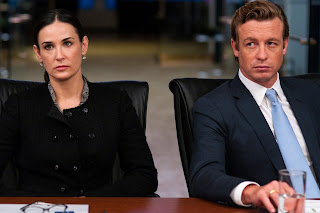
In 2008, a New York City investment bank goes through a round of layoffs. On the same day, risk analyst Peter Sullivan (Zachary Quinto) uses data provided by laid-off risk manager Eric Dale (Stanley Tucci) to uncover a looming crisis of worthless investment assets about to bankrupt the bank - and the entire industry. Peter alerts his boss Will Emerson (Paul Bettany) and trading floor manager Sam Rogers (Kevin Spacey), who quickly advise their boss Jared Cohen (Simon Barker) and chief of risk management Sarah Robertson (Demi Moore).

By the middle of the night CEO John Tuld (Jeremy Irons) is convening meetings to plot out a survival strategy. Jared supports a "first out" plan to dump the toxic assets onto the unsuspecting market the very next morning, financially saving the bank but damaging its reputation and triggering a market crash. Loyal to the bank but perturbed by the immorality of ordering his team to sell soon-to-be worthless assets, Sam is less enthusiastic about the plan.

A fictional account inspired by real events and most closely resembling what may have happened at investment bank Goldman Sachs, Margin Call unfolds like a gripping play. Director and writer J.C. Chandor introduces a few outdoor scenes, but the focus is on 36 critical hours inside the bank's offices, where analysts, managers, and executives suddenly come face to face with an existential worst-case scenario. Through their actions, Chandor teases out some hard truths about capitalism.

With diverse personalities generating impressive dynamics, this is a thriller about the flow of information and the essence of grasping criticality and then acting, including meetings convened at 2am. Sullivan is no less than a rocket scientist (literally), who chose a Wall Street career because the money is better. His manager Will is a realist; his boss Sam is a motivator. Up the ladder at the level of Jared and ultimately Tuld, the whys and details don't matter: only the trends, implications, and necessary next steps.

Chandor avoids the trap of simplistically portraying Wall Street bankers as profit-hungry vultures. Self-deprecation is in evidence, as is recognition of long-term boom and bust cycles. Trading in debt-saddled assets is described as the lubrication keeping the economy afloat and juicing the dream. Will eloquently describes the ethics of economic fairness to young risk analyst Seth (Penn Badgley):

If people want to live like this, with their big cars and these houses that they haven't even paid for, then you are necessary. The only reason they can continue to live like kings is because we've got our fingers on the scale in THEIR favor. And if I were to take my finger off...then the whole world gets really fucking fair, really fucking quickly. And no one wants that, they say they do...but they don't.

Not all the elements click. Chandor could have trusted the audience with a better description of the flaws within mortgage backed securities, and he appears unsure what to do with the character of risk manager Eric Dale, whose work uncovers the crisis just as he is being escorted out of the building. Dale becomes the subject of an aimless search adding little to the drama. Demi Moore also suffers with an underwritten role as the humourless Sarah Robertson, unconvincingly stuck somewhere between conspirator and victim.

But overall the ensemble cast members share the screen time and bring their characters to animated life, benefiting from the sharp-edged script. Paul Bettany and Simon Barker leave the best impression, while Jeremy Irons adds a dash of Machiavellian leadership. The dialogue exchanges embrace increasingly cut-throat realities as the long night progresses, some careers boosted, a few lost, others damaged but left standing, at least until the next inevitable crisis.


All Ace Black Movie Blog reviews are here.

Sunday, 25 July 2021

Movie Review: Die Hard With A Vengeance (1995)

The third instalment in the franchise, Die Hard With A Vengeance introduces buddy film elements and breaks free from a single-location focus. While the entertainment value remains high, bloat creeps in with the loss of narrative discipline.

A terrorist calling himself Simon (Jeremy Irons) triggers an explosion at a New York City department store, then threatens more carnage unless Police Lieutenant John McClane (Bruce Willis) follows his every order. The first instruction sends McClane to Harlem, where he is rescued from a rough encounter by store owner Zeus (Samuel L. Jackson). Simon then dispatches McClane and Zeus on a cross-town race to try and stop a bomb from exploding on a subway train. They are able to minimize casualties, but the bomb causes structural damage under Wall Street.

Simon next claims to have a bomb hidden in one of the City's schools, without revealing which one. McClane starts to suspect the terrorist is distracting all emergency responders to clear the way for a major crime. He makes his way back to Wall Street to try and uncover Simon's identity and real objectives.

John McTiernan returns as director, and the script by Jonathan Hensleigh (based on his book) is ambitious. Realizing the need for a refresh after confining the action in the first two movies to a high rise then an airport, Die Hard With A Vengeance expands the geography to all of New York City. The premise is broadened to a manic treasure hunt orchestrated by a madman enjoying his Simon Says powers while unspooling a malevolent hidden plot. McClane also gets support from a reluctant but resourceful partner in store owner Zeus.

The highlights are enjoyable, including the near-mortal sandwich board mess in Harlem, the race from Harlem to Wall Street through Central Park, and the edgy banter between McClane and Zeus. With almost cartoonish levels of mayhem and spectacular stunts, the energy levels are maintained at a remarkable level throughout the 128 minutes.

But the signs of fatigue creeping into the series are also obvious. The quips are forced and the action scenes often unnecessarily extended. Only Simon's voice is heard for the first half, robbing the movie of its antagonist, and it takes a long time for the outline of the genuine crime to take shape. The school bombing sub-plot drags on well past the point of effectiveness. The final act is more frenzied than good, a flurry of people, places and double-crosses dissolving into a choppy climax.

Bruce Willis, Samuel L. Jackson and Jeremy Irons bring plenty of star power, and Die Hard With A Vengeance never lacks visual polish. The novelty may be fading, but John McClane still carries caustic swagger.


All Ace Black Movie Blog reviews are here.

Thursday, 7 November 2019

Movie Review: Race (2016)


A biography of sprinter Jesse Owens, Race recreates events before and during the 1936 Olympics as one remarkable man stares down hatred and enters the athletic history books.

It's 1935, and promising black sprinter Jesse Owens (Stephan James) is the first member of his Cleveland-based family to head to college. He leaves girlfriend Ruth (Shanice Banton) and a young daughter behind and heads to Ohio State University in Columbus, where track and field coach Larry Snyder (Jason Sudeikis) immediately spots his potential. Snyder fine-tunes Owens' technique, and despite rampant verbal racial abuse Jesse is soon winning track meets across the country and setting new records.

The 1936 Olympics in Berlin beckon, but Germany is in the grip of Nazi rule and propaganda Minister Goebbels (Barnaby Metschurat) with help from filmmaker Leni Riefenstahl (Carice van Houten) wants to use the games to showcase the party's anti-Semitic and racist ideology. Members of the American Olympic committee, including Avery Brundage (Jeremy Irons) and Jeremiah Mahoney (William Hurt), debate a boycott. And as the most famous black athlete in the country, Owens comes under specific pressure to withdraw as a political statement.

A mixture of biography and social history, Race is competent on both fronts. Jesse Owens' record-breaking achievements on the track at the Berlin Olympics are legendary, and so carry little dramatic tension. Director Stephen Hopkins and writers Joe Shrapnel and Anna Waterhouse therefore wisely expand the film's scope to capture the broader context of the Nazis setting the stage for the games as a demonstration of white supremacy, highlighting Owens' achievements in both winning on the track and delivering a powerful anti-prejudicial message.

The dilemma confronted by American Olympic officials, torn between punishing their athletes or taking a principled stand against twisted institutionalized hatred, becomes an intriguing subplot. The debate on whether to exert influence through engagement or isolation resonates across generations, and here includes Nazi tactics of minimal appeasement combined with business enticement also serving a useful entrapment purpose.

As for Owens' personal story, Race is a straightforward biography. Jesse's inspirational love for Ruth, reconfirmed after an ill-considered liaison, and the strong bond he forges with coach Snyder are the two pillars of his success. The racist taunts he endures at the University and at every track across the United States serve as a reminder of progress required at home not precluding the imperative to stand up to tyranny abroad.

Stephan James brings Owens to life with determined dignity, and Jason Sudeikis delivers a vivacious performance as Snyder, the coach finally finding a way to experience the glory he missed in his days as an athlete.

Hopkins finds a late moment of poignancy with German athlete Carl Long conjuring an unlikely bond with Owens when it matters most, a reminder of the difference between the German people and their rulers. But overall Race runs the distance with proficiency rather than excellence, the cinematic interpretation of an intrinsically inspiring story more middle of the pack than frontrunner.


All Ace Black Blog Movie Reviews are here.


Friday, 19 April 2019

Movie Review: Dead Ringers (1988)


A psychological drama with some gory elements, Dead Ringers flirts with unsettling topics related to anatomy, gynecology and identical twins behaving badly, but fades precipitously in the second half.

In Toronto, identical twin brothers Elliot and Bev Mantle (both played by Jeremy Irons) grew up sharing everything. Now successful gynecologists specializing in fertility treatments, they jointly run a clinic and live together in a sleek flat. Elliot is confident and brash; Bev is more introverted. The brothers are not beyond surreptitiously interchanging identities and sharing women. When Elliot starts seeing actress and clinic patient Claire Niveau (Geneviève Bujold), he offers Bev the opportunity to attend some of the dates. Claire is none the wiser that she is having sex with two different men.

Claire has unusual gynecological anatomy which Bev finds fascinating. Gradually Bev and Claire start to fall in love, creating a wedge in the close brotherly relationship. Claire also introduces Bev to drugs, and he is soon addicted to uppers and downers. Claire starts to suspect Bev is keeping some truths from her, and when secrets are revealed both brothers have to deal with grim consequences.

The first half of Dead Ringers sets up nicely. With Jeremy Irons in sparkling form acting opposite himself and director/co-writer David Cronenberg gradually unspooling a story of twins effectively sharing one psyche, the film appears pregnant with possibilities. With only a slight adjustment in hairstyle to differentiate the brothers, many scenes sparkle with initial identity doubt. Combined with an unhealthy obsession with women's reproductive systems and the instruments used in gynecological examinations and surgeries, Dead Ringers appears destined to soar.

Unfortunately, Cronenberg's cinematic vision stalls, withers and then just slumps in the second half. Claire is sidelined and essentially the film degenerates into a slow one-actor two-character descent into self-destruction and depression. Irons is never less than terrific charting the two brothers being slowly crushed as the world emotionally and physically closes in on them. But his talents are not enough, and Cronenberg runs out of ideas and into a series of discrete dead ends.

A sojourn to the gallery of an instrument-making artist is an excuse for some imaginative tools and surgery gore, Elliot's latest companion Cary (Heidi von Palleske) sleepwalks in and out of a few scenes, and the drugs occupy ever increasing screen space. None of the haphazard plot elements amount to much as the brothers' personal and professional lives unravel in unison and along a dreary linear path.

Within the narrative void and pretty visuals plenty of interpretations are possible, including the layered contradictions of immature men being simultaneously fascinated, perplexed and manipulative of the women who provide them with life. But Dead Ringers strips down too far, the fate of the brothers predictably conjoined and inexorably turning dark, just as surely as the energy seeps out of a film that starts smart but stumbles well before the end.


All Ace Black Blog Movie Reviews are here.

Monday, 17 December 2018

Movie Review: The Mission (1986)


A historical drama, The Mission explores the role of religion and colonization in the lives of South America's indigenous communities.

It's the 1750s in the remote jungles where Brazil, Argentina and Paraguay come together. The Guarani natives dispatch a Jesuit priest to his death over a waterfall. The replacement priest is Father Gabriel (Jeremy Irons), and he uses music to gain acceptance, and starts to build a mission with the help of other Jesuits including Father Fielding (Liam Neeson).

Captain Rodrigo Mendoza (Robert De Niro) is a former military man and now a mercenary who captures Guarani for sale to slavers. After learning his lover Carlotta (Cherie Lunghi) is now enamoured with his brother Felipe (Aidan Quinn), Rodrigo falls into a severe depression. Gabriel emotionally rescues him and Rodrigo completes an arduous journey of penance and joins the newly created mission, eventually becoming a Jesuit priest himself.

Spain, Portugal and the Church vie for power in the region, and a new map is drawn up, placing the Jesuit missions in peril. Gabriel, Rodrigo and the other priests have to decide whether self-defence can be achieved through love or violence.

Directed by Roland Joffé and written by Robert Bolt, The Mission is inspired by real events, although the specific people and incidents are fictional or amalgamated. This is a multi-faceted story, starting with Rodrigo's reformation then expanding from the personal to the political. The Jesuits become pawns in a much bigger struggle, and the film carries echoes of all colonial conflicts where locals are victimized with shifting strategic priorities.

The Mission is a feast for the eyes and the ears. Joffé captures the beauty of an untamed jungle with lush greenery and magnificent waterfalls, the Guarani protected by seemingly impossible cliff walls. However, no barrier is imposing enough for the Jesuits intent on spreading the word of God, and overcoming nature's challenges is just another test to be overcome for the steadfast Gabriel.

Ennio Morricone contributes a majestic music score combining Spanish and native themes and instruments. It is rightly considered one of his most enduring works, and for the most part Joffé deploys the score judiciously.

The film's style does lean towards the heavy handed. With long pauses and stares, Joffé often triple underlines his key moments, eroding the sense of realism. Irons and De Niro play along, the two actors content to subdue most of their emotions and allow ponderous silences to speak volumes.

The settings alternate between the jungle experience and the nearby city where political machinations unfold, officials from Spain, Portugal and the Church carving up the continent with an eye towards unfolding alliances and implications back in Europe. The scenes of conniving and dealmaking are adequate, but The Mission is most at home in the wilderness.

The Mission finds an impressive climax, the definition of trust, loyalty and devoted service challenged at deeply personal levels. The questions asked are eternal, the answers elusive as ever.


All Ace Black Blog Movie Reviews are here.


Monday, 22 October 2018

Movie Review: The Man Who Knew Infinity (2015)


An earnest biography, The Man Who Knew Infinity is a heartfelt tribute to an unlikely mathematical genius.

In Madras, India, early in the 20th century, Srinivasa Ramanujan (Dev Patel) is a poor yet modest young man with a natural gift for complex mathematics. Disadvantaged by a lack of advanced education, he eventually finds a job as a lowly accounting clerk and is better able to support his wife Janaki (Devika Bhise). Ramanujan impresses his bosses and they place him in touch with Professor G. H. Hardy (Jeremy Irons) of Trinity College, Cambridge. Hardy arranges for Ramanujan to study at Cambridge so they can publish together.

In England, Hardy finds Ramanujan capable of devising complex mathematical solutions to previously intransigent problems, but lacking the necessary discipline to develop rigorous proofs needed to satisfy academic publications. Nevertheless his works are inspirational, and after a difficult start the two men become friends and inspire each other. But living in a foreign country proves difficult, as does the distance between Ramanujan and his beloved Janaki.

Written and directed by Matthew Brown as an adaptation of the book by Robert Kanigel, The Man Who Knew Infinity is a straightforward story, deriving its power from a friendship between two men from opposite corners of the world with a shared passion for math. The elegant academic milieu of Cambridge around the time of the Great War provides an attractive backdrop.

The contrasts between Hardy and Ramanujan are a large part of the film's appeal. Hardy is a confirmed atheist, and for him math is life's intellectual and emotional obsession, a career that subsumes all else, including caring about other people. For the more instinctive Ramanujan, math is a free-form extension of the spiritual world, his inspiration drawn from a profound relationship with mystic powers.

Finding common ground where Hardy allows Ramanujan the freedom to thrive and the protégé learns to appreciate some level of discipline is at the core of the film, and Brown nurtures the growing bond between the two men to maintain interest.

Unfortunately there is not much more to be offered. Pages and pages of handwritten mathematical formulae do not make for compelling cinema. On rare occasions perfunctory explanations are offered as to why any of the scribbles may matter, but overall Brown has to dance around the edges of the central subject matter, shifting the focus sideways to the people and away from the science.

Equally, Ramanujan's troubles living in England, including incidents of racial abuse, tolerating the cold climate, and adjusting to the foreign cuisine threaten to bog the film down in routine stranger-in-a-strange-land cliches.

Dev Patel and Jeremy Irons carry the film's acting load, both operating within the range prescribed by their characters' societies but releasing the necessary flashes of emotion when grandiose expectations meet harsh realities. Stephen Fry as Ramanujan's boss' boss in Madras and Toby Jones as Hardy's sidekick Professor Littlewood contribute to the supporting cast.

The Man Who Knew Infinity hardly shakes up the biography genre, but does tell its story with a quiet dignity.


All Ace Black Movie Blog reviews are here.

Sunday, 1 July 2018

Movie Review: The Words (2012)


A drama about the thin line between truth and fiction, The Words is a finely crafted story of success, guilt and self-justification.

Celebrated author Clay Hammond (Dennis Quaid) is delivering a reading of his latest bestselling novel The Words in front of a live audience. The book is about young New York-based author Rory Jansen (Bradley Cooper), who achieves overnight success when his short novel becomes an unexpected literary hit.

For many years Rory and his wife Dora (Zoe Saldana) had struggled on meagre incomes, waiting for his career to take off, but Rory experienced nothing but rejections. After they honeymoon in Paris, Rory stumbles upon an old typewritten manuscript in an old satchel bag. Dora mistakes it for his work, he claims it as his own, and it turns into his big break. But the appearance of an old man (Jeremy Irons) threatens Rory's success, while at the reading event, young literary student Daniella (Olivia Wilde) tries to seduce Clay into revealing the true meaning behind The Words.

Co-directed and co-written by Brian Klugman and Lee Sternthal, The Words is a clever story within a story within a story, with the multiple layers revolving around the creative process of putting words onto paper. The fictional Rory is the film's fulcrum, the manuscript he finds hides an old and deeply personal Parisian family tragedy of love found and lost, and the author Clay is the creator of both Rory's dilemma and the discovery that makes him famous.

Klugman and Sternthal jump around in time and alternate between the fictional world of Rory, the old man's haunting background and Clay's here-and-now reality, and easily manage to keep all three interlaced stories coherent. With one established author, one emerging author and one writer who never was, the film tackles several worthwhile themes, and poses some piercing questions about what constitutes success, the value of owning an experience, and the various guises of inspiration.

Rory feels he did not earn his fame and is undeserving of the accolades, and guilt will haunt him as he strides to the forefront of the literary world. The words he wrote are not his own, but they did fall into his laptop, unclaimed. The old man has to contend with his bittersweet experiences, hitherto only living within him, gaining widespread and unexpected exposure. And Clay conceives of this story perhaps as a mechanism to cleanse his soul, Daniella representing his interrogator as she probes the secrets underpinning the famous author's success.

Understandably, not all parts of The Words work equally well. The scenes in Paris are bathed in sepia tones and are a touch too emotionally utopian, while the interaction between Clay and Daniella is marginally forced. With Bradley Cooper, Zoe Saldana and Jeremy Irons all in fine form, the central story of Rory, Dora and the old man is the most powerful, and fortunately this is where the film invests most of its time.

Thought-provoking, nuanced and delicate, The Words shimmer off the page and onto an enjoyable screen experience.


All Ace Black Blog Movie Reviews are here.


Sunday, 18 March 2018

Movie Review: Red Sparrow (2018)


An espionage thriller, Red Sparrow features a strong Jennifer Lawrence performance but is poorly executed.

In Russia, Dominika (Jennifer Lawrence) is a famed Russian ballerina who also looks after her sick mother. When Dominika suffers a seemingly accidental career-ending on-stage leg break, her uncle Ivan (Matthias Schoenaerts) first uses her as bait in an assassination mission and then recruits her into the Red Sparrow spy school, where Russians are trained to be lethal agents with expertise in psychology and seduction.

Under the tutelage of the Matron (Charlotte Rampling), Dominika proves in training that she is as ruthless as her uncle, but resents his manipulation of her life. She is assigned to get close to CIA agent Nate Nash (Joel Edgerton), now in Budapest after fleeing from Moscow. Dominika's mission is to get Nate to reveal the identity of a high ranking Russian mole. The two spies get close to each other, and both have to find a way to get what they need in a high stakes game.

Directed by Francis Lawrence and based on a book by Jason Matthews, Red Sparrow is overlong and from about its halfway point, almost incomprehensible. Despite the needlessly prolonged 140 minutes of running time, Lawrence and his screenwriter Justin Haythe spectacularly botch the pacing, tension and key plot points.

Which is a pity, because up until the end of Dominika's training scenes Red Sparrow is a decent enough spy story with a strong character at its core, an intriguing Russian perspective, and a suitably grey, cold aesthetic. Jennifer Lawrence is another plus, fully dedicated to the role, commanding the screen and injecting a steely spine into the role.

It all goes sideways once Dominika and Nate meet. Important facts, key characters and crucial events start to wade in and out of the story with a bewildering lack of cohesion. The plot gets distracted by US Senator's aid Stephanie Boucher (Mary-Louise Parker) being suddenly drop kicked into (and then out of) the story as a wannabe traitor. Dominika's roommate in Budapest Marta is also sketched in and out, contributing seemingly key information in undecipherable snippets.

The Russian station chief in Budapest alternates between doofus and menace, and numerous senior intelligence chiefs on both the American and Russian sides (including Jeremy Irons and Ciaran Hinds) contribute little of value except more shallow obfuscation. Motivations are lost, explanations are skipped, and the film totally loses its way.

Dominika and Nate share no chemistry, and nothing that either of them has to say rings true, because their core business is lying. Several torture ordeals follow, but the impact is absent because the characters are adrift in an emotional void. Somewhere in the scattered debris of the script Dominika is plotting an elaborate ruse that becomes clear in the final scene, and by then the dots are well and truly not worth connecting.


All Ace Black Blog Movie Reviews are here.


Saturday, 10 February 2018

Movie Review: Night Train To Lisbon (2013)


A morose political drama and romance, Night Train To Lisbon packs in plenty of plot but remains more ponderous than provocative.

In Berne, grey professor Raimund (Jeremy Irons) rescues a woman before she can jump off a bridge. She promptly flees, and in her coat pocket Raimund finds a book and a train ticket to Lisbon. Impulsively he hops onto the train, and en route reads the book, which turns out to be a memoir by Amadeu (Jack Huston), a young aristocratic Portuguese doctor. Raimund is deeply affected by the lyrical prose, and in Lisbon goes looking for the author. He visits Amadeu's sister Adriana (Charlotte Rampling), and learns that the doctor died in 1974.

Through a fortuitous accident Raimund meets optometrist Mariana (Martina Gedeck), whose uncle João (Tom Courtenay) knew Amadeu. Raimund also talks to Amadeu's teacher, the priest Father Bartolomeu (Christophe Lee). Slowly Raimund pieces together the history of a group of idealistic college graduates involved in the underground resistance against the Salazar dictatorship in the early 1970s. The group consisted of Amadeu, his best friend Jorge (August Diehl), João and the beautiful Estefânia (Mélanie Laurent). As Raimund learns about the struggles and loves of the young activists, he questions his own restrained life.

An adaptation of the Pascal Mercier novel directed Bille August, Night Train To Lisbon has ambitions to be an intellectual and literary mystery. While the tone is earnest, the pacing thoughtful, and the content rich, the film also leans towards excessive self-absorption. August succumbs early and often to narration consisting of excerpts from Amadeu's book that may or may not be profound, but are certainly out of place. And Raimund's entire search-for-identity quest is off target, his suddenly instinctive and persistent actions inconsistent with the character.

The girl-on-the-bridge opening is a beguiling mystery, but the film takes far too long to circle back to the incident, and overall no one in Lisbon appears to hesitate before revealing long held personal secrets to the inquisitive stranger from Berne. And far too much time is spent with Raimund going back and forth between Adriana and Jorge, the plotline revealed through intentionally interrupted drips that may work on the written page but not in a 110 minute screen treatment.

The flashback scenes, where the film spends a good half of its running time, come with their own problems. The acting talent is generally about two levels down from the likes of Jeremy Irons, Charlotte Rampling and Christopher Lee, and the young activists appear to exist out of context. August spends next to no time establishing the framework of the Salazar regime, and tries to fit a full plot about young anti-government agitators, complete with a love triangle, into half of a movie's length. Not unexpectedly it all comes across as half-baked and borderline amateurish.

Night Train To Lisbon has good intentions to recount a worthwhile story, but is thwarted by clumsy execution.


All Ace Black Blog Movie Reviews are here.