Showing posts with label Warren Oates. Show all posts

Saturday, 18 January 2025

Movie Review: The Brink's Job (1978)


Genre: Heist Dramedy  
Director: William Friedkin  
Starring: Peter Falk, Peter Boyle, Warren Oates, Paul Sorvino, Gena Rowlands  
Running Time: 104 minutes  

Synopsis: In Boston of the late 1940s, life-long thief Tony Pino (Peter Falk) stumbles onto the headquarters of the Brink's armored car company, and finds it lightly guarded despite a reputation for being impregnable. He plots a heist to infiltrate the building and steal the safe contents. His co-conspirators include his dim brother-in-law Vinnie (Allen Garfield), fence Joe McGinnis (Peter Boyle), unhinged army veteran and self-proclaimed explosives expert Specs O'Keefe (Warren Oates), and daytime accountant Jazz Maffie (Paul Sorvino). The men are hardly competent, but the theft makes history.

What Works Well: Lovingly detailed glistening sets recreate mid-century Boston and breathe life into the true story of what was at the time the largest and most audacious robbery in the history of the United States. The sense of place complements a group of none-too-bright rogues and mavericks stumbling onto the theft of a lifetime, with an engaging Peter Falk as Tony Pino acting as the glue that binds the gang together.

What Does Not Work As Well: Despite the best efforts of a cast filled with sturdy character actors, the Walon Green script fails to build depth and settles for superficial representations. Director William Friedkin never gets the balance right between heist fundamentals, crime drama, and wry humour, and occasionally surrenders to unworthy slapstick. Already compromised by Falk's fading influence, the wayward third act is cluttered by the underdeveloped involvement of the FBI, and finally sunk by basic inattention to timeline clarity and important events. Gena Rowlands as Pino's wife Mary is sadly sidelined.

Key Quote:
Tony (to Mary): The building is asleep, and all that money is in there, and they're being held prisoner. And it's screaming at me through the walls. And it's yelling "Hey Tony, come in and grab me! Get me outta here!"


All Ace Black Movie Blog reviews are here.

Monday, 29 July 2019

Movie Review: Badlands (1973)


A crime spree drama and romance, Badlands captures the embellished absurdity of arbitrary murder in service of notoriety.

The setting is rural South Dakota in 1959. In the small and quiet town of Fort Dupree, Kit Carruthers (Martin Sheen) is a laid-back but also restless 25 year old James Dean look-alike working as a garbage collector. He romantically pursues 15 year old Holly Sargis (Sissy Spacek) over the objections of her father (Warren Oates), a painter. Kit changes jobs and becomes a cow farm worker, and as the romance with Holly deepens, he decides that they should take off together on an undefined adventure and nonchalantly kills her father when he tries to intervene.

The two young lovers burn down Holly's house in an attempt to cover their tracks, then escape to the wilderness where they live idyllically for a while in a tree house. But lawmen are on their tracks, and soon a trio of bounty hunters arrive. Kit is ready for them with a shotgun and elaborate traps. The body count rises and Kit and Holly are on the run again, driving across the open landscape towards Montana and Saskatchewan.

A remarkable debut effort from writer, producer and director Terrence Malick, Badlands is loosely based on the real 1958 crime spree of Charles Starkweather and Caril Ann Fugate. Malick independently raised the money for his vision, and crafts a disconcerting and lyrical drama narrated with haunting cluelessness by Holly. The film has an almost accidental beauty to it, a love story on the run in stark and deceptively open terrain, except that as much as Kit loves Holly he also does not hesitate to murder people while she stands by and weaves justifications in her young and infatuated mind.

The film's delicate touch appears to gloss over Kit's twisted mind and evil motives but in reality captures all there is to be said about the brash killer. With Martin Sheen radiating cockiness, Kit is bored, underemployed, uneducated, good looking and seeking a thrill. And maybe the world owes him more than a job as a garbage collector or cow wrangler. And that's enough. Kit decides that shooting Holly's father is faster than arguing with him, and every subsequent murder gets easier and constructs a legend which soon becomes a purpose.

In the intervals between episodes of bloodshed a romance blossoms as Kit and Holly settle into the routine of couples, including sharing (for the most part) domestic duties and slow dancing in the middle of nowhere to music from the car radio. The juxtaposition of an almost innocent love with cold hearted violence ought not to work, but the Badlands are a place where both life and death are easy.

The astounding Spacek was 24 years old at the time of filming but easily passes for 15, and the story is seen through her naive but expressive eyes. Holly is swept up by the attention of an older man, and her life is subsequently simplified into standing by her new found lover and trusting his every action.

Cinematography duties were shared by Tak Fujimoto, Stevan Larner and Brian Probyn, and Badlands often looks stunning. Malick places his protagonists against vast fields, skyscapes and distant mountains, the rich colours of uncontaminated nature exuding an illusory sense of calm.

A road movie punctuated by surreal bursts of terminal violence, Badlands finds the allure of a landscape where all things are possible, including killing as a pathway to infamy for its own sake.


All Ace Black Blog Movie Reviews are here.


Friday, 27 January 2017

The Movies Of Warren Oates


All movies starring Warren Oates and reviewed on the Ace Black Movie Blog are linked below:

Ride The High Country (1962)


Major Dundee (1965)


In The Heat Of The Night (1967)


The Wild Bunch (1969)


Badlands (1973)


The Brink's Job (1978)


1941 (1979)


Stripes (1981)


Blue Thunder (1983)


All Ace Black Movie Blog reviews are here.
The Movie Star Index is here.


Sunday, 19 October 2014

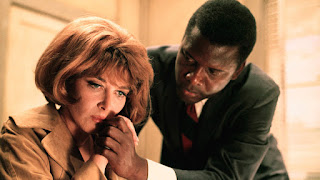
Movie Review: In The Heat Of The Night (1967)


A simmering murder mystery overheated to the boiling point by racial tensions, In The Heat Of The Night is a seminal cinematic achievement, a turning point in the portrayal of blacks on the screen and a riveting small town thriller.

In the small southern backwater of Sparta, Mississippi, night patrolman Sam Wood (Warren Oates) finds wealthy businessman Mr. Colbert dead in the street, killed with a blow to the head. The local redneck police chief Bill Gillespie (Rod Steiger) orders a sweep of the town, and Wood picks up Virgil Tibbs (Sidney Poitier) at the train station. Black, well-dressed and very much a stranger, Tibbs is immediately a suspect, and Gillespie treats him with racist contempt. But Gillespie is stunned to learn that Tibbs is a Philadelphia police detective, passing through Sparta while visiting his mother.

Through a combination of pressure from his superior and his personal pride, Tibbs stays in Sparta to help solve the murder, while Gillespie is grudgingly convinced by Sparta's mayor (William Schallert) to accept Tibbs' help. Tibbs and Gillespie never really get along, but start to tolerate each other as they track down persons of interest including Mrs. Colbert (Lee Grant), small-time drifter Harvey (Scott Wilson), Colbert's business rival Endicott (Larry Gates), and late night diner counterman Ralph (Anthony James). Sam Wood also emerges as a suspect, as well as being implicated in a sordid unwanted pregnancy involving a 16 year old local girl. With Mrs. Colbert threatening to pull her late husband's investment out of town and Tibbs attracting an increasing number of enemies, the pressure mounts to catch the murderer.

Directed by Norman Jewison and written by Stirling Silliphant based on the John Ball book, In The Heat Of The Night draws one of the most distinct before-and-after lines in Hollywood movie history. Poitier's Guess Whose Coming To Dinner, also from 1967, portrayed a black man being accepted into a white liberal educated family. In The Heat Of The Night has no such acceptance: Virgil Tibbs is a qualitatively better law officer than Gillespie; and through his sheer force of conviction, Tibbs will prove to Sparta and all its bigoted residents that a black man will overcome deep-rooted racism and serve the cause of justice.

For all its redefining of racial relations, In The Heat Of The Night is also a fine, complex murder mystery. In sweltering heat made worse by prevailing hot winds of xenophobia, plenty of suspects emerge as the potential killer, and Tibbs gathers personal enemies by focusing the investigation in unexpected directions. He is convinced the drifter Harvey is innocent when plenty of evidence points to his guilt, and Tibbs rocks the town to its core by suspecting Endicott and then getting involved in the unwanted pregnancy case. The film's climax does feel rushed, and Jewison would have done better to provide some of the secondary characters a bit more room to breathe.

In The Heat Of The Night maintains its tension by not caving in to any easy moments of reconciliation. To the bitter end, Gillespie just barely finds a way to work with Tibbs, and never misses an opportunity to make Tibbs' life harder than it needs to be. The film avoids becoming a buddy movie, as Gillespie's respect grows by barely perceptible increments. It's only in the final scene that Tibbs gets the benefit of the slightest kind gesture and phrase, and even then, Gillespie wraps his gratitude with a tinge of relief that the two are finally parting ways.

Two moments from the film stand out and earn their place in movie history. In the first, when Gillespie, who has been callously referring to Tibbs as "boy", asks Tibbs what they call him in Philadelphia, he roars back "They call me MISTER Tibbs!."  And in the second, Endicott is insulted that he is considered a suspect in the Colbert murder and slaps Tibbs hard. Tibbs returns the slap, just as hard. It's a shocking, time-stands-still moment, a black man striking a respected white cotton magnate deep in the south.

The two central performances are perfect, primarily because they don't stray from the essence of the two characters. Poitier emphasizes Tibbs' pride, confidence and hints of justified arrogance. Steiger keeps Gillespie true to a small-town cop, refusing to admit he is in over his head, furiously chewing his gum to compensate for the absence of any useful detective skills, while eyeing Tibbs with a combination of suspicion and contempt.

In The Heat Of The Night the movies encountered an inflection point. A murder was committed, and race relations on the big screen changed forever.


All Ace Black Movie Blog reviews are here.

Sunday, 8 January 2012

Movie Review: Stripes (1981)


A showcase for the comedic talent of Bill Murray, Stripes is only as good as its star. Murray's laid-back sardonic style creates good friction with the motif of military discipline, but Stripes suffers from having little to offer other than Murray's attitude.

John Winger (Bill Murray) abandons his job as a taxi driver, is abandoned by his girlfriend, and has his car repossessed, all on the same day. He convinces his friend Russell Ziskey (Harold Ramis) that they should join the army, and off they go to training camp. The fellow recruits include the overweight Ox (John Candy) and an assortment of the psychotic and the dim. Drill Sergeant Hulka (Warren Oates) tries to make soldiers out of them, with limited success. Hulka's platoon muddles its way to graduation before becoming embroiled in an unexpected incursion behind the Iron Curtain.

Much of Stripes was improvised on the spot, director Ivan Reitman keeping the cameras rolling while Murray made things up and the other cast members reacted. It's a sometimes fascinating viewing experience, but the struggle to create a cohesive movie out of essentially uncoordinated comedy moments is also clear. Stripes sags and surges, meanders and regains focus, ultimately providing an interesting but bumpy ride.

When it works, Stripes delivers scenes of comic gold. Murray's speech to rally his platoon prior to the graduation ceremony is classic, as is the platoon's performance in the ceremony itself. But in the final 30 minutes featuring the unplanned invasion of Czechoslovakia, Stripes loses its way in a groan-inducing attempt to superimpose superfluous action onto a comedy, with mostly embarrassing results.

The thin ice of material that Stripes skates on is exemplified by a deleted sequence (restored in the Extended Cut) that has Winger and Ziskey hitch a ride on a military plane to an unnamed war zone, where they are captured by undefined heavily armed mercenaries and threatened with death, but save themselves when Winger starts singing Quando Quando Quando. It's a nonsensical interlude, scraping by on Murray's improvisational talent and spontaneity. A mud wrestling match between John Candy's Ox and a bevy of near-naked models is also a punch line stranded by an absence of meaningful context.

Elsewhere in the cast, Ramis proves to himself that he is no actor, his uncomfortable performance as Ziskey crossing the line from comic to incompetent. Warren Oates performs his function as the crusty drill sergeant with good intentions, while P.J. Soles and Sean Young as the Military Police officers who develop relationships with Winger and Ziskey realize early on that they need to be comely rather than convincing.

Stripes is a one-man comedy routine expanded into a military farce. It is remarkable that it works as well as it does, and this is testimony to Murray's unique talent to deliver cool humour with perfect timing.


All Ace Black Blog Movie Reviews are here.


Sunday, 28 November 2010

Movie Review: Blue Thunder (1983)


A movie that exists for the primary purpose of showcasing helicopter acrobatics, Blue Thunder provides only a bit of fun as it plunders through the usual macho-cliches and government conspiracy puddles.

In the skies of Los Angeles, a police unit uses helicopters to support ground officers and help keep the peace. Veteran pilot Frank Murphy (Roy Scheider) is the local maverick, capable of exceptional flying tricks but haunted by his combat experiences flying in Vietnam. A sinister new chopper is brought in for testing: unlike the regular police helicopters, Blue Thunder is tricked out with a massive amount of weapons, technology and armor.

Murphy's old adversary, the slimy Colonel Cochrane (Malcolm McDowell), seems keen to bring the military-style Blue Thunder into police service, and soon there are hints at a conspiracy to manufacture civil strife in order to justify pushing the heavy-handed chopper into service. After his partner (Daniel Stern) is killed, Murphy gets help from his girlfriend (Candy Clark) and takes matters into his own hands, stealing Blue Thunder to expose the evil plot. 

The storyline of Blue Thunder is crass and conspiratorial, with basic performances to match from cast members who are capable of better, including Warren Oates in one of his last roles as Murphy's long suffering Captain. Director John Badham chooses efficiency over style, and is a lot more interested in the machinery than the people. The agitation by technology is enabled by high-tech and futuristic gizmos packed into Blue Thunder, in a triumph of impressive hardware over good storytelling. 


All Ace Black Movie Blog reviews are here.

Sunday, 21 November 2010

Movie Review: The Wild Bunch (1969)


The opening scene is a botched bank robbery that results in a prolonged shoot-out between the Wild Bunch and bounty-hunters, with civilians including women and children caught in the cross-fire.

In the middle of the movie is a smooth, old-fashioned train heist to seize weapons and ammunition.

And the movie ends with a long, gory, final battle, more of a meat-grinder, as the Wild Bunch, all four of them, take on an entire Mexican army battalion gone rogue.

Sam Peckinpah's epic western The Wild Bunch does not have the wit, sly artistic stylings, or operatic grandeur of Sergio Leone's The Good, The Bad, and The Ugly or Once Upon A Time In The West. But Peckinpah does satisfyingly saturate The Wild Bunch with a desperate mood of gloom for an entire class of men, as the time of living the outlaw life comes to an end with a bloody exclamation mark. He also introduces a poetic and lyrical style of portraying violence, aided by magnificent editing (Lou Lombardo) and cinematography (Lucien Ballard), blurring the line between condemning and enjoying violence.

The story follows Pike Bishop (William Holden) and his gang of ruthless bandits, including Dutch (Ernest Borgnine), brothers Lyle (Warren Oates) and Tector (Ben Johnson), and the Mexican Angel (Jaime Sanchez), who make a living robbing rail company payrolls. The corporations start fighting back just as ruthlessly: a company baron hires Pike's former partner Deke Thornton (Robert Ryan) to lead a group of bounty hunters to halt, once and for all, Pike's rampage.


Deke and his men botch the ambush that opens the movie but still manage to decimate the gang down to five men. Deke chases the Wild Bunch remnants across the border from Texas to Mexico. South of the border Pike and his men encounter the slimy General Mapache and his army terrorizing local villages while entertaining some seedy-looking German army types. Pike and his men fend off Deke and attempt a double-cross game of helping Mapache and the villagers to secure guns and ammunition. With Deke closing in, Mapache reveals himself to be as despicable as any gangster, and Pike plans a blaze of bloody glory.

Between the film's three main action set-pieces, there is plenty of time for Peckinpah to elaborate on the end of a way of life. He does so through conversations between Pike and Dutch, flashbacks, and expanding on Deke's internal conflict as he chases down his former partner. The movie is set in 1913, and the startling appearance of a motor vehicle, being used by Mapache's men, is a stark reminder that the outlaw cowboy days are well and truly coming to an end.

The film is populated by Western movie stalwarts and character actors, all of them grimy, dirty, desperate, none of them good, just shades of conflicted. The absence of an outright 1960s movie star helps to focus attention on the impact of the changing times on men in general, rather than any individual. The Wild Bunch chronicles a glorified era's demise, drenched in red.


All Ace Black Movie Blog reviews are here.