Showing posts with label Beatrice Straight. Show all posts

Monday, 10 October 2022

Movie Review: Patterns (1956)

A corporate boardroom drama, Patterns (also known as Patterns Of Power) reveals ruthless dynamics among men at capitalism's highest echelons.

Engineer Fred Staples (Van Heflin) and his wife Nancy (Beatrice Straight) relocate from Ohio to Manhattan, where Fred is joining the executive team at the massive Ramsey & Co industrial conglomerate. The firm is run with an iron fist by Walter Ramsey (Everett Sloane), and he sees Fred as a replacement for William Briggs (Ed Begley), a senior executive with 40 years of experience, but now in failing health.

Ramsey no longer trusts Briggs' judgment, and does all he can to humiliate him into resigning. Staples is caught between the two men. He admires Briggs' common touch and concern for workers, but is also ambitious. A showdown looms when Ramsey refuses to acknowledge Briggs' contributions to an important report.

Staples: I just hope Mr. Ramsey remembers hiring me.
Briggs: Mr. Ramsey rarely forgets anything.

A cinematic adaptation of a teleplay written by Rod Serling, Patterns infiltrates the penthouse level of a New York highrise to uncover the jungle rules of corporate backstabbing and ladder climbing. Clocking in at an efficient 84 minutes, director Fielder Cook keeps the drama at the theatrical scale of intimacy, but allows his cameras to roam among several locations, including the Staples home, the building lobby, and most impressively, the lavish hallway connecting the senior executive offices, where secretaries with their own hierarchy dutifully follow orders.
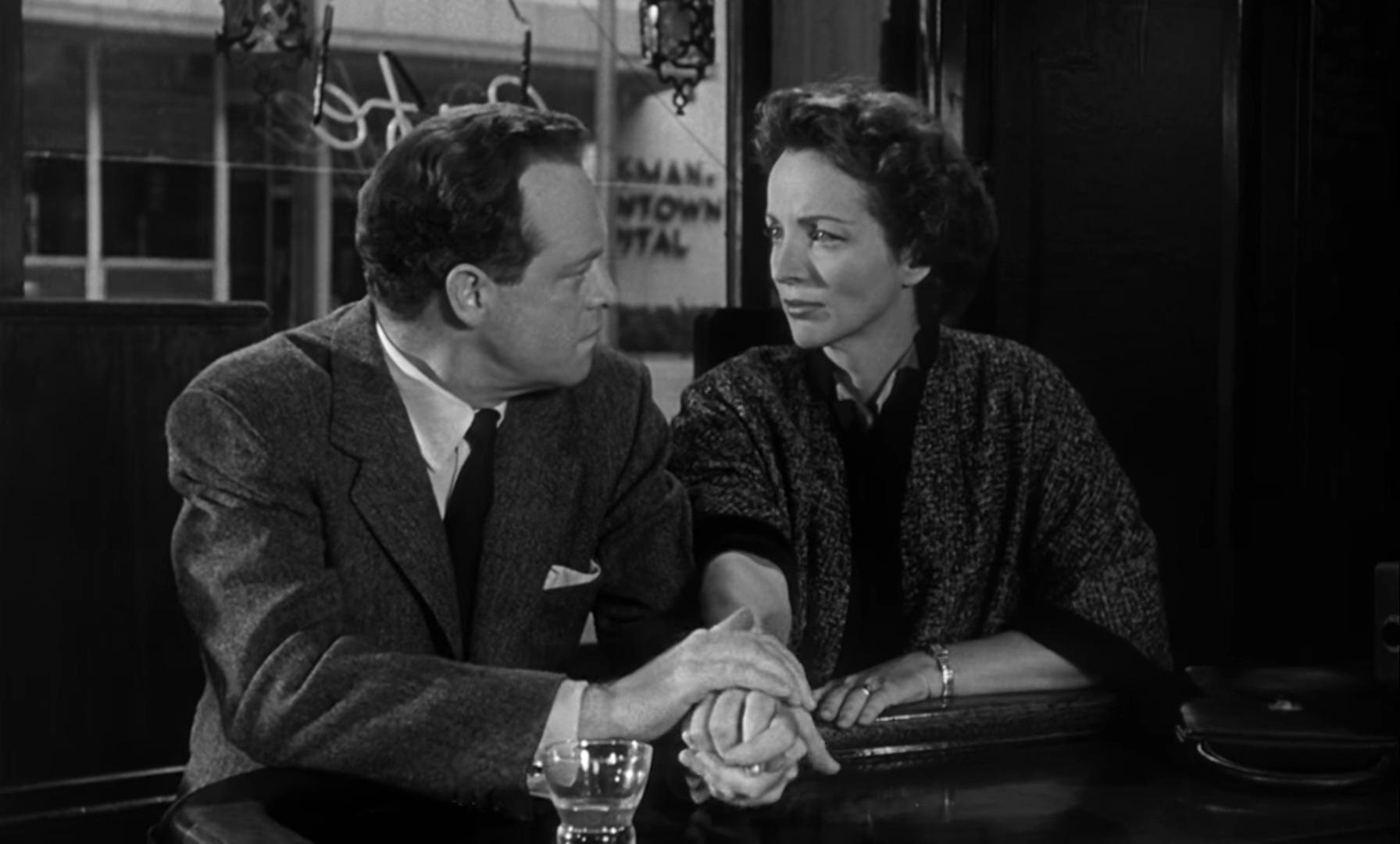
Within the short running time, Serling focuses on one net zero theme - Briggs' downfall coinciding with Staples' rise - and is quick to resort to plenty of agitated arguments, escalating into some tedious shouting matches. And for a smart man, Staples is often slow to read the room and discern his trajectory.

Ramsey: Name your terms. All terms are negotiable.

But the background contexts are still impactful. Briggs laments the loss of an era when bosses knew their workers by name, and growth came from productivity and innovation rather than acquiring bankrupt companies. Staples starts to understand why he was hand-picked by Ramsey, and what it takes to be a leader at a mammoth corporation.

The three leads rise to the challenge in dominant performances. Everett Sloane shines in conveying an unshakeable belief that Ramsey is the smartest man in the room, berating others to catch up. Ed Begley embodies Briggs' final stand, and Van Heflin straddles the middle, the drama seen through his eyes. Beatrice Straight as Nancy reveals the depth of Serling's writing, her character demonstrating calm agility at moments of highest stress.

Staples: I don't want the job. I'm through, I'm quitting, I resign as of now.
Ramsey: Why?
Staples: Because I hate your guts. You used Bill Briggs for a whipping boy. You made him knuckle under, then you beat him to death. You wouldn't try anything like that with me because I'd kill you first.
Ramsey: I'm not a nice human being. What else?

Offering no easy answers but plenty of brutal reality checks, Patterns merges dark and light into a cross-cutting perspective.


All Ace Black Movie Blog reviews are here.

Thursday, 12 November 2020

The Movies Of Beatrice Straight


All movies starring Beatrice Straight and reviewed on the Ace Black Movie Blog are linked below:


All Ace Black Movie Blog reviews are here.
The Movie Star Index is here.

Wednesday, 22 April 2015

Movie Review: Deceived (1991)


A blundering thriller with a few tense moments thrown in, Deceived relies exclusively on plot holes and general stupidity to build its narrative, and is quickly sucked into the vortex of the forgettable.

In New York City, Adrienne (Goldie Hawn) is an art restoration specialist. She meets and falls in love with art dealer Jack Saunders (John Heard). They get married, have a child and seem to have the perfect life. Then Jack reveals that he is under suspicion at work for stealing a precious necklace. One of his colleagues is found dead, and Adrienne starts noticing Jack's weird behaviour, including potentially lying about a business trip to Boston.

When she confronts him, Jack abruptly leaves the house, and word soon arrives that he was killed in a car crash. Through school records and by tracking down family friends and relatives, Adrienne starts to delve into the history of the man who was her husband, only to discover that the man she married was an impostor, and not called Jack at all. He was Frank Sullivan, a lonesome boy who was raised by an unloving mother (Beatrice Straight). Adrienne soon realizes that not only was her entire marriage a sham, but she is in mortal danger because the precious necklace has gone missing and there is a killer on the loose who thinks she has it.

Directed by Damian (son of Richard) Harris, Deceived would give made-for-TV movies a bad name had it been made for TV. The attempt to place Goldie Hawn in a serious film backfires spectacularly, although through no fault of her own, as she is serviceable as a damsel in distress. The problem lies within a pretty awful screenplay by Mary Agnes Donoghue and Bruce Joel Rubin, who can both do better, but maybe not in this genre. If there ever was the germ of a good idea here, it was eradicated by the sloppy, insulting script.

Deceived is the kind of thriller that relies on everyone being fairly imbecilic in order to move its plot forward. This is a film in which the police do not bother with fundamentals such as checking the identity of a crash victim. The tax authorities somehow do not notice that a dead man has been paying taxes for years. The murder of a respected art curator does not appear to ever be investigated. A smart wife who seriously suspects her husband of lying about traveling accepts his lame explanations and fails to request simple proof, such as an airline ticket or a hotel receipt.

The incredible lapses and ridiculous actions continue. A major expensive artifact coincidentally falls to the ground unnoticed, then is mistakenly placed in a basket of trinkets, and then casually walks out of the house around the neck of a child, with no one the wiser. Meanwhile, Adrienne, seeking a simple phone, has to wander through countless museum hallways and spooky backrooms where she will conveniently stumble onto a dead body.

The film ends with an interminable chase through a building under construction, and a character stepping into the void, a case of plot holes and literal holes finally overlapping to end the agony.


All Ace Black Blog Movie Reviews are here.


Tuesday, 5 November 2013

Movie Review: Poltergeist (1982)


A ghost story from the imagination of Steven Spielberg, Poltergeist delivers family oriented frights. The story of a haunted house and angry spirits abducting children alternates shocks with fun and adds a sprinkling of humour.

Steven and Diane Freeling (Craig T. Nelson and JoBeth Williams) seem to have an ideal California suburban life. Steven works for the development company that built the sprawling subdivision, while Diane raises their their three kids: teenagers Dana (Dominique Dunne) and Robbie (Oliver Robins) and the younger Carol Anne (Heather O'Rourke). Everything appears to be normal until Carol Anne starts to exhibit a strange fascination with television static, seemingly communicating with invisible forces within.

As a series of thunderstorm move in on the area, the spirits invade the Freeling house, at first exhibiting childlike, playful behaviour. But matters soon take a serious turn, and Carol Anne is abducted, sucked into her closet by tornado-like forces and vanishing. Carol-Anne is still able to communicate with her mother through the television set in eerie tones. The Freelings turn to Dr. Lesh (Beatrice Straight) and her team, and later the mystic Tangina Barrons (Zelda Rubinstein), to try and retrieve their daughter and reclaim control of their home, while Steven uncovers the dirty secret that may be prompting all the paranormal activity.

Spielberg is credited as producer, co-screenwriter and originator of the story. On-set mythology suggests that he was also the de facto director, but prevented from claiming that role due to E.T.-related studio-imposed limitations. Tobe Hooper, of The Texas Chainsaw Massacre fame, received the director credit, and at least helped translate Spielberg's vision into an entertaining movie with some razor sharp edges.

Poltergeist does have a few genuinely scary moments that would certainly challenge younger members of the target family audience. The concept of ghosts knowing and deploying what already scares the individual members of the Freeling family is effective. Robbie's close encounter with a tree abduction is disturbing, as are his encounters with the notoriously hideous toy clown. And towards the end, ghosts previously portrayed as invisible and playful take on evil, menacing forms. Diane has to fend off groaning skeletons, while demon-shapes make a climactic appearance to scare the family away once and for all and lay claim to the house.

But the movie also has long stretches of family-friendly fare, the opening 30 minutes dedicated to a reasonably tranquil life in the suburbs, interrupted only by Carol Anne's fascination with television static. And when the spirits make their initial presence felt, they creatively rearrange the kitchen furniture in benign and humorous interactions with the family.

Poltergeist does suffer from a rather draggy midsection. The scientific intervention by Dr. Lesh and her team, and the subsequent meddling by the medium Tangina Barrons, are generally played for rather cheap laughs, and ultimately their contributions amount to little. Other than giving an opportunity for Beatrice Straight and Zelda Rubinstein to ham it up, the outsiders just get in the way of the family confronting the invading spirits on their own terms.

The performances are memorable, JoBeth Williams a particular highlight as Diane transitions from lively suburban housewife to a suffering, befuddled mom, and finally a mother bear fed-up with the forces gnawing at her children. The ill-fated Heather O'Rourke gets to deliver the film's most famous line, "they're heeeere!" announcing to the world that Spielberg's imagination has its dark corners.

Much like the subject ghosts, Poltergeist is a movie that makes most of the right moves and many impressive noises.


All Ace Black Blog Movie Reviews are here.


Sunday, 29 July 2012

Movie Review: Network (1976)


A tragi-comic condemnation of the transformation of television news into entertainment, Network is scathing satire at its finest, a talkfest with a lot to say delivered by a cast of performers in peak form.

Veteran news anchor Howard Beale (Peter Finch) of the fictitious UBS network is two weeks away from retirement. Depressed, he has an enraged on-camera meltdown and threatens to kill himself live on the air the following week.

His boss and friend Max Schumacher (William Holden), the head of network news, is horrified, as is Frank Hackett (Robert Duvall), the chief representative of CCA, the bottom-line obsessed conglomerate that owns UBS.  Hackett demands that heads should roll, but Diana Christensen (Faye Dunaway), head of programming, spots an opportunity: Beale can be transformed to an angry modern day messiah, the news broadcast re-imagined as an entertainment spectacle with Beale the centrepiece railing nightly against all the world's injustices.

Walking a fine line between theatrical and genuine madness, Beale delivers another on-air rant with the signature line I'm as mad as hell and I'm not going to take this anymore!, galvanizing the viewing public and delivering a huge ratings boost to his new show. Meanwhile, Christensen starts a romantic entanglement with Schumacher, threatening his marriage to wife Louise (Beatrice Straight).

Diane also keeps pushing UBS towards new boundaries of entertainment, insisting on broadcasting a show that celebrates the real-world criminal activities of a far-left group. With Arthur Jensen (Ned Beatty), the head of CCA, taking a personal interest in Beale's show, events on the air and behind the scenes hurtle out of control, with lives and careers careening towards an unmanageable wreck.

Directed by Sidney Lumet and written by Paddy Chayefsky, Network is a tour de force of smart commentary about the influence of commercialism on television. Built around a series of startling monologues seamlessly intertwined within the story arc of television's descent to the lowest common denominator, Network is a spellbinding experience.

Chayefsky won the Academy Award for original screenplay, and he pinpoints the corporate influence on television as an irresistible force in the wrong direction, the investment of huge dollars demanding a return and driving decisions towards satisfying the basest instincts.

With a new generation of executives exemplified by Faye Dunaway's Diana Christensen much more interested in television news as a money-making show rather than an avenue for the distribution of essential  information, the old school are brushed aside or nonchalantly abused.

Christensen is a most intriguing character, Dunaway winning the Best Actress Academy Award for portraying a charming, driven, passionate, smart, persuasive, impatient and extremely lonely woman. She recognizes her strengths and weaknesses, and matter of factly states that her need to satisfy emotional and physical urges has more in common with men than women. Her relationship with Schumacher is a desperate attempt to bridge generations, both finding in each other everything that they lack and all that they cannot tolerate.


Finch also won the Best Actor Academy Award (posthumously) for the much more showy role of Howard Beale, a man at the centre of the drama but only in the sense of wishing to go out with a bang and being mercilessly used by everyone around him. Schumacher is his only friend, and yet even Max's acquiescence to Howard's requests for continued air-time contribute to Beale's mounting insanity. Certainly Schumacher's liaison with Diana represents sleeping with the ideological enemy.

Robert Duvall and Ned Beatty are extraordinary representations of the new corporate voice dominating programming decisions through ambitious talent like Christensen, and both get to deliver wall-shaking speeches confirming a new world order in which the almighty pursuit of money and ratings trumps all, although when Beatty's Arthur Jensen gets involved, even profit takes a back seat to the on-air glamorizing of the corporate agenda.


The depth of talent and the quality of performances extracted by Lumet extended to Beatrice Straight, who famously won the Best Supporting Actress Academy Award for the briefest of roles. During her limited screen time she delivers a sharply emotional monologue as Louise Schumacher attempts to decide if her marriage is worth saving.

Network predicted television's demise to a freak-show dominated race to ratings, a condition that continues to paralyse most of the medium. Chayefsky took television's demise to its extreme, forecasting exclamation marks of exploitation and violence that would only come to fruition a couple of generations later.  Network not only shone the spotlight on television's current and future failures, but also brilliantly exposed the human predilection to descend into the soul nullifying pursuit of the wrong objective.


All Ace Black Blog Movie Reviews are here.