Showing posts with label Stanley Tucci. Show all posts

Saturday, 6 September 2025

Movie Review: The Core (2003)


Genre: Sci-Fi Disaster Thriller  
Director: Jon Amiel  
Starring: Hilary Swank, Aaron Eckhart, Richard Jenkins, Stanley Tucci, Delroy Lindo, Alfre Woodard, Bruce Greenwood  
Running Time: 135 minutes  

Synopsis: College professor and geophysicist Dr. Josh Keyes (Aaron Eckhart) analyzes a series of unusual phenomena and concludes that the rotation of the Earth's core has been disrupted, which will result in imminent mass destruction. In a hurriedly planned mission, Josh is teamed with a crew including the arrogant Dr. Zimsky (Stanley Tucci), astronaut Beck (Hilary Swank), and brilliant inventor Braz (Delroy Lindo). They have to bore through the Earth in a specially designed vessel, and then detonate nuclear bombs to reactivate the core.

What Works Well: The opening act features a series of gripping-enough catastrophes, including pacemaker failures, disoriented birds, and an improvised space shuttle landing. The scenes featuring Dr. Keyes and Dr. Zimsky explaining their conclusions to military and political leaders are reasonably effective in establishing the premise.

What Does Not Work As Well: The rest of the film drowns in increasingly preposterous nonsense. While Sci-Fi need not be grounded in actual science, the on-the-fly silliness in this script classifies as junk. Lowlights include "unobtanium" material that can withstand enormous pressure, mission preparations that come together in three months, improvised calculations to solve complex problems in mere minutes, and a slapped-on evil plot that never gains traction. The all-too-serious attitude does not help, the special effects are patchy at best, the running time is unnecessarily prolonged, and too many scenes feature scale models of a caterpillar-like vessel navigating murky soup.

Key Quote:
Dr. Josh Keyes: So, we hotwire the nukes, as one does. We seed them through the core at locations that have to be accurate to the inch. We detonate them in a sequence that has to be accurate to the millisecond. Then we outrun the biggest nuclear shockwave in history.


All Ace Black Movie Blog reviews are here.

Sunday, 9 March 2025

Movie Review: Conclave (2024)


Genre: Drama  
Director: Edward Berger  
Starring: Ralph Fiennes, Stanley Tucci, John Lithgow, Isabella Rossellini  
Running Time: 120 minutes  

Synopsis: When the pope dies, Dean of Cardinals Thomas Lawrence (Ralph Fiennes) is entrusted with organizing the election of a successor. The frontrunners include liberal Cardinal Aldo Bellini (Stanley Tucci), Cardinal Adeyemi who may become the first black pope, the conservative Cardinal Tedesco, and the politically savvy Cardinal Tremblay (John Lithgow). The arrival of the hitherto unknown and sanguine Cardinal Benitez of Kabul causes a stir, and when the early voting rounds prove inconclusive, Lawrence has to manage startling revelations that may impact the outcome. 

What Works Well: The stellar cast exudes quiet quality, and the exemplary set designs (recreating the Vatican with artistic license) and costumes establish an elegant backdrop for a heady mixture of global power, personal ambition, and the weight of history. Compelling dramatic themes emerge from the internecine conflict between liberal and progressive values colliding with the fallibility of men held to impossible standards. Muscular music adds considerable thump to the stark political intrigue.

What Does Not Work As Well: The sophisticated ambience is let down by simplistic plotting, which degenerates into sordid scandal-of-the-day expositions. Peter Straughan's script surrenders to unworthy amateur detective exploits as revelations about an illegitimate love child, money-for-votes corruption, and secret medical histories disrupt proceedings. The cardinals demonstrate naked ambition, short tempers, and back-stabbing behaviour worthy of neophyte local politicians, while a terrorist sub-plot adds nothing of relevance. 

Key Quote:
Cardinal Benitez: The church is not the past. It is what we do next.


All Ace Black Movie Blog reviews are here.

Tuesday, 7 June 2022

Movie Review: The Children Act (2017)

A legal drama, The Children Act probes fragile human psyches navigating surprising vulnerabilities.

In London, the Honourable Mrs. Justice Fiona Maye (Emma Thompson) is a distinguished judge entrusted with the most controversial cases. But at home, her childless marriage has gone so stale that husband Jack (Stanley Tucci), a college professor, announces he is off to have an affair.

Fiona's latest case involves 17-year-old leukemia patient Adam (Fionn Whitehead). He is refusing a life-saving blood transfusion because his Jehovah's Witness beliefs consider human blood sacred. Fiona visits Adam in hospital before making her judgment, establishing a connection with the young man. But he then develops an obsession, leading to unexpected consequences.

Written by Ian McEwan (based on his novel) and directed by Richard Eyre, The Children Act packs quiet drama into a twisty, two-part story. Drawing strength from grey England locations and a supreme Emma Thompson central performance, the film first creates then challenges human bonds, deftly avoiding cliches by steering in unpredictable directions.

The first half is an attractive legal conundrum, but Fiona has the law to lean on. Adam is under 18, and therefore public health authorities have the final say about his treatment. The courtroom arguments and counter-arguments are predictable but nevertheless sharp, and given the public scrutiny, Fiona's decision to visit Adam at his hospital bed is compassionate and justified.

Just when it appears the narrative is settling down to provide educated commentary on religious rights versus established science, McEwan and Eyre swing into a different mode entirely. Now less sick but more confused, Adam forms a challenging one-sided attachment to the person who may have saved his life. He starts appearing at inopportune times around Fiona as she moves on to other cases and ponders a reconciliation with husband Jack. 

The dramatic tension evolves into a suddenly broader topic, health now encompassing mental well-being. Having played the role of physical saviour, Fiona has to confront her downstream responsibilities and the implications of severing a young man from the support network he grew up with. Beset by doubt and insecurity, their two lives are intertwined into a gripping, unpredictable knot.

The Children Act dares to step down from the judge's vantage point and ventures into the messy world, where difficult judgments reverberate among imperfect people.


All Ace Black Movie Blog reviews are here.

Saturday, 15 January 2022

Movie Review: Margin Call (2011)

A Wall Street drama, Margin Call digs into the triggers of the Great Recession with cold-eyed pragmatism.

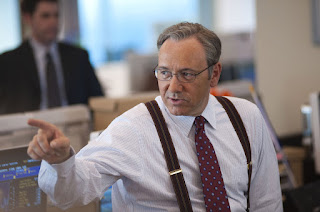
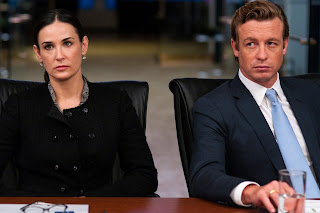
In 2008, a New York City investment bank goes through a round of layoffs. On the same day, risk analyst Peter Sullivan (Zachary Quinto) uses data provided by laid-off risk manager Eric Dale (Stanley Tucci) to uncover a looming crisis of worthless investment assets about to bankrupt the bank - and the entire industry. Peter alerts his boss Will Emerson (Paul Bettany) and trading floor manager Sam Rogers (Kevin Spacey), who quickly advise their boss Jared Cohen (Simon Barker) and chief of risk management Sarah Robertson (Demi Moore).

By the middle of the night CEO John Tuld (Jeremy Irons) is convening meetings to plot out a survival strategy. Jared supports a "first out" plan to dump the toxic assets onto the unsuspecting market the very next morning, financially saving the bank but damaging its reputation and triggering a market crash. Loyal to the bank but perturbed by the immorality of ordering his team to sell soon-to-be worthless assets, Sam is less enthusiastic about the plan.

A fictional account inspired by real events and most closely resembling what may have happened at investment bank Goldman Sachs, Margin Call unfolds like a gripping play. Director and writer J.C. Chandor introduces a few outdoor scenes, but the focus is on 36 critical hours inside the bank's offices, where analysts, managers, and executives suddenly come face to face with an existential worst-case scenario. Through their actions, Chandor teases out some hard truths about capitalism.

With diverse personalities generating impressive dynamics, this is a thriller about the flow of information and the essence of grasping criticality and then acting, including meetings convened at 2am. Sullivan is no less than a rocket scientist (literally), who chose a Wall Street career because the money is better. His manager Will is a realist; his boss Sam is a motivator. Up the ladder at the level of Jared and ultimately Tuld, the whys and details don't matter: only the trends, implications, and necessary next steps.

Chandor avoids the trap of simplistically portraying Wall Street bankers as profit-hungry vultures. Self-deprecation is in evidence, as is recognition of long-term boom and bust cycles. Trading in debt-saddled assets is described as the lubrication keeping the economy afloat and juicing the dream. Will eloquently describes the ethics of economic fairness to young risk analyst Seth (Penn Badgley):

If people want to live like this, with their big cars and these houses that they haven't even paid for, then you are necessary. The only reason they can continue to live like kings is because we've got our fingers on the scale in THEIR favor. And if I were to take my finger off...then the whole world gets really fucking fair, really fucking quickly. And no one wants that, they say they do...but they don't.

Not all the elements click. Chandor could have trusted the audience with a better description of the flaws within mortgage backed securities, and he appears unsure what to do with the character of risk manager Eric Dale, whose work uncovers the crisis just as he is being escorted out of the building. Dale becomes the subject of an aimless search adding little to the drama. Demi Moore also suffers with an underwritten role as the humourless Sarah Robertson, unconvincingly stuck somewhere between conspirator and victim.

But overall the ensemble cast members share the screen time and bring their characters to animated life, benefiting from the sharp-edged script. Paul Bettany and Simon Barker leave the best impression, while Jeremy Irons adds a dash of Machiavellian leadership. The dialogue exchanges embrace increasingly cut-throat realities as the long night progresses, some careers boosted, a few lost, others damaged but left standing, at least until the next inevitable crisis.


All Ace Black Movie Blog reviews are here.

Sunday, 19 September 2021

Movie Review: Worth (2020)

A drama about the value of life, Worth delves into the crass process of calculating a monetary amount to compensate victims of an atrocity.

After the terrorist attacks of September 11, 2001, lawyer Kenneth Feinberg (Michael Keaton) is appointed by the White House to negotiate a settlement agreement with the victims' families, in lieu of crippling lawsuits against the airlines. Working with his law partner Camille Biros (Amy Ryan), Kenneth's initial approach is cold-hearted and formula-based.

But the families' emotions are raw, and Charles Wolf (Stanley Tucci), who lost his wife in the attacks, organizes them to oppose and improve the proposed settlement. Kenneth's team members uncover difficult individual situations impossible to fit within a formula, including a gay partner not recognized as family and a firefighter with a complicated domestic life. Meanwhile, lawyer Lee Quinn (Tate Donovan) argues for much higher settlements for families of high-income executives. Gradually, Feinberg starts to understand a different approach will be required.

Based on real events as recounted in Feinberg's book, Worth examines the conflict between the need for an emotions-free legal settlement and the passionate turmoil of families reeling after an inexplicable and catastrophic loss. The plot lacks traditional tension between good and bad, and the blood-sucking lawyer sub-text is avoided when Feinberg accepts his assignment on a pro bono basis. The film faces several other narrative obstacles: an empathy-challenged corporate suit is a poor protagonist choice for a heart-wrenching 9/11 drama, and any substantive discussions about actuarial formulae are more than likely to induce sleep.

To their credit, director Sara Colangelo and writer Max Borenstein navigate around these pitfalls with decent agility. They find refuge in victims' family members telling their stories almost straight to the camera, and Feinberg's team of junior lawyers learning to listen and tugging on their boss to modify his approach.

The performances also help. Michael Keaton invests in Feinberg as a confident but also apathetic lawyer who thinks he has all the answers, only gradually awakening to the enormous human scale and complexity of this particular challenge. If Keaton's Feinberg is the drama's brain, then Stanley Tucci as Wolf is the heart, pumping effort into creating a difficult bridge between the families and the lawyers, and eventually orienting Feinberg towards demonstrated compassion.

Worth is more curious than compelling. It's a corner of the 9/11 tragedy worth exploring, insofar as cinema and the process of hammering out compensation agreements can co-exist.


All Ace Black Movie Blog Reviews are here.

Friday, 27 November 2020

Movie Review: Beethoven (1992)

A child-friendly comedy, Beethoven offers harmless laughs in the story of an amiable dog adopting a family and guiding them in and out of various messes.

A St. Bernard puppy escapes from evil veterinarian Dr. Varnick (Dean Jones) and his two dognappers (Stanley Tucci and Oliver Platt), and makes its way to the suburban home of George Newton (Charles Grodin). The three Newton kids Ryce, Ted and Emily are immediately enamoured with the puppy, and their mother Alice (Bonnie Hunt) helps convince the dubious George to keep it.

The dog is given the name Beethoven and grows into a big, slobbering, messy but lovable adult. Beethoven becomes an essential family member, protecting George from shady business investors, supporting Ted against school bullies, rescuing Emily from a pool incident and helping Ryce meet her cute classmate. But Dr. Varnick still has nefarious plans, placing Beethoven and all the Newtons in peril.

Co-produced by Ivan Reitman and directed by Brian Levant, Beethoven delivers family-suitable laughs, yuks and yukky laughs. The script by Edmond Dantès and Amy Holden Jones stays within all the safe zones for young children with just a few zingers thrown in for the adults to enjoy, and with a big friendly dog as the center of attention and three kids to interact with, the humour is easy to find.

To support young attention spans the narrative structure is episodic, as Beethoven gets a succession of relatively short set-pieces to demonstrate his smarts. A few end in riots of laughter, including the escapades of the malicious investor couple (David Duchovny and Patricia Heaton) seeking to steal George's business. Dr. Varrick's heartless plot supplies the overarching wickedness connecting the introduction to the climax, but of course he is up against a wholesome family pulling together.

The visuals are smooth, Levant often adopting a dog's point of view as a few other 4-legged friends of Beethoven woof their way into the story. Mercifully, just the one musical montage sneaks in, here used to fast-track Beethoven's growth from cute and small to still cute but not-so-small.

Fully aware who the real star is, the human actors easily slip into support mode, Charles Grodin playing up his set-upon dad persona, Bonnie Hunt countering with the sympathetic mom adept at finding her husband's soft spots. Dean Jones is the caricaturish villain, staying just on the right side of not-too-scary, while his sidekicks chase after bumbling laughs, both Stanley Tucci and Oliver Platt paying their dues in relatively early roles.

Full of energy if not originality, Beethoven is easy viewing.


All Ace Black Blog Movie Reviews are here.

Sunday, 29 March 2020

Movie Review: It Could Happen To You (1994)


A romantic comedy loosely inspired by true events, It Could Happen To You is amiable enough and benefits from grounded Nicolas Cage and Bridget Fonda performances.

In New York City, Charlie Lang (Cage) is a kind-hearted police officer, happy to remain a beat cop working the streets with his partner Bo (Wendell Pierce). Charlie is married to the materialistic Muriel (Rosie Perez) who resents Charlie's lack of ambition and their modest Queens apartment.

Yvonne Biasi (Fonda) is a compassionate coffee shop waitress, and she has to declare bankruptcy when her no-good husband Eddie (Stanley Tucci) racks up massive credit card debt. Yvonne and Eddie are separated, but she cannot afford to go through a divorce.

After a quick coffee stop Charlie finds himself short of cash for a tip and promises Yvonne half his lottery ticket. The draw is that night, and the ticket wins $4 million. Although Muriel is furious, Charlie insists on honouring his promise and sharing half with Yvonne. All their lives change forever, and as Muriel starts indulging her every whim, Charlie finds himself increasingly attracted to Yvonne, although the reemergence of Eddie adds further complications.

It Could Happen To You adheres strictly to genre conventions, and adds a layer of genuine sweetness. Charlie and Yvonne are an impeccable fit, both saddled with insufferable spouses, and director Andrew Bergman never introduces even an iota of doubt that the cop and waitress will end up together. With down-to-earth Queens locations, a relaxed tone and an ideal run time of 101 minutes, the film is easy to enjoy.

The couple-to-be are almost too perfect: he helps New Yorkers cross the street and plays ball with the neighbourhood kids every night. She looks after all her regular customers with an outstanding level of bona fide affection. Which raises the question as to how they ended up with their polar-opposite spouses. Muriel is greed personified, hyper-agitated by her man's disinterest in financial wealth. Eddie is nothing but a slimy leach.

Clumsy narration courtesy of an Isaac Hayes character named, of all things, Angel, as well as globs of exposure for the New York Post, are among the other unnecessary distractions.

Where the Jane Anderson script dares to be original is on doubling down on a level of natural goodness and old fashioned charm. Charlie and Yvonne create an irony-free, honesty-rich bubble and gradually work their way towards an authentic love, casting aside the edgy snarkiness often deployed as a humour device. Nicolas Cage and Bridget Fonda buy into the wholesome personas and add doses of benevolent elegance to the romance.

A lottery win brought two perfectly compatible people together, and the only irony on display is their joint understanding of what true affluence means.


All Ace Black Blog Movie Reviews are here.


Saturday, 29 February 2020

Movie Review: Road To Perdition (2002)


A gritty gangster drama, Road To Perdition is a visually stunning story of redemption, revenge and fatherhood.

In rural Illinois of 1931, Michael Sullivan (Tom Hanks) works as a mob enforcer for local Al Capone affiliate John Rooney (Paul Newman). He keeps the details of his work private and is aloof towards his family, including wife Annie (Jennifer Jason Leigh) and two sons Michael Jr. (Tyler Hoechlin) and Peter. Rooney treats Michael likes a son, much to the resentment of his unstable real son Connor (Daniel Craig).

When the curious Michael Jr. witnesses the killing of one of Rooney's rivals, Connor decides to wipe out the entire Sullivan family. Michael flees to Chicago with Jr. and connects with Capone's second-in-command Frank Nitti (Stanley Tucci), offering his services in exchange for being allowed to hunt down Conner. But Rooney stands by his real son, placing Connor in hiding and reluctantly unleashing hired killer and crime photographer Harlen Maguire (Jude Law) to finish off the Sullivans.

A richly textured exploration of mobster life focusing on the sins of the father, Road To Perdition is a lyrical ode to generational change among career criminals. The graphic novel by Max Allan Collins and Richard Piers Rayner is translated to the screen by director Sam Mendes and cinematographer Conrad L. Hall, and the film's rich style adds a captivating dimension, at once emphasizing emotional resonance and evoking a bygone era.

The film adopts the perspective of Michael Jr. remembering a seminal six weeks on the run with his father, the only time he got to know his dad. Previously Michael was a cold and distant figure involved in shadowy and undefined business for Mr. Rooney. When Jr. surreptitiously snoops into the business of adults, suddenly the reality of his father's murderous assignments comes into relief and the two are forced together just to survive. A lifetime of bonding is compressed into one road trip, and Jr. finally penetrates his father's veneer and by extension learns about himself.

Multiple father-son dynamics nurture the film's layered background. Rooney treats Michael as a son, and Mendes uses one scene at the piano to expressively colour-in the strength of their connection. But this is at the expense of Connor, slightly psychotic but fully aware that Michael has displaced him and occupies pride of place in Rooney's emotional bank.

However, Connor holds the trump card of bloodline and status as natural successor to his father's empire, and is quick to seize the opportunity to eliminate the Sullivan threat, forcing Rooney into the ultimate unwanted dilemma of having to choose between his biological and chosen sons.

The sprawling drama unfolds in a compact format at under two hours, and screenwriter David Self respects the visual essence of the source material by economizing on dialogue. The action scenes are plentiful, sharp and exquisitely staged. Thomas Newman's music complements Hall's cinematography to create masterpiece arrangements, the framing, compositions and lighting often breathtaking. Water is a frequent theme, whether through rain, melting ice or in bathtubs, reflecting the inherent fluidity of mobster life.

In one of his most unique performances Tom Hanks finds a much more dangerous screen presence while maintaining his core humanity. Hanks thrives in defining Michael's separated duality as a killer and family man, and convincingly fills the yawning gap of fatherhood with compassionate yet steely determination to protect his son. Paul Newman, Daniel Craig, Stanley Tucci and Jude Law form a dazzling supporting cast.

A pathway to retribution, atonement, and awakening, Road To Perdition offers a sublime journey.


All Ace Black Blog Movie Reviews are here.


Friday, 5 April 2019

Movie Review: Lucky Number Slevin (2006)


A raucous crime thriller, Lucky Number Slevin offers a delectable multi-faceted plot and jaunty execution. A busy story of gangland vendettas offers rich rewards and plenty of barbed wit.

After a series of seemingly unrelated murders including the killing of two bookies and a sniper attack, Goodkat (Bruce Willis) sits next to a young man at an empty bus terminal and recounts a strange story from 1979, when a struggling family was brutally annihilated as a result of a horse race fix gone wrong.

Back in the present Slevin Kelevra (Josh Hartnett) arrives in New York City to stay at the apartment of his friend Nick Fisher, who is mysteriously nowhere to be found. Jovial next-door neighbour Lindsey (Lucy Liu) makes friends with Slevin, but he is soon mistaken for Nick and abducted, twice: first by mobsters working for The Boss (Morgan Freeman), then by goons working for The Rabbi (Ben Kingsley).

The Boss and The Rabbi used to be gangland partners who ran the city's most powerful crime syndicate. Now they have fallen out, The Boss' son has been killed, and he wants Slevin to assassinate The Rabbi's son in retaliation. Meanwhile The Rabbi wants Slevin to repay an outstanding loan. Goodkat is lurking in the shadows, and police detective Brikowski (Stanley Tucci) tries to untangle all the motives as Slevin seeks to survive the impending mayhem.

Plenty of movies have attempted to recreate the sheer verve of Pulp Fiction; few have succeeded as well as Lucky Number Slevin. This is an in-your-face barely-in-control full throttle thriller, a white knuckle wild ride through the world of crime and punishment.

Combining numerous disparate events that slowly converge into a brilliant whole with a collection of memorable characters, Lucky Number Slevin is an intricate narrative puzzle. The film starts with the pieces all over the place, but writer Jason Smilovic and director Paul McGuigan know exactly where they are heading and how to get there. Every detail matters, and as the picture is assembled the narrative wizardry comes to the fore. Of course the plot holes are there to be picked, but overall the story of vendettas, revenge, goons and rogue assassinations is sly and resplendent.

Stylistically McGuigan deploys typical Tarantinoesque touches, including colourful marginal characters, just about everyone lying about almost everything, occasional philosophizing, brief explosions of violence, and oddities like rivals The Boss and The Rabbi occupying apartments across the street from each other. In relative terms the blood and gore are dialed back, and Lucky Number Slevin revels in the power of a single compact trigger event for all the mayhem.

The cast members stay within themselves and allow the script to star. Josh Hartnett is in the middle of the pandemonium as Slevin, and finds one of his career best fitting roles. Without stretching beyond established personas, Bruce Willis, Morgan Freeman and Ben Kingsley offer plenty of weighty veteran talent, all three as men still trading in death when they should know better.

Breezy and fierce in equal measures, Lucky Number Slevin runs the perfect race.


All Ace Black Blog Movie Reviews are here.


Saturday, 1 December 2018

Movie Review: A Private War (2018)


A biographical drama, A Private War covers chapters from the career of war correspondent Marie Colvin.

The film opens in 2012 in the devastated Syrian city of Homs, reduced to rubble as part of the raging civil war. In flashback, Colvin's prior assignments for the British Sunday Times newspaper are recalled. In 2001, she covers the conflict in Sri Lanka and loses her left eye during a battle between the army and Tamil rebels. In 2003 she is in Iraq, pursuing the location of a mass grave of civilians to uncover one of Saddam Hussein's atrocities against his own people. She witnesses the horrific outcomes of an improvised explosive device.

In 2011 she is in the midst of the Arab Spring uprising, and enters a war-torn Libya to interview besieged and delusional leader Muammar Gaddafi. Despite accolades and recognition throughout the  journalism world, the hard-drinking and chain-smoking Marie's constant exposure to war and its impact on civilians induces post-traumatic stress disorder, and she spends time in rehabilitation. But she is inexorably drawn to conflict zones, and enters Homs at the height of the Syrian conflict.

Written by Arash Amel and based on the Marie Brenner magazine article, A Private War combines the biography of a troubled and courageous journalist with a horrors-of-war exposition. The film is episodic by nature, and hampered by a singular focus on Marie. Her in-field colleagues Paul Conroy (Jamie Dornan) and Norm Coburn (Corey Johnson) barely register as individuals, and in her private life lover Tony Shaw (Stanley Tucci) is presented as nothing other than a convenience.

With Rosamund Pike in fine form, some of these shortcomings are overcome by director Matthew Heineman as he delves into the soul of a woman pulled to the site of the world's worst inhumane corners to record the often covered-up indiscriminate violence against defenceless civilians. She visits hellholes so that others don't have to, and to try and nudge the soul of an often uncaring world into action. That the brutality cycle repeats only in different settings undoubtedly contributes to Marie's emotional disintegration.

The film's final chapter is a harrowing recreation of Homs reduced to rubble, with reporters and civilians trapped and barely surviving as death rains from above. Marie transmits to the outside world to once again try and poke public consciousness towards witnessing the uncomfortable. Large scale atrocities are nourished by indifference, and Marie Colvin dedicated her life to turn apathy into empathy.


All Ace Black Blog Movie Reviews are here.


Saturday, 17 February 2018

Movie Review: The Terminal (2004)


A mild comedy, drama and romance, The Terminal offers harmless entertainment in a message-heavy but slick production.

Tourist Viktor Navorski (Tom Hanks) arrives at New York's JFK airport and is refused entry. While Viktor was in the air, the government of his fictional home country of Krakozhia was deposed as a civil war erupted. Frank Dixon (Stanley Tucci), the airport's Acting Customs Director, deems Viktor stateless and status-less, and restricts him to the international transfer lounge until the State Department can figure out a solution.

Hours turn into days then weeks and months. Viktor creates a sleeping area at an unused gate, teaches himself better English, and befriends airport employees including customs agent Dolores (Zoë Saldana), a janitor (Kumar Pallana), a baggage handler (Chi McBride) and a catering company employee (Diego Luna). Viktor also meets and is entranced by flight attendant Amelia (Catherine Zeta-Jones). They become his family of sorts as Dixon dreams up ways to get rid of his unwanted guest.

Directed by Steven Spielberg, The Terminal offers family-friendly entertainment, celebrating diversity, the American cultural mosaic and the value of immigrants who love their original homeland yet are willing to also love the United States. The film is partially inspired by a real-world case of a seemingly stateless man who lived for years at Charles de Gaulle Airport. Set almost entirely in a purpose-built set, The Terminal condenses societal tensions into one building teaming with commerce, where the fate of new arrivees is decided with an abrupt passport stamp.

The Terminal's messaging is heavy-handed, as Spielberg launches into blunt metaphors and stark characterizations. Frank Dixon is the antagonist careerist white man holding all the power and wielding it irresponsibly, while most of the other characters are visible minorities or outsiders struggling for a better life. The emotional strings are weighed down with syrup, from the secret contents of Viktor's peanut box (the revelation is both mundane and clumsy) to Amelia's search for true love in all the wrong time zones. Meanwhile all of Viktor's new friends are decent and jovial folks hiding secrets.

The film clocks in at an unnecessarily long 128 minutes, and despite the lack of a deft touch Spielberg still delivers a polished package. The good elements include dynamic Janusz Kamiński cinematography that makes the most out of the elaborate set, and a typically dependable Tom Hanks performance. Hanks grows into the role, starting out at an unfortunately cartoonish level but evolving into a well-rounded character with plenty of steel in his core, surrounded by Hank's forte of universal human decency.

Predictably amiable, The Terminal is certainly a functional building, designed to be better than bland but less than thrilling.


All Ace Black Blog Movie Reviews are here.


Sunday, 22 October 2017

Movie Review: The Fifth Estate (2013)


A biographical technology drama, The Fifth Estate delves into the chaotic formative years of WikiLeaks and the profound questions caused by the sudden public availability of state secrets.

The film briefly starts in 2010, with The Guardian, The New York Times and Der Spiegel about to co-publish The Afghan War Logs, derived from thousands of United States secret government cables leaked to WikiLeaks by Bradley Manning. The story then shifts back to 2008, when German tech whiz Daniel Domscheit-Berg (Daniel Brühl) meets and agrees to help WikiLeaks founder Julian Assange (Benedict Cumberbatch). Assange is passionate about providing an unfiltered anonymous platform for whistleblowers to reveal hidden corporate and government information.

The popularity of WikiLeaks grows with revelations about tax evasion on a grand scale at a Swiss Bank. Daniel is captivated by Julian, who is enigmatic but also obsessed with his own version of the truth and not beyond twisting facts for his benefit. The worldwide scoops multiply, and WikiLeaks becomes a thorn in the US government's side. Daniel's relationship with girlfriend Anke (Alicia Vikander) suffers, and more tension lies ahead as Assange seems oblivious to the individual harm that could be caused by the release of unredacted data.

Directed by Bill Condon, The Fifth Estate is only a few years removed from the events depicted. Both a biography of Assange and a commentary on the rapidly shifting world of no secrets, the film is always dynamic, sometimes frantic, and often resembles the chaotic no-one-is-in-control reality of information in the citizen journalist world.

The Fifth Estate is based on two 2011 books: Inside WikiLeaks: My Time with Julian Assange at the World's Most Dangerous Website by Domscheit-Berg, and WikiLeaks: Inside Julian Assange's War on Secrecy by David Leigh and Luke Harding. And this is not a hero-worship story: the film presents Assange as a deeply flawed man living in his own world, charismatic enough to dominate a room and attract ardent followers but also blinkered in pursuing a self-defined mission. It's an attractive proposition for a biography to pursue, and allows screenwriter Josh Singer to chase the various shades of grey morality in the WikiLeaks story.

Aware that the film is treating history too close to the source, Condon expands the breadth and triangulates numerous issues, rather than diving too deeply into any one aspect. The Fifth Estate takes pains to cover the people, the technology, the profession of journalism, the actual historical events, and the implications both intended and not, and never dwells for too long in one place. There is something here from every angle, and while none of it is perfect or fully satisfying, it is all rich fodder for thoughtful discussion.

Through the sub-story of a trio of State Department and White House officials (played by Laura Linney, Stanley Tucci and Anthony Mackie) struggling to cope with the sensitive state secrets suddenly detonating on WikiLeaks, Condon takes a stab at reflecting the information age's unexpected consequences. He also throws in a sub-sub-story of an American informant in the Libyan government, whose identity is potentially exposed in the leaks.

Elsewhere traditional journalists at The Guardian, already struggling with the digital revolution, now have to contend with defending their professional standards as a tsunami of astounding information is about to be unleashed on an unsuspecting world in unfiltered format. Are the rules being rewritten, or is this the reason the tried and tested rules exist in the first place?

Benedict Cumberbatch delivers a chilling performance as Assange, self-assured, emotionally domineering and steely-eyed, his shock of white hair working to his advantage. Daniel Brühl gets plenty of screen time, and the film is as much the Domscheit-Berg story as it is about Assange, and this is not necessarily always a good thing. Alicia Vikander cannot do much with the role of the token girlfriend.

The Fifth Estate doesn't contain any great revelations, yet it's a stylish point-in-time marker, a chronicle of an inflection point in privacy's death march. Governments are also losing the right to keep any secrets, and all it took was one determined man and one website to make it happen.


All Ace Black Blog Movie Reviews are here.


Tuesday, 26 September 2017

Movie Review: Big Trouble (2002)


A madcap comedy, Big Trouble overloads the screen with wild characters and ridiculous events hurtling at an insane pace. A lot of it does generate big laughs, but the entertainment remains breathlessly shallow.

In Miami, former journalist Eliot Arnold (Tim Allen) runs a one-man advertising business. Eliot's teenaged son Matt (Ben Foster) attempts to drench classmate Jenny Herk (Zooey Deschanel) with a water gun, but instead interferes with the real attempted assassination of Jenny's father Arthur (Stanley Tucci) by hitmen Henry (Dennis Farina) and Leonard (Jack Kehler). Miami cops Monica (Janeane Garofalo) and Walter (Patrick Warburton) try to sort out the mess, while Eliot is immediately attracted to Anna (Rene Russo), Arthur's long suffering wife.

The events of the night result in wandering free spirit Puggy (Jason Lee), who likes to live in trees, meeting Arthur's housekeeper Nina (Sofia Vergara), and the two develop an immediate attraction.

Arthur is embezzling funds from a mobster-linked organization, and to seek revenge on his would-be killers he attempts to purchase a mysterious weapon in a steel case from Russian criminals. But his plans are foiled by Snake (Tom Sizemore) and Eddie (Johnny Knoxville), two sleazeball incompetent petty thieves. FBI agents Pat Greer (Heavy D) and Alan Seitz (Omar Epps) are trying to recover the missing weapon, resulting in a frenzied chase across Miami.

There is no doubt that Big Trouble contains some big laughs. Director Barry Sonnenfeld adapts the Dave Barry book of the same name with an eye to achieving a nutty spectacle at a breakneck pace, and often hits his targets within a compact 85 minutes of pure insanity.

Despite the numerous characters and events, Sonnenfeld manages to keep a hold of the material and generates a steady stream of laughs, quickly moving away from any sense of normal and into the realm of the absurd where anything goes. The scenes involving the Russian arms traders pretending to be seedy bar operators tend to work best, and the hitman character of Henry gets the sharpest lines and some funny gems.

The hapless duo of Snake and Eddie are effective as victims of Darwinian certainty surely awaiting their hour of extinction. Meanwhile a herd of goats makes a late appearance and gets right into the action, as does a mall cop, Eliot's cigar-chomping client and the Herk family dog.

Less effective is the airy subplot involving the ethereal Puggy being lifted along with events, while Nina is the most notable victim of the overstuffed script. Tim Allen is supposed to be in the middle of the mess but only achieves middling success, his suburban doofus Dad persona not quite finding a home in the edgy material. Stanley Tucci goes the other way with his over-the-top bagman, cussing up a storm.

Ultimately what Big Trouble lacks is any sense of genuine soul or caring. The film is about a large number of people running around engaged in cartoon-like behaviour and stirring up crazy funny antics; none of them come close to being real characters worth knowing or caring about. Big Trouble is really funny while it lasts, but has big trouble leaving a lasting impression.


All Ace Black Blog Movie Reviews are here.


Saturday, 17 June 2017

Movie Review: Shall We Dance? (2004)


A romantic comedy, Shall We Dance? is a gentle twirl through the turbulent waters of middle age.

In Chicago, John Clark (Richard Gere) is a well-established lawyer specializing in executing wills. Happily married to Beverly (Susan Sarandon) and the father of two teenagers, John is nevertheless hitting a full-fledged middle age emotional crisis, feeling empty inside after nearly 20 years of the same marriage and the same career. On his daily train commute he regularly spots a sad-looking Paulina (Jennifer Lopez) staring out of the window of Miss Mitzi's ballroom dance studio. On a whim John signs up for evening dance classes and keeps his new hobby a secret.

At the studio John meets fellow novice dancers Chic (Bobby Cannavale) and Vern (Omar Miller), and veteran resident dancer Bobbie (Lisa Ann Walter), who still dreams of competing to win. He also stumbles onto co-worker Link Peterson (Stanley Tucci), who leads a secret life of dancing. John learns that Paulina is recovering from a broken relationship, but she rebuffs his tentative advances. John is reinvigorated by the joy of dancing and new friendships, but Beverly starts to suspect that her husband is having an affair and hires a private detective (Richard Jenkins) to investigate.

Directed by Peter Chelsom, Shall We Dance? is a remake of a 1996 Japanese film. The Hollywood version settles down for a relaxed tone, sprinkling mild humour and melancholy in equal measures while avoiding extremes in any direction. The film is easy to like as it works its way to the predictable uplifting resolutions, but also stays at the shallow end of the pool.

Unusually for a relatively lightweight film about dance and angst, this is a male perspective. While Chelsom never quite explains why the first world problems in John Clark's privileged life are worth caring about, the numbness brought upon by a daily routine simultaneously drudgerous and frantic is familiar enough. Gere does a fine job as man quietly venturing outside his zone of comfort without knowing quite why and feeling deeply guilty about keeping any secrets.

The dance sequences are staged with a mixture of fun and flamboyance. None of the performances are meant to showcase expert dancers, and the film benefits from the self-deprecatory attitude conveyed by dance amateurs stepping out for personal reasons. Paulina is the exception, and Jennifer Lopez delivers a subdued performance as the temporarily fallen star licking her wounds as she gathers the courage to go again.

Mimicking the studio awkwardness, the relationship dynamics between the characters remain refreshingly clumsy, John never quite knowing how to say the right things to neither Beverly nor Paulina. And that may not be a bad thing. The loudmouthed Bobbie speaks her mind, causes carnage and may be the loneliest character in the film.

A simple message delivered in a fleeting package, Shall We Dance? is an invitation to refresh a stale psyche by embracing small risks.


All Ace Black Blog Movie Reviews are here.


Saturday, 31 December 2016

Movie Review: Maid In Manhattan (2002)


A romantic comedy derived from Cinderella, Maid In Manhattan showcases the worst of the genre in a gag-inducing saccharine package.

Single mom Marisa Ventura (Jennifer Lopez) works as a maid at the swanky Beresford Hotel in New York City. Marisa looks after her young son Ty as best as she could, and harbours ambitions to apply for the management training program. One of the guests at the hotel is Chris Marshall (Ralph Fiennes), a third generation politician running for a Senate seat. Marshall's campaign manager is the highly strung Jerry Siegal (Stanley Tucci).

Chris bumps into Marisa just as she is surreptitiously trying on a designer Dolce & Gabbana suit belonging to Caroline Lane (Natasha Richardson), another guest at the hotel, and he is immediately smitten. They start an unlikely relationship, and Marisa keeps her identity as a maid a secret. Meanwhile Jerry recognizes that his candidate is inviting bad publicity, while Caroline has ambitions of her own to seduce the handsome Chris.

Directed by Wayne Wang, Maid In Manhattan is an inoffensive fairy tale with a predictable start, middle and end, fully dependent on coincidences and misunderstandings due to characters never saying what needs to be said when it needs to be said. There are maybe two sharp lines of dialogue delivered by Jennifer Lopez to underline issues of classicism, but otherwise the Kevin Wade screenplay is an exercise in vanilla bland dialogue set to a vanilla bland music soundtrack.

The tired ingredients are all here: the cute kid, the lovable dog, Marisa's sassy maid friends, the romantic competition in the form of the conniving Caroline Lane. Two elderly French sisters provide attempted comic relief as incompetent hotel burglars.

Lopez is not a horrible actress and spends long intervals in a deglamorized maid outfit, but she does tend to over emote at every opportunity. The supporting cast contains plenty of talent taking the day off, with Ralph Fiennes, Bob Hoskins (as the hotel's head butler), Natasha Richardson, Stanley Tucci and Frances Conroy slumming it in the overacting department for an easy paycheque. Fiennes never comes close to establishing chemistry with Lopez, and the comic moments are more silly than funny.

The only miracle of Maid In Manhattan is that it ever got made.


All Ace Black Blog Movie Reviews are here.


Saturday, 9 January 2016

Movie Review: Spotlight (2015)


A newspaper drama based on real events, Spotlight recreates the Boston Globe's investigation into child abuse by Catholic priests. With a quality cast in good form the film sustains a steady level of engagement, without fully breaking away from the constraints of a well known story.

In 2001, Marty Baron (Liev Schreiber) is hired as the Globe's new editor. He quickly authorizes the investigative Spotlight team, led by Robby Robinson (Michael Keaton) to dig into accusations that a Catholic priest named Geoghan was a serial sexual abuser of children, and that Boston's Cardinal Bernard Law (Len Cariou) knew about the incidents and did nothing. Robinson's team consists of reporters Michael Rezendes (Mark Ruffalo), Sacha Pfeiffer (Rachel McAdams) and Matt Carroll (Brian d'Arcy James). Assistant Managing Editor Ben Bradlee Jr. (John Slattery) supports the investigation while warning that the Church will mobilize to push back against the newspaper.

Rezendes establishes contact with scrappy lawyer Mitchell Garabedian (Stanley Tucci), who is fighting a lonely battle representing multiple former child victims of abuse by Catholic priests. Robinson and Pfeiffer pursue lawyers who have defended the Church behind the scenes to keep the abuse accusations away from public scrutiny. Gradually victims come forward to share their stories with the Spotlight team, and it becomes apparent that many more priests were likely engaged in abusing children. With the sensational exposé taking shape, the terrorist attacks of September 11 derail the publication schedule, and pressure mounts on Robinson to avoid rocking the boat of Boston's established society.

Directed by Tom McCarthy, Spotlight draws its energy from the familiar theme of crusading reporters committed to a cause. The film is an earnest treatment of a sensitive subject, and the script by McCarthy and Josh Singer covers all the angles, including victims, lawyers, priests, reporters and Boston's power brokers. Some want the truth, others justice, while the elite circles where the church, money and tradition intersect just want the whole story to be swept under the carpet.

Very much a galloping talk fest, the script does pack in a large number of names, referrals and sources with short roles, and it's sometimes difficult to keep track of all the players. There is even a subject matter expert only available over the phone, psychotherapist and priest researcher Richard Sipe (an uncredited Richard Jenkins) offering crucial insights based on years of research, but never seen in person. The few scenes of action try to generate drama from the mundane pursuit of documents in the bureaucratic maze of government offices, where the hours are short and the red tape thick.

Spotlight's best moments are when the reporters pause and allow the enormity of the emerging story to wash over them. Emotions flair between Robinson and Rezendes in a disagreement over timing, Rezendes and Pfeiffer discuss what the church meant to them, while Carroll finds the scandal residing closer to his home than he would like. Robinson has to face his own history as a reporter, a case of present-day success revealing yesterday's imperfections. McCarthy also ironically humanizes Baron by keeping him cold and aloof. More of these interludes would have made Spotlight even better.

The theme of an outsider having the courage to lift the lid over an established but corrupt order resides at the of the film. Baron is a Jew, a newcomer to Boston, and has a resume that suggests he won't stay long at the helm of the Globe. He is presented as a fascinating character but unfortunately drifts towards the edges of the film, his influence only tangentially hinted at while the focus resides with Robinson and his team.

Keaton, Ruffalo, McAdams and James get on with the job of portraying reporters without much fuss, Ruffalo getting the most animated role. The supporting cast is loaded with interesting performances. Liev Schreiber is cool and cold as Baron, Stanley Tucci ruffled and exasperated as the lawyer Garabedian (another self-aware outsider), and Billy Crudup makes a welcome appearance as Eric MacLeish, the slick lawyer with a scripted message and much to hide.

Spotlight celebrates the still relevant power of old-fashioned reporting to drag a tragic scandal into the open. The reporters get the satisfaction of a job well done, but the real beneficiaries are the unnamed vulnerable children of the future whose lives may have been made that much safer.


All Ace Black Blog Movie Reviews are here.


Thursday, 23 April 2015

Movie Review: The Devil Wears Prada (2006)


An inside look at the fashion industry, The Devil Wears Prada combines cutting comedy with career drama and emerges with a winning outfit.

In New York City, Andrea "Andy" Sachs (Anne Hathaway) joins the staff of Runway magazine as the second assistant to editor-in-chief Miranda Priestly (Meryl Streep). Andy has aspirations to be a serious journalist, could not care less about fashion, and dresses accordingly, much to the horror of first assistant Emily (Emily Blunt). Miranda is a living legend of the fashion world, a humourless trend-setting titan who looks after every detail of what goes into the magazine and demands nothing but perfection from her staff.

Andie is a complete misfit in the office, and struggles to keep up with the Miranda's obsessive and often menial demands. But she gets some advice and support from Runway's art director Nigel (Stanley Tucci), and gradually she finds her legs and earns Miranda's grudging respect. But as Andie grows more fond of her career and the world of fashion, her behaviour and interests change, causing a rift with boyfriend Nate (Adrian Grenier). Things get even more complicated when up-and-coming writer Christian Thompson (Simon Baker) takes a liking to Andie and starts pursuing her romantically. With Miranda as a mentor and the fashion world now a viable career option, Andie has to decide between her old and new values.

Based on the best-selling book by Lauren Weisberger, The Devil Wears Prada is a glitzy, polished romp through the world of high fashion and designer brands. Director David Frankel fully invests in creating a sparkly, glamorous, and luxurious look and feel, turning the film into a glossy fashion magazine in motion, and it works. The film succeeds in capturing all the seductive attributes of an industry that targets women and specializes in creating and selling new "must-haves" every month.

It's a powerful, fully-perfected and finely-honed bubble world, and even level-headed, idealistic Andie is sucked in. The film soars well beyond a satire or comedy by carefully tracing Andie's path from could-not-care-less to an insider in tune with the power politics that decide winners and losers behind the scenes. Andie and Miranda initially inhabit different planets, and the strength of the script (by Aline Brosh McKenna) resides in cleverly stripping away the dissimilarities and finding the core of two women who may have a lot more in common than either of them cares to admit.

The visual highlights include several snappy montage sequences brilliantly edited by Mark Livolsi and set to a stylish soundtrack. In the film's opening sequence the focus is on the effort women routinely go through in preparing to face the workday. Miranda's montage features her patented throw-the-coat-and-bag-at-Andie's-desk move; while Andie's fashion transformation gets its own before/after in-motion treatment. Montages can be more than tiresome; The Devil Wears Prada packs in three and creates the appetite for more. And as if the snazzy Manhattan setting is not enough, the film detours to Paris for a critical week in Andie's education.

Meryl Streep revitalized her career with her epic performance as Miranda Priestly. She lost the Academy Award to Helen Mirren for The Queen, but Streep's performance is arguably the more likely to be remembered down the years. Her understated sense of superiority is a delight to watch, and she makes the simple catch-phrase "that's all..." a signature line signifying the nightmarish abyss between legends and mortals.

Anne Hathaway is perfect if more predictable as Andie, while Emily Blunt is an absolute revelation and frequently a riot as first assistant Emily, a woman fully consumed by the fashion world and her standing within it. And as Nigel, Stanley Tucci portrays the lieutenants of the fashion world, faithfully following the orders of the Mirandas but unlikely to ever get their shot at stardom or status.

Both an expose and a character-rich essay on the unexpected allure of careerism, The Devil Wears Prada is dressed to impress.


All Ace Black Blog Movie Reviews are here.