Showing posts with label Demi Moore. Show all posts

Sunday, 16 November 2025

Movie Review: Blame It On Rio (1984)


Genre: Romantic Farce  
Director: Stanley Donen  
Starring: Michael Caine, Joseph Bologna, Michelle Johnson, Demi Moore, Valerie Harper  
Running Time: 100 minutes  

Synopsis: With their marriage wobbling, Matthew and Karen (Michael Caine and Valerie Harper) go on separate vacations. Matthew heads to Rio with his teenaged daughter Nikki (Demi Moore), his best friend Victor (Joseph Bologna), who is going through a divorce, and Victor's daughter Jennifer (Michelle Johnson). Once in Rio, 43-year-old Matthew and 18-year-old Jennifer develop a mutual attraction and embark on an affair. Jennifer is thrilled that she has seduced an older man, but Matthew is horrified that he is sleeping with his buddy's daughter.

What Works Well: Michael Caine manages to raise his performance above the material, and rescues a few laughs. The Brazilian scenery, street life, and culture are captured with palpable vibrancy.

What Does Not Work As Well: The carnage of excessive nudity, obsession with ogling, and aggressive seduction cannot hide the failings of a limp script. Once Matthew and Jennifer trigger their illicit liaison, momentum grinds to a halt, with insufficient plot points to occupy the remaining hour. Apart from Caine, the performances range from over-acting (Bologna) to non-acting (Johnson and Moore). Adding to the icky premise is the stench of every adult character behaving as badly as possible, driven by hormones and with no regard for damage caused to friendships or long-term relationships.

Key Quote:
Matthew: Last night never happened.
Jennifer: I know. I was there when it didn't.


All Ace Black Movie Blog reviews are here.

Friday, 11 October 2024

Movie Review: Flawless (2007)


Genre: Heist Drama  
Director: Michael Radford  
Starring: Demi Moore, Michael Caine  
Running Time: 108 minutes  

Synopsis: In present-day London, Laura Quinn (Demi Moore) is being interviewed for a magazine article. In a flashback to 1960, she recalls her time as the only woman manager at the world's largest diamond trading company. Despite her abilities and intellect, Laura is repeatedly passed over for any further promotions. Elderly janitor Mr. Hobbs (Michael Caine) exploits her disgruntlement to lure her into a daring heist. The installation of a video security system threatens their plans, but Hobbs' intentions will surprise everyone.

What Works Well: The 1960s London setting, outfits, and hairstyles are attractive, the interior of the London Diamond Corporation building is impressive, and Michael Caine delivers a steely yet subdued veteran performance.

What Does Not Work As Well: Cerebral thrillers require close-to-watertight plotting, and Flawless falls well short. The heist mechanics vary from muddled to incredulous, essential details are skipped altogether (including, just as one example, the number of janitorial cart trips required to move two tons of diamonds), and too many indistinct stuffed bankers' shirts clutter the second half. The primary focus is ultimately misdirected: Mr. Hobbs is the more interesting instigator with a seemingly deep backstory, but he is sidelined by Laura as the bamboozled accomplice.

Key Quote:
Hobbs: Sometimes, to make something right, you have to do something just as wrong.


All Ace Black Movie Blog reviews are here.

Sunday, 6 October 2024

Movie Review: Now And Then (1995)


Genre: Coming-Of-Age Dramedy  
Director: Lesli Linka Glatter  
Starring: Demi Moore, Melanie Griffith, Rosie O'Donnell, Rita Wilson, Thora Birch, Christina Ricci  
Running Time: 100 minutes  

Synopsis: Now in their 30s, four friends from childhood re-convene in their small hometown of Shelby, Indiana. Chrissy (Rita Wilson) still lives in her parents' house and is about to give birth. Roberta (Rosie O'Donnell) is a doctor, Teeny (Melanie Griffiths) a Hollywood star, and Samantha (Demi Moore) an author. In a long flashback they reminisce about the summer of 1970, when as pre-teens they became aware of life's complexities, including imperfect parents, societal ills, and burgeoning sexuality.

What Works Well: This girl's equivalent of Stand By Me explores a range of pre-adult experiences ranging from mundane misadventures (the girls have a running feud with a group of boys) to painful awakenings into the adult world. The four young actresses (Ashleigh Aston Moore as Chrissy, Christina Ricci as Roberta, Thora Birch as Teeny, and Gaby Hoffman as Samantha) capably carry the acting load and tease out subtle bonds within the already sturdy quadrangle: Chrissy and Roberta are best friends and as adults remained in Shelby, while Teeny and Samantha share a more adventurous spirit and moved far from their hometown. Brendan Fraser adds era context as a Vietnam War veteran, and Walter Sparrow makes an impact as "Crazy" Pete.

What Does Not Work As Well: The adult Samantha over-narrates with saturated sullenness, and the book-end scenes featuring the grown women appear slapped-on to add marketable star names. Moore, Griffith, and O'Donnell barely mask their disinterest, while Wilson embraces cartoon representations. In the flashback, excessive time is occupied with a side-story involving seances and a community tragedy from years past, while a near-death encounter involving an over-sized catch basin is dramatic overkill.

Key Quote:
Young Roberta: You can't get pregnant from French-kissing!


All Ace Black Movie Blog reviews are here.

Saturday, 15 January 2022

Movie Review: Margin Call (2011)

A Wall Street drama, Margin Call digs into the triggers of the Great Recession with cold-eyed pragmatism.

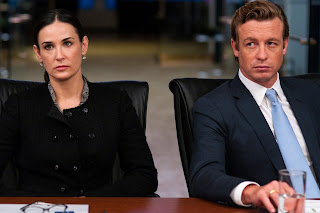
In 2008, a New York City investment bank goes through a round of layoffs. On the same day, risk analyst Peter Sullivan (Zachary Quinto) uses data provided by laid-off risk manager Eric Dale (Stanley Tucci) to uncover a looming crisis of worthless investment assets about to bankrupt the bank - and the entire industry. Peter alerts his boss Will Emerson (Paul Bettany) and trading floor manager Sam Rogers (Kevin Spacey), who quickly advise their boss Jared Cohen (Simon Barker) and chief of risk management Sarah Robertson (Demi Moore).

By the middle of the night CEO John Tuld (Jeremy Irons) is convening meetings to plot out a survival strategy. Jared supports a "first out" plan to dump the toxic assets onto the unsuspecting market the very next morning, financially saving the bank but damaging its reputation and triggering a market crash. Loyal to the bank but perturbed by the immorality of ordering his team to sell soon-to-be worthless assets, Sam is less enthusiastic about the plan.

A fictional account inspired by real events and most closely resembling what may have happened at investment bank Goldman Sachs, Margin Call unfolds like a gripping play. Director and writer J.C. Chandor introduces a few outdoor scenes, but the focus is on 36 critical hours inside the bank's offices, where analysts, managers, and executives suddenly come face to face with an existential worst-case scenario. Through their actions, Chandor teases out some hard truths about capitalism.

With diverse personalities generating impressive dynamics, this is a thriller about the flow of information and the essence of grasping criticality and then acting, including meetings convened at 2am. Sullivan is no less than a rocket scientist (literally), who chose a Wall Street career because the money is better. His manager Will is a realist; his boss Sam is a motivator. Up the ladder at the level of Jared and ultimately Tuld, the whys and details don't matter: only the trends, implications, and necessary next steps.

Chandor avoids the trap of simplistically portraying Wall Street bankers as profit-hungry vultures. Self-deprecation is in evidence, as is recognition of long-term boom and bust cycles. Trading in debt-saddled assets is described as the lubrication keeping the economy afloat and juicing the dream. Will eloquently describes the ethics of economic fairness to young risk analyst Seth (Penn Badgley):

If people want to live like this, with their big cars and these houses that they haven't even paid for, then you are necessary. The only reason they can continue to live like kings is because we've got our fingers on the scale in THEIR favor. And if I were to take my finger off...then the whole world gets really fucking fair, really fucking quickly. And no one wants that, they say they do...but they don't.

Not all the elements click. Chandor could have trusted the audience with a better description of the flaws within mortgage backed securities, and he appears unsure what to do with the character of risk manager Eric Dale, whose work uncovers the crisis just as he is being escorted out of the building. Dale becomes the subject of an aimless search adding little to the drama. Demi Moore also suffers with an underwritten role as the humourless Sarah Robertson, unconvincingly stuck somewhere between conspirator and victim.

But overall the ensemble cast members share the screen time and bring their characters to animated life, benefiting from the sharp-edged script. Paul Bettany and Simon Barker leave the best impression, while Jeremy Irons adds a dash of Machiavellian leadership. The dialogue exchanges embrace increasingly cut-throat realities as the long night progresses, some careers boosted, a few lost, others damaged but left standing, at least until the next inevitable crisis.


All Ace Black Movie Blog reviews are here.

Sunday, 9 January 2022

Movie Review: Indecent Proposal (1993)

A romantic drama, Indecent Proposal posits an interesting dilemma but proceeds to bungle the premise.

Los Angeles high school sweethearts Dave and Diana Murphy (Woody Harrelson and Demi Moore) married young and are still deeply in love. He is an architect and she is a real estate agent. But they overextend financially, and when a recession hits, they find themselves near bankruptcy and about to lose everything.

In a desperate attempt to raise cash they head to Las Vegas, where billionaire tycoon John Gage (Robert Redford) spots Diana and is immediately infatuated. After the couple's gambit to make money at the tables fails, John makes them an extraordinary offer: one night of intimacy with Diana in exchange for a million dollars. The couple have to decide if the money is worth the risk to their marriage, but John's agenda extends beyond just the one night.

Indecent Proposal is more of a cocktail party conversation starter than a movie. Directed with magazine glossiness by Adrian Lyne from a truistic script by Amy Holden Jones, the narrative peaks when the billionaire pops the question. What follows is a quick decent to the land of Dave's jealousy and John's stalking, Diana caught between two men demonstrating juvenile and entitled behaviour within a distastefully warped love triangle.

Which is all unfortunate. The three photogenic stars deserve better material to work with, the script leaving them stranded without basic definitions. As the one night stand develops into a longer pursuit and relationship, Diane never questions what John sees in her, nor when he will discard her in favour of the next ingenue he spots at a boutique. Nor does she express any concerns about jumping from a scrappy life to the elite circle of billionaires.

Hubby Dave switches in an instant from go-along to manically possessive, while John Gage is the blandest of billionaires. Redford affixes a condescending smile and glides through the movie with a laughably unconvincing justification for Gage's exercise in home-wrecking - something about not finding the courage to speak to a stranger on a subway car when he was a teenager.

Boosted by a radiant Demi Moore, the earlier scenes of Dave and Diana as a young couple in love carry an attractive innocence, and Lyne knows his way around a good sex scene. The passionate details of Diana's night with John are omitted, a clever creative decision to capture Dave's state of mind. But despite the occasional spark, Indecent Proposal is a decent idea wasted.


All Ace Black Movie Blog reviews are here.

Saturday, 22 May 2021

Movie Review: Very Good Girls (2013)

A coming-of-age drama, Very Good Girls explores friendship, secrets and early sexual adventures but barely offers anything new.

In New York, best friends Lilly (Dakota Fanning) and Gerri (Elizabeth Olson) would like to lose their virginity before heading out to college. Lilly's home environment is tense and her parents Edward and Norma (Clark Gregg and Ellen Barkin) barely communicate. Edward (Clark Gregg) is caught having an affair and soon leaves the house. In contrast Gerri's household is warm and loud, enlivened by her animated father Danny (Richard Dreyfuss). Lilly woks for the summer as a tour boat guide and has to fend off the lecherous advances of her boss Fitsimmons (Peter Sarsgaard).

At Brighton Beach Lilly and Gerri meet hunky ice cream seller David (Boyd Holbrook) and they both set their eyes on him. Gerri openly states she wants to pursue David; Lilly is more coy, seeking a seduction without telling Gerri. Soon both young women are in various stages of involvement with the same guy, straining their friendship.

An independent production written and directed by Naomi Foner, Very Good Girls is low on energy and lacking innovation. The laid-back and carefree attitude suits the last-summer-before-college vibe, and both Dakota Fanning and Elizabeth Olson radiate youthful enthusiasm growing into adulthood with just the right dash of trepidation. But even for the sparse 91 minutes of running time, the material is thin and familiar, the characters quickly confined to uncommunicative territory spiked by obfuscation to serve the script's agenda.

The initial strong bond between Lilly and Geri is only sketched-in (a propensity for tearing off their clothes in public a hasty substitute for playful trust), leaving their friendship susceptible to the corrosive side-effects of a race for achieving womanhood behind secretive curtains. The scenes of young love and mutual seduction between Lilly and David are not helped by his predictably moody but vacuous character (he is the walking cliche of an aspiring street artist who wants to visit Europe). When their budding love affair hits the first rock of mistrust, the intended emotional impacts don't register.

The trio of Ellen Barkin, Richard Dreyfuss and Demi Moore (as Gerri's mother) roll back the decades and add veteran star power despite underwritten roles. Vaguely amiable without carving out an identity, Very Good Girls pout and plot but fade towards the back of a crowded class.


All Ace Black Movie Blog Reviews are here.

Saturday, 12 January 2019

Movie Review: The Seventh Sign (1988)


A supernatural thriller, The Seventh Sign imagines the end-of-the-world with a mixture of derived and original ideas.

A series of strange and cataclysmic events occur around the world. All marine life starts to die off the Haitian coast; a town in the Israeli desert is destroyed by a freak ice storm; and many people die in Nicaragua, turning a river red with blood. A brooding stranger (Jürgen Prochnow) breaks a mysterious seal at the location of each apocalyptic event, while Father Lucci (Peter Friedman) investigates the phenomena on the behalf of the Church.

Meanwhile in Venice, California, Abby Quinn (Demi Moore) is pregnant but anxious, having previously miscarried. Her supportive husband Russell (Michael Biehn) is a lawyer trying to save convicted killer Jimmy from the electric chair for murdering his incestuous parents. The stranger, now calling himself David, arrives to rent a carriage house from Abby and Russell. She starts to experience disturbing visions, and finds ancient scrolls in David's possessions leading her to believe he is threat to the unborn child. She reaches out to a rabbi for help, but a young Jewish student is more accommodating and starts to help her interpret Biblical prophecies.

Drawing on elements from Rosemary's Baby, The Omen and The Exorcist, The Seventh Sign feigns a devilish story but then heads in a different direction. Director Carl Schultz and writers Clifford and Ellen Green have a sly agenda in mind, and go searching for more religiously themed interpretation of the end of the world. The film is a combination of a familiar but benign level of spookiness mixed with some clunky execution (perhaps betraying a limited budget) and ending with some nice human-focused touches.

By not conforming to expectations the film both befuddles and surprises, and the wayward oscillations occasionally threaten to hamper enjoyment. The more common components dominate the early scenes and include a likeable but anxious couple, unexplained destructive forces and events, a priest chasing after an explanation, the intermittent intervention of animals seemingly serving a higher purpose, ancient scrolls in impenetrable languages foreshadowing something really bad happening, and the obligatory scenes in creepy churches.

But as The Seventh Sign reveals its real intentions though a slightly jerky left turn, the story becomes less about abominations and more about a here-and-now challenge to Abby, and a more contemplative film emerges.

With a strong assist from Jesus Christ himself, in one of his more unusual and memorable screen appearances, and a game Demi Moore working hard to move past brat pack territory, Schultz lands The Seventh Sign with a tolerable amount of damage. It's always a good sign when the film's better moments arrive late, and by the time the fifth and sixth signs are out of the way and humanity's future is at stake on the delivery table, the momentum and emotions are palpable.


All Ace Black Blog Movie Reviews are here.


Sunday, 20 May 2018

Movie Review: Disclosure (1994)


A drama about sexual harassment and dirty power politics in an office setting, Disclosure presents a compelling story in a sleek package, despite rampant over-the-top tendencies.

In Seattle, Tom Sanders (Michael Douglas) is happily married to lawyer Susan (Caroline Goodall), and expected to be promoted to Vice President at a high-tech company about to yield a financial windfall through a merger. Tom receives news that the company's latest groundbreaking hardware device is experiencing significant quality control issues. He is then shocked to learn that President Bob Garvin (Donald Sutherland) has selected outsider Meredith Johnson (Demi Moore) for the VP job.

Meredith and Tom share a history as passionate lovers. Now she invites him to her office for an after-hours meeting and aggressively initiates sexual contact, which he resists. The next morning Meredith accuses Tom of sexual harassment. He starts receiving anonymous emails from "A Friend" encouraging him to fight back. Tom connects with lawyer Catherine Alvarez (Roma Maffia) and launches a harassment claim of his own. The resulting power struggle rocks the company and threatens Tom's career.

Directed by Barry Levinson and based on a Michael Crichton book, Disclosure is both tawdry and relevant. The film is not far from glossy magazine trash, where all characters believe themselves to be master manipulators and the sets are stylish over-representations of avant garde architecture masterpieces. Yet Disclosure fearlessly dives into the minefield of gender issues in the workplace, tackling the imbalance between men and women and covering all the territory from light pats on the bum to shoulder rubs and unwanted blowjobs in locked offices.

The plot spares no one, and all the characters have something to answer for. Meredith is a maneater, but all she can be accused of is behaving like men have done for ages. Tom Sanders is her principal victim, but he is less than honest with his wife and less than innocent in his treatment of his assistant. Bob Garvin is the master chess player, playing the game several moves ahead of everyone else, and with sickening oiliness. Several other office types, from veteran brown-nosers to young and insecure techies, bring Disclosure's world to life.

The plot does not even stop at the sexual battlefield. The film is also about the high profit, high risk, cut throat world of business mergers, and careers in the fast-paced technology industry. Levinson manages to cram in an exploration of the risks of offshore manufacturing in far-flung low-cost locales (Malaysia, in this case) and the emerging field of virtual reality.

Of course, all the plot elements come crashing together in a less-than-convincing finale filled with the usual assortment of losers licking wounds of various severities and winners who will carry forth into the next sordid campaign. Disclosure takes no prisoners, but dishes out plenty of guilty pleasure.


All Ace Black Blog Movie Reviews are here.


Thursday, 21 December 2017

Movie Review: Ghost (1990)


A fantasy romance mystery drama with a touch of humour, Ghost hits all the right notes in the story of love's endurance despite death's interruption.

In New York City, Wall Street banker Sam Wheat (Patrick Swayze) and pottery artist Molly Jensen (Demi Moore) are deeply in love and thinking of getting married. Carl Bruner (Tony Goldwyn) is a friend of the couple and Sam's colleague at work. One night after a theatre performance, Sam and Molly are confronted by a mugger, and Sam is shot and killed in the confrontation. But he is not ready to fully depart to the afterlife: he hangs around as a ghost, able to observe everything but unable to communicate.

Sam's ghost is shocked when the mugger Willie Lopez (Rick Aviles) returns to Molly's apartment for an attempted theft. He realizes that the mugging was actually a murder related to money laundering at the bank, and Molly is still in grave danger. Sam connects with psychic Oda Mae Brown (Whoopi Goldberg) and she becomes his means of communication, but convincing Molly that Sam's ghost is still hovering and looking after her well-being will not be easy.

Directed by Jerry Zucker and written by Bruce Joel Rubin, Ghost is a perfectly conceived and exquisitely constructed film. Finding an impeccable combination of romance, mystery, and spectral interaction with a complementary dusting of comedy, the film weaves an irresistible two-hour magic spell filled with tears and laughs.

The romance elements are the powerful magnetic force at the core of the film. Ghost is first and foremost a love story about the bond connecting two people across multiple dimensions. The pottery scene set to the tune of the Righteous Brothers' Unchained Melody is the most heartfelt expression of the passion between Sam and Molly, and one of cinema's most famous romance moments. But Zucker also fills the film with wistful moments, as the lovers frequently sense each other without quite being together.

Demi Moore and Patrick Swayze are both at the peak of their star power and find instantaneous chemistry. Neither will ever be accused of achieving acting greatness, but they both deliver what Ghost needs in terms of an attractive, confident couple who nevertheless have some difficulties expressing what sometimes needs to be said. Swayze of course gets several shirtless scenes, and Moore's practical yet stylish haircut is one of the most prominent symbols of the end of the 1980s.

The humour arrives courtesy of the Oda Mae Brown character, Whoopi Goldberg's finest big screen role. Oda Mae is a fraud psychic when Sam first meets her, but his presence awakens her genuine ability to communicate with the dead, very much a case of be careful what you wish for. Oda Mae's shock at her newly discovered powers opens the door to plenty of comic moments, none more so than when her small but suddenly popular Brooklyn store is overrun by both grieving family members and the recently deceased.

An angry ghost who haunts New York's subway cars and takes umbrage at Sam's intrusiveness injects a few more laughs of the more dangerous kind.

The special effects are decent for the era, but more impressive is Zucker inserting Sam into most scenes and allowing the other characters to carry while ignoring his presence. Most of the film plays out in two dimensions at once, the real world oblivious to the presence of spirits, and yet observed by a present ghost desperate to communicate but unable to. When Sam learns the art of interacting with physical objects, the more traditional noisy apparition is suddenly explained.

The money laundering conspiracy story at Sam's workplace adds an edge to Ghost, introducing nefarious antagonists and giving Sam his reason to hang around and meddle in the world of the living until the real reason for his death is uncovered and Molly is safe. Zucker also has fun showing an alternative to the bright-light-upon-death, for those whose actions mean they go down rather up at the end.

Ghost is unabashedly fanciful, unapologetically romantic, and indisputably a classic.


All Ace Black Blog Movie Reviews are here.


Sunday, 5 March 2017

Movie Review: Striptease (1996)


An adult-oriented comedy thriller, Striptease attempts to mix salaciousness with humour and some action. It falls short on almost all counts.

In Florida, Erin Grant (Demi Moore), formerly an FBI secretary, loses custody of her young daughter Angela (Rumer Willis) to her sleazeball husband Darrell (Robert Patrick). To make the quick money she needs to launch an appeal, Erin accepts a job stripping at the Eager Beaver nightclub, where the sympathetic bouncer Shad (Ving Rhames) looks after the girls.

One night Erin catches the eye of David Dilbeck (Burt Reynolds), a lecherous Congressman. Dilbeck is photographed getting into an embarrassing altercation at the club, setting off a cycle of blackmail that spirals into murder. Lieutenant Al Garcia (Armand Assante) starts snooping around, and Erin finds herself sucked into a world of big money, political corruption and personal danger as she doggedly pursues custody of Angela.

Directed and written by Andrew Bergman, Striptease is most famous for Demi Moore's record $12.5 million salary, and for perhaps being the first movie where an A-list actress aggressively promotes her nudity almost for its own sake. The film is not good, but also not nearly as awful as its reputation.

After the critical failure of 1995's Showgirls, the marketing and tone of Striptease was thrown into disarray, with attempts to focus more on the comedy and human story while somehow still capitalizing on Moore's bareness. The disconnects are evident in the film. The striptease sequences are longer and more numerous than they need to be for any purpose other than cheap titillation. When she is not gyrating, and despite the lack of meaningful character depth, Moore adopts a serious and dramatic mother-on-a-quest stance, which is generally completely at odds with all that is going on around her.

Burt Reynolds as Congressman Dilbeck and Robert Patrick as the lowlife Darrell are on a different wavelength entirely and play their roles with screwball intentions. The result is quite a few funny moments, but also a film that is mainly stuck in a no man's land as eroticism, drama and comedy walk away from each other.

Despite the disharmony, the film delivers several sharp jabs towards the hypocrisy of seedy politicians like Dilbeck, a man who cannot control his libido, gets off on Erin's laundry lint and slathers himself with Vaseline in search of a cheap thrill, but yet stands up and pontificates about family values at election events. And Reynolds is in fine form, infusing the role with a breathtaking level of selfish yet clueless entitlement.

Ironically Striptease is limp when revealing flesh, but sharp when shredding spurious sanctimony.


All Ace Black Blog Movie Reviews are here.


Saturday, 21 January 2017

Movie Review: Mr. Brooks (2007)


An intriguing psychological crime thriller, Mr. Brooks has layered depth but also too much plot and some questionable character behaviours.

In Portland, Earl Brooks (Kevin Costner) is a seemingly respectable businessman, married to Emma (Marg Helgenberger) and with a daughter Jane (Danielle Panabaker) in college. But Brooks is actually a methodical serial murderer known as the thumbprint killer. His evil alter ego Marshall (William Hurt) has just reappeared, egging Brooks to resume the killings. Brooks yields and goes ahead with the double murder of a young couple, but their neighbour Graves Baffert (Dane Cook) captures photographs of the crime in progress. Baffert adopts the name Mr. Smith and blackmails Brooks into accepting him as a protégé.

Detective Tracy Atwood (Demi Moore) is tough as nails, independently wealthy, dealing with a nasty divorce and intent on investigating Brooks' latest crime scene all while evading a violent recently released criminal bent on revenge. As Tracy closes in on Brooks, Mr. Smith demands to be involved in the next killing, while Brooks' daughter Jane starts to reveal shocking secrets of her own.

Directed by Bruce A. Evans, Mr. Brooks delves into the mind of a killer battling against his own demons. The interaction between good and evil within one damaged intellect is cleverly personified by the ominously laid back presence of Marshall, a character only seen and heard by Brooks but instrumental to his being. The film is taut and dark despite suffering from sprawl.

Mr. Brooks packs in enough plot for about three movies. Tracy's divorce sub-plot and her stalking by a maniacal murderer provide plenty of distractions, while over at the Brooks household, daughter Jane comes up with some really big surprises every time she appears on screen. It's a potpourri of evil intentions, all justified and at least loosely connected to the central emotional themes. Evans maintains decent control and Mr. Brooks can never be accused of standing still or shortchanging the main characters.

But the film's core drama is the tension in Brooks' head as personified by Marshall, and the scenes between Costner and Hurt are a class above everything else going on in the film. The many side-quests are much more routine and start to get in the way. And unfortunately, the character of Mr. Smith is by far the weakest thing going on in Mr. Brooks. Despite the incriminating photographs, Mr. Smith's desire to participate in murder is less than convincing and he never comes close to being a match for the Brooks / Marshall combo. They always appear to be a couple of laps ahead of the hapless amateur photographer, depriving the film of tension.

Occasionally Mr. Brooks slips into unnecessarily gory violence, creating disharmony with the more welcome emphasis on psychological turmoil Brooks and Tracy are suffering through.

Kevin Costner and William Hurt are a joy to watch together, the two veterans smoothly playing off each other in the tight confines of the psyche. Demi Moore stays within herself and is all grim determination, while Dane Cook simply cannot keep up with the talent around him.

Mr. Brooks is a mind trip to the land of mental disturbia, cluttered by plenty of more conventional diversions.


All Ace Black Blog Movie Reviews are here.


Saturday, 23 May 2015

Movie Review: G.I. Jane (1997)


A military training action drama, G.I. Jane tackles the issue of gender equality in the armed forces but more often than not heads straight towards the most obvious clichés.

Veteran Texas Senator Lillian DeHaven (Anne Bancroft) strikes a sleazy deal with Department of Defence officials. The Navy will allow women to prove their combat capabilities by participating in a training program, in exchange for DeHaven facilitating the confirmation hearings for the incoming Secretary of the Navy. Navy analyst Lieutenant Jordan O'Neil (Demi Moore) is selected to be the first woman trainee, and she is thrust into the Navy SEAL-like Combined Reconnaissance Team program, considered the most arduous training regime offered by the military.

Command Master Chief Urgayle (Viggo Mortensen) runs the brutal training program, and with Jordan the only woman in a class full of male recruits, she is not expected to survive even the first week. Initially Jordan is provided with special treatment to help her compete, but she rejects the privileges and insists on being treated exactly like the men. With a determined Jordan making surprising progress through the physically punishing and mentally draining program, her success starts to make waves in Washington DC, where DeHaven is facing another crisis that will require more deal making.

Whenever G.I. Jane tries to expand its horizons beyond the training course, it stumbles awkwardly. The scenes in Washington featuring Senator DeHaven and a large group of faceless defence department suits never move beyond the most obvious theatre. Jordan's home life and romantic relationship is hard boiled in scenes so brief that next to nothing is known about her as a person. And the film ends with the ever so tiresome bromide of a class full of trainees suddenly thrust into a poorly defined actual combat mission. Hello undefined bad guys running around in the Libyan desert.

The film therefore lives and dies in the training program that Jordan and her fellow recruits are subjected to, and here director Ridley Scott does shine. The exercises designed to harden the trainees into well-honed fighting machines capable of withstanding whatever nature and enemies throw at them are long, detailed and almost physically exhausting to watch. Scott deploys his usual expertise in shadows and back-lighting, and along with cinematographer Hugh Johnson the film is bathed in spectral blue-green representing the nighttime home of special forces.

G.I. Jane is at its best when there is little dialogue and plenty of physical effort on display. Whenever the film moves towards humanizing the tension between Jordan, Urgayle and the many interchangeable men surrounding her it becomes obvious that the script (by David Twohy and Danielle Alexandra) is firmly stuck in first gear, and none of the characters can say anything or display any emotions beyond basic "women don't belong here / yes they do" clipped exchanges.

Demi Moore deserves a lot of credit for undergoing an intense physical training program to get in shape for the role of Jordan O'Neil. She shaves her head on-screen, performs all her own stunts and enjoys plenty of scenes showing off her buff body being put through the exhaustive training grind. Her acting is admirably intense, but that is all. G.I. Jane never succeeds in revealing much about Jordan except that she starts out resolute and gets ever more tenacious, in proportion to the number of people who want her to fail, and Moore is stuck in that box. Viggo Mortensen provides an interesting angle on the traditional ruthless training instructor persona, but the script cannot deliver an evolution to his poetry-loving ferocity.

G.I. Jane succeeds as an inside look at what it takes to be an elite soldier, but otherwise misfires when it comes to creating people and a story worth caring about.


All Ace Black Blog Movie Reviews are here.