Showing posts with label Jamie Dornan. Show all posts

Saturday, 10 February 2024

Movie Review: Endings, Beginnings (2019)


Genre: Romantic Drama  
Director: Drake Doremus  
Starring: Shailene Woodley, Jamie Dornan, Sebastian Stan  
Running Time: 110 minutes  

Synopsis: 30-something Daphne (Shailene Woodley) breaks up with her long-term boyfriend Adrian, abandons her job, and moves in with her sister Billie (Lindsay Sloane). Daphne quits drinking and commits to being single for a while, but at a New Year's Eve party she meets free-spirited Frank (Sebastian Stan) and the more serious Jack (Jamie Dornan). She is soon romantically involved with both of them, despite learning they are close friends.

What Works Well: Shailene Woodley tries hard to make something out of the perpetually smoking and none-too-bright Daphne, while Wendie Malick as her effectively off-putting mother Sue deserved more screen time.

What Does Not Work As Well: Director and co-writer Drake Doremus enjoys filming his sideways-drifting characters from the back with unnecessarily jerky camerawork, and much of the improvised dialogue is unsynched from the visuals. All the attention-seeking flashiness fails to mask the embarrassment of three purpose-free hormone bags engaged in emotionally asinine behaviour, and the drama quickly becomes exceptionally tedious. Daphne's search for companionship is not helped by Frank and Jack being virtually interchangeable, other than when engaging in sex.

Conclusion: How to fail at life by really trying.


All Ace Black Movie Blog reviews are here.

Sunday, 29 October 2023

Movie Review: Wild Mountain Thyme (2020)


Genre: Romantic Comedy
Director: John Patrick Shanley
Starring: Emily Blunt, Jamie Dornan, Christopher Walken, Jon Hamm
Running Time: 102 minutes

Synopsis: In rural Ireland, Anthony (Jamie Dornan) and Rosemary (Emily Blunt) grew up on adjacent farms. Rosemary has been waiting all her life for Anthony to express his love and propose marriage, but he is awkward and hesitant. When Anthony's ailing father Tony (Christopher Walken) hints that US-based cousin Adam (Jon Hamm) may inherit the farm instead of Anthony, Rosemary has to more proactively define her future.

What Works Well: The idyllic beauty of the Irish countryside and the farming way of life saturate a quirky romance, embracing Anthony and Rosemary as a non-traditional would-be couple. Director John Patrick Shanley also wrote the witty script based on his play, and adopts suitably modest pacing as Rosemary is gradually nudged to a place of passionate courage. Secondary characters animate the background and underline the culture-building sense of community and family history.

What Does Not Work As Well: Ireland appears to be stuck in olden times, and while they admirably invest in their roles, both Emily Blunt and Jamie Dornan (in their late 30s) may be too old for these characters. The best scenes are also the talkiest, the stage origins unconcealed and the sophisticated banter inconsistent with an environment of earthy genuineness. The final narrative twist is quite bewildering, and the predetermined ending then arrives in a flustered rush.

Conclusion: Beautiful to look at, but the terrain is also uneven.


All Ace Black Movie Blog reviews are here.

Saturday, 5 March 2022

Movie Review: Belfast (2021)

A coming of age drama with sparks of humour, Belfast is a child's view of The Troubles in Northern Ireland, but more profoundly a lyrical reflection on a family's warmth and sense of belonging.

In 1969, nine-year-old Buddy (Jude Hill) is living with his Protestant family in a mixed Belfast neighbourhood. Their street is attacked by a Protestant mob eager to evict Catholic families. But the neighbours want no part of the religious conflict and erect makeshift barricades to dissuade troublemakers. British troops move into the area, adding tension to the streetscape. At school, Buddy has a crush on his classmate Catherine, and gets advice on love and academics from his grandfather Pop (Ciaran Hinds), who is still very much in love with Granny (Judi Dench). 

Buddy witnesses The Troubles adding strain on his parents Ma (Caitriona Balfe), who holds the house together, and Pa (Jamie Dornan) who is often away at work sites in England. Pa is convinced the family should relocate to get away from the threat of violence, but Ma believes Belfast is home and her family would be unwelcome strangers anywhere else. Local troublemaker Billy Clanton (Colin Morgan) ups the pressure on Pa to support the Protestant cause, while Buddy gets dragged into a shop-lifting escapade and then a more serious rioting incident.

Written and directed by Kenneth Branagh, Belfast is a semi-autobiographical recollection of childhood, similar in style and tenderness to John Boorman's Hope and Glory and Alfonso Cuarón's Roma. Here The Troubles create a backdrop and an influence but without dominating young Buddy's life. Branagh cuts through externalities to arrive at what matters most to a child: the home environment and the tone set by parents.

Firmly entrenched in middle class, Ma and Pa are having troubles of their own. The spectre of financial pain related to unpaid back-taxes hangs over the household. Pa is frequently away for weeks at a time, and his perspective from outside Belfast allows him to better understand Northern Ireland's grim prospects. His resolve to leave hardens with exotic Vancouver and Sydney joining England as prospective destinations. Ma's entire life is invested in Belfast, and these faraway places may as well be on the moon.

The idea of uprooting can be traumatic, but children are also resilient, and Branagh captures the multiple concerns of a busy child's life. As the debate between Pa and Ma gains an edge, it's not so much the topic that worries Buddy: just the fact that all is not well between his parents is a source of anxiety. Pop and Granny are always ready with the soothing balm of wisdom, and Buddy's other concerns include winning the attention of cute and brainy classmate Catherine and deciding whether or not to start participating in street-level mischief.
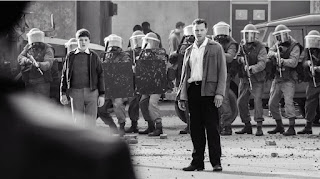
Through it well, Buddy catches film snippets on television, and the local movie theatre is the most exciting family outing. The child's nascent and wide-eyed love of the movies trickles all the way down from Granny, who anyway can't stop talking in the theatre. Branagh uses black and white cinematography to evoke the past, with just a few splashes of colour as exclamation points. The framing is often exquisite: almost every scene is meticulously constructed to emphasize symmetry or perspective, underlining Buddy's unique lens. 

The performances are uniformly good without being flashy. Caitriona Balfe is quietly effective in demonstrating the enormous impact of a steadfast mother, and Ciaran Hinds establishes Pop as a memorably caring presence. The film rotates around Buddy, and Branagh ensures Jude Hill is simply endearing. Finally here is a child who is a child, curious, awkward, observant, and astute, but never precocious or mouthy.

The film's most poignant moments radiate love. The crusty spark between Pop and Granny remains in evidence, but the displays of romance between Ma and Pa, when they stop bickering and pause to appreciate each other and rekindle passion, are simply sublime. The Troubles may be a dark cloud in the Belfast sky, but a family's rock solid parental foundation is eternal.



All Ace Black Movie Blog reviews are here.

Sunday, 3 November 2019

Movie Review: Fifty Shades Of Grey (2015)


An erotic romantic drama, Fifty Shades Of Grey is a slight improvement on the book but is still an exceptionally poorly written bore.

Anastasia Steele (Dakota Johnson) is about to graduate from her Portland-based university. She heads to Seattle to interview young business tycoon Christian Grey (Jamie Dornan) for the student newspaper. Despite Ana's clumsy nervousness, the two are immediately attracted to each other. Christian initiates a few dates, but then darkly hints he is possessive and that Ana may want nothing to do with him.

He nevertheless starts showering her with gifts, then reveals he is only interested in a contract-based dominant/submissive sexual relationship whereby she would be his consenting sex slave. Ana is unsure, and takes her time reviewing and mulling over the contract while trying to understand why Christian cannot establish normal human connections. Without her committing to the contract they anyway initiate sex, and he introduces her to his playroom, filled with bondage, dominance and submission equipment.

The source material by E.L. James consisted of kitschy sex scenes stitched together with laughable prose, all originating as fan fiction. Yet the enormous commercial success of the books spawned an imperative for a film adaptation, and here writer Kelly Marcel and director Sam Taylor-Johnson sign up for the unenviable task of creating a viable movie out of tawdry erotica. They fail.

With plastic dialogue and character actions extracted from delusional reveries, Fifty Shades Of Grey is a slow motion fantasy in cold colours. The film stretches for a mind-numbing 128 minutes all bathed in blue, grey and black (except, of course, for the red playroom), while what passes for sensual music floods the soundtrack.

Within this milieu Jamie Dornan cannot manage anything other than a deer-in-the-headlights performance as Christian Grey, a supposed genius gazillionaire suddenly bamboozled by a woman who refuses to sign away her sexual freedom just because he demands it. Of course almost nothing will be known about Christian, because the script requires he stays silent and mysterious about his troubled past while Ana asks him essentially the same question for about two hours. Dornan can deal with the silent part, but rather than mysterious he is just blank.

Ana fares better, and in the hands of Dakota Johnson she is the one marginally tolerable part of the viewing experience. Whether intended or not, the film carries a feminist message of Ana only acquiescing to a man's obtuse demands after conducting due diligence and then on her own terms. Johnson does what she can with the flimsy material, at least for the parts when she is not naked.

The sex scenes are far fewer than in the book, but the second half does feature a steady stream of love making sessions ranging in kinkiness from vanilla to various forms of bondage, all filmed on the mainstream side of softcore. By the time Christian graduates to whipping, Anastasia decides she has wasted enough time with a man who can only express compassion through inflicting pain. In a non-ending meekly surrendering to the inevitable, she asserts her independence but unfortunately cannot escape the all-powerful clutches of the compulsory sequel.


All Ace Black Blog Movie Reviews are here.

Saturday, 1 December 2018

Movie Review: A Private War (2018)


A biographical drama, A Private War covers chapters from the career of war correspondent Marie Colvin.

The film opens in 2012 in the devastated Syrian city of Homs, reduced to rubble as part of the raging civil war. In flashback, Colvin's prior assignments for the British Sunday Times newspaper are recalled. In 2001, she covers the conflict in Sri Lanka and loses her left eye during a battle between the army and Tamil rebels. In 2003 she is in Iraq, pursuing the location of a mass grave of civilians to uncover one of Saddam Hussein's atrocities against his own people. She witnesses the horrific outcomes of an improvised explosive device.

In 2011 she is in the midst of the Arab Spring uprising, and enters a war-torn Libya to interview besieged and delusional leader Muammar Gaddafi. Despite accolades and recognition throughout the  journalism world, the hard-drinking and chain-smoking Marie's constant exposure to war and its impact on civilians induces post-traumatic stress disorder, and she spends time in rehabilitation. But she is inexorably drawn to conflict zones, and enters Homs at the height of the Syrian conflict.

Written by Arash Amel and based on the Marie Brenner magazine article, A Private War combines the biography of a troubled and courageous journalist with a horrors-of-war exposition. The film is episodic by nature, and hampered by a singular focus on Marie. Her in-field colleagues Paul Conroy (Jamie Dornan) and Norm Coburn (Corey Johnson) barely register as individuals, and in her private life lover Tony Shaw (Stanley Tucci) is presented as nothing other than a convenience.

With Rosamund Pike in fine form, some of these shortcomings are overcome by director Matthew Heineman as he delves into the soul of a woman pulled to the site of the world's worst inhumane corners to record the often covered-up indiscriminate violence against defenceless civilians. She visits hellholes so that others don't have to, and to try and nudge the soul of an often uncaring world into action. That the brutality cycle repeats only in different settings undoubtedly contributes to Marie's emotional disintegration.

The film's final chapter is a harrowing recreation of Homs reduced to rubble, with reporters and civilians trapped and barely surviving as death rains from above. Marie transmits to the outside world to once again try and poke public consciousness towards witnessing the uncomfortable. Large scale atrocities are nourished by indifference, and Marie Colvin dedicated her life to turn apathy into empathy.


All Ace Black Blog Movie Reviews are here.


Sunday, 2 September 2018

Movie Review: Anthropoid (2016)


A World War Two action drama based on real events, Anthropoid is a stellar retelling of the assassination attempt on Reich Protector Reinhard Heydrich of the Nazi SS, also known as the Butcher of Prague.

It's late 1941, and Heydrich has been appointed by Hitler to crush all resistance in occupied Czechoslovakia. Agents Jozef Gabčík (Cillian Murphy) and Jan Kubiš (Jamie Dornan) of the Czechoslovak government-in-exile are parachuted into the countryside. Jozef's foot is injured upon landing, and the two men have to evade Nazi sympathizers and make their way into Prague. They find the resistance decimated, but manage to connect with a surviving cell led by "Uncle" Jan Zelenka-Hajský (Toby Jones) and Ladislav Vaněk (Marcin Dorociński).

Jozef and Jan are harboured by a local family, and to facilitate their movements connect with underground members Lenka (Anna Geislerová) and Marie (Charlotte Le Bon), as they set about planning their mission to assassinate Heydrich. They track his movements and select a location for an ambush. There is dissent about the mission within the ranks of the dispirited resistance, with Vaněk among those fearing the Nazi retaliation. The day of the strike arrives, and not much goes according to plan.

Directed and co-written by Sean Ellis, Anthropoid is an exquisitely constructed film. Breathing deeply from the soul of a city crushed under the Nazi boot, Ellis delves into the people, the places and the events with obvious care, fleshing out in admirable detail the characters, emotions and frightful consequences of a seminal yet controversial mission.

With the Nazis at the height of power and Czech resistance effectively crushed by Heydrich, the idea of a ragtag group assassinating the third most powerful man in Hitler's regime (and the main architect of the Holocaust) was rightfully inconceivable. And even should they succeed, the bloody and disproportionate reprisals were predictable, piling more agony onto an already suffering nation.

And yet. The potential morale and propaganda boost was undeniable, and the message of unyielding continued resistance would register at the highest levels of the Third Reich. And so Jozef and Jan carry on their reconnaissance, meld into the city, cozy up to Lenka and Marie to help conceal their identities, and cobble together the resources and help to try and carry out their mission.

Ellis dedicates the first hour of Anthropoid to the careful set-up, the attempted assassination lands right at the midpoint, and the second half of the film kicks into a high gear. Now the hunters are the hunted, the backlash is, as anticipated, fearsome. Acts of historic heroism and treachery play out on the streets of Prague, culminating in a fearsome climax at the Cathedral. The final battle is filmed with an artistry at once horrifying and stirring. Sacrifice, brutality and heroism in a World War Two context have rarely been captured on-screen with this level of passion.

The performances are stoic, Cillian Murphy most prominent as the singularly determined agent, Toby Jones providing stalwart support as the astute leader of the surviving local resistance.

Heartfelt and unblinking, Anthropoid takes its place among the great World War Two movies.


All Ace Black Blog Movie Reviews are here.