Showing posts with label Tom Hanks. Show all posts

Sunday, 9 March 2025

Movie Review: Here (2024)


Genre: Drama  
Director: Robert Zemeckis  
Starring: Tom Hanks, Robin Wright, Paul Bettany, Kelly Reilly  
Running Time: 104 minutes  

Synopsis: Multiple stories unfold non-linearly but in one geographic location (likely in Pennsylvania), as seen from a single fixed vantage point. The main story starts with World War Two veteran Al Young (Paul Bettany) and his wife Rose (Kelly Reilly) purchasing a house after the war. Al settles into a career as a dissatisfied vacuum cleaner salesperson. Their eldest son Richard (Tom Hanks) falls in love with Margaret (Robin Wright), who moves into the house. They raise a daughter Vanessa, and Richard gives up his love of art to sell insurance. Others who occupy the same location in different eras include an indigenous couple; the son of Benjamin Franklin; an early aviator in the 1920s; a furniture designer in the early 1940s; and a black family during the Covid pandemic.

What Works Well: A technically audacious drama co-written by director Robert Zemeckis and Eric Roth weaves time through one small patch of geography, simultaneously conveying intimate individual emotions and the transient human experience. The remarkably fast passage of time is an underlying theme, but also the rich experience that can be packed into one living room, spanning from Al to Vanessa in 60 years. Humour, tragedy, conflict, love, and loss pass in front of the camera's steady gaze, Zemeckis deploying on-screen panels, fluid transitions, and AI-enhanced de-aging to effortlessly maintain coherence across centuries. Brisk pacing adds to the fly-on-the-wall joy.

What Does Not Work As Well: By definition the focus is on snippets and vignettes rather than any depth, and the flash-fried storylines surrounding the Young family suffer from comparative neglect.

Key Quote:
Richard (at 18 years old): You know, if you like, you could spend the rest of the night here.
Margaret: I could spend the rest of my life here.


All Ace Black Movie Blog reviews are here.

Saturday, 13 January 2024

Movie Review: Punchline (1988)


Genre: Drama  
Director: David Seltzer  
Starring: Sally Field, Tom Hanks, John Goodman  
Running Time: 122 minutes  

Synopsis: In New York City, Lilah Krystick (Sally Field) is a housewife and amateur stand-up comic. Although she is awkward on stage and rarely delivers laughs, she still performs regularly at the Gas Station club. Financially struggling fellow comic Steven Gold (Tom Hanks) is the club's rising star, but under family pressure to pursue a medical career. Lilah's husband John (John Goodman) wants her to focus on being a wife and mother, but she is determined to pursue comedy and strikes up a friendship with Steven.

What Works Well: Director and writer David Seltzer demonstrates courage to craft a serious drama within the world of comedy. While the better stand-up routines contain laughs, the focus is on pathos, hustle, and the specter of failure. Under the stewardship of proprietor Romeo (Mark Rydell), the Gas Station club roster of comedians consists of mostly awful performers eking out a heckled living. Even for a talented comic like Steven Gold, the pathway to discovery is far from certain, and the resultant emotional strain provides Tom Hanks with a latitude of desperation. Refreshingly, the unbalanced would-be romance between Steven and Lilah sprouts in the shadow of thorns.

What Does Not Work As Well: By definition the tone suffers from gyrations between awkwardness, laughter, and trepidation, while Seltzer indulges most scenes for longer than necessary.

Conclusion: The struggles and sadness residing within laughter.


All Ace Black Movie Blog reviews are here.

Sunday, 5 November 2023

Movie Review: A Man Called Otto (2022)


Genre: Comedy Drama
Director: Marc Forster
Starring: Tom Hanks, Mariana Treviño, Rachel Keller
Running Time: 126 minutes

Synopsis: Self-appointed neighbourhood overseer Otto Anderson (Tom Hanks) is stern, bitter, depressed, and still traumatized by the loss of his wife Sonya (Rachel Keller, in flashbacks). After his retirement, Otto's determination to kill himself is interrupted by vivacious and pregnant new neighbour Marisol (Mariana Treviño), who moves in across the street. Otto is reluctantly drawn into Marisol's cheerful life with her husband and two daughters, and starts to re-engage with other neighbours. But he remains engulfed in sorrow and resolute in wanting to end his life.

What Works Well: The remake of a Swedish movie is a feel-good, heart-warming tale about overcoming grief by reconnecting with community. Director Marc Forster does not shy away from Otto's dark mental state and desire to stop living, but provides balance through moments of joy lurking beneath the mundane. From a cat seeking a new home to Marisol learning to drive then an encounter with a troubled youth who holds a special connection with Sonya, glimmers of light start to shine into Otto's life. The movie is peppered with sharp humour, and Mariana Treviño is a fearless source of energy as the change catalyst.

What Does Not Work As Well: While not quite miscast, Tom Hanks' nice guy persona struggles to project Otto's grumpiness (Clint Eastwood was more perfectly suited to a similar role in Gran Torino). The film's satisfying but still vanilla taste is confirmed with Otto's linear and predictable progression out of the doldrums, and the running time is longer than it needs to be.

Conclusion: An unapologetically sentimental but still sharply delivered comedy about rediscovering purpose.


All Ace Black Movie Blog reviews are here.

Saturday, 4 February 2023

Movie Review: Elvis (2022)


Genre: Biographical Music Drama
Director: Baz Luhrmann
Starring: Austin Butler, Tom Hanks, Olivia DeJonge
Running Time: 159 minutes

Synopsis: Raised in a poor black Memphis neighbourhood, a young Elvis Presley (Austin Butler) records a minor hit in 1954. Savvy carnival huckster Colonel Tom Parker (Tom Hanks) recognizes the commercial potential of a white singer embracing black music energy and performing with unbridled sex appeal. Parker rapidly steers Elvis' career to the pinnacle of the burgeoning rock 'n' roll movement, horrifying self-appointed guardians of morality. After an overseas stint in the military where he meets bride-to-be Priscilla (Olivia DeJonge), Elvis attempts to achieve screen stardom, but the Colonel has his own agenda.

What Works Well: Director, co-writer, and co-producer Luhrmann delivers a razzle dazzle spectacular. Split screens, stark lights, vivid colours, outlandish costumes, and energetic musical performances capture Elvis' stature on a large canvas. Luhrmann develops and sustains three strong themes: the influence of black culture on Elvis' music; the scandalous shock value of his pelvic gyrations on an entire generation; and most of all, the Colonel's Svengali manipulations. With a surprisingly deft touch, the final act also explores the unbearable weight of superstardom on a husband and father. Austin Butler is stellar, while Tom Hanks is deliciously hammy.

What Does Not Work As Well: The pacing is measured and the scope epic, but the running time remains longer than needed. Beyond Elvis, the Colonel, and to a lesser extent Priscilla, the supporting characters - and supporting cast - are largely anonymous.

Conclusion: A suitably lavish royal salute to the King.


All Ace Black Movie Blog reviews are here.

Sunday, 21 August 2022

Movie Review: Larry Crowne (2011)

A harmless romantic comedy, Larry Crowne is filled with good people overcoming familiar crises. The film bobbles sideways rather than ever moving forward.

In Los Angeles, middle aged and divorced Larry Crowne (Tom Hanks) is a dedicated and good natured employee at a big-box store. A 20-year Navy veteran (where he served as a cook), Larry was never promoted to the front office due his lack of a college degree, and now he is shocked to be laid off.

Determined to improve his education, Larry enrolls in language and economics courses at a local college, where he meets Mercy Tainot (Julia Roberts), the demotivated teacher of an english communications class. Larry also buys a scooter to save on gas money, finds a job as a diner cook, and befriends popular student Talia (Gugu Mbatha-Raw), who introduces him to her scooter-riding friends. Mercy is stuck in a failing marriage and has lost her passion for teaching, but gradually she warms up to Larry.

Two of Hollywood's all-time most popular stars team-up for a pleasant-enough romance. Tom Hanks directs himself and co-wrote the script with Nia Vardalos, and they keep the plot free of villains, contrived complications, or silly misunderstandings. Larry's world is instead filled with nice people navigating the ups and downs of life. The scooter represents the perfect summary of the narrative intentions: pragmatic and docile fun. The background context has Larry dealing with a life-at-a-crossroads moment, his lack of a college education and the breakdown of his marriage combining to drop him into an economic storm. Mercy is grappling with a smoldering wreck of a marriage, whatever potential her writer husband Dean (Bryan Cranston) once had now being consumed by an online porn habit. 

Both Hanks and Roberts can play these roles in their sleep, and Hanks as director allows himself to overplay the perpetually befuddled mannerisms of a mature student in a college full of kids. Gugu Mbatha-Raw provides a positive spark, as Talia takes the old guy under her wing and helps him scrape off some of the accumulated moss.

A classy supporting cast brightens the peripheries, and includes Cedric the Entertainer as Lamar, Larry's friend, neighbour, and brilliant yard sale entrepreneur. Taraji P. Henson is Lamar's wife, Pam Grier is another college teacher, and Rami Malek is an animated student in Mercy's class. The best comic moments are provided by George Takei as Dr. Ed Matsutani, a college professor somehow combining arrogance, compassion, and a maniacal laugh.

The peak moment of tension is limited to a drunken smooch between teacher and student, embarrassing them both before the fog lifts and the path is cleared for the requisite happy ending. Larry Crowne rides his scooter on a straight and narrow path, seeking only the amiable stops.


All Ace Black Movie Blog reviews are here.

Tuesday, 15 February 2022

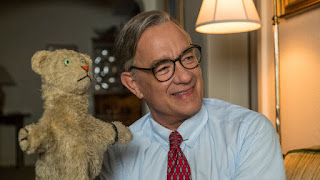
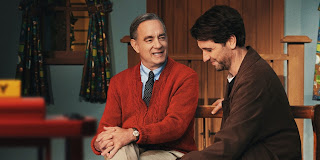
Movie Review: A Beautiful Day In The Neighborhood (2019)

A deft biographical drama, A Beautiful Day In The Neighborhood captures the spirit of Fred Rogers through an interviewer's own father-son story.

In 1998, Lloyd Vogel (Matthew Rhys) is a New York City-based writer for Esquire magazine with a reputation as a cynical and hard-nosed journalist. Married to Andrea (Susan Kelechi Watson), he is having trouble adjusting to being a new dad, and is not on speaking terms with his father Jerry (Chris Cooper). For an upcoming issue profiling heroes, Lloyd's editor assigns him a short puff-piece on children's television personality Fred Rogers (Tom Hanks), of Mr. Rogers' Neighborhood fame.

Lloyd visits Rogers in Pittsburgh where the show is filmed, and a series of interviews ensue, with Lloyd frequently finding himself answering rather than asking questions. With Jerry desperately trying to reconnect with his son, Lloyd starts to understand that the life affirming, empathetic, and deeply caring Rogers selected him for an emotional rescue.

Deploying a clever structure based on actual events, A Beautiful Day In The Neighborhood exhibits Rogers' essence with a delightful touch. The script by Micah Fitzerman-Blue and Noah Harpster places Rogers to the side as a secondary or even tertiary character, but then reveals his influence through interactions with an interviewer navigating a crisis. Director Marielle Heller stays out of the material's way, staging close-ups within modest sets to minimize distractions and allow humanity to shine. 

Rogers' positive impact on children is revered, and the television set charm is on full display as a well-rounded neighbourhood where all emotions are welcome. The film's intention is to appreciate Rogers' wisdom more universally, and the confines of the show are used as a framing device for a story about familial stress and angst. 

The conflicts between Lloyd, his father Jerry, and his wife Andrea stem from standard-fare daddy issues, but provide a sufficient structure to demonstrate Rogers' principles in action: respect, dignity, and acceptance; mature explanations; an even temperament; and sufficient trust to delve into difficult topics. Methods are as important as fundamentals: as portrayed by a calmly piercing Tom Hanks, Rogers focusses intently on the matter at hand and only on the person in front of him. And in that moment, nothing else matters.

Heller does enough to avoid a hagiography. Rogers' time-stands-still eccentricities are on display, often exasperating his staff. And on the infrequent occasions when Lloyd can get his questions answered, he probes Rogers' relationship with his own children, hinting at the pitfalls of living with a saintly personality. 

A Beautiful Day In The Neighborhood adopts the calm attributes of its subject matter, celebrating quaintness in a good way: well-meaning, positive, and with just a hint of mischievous quirkiness.


All Ace Black Movie Blog reviews are here.

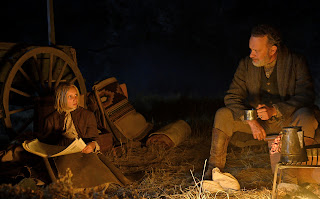
Movie Review: News Of The World (2020)

A decorous but episodic western, News Of The World journeys through a post-war landscape riddled with pain, mistrust and divisions.

The setting is Texas in 1870, five years after the Civil War's end. Captain Jefferson Kidd (Tom Hanks) of San Antonio served in the Confederate Army, and now makes his living traveling to ramshackle towns as a newspaper reader. Kidd theatrically animates his readings to perk-up weary townsfolk overburdened by work and demoralized by the South's defeat.

On the road outside Wichita Falls, Kidd stumbles upon a recent lynching and rescues the abandoned Johanna (Helena Zengel), a spirited blonde and blue-eyed young girl of German heritage. She was abducted as a child and raised by the Kiowa Tribe, and has now been orphaned twice over. She only speaks the Kiowa language, and Kidd does not find any officials willing to take responsibility for her. He reluctantly decides to take Johanna into his care for the 400 mile journey to the town of Castroville, where she may have relatives.

A staid road trip movie, News Of The World examines a defeated society still reeling from the emotional and economic ravages of war. Director Paul Greengrass co-wrote the script with Luke Davies, and creates in the story of Kidd and Johanna a sturdy frame to carry a diverse set of observations. The bond between lonely traveler and lost child is both a strength and a challenge: it's easy to foresee how their trip will end, but in the comforting presence of Tom Hanks, it's also easy to ride along.

Events along the long road to Castroville are presented in discrete short story chapters. Kidd's empathetic demeanour calms down a crowd getting restless at Federal meddling and omnipresent blue-uniformed soldiers. A dangerous episode features three outlaws led by Almay (Michael Angelo Covino) seeking to force Johanna into the sex trade. Kidd and Johanna then ride into a self-declared racist fiefdom run by Mr. Farley (Thomas Francis Murphy), and here the news reader intentionally agitates the crowd against their oppressor. Next, the plains of the Kiowa tribe are home to a side-trip to the past, an accident, a vicious sandstorm, and a magnanimous gesture.

The travails are beautifully filmed and capture the loneliness of a wide open country dotted with small settlements, where time passes slowly and dangers are born from a marriage of human desperation and unforgiving terrain. The simple unifying theme explores deepening roots of mutual respect, two-way learning, and growing dependence between Kidd and Johanna, a surrogate father-daughter thread nurturing two souls traumatized by loss. It's neither complex nor dramatically imaginative, but suitably soothing.


All Ace Black Movie Blog reviews are here.

Saturday, 30 January 2021

Movie Review: You've Got Mail (1998)

A romantic comedy with would-be lovers on either side of the corporate fence, You've Got Mail delves into the emerging online world to update a story of virtual friends and real-world foes.

Using the online pseudonyms Shopgirl and NY152, New Yorkers Kathleen Kelly (Meg Ryan) and Joe Fox (Tom Hanks) correspond through daily emails, having met in a chat room. In the real world Kathleen owns a small children's bookstore she inherited from her mother, and is in a relationship with newspaper columnist Frank (Greg Kinnear). Joe runs the giant Fox Books megastore discount chain and is romantically attached to book publisher Patricia (Parker Posey).

With Joe about to open a new Fox Books location and drive Kathleen's store out of business, they meet and she shuns him as a heartless businessman. Meanwhile their daily emails develop into a deep friendship, until Joe discovers that his online soulmate is also his real world nemesis. He has to find a way to turn a digital romance into a true love affair.

Updating 1940's The Shop Around The Corner and taking advantage of emerging social media trends, You've Got Mail pulls off the far-fetched central premise with practised ease. Director Nora Ephron co-wrote the script with her sister Delia, and reunites with Hanks and Ryan from the 1993 hit Sleepless In Seattle. The pre-established chemistry is evident and helps navigate the bumpy patches, especially a rather prolonged final act.

The dichotomy between real-world sparring and on-line friendship drives the narrative. Ephron establishes Kathleen and Joe's physical proximity early: they navigate the same streets everyday, oblivious to each other and their digital friendship, virtually connected in a practically disconnected world. The difference in their behaviour is stark. Benefitting from on-line anonymity and a "no telling details" rule, the emails represent their truer selves, full of honesty and self-doubt. In person Kathleen's shield goes up and she understandably rails at Joe's corporateness before giving herself a chance to know him as a person.

A sparkling New York is scrubbed clean and serves as a typically idyllic rom-com backdrop. Consistent with the small store/big corporation conflict, Ephron allows street-level businesses to provide the city's heartbeat, scenes of shutters opening to start the day serving as the source of streetscape vibrancy.

Hanks and Ryan radiate star power and next-door genuineness. Although Ephron at times appears to encourage theatrically ditzy performances from both, they settle down and excel in two separate modes: in-person clashes and behind-the-keyboard narration.

Meanwhile the edges of the story are kept busy, with a strong but over-elaborate supporting cast. In addition to a funny and hyper Parker Posey as his girlfriend, Joe Fox is surrounded by a best friend (Dave Chapelle), as well as a father (Dabney Coleman) and a grandfather who both have young children. Greg Kinnear's caustic newspaper opinionist is a good match for Kathleen, and she also has three store employees (Jean Stapleton, Steve Zahn and Heather Burns) to worry about. Unsurprisingly, several of the side-characters fade away or are just unceremoniously dropped due to crowding.

But despite some well-intended bloat, You've Got Mail succeeds in parsing togetherness apart, and delivers a breezy romance.


All Ace Black Movie Blog reviews are here.

Saturday, 27 June 2020

Movie Review: The Bonfire Of The Vanities (1990)


A satirical comedy-drama about human surrender to avarice, The Bonfire Of The Vanities tackles weighty subjects with a dismissively careless attitude.

Perpetually drunk reporter-turned-author Peter Fallow (Bruce Willis) basks in the glory of his new-found fame as a best-selling author. In flashback, Fallow recounts the past year's events. Sherman McCoy (Tom Hanks) is one of the few "Masters of the Universe", a mega-wealthy Wall Street bond trader raking in millions per deal. Married to Judy (Kim Cattrall), he is carrying on an affair with the equally married airhead Maria Ruskin (Melanie Griffith).

Sherman picks up Maria from the airport and after a wrong turn they end up deep in the Bronx late at night. They tangle with two Black men and in the frantic effort to drive away Maria, now in the driver's seat, accidentally runs over one of the men. Maria convinces Sherman not to report the incident, but with the victim in a coma the outraged South Bronx Black community rises to demand justice and a full investigation of the hit-and-run, with Reverend Bacon (John Hancock) leading the protests.

Ambitious District Attorney Weiss (an uncredited F. Murray Abraham) recognizes the publicity value of the case. Assistant DA Kramer (Saul Rubinek) starts investigating, and Fallow is plucked from obscurity to start pumping newspaper headlines. Soon Sherman's car is identified and his life is forever altered, with a climax in the courtroom of the Black Judge White (Morgan Freeman).

An adaptation of Tom Wolfe's novel, The Bonfire Of The Vanities critiques rampant narcissism with inflated humour. Overcoming a nightmarish production cycle featuring countless casting and miscasting chops and changes, director Brian De Palma nevertheless luxuriates in creating a vivid and hyper-realistic world, whether in McCoy's Manhattan apartment or on the streets of the Bronx. And he layers on the cinematic tricks, glitz and style, including a spectacular opening single tracking shot extending close to five minutes as Farrow arrives at a gala event. 

But the problems run deep, from Farrow's boring and unnecessary narration to the juvenile comedy antics, including McCoy using a shotgun to end a party and Kramer instigating a physical courtroom fracas. And unrefined hyperbole surrounds every distasteful character. In the context of a movie studded with star names, the absence of a single empathetic character becomes a problem script writer Michael Cristofer cannot solve. Fallow has traded his career for the bottle, Maria is an over-sexed and vocabulary-challenged moron, Weiss is a villain in a suit with his eyes solely on the Mayor's chair, and Reverend Bacon is a larger than life thunderous buffoon.

Which leaves Tom Hanks stranded in the central role of Sherman McCoy, a man with apparently no redeeming qualities, making money by trading money and happy to cheat on his wife with a bimbo. Still, the film needs a victim and McCoy is the closest thing to it, but he remains a relative non-entity as the cause of racial justice is co-opted by all around him for selfish causes.

Morgan Freeman's Judge White emerges as the one individual fighting a rearguard action to safeguard some sense of decency amidst the sea of moral bankruptcy. Within a societal sensibility portrayed as rotten to the core and well beyond salvation, his climactic speechifying carries no conviction.

For all its faults, The Bonfire Of The Vanities is nothing if not perceptive. It borders on cartoonish, but the film lays bare the tsunami of materialistic selfishness and greed corroding hearts and minds, a fiery spiral reaching into every corner and always spinning downwards.


All Ace Black Blog Movie Reviews are here.


Saturday, 29 February 2020

Movie Review: Road To Perdition (2002)


A gritty gangster drama, Road To Perdition is a visually stunning story of redemption, revenge and fatherhood.

In rural Illinois of 1931, Michael Sullivan (Tom Hanks) works as a mob enforcer for local Al Capone affiliate John Rooney (Paul Newman). He keeps the details of his work private and is aloof towards his family, including wife Annie (Jennifer Jason Leigh) and two sons Michael Jr. (Tyler Hoechlin) and Peter. Rooney treats Michael likes a son, much to the resentment of his unstable real son Connor (Daniel Craig).

When the curious Michael Jr. witnesses the killing of one of Rooney's rivals, Connor decides to wipe out the entire Sullivan family. Michael flees to Chicago with Jr. and connects with Capone's second-in-command Frank Nitti (Stanley Tucci), offering his services in exchange for being allowed to hunt down Conner. But Rooney stands by his real son, placing Connor in hiding and reluctantly unleashing hired killer and crime photographer Harlen Maguire (Jude Law) to finish off the Sullivans.

A richly textured exploration of mobster life focusing on the sins of the father, Road To Perdition is a lyrical ode to generational change among career criminals. The graphic novel by Max Allan Collins and Richard Piers Rayner is translated to the screen by director Sam Mendes and cinematographer Conrad L. Hall, and the film's rich style adds a captivating dimension, at once emphasizing emotional resonance and evoking a bygone era.

The film adopts the perspective of Michael Jr. remembering a seminal six weeks on the run with his father, the only time he got to know his dad. Previously Michael was a cold and distant figure involved in shadowy and undefined business for Mr. Rooney. When Jr. surreptitiously snoops into the business of adults, suddenly the reality of his father's murderous assignments comes into relief and the two are forced together just to survive. A lifetime of bonding is compressed into one road trip, and Jr. finally penetrates his father's veneer and by extension learns about himself.

Multiple father-son dynamics nurture the film's layered background. Rooney treats Michael as a son, and Mendes uses one scene at the piano to expressively colour-in the strength of their connection. But this is at the expense of Connor, slightly psychotic but fully aware that Michael has displaced him and occupies pride of place in Rooney's emotional bank.

However, Connor holds the trump card of bloodline and status as natural successor to his father's empire, and is quick to seize the opportunity to eliminate the Sullivan threat, forcing Rooney into the ultimate unwanted dilemma of having to choose between his biological and chosen sons.

The sprawling drama unfolds in a compact format at under two hours, and screenwriter David Self respects the visual essence of the source material by economizing on dialogue. The action scenes are plentiful, sharp and exquisitely staged. Thomas Newman's music complements Hall's cinematography to create masterpiece arrangements, the framing, compositions and lighting often breathtaking. Water is a frequent theme, whether through rain, melting ice or in bathtubs, reflecting the inherent fluidity of mobster life.

In one of his most unique performances Tom Hanks finds a much more dangerous screen presence while maintaining his core humanity. Hanks thrives in defining Michael's separated duality as a killer and family man, and convincingly fills the yawning gap of fatherhood with compassionate yet steely determination to protect his son. Paul Newman, Daniel Craig, Stanley Tucci and Jude Law form a dazzling supporting cast.

A pathway to retribution, atonement, and awakening, Road To Perdition offers a sublime journey.


All Ace Black Blog Movie Reviews are here.


Monday, 1 July 2019

Movie Review: Toy Story 4 (2019)


The fourth chapter in the animated saga of toys who come to life when kids are not looking, Toy Story 4 explores the courage to embrace life's ever-changing phases.

Nine years ago, Woody (voice of Tom Hanks) decided to remain loyal to his owner Andy and forgo the companionship of Bo Peep (Annie Potts), who was boxed up and shipped out. Now Woody finds himself falling out of favour with his new owner Bonnie. He nevertheless helps her through the first day at preschool, where she creates a new toy Forky (Tony Hale) made from craft material briefly dumped in the trash.

Bonnie's family embark on a road trip, and Woody tries to educate Forky on his new role as Bonnie's favourite toy. But the confused Forky escapes the family RV, and Woody goes after him. The two end up at an antique store where Forky is grabbed by the bitter doll Gabby Gabby (Christina Hendricks), who has a broken voice box. Woody re-connects with Bo Peep, and with the help of Buzz Lightyear (Tim Allen) and motorcycle stunt toy Duke Caboom (Keanu Reeves), they have to rescue Forky and reunite with Bonnie.

The first trilogy arrived at a near-perfect ending, so re-launching the franchise nine years later was a calculated risk. Thanks to a clever and multi-layered script by Stephany Folsom and Andrew Stanton, Toy Story 4 is a worthy addition to the adventures of Woody, Buzz Lightyear and their pals. The film contains perfect doses of madcap adventures, sharp humour, new toys, as well as lessons in friendship and loyalty. And this time Woody's strong value system is challenged in new and unexpected ways as his emotional landscape changes again.

The main new theme arrive courtesy of Bo Peep, who has embarked on a life of freedom and independence away from serving a child's happiness. She is exploring the world on her own terms and having plenty of fun doing it. In addition to the forceful message of female strength and empowerment, her unapologetic stance is completely at odds with everything Woody knows and stands for. But gradually, combined with Bonnie confining Woody more frequently to the dark closet and playing with other toys, Bo Peep's lifestyle starts to make a lot more sense.

Director Josh Cooley also has another interesting narrative thread to pursue. Gabby Gabby is introduced as the villain of the piece, her entourage of ventriloquist doll goons prime candidates for inducing nightmares among young viewers. But the film's commitment to delving beneath superficialities is laudable, and Gabby Gabby has her own backstory and quest to fulfil. Woody is again faced with an exceptionally difficult decision to make, and once again his current status relative to Bonnie will influence his actions.

Visually Toy Story 4 continues to achieve new levels of excellence in computer animation, and the screen is often rich with crisp content and stunning details. Various intriguing settings afford the animators opportunities to flex their muscles, from the RV's interior to expansive carnival grounds teaming with activity. The ramshackle antique store emerges as the film's most memorable locale.

While all the old favourites are here and Bo Peep's promotion to a strong female central role is a welcome boost, the series refreshes the toy line-up with some new arrivees. Most prominent and marketable is the insecure Duke Caboom, a Canadian stunt rider rejected by his first owner because Duke could not live up to his extravagant television advertising exploits.

An excellent use of nostalgia to push into brave new territory, Toy Story 4 builds upon tradition to thoughtfully challenge the status quo.


All Ace Black Blog Movie Reviews are here.


Tuesday, 2 October 2018

Movie Review: Splash (1984)


A fantasy romantic comedy, Splash succeeds in creating an unlikely love story between a mermaid and a man.

As an eight year old, Allen Bauer fell off the Cape Cod ferry and had a weird underwater encounter with a young mermaid. 20 years later Allen (Tom Hanks) is running a fruit distribution business in Manhattan with his obnoxious brother Freddie (John Candy), and not much of a believer in love. After another mishap at sea again near Cape Cod, Allen is rescued by the same, now grown mermaid (Daryl Hannah). She finds his wallet and decides to track him down, her tail turning to legs once on shore.

Allen is startled by the beautiful and initially naked woman who latches onto him, and he is blissfully unaware she is a mermaid. She learns English in one afternoon by watching television, they fall deeply in love, and he gives her the name Madison. Meanwhile, volatile scientist Dr. Walter Kornbluth (Eugene Levy) has spent his entire career trying to prove the existence of mermaids. He is hot on Madison's tail, so to speak, eager to reveal her true nature.

Directed by Ron Howard and produced by Brian Grazer, Splash sounds ridiculous, and indeed the script was roundly rejected before Disney picked it up for their new more adult-oriented Touchstone marque. And thanks to Howards' deft touch, Hanks' everyman persona and Hannah's curious innocence, the film simply clicks. Comedy and romance come together in an irresistible and most literal fish-out-of-water tale, boosted by smooth special effects and crystal quality underwater scenes.

With buoyant irreverence the film plays with the theme of love emerging from the unlikeliest of places, romance blossoming from within the ocean despite Allen being terrified of water. Other percolating ideas include New York as a city that welcomes all aliens, the unintended usefulness of useless television, and government types as military-happy incompetent meddlers (and here Splash borrows from E.T.).

Not everything about Splash quite works, and the weaker moments find Howard catering to more base instincts. The ending introduces an unnecessary chase featuring military trucks full of soldiers running around, and some of Freddie's antics belong in a more lowbrow comedy. Levy's performance is also free of any nuance. And in making Madison exceptionally libidinous Splash does surrender to the male fantasy of the beautiful, available and innocent woman draping herself all over an unsuspecting man.

But thankfully, most of the film is centred on Allen and Madison as a compatible match, and both are entranced by a sense of discovery. He is falling genuinely in love for the first time, and she is discovering life on land, and their relationship is strengthened by the shared sense of wonder about what is possible. Splash may be a fishy love story, but its tail is in the right place.


All Ace Black Blog Movie Reviews are here.


Saturday, 17 February 2018

Movie Review: The Terminal (2004)


A mild comedy, drama and romance, The Terminal offers harmless entertainment in a message-heavy but slick production.

Tourist Viktor Navorski (Tom Hanks) arrives at New York's JFK airport and is refused entry. While Viktor was in the air, the government of his fictional home country of Krakozhia was deposed as a civil war erupted. Frank Dixon (Stanley Tucci), the airport's Acting Customs Director, deems Viktor stateless and status-less, and restricts him to the international transfer lounge until the State Department can figure out a solution.

Hours turn into days then weeks and months. Viktor creates a sleeping area at an unused gate, teaches himself better English, and befriends airport employees including customs agent Dolores (Zoë Saldana), a janitor (Kumar Pallana), a baggage handler (Chi McBride) and a catering company employee (Diego Luna). Viktor also meets and is entranced by flight attendant Amelia (Catherine Zeta-Jones). They become his family of sorts as Dixon dreams up ways to get rid of his unwanted guest.

Directed by Steven Spielberg, The Terminal offers family-friendly entertainment, celebrating diversity, the American cultural mosaic and the value of immigrants who love their original homeland yet are willing to also love the United States. The film is partially inspired by a real-world case of a seemingly stateless man who lived for years at Charles de Gaulle Airport. Set almost entirely in a purpose-built set, The Terminal condenses societal tensions into one building teaming with commerce, where the fate of new arrivees is decided with an abrupt passport stamp.

The Terminal's messaging is heavy-handed, as Spielberg launches into blunt metaphors and stark characterizations. Frank Dixon is the antagonist careerist white man holding all the power and wielding it irresponsibly, while most of the other characters are visible minorities or outsiders struggling for a better life. The emotional strings are weighed down with syrup, from the secret contents of Viktor's peanut box (the revelation is both mundane and clumsy) to Amelia's search for true love in all the wrong time zones. Meanwhile all of Viktor's new friends are decent and jovial folks hiding secrets.

The film clocks in at an unnecessarily long 128 minutes, and despite the lack of a deft touch Spielberg still delivers a polished package. The good elements include dynamic Janusz Kamiński cinematography that makes the most out of the elaborate set, and a typically dependable Tom Hanks performance. Hanks grows into the role, starting out at an unfortunately cartoonish level but evolving into a well-rounded character with plenty of steel in his core, surrounded by Hank's forte of universal human decency.

Predictably amiable, The Terminal is certainly a functional building, designed to be better than bland but less than thrilling.


All Ace Black Blog Movie Reviews are here.


Monday, 15 January 2018

Movie Review: The Post (2017)


A journalistic drama, The Post is a familiar but still relevant story of press freedom.

It's 1971 and the Vietnam War is grinding on. A disgruntled government contractor secretly makes copies of the Pentagon Papers, secretive voluminous reports about the war commissioned by Secretary of Defense Robert McNamara (Bruce Greenwood) in the mid 1960s. The Papers reveal a very different version of the truth than the official government narrative. Soon the New York Times is running front page stories much to the disgust of President Nixon, who issues a court order to stop the Times publishing any further revelations.

Over at the Washington Post editor Ben Bradlee (Tom Hanks) chases the story, while the Post's owner Kay Graham (Meryl Streep) is occupied with floating the paper on the stock exchange. Graham is also encountering near blatant sexism as Washington DC's elites dismiss her as an accidental owner of the paper with no real skill or talent to contribute. With help from senior reporter Ben Bagdikian (Bob Odenkirk) Bradlee finally gets his hands on the Pentagon Papers, but Graham will have to decide whether to risk the Post's future by agreeing to publish, a decision made all the more difficult by her friendship with McNamara.

Directed and co-produced by Steven Spielberg, The Post was rushed into production as an antidote project to the attacks on the press emanating from the Trump White House. With Streep and Hanks representing the upper echelons of Hollywood royalty lending their considerable talents, this is a reasonably engaging but firmly conventional story about the mainstream media staring down government pressure and court orders to reveal the truth about an ongoing war. The film is earnest in its intentions but also blatantly preachy.

Slick and professional as it is in recreating a 1970s newsroom milieu and a society were men still determined every action, there is no escaping that The Post adds little to the press-versus-authority sub-genre. The terrain is already well-covered by the likes of All The President's Men, State Of Play, Spotlight and The Fifth Estate. Editors egging on their reporters who then work the phones, pound the sidewalk, track down their sources, and clack away at typewriters as the deadline approaches for the presses to run, all under pressure of dark and evil authoritarian forces, is overly familiar cinematic material.

With the ending well known, the drama emanates from the day-to-day tactics and small sequential battles Bradlee and Graham had to personally and professionally wage and overcome. And Kay Graham's story is the one that resonates. With Meryl Streep in stellar form, the quiet struggle for a woman of considerable but theoretical influence to find her voice emerges as The Post's highlight. Spielberg expertly stages a succession of painful moments where Kay is marginalized, ignored and subjected to condescending behaviour by elderly white men in dark suits unaccustomed to a woman carrying and exerting decision-making authority. When it's finally her time to step forward and shape history, the societal seismic shock is profound.

Despite a lack of originality in style and content, The Post still delivers an important story in a proficient package.


All Ace Black Blog Movie Reviews are here.


Friday, 5 May 2017

Movie Review: That Thing You Do! (1996)


A musical dramatic comedy about a fictional one-hit wonder band, That Thing You Do! captures the vibe of an era but remains as shallow as its one hit song.

It's 1964 in Erie, Pennsylvania, and Guy Patterson (Tom Everett Scott) works at his father's appliance store while practicing his drums as a hobby. He agrees to perform on a one-off basis with the band of his friend Jimmy Mattingly (Johnathon Schaech) when the regular drummer breaks his arm. Jimmy has written a new ballad, but Guy doubles the tempo and turns That Thing You Do! into a peppy pop love song.

Guy sticks with the band, now named The Oneders, and they land a regular show at the local bar. On the strength of the catchy song they develop a following, attracting the attention of a local music producer who helps them cut a record and start touring locally. At an unfortunately bad show in Pittsburgh, Guy connects with promoter Mr. White (Tom Hanks), who signs them to Play-Tone Records. Renamed The Wonders, the band hit the road and seem to be on their way to the big time as the song races up the chart. But Jimmy is frustrated that neither his fellow band members nor White seem interested in writing and recording more material.

Tom Hanks' directorial debut, That Thing You Do! is good natured fun. Much like the band, the film rides its one ridiculously catchy song all the way from garage band territory to the top of the charts. But the story is also remarkably linear in recounting the rapid rise and quicker fall of a ragged band, and at the end of the film little of substance is revealed about any of the main characters.

The movie recreates a more innocent America discovering the sounds of The Beatles and not yet tainted by Vietnam and Watergate, the young boomer bonhomie of the times providing plenty of energy. Hanks constructs a breathtaking highlight when the young band members hear their song played on the radio for the first time, their sense of unbridled joy and exuberance jumping off the screen.

The title song is inspired by I Want To Hold Your Hand-era Beatles, and the film benefits from an everything-is-possible attitude, where with the help of the right promoter and radio play new stars can indeed be born.

While the rise of The Wonders is spectacular, their fall from grace is abrupt, and the film begins to feel rushed when the fun stops. A clunky romance is tacked on to conjure up a sappy ending, but by then the magic is well and truly gone.

Tom Everett Scott is lively as the cocky drummer Guy Patterson, not taking anything too seriously as he rides the wave as far away as possible from his father's cold appliance story. Hanks exudes detached and steely eyed professionalism as Mr. White, engineering the band's rise and prioritizing the commercial power of their one hit.

Johnathon Schaech as the serious Mattingly is short changed, Hanks' script confining the band leader to one dour mode, while his smarts and drive deserved more exposition. Other cast members include Liv Tyler as Jimmy's girlfriend Faye and Charlize Theron as Guy's high maintenance and soon to be ex-girlfriend Tina. The band members are rounded out by Steve Zahn, Ethan Embry and Giovanni Ribisi.

That Thing You Do! offers light-hearted toe-tapping enjoyment, like a summer hit that's everywhere at once before blowing away when it's time to get serious.


All Ace Black Blog Movie Reviews are here.


Thursday, 4 May 2017

Movie Review: The Circle (2017)


A near-future technological thriller exploring loss of privacy, The Circle starts with some good ideas but quickly loses its way.

Mae Holland (Emma Watson) is thrilled to join social media giant The Circle as a customer service representative. Her best friend Annie (Karen Gillan) is a high powered member of the firm's leadership team, advising co-founders Eamon Bailey (Tom Hanks) and Tom Stenton (Patton Oswalt). In her personal life Mae is drifting away from childhood friend Mercer (Ellar Coltrane), and trying to help her father Vinnie (Bill Paxton) deal with multiple sclerosis.

Mae enjoys her job although she finds the company's cult-like insistence on a high level of social media activity and participation at company events intrusive. She meets star software coder and fellow employee Ty Lafitte (John Boyega), who is keeping a low profile and is deeply suspicious of the company's ambitions to dominate and record people's lives. The Circle's latest tech innovations include mini cameras recording everything everywhere, but also medical advancements that help Vinnie. When Mae has a brush with death and is saved by The Circle's all-pervasive monitoring, she becomes a strong advocate for more intrusion into people's lives and freedoms.

Directed and co-written by James Ponsoldt and based on the book by Dave Eggers, The Circle imagines a bleak future where a social media giant is ready to fully eradicate privacy with a combination of mass surveillance, data gathering, storage, retrieval and analytics, and partnerships with government, all in the sunny name of worshipping the positive power of sharing. It's difficult to argue with the central premise that society is willingly surrendering privacy to the benefit of gigantic corporations. But after an encouraging start, The Circle hits all the wrong keys, and quickly dissolves into a dissonant mess.

Mae's transformation from an everyday millennial carrying healthy doses of cynicism and caring for her family into an advocate for subversive plots is unconvincing. She acquiesces in a zombie-like state to having every moment of her life live streamed, and later champions a really lousy digital version of global mob justice. Meanwhile, the characters of Eamon Bailey and Tom Stenton are throwbacks to another era when boomers presided over large corporations: today's tech giants are more likely to be owned and run by individuals two generations removed from Tom Hanks.

The thriller elements are particularly half baked. Mae and Ty run around empty cavernous underground tunnels that are supposedly extremely threatening because they will be filled with...more servers.

And ultimately The Circle stops being a movie and becomes a series of tedious Ted talks, Ponsoldt running out of ideas, money or both. The ending is a highly unsatisfactory mess. Annie cracks under unexplained pressure, Mae performs a couple more unexplained 180 degree turns, and an unexplained plot of secret emails is revealed, exposing...what, exactly?

Emma Watson and Karen Gillan do their best to inject energy into the film, and the more watchable parts are due to Gillan nailing the hyperstrung young executive relishing her part in ruling the world. Hanks generally sleepwalks through his few scenes.

The Circle attempts to tackle current and important online themes, but triggers error 404 instead.


All Ace Black Blog Movie Reviews are here.


Sunday, 30 April 2017

Movie Review: The Man With One Red Shoe (1985)


A bland comedy set in the domestic spy world, The Man With One Red Shoe is about nothing in particular and struggles to define a purpose.

In Morocco, CIA Deputy Director Cooper (Dabney Coleman), who covets the top job, sabotages an undercover drug operation and embarrasses CIA Director Ross (Charles Durning). Back in Washington DC, Ross is forced to testify before a Senate subcommittee, but plots his revenge against Cooper. Knowing that Cooper is tracking his every move, Ross dispatches loyal ally Brown (Edward Herrman) to the airport to liaise with a complete stranger.

Brown picks violinist Richard Drew (Tom Hanks) at random, and their brief interaction sets Cooper and his crew on a wild goose chase to find out why Drew is important. Drew is actually the victim of frequent pranks by orchestra percussionist Morris (Jim Belushi), and in return Drew is having an affair with Morris' wife Paula (Carrie Fisher). Otherwise Drew is a normal everyday guy, but Cooper's surveillance kicks into overdrive, including mobilizing the luscious agent Maddy (Lori Singer) to seduce Drew and learn his secrets.

Directed by Stan Dragoti, The Man With One Red Shoe is a remake of the 1972 French film Le Grand Blond Avec Une Chaussure Noire starring Pierre Richard. The Hollywood version enjoys slick production value and a strong cast including a young Tom Hanks, but the jokes (if they exist at all) are lame, the story is unengaging, and a void exists where meaningful plot elements and substantive characters are supposed to reside.

Drew is an innocent bystander and remains a most uninteresting central character, and Hanks can do nothing with role. Jim Belushi tries too hard as the immature friend still pulling high school level pranks, while Carrie Fisher gets one long scene in fetching leopard lingerie in a nod to her Return Of The Jedi slave outfit, but otherwise drifts aimlessly in and mostly out of the film.

Cooper and Ross contribute most of the narrative drivers in an astonishingly dreadful spy versus spy battle. Neither man is remotely likable, and who wins or who loses their petty careerist battle generates the flimsiest foundation for comedy. While Dabney Coleman and Charles Durning are fine supporting actors, they cannot carry the weight of the plot or the laughs. Lori Singer nails the role of the seductress and gets to wear a contender for the most stunning backless dress paraded on screen. She also owns the best laugh with a caught-in-the-zipper moment.

The Man With One Red Shoe doesn't so much run out of original ideas; it never had any in the first place.


All Ace Black Blog Movie Reviews are here.


Saturday, 11 March 2017

Movie Review: The Da Vinci Code (2006)


The most famous book of its era comes to the screen, and The Da Vinci Code is magnetic and muddled in equal measures.

While on a trip to Paris, symbologist Robert Langdon (Tom Hanks) is summoned to the Louvre, where Police Captain Bezu Fache (Jean Reno) is presiding over the gruesome murder scene of Jacques Saunière. Although he was killed by the assassin Silas (Paul Bettany), before dying Saunière left cryptic clues potentially implicating Langdon. Fache's interrogation is interrupted by detective Sophie Neveu (Audrey Tautou), who claims to be Saunière granddaughter and helps Landon escape the Louvre and set out on a wild hunt to find the real killer.

By sequentially solving Saunière's art-related puzzles, many involving the works of Leonardo Da Vinci, Langdon and Neveu conclude that Saunière was a grand master of the Priory of Sion, a secretive organization dedicated to protecting one of the most explosive religious secrets in history. Langdon connects with his old colleague Sir Leigh Teabing (Ian McKellen) and starts to piece together a murderous conspiracy involving the someone called the Teacher working with Bishop Aringarosa (Alfred Molina) of Opus Dei to either find or destroy the Holy Grail. Neveu's family history increasingly becomes part of the story.

The adaptation of Dan Brown's runaway bestseller was always going to be a challenge, and director Ron Howard nearly buckles under the pressure. Seemingly overawed by the material, Howard delivers a bloated 149 minutes consisting mostly of characters debating undoubtedly compelling and competing versions of religious history, punctuated by a few implausible action scenes. What was exciting on the written page often becomes rather mundane on the screen, as the cerebral puzzles central to Brown's thrill ride only partially translate to a captivating visual experience.

The Akiva Goldsman script tries hard but is only successful in patches. He stubbornly refuses to shed any of the book's complexities. Every character and every twist and turn contained within almost 500 pages are crammed into the film, and the result is almost incomprehensible to anyone who has not read the book (admittedly, that's a small number). Despite the long running length, the film struggles for balance: most of the talk is about history, but when it comes to explaining the here-and-now conspiracy, Goldsman and Howard leave behind scattered fragments of a difficult to follow plot.

And yet The Da Vinci Code survives despite itself. There is enormous power in Brown's imaginative story, and the underlying strength of the material holds the drama together. Extrapolating the implications of the purported mission of the Priory of Sion and the supposed clues hidden in Da Vinci's Last Supper is a mind bending experience, and with help from an excellent Ian McKellen performance, Howard handles these scenes well. Paul Bettany is the other stand-out performer, providing the killer Silas with an intriguing mix of tortured pathos and grim determination.

Simultaneously astute and awry, The Da Vinci Code is a puzzle of partially perfected promise.


All Ace Black Blog Movie Reviews are here.