Showing posts with label Robert Shaw. Show all posts

Sunday, 4 June 2023

Movie Review: Force 10 From Navarone (1978)


Genre: World War Two Adventure
Director: Guy Hamilton
Starring: Robert Shaw, Harrison Ford, Edward Fox, Carl Weathers, Franco Nero, Barbara Bach, Richard Kiel
Running Time: 126 minutes

Synopsis: In 1943, the British Army dispatches Major Mallory (Robert Shaw) and explosives expert Sergeant Miller (Edward Fox) to Yugoslavia. Their mission is to terminate a German intelligence officer embedded with the Partisan rebels as Captain Lescovar (Franco Nero). Mallory and Miller join forces with American Lieutenant Colonel Barnsby (Harrison Ford) and his men, who are on a special mission to sabotage a bridge. Not much will go according to plan for either mission.

What Works Well: Despite a tenuous-at-best connection with The Guns Of Navarone, this sequel is a decent-enough old-fashioned against-the-odds World War Two adventure mission. Harrison Ford builds on his breakout success, supported by director Guy Hamilton and fellow Bond series alumni Robert Shaw, Richard Kiel, and Barbara Bach. Enough double-crosses, lies, and mishaps maintain interest in the Yugoslavian countryside, and the final thirty minutes build to a tense climax. The militaristic Ron Goodwin music score provides a charmingly corny accompaniment to the jaunty vibe, and Carl Weathers adds spirit if not talent in the role of a stowaway soldier. 

What Does Not Work As Well: Why is an explosives expert with a briefcase full of clever bombs sent on an assassination mission instead of the sabotage mission? This and many other logic questions undermine any sense of realism, as Robin Chapman's script, loosely inspired by Alistair MacLean's novel, drifts for long stretches. The characters get sidetracked early and often to pad the running time, enabling some the dialogue and acting, particularly by Kiel and Bach, to stretch beyond hammy.

Conclusion: Assembled from recycled but still functional components.


All Ace Black Movie Blog reviews are here.

Tuesday, 6 October 2020

Movie Review: Battle Of Britain (1969)

A World War Two historical drama, Battle Of Britain recreates epic dogfights and bombing raids, but fails to generate any sense of narrative engagement.

It's 1940, and with France's capitulation to the advancing armies of Nazi Germany looking assured, Britain's Air Chief Marshal Sir Hugh Dowding (Laurence Olivier) concludes all air force resources should be consolidated at home for the upcoming defence effort. After the Allies are defeated and evacuated from Dunkirk, the United Kingdom stands alone and braces for an invasion.

Commander-in-Chief of the Luftwaffe Hermann Göring (Hein Riess) is confident an air force bombing campaign can quickly gain command of the skies. But the British rally, aided by the superior maneuverability of the Spitfire compared to the German Messerschmitt Bf 109. In months of aerial combat including the bombing of cities, both sides endure heavy losses.

A Harry Saltzman production directed by Guy Hamilton, Battle Of Britain features numerous sequences of painstakingly staged combat in the skies. Most of the budget was invested in authentic scenes of Spitfires intercepting German bombers and engaging with Messeschmitts, as the Luftwaffe attempts to knock out radar installations and airfields before targeting London in retaliation for the British bombing of Berlin. In return the Royal Air Force musters every available fighter plane and pilot to mount a spirited defence, taking advantage of German hubris and strategic mistakes to inflict heavy losses on the attackers and Göring's pride.

Unsurprisingly the combat scenes grow quite repetitive. Scenes of planes catching fire, exploding in mid-air or hurtling to the ground become tiresome with incessant recurrence, as do the visuals of pilots killed in cockpits or air crews attempting to bail out of flaming bombers.

And outside the combat scenes, Battle Of Britain stutters and stalls. Despite an overlong running time of 132 minutes, the strategic, tactical and personal contexts are either sketched at rudimentary levels or missing altogether. The on-the-ground interludes are haphazardly assembled with no regard for flow. In a case of quantity over quality, a cast featuring a who's who of British acting talent fails to create a single memorable character or worthwhile storyline. Michael Caine, Robert Shaw, Christopher Plummer, Trevor Howard, Harry Andrews, Michael Redgrave, Patrick Wymark and Ralph Richardson (among many others) get a few glib lines each in poorly defined roles as airmen, squadron leaders or commanders, all to no effect. And as pilots masked and belted into their cramped cockpits, all the actors are essentially undifferentiated.

Some of the attempts to create human stories are laughably inept, including a clunky marital tiff between Plummer and Susannah York. Ian McShane receives what should have been the one good moment involving family sacrifice, but his chapter drops in and out with no meaningful setup or follow-through, losing all impact.

Battle Of Britain is all about flying hardware, hearts and souls forgotten on the ground.


All Ace Black Movie Blog reviews are here.

Sunday, 28 July 2013

Movie Review: Jaws (1975)


A men-versus-shark thriller and the original modern high-budget, high-publicity summer blockbuster film, Jaws is a wild ride straight into the razor-sharp teeth of entertainment. Director Steven Spielberg's first massive hit is a gripping, suspense-filled battle between one small community and one mammoth killing machine.

At the New England summer resort town of Amity Island, a giant white shark starts a reign of terror. A skinny-dipping woman is the first to be killed, followed by the young Alex Kintner. Police Chief Brody (Roy Scheider), who has just moved to the community with his wife Ellen (Lorraine Gary) and young son, is afraid of the water and wants the beaches closed to safeguard the public from further attacks. But with the July 4th weekend fast approaching and the town's economic viability at stake, the town's Mayor Vaughn (Murray Hamilton) would hear none of it, especially when a large tiger shark is jubilantly caught and the threat hastily proclaimed to be over.

When the great white makes an audacious attack against Brody's young son and his friends in a supposedly sheltered  inner pool, Brody teams up with grizzled shark hunter Quint (Robert Shaw) and marine biologist Hooper (Richard Dreyfus), and they head out in Quint's boat to hunt down the predator on the open water. With tension mounting between the gruff Quint and the college-educated Hooper, they soon make contact with the seemingly indestructible and incredibly powerful shark, and the determined hunters become susceptible prey.

Drawing on eternal themes of man versus monster and the need to confront existential fears in order to survive, Jaws is a simple story of a large shark terrorizing a small community. But the movie adaptation of the Peter Benchley novel started shooting without a script, with an inexperienced director, and with a mechanical shark that rarely functioned. Over budget and way over schedule, producers Richard Zanuck and David Brown demonstrated remarkable faith in a 28-year-old Spielberg, and through talent and serendipity, he delivered a classic. Jaws went on to become the highest grossing film in history (until Star Wars came along).

The malfunctioning mechanical shark meant that Spielberg had to suggest the presence of the beast much more than show it. Jaws was therefore transformed from a horror film to a suspense thriller, the lethal predator lurking but unseen, its presence mostly suggested through point-of-view shots, and confirmed with the agony of churning water turning red with the gushing blood of mangled victims.

The imagination always creates the most powerful of visions, and the shark became the most menacing threat that every viewer could individually imagine. When the shark finally does appear it causes a jolt, never more so than the startling over-Brody's-shoulder shot, leading to the classic and prophetic "You're gonna need a bigger boat" line, ad-libbed by Scheider to Shaw.

The brilliantly minimalistic soundtrack by John Williams became as much a part of the film as the shark itself. Built on an astonishingly simple but incredibly sinister tuba two tone, the chilling music ignited Williams' career and started and long-lasting association with Spielberg.

Among the actors, Robert Shaw makes the strongest impression. Enjoying Quint as a larger than life and naturally abrasive hunter, Shaw lets loose with the dry laugh, the bad jokes, the long stories and the abuse directed mostly at Hooper. But he also gets the most deadly serious monologue in the film, recounting his background as a crew member of the USS Indianapolis, torpedoed by the Japanese at the end of World War Two with the survivors mercilessly attacked by sharks as they awaited rescue. It's a riveting island of quiet personal terror in the wide open seas of Jaws.

Roy Scheider plays Brody as a stoic man trying to do what is right, an outsider to the community objectively assessing the risks much to the consternation of the locals. He is finally forced to confront his fear of the water, although how a man with water phobia ever landed the position as Chief of Police at a seaside resort remains to be explained. Dreyfuss is slightly annoying as the academic shark expert Hooper, a know-it-all almost deserving of the abuse dished out by Quint.

Murray Hamilton brings delicious smarminess to Mayor Vaughn, and he gets the second best line of the movie when confronting the idea that the dead tiger shark may not be the killer terrorizing his community: "This is not the time or the place to perform some kind of half-assed autopsy on a fish. And I'm not going to stand here and see that thing cut open and have that little Kintner boy spill out all over the dock."

Jaws delivers extraordinary suspense in the water, an unforgettable story of evil lurking beneath the surface, a killing machine operating with beady-eyed efficiency.


All Ace Black Blog Movie Reviews are here.


Tuesday, 28 May 2013

Movie Review: The Taking Of Pelham One Two Three (1974)


A tense New York thriller, The Taking Of Pelham One Two Three is an unyielding tension-packed hostage drama accentuated by a veteran cast.

Four densely disguised and heavily armed men seize control of a New York subway car with seventeen passengers on board. Using only pseudonyms to address each other, the leader is ex-mercenary Mr. Blue (Robert Shaw), and the rest of the gang consists of former New York transit employee Mr. Green (Martin Balsam), the trigger happy Mr. Grey (Hector Elizondo), and Mr. Brown (Earl Hindman). With the hostage train held between stations, the New York subway system grinds to a halt.

Over the train's radio system, Mr. Blue opens negotiations with Lieutenant. Zachary Garber (Walter Matthau) of the transit police, demanding one million dollars within an hour, otherwise a hostage will be killed every minute. Garber has to convince the unpopular Mayor (Lee Wallace) and his assistant (Tony Roberts) to pay-up, the money has to be collected and counted, and then sped through New York to the 28th Street station, the closest entrance to where the hostage train is stopped. With time running out, Mr. Blue starts to lose patience and the subway tunnels fill-up with police officers and snipers.

Not every aspect of The Taking Of Pelham One Two Three works well. The characters are given either rudimentary backstories or none at all, a missed opportunity for Mr. Blue, Mr. Green and Garber. The Mayor of New York is laboriously introduced then unceremoniously dumped. And the ending in particular is a bit ragged, the hijackers suddenly becoming error prone in a manner inconsistent with all the intricate prior planning that went into the hijacking.

But otherwise, the film is a transcendent example of 1970s crime dramas set in New York. The Taking Of Pelham One Two Three derives monstrous energy from the City. Whether the transit employees, the police officers, the politicians or the hostages, here everyone is rude, loud-mouthed, sometimes vulgar, and quite irritable. Yet they do what they need to do to make things work and get by for another day. Faced with a bizarre hostage crisis, nothing in the response goes according to any plan, but sheer persistence and jagged cooperation keeps Garber one step ahead of a lot of dead hostages.

Walter Matthau provides a timely reminder of his effectiveness in dramatic roles, his unkempt persona perfectly suited to the transit authority setting. Director Joseph Sargent portrays a transit system that works but only because of the dogged determination of the stubborn, sweaty characters that run it, and Matthau's Lieutenant Garber is a perfect fit.

Robert Shaw as Mr. Blue is a formidable main foe. A cold hearted killer with ice in his veins, Blue plans for events several steps ahead of everyone else, and whiles away the time solving crossword puzzles as a million dollar life and death drama unfolds. With his British accent elevating him above the prevailing New York riff-raff, Blue appears in total control of an audacious hostage plot.


David Shire provides a drop-dead brilliant music score, a driving, brass-heavy tune with an infectious riff that goes exactly nowhere but enjoys every groovy juncture. The Taking Of Pelham One Two Three careens down the tracks, a blast of an entertaining ride.


All Ace Black Blog Movie Reviews are here.


Saturday, 16 March 2013

Movie Review: A Man For All Seasons (1966)


The biography of Sir Thomas More based on Robert Bolt's play, A Man For All Seasons is a distinguished talkfest and engrossingly well-acted. The story of a principled member of the intelligentsia refusing to bend to the will of his king brings to life the high stakes political games of sixteenth century England which shaped the future of both religion and the monarchy.

It's the early 1500s, and Cardinal Wolsey (Orson Welles) summons the independent-minded member of the Privy Council Sir Thomas More (Paul Scofield) to discuss a looming crisis. King Henry VIII (Robert Shaw) is trying to circumvent the church and invent the necessary laws allowing him to divorce his wife Catherine of Aragon and marry mistress Anne Boleyn. A principled lawyer, Sir Thomas sees no legal reason for the Pope to grant an annulment, and resists the pressure to support the King's machinations.

Sir Thomas is later appointed by the King to the powerful position of Lord Chancellor. His wife Alice (Wendy Hiller), daughter Margaret (Susannah York), son-in-law William Roper (Corin Redgrave) and friend the Duke of Norfolk (Nigel Davenport) are all outspoken and provide him with varying opinions about the unfolding battle between the King and the Church. Henry desperately wants the necessary legal cover for the annulment, but Sir Thomas stands by his principles and resigns his office, maintaining silence as the King breaks away from the Catholic Church and declares himself head of the Church of England. Thomas Cromwell (Leo McKern), a senior advisor to the King, and Richard Rich (John Hurt), an ambitious but morally weak man, start to plot against More.

Effectively a series of long, thoughtful conversations among a diverse group of powerful politicians, A Man For All Seasons builds authoritative momentum from complex characters. The personality contrasts allow the film to sparkle. Sir Thomas, King Henry, Cromwell and Rich all bring markedly different skills to their positions of influence. More is steeped in principle, King Henry wields his power with flamboyant madness, Cromwell is the conniving back-room operator, and Rich is the weaselly weakling, seeking undeserved position simply to satisfy naked ambition.

With nothing going on except the talking, A Man For All Seasons is all about the acting, the sets, and the costumes. The cast deliver with perfection, immersing themselves in their characters and making full use of the excellent prose in Robert Bolt's screenplay. In an Academy Award winning performance, Paul Scofield reprises his stage role and gives Sir Thomas a dignified air and a calmness that comes from possessing the deepest convictions. With More easily able to reconcile the laws of the land with the rules of the Church, Scofield portrays a man patient with others of lesser intellect and at peace with the destiny that comes from standing on principle and opposing the will of the King.

In one his earliest film roles, John Hurt portrays Rich with searching eyes and a brain racing in all the wrong directions. Hurt captures the tentativeness of man out of his depth but riding a blind drive for power, and as More sacrifices all to stay true to his values, Rich slowly but surely sacrifices all his morals in an ugly grab for higher office. Leo McKern succeeds in portraying Cromwell as the worst example of a dark political operator, alternating between promises and threats, all delivered in couched language, to serve the master of the day and extend his own reach. In a relatively small role, Robert Shaw has fun as King Henry VIII, all bombast, loud laughter, and pomposity fuelled by exaggerated arrogance and blind entitlement. Vanessa Redgrave appears in an end-credited cameo as a radiant Anne Boleyn.

Director Fred Zinnemann, who also produced, directs at a stately pace and does his best to find some exteriors, but has to be satisfied with some repetitive river-boat taxi shots, predictable gardens and static gargoyles. He does better bringing lush interiors to life, the set designs of A Man For All Seasons recreating the grandeur of life in the top echelons of English society, as well as the dark offices and holding cells where the real decisions are made and implemented.

Resisting the will of the King is ultimately not about right or wrong. Rather, Sir Thomas More demonstrated a pure example of supreme personal courage to be true to his own bedrock beliefs, no matter what the sacrifice.


All Ace Black Movie Blog reviews are here.

Wednesday, 19 December 2012

Movie Review: From Russia With Love (1963)


James Bond's second adventure is also one of his best. With a more realistic and well-paced plot, Sean Connery in the groove, a genuine life and death struggle, and Daniela Bianchi actually succeeding in creating a believable person as the main Bond girl, From Russia With Love delivers all that is good about the series.

To avenge the death of Dr. No, SPECTRE hatch a plot to kill Bond while sparking tension between east and west and making money as a bonus. The evil plot is masterminded by chess grandmaster Kronsteen (Vladek Sheybal) and implemented by Soviet defector Rosa Klebb (Lotte Lenya). They recruit lowly clerk Tatiana Romanova (Bianchi) at the Soviet Embassy in Istanbul to lure the British by offering to facilitate the theft of a coveted Lektor cryptograph. To ensnare Bond, the plot requires Tatiana to insist that she will only deal with him, with Kronsteen's plan calling for Bond to be killed and the Lektor sold back to the Soviets once the deed is done.

MI6 gets the message from Tatiana, and despite sensing a trap Bond travels to Istanbul, where he joins forces with resourceful local station intelligence chief Ali Kerim Bey (Pedro Armendariz). SPECTRE assassin Red Grant (Robert Shaw) is soon shadowing Bond and stoking tensions between the British and the Soviets. Tatiana makes contact with Bond and seduces him but also falls in love. Both are soon fighting for their lives. 

In a case where less is more, From Russia With Love has a single gadget (a tricked-out briefcase), one main foreign location (Turkey), one prominent and effective ally (Kerim Bey), and one main romantic interest (Tatiana). The bad guys are given plenty of time to explain and plan their plot, and the theft of a cryptograph machine is more consistent with actual spy missions than the outlandish objectives of most other Bond villains. In the form of Kronsteen, Klebb and Grant, Bond faces a triple threat of smart and ruthless enemies, with Lotte Lenya giving Klebb, in particular, nightmarish qualities of ugly but undisguised evil.

Tatiana Romanova, with a mercifully normal name, is a star-struck secretary, thrust into Bond's orbit and quickly falling for him. But believing that she has been recruited by the Soviet state, Tatiana is still loyal to her mission as she seduces Bond. Rarely has the series thrown up a girl as interesting as Tatiana, and despite her voice being dubbed, Daniela Bianchi makes for a memorable Bond girl.

Connery's Bond is witty and dangerous, aware that the odds are stacked against him in hostile territory but enjoying the game all the same. Connery is just as comfortable playing the rabbit as he is playing the fox, poking foes while parrying their thrusts in a confident performance.

Revenge against Bond, and the central demand that he be killed, is another unique attribute permeating throughout From Russia With Love. Bond is both the hunter and the hunted, going into a trap eyes wide open, but nevertheless unable to resist the opportunity to grab a piece of essential Cold War hardware.

As the tip of the spear aimed at Bond's heart, Robert Shaw creates in Red Grant a formidable killing machine, ironically helping to keep Bond alive until the theft is done, and then moving in for the final kill.

The climactic fight to the death between Bond and Grant in the tight confines of a train cabin is brilliantly filmed by director Terence Young, and edited with crunching intensity by Peter Hunt. In a troubled production beset by cost over-runs, script challenges, and scary on-location accidents, Young and Hunt produce a streamlined and smart action film, an early quality standard for the rest of the series to aspire towards.


All Ace Black Movie Blog reviews are here.

Monday, 17 September 2012

Movie Review: The Sting (1973)


A slick caper movie, The Sting brings together a stellar cast, a clever premise and an inspired music score. The result is an all-time classic, one of the few magical moments where all the elements required to create an exceptional cinematic experience come together in a perfect package.

It's the 1930s, the Great Depression is lingering, and small-time grifter Johnny Hooker (Robert Redford) operates in the Chicago suburbs with his friend and mentor Luther (Robert Earl Jones). Unintentionally, Hooker and Luther swindle ten thousand dollars from ruthless big-time crime boss Doyle Lonnegan (Robert Shaw). Not used to being challenged, Lonnegan has Luther killed, while Hooker finds himself pursued both by corrupt cop Snyder (Charles Durning) and a team of assassins.

Hooker takes refuge in Chicago proper and teams up with legendary con man Henry Gondorff (Paul Newman). Having fallen foul of federal authorities, Gondorff is depressed and inactive, hanging out in a brothel run by Billie (Eileen Brennan). But the opportunity to outwit Lonnegan and seek revenge for Luther's death revitalizes Gondorff, and he assembles a large crew of friends and con men to lay an elaborate, high-stakes trap for Lonnegan centred on illegal horse race gambling.

Despite the subject matter of con men conning other con men, The Sting is brimming with class. The clothes, the sets, and the confidence with which the characters carry themselves create a fashionable environment where the underworld celebrates its existence in a parallel universe away from the mundanely legitimate world. The alternate yet grim reality gives The Sting an invincible and surreal aura, a setting where the rules of life and death are set by men whose main obsession is to separate marks from their money as cleverly as possible.

The undercurrent of The Sting is that in the world of con men no one wins, and there will always be a more clever ruse to fall for. It's only the most recent score that matters, because neither the money nor the satisfaction will last. Hooker manages to lose his surprising initial windfall faster than he ever obtained it, and Gondorff is long past believing that any score will fill the emptiness left by a lost friend. In this world the details of the plan and the friendships made along the journey are the victory; the outcome a fleeting moment to justify starting the next devious adventure.

Robert Redford and Paul Newman play along, creating in Hooker and Gondorff two enduring characters applying all their smarts and charm to all the wrong pursuits. Redford was nominated for his only acting Academy Award, his portrayal of Hooker combining boyish enthusiasm, street smarts, and determination to seek justice. He is the one character in The Sting to face complex dilemmas, including keeping the assassins a secret from Gondorff, playing a dangerous game with the FBI, and chancing a delicate romance with the new cashier at the local eatery. Newman's role is more straightforward, Gondorff weathered by the stresses of a life spent conning others, but still in command of all the necessary tricks and an army of contacts to organize a final gambit.

Robert Shaw makes for a worthy adversary, hissing through an Irish accent as Lonnegan manages his empire of corruption with a ruthless streak. Charles Durning is the perfect flatfoot, a Lieutenant not even trying to hide the grime of corruption clinging to his trench coat.

George Roy Hill directs with a nimble touch, revealing enough of the plot to maintain clarity as the complex sting unfolds, but holding back a few  surprises to expertly prolong the deliciously building crescendo. Dividing the movie into chapters complete with title cards, Hill evokes old-fashioned film-making, eschewing awkward transitions in favour of neat announcements. The script, a debut effort from David S. Ward, wastes no scenes, keeping the momentum with the convoluted plot, and slipping in character development in precise increments.

Marvin Hamlisch adapted Scott Joplin's ragtime tunes for The Sting, particularly The Entertainer, and in the process of creating one of the most famous movie soundtracks revitalized interest in Joplin's repertoire. The music is a perfect match for the light-hearted yet melancholy mood of the film, men like Hooker and Gondorff enjoying flirtations with success but recognizing the overall bleakness of fate in the depressed underground world that they occupy. When the only certainty is that one game will follow another, it's ultimately the elegance of the play rather than the prize that matters most.


All Ace Black Blog Movie Reviews are here.


Sunday, 14 November 2010

Movie Review: The Deep (1977)


There are two main objectives behind The Deep: the first is to showcase the dramatic advancements in underwater filming that were occurring in the second half of the 1970's. The second is to showcase Jacqueline Bisset in a variety of revealing poses.

Author Peter Benchley had enjoyed huge success with his 1974 debut book Jaws, which was turned into the most successful (at that time) movie ever made by a young Steven Spielberg in 1975. Benchley's next book was going to be a success no matter what, and he released The Deep in 1976. The book is a muddled, unconvincing sunken-treasure adventure, and Benchley co-wrote the script for this muddled, unconvincing movie adaptation released in 1977.

The story follows David Sanders (Nick Nolte) and Gail Berke (Bisset) two amateur divers vacationing in Bermuda where they stumble onto a lost shipwreck with some precious cargo. They seek the help of local shipwreck expert Romer Treece (Robert Shaw), and soon enough they are pursued by spooky local henchmen from Haiti led by Henri Cloche (Louis Gossett Jr.). And emerging into the sunlight in a seemingly drunken stupor is Adam Coffin (Eli Wallach), an easily manipulated shipwreck survivor.

It turns out that David and Gail have uncovered not one but two shipwrecks on top of each other, one carrying enormous amounts of morphine that Cloche wants to get his hands on, and the other carrying an even more precious treasure of ancient jewelry.

The underwater scenes consume more than half the film, and have little to no dialogue as David, Gail and Romer explore the wrecks and irritate a particularly ugly large eel. The underwater cinematography is impressive, and director Peter Yates is able to maintain both tension and comprehension with few spoken words.

The scenes above the water are mostly tiresome discussions as the trio try to research and understand the shipwrecks, their cargo and their history, occasionally interrupted by Cloche and his men seeking to do harm.

Bisset finds reasons to remove her wet T-shirt, remove her bikini top, unbutton her shirt to her navel, and wrap herself in a towel, but always turns her back discreetly to the camera when needed, as Yates and his star focus on the tried and true titillation school of film-making. Nolte plays the angry-young-man with the clever shadings of an angry young man, and Shaw appears unsure whether or not his role as the grizzled expert that everyone turns to for help is actually a reincarnation of Quint from Jaws.

John Barry, of James Bond music fame, and disco queen Donna Summer collaborated on the hypnotic, synth-driven main theme music for the film, appropriately titled Down Deep Inside (Theme From The Deep). It turned into a major chart hit and helped drive the success of the film.

Benchley's next book was The Island, published in 1979, about modern-day pirates, and its failure along with the hideous 1980 movie adaptation starring Michael Caine, officially ended his winning streak. The Deep provided some strong hints that it would turn out all wet.


All Ace Black Blog Movie Reviews are here.


Saturday, 2 October 2010

Movie Review: Battle Of The Bulge (1965)


Movies by necessity need to simplify complex battlefield events into simpler stories that fit into a 2 hour structure. But Battle Of The Bulge, despite a 167 minute running time, falls into an oversimplification trap.

The final decisive World War Two battle in Europe, that in reality lasted for more than a month and involved millions of men, is essentially reduced to a contest of wits between two men, the fictional German tank commander Hessler (Robert Shaw) and the equally fictional American intelligence officer Kiley (Henry Fonda). It's a harsh summary of the movie, but the battle is basically presented as a single tank column advance, over what seems like a matter of days, and once the Germans fail to secure a tank depot, it is all over. Even as a work of fiction, this is poor representation of a historical battle on film

What Battle Of The Bulge does well is to stage fairly massive tank battles, with director Ken Annakin making the most of the widescreen Ultra Panavision format. The terrain as portrayed may be all wrong, but there is no denying the grandeur of the scenes of advancing German tanks swatting away feeble opposition, and then meeting American tanks in hulking steel-on-steel duels.

The film, intriguingly a Spanish co-production, also benefits from a good cast. Fonda represents the ignored voice in the wilderness warning of a sneak German attack against the weakly defended Ardennes front, and Robert Shaw is an adequate foe, although his role suffers from a jarring split personality. Hessler abruptly transitions from a reasonable and realistic commander in the first half to a fire-breathing mental case in the second half. Maybe that is what war does to people.
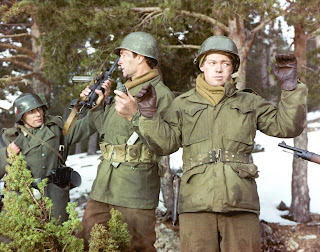
In support is Charles Bronson, who is incredibly listed deep in the credits although his role as Major Walenski, leading the platoon defending the leading edge of the American front line, is more prominent and interesting than most of the stars billed above him. Telly Savalas plays the typical Telly Savalas role, a minor but loud-mouthed tank commander much more interested in his smuggling business than the war, but who gets caught up in the thick of the action all the same. Robert Ryan strides around as the fictional General Grey, representing both the lack of preparedness of the American leadership, and then their rallying to turn the tide of battle.

Battle Of The Bulge may have dodgy value as a history lesson, but as an old-fashioned, action-packed, star-powered World War Two epic, it is enjoyable.


All Ace Black Movie Blog reviews are here.