Showing posts with label Robin Wright. Show all posts

Sunday, 9 March 2025

Movie Review: Here (2024)


Genre: Drama  
Director: Robert Zemeckis  
Starring: Tom Hanks, Robin Wright, Paul Bettany, Kelly Reilly  
Running Time: 104 minutes  

Synopsis: Multiple stories unfold non-linearly but in one geographic location (likely in Pennsylvania), as seen from a single fixed vantage point. The main story starts with World War Two veteran Al Young (Paul Bettany) and his wife Rose (Kelly Reilly) purchasing a house after the war. Al settles into a career as a dissatisfied vacuum cleaner salesperson. Their eldest son Richard (Tom Hanks) falls in love with Margaret (Robin Wright), who moves into the house. They raise a daughter Vanessa, and Richard gives up his love of art to sell insurance. Others who occupy the same location in different eras include an indigenous couple; the son of Benjamin Franklin; an early aviator in the 1920s; a furniture designer in the early 1940s; and a black family during the Covid pandemic.

What Works Well: A technically audacious drama co-written by director Robert Zemeckis and Eric Roth weaves time through one small patch of geography, simultaneously conveying intimate individual emotions and the transient human experience. The remarkably fast passage of time is an underlying theme, but also the rich experience that can be packed into one living room, spanning from Al to Vanessa in 60 years. Humour, tragedy, conflict, love, and loss pass in front of the camera's steady gaze, Zemeckis deploying on-screen panels, fluid transitions, and AI-enhanced de-aging to effortlessly maintain coherence across centuries. Brisk pacing adds to the fly-on-the-wall joy.

What Does Not Work As Well: By definition the focus is on snippets and vignettes rather than any depth, and the flash-fried storylines surrounding the Young family suffer from comparative neglect.

Key Quote:
Richard (at 18 years old): You know, if you like, you could spend the rest of the night here.
Margaret: I could spend the rest of my life here.


All Ace Black Movie Blog reviews are here.

Saturday, 26 November 2022

Movie Review: Land (2021)

A mental crisis drama, Land is scenic but slight.

Edee (Robin Wright) is in a depression following the death of her husband and son. After her sister Emma (Kim Dickens) pleads with her not to harm herself, Edee leaves her life behind and relocates to a rural off-the-grid mountain cabin where she intends to live off the land.

Having no experience in hunting, fishing, or chopping wood, she runs out of food. Hunter Miguel (Demian Bichir) finds her near starvation, and with support from nurse Alawa (Sarah Dawn Pledge), they help Edee regain her strength, although she refuses to leave the cabin. Miguel starts to frequently drop by to teach Edee survival skills, and they develop a gradual friendship.

The directorial debut of star Robin Wright, Land is filled with static shots of beautiful rugged terrain. The movie was filmed in the Alberta Rockies, and mother nature is a prominent co-star. However, an 89 minute film stocked with ponderous postcard beauty is in some amount of narrative trouble. Jesse Chatham and Erin Dignam collaborated on the script, and a woman alone in an isolated cabin yields many pages devoid of any dialogue, momentum drifting away towards the distant mountain tops.

This takes nothing away from Wright's performance, as she throws herself into a role reminiscent of Emile Hirsch in Into The Wild. Ill-prepared, Edee will disconnect from a pain-causing society and retreat into nature, and if death is a price to pay, so be it. This asking-for-it attitude is both frustrating to watch and effective at conveying the depth of despair, and Wright carves a path from nice-try determination to hopeless odds, where a bear, bitter cold, and starvation await.

The final third is a maybe friendship-in-the-making with Edee nudged back to an equilibrium by a kind stranger and his dog. She perks up, but this Land best belongs on an art gallery wall.


All Ace Black Movie Blog reviews are here.

Wednesday, 14 April 2021

Movie Review: White Oleander (2002)

A mother-daughter drama, White Oleander is full of spiky surprises, excellent performances, and heartache.

In New York, budding artist Astrid Magnussen (Alison Lohman) recalls her childhood in flashback. She never knew her father, and was raised in California by her fiercely independent mother Ingrid (Michelle Pfeiffer), a somewhat famous visual artist. Astrid is just 15 years old when Ingrid is arrested and convicted for the murder of her lover. 

Astrid becomes a ward of the state and lives in foster homes with stints at the McKinney Children's Centre. Her character is shaped by foster mothers including Jesus-loving former stripper Starr (Robin Wright), fading actress Claire (Renée Zellweger), and Russian thrift market hustler Rena. Throughout, Astrid keeps visiting Ingrid in prison, and gradually starts to understand the level of control and manipulation her mother is capable of.

An adaptation of the Janet Fitch book, White Oleander weaves an impressive tapestry of complex human interactions. The screenplay by Mary Agnes Donoghue does at times strike the episodic tones of book chapters, but director Peter Kosminsky charts a course towards a cohesive narrative packed with the painful but also realistic travails of an adolescent dangerously close to falling through the cracks.

The film's strength is derived from the gradual unveiling of Ingrid's core, and the corresponding impact on Astrid. Ingrid starts as a role model for the liberated and successful single mom raising her daughter to be just as strong. Her arrest for murder arrives early and is just the first of many shocks to rock Astrid's life. Subsequently, and despite the prison walls separating them, Ingrid's remarkable character traits are exposed through the eyes of her daughter. Astrid develops a distaste towards the dark side of individualism and starts to question, rather than simply accept, her mother's uncompromising and self-centred actions. Eventually, themes of loneliness, betrayal, narcissism, and despondency merge into a complex definition of a woman determined to confront the world on her own terms.

Meanwhile Astrid evolves under the influence of foster mothers. She discovers the power of her own sexuality, and in Starr and Claire finds common traits of superficial domesticity obscuring churning dissatisfaction. Love lost or sought is always part of the fuel mix driving the mothers' behaviour, and the exceptional power of love to cause hurt and initiate healing emerges as an overarching arc.

With men a sideshow, the women-dominated cast is excellent with two stand-out performances. From her prison courtyard Michelle Pfeiffer radiates chilling levels of emotional domination and an immense capacity to scorch the earth around her daughter's life. And in her breakthrough role Alison Lohman is a revelation, navigating Astrid's frequently tragic journey with convincing transitions towards adulthood and assertiveness. Robin Wright and Renée Zellweger provide memorable support, but their different-but-the-same foster mothers are more predictable.

Emotive without descending into sentimentality, White Oleander seeks the tenacious pursuit of individual growth despite life's lurking poisons.


All Ace Black Movie Blog reviews are here.

Friday, 30 March 2018

Movie Review: Rampart (2011)


A character drama, Rampart goes for oodles of style but is fundamentally lacking in meaningful substance.

It's 1999 in Los Angeles, and the police department is rocked by the corruption scandal named after the tough Rampart division. Veteran Officer Dave Brown (Woody Harrelson) carries a dirty reputation and emotional scars from the Vietnam War, patrolling the streets with an eye for brutality.  Brown is barely on speaking terms with his two ex-wives (who are also sisters) Barbara and Catherine (Cynthia Nixon and Anne Heche). He is also detached from the lives of his two daughters, brooding teenager Helen (Brie Larson) and the younger Sarah.

Brown roughs up a detainee and is caught on camera bludgeoning another man. He is hauled in front of disciplinary committees while Assistant District Attorney Joan Confrey (Sigourney Weaver) urges him to retire. Brown starts an affair with lawyer Linda (Robin Wright), although he is suspicious of her motives. Meanwhile retired cop Hartshorn (Ned Beatty) is sympathetic and warns Brown that he is being used as a distraction.

Directed by Oren Moverman who also co-wrote the script with James Ellroy, Rampart is caught in no-man's land. With a barely-there story, an unexplained context and wafer-thin characterizations, the film spends most of its time in close-up, observing Brown's mannerisms as he cruises the streets and lights up cigarettes.

While Woody Harrelson buys fully into the role, he has precious little to work with. Officer Brown is certainly not likable and neither is he magnetic or interesting. He is simply a disturbed thug, doing just enough to ensure the system will struggle to fire him. The post Vietnam War trauma excuse floats in and out of the film in a couple of references, and otherwise Brown is left exposed on-screen, unable to generate any reason why anyone would care about him.

Elsewhere plenty of people populate Dave Brown's universe, with a strong cast ready to bring them to life, and they are all shortchanged. Two ex-wives who are sisters may be an interesting twist, but not when they are both ill-defined. A dark affair with a seemingly troubled slick lawyer slumming it in Brown's universe offers intriguing opportunities, but Moverman and Ellroy do not appear to know what to do with the subplot.

Ned Beatty's Hartshorn shows up intermittently hinting at dirty conspiracies, and these are perhaps better explained in other movies. Ben Foster as a wheelchair-bound but rather ghostly presence shares some sit-still-and-stare moments with Harrelson, and Ice Cube pops up late as an Internal Affairs officer. Steve Buscemi and Jon Bernthal appear in brief scenes.

Rampart vaguely hints at attempts to echo the street-level grittiness of Training Day but in the end falls well short. This cop drama is absent both the compelling cop and the essential drama.


All Ace Black Blog Movie Reviews are here.


Sunday, 4 February 2018

Movie Review: Unbreakable (2000)


A psychological superhero origins story, Unbreakable offers interesting nuggets without quite properly meshing.

In Philadelphia of 1961, Elijah Price is born with a rare disease that causes extremely fragile bones. In the present day, security guard David Dunn (Bruce Willis) is the only survivor - and escapes without as much as a bruise - when a major commuter train derailment kills the other 131 passengers. David's soulless marriage to Audrey (Robin Wright) is just about over, with their son Joseph suffering the consequences but still idolizing his father.

In the aftermath of the train derailment David is contacted by Elijah (Samuel L. Jackson), who now runs a comic art gallery. At Elijah's often irritating prompting, David realizes that he has never been sick in his life. With Joseph's help David tests his physical strength and is astounded at the huge weights he can lift. Audrey initiates a last-ditch attempt to save the marriage, while David still has to come to terms with injuries he sustained in a long-ago car crash that ended his promising football playing career, as well as his dislike of water.

After the remarkable success of The Sixth Sense the pressure was on writer and producer M. Night Shyamalan to create a worthy follow-up. Teaming again with Bruce Willis, Shyamalan was only partially successful. Unbreakable enjoys a dark moodiness as it delves into the psyche of a man who may be capable of a lot more than he knows. But a superhero origins story for an unknown superhero only goes so far, and there are enough plot holes to undermine some of the good work before the rushed ending arrives.

The premise of a man getting to middle age having never noticed that he may be a bit special is difficult to swallow, and raises questions about just how smart this superhero is going to be. But beyond that, the awakening of an initially disinterested and disbelieving David Dunn to his own powers is at the heart of the film, and in another understated performance, Willis plays along. Walking away unscathed as the only survivor from a train wreck that claims 131 lives is a wake up call for anyone, and Dave, depressed as he is in a dead end job, listens enough to Elijah's haranguing to start exploring the art of the fantastically possible.

The dynamics between David and his wife Audrey and son Joseph add another layer of depth to the film. Robin Wright deserves credit for soaking Audrey with grief stemming from a detached husband and a crumbling relationship, but still willing to put in the work to try and save her marriage. The father-son interactions are also intricate, Joseph demonstrating quiet resilience and carving a role for himself in his dad's transformation.

But the scenes with Elijah generally don't work as well, his story limited to a few interventions and an ending that spirals to places Shyamalan does not give himself time to follow. Overall, the film's climax is an unsatisfactory muddle, and as David comes to terms with his powers, both the protagonist and the film become less interesting. Not surprisingly, unbreakable and unaware makes for better drama than just unbreakable.


All Ace Black Blog Movie Reviews are here.


Saturday, 11 November 2017

Movie Review: Blade Runner 2049 (2017)


A magnanimous science fiction epic, Blade Runner 2049 expands on the original with a rich quest for private and collective identity.

It's the titular year, and Agent K (Ryan Gosling), a replicant working for the Los Angeles Police Department, is a "blade runner", an expert at tracking down and retiring older generation rogue replicants. He uncovers the whereabouts of replicant Sapper Morton (David Bautista), a farmer who puts up a fierce fight before K gets the upper hand. Buried deep under a tree on Morton's property is a strong box. K's boss Lieutenant Joshi (Robin Wright) and her team unearth the container and find it filled with the bones of a deceased replicant harbouring a shocking secret.

Joshi assigns K to track the origins of the bones, a journey that starts at the Wallace Corporation, the massive company that took over the assets of the replicants' original designer and manufacturer Tyrell. Niander Wallace (Jared Leto) suspects that the answers being sought by K could give him enormous additional influence, and instructs his chief enforcer replicant Luv (Sylvia Hoeks) to track K's movements. Helped by his holographic girlfriend Joi (Ana de Armas), K's inquiries lead him to replicant dream creator Dr. Ana Stelline (Carla Juri) and retired blade runner Rick Deckard (Harrison Ford), hiding in the radiated wasteland of Las Vegas.

Set 30 years after the events of the first film and released 35 years after Ridley Scott's flawed and multi-versioned classic, Blade Runner 2049 is an unequivocal masterpiece. Directed by Denis Villeneuve, the sequel breathes deeply from the world created by Scott and original short story author Philip K. Dick, and creates an absorbing, thought-provoking story about the evolution of what is real and what ultimately matters.

Villeneuve combines regular doses action with stunning visuals to bring Agent K's search to life, and the film is a lavish feast for the eyes. Every scene features an exposition of a future world offering little to celebrate but enthralling nonetheless. Crowded markets dominated by garish and holographic neon signs on imposing buildings, garbage disposal wastelands, the sleek innards of colossal corporations, and the ruins of a gaudy Las Vegas all flicker to life in visions both harrowing and unmistakably compelling.

In addition to playing with colours, contrasts, mists and glowing nighttime environments, Villeneuve frequently shoots through partially transparent surfaces, rain-covered windows a favourite technique, both to add artistry and heighten the sense of receding-but-still-there barriers between humans and machines. As a quibble, some of the sets are notable for their lack of animation, Agent K incongruently often the only presence at locations away from the central marketplace.

The music is co-composed by Hans Zimmer, and is jarring in its exquisite discordancy. Loud, synth-driven and often overbearing, Zimmer adds to the film's sensory texture but also frequently intrudes rather than complements.

Plotwise Blade Runner 2049 is a proper sequel, and it's well worth recalling Deckard's adventure from the first film to properly enjoy the rich continuation of the story. Agent K picks up snippets of the physical and emotional dangers Deckard encountered a generation prior, and 2049 collects the echoes and builds upon the themes of core identity at the individual and collective levels.

Agent K's quest quickly becomes deeply personal and yet carries boundless implications. This is an imaginative science fiction film where the threads of the future are already present. A coming era where robots are more prevalent and integrated into a deeply damaged society appears well within reach, and the screenplay by Hampton Fancher and Michael Green is as strong as all the visual splendor. Blade Runner 2049's abundant plot rewards concentration, and effortlessly expands into the 163 minutes of running time.

And while 2049 finds the safe harbour of elegant resolutions, it also offers an abundance of fertile material introduced and parked for future films to perhaps pick up upon. The Wallace Corporation is a menacing behemoth that deserves further investigation, while an entire subplot featuring working girl replicant Mariette (Mackenzie Davis) and her colleagues appears to be more about set-up than resolution. And the enigmatic dream scientist Dr. Ana Stelline has stories that can feature in subsequent episodes.

The performances are competent without needing to be more. Gosling, Ford and Wright are generally appropriately monotonal, although Gosling does ride some emotional ups and downs as his journey veers into more than one unexpected valley. And the characters intermingle with extrapolated science beyond the replicant premise. Ana de Armas is surprisingly effective as the holographic girlfriend, and instigates a very different kind of high-tech lovemaking scene. Sylvia Hoeks is icy cold as the chief villain, doing the dirty work of the blind Niander Wallace, who overcomes his disability with miniature drones connected to a chip implant.

A hypnotic showpiece, Blade Runner 2049 expounds on the premise of humanity as its creations begin to meld in a bleak, haunting and potentially prescient version of the future.


All Ace Black Blog Movie Reviews are here.

Sunday, 18 June 2017

Movie Review: Wonder Woman (2017)


A superhero adventure, Wonder Woman combines perfunctory Greek mythology with wartime heroics in an entertaining package. The film pushes female empowerment in the name of peace, but is nevertheless weighed down by the genre's heavy anchors.

On the hidden fog-shrouded island of Themyscira, Princess Diana (Gal Gadot) is the daughter of Queen Hippolyta (Connie Nielsen), leader of an all-woman Amazonian tribe tasked by Zeus to maintain peace and be ready to fight off warmongering god Ares. Diana is trained by her warrior aunt General Antiope (Robin Wright) to be a fierce combatant, while Hippolyta hints to her daughter that she possesses special powers.

Diana rescues British spy Captain Steve Trevor (Chris Pine) from drowning when his plane crash lands in the adjacent sea. She soon learns that the Great War is raging, and assuming that Ares must be behind the carnage, she perceives it her duty to leave Themyscira and put a stop to the evil. She accompanies Steve to London where he connects with politician Sir Patrick Morgan (David Thewlis), and then onto the trenches of the front lines, where Diana discovers her powers as Wonder Woman. She then has to find a way to stop General Erich Ludendorff (Danny Huston), who is planning to unleash a new highly destructive poison gas with the help of the evil Doctor Isabel Maru (Elena Anaya).

Directed by Patty Jenkins with a budget close to $150 million, Wonder Woman finally comes to the big screen after decades of false starts. The delays were partially caused by the critical and commercial failures of Catwoman (2004) and Elektra (2005) casting doubt on the marketability of a female protagonist in the overcrowded superhero space. Within the tight confines of the genre, Jenkins and writer Allan Heinberg get almost everything right, mixing a mythology-heavy origins story with a World War One action adventure filled with raucous action, villains and the requisite sidekicks.

Themes of duty, sacrifice and the essence of humanity are dealt with in straightforward broad brush strokes. Wonder Woman is a novice in the big bad world of humans, and the film benefits from her sense of learning and discovery. Her initial childlike naivete has to be replaced by a better understanding of the complexities of what humans are capable of, and her journey underpins the film's narrative.

Moments of humour also help, including a conversation between Diana and Steve about sexuality and procreation, and reactions to Diana's warrior mentality invading London circa 1918 and the muddy trenches of a stalemated front.

But for all its polished elements, this is a superhero movie, and the genre is tightly handcuffed by its childish fundamentals. There will be many large scale battles, there will be an overabundance of CGI, and there will be many large explosions, pyrotechnics and destruction on a mammoth scale. It's all remarkably predictable and unspools at the expected intervals, the special effects methodically gaining the upper hand over the humans as the end credits approach. A lot of the dialogue is stiff, and most of the characters are superficial. The 140 minutes do begin to drag.

Helping maintain interest is a terrific Gal Gadot performance. She steps into the role with ease, proving a perfect fit and immediately owning the best Wonder Woman attributes: feminine strength, smarts and curiosity in a perfectly calibrated athletic package.

In a creatively exhausted genre running on fumes, Wonder Woman is a brighter spark than most.


All Ace Black Blog Movie Reviews are here.


Saturday, 26 March 2016

Movie Review: Forrest Gump (1994)


A comedy-drama about the American dream in the 20th century, Forrest Gump is an irresistible romp through pop culture history with one simpleton who is always in the right place at the right time.

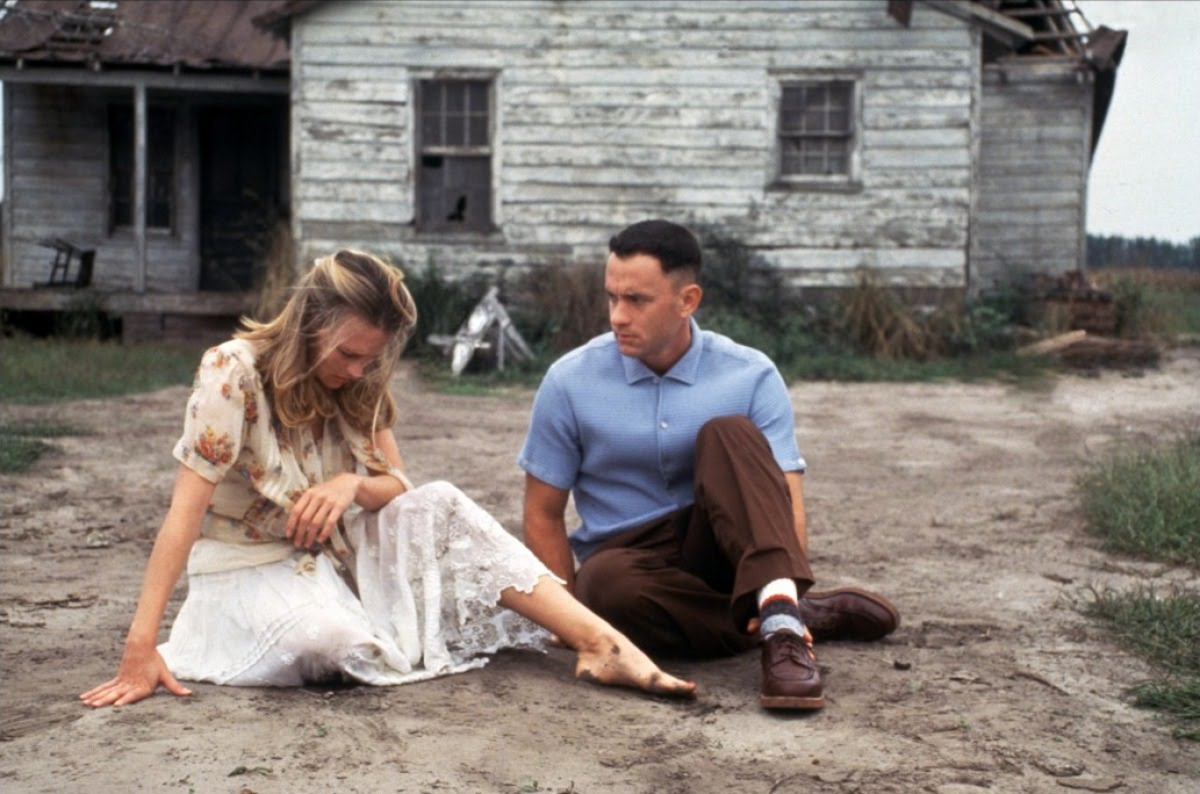
The film is mostly told in flashback, with Forrest Gump (Tom Hanks) sitting at a bus stop recounting his story to a succession of strangers next to him. Born in rural Alabama, Forrest has a low IQ of 75, but his mother (Sally Field) does all she can to make sure he feels normal and gets a decent education. As a child Forrest is hampered by a bent spine, and his only friend is Jenny, an almost angelic schoolmate growing up in an abusive household.

While avoiding bullies, Forrest discovers that he can outrun anyone, and his speed becomes his ticket to a college education, where he becomes a star if clueless football running back. He then joins the Army and serves a tour in the Vietnam War, where he meets Lieutenant Dan Taylor (Gary Sinise) and fellow Alabaman Bubba Blue (Mykelti Williamson), a wannabe shrimp fisherman. Forrest's simple outlook on life help him to become a battlefield hero, and after the war he finds success first as a table tennis champion and then as a shrimp businessman. All the time Forrest tries to maintain contact with Jenny (Robin Wright), the one love of his life, as she joins the cultural revolution and struggles to overcome the shadow of her childhood.

An Eric Roth screenplay adaptation of a Winston Groom novel directed by Robert Zemeckis, Forrest Gump is an easy to digest lesson in the art of seizing the sometimes ridiculous opportunities of life. Forrest remains true to core principles derived from a rural upbringing and a saint of a mother, and reaps the benefits from always doing well for others. Both funny and poignant but never demanding, the film is a smooth balm of reassurance that the American dream works even for idiots, as long they carry good intentions and retain human values.

Riding a steady Tom Hanks performance that mixes naive whimsy with the positivity emanating from believing the best about every situation, the film paints with the broad brush of nostalgia from the 1960s and 1970s. Forrest somehow finds himself over a 20 year period an unlikely hero on the college football field, in the Vietnam jungle, in the thick of the Cold War, in the world of business, and helping to define the cultural zeitgeist. It does not take a genius to positively shape global events much less the lives of others, and in the process of contributing to history, Forrest becomes a regular and celebrated guest at the White House. In an early deployment of clever CGI, Hanks as Gump is seamlessly inserted into many historical film reels, interacting with the likes of Presidents Kennedy and Nixon.

Despite a longish running time of over 140 minutes, Zemeckis never lingers on any one chapter. Highlights include the childhood scenes with Forrest's mother doing everything she needs to do to get him enrolled in school, and an epic Vietnam War firefight that sets the stage for Forrest's heroics and long-term future business success and friendship with Lieutenant Dan. Late in the film Forrest simply goes for a run; a really, really long run to leave the past behind and come to terms with the thing called life.

The impossible, long-distance candle of love that Forrest holds for Jenny ties the film together. Forrest unwittingly ends up a winner at everything that he doesn't intend to do, but his singular intention to win her love proves to be the toughest challenge of his life. Robin Wright brings Jenny to soulful life with plenty of angelic pragmatism, a victim of abuse whose life was spun into the wrong orbit at an early age and never quite recovered. Forrest Gump succeeds not only as a story of a man who rises above his lowly station to achieve remarkable success; but also because it lingers on the heartache of a woman severely damaged in childhood, struggling to hang on despite the constant devotion of her one true friend.


All Ace Black Blog Movie Reviews are here.


Saturday, 3 October 2015

Movie Review: Everest (2015)


Based on the tragic true story of the ill fated May 1996 campaign when eight climbers died over two days, Everest boasts some majestic cinematography, but fundamentally fails to create sufficient human drama to properly resonate.

New Zealander Rob Hall (Jason Clarke), an experienced mountain climber, has invented Everest tourism, whereby relatively inexperienced climbers are guided in large groups up to the world's highest peak. Now others are jumping on the bandwagon, including brash American expedition leader Scott Fischer (Jake Gyllenhaal), creating a logjam of guides and ill-equipped tourists all wishing to reach the summit in the narrow climbing season window. Rob leaves his pregnant wife Jan (Keira Knightley) behind for his latest assault on the mountain.

His group includes Texas doctor Beck (Josh Brolin), mailman Doug (John Hawkes), Japanese mountaineer Yasuko (Naoko Mori) and Outdoor magazine journalist Jon Krakauer (Michael Kelly). Rob's Base Camp support staff consists of logistics manager Helen (Emily Watson) and the group's doctor Caroline Mackenzie (Elizabeth Debicki). Rob and Scott create an uneasy alliance to better manage their way through the crowd of climbing groups, with Russian guide Anatoli Boukreev (Ingvar Eggert Sigurðsson) adding experience to Scott's team. May 10 is the designated day to reach the summit, but a variety of mishaps result in the climb falling dangerously behind schedule, just as a monstrous storm moves in.


The events of May 10 and 11 1996 shocked the world, and placed a focus on mountain climbing tourism, sparking debates about the wisdom of treating Everest like any other item on an adventurer's bucket list. Several books were later written by survivors, including Krakauer's best-selling Into Thin Air and Boukreev's rebuttal The Climb.

With the survivors understandably differing, sometimes bitterly, on many details of exactly what happened on those two chaotic days, the film Everest is not based on any single account. Directed by Baltasar Kormákur and co-written by William Nicholson and Simon Beaufoy, the film tries to stick to the known facts. Hall is portrayed as a well-intentioned, experienced guide faced with difficult decisions borne out of his love for expanding the appeal of mountain climbing. All the other characters are presented in a rather emotionless manner, their actions provided with the most basic motivation and left to be.

This leaves Everest with plenty of people and not much drama. The battle whereby a mammoth mountain teams up with a massive blizzard to shake off small humans provides plenty of opportunity for astounding cinematography by Salvatore Totino, but is otherwise asymmetrical in the extreme. From the first majestic shots of the intimidating Everest peak and the explanations about the dead zone where the human body starts to die at high altitude, the contest is settled. Kormákur does his best to zoom in on the climbers struggling up and then down the hill, but when everyone is bundled in multiple layers of climbing gear and conversations are reduced to shouting over howling winds, it's difficult to distinguish the characters, or to develop empathy.

Hall and Beck are provided with sketched-in worried-women-back-home, a loving and pregnant partner in Hall's case and a relatively angry and estranged wife for Beck. The rest of the climbers are defined in the broadest terms: Yasuko is aiming to check-off all of the world's tallest peaks; Doug is getting too old and wants one last crack at reaching the peak. Plenty of other faceless climbers trudge through the snow and die with barely an introduction. The actors do what they can, but other than Jason Clarke as Hall and Josh Brolin as Beck, the likes of Gyllenhaal, Knightley, Worthington and Wright are reduced to glorified cameos with disjointed snippets of screen time.

Krakauer, meanwhile, is trying to understand the age-old question of why climbers do what they do. Of course there is no satisfying answer to that conundrum. Some humans will always seek an escape from the mundane by testing themselves against nature, no matter how many times nature tilts the elements in her favour. Everest tries for deeper meaning, but settles for the same conclusion: the people may try hard but the mountain can always choose to win.


All Ace Black Blog Movie Reviews are here.


Wednesday, 1 July 2015

Movie Review: The Princess Bride (1987)


A fantasy romance comedy, The Princes Bride rides a wave of seductive cheekiness and delivers for both adults and their kids.

Grandpa (Peter Falk) visits his sick grandson (Fred Savage) and reads to him The Princess Bride. The story is set in medieval times, in a land ruled over by the evil Prince Humperdinck (Chris Sarandon) and his brutal head henchman Count Tyrone Rugen (Christopher Guest). Buttercup (Robin Wright) is a beautiful young woman who loves to ride her horse. She falls deeply in love with her farm boy Westley (Cary Elwes), but they are separated when he goes off to find his fortune. Word arrives that Westley has been captured and likely killed by the Dread Pirate Roberts.

Humperdinck chooses Buttercup to be his bride, but his real intent is to start a war for personal gain. Humperdinck hires master criminal Vizzini (Wallace Shawn) and his gang, consisting of the giant Fezzik (Andre the Giant) and master swordsman Inigo Montoya (Mandy Patinkin), to kidnap Buttercup, kill her and blame the death on a neighbouring kingdom. A mysterious masked man in black gives chase, eventually disposing of Vizzini, rescuing Buttercup and escaping into the scary Fire Swamp. The masked man turns out to be Westley, coming back to reclaim his true love. But Humperdinck will not give up easily, and the lovers will need to overcome captivity and torture to seal their destiny.

Directed by Rob Reiner and breezily written by William Goldman, The Princess Bride is part romance adventure, part swashbuckler, and all clever satire. The package could not be any more perfect, as the film delivers action, thrills, laughs and pure first love for younger audience members, while maintaining a glint-in-the-eye edge of evil wit for their parents.

The overarching theme of true-love-will-conquer-all hovers over the film like an exquisite rainbow, and at the heart of the movie Robin Wright and Cary Elwes deliver honest performances full of heroism underpinned by the conviction that no matter what, they belong together. But The Princess Bride shines because of the diversity of interesting characters and sub-stories, and Goldman excels in creating a world of colourful scoundrels and side kicks. The charismatic Inigo Montoya carries a major revenge sub-plot of his own, and Mandy Patinkin has rarely been better as Inigo forces his way into a co-lead role with Buttercup and Westley. The transformation of Inigo and the giant Fezzik from bad guys to good allies is another strong anchor theme in the film, and the two also provide a steady stream of humour.

And our heroes have not one, not two, but three villains to contend with. Humperdinck may be the head antagonist, and he emerges as a paper tiger, a man equal parts unearned power and distasteful cowardice. More potent is the darkly menacing Count Tyrone, a heartless torturer with a well-earned reputation for ruthlessness. Meanwhile, in a relatively brief but unforgettable role, Wallace Shawn creates in Vizzini an inconceivably irritating criminal, a short man ruling over his gang with smarts until he outsmarts himself in a cerebral confrontation with the masked man in black. Billy Crystal and Carol Kane show up in small and campy comic relief parts.

Reiner respects the setting of his story and does not shy away from some mildly disturbing scenes of torture, and adds blood when necessary to emphasize the outcome of key sword battles. As a counterbalance and to relieve any mounting tension, a large part of the film's charm resides in the frequent returns to the grandson's bedroom, as he starts out full of skepticism but gradually warms up to all the thrills and yes, smoochy romance that the story being read by grandpa has to offer. For the young and old alike, The Princess Bride casts an immaculate magical spell.


All Ace Black Blog Movie Reviews are here.


Wednesday, 13 August 2014

Movie Review: A Most Wanted Man (2014)


A contemporary counter-terrorism drama, A Most Wanted Man adapts the John le Carré novel into a serviceable film. While Philip Seymour Hoffman's final performance is a rich achievement, the rest of the film idles among too many characters stuck in a singular mode.

A mysterious Chechen man named Issa Karpov (Grigoriy Dobrygin) arrives illegally in Hamburg, Germany, and immediately attracts the attention of the authorities. Günther Bachmann (Philip Seymour Hoffman) heads a Hamburg-based anti-terrorist unit tasked with infiltrating terrorist cells, and he places Issa under observation. Günther is also interested in the activities of Dr. Faisal Abdullah (Homayoun Ershadi), a seemingly distinguished Muslim leader who advocates peace while raising funds for charities. The problem is that a sliver of all the money raised by Dr. Faisal always seems to be diverted to terrorist causes. The CIA's Berlin station chief Martha Sullivan (Robin Wright) keeps a watchful eye on Günther's activities.

Günther takes a risk and resists the pressure to detain and interrogate Issa, and instead pursues the connections that can lead to bigger conspirators. Issa makes contact with Annabel Richter (Rachel McAdams), a young lawyer who helps immigrants settle in Germany. Issa wants Annabel's assistance to approach the private bank controlled by Tommy Brue (Willem Dafoe), where Issa's father, a former Russian general, has parked a fortune that now belongs to Issa. With a large amount of money at play, Günther finds himself confronting a shadowy transaction that may be as simple as a young man distributing his father's wealth to charities, or as deadly as terrorist financing for the next big attack.

A Most Wanted Man is Philip Seymour Hoffman's final completed performance, and he is the main reason to watch the film. He delivers a tortured performance as Günther, a man uncomfortable with the new rules of war in the post-9/11 era. Hoffman wears Günther's emotional burdens like a heavy winter jacket, a master warrior of the spy world who has lost too many soldiers and yet tries to adhere to the old rules of patient observation, surveillance, nurturing informants and network infiltration.

But this is Hamburg, where the 9/11 plot was hatched and developed. Government types in Berlin are agitated and eager to quickly stamp out characters like Issa, and the CIA is all too willing to help by bundling people off to black interrogation sites. Günther has to fend off the rabid dogs demanding action while first ensuring that he does not lose Issa, and then proving that the patient approach can pay dividends. With Günther as the one character grappling with complex realpolitik trade-offs that could potentially cost many innocent lives, not to mention his career, Hoffman is flawless.

Unfortunately for the film, none of the other characters are nearly as complex. Issa, Annabel, Brue, Martha and Dr. Faisal are predictable and monochromatic, and in a case of too many characters causing a shortage of development space, none of them undergo any form of interesting evolution. The book provided breathing room for the relationship between Issa and Annabel to deepen, and rounded Brue with a complex backstory. Despite a two hour running time, this is all sacrificed by director Anton Corbijn and screenwriter Andrew Bovell, leaving Hoffman to fight a lonely battle to maintain momentum.

As can be expected with any le Carré adaptation, A Most Wanted Man is slow paced, more concerned with mood, gloom and pessimism than the traditional trappings of a thriller. The film delivers infrequent jolts of activity, but generally just soaks in a grey aura resigned to an eternal conflict between opposing forces locked in a shadow war. The causes, labels and tactics may change, but for men like Günther, with every skirmish a little piece of the soul dies a tortured death.


All Ace Black Blog Movie Reviews are here.