Showing posts with label Oscar Isaac. Show all posts

Friday, 20 March 2026

Movie Review: Frankenstein (2025)


Genre: Monster Drama  
Director: Guillermo del Toro  
Starring: Oscar Isaac, Jacob Elordi, Mia Goth, Christoph Waltz, Lars Mikkelsen  
Running Time: 150 minutes  

Synopsis: It's 1857 near the Arctic Circle, and a Danish navy vessel led by Captain Anderson (Lars Mikkelsen) rescues Baron Victor Frankenstein (Oscar Isaac), who is escaping from the Creature (Jacob Elordi) he created. In flashbacks, the badly injured Victor recounts his story. As a child he experienced no love from his father (Charles Dance), and grew up to be an Edinburgh surgeon obsessed with defeating death. Shunned by the establishment, he finds a benefactor in Henrich Harlander (Christoph Waltz), whose daughter Elizabeth (Mia Goth) is engaged to Victor's brother William (Felix Kammerer). Victor establishes a lab at an isolated tower, assembles body parts from fallen soldiers, and creates the Creature, but is then frustrated by its slow mental progression.

What Works Well: Director Guillermo del Toro adapts Mary Shelley's source material into a spectacularly imaginative spectacle filled with human heart and longing. Gothic sets, bold cinematography, elaborate make-up, and intricate costumes create a monstrous nightmare emanating from narcissism, a yearning for love, the complications of incomplete father-son bonds, and the questionable value of life without death. Oscar Isaac throws himself into a dark role where brilliance is stranded by the inherited absence of empathy, and Jacob Elordi surrounds acute loneliness with immense physical presence.  

What Does Not Work As Well: While the story is rich in incident and details, the running time is still too long.

Key Quote:
The Creature: If you are not to award me love, then I will indulge in rage. And mine is infinite!


All Ace Black Movie Blog reviews are here.

Sunday, 11 May 2025

Movie Review: The Card Counter (2021)


Genre: Drama  
Director: Paul Schrader  
Starring: Oscar Isaac, Willem Dafoe, Tye Sheridan, Tiffany Haddish  
Running Time: 112 minutes  

Synopsis: Convicted for his role in the Abu Ghraib prison atrocities, former US Army soldier William Tell (Oscar Isaac) uses his time behind bars to learn blackjack card counting. Once released, he travels between casinos keeping a low profile and aiming for modest winnings. William is also a good poker player, and stable manager La Linda (Tiffany Haddish) offers to bankroll him. At a security convention, William meets Cirk (Tye Sheridan), a young man plotting revenge on retired Major John Gordo (Willem Dafoe), who was instrumental in teaching torture techniques during the Iraq War. William takes Cirk under his wing to keep him out of trouble, and turns to the poker circuit to raise a large amount of money in a hurry.

What Works Well: Stylish cinematography conveys a sense of resigned desperation in the seen-one-seen'em-all hotel casinos and poker rooms where gamblers go to work. A stone-faced Oscar Isaac hides behind shades and conveys a man-on-a-mission-to-disappear vibe, pausing only long enough to wrap motel room furniture in white sheets.

What Does Not Work As Well: Despite the involvement of producer Martin Scorsese, the cards are drawn from different decks and suffer from shiftless lethargy. The plot meanders from blackjack to poker, from gambling drama to the emotional scars of war, from low-key winnings to in-the-spotlight tournaments, and from a one-person character study to another person's not-even-half-baked revenge plot. Unsurprisingly, the internally inconsistent dramatic components falter like scattered chips in a mess of misguided bets. William's transformation from loner to father figure is unconvincing, Willem Dafoe barely features and need not have bothered, a crucial confrontation is omitted, an irritating poker foe is built-up and left hanging, and Tiffany Haddish's character adds nothing of value.

Key Quote:
Major Gordo: This is where all the good stuff happens.


All Ace Black Movie Blog reviews are here.

Friday, 30 August 2024

Movie Review: At Eternity's Gate (2018)


Genre: Biographical Drama  
Director: Julian Schnabel  
Starring: Willem Dafoe, Oscar Isaac, Rupert Friend, Mads Mikkelsen, Mathieu Amalric, Emmanuelle Seigner  
Running Time: 110 minutes  

Synopsis: Depressed by the grey weather and pretentious art scene in Paris, Vincent van Gogh (Willem Dafoe) relocates to the sunnier southern countryside and settles in the town of Arles. The surrounding landscapes inspire his creativity and craving for brightness, but drinking and poverty take a toll on his mental health despite financial support from his brother Theo (Rupert Friend). Fellow artist Paul Gaugin (Oscar Isaac) comes for a lengthy visit, but when he departs back to Paris, Vincent's mood deteriorates.

What Works Well: In this focused character study, director and co-writer Julian Schnabel delves deep into the psychology of the brilliant but tortured artist as he toils in obscurity to reinvent the language of painting. van Gogh's mental state, including his status in art history and the toll this takes on a fragile mind, emerges through finely crafted dialogue exchanges with his brother Theo, Gaugin, a priest (Mads Mikkelsen), a doctor (Mathieu Amalric) and Madame Ginoux (Emmanuelle Seigner). Aided by an intense Willem Dafoe performance, Schnabel uses unsettled camera movements, full-on in-your-face character framing, and some lens trickery to convey the warped reality of a buckling genius. 

What Does Not Work As Well: The running time is padded with plenty of dreamy shots of van Gogh striding through the beautiful agricultural fields of southern France. Some of the editing and scene transitions are rough around the edges.

Key Quote: 
Van Gogh: Maybe God made me a painter for people who aren't born yet.


All Ace Black Movie Blog reviews are here.

Saturday, 11 May 2024

Movie Review: Life Itself (2018)


Genre: Romantic Drama  
Director: Dan Fogelman  
Starring: Oscar Isaac, Annette Bening, Olivia Wilde, Antonio Banderas, Mandy Patinkin, Olivia Cooke, Samuel L. Jackson  
Running Time: 117 minutes  

Synopsis: The story is told in multiple ultimately inter-connected chapters across many time periods, all revolving around themes of love, death, and life's inherent unpredictability. 
  • In New York, Will (Oscar Isaac) is grieving the loss of his wife Abby (Olivia Wilde), and reveals their love story in sessions with his therapist (Annette Bening).
  • Dylan (Olivia Cooke) suffered multiple losses during her childhood and was raised by her grandfather (Mandy Patinkin). Now in her early twenties, she is a rebellious teenager angry at the world.
  • In Spain, Javier (Sergio Peris-Mencheta) labours in the olive groves of land owner Saccione (Antonio Banderas). Javier marries Isabel (Laia Costa) and they have a son, but a family trip to New York undermines their happiness.
  • Rodrigo (Àlex Monner) is a foreign student in New York, where he has a casual relationship with Shari (Isabel Durant) before meeting the love of his life.
What Works Well: Writer and director Dan Fogelman crafts an intricate multi-generational drama about the quirks of fate and the small moments that make a big difference across decades. A bus accident connects the stories in a split-second of joint inattention, but sorrow and loss are the seeds of birth and renewal as the human spirit carves pathways around tragedy. The fragmented structure creates an engaging puzzle-like milieu, and the impressive ensemble cast members find character depth despite sharing the screen time.

What Does Not Work As Well: The foul-mouthed prologue involving Samuel L. Jackson (as himself) is wholly unnecessary. Once the narrative settles, the intended themes lack subtlety, and the sentimentality reaches extreme levels.

Conclusion: Life's standard trajectory is a series of curves.


All Ace Black Movie Blog reviews are here.

Saturday, 10 February 2024

Movie Review: Triple Frontier (2019)


Genre: Action  
Director: J.C. Chandor  
Starring: Ben Affleck, Oscar Isaac, Garrett Hedlund, Charlie Hunnam  
Running Time: 125 minutes  

Synopsis: American military advisor Santiago "Pope" Garcia" (Oscar Isaac) provides his services to government forces in Colombia. He learns through an informer that drug lord Lorea is living in a jungle hideout with a massive stash of money. Pope recruits former military colleagues, including Tom "Redfly" Davies (Ben Affleck) and brothers William and Ben Miller (Charlie Hunnam and Garrett Hedlund), for an audacious mission to invade Lorea's fortress and steal the money.

What Works Well: Director J.C. Chandor and his co-writer Mark Boal cover the basics well, with a straightforward story, good action staging and editing, high production values, a variety of scenic settings, and plenty of local colour. The second half carries echoes of no less than The Old Man And The Sea, the catch of a lifetime tested by an epic masculinity-past-its-prime trek fraught with unforeseen challenges.

What Does Not Work As Well: With character backgrounds kept to a minimum (or skipped altogether), the performances are of the plastic variety. Ben Affleck and Oscar Isaac go through the motions with no sense of conviction, the other squad members are interchangeable, and the antagonist Lorea barely gets any screen time. When the going gets tough, the attempts to convey suffering and moral dilemmas fall flat.

Conclusion: The star power is dimmed by lackadaisical treatment.


All Ace Black Movie Blog reviews are here.

Thursday, 10 February 2022

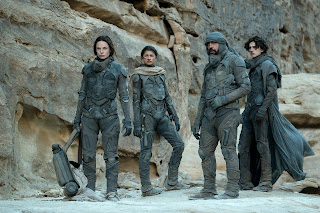
Movie Review: Dune: Part One (2021)

A science fiction epic, Dune: Part One is a breathtakingly beautiful and eloquently crafted adaptation of a complex story.

In the year 10191, the desert planet Arrakis is the galaxy's only source of precious Spice, a material with special properties and essential for interstellar travel. The House of Harkonnen has been responsible for mining Spice for many years, but now the Emperor decrees the House of Arteides will have dominion over Arrakis. The Fremen are the local inhabitants of Arrakis, brutally mistreated by Harkonnen and sceptical anything will change under Arteides. The desert planet's other residents are brutal and massive subterranean worms.

The benevolent Duke Leto Arteides (Oscar Isaac) prepares his people for a new position of prominence. His partner Lady Jessica (Rebecca Ferguson) belongs to the Bene Gesserit, an exclusive ancient sisterhood possessing special powers. Their son Paul (Timothée Chalamet) is growing into adulthood: both Leto and Jessica have high hopes for him, but Paul is troubled by vivid visions featuring death on Arrakis. The Arteides military commanders include weapons master Gurney Halleck (Josh Brolin) and fierce warrior Duncan Idaho (Jason Momoa).

The House of Arteides arrive at Arrakis and take control of mining operations. Leto and Paul offer better cooperation to Fremen leader Stilgar (Javier Mardem), and meet with Dr. Liet-Kynes (Sharon Duncan-Brewster), the Emperor-appointed planet handover judge. But all is not what is seems: the House of Harkonnen under Baron Vladimir (Stellan Skarsgård) has evil designs to reclaim control of Arrakis, and the Emperor is far from neutral.

Immediately eradicating bad memories of David's Lynch's 1984 atrocity, director Denis Villeneuve finally provides Frank Herbert's book with the screen treatment it deserves. Villeneuve co-wrote the script with Jon Spaihts and Eric Roth, and they wisely tackle just the first half the book. With a length of 156 minutes, Dune: Part One invests the necessary time to parse-out characters, motivations, and events into sequentially comprehensible increments.

Despite covering a partial story, this is a spectacular and ambitious achievement, filled with intersecting agendas and compelling arcs. Villeneuve demonstrates equal care for the visuals and the people, merging a deep narrative about destiny with stunning cinematography and special effects, all complemented by a brooding Hans Zimmer score. At the heart of the exhilarating sand-swept experience are eternal themes of human accountability, the ethics of resource exploitation, warmongering, superior powers, and battles for supremacy. Almost miraculously, all the threads remain intact and traceable.

A powerful and mysterious mother-son bond ties key events together, Lady Jessica quietly complicit in shaping her son's destiny, and by extension the galaxy's future. Her continued active participation in Paul's tumultuous mental and physical challenges provides a unique charge. Elsewhere the expansive action and combat scenes are well-staged and well-spaced within the political and personal intrigue. 

The actors take their roles seriously and hold their ground despite all the innovative costumes and imaginative set designs. Crucially, Timothée Chalamet finds the seam of uncertainty as a young man tentatively stepping into an elevated level of responsibility, and he is ably supported by Oscar Isaac and Rebecca Ferguson. Josh Brolin and Jason Momoa add macho presence, and only the Harkonnen cast members are allowed to slip into appropriately outlandish representations.

The final act is more ingrained with the Fremen, allowing Paul's visions to start translating into a purpose, and Zendaya finally appears outside the dream realm as Chani. Dune: Part One finds a deeply satisfying ending for the beginning, and is also honest in preparing for more to come.


All Ace Black Movie Blog reviews are here.

Saturday, 25 September 2021

Movie Review: Robin Hood (2010)

A medieval drama and romance, Robin Hood creates an epic backstory for the legendary outlaw.

The year is 1199, and Robin Longstride (Russell Crowe) is an archer in the army of Richard The Lionheart (Danny Huston), as England's King fights his way back home from the crusades. But Richard is felled by an arrow at a battle in France, and his weakling brother Prince John (Oscar Isaac) ascends to the throne. Robin impersonates the dead knight Sir Robert Loxley and along with a small group of men they make it back to England.

Meanwhile John is being undermined by his double-crossing friend Godfrey (Mark Strong), who is really working for France's King Philip to weaken England and enable an invasion. In Nottingham Robin meets and falls in love with Marion Loxley (Cate Blanchett), while her father, the elderly and blind Walter (Max von Sydow), helps Robin understand his lineage. 

John's extreme taxation policies and Godfrey's raids on fellow Englishmen push the country towards civil war and serve Philip's agenda. Robin teams up with Lionheart loyalist William Marshal (William Hurt) to try and avert disaster.

Running a luxurious 140 minutes with content to match, Robin Hood is an engrossing drama, mixing historical factoids with plenty of rambunctious fiction. Director Ridley Scott re-teams with his Gladiator star Russell Crowe, and although the results are not quite as spectacular, this is still a finely crafted tale of swords, bows, and arrows, rich with story lines, court intrigue, memorable characters and no shortage of large-scale bone-crunching battles.

The Brian Helgeland screenplay steers well clear of the frivolity, simplistic heroics and light-heartedness associated with previous cinematic Robin Hood versions. This is a mud-splattered and grim outing, levity limited to a couple of brief dialogue exchanges, the merry men pushed well into the background. In search of a wider audience Scott avoids blood and gore visuals, but this adventure would have benefited from more realistic representations of the era's brutality.

Crowe's dour Robin suits the England-in-crisis surroundings. Untethered from any clan, he is haunted by a lost father and too many battles on the way to and from Jerusalem. The supporting cast is brimming with talent, von Sydow, Isaac, Hurt and Strong joined by Matthew Macfadyen as the Sheriff of Nottingham (here a relatively minor character), Léa Seydoux as Isabella (Prince John's ambitious lover) and Eileen Atkins as Eleanor of Aquitaine (his concerned mother).

The narrative weakness resides in Robin's relatively limited influence on events around him. For the most part he is on the edge of the major plot points, first with Richard the Lionheart's army then back in England where John, Godfrey and Marshal are driving the agenda. Even in the quieter moments at the Loxley estate, Robin's surroundings and fate are defined by Walter's wisdom and Marion gradually learning to love him.

Robin's personality does emerge on a few occasions, speaking truth to power (and paying for it) when invited to do so by Lionheart, recognizing the opportunity to impersonate a knight as a ticket home, and then helping Marion's fledgling estate avert starvation by plotting his first steal-from-the-rich escapade. 

Now provided with a pre-banditry history of hostility and hurt, Robin Hood emerges as a more hardened legend.


All Ace Black Movie Blog reviews are here.

Wednesday, 21 July 2021

Movie Review: Operation Finale (2018)

A recreation of Nazi leader Adolf Eichmann's capture by Mossad agents, Operation Finale squanders a good story and stalls on minutiae.

It's 1960, and the Mossad leadership receive intelligence that Eichmann (Ben Kingsley), a principal architect of the Holocaust, is living with his wife Vera (Greta Scacchi) and son Klaus (Joe Alwyn) in Buenos Aires. Eichmann's identity was exposed when Klaus started dating the German Jew Sylvia Hermann (Haley Lu Richardson), who alerted her father Lothar (Peter Strauss). Israel's Prime Minister Ben-Gurion authorizes Eichmann's capture and transport to Israel to stand trial, recognizing the historic importance of publicly prosecuting a Nazi leader. 

A team of agents including Peter Malkin (Oscar Isaac), interrogator Zvi Aharoni (Michael Aronov) and doctor Hanna Elian (Mélanie Laurent) is dispatched to Argentina. They establish a safe house and conduct surveillance. The agents then abduct Eichmann at night while he is walking back home from his factory job, but extracting him back to Israel will not be straightforward.

An attempt to tap into an Argo-type vibe, Operation Finale stumbles on misdirected focus. Eichmann's globally televised trial is a milestone event in history, so writer Matthew Orton and director Chris Weitz seek nonexistent tension in a battle of wills between the Mossad agents and the captured Eichmann over whether or not he will sign a piece of paper. In an operation in which everything is forged, the coerced signature of a kidnap victim is a simply insufficient central plot device.

With events confined to the safe house for long stretches, other miscalculations abound. After seizing Eichmann, the ten day delay to secure a flight out of Buenos Aires is presented as an unplanned challenge for the Mossad team, and yet is a barely explained piece of operational incompetence. The fate of several characters crucial in the opening act is left hanging. And other than Malkin, the remaining Mossad agents remain essentially undefined.

The performances of Ben Kingsley as Eichmann and Oscar Isaac as Peter Malkin are better than the material, and their scenes together create a crackling duel between a manipulative master of evil and fiery trained assassin suppressing his instincts for revenge. Malkin's family history (he lost his sister and her children to Nazi death squads) provides an undercurrent of sorrow, but is also overplayed.

The just-in-time final act is Hollywoodization at its worst. Despite good source material, Operation Finale boards the wrong flight.


All Ace Black Movie Blog reviews are here.

Tuesday, 12 February 2019

Movie Review: The Two Faces Of January (2014)


An on-the-run thriller, The Two Faces Of January aims for a mysterious and steamy premise but stumbles on a lack of smarts and sophistication.

Athens, 1962. Rydal (Oscar Isaac) is an American tour guide and small time hustler. He is estranged from his family and recently skipped his father's funeral. Rydal spots American couple Chester and Colette MacFarland (Viggo Mortensen and Kirsten Dunst) enjoying their vacation, and is captivated by Colette's beauty. He befriends the pair, and learns that Chester is a wealthy investment banker.

A private detective catches up with Chester and attempts to shake him down to recover money Chester lost on behalf of dubious investors. Rydal stumbles upon the violent struggle between detective and banker, and helps Chester and Colette escape to Crete and also arranges for fake passports to allow them to flee the country. As the authorities start to catch up, tensions increase between the hard drinking Chester and the resourceful Rydal, with Colette caught between the two.

Author Patricia Highsmith is best known for writing Strangers On A Train and The Talented Mr. Ripley. The Two Faces Of January was published in 1964, and is here brought to the screen by Hossein Amini, who also penned the screenplay. The title refers to the two faces of the Roman god Janus, an appropriately obscure reference to the unsatisfying plot. While the first half of the film holds plenty of promise, unfortunately the back end fades away into an uninspiring battle of wits.

The introduction of the sun-drenched Grecian settings and the intriguing characters create rich possibilities for story development. Rydal's shifty street smarts, Chester's shady background, the festering psychological wounds of Rydal's anger at his deceased dad, and the classic romantic triangle build up a sturdy narrative foundation.

But is all goes to nought. Chester starts to drink heavily, stupid decisions layer on top of each other, the trio push deeper into the Crete countryscape, and the film starts to resemble a wilderness adventure. A midnight sojourn into cavernous Greek ruins provides a backdrop for more bad judgment on all sides, necessitated by the plot but far from convincing. The final 45 minutes are consumed by a tired and rather inane game of cat and mouse that miserably fails to build up any tension.

A late and desperate lunge to bolster the surrogate father theme is unconvincing, Amini having failed to nurture the human connections necessary to earn the payoff.

The cast deserved better. Although Mortensen, Dunst and Isaac never stretch, they appear committed to the material and offer enough intensity to hint at what could have been a better movie. As it is, neither of January's faces offers the requisite allure.


All Ace Black Blog Movie Reviews are here.

Sunday, 4 November 2018

Movie Review: Annihilation (2018)


A science fiction horror film, Annihilation offers plenty of original material without quite reaching the profound heights it aims for.

Lena (Natalie Portman), a cellular biology professor and former army soldier, is in quarantine and being debriefed as the only survivor of a treacherous mission. In flashback, she recounts her story. She was grieving the disappearance of her husband Kane (Oscar Isaac), a Special Forces soldier missing for 12 months, when he suddenly reappears at home in a daze and suffering severe internal injuries. They are both whisked away to a secret military and scientific base in a large isolated natural reserve.

With Kane sedated and under treatment, psychologist Dr. Ventress (Jennifer Jason Leigh) explains to Lena that they are on an edge of an ever-growing area occupied by "the Shimmer", an alien phenomenon that crash landed onto Earth. All previous missions into the area have been annihilated, and Kane is the first survivor to ever walk out. Lena joins Ventress and four other women scientists preparing to enter the Shimmer, including Thorensen (Gina Rodriguez), Radek (Tessa Thompson) and Sheppard (Tuva Novotny).

Written and directed by Alex Garland, Annihilation is a beautifully photographed, glossy and innovative film. Capably blending human psychology with science and no shortage of horror and gore, Garland introduces plenty of thought-provoking material. The emphasis on a group of women scientists is refreshing, as is the premise of women scientists deployed to fulfill a mission where military men have previously failed. The fantastical imagery is seamlessly produced, and the monsters contribute moments of effective horror.

However, the film does suffer from an unfortunate inattention to important details, including an almost total disregard for basic scientific and military discipline. Garland decides to bypass some seemingly critical explanations, such as how a group of scientists are equipped with military rifles, why they proceed to touch and take samples within the Shimmer without any protective equipment, and according to what logic are guards posted on vulnerable open ground instead of on a readily available watchtower.

Garland does better on the more intellectual elements. One fundamental question emerging within the Shimmer is the reconstruction of nature, including humans, according to new cellular compositions, and the film asks whether markedly reimagined natural rules could possibly be a good thing. And the in-built human propensity to deconstruct as an escape and coping mechanism becomes a common thread in the lives of the women on the expedition.

While Garland does try to give each of the scientists a backstory, other than Lena and Ventress, they remain relatively featureless.

The final climactic resolution weaves together threads of renewal emerging from the pre-existing condition, and contains beauty, potential and mystery. Garland leaves most of the interpretation up for discussion, and while Annihilation is far from perfect, the Shimmer offers plenty of wonders to ponder.


All Ace Black Blog Movie Reviews are here.


Thursday, 4 January 2018

Movie Review: Star Wars: The Last Jedi (2017)


The eighth episode in the original Star Wars saga and the second in the sequel trilogy, The Last Jedi is a magnificent achievement, brilliantly combining the series' familiar elements with original ingredients and powerful plot developments.

Picking up events immediately after The Force Awakens, the resistance fighters led by General Leia Organa (Carrie Fisher) are routed, and the evil forces of the First Order under the command of General Hux (Domhnall Gleeson) are moving in for the final kill. Ace resistance pilot Poe (Oscar Isaac) leads a daring bombing counterattack but incurs heavy losses.

Meanwhile Force-sensitive scavenger Rey (Daisy Ridley) and Chewbacca (Joonas Suotamo) track down the legendary Luke Skywalker (Mark Hamill), now the last known Jedi, on a remote planet. Rey pleads with Luke to come to the rescue of the resistance. He refuses, having still not come to terms with failing to prevent his nephew Kylo Ren (Adam Driver) from turning to the dark side under Supreme Leader Snoke (Andy Serkis). Rey starts to experience Force-enabled face-to-face communications with Kylo, and they try to influence each other towards opposite sides of the Force.

Leia is severely wounded in battle, and Vice Admiral Amilyn Holdo (Laura Dern) takes over command but immediately clashes with the hot headed Poe. With Rey and Kylo having an in-person audience with Snoke, former stormtrooper turned rebel Finn (John Boyega) and resistance maintenance worker Rose (Kelly Marie Tran) team up for a mission to secure the services of a hacker who can help the remaining resistance ships escape. Their search yields the services of the seemingly capable DJ (Benicio del Toro), but things are about to get much worse for the decimated rebel army.

After the relatively disappointing warmed-over rehash offered by The Force Awakens, Rian Johnson takes over as writer and director and delivers a spectacular boost to the franchise. The Last Jedi is best described as fearless, introducing new Force capabilities, one of the best lightsaber battles in the series within Snoke's inner sanctuary, a stunning landing pad for one essential arc, stirring acts of bravery and sacrifice, and a marvellously tense Force-enabled connection between Rey and Kylo, pregnant with possibilities.


And nothing is taken away from the action set-pieces, here delivered with a searing creativity and clarity of execution. Johnson pushes away from the familiar and finds new showdowns and genuinely thrilling battles, including Poe's bombing raid; the First Order all but annihilating the rebel fleet; a slow but existential space chase; and a finale at a previously abandoned resistance base that features several epic confrontations.

The narrative is pushed forward with Luke and Kylo both offering versions of where it all went wrong, and Luke forced to define his true legacy in unexpected but faultless fashion. Rey makes progress in coming to terms with her origins and role in the unyielding struggle between good and evil. Gradually Poe and Finn unite with Rey at the centre of the story, and now they are joined by the unlikely and disguised heroism of Rose.

The Last Jedi is not without its faults. The running time of 152 minutes is excessive, Finn and Rose's side quest to the casino planet a particular bloat culprit, and some of the multicultural preachiness is flagrant. But Johnson also introduces a mean streak of humour to combat the slow parts. The noisy robot BB-8 and the perpetually worried Porg furry creatures are deployed in just the right doses, and several other characters and creations make timely contributions.

Despite the large cast, a few performances do stand out. Adam Driver emerges as a magnetic presence, the uncertainty within him bursting out in prodigious directions. Daisy Ridley and Benicio del Toro are the other notable cast members, Ridley mixing the perilous unknowns of Rey's ancestry with grim determination, del Toro luxuriating in DJ's confidence as an enigmatic man who can code break his way out of any situation.

With John Williams contributing another iteration of cinema's most beloved music score, The Last Jedi travels at lightspeed to claim a place as one of the most satisfying entries in the legendary series.


All Ace Black Blog Movie Reviews are here.


Sunday, 30 April 2017

Movie Review: The Promise (2016)


An epic love triangle set during the dying days of the Ottoman Empire and amidst the horror of the Armenian genocide, The Promise is an old fashioned but still effective grand drama.

At the dawn of the Great War, Mikael Boghosian (Oscar Isaac) is a young Armenian man passionate about medicine and living in a small village in the Ottoman Empire. He promises to marry fellow villager Maral (Angela Sarafyan) for convenience, and uses the dowery to finance his education at the prestigious Imperial Medical Academy in Istanbul. In the big city, Mikael meets and falls in love with fellow Armenian Ana Khesarian (Charlotte Le Bon), who is already in a relationship with Associated Press journalist Chris Meyers (Christian Bale). Mikael also becomes friends with fellow medical student Emre Ogan (Marwan Kenzari), the son of an influential Ottoman army man.

The war breaks out, and the Armenian community is immediately subjected to a rising tide of violence and intimidation. Initially Mikael is saved from conscription by Emre, but eventually he is seized and sent to a prisoner labour camp. The campaign against the Armenians grows into large scale massacres as entire villages are emptied out and their residents indiscriminately slaughtered. Chris risks his life to cover the atrocities, while Mikael tries to survive and save his family, including his now-wife Maral. Ana is torn between the two men, as she helps with the growing crisis of refugees and orphans.

Directed by Terry George, The Promise aims for a lofty love story set against turbulent wartime history in the vein of Doctor Zhivago and The English Patient, and with laudable artistry shines a light on the second worst genocide of the 20th century. And through the character of Emre, George and co-writer Robin Swicord ensure that some balance is introduced to the story -- some Turks stood against the tide of ethnic hate. But despite the earnest tone and lavish production values, The Promise falls short of its ambitions due to limited original content and a muddled second half.

The front end of the film is by far the better experience. Mikael's story in the prelude to war is filled with personal and national intrigue. The Istanbul setting is deliciously conspiratorial, with Turks, Arabs and Armenians co-existing but somewhat uneasily. Businessmen, academics, journalists and army men circle each other as German military types start to make their presence felt and the winds of a global conflict blow into the city.

Meanwhile Mikael promises to wed village girl Maral, takes her father's money and promptly falls in love with the irresistibly cosmopolitan Ana, herself in an uneasy relationship with Chris. The overlapping love triangles create a tense personal dynamic, with both Mikael and Ana carrying guilt into their relationship.

Once the fighting erupts and the Armenian population is targeted, the film loses its footing. Frequent and dizzying perspective changes are introduced, with Mikael, Ana and Chris taking turns at the centre of the story. Instead of gelling the film fragments into vaguely unsatisfying episodes. The emphasis shifts from romance and politics to the Armenian genocide unfolding in the countryside, and a patched-on drama about undefined orphans and missionaries having to flee for their lives never gains emotional traction.

Despite the lack of genuine resonance, The Promise is never less than interesting to watch, a valuable spotlight on an under-reported and abominable episode in history.


All Ace Black Blog Movie Reviews are here.

Wednesday, 19 April 2017

Movie Review: Ex Machina (2014)


A near-future psychological science thriller, Ex Machina peeks into the potential ramifications of evolving artificial intelligence and offers a stark vision.

Caleb Smith (Domhnall Gleeson) is a programmer working for Blue Book, the world's dominant on-line search engine. Caleb wins an employee contest to spend a week at the home of Blue Book's reclusive founder Nathan Bateman (Oscar Isaac). After a helicopter trip Caleb arrives at the luxurious but secluded house, where Nathan gives him his assignment for the week: Caleb is to interact with Ava (Alicia Vikander), Nathan's latest artificially intelligent robot, to determine her level of self-consciousness through a version of the Turing test

Caleb starts spending time with Ava in sessions recorded and monitored by Nathan, and Ava quickly demonstrates that she is indeed supremely capable of displaying human cognition and emotions. Between the sessions Caleb gets to know Nathan, who emerges as a hard drinking, lonely but manipulative genius. When mysterious power outages start to repeatedly disrupt the interactions with Ava, Caleb suspects there is more going on than he initially believed.

Written and directed by Alex Garland, Ex Machina is sparse, sometimes slow moving but always thought provoking. With the sleek look of detached modernity, Garland extends the Frankenstein narrative into the age of advanced robotics, and proposes a viable scenario where unintended consequences, both human and artificial, are the norm. When artificial intelligence includes heightened self awareness and inherent sexuality, the line between intelligent human and intelligent machine begins to blur, loyalties merge, and outcomes are predictably unpredictable.

The film is a three-person (or two-person, one robot) character study set almost entirely at Nathan's house, and the locations are limited to a handful of rooms. Garland effectively designs a theatrical dynamic where the three characters are forced to interact together by choice or design, and the implications of Ava's near-human levels of intellect and emotion are revealed through Caleb's eyes. Ava wastes no time in gaining the emotional upper hand and starts to dominate her visitor's psyche, maybe to get back at her creator or maybe just because she is bored and looking for an escape. Whether Nathan is implicated in her behaviour or simply her inventor is the puzzle that Caleb has to grapple with as the dark side of artificial intelligence evolution starts to emerge.

The film encounters a few substantive weaknesses. In stretching to 108 minutes of running time Garland notably runs out of original ideas about halfway through, and some of the scenes between Caleb and Nathan descend into tiresome drunken stupors. The ending picks up energy but in the wrong direction: Ex Machina abandons its more cerebral pursuits to chase more familiar but less satisfying conclusions. The robots are getting more clever, but the humans sometimes still get stuck in stock territory.


All Ace Black Blog Movie Reviews are here.


Tuesday, 18 April 2017

Movie Review: For Greater Glory (2012)


A well-produced historical war epic, For Greater Glory (also known as Cristiada) shines a welcome light on a little-known but ugly conflict. The film is old-fashioned in scale and scope, but leans too far towards sanctifying pro-Catholic sentiment to be taken seriously.

It's 1926 in Mexico, and secular President Calles (Rubén Blades) insists that anti-Catholic provisions in the 1917 Constitution be enforced. Protestors demanding religious freedoms take to the streets, and the subsequent government crackdown includes the deportation of priests and the killing of others, including Father Christopher (Peter O'Toole). The violence triggers a rebellion, with ragtag militias known as the Cristeros squaring off against federal soldiers. The rebel leaders include the militant Father Vega (Santiago Cabrera), ostensibly responsible for a civilian massacre, and legendary peasant commander Victoriano "El Catorce" Ramírez (Oscar Isaac), known for single-handedly killing fourteen federalist soldiers.

Needing better organization, the Cristeros approach retired General Enrique Gorostieta (Andy Garcia) and offer him the opportunity to forge the disparate anti-government troops into a cohesive fighting force. Over the protests of his wife Tulita (Eva Longoria), he agrees to leave his comfortable life as a soap magnate and heads to the hills to lead the rebellion. A young boy José (Mauricio Kuri) joins the rebels and becomes Gorostieta's surrogate son. The war drags on for years, until the American government through Ambassador Morrow (Bruce Greenwood) decides to intervene while keeping an eye on American interests in the Mexican oil fields.

A lavish Mexican production directed by Dean Wright, For Greater Glory recalls Hollywood's epics of the 1950s and 1960s, with a grand scope, multiple storylines, serious characterizations, armies of extras and grand battles. For Greater Glory is also unfortunately encumbered by a lack of subtlety that may have been acceptable in a different era, but now borders on propaganda. The film treats the conflict as an almost straightforward battle between good (the Catholic church) and evil (President Calles), and there is no attempt to introduce shades of grey or nuanced context.

The obtuse tone is unfortunate, because there is a lot to enjoy in the movie. Wright, the visual effects producer for Titanic, two Lord of the Rings movies and two Narnia movies, knows how to make a scene look good, and despite the long 145 minutes of running time the film never lacks for visual splendor or energy. The action scenes are particularly well handled, Wright navigating the chaos of battle with fluid expertise.

Less impressive is an overemphasis on the story of young José, a fable that creeps into consecration territory, impressive for the devout but otherwise overcooked into a chewy mess of miraculous manipulation.

Andy Garcia leads a large cast and delivers a distinguished performance as General Enrique Gorostieta, a man who believes in freedom, family and finances, and therefore triangulates his way into leading the Cristeros despite being a confirmed atheist. Peter O'Toole, at 80 years old, is much more theatrically divine as Father Christopher.

Unabashedly one-sided, For Greater Glory preaches to the converted and allows its tone-deaf stance to compromise an otherwise worthwhile retelling of a largely forgotten civil war.


All Ace Black Movie Blog reviews are here.

Sunday, 11 September 2016

Movie Review: A Most Violent Year (2014)


A gritty business drama, A Most Violent Year is a pragmatic story of commerce and crime coming together in a brewing mix. The film promises much, but ultimately misses its boiling point.

It's 1981 in a violence-plagued New York City. Abel Morales (Oscar Isaac) is an immigrant who has done well running the growing Standard Heating Oil company, having purchased the business from the father of his wife Anna (Jessica Chastain). Abel is now taking the biggest risk of his career, trying to close the deal on an expensive river front industrial property to further boost his business advantage. The Morales family move into their dream new house, but all is not well.  Abel's adversaries are circling, and the Standard delivery trucks are being repeatedly hijacked and their cargo of oil stolen. One driver, an ambitious young man called Julian (Elyes Gabel) is badly roughed up in one such heist.

Abel and his lawyer Andrew Walsh (Albert Brooks) turn to District Attorney Lawrence (David Oyelowo) to try and identify the aggressors, but Lawrence is no help. In fact, the DA's office is about to charge Standard Oil with various counts of fraudulent business practices. An attempted break-in at Abel's house is followed by more truck hijackings, with the level of violence increasing to include shootouts on the freeway. Anna grows restless, the bankers get cold feet, and suddenly Abel has to face the prospect of potentially losing everything he has ever worked for.

Directed by J.C. Chandor, A Most Violent Year leaves the vague impression that it should be much better than it is. There is a thread of sloppiness that runs through the film, from a script (written by Chandor) that sounds remarkably stilted to a slipshod editing job that all too readily truncates scenes prematurely. Key characters, including the lawyer Walsh and most of Abel's business competitors, are barely provided with any screen time despite their increasing importance to the story. Instead the film tilts towards over-investing in individuals like Julian, who are ultimately not as relevant. The film ends with too many loose ends flailing in the riverfront breeze.

Visually the film captures a pleasing late 1970s / early 1980s dour aesthetic, but the attempt at industrial bleakness also borders on sparse.

Where the film does succeed is in presenting an inflection point in a struggle between good and evil on the battlefield of a single industry and more specifically one business. While the 1970s are associated with a crime-infested and dangerous New York City, by the time the late 1980s rolled around the city had undergone a remarkable transformation into a sparkling modern day and relatively safe metropolis. A Most Violent Year sits at the transformational crossroads, Abel's stubborn insistence on a different way of doing things representing a forthcoming societal sea change.

Most of the better moments come thanks to a terrific performance by Oscar Isaac as Abel Morales. He finds the essence of a man determined to play the business games as ethically as possible within the confines of a corrupt industry. Isaac's dark, intense eyes are essential in conveying a businessman carrying the weight of the future on his shoulder and fending off appeals from all around him to dive into distasteful sleaze and increased violence.

The pacing and tone are also generally good. The film maintains steady momentum, Abel and Anna dealing with one misfortune after another, and creating some of their own strife through a tumultuous lack of alignment. The rising tension serves to highlight the film's shortcomings, with some of the good set-up work going to waste, Chandor too often failing to deliver the intellectual punch when needed.

A marginally rewarding drama, A Most Violent Year is also an opportunity wasted.


All Ace Black Blog Movie Reviews are here.