Genre: Comedy

All Ace Black Movie Blog reviews are here.
Reviews of Classic and Current Movies


In New England, literature professor Coleman Silk (Anthony Hopkins) retires from his distinguished college position after being falsely accused of using a racial slur. His wife Iris dies soon afterwards. Embittered, Coleman approaches author Nathan Zuckerman (Gary Sinise) to help write his story. He then starts an affair with Faunia (Nicole Kidman), an angry-at-life janitor. She is living in fear of her psychotic ex-husband Lester (Ed Harris), a psychologically damaged Vietnam War veteran.
Flashbacks to the 1940s reveal Coleman's secret. He comes from a black family, but can pass as white. As a young man (Wentworth Miller) attending college he develops a romance with white classmate Steena Paulsson (Jacinda Barrett), but their relationship is compromised when she meets his mother. Coleman disavows his family and commits to living a lie pretending to be a white Jew. Now in the twilight of his life, the affair with Faunia rejuvenates his spirits.
The Human Stain appears to have no idea what topic to pursue. The disjointed Nicholas Meyer script, adapting a Philip Roth novel, is burdened with enough big ideas and juicy subplots to occupy several movies, and unsurprisingly, director Robert Benton never grabs hold of the material. The production quality is high and each individual social issue holds promise, but the whole is considerably less than the sum of the parts.
The competing themes are wedged into a 105 minute jumble. A career ended by political correctness running amok, a wife dying of a broken heart, a winter-spring romance that also spans the class divide, a secret life hiding true racial identity and resulting in a fractured family, an author dealing with writer's block, a lost romance of youth, and a violent ex-husband who wants to turn a drama into a thriller: every scene steers in a different direction and the movie spins in place.
Benton is not helped by the miscasting of both central characters. Hopkins and Kidman share no chemistry, and misery loving company is the only justification for their characters' romance. Neither Hopkins as an inherently black man nor Kidman as a scrappy white trash woman convince, but of the two, Hopkins seems particularly lost. While Benton is working overtime to make racial origins a centrepiece, Hopkins appears clueless, his focus purely on the unexpected joy of finding a new love.
Fundamentally lacking discipline, The Human Stain is overloaded and underdeveloped.
All Ace Black Movie Blog reviews are here.
In a prologue set in Detroit, young Bob Ivanovich rushes back from school eagerly anticipating a circus in his backyard to celebrate his birthday. He is disappointed his parents did not actually arrange the event. The disappointment compounds Bob's embarrassment that his father is a just a scrap metal dealer, and he withdraws into himself.
Thirty years later, Bob (Michael Keaton) has shunned his family, changed his surname to Jones, and relocated to Los Angeles. He is now a successful public relations executive and happily married to Gail (Nicole Kidman), who is pregnant with their first child. He is stunned to receive a terminal cancer diagnosis, and learns he just has months to live.
Bob starts to record video messages containing lessons in life to his unborn son, and reluctantly seeks treatment with Mr. Ho (Haing S. Ngor), a traditional Chinese healer. Gail also insists they travel back to Detroit to attend the wedding of Bob's brother Paul (Bradley Whitford), a trip offering Bob an opportunity to reconnect with his parents.
Undoubtedly sentimental and expertly manipulating a path towards a torrent of tears, My Life looks back at buried regrets and ahead to the final end. Writer and director Bruce Joel Robin frames the story through the lens of a video camera as Bob prepares for a future that does not include him, but then broadens the narrative towards linking physical disease with emotional pain.
It's easy to surrender to the film's charm, despite hokey excesses. Mr. Ho's treatment consists of holding his hands above Bob's body and sensing the ailments within. As visions of bright lights spark through Bob's head, it's not terminal cancer Mr. Ho is looking for, but rather the poison of resentment Bob harbours towards his family. Embarrassment metastasized into rejection, Bob's version of the American Dream not finding room to appreciate the sacrifices of immigrant parents.The rest is easy to predict, from Bob overcoming his life-long fear of rollercoasters to finding the tortuous path to reconciliation, as the shadow of a looming death ironically removes the shroud of acrimony. The videotaped vignettes offer interludes of humour and poignancy as a dad communicates with a son he may never meet.
Through it all Michael Keaton plays the appropriate notes from denying his emotions to welcoming a greater love, as the make-up department works overtime to usher death into the room. Nicole Kidman has an easy role as the good wife prodding her husband towards forgiveness, and Haing S. Ngor trots out all the trite eastern mysticism cliches.
Undoubtedly fluffy, My Life welcomes death with few sharp edges, but plenty of moisture.
All Ace Black Movie Blog reviews are here.
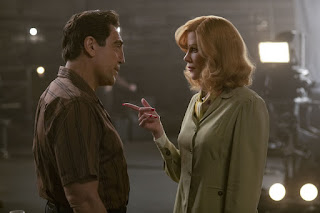
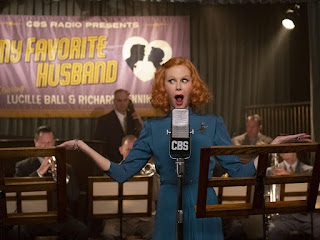
In 1952, the I Love Lucy sit-com is the top-rated television show. Over one week, the show's husband-and-wife star team of Lucille Ball (Nicole Kidman) and Desi Arnaz (Javier Bardem) navigate a series of challenges as the cast and crew prepare for Friday's taping of the latest episode in front of a live audience.
The newspapers are full of stories about Desi's infidelities. A radio show suggests Lucy is a communist. The couple reveal Lucy is pregnant, shocking executive producer Jess Oppenheimer (Tony Hale), the network, and the sponsors. Meanwhile, co-stars Vivian Vance (Nina Arianda) and William "Bill" Frawley (J.K. Simmons) add to the problems. Vivian resents being portrayed as frumpy, and Bill's caustic attitude causes aggravation.
As the week progresses, Desi insists the pregnancy will be weaved into future episodes instead of being hidden, while Lucy assesses the state of her marriage and works with writers Madelyn (Alia Shawkat) and Bob (Jake Lacy) to perfect the latest episode as the taping deadline approaches.
Written and directed by Aaron Sorkin, Being The Ricardos is handsomely mounted and well-acted, but also clumsily bites off more than it can chew. Enough material to occupy several movies is crammed into the events of a single week, with a predictable and vaguely unsatisfying outcome of quantity over quality and superficial treatment of all issues.In addition to the dramas about the communist accusations, infidelity, Lucy's pregnancy, and bickering co-stars, Sorkin crowds-in a barely-baked conversation about the feminism generational divide, an unconvincing side-trip to Desi's bruised ego as defined by others, flashbacks to the couple's courtship and early days of marriage, black and white recreations of completed episode scenes, and look-backs by older versions of the characters unnecessarily commenting on events. Unsurprisingly the running time extends to a wholly unwarranted 131 minutes, the narrative pointing in multiple directions but barely progressing on any.
On the domestic front, the one emergent unifying theme is Lucy's personal ambition to find a home of contentment, the show's stage set the closest thing to her sanctuary and the one place she can spend time with Desi before he escapes to palling around with his buddies. The film also offers revealing glimpses into the joint creative process required to pull together 22 minutes of quality comedy every week, Lucy's dedicated attention to detail and her exacting standards never wavering despite all the turmoil.
Sorkin favours a smoky beige-yellow palette to recreate a bygone era, and stars Nicole Kidman and Javier Bardem comfortably step into the early 1950s milieu. But they are forced to frequently shift emotional gears to keep up with competing contexts, often in the same scene. Despite enticing moments, Being The Ricardos is a bottleneck of ideas.
All Ace Black Movie Blog reviews are here.
In 1939, Lady Sarah Ashley (Nicole Kidman) travels from England to remote northern Australia to admonish her philandering husband. He is operating the fledgling Faraway Downs cattle ranch and locked in a land battle with evil cattle baron King Carney (Bryan Brown), who is seeking to monopolize beef supplies to the army as World War Two rumbles to life.
Upon arrival Sarah meets Drover (Hugh Jackman), an independent cattle driver, then discovers her husband murdered. She fires foreman Neil Fletcher (David Wenham), who is secretly working for Carney to undermine Faraway Downs. Also on the ranch is young mixed-race child Nullah (Brandon Walters), who is in danger of being forcibly scooped up by the government and placed in a religious school. Sarah bonds with Nullah, who has a strong spiritual relationship with his Aboriginal grandfather King George (David Gulpilil).
Sarah teams up with Drover to drive her cattle on a treacherous journey to Darwin, where she hopes to break Carney's monopoly. But Fletcher is determined to stop them, while punishing Japanese air raids bring the war to the country's doorstep.
An epic running for 2 hours and 45 minutes, Australia attempts to capture the identity of a nation. Directed, co-produced, and co-written by Baz Luhrmann, the film is infused with an independent, can-do attitude, a strong bond between people and nature, and no shortage of visual beauty within the vastness of a sparsely populated continent. Also prominent is a sneaky sense of humour, essential to survive the physical and emotional hardships of forging a nation with pure toil.
Luhrmann unapologetically embraces sentimental, romantic, overblown, and old-fashioned grandeur. He also freely borrows nation-defining themes from epics like Gone With The Wind (1939), Red River (1948), and especially Once Upon A Time In The West (1968). Notably, a woman is most influential in taming the land, Lady Ashley discovering her motherly instincts, refusing to yield to the will of a corrupt competitor, standing up to ill-conceived government policy (doubtless drafted by men), and never giving up on Nullah when all seems lost. She points the direction to a more virtuous future, and inspires good men like Drover to hustle the country along.The mixed identity of Nullah represents Australia's dual European and Aboriginal heritage. Both the child and his grandfather King George possess a mystical association with nature, contributing to several highlight scenes including a mammoth cliff-hanging (literally) stampede. Once Sarah connects with Nullah (through an overused reference to Over The Rainbow) and witnesses boorish officers causing him misery, she intrinsically understands the future has to celebrate, not conceal and suppress, the coming together of two cultures.
Nicole Kidman and Hugh Jackman create a likeable couple with no shortage of chemistry, both displaying necessary doses of frontier stubbornness and feistiness. Bryan Brown and David Wenham occupy the opposite corner with suitable malevolence. Young Brandon Walters is instantly amiable as a child caught between two civilizations.
The centrepiece epic cattle drive is both exhilarating and exhausting to watch, and finds a celebratory climax. Remarkably, a whole additional hour is to come, the relationship between Sarah and Drover facing a serious crisis and the country now firmly in the shadow of Japanese air force hostilities. It may not be short nor subtle, but Australia unabashedly celebrates ambition and audacity.

All Ace Black Movie Blog reviews are here.
Ex-FBI Agent Ray Kasten (Chiwetel Ejiofor) returns to Los Angeles and reconnects with former colleagues Claire Sloan (Nicole Kidman), now the District Attorney, and Agent Jess Cobb (Julia Roberts). Ray is seeking Claire's permission to pursue a man called Marzin (Joe Cole), a suspect in an unsolved murder with a personal connection to Ray and Jess. Flashbacks reveal events from 13 years prior. In the shadow of the September 11, 2001 terrorist attacks, Ray and Jess are tasked with monitoring a mosque-based cell, where their colleague Agent Siefert (Michael Kelly) is running an informant. Ray is also attracted to Claire, a lawyer newly appointed to the Los Angeles office.
The surveillance operation is disrupted when Jess's daughter Crystal is murdered and suspicion falls on Marzin, a member of the mosque community revealed to be Siefert's snitch. District Attorney Morales (Alfred Molina) prioritizes counter-terrorism ahead of solving the murder, leaving Ray frustrated and Jess disillusioned. Now more than a decade later Ray is back for another attempt at capturing Marzin, and he also rekindles his relationship with Claire.
Secret In Their Eyes has too much going on, and also not enough. Billy Ray directs his own script, and while the ambition to cast a personal quest against seminal events is apparent, this is a muddled story always emphasizing the wrong thing. With a backdrop of history's worst terrorist atrocity and then the murder of an FBI agent's daughter, the stuttering romance between Ray and Claire repeatedly gets in the way. She is a cool, cold and calculating lawyer, he is a scrappy field agent, the chemistry never materializes, but Ray keeps on trying.
Meanwhile Julia Roberts finds herself deglamourized and shoved to a background role. Little is revealed about Jess and less is known about her murdered daughter, leaving an emotional void around the central mystery obsessing Ray for 13 years. Marzin as a generic and ill-defined bad guy adds to the impressive blankness.
The constant time jumps make matters worse. Only minor hairstyle changes help differentiate the scenes in the present from those in the past, and with Ray pursuing Marzin in both timeframes, it is often confusing to keep track. And even the action scenes are a let down. On multiple occasions Ray gets close to Marzin, triggering routine confrontations with the same outcome, investigative work undone by operational ineptitude.
Ejiofor, Kidman and Roberts are never less than watchable, but Secret In Their Eyes is a tractionless waste of talent.
All Ace Black Movie Blog reviews are here.
The Owens women come from a long line of witches, and one of their ancestors unleashed a curse dooming all her descendants to calamitous love lives. Sure enough, sisters Sally and Gillian Owens (Sandra Bullock and Nicole Kidman) tragically lost their parents at a young age and were raised by aunts Frances and Bridget (Stockard Channing and Dianne Wiest).
Sally tries to counter the curse by leaving witchcraft behind, settling down and starting a family, while Gillian heads off in search of fun and casual relationships. Sally learns the hard way she cannot escape the curse and is soon dealing with heartache, while Gillian falls in with no-good boyfriend Jimmy Angelov (Goran Visnjic). The sisters soon find themselves in a heap of trouble, and detective Gary Hallet (Aidan Quinn) comes snooping.
An adaptation of the book by Alice Hoffman, Practical Magic throws a tepid romance, childish magic tricks and rarely funny humour into a bland mix. Director Griffin Dunne has a magnificent cast at his disposal, Nicole Kidman and Sandra Bullock supported not only by Stockard Channing and Dianne Wiest but also Margo Martindale, a young Evan Rachel Wood and Chloe Webb.
Some fun is achieved with the concept of harmless modern-day witches with a limited repertoire of tricks (blowing candles on and self-stirring tea cups are about the extent of it) trying to fit into a small town society, and the actresses try their best to salvage a base level of watchability, but they are ultimately stymied by a lame script devoid of wit and sparkle.
The plot meanders aimlessly, waving unconvincingly at themes of sisterhood, unwarranted ostracism, and the trade-off between domesticity and fun. Most of the wispy threads are summarily abandoned in favour of dabbling in crime, attempted screwball comedy, and a late-in-arriving romance badly in need of thawing. A nauseating let's-all-be-happy climax, complete with smoky special effects, can't come - and go - soon enough.
Despite the preponderance of acting talent, Practical Magic can only conjure up feeble spells and disappears in a puff of irrelevance.
All Ace Black Blog Movie Reviews are here.