Genre: Crime Thriller

All Ace Black Movie Blog reviews are here.
Reviews of Classic and Current Movies


A young woman (Jessie Buckley) and her boyfriend Jake (Jesse Plemons) have been together for about seven weeks, and are now on a long drive in snowy weather to his parents' farmhouse. Although the young woman finds Jake interesting and smart, she has doubts about the relationship and is thinking of ending it. Tonight she will meet his parents for the first time over dinner. The snowstorm is expected to worsen, and the young woman is eager to return home afterwards to prepare for a busy week.
At the farmhouse, Jake's parents (Toni Collette and David Thewlis) exhibit strange behaviour, including showing up late to greet their guest. Then the young woman experiences bizarre shifts in time, the parents appearing at various stages of aging. In parallel scenes, an elderly night janitor mops the floors at a high school, while students rehearse dances from the musical Oklahoma!
An adaptation of the Iain Reid book written for the screen and directed by Charlie Kaufman, I'm Thinking Of Ending Things is an introspective and abstract reflection on expectations across time. In equal doses mesmerizing and maddening, the film meanders through an obtuse labyrinth dreamily detached from reality, enlivened by a pseudo-Gothic style hinting at horror but content with the joy of empty threats.
Kaufman weaves an often claustrophobic pattern unconcerned with familiar narrative rules. Before and after the dinner, plenty of time is invested in the car trips, and other than the incessant snow, the passing scenery is of no consequence. Instead, the young woman and Jake engage in long, often tediously self-conscious intellectual conversations and debates, the cameras zoomed in on the couple within the intimate 1.33:1 aspect ratio.Interrupting the two in-car segments is the dinner with Jake's parents, and here Kaufman reveals, in a nonchalant manner, the hallucinatory elements. A lot more is going on than just a young woman thinking of breaking up with her boyfriend, and most of it is inaccessible. The clues to the arcane psychological puzzle start with a title open to interpretation, and include cryptic fragments scattered inside the house and within the dialogue. Attempts at assembling a rational picture are doomed to frustration by intentionally convoluted perspectives.
Later, a pit-stop at an ice-cream stand prompts a detour to Jake's old high school. The couple's fraught adventure merges with the night janitor's experience, and Kaufman audaciously introduces new sharp and weird turns in both content and presentation.
Rather remarkably, the 134 minutes of running time pass by quickly, the edge of unease amplified by cautiously agitated performances from Jessie Buckley and Jesse Plemons. As the parents, Toni Collette and David Thewlis stretch into nervy territory.
Themes of compatibility, loneliness, regret, self-doubt, self-worth, and dominant cultural imprints intermingle. Ambiguously stimulating, I'm Thinking Of Ending Things welcomes free-form interpretation, with all the associated exasperation.
All Ace Black Movie Blog reviews are here.
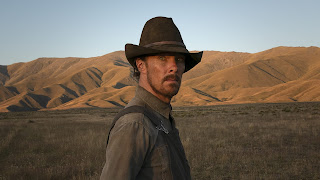
In Montana of 1925, brothers Phil and George Burbank (Benedict Cumberbatch and Jesse Plemons) own and run a cattle ranch. Phil idolizes the memory of deceased cowboy Bronco Henry, who taught him all he knows about ranching 25 years ago. He is also a brash leader and enjoys belittling others, especially George, who is calmer and quieter. After a cattle drive to a nearby trading town, George quickly courts and marries the widow Rose Gordon (Kirsten Dunst), who runs an inn and restaurant. Her teenaged son Peter (Kodi Smit-McPhee) loves to create paper flowers and has feminine tendencies, making him an easy target for Phil.
Phil believes Rose is a cheap gold-digger not really in love with George and only looking for a cut of the Burbanks' wealth. When George is away, Rose is intimidated and starts to drink heavily. Peter enrolls in medical school, but on a visit back to the ranch, the dynamic between him and Phil starts to change.
For a film clocking in at 126 minutes, remarkably little happens in The Power Of The Dog. Director and writer Jane Campion adapts a book by Thomas Savage, and is primarily interested in the rugged beauty of the landscape, a place where men are men and any man lacking macho swagger is a misfit and soft target. Phil, George, Rose, and Peter create a compelling quartet of characters brought together by a hasty union, and Phil's grim but conflicted and intentionally aggravating persona pulses a steady crackle of tension through the inter-personal dynamics.While the film is not exactly a slog, the pacing is near-moribund. A good three quarters of the movie invests in the foundational set-up, a long and ultimately pointless dinner party sequence among the slow-moving, often circular distractions. Campion finally progresses beyond Phil's underhanded insults and towards character evolutions, some unpredictability, and a heightened sense of drama. Needs and weaknesses are revealed, and a double-ended low-key duel unfolds. The thematic arc remains subtle, evocations of a changing west quietly exposed through intellect as an emergent clandestine weapon on the prairies.
With narrative momentum barely providing any competition, the actors grab centre-stage. Benedict Cumberbatch conveys dominant sweaty presence with an intensity crafted to hide tortured secrets. Jesse Plemons and Kirsten Dunst are adequate foils, while Kodi Smit-McPhee gains impressive stature and prominence in the final act.
Lyrical and soulful, The Power Of The Dog is also an embrace of cinematic lethargy.
All Ace Black Movie Blog reviews are here.
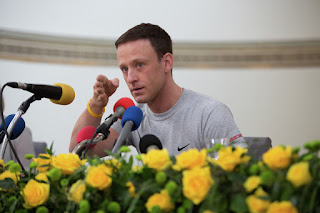
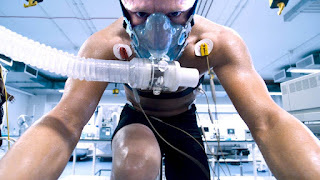
In the 1990s, American cyclist Lance Armstrong (Ben Foster) starts to participate in the Tour de France. He notices the top teams are under the care of Dr. Michele Ferrari (Guillaume Canet), who administers chemicals like Erythropoietin (EPO) to enhance performance. A testicular cancer diagnosis interrupts Armstrong's career and he undergoes brutal rounds of chemotherapy treatment.
Upon his return to racing, Armstrong is not considered a contender. But determined to win, he recruits Dr. Ferrari's doping services along with Johan Bruyneel (Denis Menochet) as team director, and they select teammates with the singular purpose of propelling Armstrong to a win. He is promptly victorious in 1999, crushing the field. Sunday Times reporter David Walsh (Chris O'Dowd) is suspicious of Armstrong's dramatically improved performance, but as the American proceeds to dominate the sport, proof of his doping is frustratingly difficult to secure.
Directed by Stephen Frears with a script by John Hodge, The Program adapts Walsh's book Seven Deadly Sins. The reporter is a relatively minor character in the film, with Frears focussing most of his attention on Armstrong as a headstrong phony. In a sport where not cheating means not winning, Armstrong and his crew are portrayed as perfecting doping and test evasion into an art form. His personal story of recovery from cancer provides cover from criticism, while an acquiescent media and inspired fans are happy to celebrate a feel-good story and avoid asking any questions.
The film adopts a relatively straightforward semi-documentary style, with the picturesque racing scenes adding some panache. With Walsh's investigation finding limited traction and a stone-faced liar occupying the story's centre, Frears is caught without a sympathetic protagonist. Ben Foster is in stoic form as a mechanical coldness permeates the narrative, the roboticization aided by an absence of context about Armstrong's formative years.The Program does succeed in portraying a crass win-at-all-costs mentality devoid of sportsmanship. Armstrong builds a commercial empire on the back of his fake victories, rising to the top echelons of celebrity athletes and brand name recognition. Frears covers Armstrong's charitable work with cancer patients as the one ray of goodness within a jungle of deception.
The recruitment of Mennonite Floyd Landis (Jesse Plemons) into Armstrong's team introduces ethical tension and starts the sequence of events eventually exposing the truth. Also playing a role is professional bridge player and prize money insurance agent Bob Hamman (Dustin Hoffman, in just a couple of scenes), who smells a fraud and starts making inquiries. But the characters remain in the shadows of mendacity, and perhaps appropriately for a sport that sold its soul, The Program replaces the warmth of human achievement with bloodless efficiency.
All Ace Black Movie Blog reviews are here.
A soulful western, Hostiles combines the traditions of the arduous journey with a lyrical exploration of troubled relations between whites and natives.
In 1892 at Fort Berringer in New Mexico, Captain Joseph Blocker (Christian Bale) is selected to escort ailing Cheyenne Chief Yellow Hawk (Wes Studi) to his ancestral lands in Montana. Blocker is close to retirement, and has built a fearsome reputation as a merciless fighter and killer of natives. He resents having to be civil to Yellow Hawk, who has a similar record of brutal killing, including scalping several of Blocker's colleagues.Blocker recruits a few trusted soldiers for the mission, including long-term friends Sergeant Metz (Rory Cochrane), who is also nearing retirement, and Corporal Woodson (Jonathan Majors), as well as West Point graduate Lieutenant Kidder (Jesse Plemons) and raw recruit Private Dejardin (Timothée Chalamet). Yellow Hawk is accompanied by his son Black Hawk (Adam Beach), daughter, daughter-in-law and grand-daughter.
Soon after embarking on the trip they encounter settler Rosalee Quaid (Rosamund Pike) in shock having just lost her entire family, including three children, to a vicious raid by a Cherokee war party. Rosalee joins Blocker's group, with many dangers to come on the long trail to Montana.
With chapters of brutal violence committed by all sides, some shown on screen and others described in hushed tones, Hostiles stares at the blood-drenched legacy of the west. After each bout of blood-letting director and writer Scott Cooper takes the time to include reverent burials, settlers, soldiers, natives, adults and children laid to rest in mounting numbers, often in unmarked graves, the hard soil of a nation-in-progress nourished by death.At 133 minutes, the film is long but Cooper sustains the intensity. Having established the barbarous context, Hostiles searches for what may emerge after the visceral need to kill subsides. Men like Blocker, Metz and Yellow Hawk are retiring or dying and understand they are too damaged to evolve. The next generation, personified by Lieutenant Kidder and Black Hawk and his family, may be a lot less blood thirsty, with fewer scores to settle and more capacity to achieve reconciliation, but only if they survive to forge a better future.
And Cooper ensures the moral dilemmas leave no room for black and white resolutions, only gray choices. Some horrific killings are justified as part of the job, other rampages are denounced as murder and punished by hanging. Violence in the name of protecting land is either noble or ignominious, depending on who is making the claim, and when. On such vagaries men live, die and judge themselves and others.Although some chapters stumble and hints of repetitiveness set in, the film weaves an always unsettling sombre mood. Max Richter's music score adds poignant tones, and often stunning Masanobu Takayanagi cinematography captures majestic landscapes of untamed and unforgiving terrain.
Christian Bale delivers a performance of sometimes frightening intensity and stoic masculinity, conveying with his eyes the horrors of a life spent killing etched firmly on his psyche. But Bale also captures the irresistible forces of change in his humane approach to helping Mrs. Quaid and a gradual willingness to understand Yellow Hawk's world. The rest of the cast is suitably detached, and includes Ben Foster as an army soldier turned prisoner and Scott Wilson as an uncompromising landowner.
Dark, humourless and thought-provoking, Hostiles confronts all enemies, especially those lurking within.
All Ace Black Blog Movie Reviews are here.