Monday, 14 April 2025
Movie Review: Reagan (2024)

Saturday, 13 April 2024
Movie Review: The Champ (1979)
Saturday, 26 November 2022
Movie Review: Runaway Train (1985)
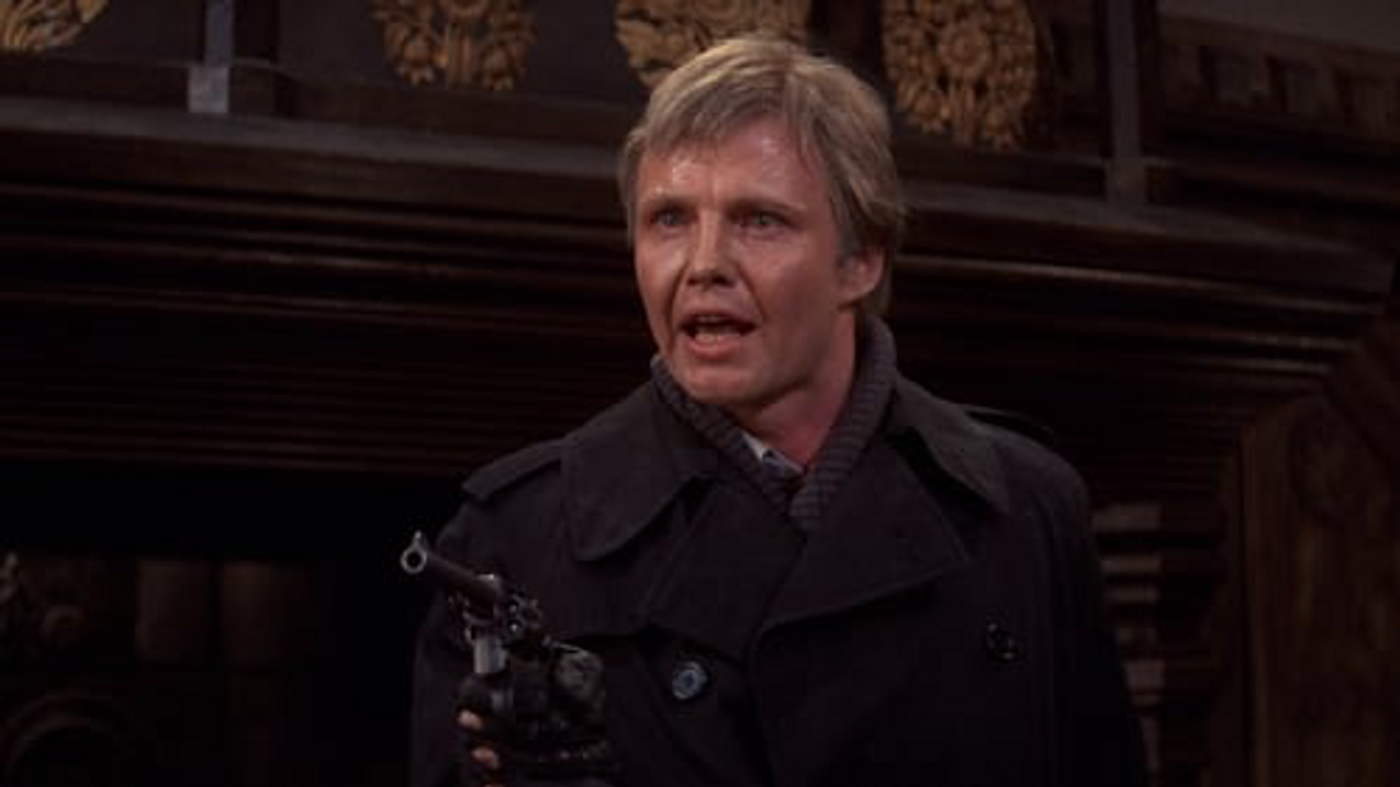
Oscar "Manny" Manheim (Jon Voight) is the toughest inmate at Alaska's remote Stonehaven Maximum Security Prison. A court order forces Associate Warden Ranken (John P. Ryan) to release him from three years of solitary confinement. The two men resume a duel, and Manny is injured in a knifing arranged by Ranken. He accelerates his latest breakout plan and escapes through the sewer system, with fellow prisoner Buck McGeehy (Eric Roberts) tagging along.
Buck: [in the sewer] It stinks in here, man.
Manny: You don't like that smell? That's the smell of freedom, brother.
The two men traverse the snowy wilderness to a rail switchyard, were they secretly jump onto a short train consisting of four locomotives. The engineer suffers a heart attack, leaving the train hurtling at high speeds. With Ranken pursuing the escapees, control centre dispatchers Dave Prince (T. K. Carter) and Frank Barstow (Kyle T. Heffner) scramble to clear other trains out of the way. Manny and Buck have to survive each other and look for ways to stop the runaway, and are then shocked to find locomotive hostler Sara (Rebecca De Mornay) with them on the train.
Manny: I'm at war with the world and everybody in it.
Based on a story by Akira Kurosawa, Runaway Train is assembled from contrasting pieces yet somehow works. Djordje Milicevic, Paul Zindel, and Edward Bunker collaborated on the screenplay, and wedge-in an overheated prison drama, a wild and chilly ride on a brakeless train, unpredictable character dynamics, and finally a turn towards hallowed acts of redemption. Director Andrei Konchalovsky approaches the material with a no-compromise attitude and plenty of gumption, repeatedly betting on a no-half-measures approach and scoring impressive wins in words, actions, and visuals. Once the action moves to the frigid outdoors, cinematographer Alan Hume creates a mystical grey aesthetic, the runaway train piercing terrain more than capable of consuming human incursions.Suitably occupying the plot's centre is Jon Voight's scenery chewing performance as Manny. His brutal nature is more talked about than demonstrated, although he survives a knifing with barely a grimace. Using an off-centre accent, Manny's lines of dialogue flow from a tortured poet's soul, an emotionally wounded human beast refusing captivity and aware no other place suits him.
Sara: [tearfully] You're an animal!Manny: No, worse! Human. Human!
One monster deserves another, and the antagonist Warden Ranken is a worthwhile and dogged adversary, the jailer evolving into an amalgam of the men he keeps locked up. Eric Roberts attempts to inject jokey comic relief with limited effect. Rebecca De Mornay fares better as the resourceful civilian witnessing the unfolding high speed drama from under layers of grease and dirty coveralls.
The film's thematic heart is the function and purpose of men like Manny in a modern society. Fearless, indestructible, resolute, and incapable of adhering to any rules, here he is free in the wild, his last available environment. This thoughtful brute is confronting dwindling options, but Manny will still choose the train and only ride on his own terms.
Manny: Win, lose, what's the difference?
All Ace Black Movie Blog reviews are here.
Monday, 7 November 2022
Movie Review: The Odessa File (1974)
In 1963, Israel is worried about an Egyptian missile program powered by guidance technology being developed in West Germany. The secret Odessa group consisting of ex-Nazis and their sympathizers are believed to be supporting the program. In Munich, freelance journalist Peter Miller (Jon Voight) obtains a Holocaust survivor's diary revealing atrocities committed by SS officer Eduard Roschmann (Maximilian Schell) at the Riga ghetto during the war.
Roschmann is still at large and was recently spotted in Hamburg. Determined to find him, Peter attends a pro-Nazi rally then connects with Israeli intelligence agents to plan an infiltration of Odessa. But getting close to Roschmann and his protectors will be dangerous for the journalist and his girlfriend Sigi (Mary Tamm).
An adaptation of a Frederick Forsyth novel, The Odessa File sustains decent intensity within a pattern of wayward targeting. What starts as a missile guidance systems threat quickly becomes a one-man quest to find the Butcher of Riga. But then both objectives are sidelined as a large chunk of the second half is occupied with details of Miller jumping through hoops to join Odessa. The final showdown reveals yet another narrative thrust, here used as a late surprise when it could have been better deployed as motivation.
Despite a running length of 128 minutes, writers Kenneth Ross and George Markstein struggle to distill the book into a cinematic flow, their script succumbing to unnecessary details and failing to leverage the antagonist viewpoint. Roschmann and Odessa are talked about a lot, but their present-day strategic actions and plotting are omitted and only tactically represented by interchangeable faceless bureaucrats, gatekeepers, and assassins.But all is not lost. Director Ronald Neame builds forward momentum through a dour, evil-walks-among-us mood, and maintains narrative clarity. Jon Voight falls victim to several creaky moments of phony outrage, but otherwise overcomes his German accent to hold the core. The action scenes are well handled, including a tangle with a subway train and a close quarters battle with a henchman. A sweat-drenched prove-your-identity interrogation is gripping. Amidst the clutter, The Odessa File offers some rewarding pages.
All Ace Black Movie Blog reviews are here.
Tuesday, 2 June 2020
Movie Review: Anaconda (1997)
A horror movie about a voracious giant snake, Anaconda offers a predictable premise, cheesy good special effects, and a ready-to-eat buffet of decent cast members.
In South America, documentary filmmaker Terri Flores (Jennifer Lopez) is embarking on a dangerous river journey to find an elusive Amazonian tribe. Her crew includes cameraman Danny Rich (Ice Cube), anthropologist Dr. Steven Cale (Eric Stoltz), production manager Denise Kalberg (Kari Wuhrer), sound engineer Gary Dixon (Owen Wilson), and pompous actor/narrator Warren Westridge (Jonathan Hyde).
Boat skipper Mateo (Vincent Castellanos) navigates the group along the river and early in the journey they rescue Paraguayan snake hunter Paul Serone (Jon Voight) from his stranded boat. Grizzled and caustic, Serone starts to take charge. His singular objective is to find and capture alive a mammoth human-eating anaconda, placing Terri and her crew in grave danger.
An old-fashioned creature feature, Anaconda follows a traditional construct by lining up a small group of victims as sumptuous meals. Peruvian director Luis Llosa delivers an ultra economical thriller within 89 minutes with all the requisite creepy, scary and disgusting moments, and still invests the film's first half in getting to know the characters and terrain. The mist-shrouded spooky Amazonian setting proves more interesting than the people, who never rise above stock soft-meat targets.
Except for Serone. Following in the footsteps of Quint and many previous cinematic acerbic hunters on destiny's path to confront their greatest nemesis, Jon Voight bites into the role with reptilian venom. He deploys an upside down smile and exotic accent to express unbridled disdain at the urbanite civilian film crew, easy to manipulate and easier to kill as necessary.
The ridiculously large and frequently angry snake, a special effects creation slithering between funny and hideous, does not welcome visitors and starts to attack with satisfying regularity in the second half. But Serone proves just as treacherous, leaving Anaconda with two oversized villains and plenty of hissing.
All Ace Black Blog Movie Reviews are here.
Thursday, 18 January 2018
Movie Review: National Treasure (2004)
A modern-day treasure-hunt adventure, National Treasure offers slick escapism in a glossy production package.
Mesmerized by stories he heard as a child from from his grandfather (Christopher Plummer), Benjamin Franklin Gates (Nicolas Cage) has dedicated his life to finding the fabled treasure of the Knights Templar, despite the cynicism of his father Patrick (Jon Voight). The treasure may now be in the United States shrouded in the mythology of the founding fathers and the secretive Masons. To track down a key clue Ben and his friend Riley (Justin Bartha) obtain funding from the shady Ian Howe (Sean Bean) and uncover the wreck of the ancient ship Charlotte under the North Pole ice.
On board they find clues pointing to an invisible treasure map on the back of the original Declaration of Independence. Ben and Ian disagree on how to proceed, causing a major falling out. Ben connects with Dr. Abigail Chase (Diane Kruger) of the National Archives, but cannot convince anyone that the Declaration is at risk. Ben and Ian concoct separate plans to steal the highly protected document, setting off a massive chase and the attention of FBI Agent Peter Sadusky (Harvey Keitel).
An unlikely collaboration between family-friendly Disney Studios and action-loving producer Jerry Bruckheimer, National Treasure is a respectable urban take-off on Indiana Jones-style adventurism. Directed and co-produced by Jon Turteltaub, the film carries the singular objective of providing treasure-hunt style thrills. Logic, physics and common sense mostly stay out of the way, yielding to fun, a well-executed dual heist sequence, energetic chases and descents into impressive cavernous spaces.
Arriving at the perfect time about 18 month after the release of the sensational bestseller The Da Vinci Code, National Treasure borrows many of Dan Brown's better points. The pacing is fast enough to glide over the inherent absurdities, the clues often hide in plain sight and within historically famous artifacts, Ben is an extraordinary on-the-fly puzzle solver, a smart and capable woman joins the chase, and as the end draws near the dangers and close calls amplify. With a strained father-son relationship coming into play between Ben and Patrick, the film also colours in a decent background for its reluctant hero.
Although he lands on the side of marginally colourless, Nicolas Cage maintains control and brings Ben to life as a man fully aware that his life may have been frittered away chasing a myth. Cage is surrounded by a good cast, Sean Bean in particular heartily sinking his teeth into another villainous role.
Lighthearted yet genuine in its intentions, National Treasure never threatens to astound but does follow the right map.
All Ace Black Blog Movie Reviews are here.
Monday, 25 December 2017
Movie Review: Zoolander (2001)
A sharp no holds barred satire of the fashion world, Zoolander is a wild ride through a haughty industry.
When Malaysia's newly elected President promises reforms to end cheap child labour in the garment industry, the evil barons of the fashion world are sent into a panic. Top designer Mugatu (Will Ferrell) is tasked with plotting an assassination of the President. He identifies none-too-bright top fashion model Derek Zoolander (Ben Stiller), who works for a model agency run by Maury Ballstein (Jerry Stiller), as the perfect sap to be unwittingly recruited as an assassin.
Unfortunately, Zoolander, despite his famous Blue Steel "look" and miniature cell phone, is plunged into a personal crisis of confidence when reporter Matilda (Christine Taylor) publishes an unflattering profile in Time magazine and then he loses his model-of-the-year crown to the much-too-cool Hansel (Owen Wilson). This does not stop Mugatu and his top henchwoman Katinka Ingabogovinanana (Milla Jovovich) from launching their plan to brainwash Zoolander and turn him into a martial arts assassin to the tune of Relax by Frankie Goes To Hollywood.
Co-written and directed by Ben Stiller, Zoolander is successful at drawing good and sustained laughs out of abject stupidity. Stiller sharpens his knives and does not try to be respectful. This is an all out assault on stupid models, corrupt business owners, and laughable designers, and the film mercilessly pokes away at the parties, the prancing, and the attitudes. The only rational character in the entire movie is the reporter Matilda, and she acts as the outside observer lifting the lid on the vacuous, corrupt and exploitive underpinnings of the industry.
The highlights are many. Zoolander and Hansel engage in a walk-off duel, a melange of boxing bout and showdown at high noon judged by none other than David Bowie. The brainwashing scene featuring psychedelic Mugatu images is a classic riff on The Manchurian Candidate. And the conspiratorial contribution of hand model Prewett (David Duchovny) gives the assassination plot and the broader fictional history of the fashion industry's involvement in high profile deaths pop culture legitimacy. Stiller even finds time within the 89 minutes of running length for a "going home" sojourn to the "coal mines of New Jersey", where Stiller reconnects with his roots including dad Larry (Jon Voight).
Ferrell is liberated by wild makeup and lets loose as the out-there designer Mugatu. His launch of the homeless-inspired Derelicte line is not only a sharp jab at the fashion world's lack of ethics, but also sadly inspired by a real campaign. Zoolander spots the weaknesses in its target trade, and attacks with ferocity and a devious smile.
All Ace Black Blog Movie Reviews are here.
Wednesday, 6 July 2016
Movie Review: Heat (1995)
A contemporary crime drama, Heat unites legends Al Pacino and Robert De Niro in a masterful story of two men on either side of the law willing to do anything to achieve success in their chosen professions.
In Los Angeles, crime boss Neil McCauley (De Niro) and his gang execute their latest score: an audacious robbery of bearer bonds out of an armored truck. Neil's regular and dependable gang members include Chris (Val Kilmer), Michael (Tom Sizemore) and Trejo (Danny Trejo). The unstable Waingro (Kevin Gage) is a late addition to the team, and he perpetuates a bloodbath that results in three security guards being killed. Neil's fence and outlet to the legitimate world is Nate (Jon Voight), and he tries to arrange a buy-back deal for the stolen bonds. But the victim, corrupt businessman Roger Van Zant (William Fichtner), decides that severe revenge is the best response.
The robbery brings Neil gang to the attention of Los Angeles Police Department Lieutenant Vincent Hanna (Al Pacino) and his crew of investigators, and they place Neil's men under surveillance. Neil meets and starts a relationship with Eady (Amy Brenneman), although his personal philosophy is to never get emotionally involved with anyone. Vincent's marriage to Justine (Diane Venora) is in trouble thanks to his obsession with work, and his stepdaughter Lauren (Natalie Portman) is feeling the strain. Meanwhile Chris has a gambling problem and fritters away his crime proceedings, much to the disgust of his wife Charlene (Ashley Judd).
Directed and written by Michael Mann, Heat is a dark, complex, and character-driven crime story, inspired by real events and delivered by a superlative cast in top form. For the first on-screen pairing of Al Pacino and Robert De Niro (they both starred in Godfather Part II but in different time eras), Heat conjures up an existential duel suitable for two of the all-time finest actors to sink their teeth into. The film runs for a mammoth 170 minutes, but never drags. Mann injects enough texture, human emotion and deep character interactions to keep the drama humming along at a steady clip.
Heat never betrays its character motivations. At the centre of the film are two professionals who care deeply about what they do and will sacrifice everything to achieve their objectives. Vincent is on his third marriage, and fully understands that his home life is doomed to suffer as his real attachment is to the task of bringing scum to justice. Neil is dedicated to the craft of high-stakes heists, and has simplified his life down to the principle of being ready to abandon absolutely everything and flee in 30 seconds or less. Neither man will yield, and they admit as much to each other in a seminal meeting over coffee about halfway through the film.
The women serve to humanize the men, and the key characters are grounded by domestic fronts that serve as reminders that there may be more to life than crime, investigation and violence. Justine is aching to reclaim her man but is also not beyond hurting him, while her daughter Lauren is in a lot of emotional trouble. Eady unexpectedly eases her way into Neil's heart, adding a reason for him to question whether tangling with the dogged Vincent is worth the risk. And Charlene suffers the cruelest fate, having to contend with all her husband's risk-taking but enjoying none of the rewards, as he gambles away his cut from every score.
And when it's time for the action set-pieces, Mann delivers some astounding beauties. The initial armored truck assault is short, sharp, vivid and ultimately brutal. An ambush in an abandoned drive-in parking lot follows, revealing the depth of treachery among thieves. The highlight is a jaw-dropping and prolonged street shootout after a botched bank hold-up, Neil and his men attempting to fight their way out of Vincent's suddenly tightening noose, Mann turning a section of Los Angeles into a harrowing war zone complete with blazing assault rifles. And the climax works its way through a series of score-settling punctuation marks, ending with a tense one-one-one showdown on the LAX tarmac.
Heat adds a smooth aesthetic augmented by atmospheric music. The Dante Spinotti cinematography is cool and crisp, often making use of the city lights by night to punctuate dark blue hues with glittering gold. Elliot Goldenthal provides a moody and evocative music score.
Ambitious in scale yet taut in execution, Heat shines at a white hot temperature.
All Ace Black Blog Movie Reviews are here.
Tuesday, 24 May 2016
Movie Review: Midnight Cowboy (1969)
A quintessential character drama, Midnight Cowboy is the story of two down-and-almost-out men forging an unlikely friendship.
Handsome, sturdy and dim dishwasher Joe Buck (Jon Voight) leaves his life in rural Texas behind and heads to New York City. In flashback, snippets of Joe's troubled childhood are revealed, including a disturbing relationship with his grandmother and a passionate affair with a girlfriend that ends badly. Now Joe's intention is to sell his services as a male prostitute with a cowboy persona to the wealthy women of New York. But his early and clumsy attempts to establish a career as a stud are a miserable failure, including an early session with socialite Cass (Sylvia Miles) that ends with him paying her.
Joe stumbles across Rico Rizzo (Dustin Hoffman), known to all as Ratso, a suitable nickname but one that he hates. Ratso is a penniless gutter rat and petty thief with a bum leg and a persistent cough. He promptly swindles Joe out of $20 by sending him to see a religious zealot on the pretext of arranging to find him a manager. Eventually, with Joe quickly running out of money and getting ever more desperate, Ratso takes him into his derelict apartment in a condemned building. The two men establish a spiky friendship as they attempt to find ways to make enough money to eat, stay warm and take care of Ratso's worsening health.
Directed by John Schlesinger and written by Waldo Salt adapting the James Leo Herlihy novel, Midnight Cowboy is a slice of societal anthropology set in corners often ignored. The story of the pathetic gigolo and the pitiful tramp finds the human spirit fighting for survival and small moments of joy against the forces of poverty, rejection, hunger, cold and despair. The film is absorbing in its depiction of the struggle for dignity, the pace surprisingly brisk and the misadventures of Joe and Ratso always offering ever newer levels of desperation.
Midnight Cowboy is paradoxically filled with elegance, beauty and the essence of companionship. Schlesinger constructs an affecting, deeply involving narrative filled with poignant moments, made all the more enduring by the certainty that Buck and Ratso do not have the capacity to actually succeed at anything. Their lives and hopes will forever be a series of disappointments, and they will nevertheless not give up. Even from the bottom of the sewer, hope persists that tomorrow will be a better day.
The affecting soundtrack by John Barry perfectly complements the film, and includes Fred Neil's song Everybody's Talkin' and the soulful, legendary main harmonica theme by Toots Thielemans. The cinematography by Adam Holender captures life from the perspective of two men at the bottom looking up, the tonier districts of New York City offering a cold, unwelcoming shoulder while the seedier streets tantalize with nighttime lights, blurry neon colours and the promise of cash earned the dirty way.
In a career-making role, Jon Voight embodies Joe Buck and creates an enduring image of a strong but slow man buffeted by life yet determined to make something out of his limited skill set. In his first role after The Graduate, Dustin Hoffman announces his outstanding range and reinvents himself from clean-cut college kid to street scoundrel persevering on society's left-overs. Rico Rizzo persists only in the dumps and condemned margins of the city, yet when he roars I'm walkin' here! at an errant taxi, he owns the street, ever so briefly.
Midnight Cowboy starts with a long bus ride and ends with another. In a testament to both the human spirit and the film's unique viewpoint, both are journeys incredibly propelled by unbridled optimism.
All Ace Black Movie Blog reviews are here.
Friday, 1 January 2016
Movie Review: The Manchurian Candidate (2004)
During the 1991 Gulf War to liberate Kuwait, a small US army reconnaissance unit under the command of Major Bennett Marco (Denzel Washington) engages the enemy in a fierce fire fight. Marco is knocked out, and Sergeant Raymond Shaw (Liev Schreiber) takes charge. Although two soldiers are consequently killed and the unit is lost in the desert for three days, after the ordeal Shaw is awarded the Medal Of Honor for his bravery and leadership in battle, based on the testimony of Marco and all the surviving men.
Years later, the US is involved on multiple fronts in the war against terrorism. Shaw is a respected Congressman but very much under the influence of his domineering mother Senator Eleanor Prentiss Shaw (Meryl Streep). He is also in the running to be named as the Vice Presidential candidate on his party's ticket for the upcoming election. Meanwhile, Marco is struggling with vivid dreams that suggest the story of the Kuwait firefight is more manufactured than real, and that all the unit members may have been subjected to mind control techniques. Risking his reputation and his life, Marco digs into the story and uncovers the involvement of Manchurian Global, a private equity conglomerate heavily invested in arms deals, funding politicians and dangerous science. Marco reaches out to Shaw, but uncovering truth from fiction and the real motives at play will not be easy.
Directed by Jonathan Demme and with an all-star cast, this remake is not as needless as most. The story is updated to the present day, with the Gulf War and the war on terrorism replacing the Korean War and the war on communism respectively. Wisely not competing with the grim aesthetic of the original, Demme applies a thorough shine to this version, with electoral machines in full swing, corporate chicanery operating behind the scenes and the media cycle reporting on every detail.
The Manchurian Candidate offers a pleasing mix of conspiracy, back-room politics, a personal quest for the truth, frazzled flashbacks, wicked science, police work and a rush against time to a satisfying climax. Demme keeps the pace moving, and the 130 minutes zoom by fairly effortlessly. The film works hard to establish a fledgling bond between the high-flying Raymond Shaw and his forgotten former commander Bennett Marco, and the investment pays off as the resolution unfolds.
But the script can't shake a couple of significant problems. In modern day politics organizations like Manchurian Global easily buy and sell high ranking politicians with good old fashioned graft. Resorting to an elaborate and dangerous plot to brainwash soldiers in the middle of the desert to serve a political purpose seems disingenuous in the extreme. Another gaping logic hole opens up when Raymond Shaw, Vice Presidential candidate, is activated to personally do the dirty work once the conspiracy is threatened, another highly implausible and self-defeating tactic from evil plotters with supposedly every angle covered.
The performances from a host of familiar faces are adequate. Denzel Washington comfortably occupies the space of the increasingly troubled veteran soldier on a quest to uncover an alternative truth when his version of reality stops being plausible. Schreiber maintains a suitable facade of tortured coldness, while Streep is, for once, relatively perfunctory. Kimberly Elise makes a good impression in the second half of the film as Eugenie Rose, Marco's potential love interest and possibly hiding her own secrets.
Jon Voight has a few scenes as Shaw's political rival, and Vera Farmiga gets even fewer minutes in an underdeveloped sub-story as Voight's daughter and Shaw's lost love interest. Jeffrey Wright, Anthony Mackie, Dean Stockwell and Charles Napier show up in brief roles.
The Manchurian Candidate 2004 edition is a reasonable effort, a classic story modernized but not fully reinvented.
All Ace Black Blog Movie Reviews are here.
Wednesday, 21 October 2015
Movie Review: Pride And Glory (2008)
A police corruption procedural drama, Pride And Glory flirts with a promising premise, but fails to deliver any new angles and dissolves into sub-standard territory.
The New York City police department is thrown into turmoil when four officers on the anti-narcotics unit are killed in a shootout with criminal Angel Tezo and his gang. The slain men all reported to Francis "Franny" Tierney Jr. (Noah Emmerich), a well-meaning commanding officer and the son of Police Chief Frank Tierney Sr. (Jon Voight). Frank Sr. convinces his other son Ray (Edward Norton) to help in the shooting investigation. Ray previously was involved in the drug wars, but grew disillusioned when he was embroiled in a false testimony scandal.
Officer Jimmy Egan (Colin Farrell) is a member of the anti-drug squad, and is also the brother-in-law of Franny and Ray. Jimmy is the informal leader of a group of corrupt officers receiving large payments from drug dealers. The four officers were killed because Jimmy was trying to squeeze out Tezo in favour of Casado, another crime king. Ray reluctantly starts his investigation, and it does not take him long to uncover the ring of corruption within the police department, triggering a moral and familial dilemma involving Ray, Frank, Franny and Jimmy.
Treading over the well-worn territory of honour, deep-seated corruption, and the police officer's unspoken code of conduct, Pride And Glory adds the interesting twist of multiple members of the same family embroiled in a swirling controversy triggered by the slaughter of four officers. But the promising start slowly but surely gives way to sideways drift, and eventually the movie arrives at a complete stall.
The screenplay by Gavin O'Connor and Joe Carnahan fails to capitalize on the set-up, leaving the characters undeveloped and the actors struggling with plenty of tough words but little context. The film defaults to a series of scenes with men angry at each other and doubling up on threats, but the details of the corruption, the motivations and the backstories are at best hinted at and more commonly just ignored.
There are a few action scenes but these are more muddled than effective, director Gavin O'Connor proving incapable of adding any zest to the proceedings. The frazzled ending, once it arrives after an overlong 130 minutes of running time, is a disastrous mano-a-mano fist fight followed by a botched robbery and a flash mob that just happens to be at the right place at the right time to tidy up the plot in a most unsatisfying manner.
Edward Norton is the one actor to emerge with any credit, and he tries to infuse Ray with some self-reflection and evidence of a troubled past to round out the character. Jon Voight, Colin Farrell and Noah Emmerich are sturdy but hampered by the unimaginative writing. The women in the lives of the police officers are reduced to the bittiest of meaningless roles, the opportunity to properly delve into family pressures once again registering as a bad miss.
Pride And Glory flickers early, but is then extinguished into blandness and is ultimately as forgettable as its title.
All Ace Black Blog Movie Reviews are here.
Tuesday, 30 December 2014
Movie Review: The Rainmaker (1997)
A David versus Goliath courtroom drama with plenty of appeal, The Rainmaker enjoys a stellar cast in fine form and hits all the right notes, but never quite reaches the emotional heights that it strives for.
Rudy Baylor (Matt Damon) graduates from law school in Memphis, and the only job he can land is with the office of ambulance-chaser "Bruiser" Stone (Mickey Rourke) and his crony Deck Shifflet (Danny DeVito), who has never been able to pass the bar exam. Shifflet takes Baylor under his wing and teaches him the ropes. Soon Rudy has three clients: the elderly Miss Birdsong (Teresa Wright) wants to rewrite her will; low-income mother Dot Black (Mary Kay Place) wants to sue the Great Benefit insurance company for denying coverage for her leukemia-afflicted son Donny Ray (Johnny Whitworth); and Kelly Riker (Claire Danes) is being regularly physically abused by her husband.
Bruiser runs into some serious trouble with the law, prompting Rudy and Deck to establish their own business, as the insurance company lawsuit starts to occupy most of their time. Great Benefit hires a crack team of lawyers headed by the slick Leo F. Drummond (Jon Voight) to defend the case, and Rudy finds himself out of his depth in terms of experience and resources. But Dot refuses to settle, and the case lands in court, with Judge Tyrone Kipler (Danny Glover, in an uncredited performance) presiding. As Kelly's confrontations with her husband grow ever more dangerous, Rudy has to uncover Great Benefit's unethical practices to convince the jury that Donny Ray never received the medical treatment that he deserved.
By the time The Rainmaker arrived in movie theatres as a big-budget, high-quality adaptation of a John Grisham novel, the 1990s alone had already offered a multitude of quality courtroom dramas including three Grisham adaptations. A Few Good Men (1992), The Firm (1993), In The Name Of The Father (1993), The Client (1994), Sleepers (1996), and A Time To Kill (1996) featured big name stars, big name directors and some seminal courtroom moments, and The Rainmaker unfortunately suffers from the nagging feeling that Hollywood was perhaps going to the same well one time too many. There was little new that the genre was able to offer by 1997, and while The Rainmaker does everything right, it doesn't do much that is particularly memorable.
Director Francis Ford Coppola wrote the screenplay, and in one of his more traditional outings, steers the film safely through all the tight corners. The 135 minutes of running time pass by smoothly, and the Memphis setting, mostly in the grungier parts of town, enriches the context. Rudy Baylor is a likable if somewhat bland protagonist, and Matt Damon applies his boyish charm in the right doses to make the rookie lawyer a scrappy hero worth investing in. The narration provided by Baylor, is, for the most part, unnecessary.
The three stories compete for attention in the first half of the movie, but the insurance lawsuit dominates the second half, and the movie evolves as expected into a satisfying high-stakes courtroom showdown to influence the jury. Jon Voight does his part and creates in Drummond a worthwhile adversary who justifies his high fees by shredding witnesses just when Rudy starts to believe that he might gain an unlikely upper hand.
The other two legal cases, involving Miss Birdsong's will and Kelly's domestic abuse, do get short changed, and ultimately get in the way of the main narrative thrust and are almost all but discarded. Miss Birdsong's ordeal with the will is a great excuse to see Teresa Wright on the screen one last time. Kelly's wife abuse story takes a turn towards mayhem that has all the appearances of a desperate attempt to occupy Rudy with something other than the insurance firm lawsuit.
Danny DeVito, Mickey Rourke and Danny Glover add plenty of animation and some moments of humour, while late in the case Virginia Madsen and Roy Scheider make telling contributions in the courtroom.
Despite having its heart in the right place and working the big bad corporation theme to perfection, The Rainmaker lacks a killer moment of impact to differentiate it from other legal dramas. This does not make it a lesser film, just a lower profile but still enjoyable adventure in the jungles of the law.
All Ace Black Blog Movie Reviews are here.
Sunday, 12 October 2014
The Movies Of Jon Voight
All movies starring Jon Voight and reviewed on the Ace Black Movie Blog are linked below:
Midnight Cowboy (1969)
Deliverance (1972)
The Odessa File (1974)
Heat (1995)
Mission: Impossible (1996)
Anaconda (1997)
The Rainmaker (1997)
Enemy Of The State (1998)
Pearl Harbor (2001)
Zoolander (2001)
Ali (2001)
The Manchurian Candidate (2004)
National Treasure (2004)
Tropic Thunder (2008, cameo as himself)
Pride And Glory (2008)
Four Christmases (2008)
Reagan (2024)