Showing posts with label Armand Assante. Show all posts

Sunday, 1 March 2026

Movie Review: Judge Dredd (1995)


Genre: Science Fiction Action Thriller  
Director: Danny Cannon  
Starring: Sylvester Stallone, Armand Assante, Diane Lane, Max von Sydow, Rob Schneider, Jurgen Prochnow  
Running Time: 96 minutes  

Synopsis: In a dystopian future, humanity is packed into megacities to shelter from the devastated Cursed Earth. "Judges" act as police officers, juries, and executioners to try and keep the peace. Fearless Judge Joseph Dredd (Sylvester Stallone) is a protege of Chief Justice Fargo (Max von Sydow), whose rival Judge Griffin (Jurgen Prochnow) advocates for a stricter law-and-order agenda. Dredd is framed for murder, Fargo is sidelined, and Dredd's former partner Rico (Armand Assante) is unleashed to cause mayhem. With help from Judge Hershey (Diane Lane), Dredd has to exonerate himself and uncover a conspiracy involving his own past.

What Works Well: This comic book adaptation is packed full of special effects and quirky humour, and provides a sturdy platform for star Sylvester Stallone to deliver plenty of zingers. The plot is a familiar conflict between the light and dark sides of human aspirations, but never takes itself too seriously. Director Danny Cannon inserts action interludes at regular intervals to maintain momentum, with most of Rob Schneider's comic relief contributions landing just on the right side of the line separating entertaining from annoying.

What Does Not Work As Well: The visual style and star salaries appear to have consumed most of the budget, resulting in a short running time and a sense of muddled expediency. Ideas introduced but truncated include the complex relationship between Dredd and Rico, the rupture between Rico and Griffin, the genetic cloning sub-plot, and the role of Dr. Ilsa Hayden (Joan Chen). What remains is more a highlight reel than any attempt at serious world building or character depth.

Key Quote:
Rico (to Dredd): The only difference between us, Joseph, is you destroyed your life to embrace the law. And l destroyed the law to embrace life.


All Ace Black Movie Blog reviews are here.

Sunday, 21 September 2025

Movie Review: Trial By Jury (1994)


Genre: Legal Drama Thriller  
Director: Heywood Gould  
Starring: Joanne Whalley, Armand Assante, Gabriel Byrne, William Hurt, Ed Lauter, Kathleen Quinlan  
Running Time: 107 minutes  

Synopsis: Notorious crime boss Rusty Pirone (Armand Assante) is facing a trial by jury, with prosecutor Daniel Graham (Gabriel Byrne) confident of a conviction. Ex-cop-gone-bad Tommy Vesey (William Hurt) is now Pirone's "jury consultant", and targets juror Valerie Alston (Joanne Whalley-Kilmer) with an intimidation campaign, threatening her son and father unless she sabotages deliberations and achieves a hung jury. But Vesey also starts to care for Valerie, leading to conflicted loyalties and violence.

What Works Well: Wayward plotting is saved by a gloss of production quality and an exceptional cast. Director Heywood Gould sets the context in short sharp strokes, and introduces a large set of characters with admirable efficiency. From courtroom jousting to the various threats unleashed on Valerie's life, the energy is maintained at a high level. Joanne Whalley-Kilmer is at her best when she tangles up the jury deliberations, Armand Assante drips oily villainy, William Hurt finds complexity in a memorably unlikely role, and the likes of Gabriel Byrne and Ed Lauter provide depth.

What Does Not Work As Well: The plot gets increasingly more outlandish and ultimately discards any pretense of logic or grounding. The opening sequence demonstrates what Pirone's criminal enterprise is capable of, undermining most of the subsequent pussyfooting to manipulate a jury outcome.

Key Quote:
Rusty Pirone: I'm the guy who falls into a sewer and comes out with his pants pressed.


All Ace Black Movie Blog reviews are here.

Sunday, 4 September 2022

Movie Review: Little Darlings (1980)

A teen sex comedy, Little Darlings adopts a girls' perspective on the hazards of adolescence and steers towards nuanced treatment of a tricky subject.

In the Atlanta area, teen girls from different backgrounds attend Camp Little Wolf for the summer. The tough-spoken Angel Bright (Kristy McNichol) is from the wrong side of the tracks, and immediately clashes with the wealthy Ferris Whitney (Tatum O'Neal). Both are 15 years old, and shamed as virgins by the conceited Cinder (Krista Errickson). Before long, all the girls at the camp are betting on whether Angel or Ferris will lose her virginity first.

The romantic Ferris sets her eyes on camp instructor Gary Callahan (Armand Assante), but he is cautious with her flirting. The more pragmatic Angel spots seemingly willing teenager Randy (Matt Dillon) from the adjacent boys' camp. As both girls get closer to their first sexual experience, unexpected doubts and uncertainties surface.

Featuring two bright young talents in Kristy McNichol and Tatum O'Neal, Little Darlings threatens to fall into routine teen summer camp movie shenanigans, girl style, but then recovers into a more serious exploration of peer pressure, young women's dilemmas with sex, and the nature of friendships. Writers Kimi Peck and Dalene Young are not short on cringey dialogue and cannot resist throwing in catfights and foodfights, but the second half is more concerned with confronting genuine emotions and discards the search for cheap laughs.

Angel not only embarks on a quest to lose her virginity, she is also the camp misfit, a tough and troubled kid alone in a middle class crowd. She initiates all her interactions with Randy (a more-than-meets-the-eye Matt Dillon), but she is also unsure if she wants to pursue what she is initiating. McNichol emerges as a compelling actress, director Ronald F. Maxwell recognizing her ability to command the screen in several compelling scenes. 

In contrast Tatum O'Neal as Ferris defaults to princess mannerisms and fairytale romance ambitions, her juvenile flirtations with Gary (a disheveled Armand Assante) easy to rebuff. Little Darlings unfortunately turns down the opportunity to harness the power of friendship between Angel and Ferris: they spend most of the movie hissing at each other, time that could have been better invested exploring commonalities.

Maxwell does surround the two leads with a gaggle of well-defined supporting characters, including Cynthia Nixon in her debut as Sunshine (all peace and love until it's time for war), Alexa Kenin as the grounded Dana, and Krista Errickson as the perfectly irritating snob Cinder. An impressive soundtrack features music by Blondie, Supertramp, The Cars, the Bellamy Brothers, and John Lennon.

Little Darlings stretches into the deceptions that weave individuals into groups, the truth blurred to best fit in and get along. The real rite of passage, it turns out, is defining what really matters on the arduous trip to adulthood.


All Ace Black Movie Blog reviews are here.

Wednesday, 2 February 2022

Movie Review: Unfaithfully Yours (1984)

A revenge comedy, Unfaithfully Yours reaches for sophisticated laughs in high society, but rarely hits the right notes.

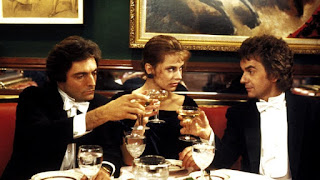
In New York City, celebrated orchestra conductor Claude Eastman (Dudley Moore) returns from a successful trip to London, and prepares for a performance featuring star violinist and ladies magnet Max Stein (Armand Assante). Claude is married to the much younger Italian actress Daniella (Nastassja Kinski), and his entourage includes manager Norman (Albert Brooks) and butler Giuseppe (Richard Libertini). 

Thanks to bumbling private detective Keller (Richard B. Shull), Claude stumbles upon evidence Daniella may be having an affair with Max. Enraged by jealousy, he plots an elaborate revenge for the night of the big concert. But while he imagines the perfect plan, reality will turn out to be much different.

A remake of the 1948 Preston Sturges comedy, Unfaithfully Yours has only a slight story to tell despite the involvement of three writers (including Barry Levinson). Director Howard Zieff delivers one good scene featuring duelling violins at a nightclub, then aims for the centrepiece sequence of Claude imagining his perfect murder while energetically conducting the orchestra, quickly followed by the reality of his best laid plans going quite wrong. It's a good final act aided by silly Halloween masks, but getting there gets a bit drudgerous.

At the appropriate comedic scale, Claude and Daniella do convey a sense of underlying love as two artists giving romance a whirl if for no other reason than joint inspiration and shared glamour. But then the film leans too heavily on the painfully slow process of Claude's jealousy building, followed by identifying Max as the alleged Lothario, then a series of more-irritating-than-funny communications breakdowns to stoke the flames of rage. 

The script lacks a cutting edge, and so Dudley Moore sputters and strides this way and that, caught somewhere between aspirations of worldliness and juvenile physical comedy. The surrounding cast is rich with talent, but every character is strictly confined to a single definition.

With enjoyable classical music and glitzy cinematography, Unfaithfully Yours exists in a classy milieu. Too bad the humour arrives poorly dressed for the occasion.


All Ace Black Movie Blog reviews are here. 

Friday, 12 July 2019

Movie Review: Private Benjamin (1980)


A comedy and romance about life's twists and turns and resultant decision points, Private Benjamin combines army humour with a worthwhile story about finally growing up.

In Philadelphia, 26 year old Judy Benjamin (Goldie Hawn) is a spoiled princess from a rich family, about to get married for the second time. But new husband Yale (Albert Brooks) expires during intercourse on their wedding night, sending Judy into a depression. She is lured into volunteering for the army by a recruiter (Harry Dean Stanton) selling her a vision of private waterfront rooms and yachts.

Instead, Judy finds herself in Biloxi, Mississippi, undergoing six weeks of basic training under the command of Captain Doreen Lewis (Eileen Brennan) and Drill Sergeant Ross (Hal Williams). She wants to quit and her parents (Sam Wanamaker and Barbara Barrie) arrive to take her home. But Judy experiences a last minute change of heart and decides to tough it out, changing her life's trajectory and leading to a romance with suave French doctor Henri Tremont (Armand Assante).

Close to her stardom peak, Goldie Hawn co-produces, stars in and energizes a warm hearted comedy. Private Benjamin is an old-fashioned star vehicle, and Hawn owns every scene of her movie. From flighty and overindulged rich girl looking for a professional husband and an easy life to a hardened army graduate standing up for herself, Judy Benjamin's journey combines laughs with knowing commentary about redefining trajectories.

The comedy stems from the conflict in expectations between a self-proclaimed professional shopper and life in an army barracks, and director Howard Zieff places Judy in plenty of awkward situations to ram home her new reality. Cleaning toilets, endurance training and physical tussles with other volunteers create rich terrain for humour and evolution, while raising Judy's awareness that there may be more to life than choosing the perfect interior decorating fabric colour.

The film's third act is more serious and involves Judy's post-graduation posting in Europe, and the subsequent relationship with Henri. The departure from the earlier broad laughs and the abandonment of Judy's hard-earned gal-pals is a narrative risk. But co-writers Nancy Meyers, Charles Shyer, and Harvey Miller know what they are doing, because as the 1980s kick-off, women's empowerment extends beyond admittance to previously male-only domains and towards putting new found skills to practical use. Judy's journey is only satisfying when she starts navigating her life with a new sense of maturity and independence.

Eileen Brennan provides solid support as a tough but vulnerable Captain Lewis, who evolves from trainer to nemesis. Armand Assante is all smarmy charm as the latest seemingly safe catch luring Judy into old habits.

Private Benjamin joins the army to escape a personal tragedy and chase a fantasy, but discovers a bold new reality instead.


All Ace Black Blog Movie Reviews are here.


Thursday, 12 October 2017

Movie Review: Diamond Cartel (2017)


An action crime thriller and Peter O'Toole's final film, Diamond Cartel is notable for somehow collecting some famous actors who should know better and throwing them into a Grade Z Kazakh production.

The barely comprehensible plot involves two lovers caught up in a feud between numerous gangsters somewhere between Siberia and Kazakhstan. Gang boss Mussa (Armand Assante) attempts to negotiate a $30 million deal to purchase a massive diamond from a Mr. Liu. But the exchange, which includes a brief appearance by an undefined Mr. Mike (Michael Madsen), is violently disrupted by the crew of Mussa's disgruntled henchman (played by Nurlan Altaev).

The bloodbath triggers an unexpected reunion between Aliya (Karlygash Mukhamedzhanova) and her childhood friend and former lover (actor Aleksey Frandetti), a soft-spoken non-violent man. Aliya was forced into becoming an assassin by Mussa. Now in possession of both the diamond and the $30 million, Aliya and Frandetti traverse Kazakhstan from end to end, hotly pursued by a large group of heavily armed bad guys. At the end of the journey is none other than Peter O'Toole as a crusty boathouse keeper, waiting to deliver his final two minutes of screen time.

O'Toole passed away in 2013. His last role was in this film, initially called The Whole World At Our Feet and released in the local Kazakh market in 2015. Two years later the film was redubbed, re-edited and renamed as Diamond Cartel, and released more widely.

Directed by Salamat Mukhammed-Ali, Diamond Cartel is a throwback to low budget mindless 1980s action movies. Horrifically dubbed (even the English-speaking actors appear victimized) with stupefyingly plastic dialogue, and featuring acting talent that oscillates between non-existent to over-the-top, this is an impenetrable chase film, serving intermittently as a Kazakh tourist video and otherwise aiming for ultra violent set-pieces delivered with no wit and less context.

To be fair, as a viewing experience it's not a total loss. The production values are decent, director Mukhammed-Ali does demonstrate regular doses of in-your-face panache, and leading lady Mukhamedzhanova shows flashes of promise. The film is delivered with a vivid, almost over-exposed colour palette, and the combination of a stark aesthetic bolted onto a bizarrely disjointed plot manages to hold interest, if not always for the right reasons.

And then there is Armand Assante, the one recognizable import with substantive screen time. He spends the film establishing a new fashion trend of slick jackets with no shirt underneath, and bites into the Kazakh scenery with unrestrained venom.

A so-bad-it's-bad curiosity, Diamond Cartel has shiny star names but the glitter is all fake.


All Ace Black Blog Movie Reviews are here.


Sunday, 5 March 2017

Movie Review: Striptease (1996)


An adult-oriented comedy thriller, Striptease attempts to mix salaciousness with humour and some action. It falls short on almost all counts.

In Florida, Erin Grant (Demi Moore), formerly an FBI secretary, loses custody of her young daughter Angela (Rumer Willis) to her sleazeball husband Darrell (Robert Patrick). To make the quick money she needs to launch an appeal, Erin accepts a job stripping at the Eager Beaver nightclub, where the sympathetic bouncer Shad (Ving Rhames) looks after the girls.

One night Erin catches the eye of David Dilbeck (Burt Reynolds), a lecherous Congressman. Dilbeck is photographed getting into an embarrassing altercation at the club, setting off a cycle of blackmail that spirals into murder. Lieutenant Al Garcia (Armand Assante) starts snooping around, and Erin finds herself sucked into a world of big money, political corruption and personal danger as she doggedly pursues custody of Angela.

Directed and written by Andrew Bergman, Striptease is most famous for Demi Moore's record $12.5 million salary, and for perhaps being the first movie where an A-list actress aggressively promotes her nudity almost for its own sake. The film is not good, but also not nearly as awful as its reputation.

After the critical failure of 1995's Showgirls, the marketing and tone of Striptease was thrown into disarray, with attempts to focus more on the comedy and human story while somehow still capitalizing on Moore's bareness. The disconnects are evident in the film. The striptease sequences are longer and more numerous than they need to be for any purpose other than cheap titillation. When she is not gyrating, and despite the lack of meaningful character depth, Moore adopts a serious and dramatic mother-on-a-quest stance, which is generally completely at odds with all that is going on around her.

Burt Reynolds as Congressman Dilbeck and Robert Patrick as the lowlife Darrell are on a different wavelength entirely and play their roles with screwball intentions. The result is quite a few funny moments, but also a film that is mainly stuck in a no man's land as eroticism, drama and comedy walk away from each other.

Despite the disharmony, the film delivers several sharp jabs towards the hypocrisy of seedy politicians like Dilbeck, a man who cannot control his libido, gets off on Erin's laundry lint and slathers himself with Vaseline in search of a cheap thrill, but yet stands up and pontificates about family values at election events. And Reynolds is in fine form, infusing the role with a breathtaking level of selfish yet clueless entitlement.

Ironically Striptease is limp when revealing flesh, but sharp when shredding spurious sanctimony.


All Ace Black Blog Movie Reviews are here.


Wednesday, 22 February 2017

Saturday, 6 September 2014

Movie Review: Hoffa (1992)


A biography of the legendary leader of the Teamsters Union, Hoffa bounces on the surface of superficiality and never comes close to properly exploring neither the person nor the issues that defined him.

The film starts in 1975 on the day Hoffa (Jack Nicholson) died, as he and his close associate Bobby Ciaro (Danny DeVito) wait for a meeting in the parking lot of a secluded diner. Flashbacks recount the story of Hoffa's rise to power. He first meets Ciaro in the 1930s, as Hoffa fights to organize truck drivers into a union. Hoffa is not afraid of violent methods, and one of his trusted friends Billy Flynn (Robert Prosky) is killed in a fire bombing gone wrong. There are frequent large scale and vicious clashes between pro- and anti-union forces.

A turning point in the struggle for workers' right is an alliance that Hoffa creates with organized crime, represented by mob boss D'Allesandro (Armand Assante). The Teamsters Union is formed and Hoffa gains power, money, influence and notoriety, but still presents himself as a man of the people. Ciaro gradually becomes Hoffa's closest advisor, while Pete Connelly (John C. Reilly) is also admitted into Hoffa's inner circle. But Hoffa becomes a target for anti-corruption officials and politicians, including an idealistic Bobby Kennedy (Kevin Anderson), precipitating his spectacular downfall.

Hoffa's problems are many, but start with a surprisingly spineless script by David Mamet. Every opportunity to delve into Hoffa's background, motivation, and leadership talent is missed, the film often fading away just when Hoffa is getting into his groove. Moments that should have been seminal, such as Hoffa exerting his influence on Ciaro during their foundational truck ride, or the critical negotiations with the mob, are just edited out in an astounding example of either lazy writing or clueless editing.

The film is also silent about Hoffa's upbringing and influences, and he is just presented as the mysterious organizer dropped into a period of labour strife and inspired by...nothing. And too much time is spent on a ponderous imagining of Hoffa's final hours, his mysterious disappearance theorized as a meeting-gone-wrong at an out of the way roadside diner.

Equally poor is the treatment of all secondary characters, who are sketched in the most rudimentary manner. Bobby Ciaro is a fictional amalgamation of Hoffa's associates but too often the movie appears to be about him, while the other union bosses, underworld types, family members, politicians and enforcement officials drift in and out of the film at perfunctory intervals, offering no context and spouting stock lines.

Danny DeVito's directing is sometimes clever but mostly succeeds in amateurishly pointing to itself, with an over-reliance on rookie zoom and pan tricks, and flourishing musical crescendos every time a large-scale brawl erupts between armies of extras.

The good moments in Hoffa come courtesy of some good set designs, including the recreation of grim 1930s blue collar work environments. The large crowd scenes are well-handled, and Nicholson does his best to salvage a person out of the wreckage of the script. In a performance that is mostly under control, Nicholson at least finds the inner fire and magnetic intensity that drove Hoffa from grimy obscurity to the riches bestowed on the top union boss in the land.

Underwhelming and lacklustre, Hoffa is cause for a grievance.


All Ace Black Blog Movie Reviews are here.

Thursday, 20 March 2014

Movie Review: The Marrying Man (1991)


A romantic comedy built on a mutually obsessive relationship, The Marrying Man doesn't escape all the traps of the genre, but does take some welcome risks with its lead characters.

It's the 1950s in Los Angeles, and Charley Pearl (Alec Baldwin) is a multi-millionaire playboy, the heir to a toothpaste empire. After years of partying he plans to finally settle down and marry Adele (Elizabeth Shue), the daughter of studio mogul Lew Horner (Robert Loggia). On a bachelor party road trip to Las Vegas with his buddies, and just six days before the wedding, Charley sets his eyes on smoking hot lounge singer Vicki Anderson (Kim Basinger). The attraction between them is immediate and irresistible, but the only problem is that Vicki is the girlfriend of ruthless mobster Bugsy Siegel (Armand Assante).

Fortunately for Charley, Bugsy was anyway about to dump Vicki, and as his poetic act of revenge for the couple's dalliance he forces Vicki and Charley to get married at gunpoint, to ruin Charley's impending wedding to Adele. Lew is of course perfectly livid that his daughter has been wronged, but the forced marriage starts a prolonged on-again, off-again tumultuous relationship between Charley and Vicki, the two unable to co-exist as a committed couple and also unable to be apart from each other for any length of time. In what becomes a recurring cycle, divorces are always followed by fortuitous meetings and re-marriages, as they try to navigate a way towards happiness.

The Marrying Man does suffer from some mundane patches and uneven emotions, but overall it is better than it deserves to be thanks to an unusually audacious Neil Simon script that pushes the relationship between Charley and Vickie towards a rare extreme of oscillation. Just when the plot threatens to collapse into the realm of the ridiculous, it touches the magic glow of two flawed souls destined to be with each other. The film's charm emerges from their struggle and insistence on trying every wrong way to thrive before stumbling into harmony.

Director Jerry Rees paints with vivid colours, the dusty Las Vegas of the 1950s coming alive thanks to the people rather than the neon. The Marrying Man also benefits from Kim Basinger at her luminous best, doing her own singing and quite convincing as a local lounge diva, her voice and glowing aura casting a spell through the haze of smoke and alcohol. A young Alec Baldwin finds the space between free spirited playboy and a man thunderstruck by the woman who will be both his life and his misery.

The humour is low key, although Robert Loggia briefly does inject a potent dose of hilarity when he blows a large gasket upon learning that his daughter has been ditched. Paul Reiser leads a breezy supporting cast as the leader of Charley's group of friends, while Armand Assante gets only a couple of scenes but leaves an impression as a slick Bugsy Siegel.

As romantic comedies go, The Marrying Man pushes into new directions, finding enough unexpected pleasures to raise a decent spark - enough anyway for Baldwin and Basinger to subsequently become a real-life married couple.


All Ace Black Blog Movie Reviews are here.

Tuesday, 31 December 2013

Movie Review: American Gangster (2007)


An epic gangster's tale inspired by real events, American Gangster is a potent mix of low key audaciousness. As told by director Ridley Scott, the story of the rise and fall of drug lord Frank Lucas is quietly absorbing without veering into amplified dramatics.

In Harlem of the late 1960s, elderly local crime boss Ellsworth "Bumpy" Johnson (Clarence Williams III) dies, leaving his loyal driver and assistant Frank Lucas (Denzel Washington) in charge of his fledgling operations. In the meantime, New Jersey police detective Richie Roberts (Russell Crowe) makes himself extremely unpopular by turning in one million dollars worth of crime money that he found in the trunk of a criminal's car. With the police department rife with corruption and officers on the take, Richie's actions mean that he is shunned by fellow officers, while his home life is also falling apart.

Frank is ambitious but prefers to keep a low profile compared to the other flashy criminals trying to fill the vacuum created by Bumpy's demise. Frank spots an opportunity to mass import high quality heroin directly from the jungles of Vietnam on board US military cargo planes, and recruits his extended family, including his brother Huey (Chiwetel Ejiofor) to control the preparation and distribution of the drug under the Blue Magic brand. Frank is soon extremely wealthy and in control of the New York drug market, and marries Puerto Rican beauty queen Eva (Lymari Nadal). The higher quality and lower price of his product cause an addiction epidemic, and also antagonize the established Mafia families represented by Dominic Cattano (Armand Assante).

Richie is invited to lead a specialized anti-drug police unit, and assembles a group of unconventional but effective street-wise police detectives who start to investigate the drug kings of New Jersey and New York. With the impending end of the Vietnam War threatening Frank's supply of drugs, Richie gradually uncovers the remarkable extent of Frank's operations, and starts to look for an informer to bring down the drug empire.

A worthy addition to the collection of grand films about crime as a serious family business, American Gangster has a luxurious scope and monumental stamina. Despite a running length of close to 160 minutes, the film never loses momentum, screenwriter Steve Zaillian keeping two stories moving briskly in parallel, both inspired by exceptional real men but with artistic licence exercised to create a movie event.

Frank's surreptitious rise to the top of the New York drug world is an epic tale of the quiet black American man who out-manoeuvred his competition and dominated the market, peddling misery to the masses while enriching his family. Richie is as remarkable for being the straight cop in a sea of corruption, exorcised for doing his job but finding his calling in the pursuit of drug lords. Scott's challenge is that the two men only meet in the final 20 minutes, and this is handsomely overcome by drawing two trajectories that are clearly destined to come together but that are also robust enough to stand alone.

In a film packed with on-location shooting, Scott recreates Harlem and other New York locations of the late 1960s and early 1970s, a rotting apple where drugs, crime, misery and death flourish in the rampant urban decay. Frank heartlessly takes advantage of the downtrodden within the despair, his obsession with dignity standing in stark contrast with the plague that his neatly packaged heroin unleashes on the residents of his crumbling neighbourhoods.

In support of the excellent Washington and Crowe, American Gangster boasts an impressively deep cast, with small but important roles for Ruby Dee as Frank's mother, Josh Brolin as a corrupt New York City police detective, Cuba Gooding Jr. as a nightclub owner distributing Blue Magic, and Idris Elba as Tango, Frank's rival for control of Harlem after Bumpy's death.

The film is driven by the two main characters and has only one traditional cinematic action scene, a raid on a drug lab. Otherwise the menace of drugs seeping into the pores of society poses a greater threat than any number of chases or shoot-outs. Frank has to eliminate one competitor to make a statement, and he later becomes the subject of a mysterious assassination attempt, but otherwise American Gangster succeeds in creating a depressing canvass where death prevails through the mundane business of addiction rather than combat. As men like Frank Lucas know only too well, controlled, self-administered, and wide-spread violence that is unseen and unheard can be the most damaging - and the most lucrative.


All Ace Black Blog Movie Reviews are here.