Showing posts with label Wilford Brimley. Show all posts

Sunday, 28 June 2026

Movie Review: The Hotel New Hampshire (1984)


Genre: Dramedy  
Director: Tony Richardson  
Starring: Jodie Foster, Rob Lowe, Beau Bridges, Nastassja Kinski, Wilford Brimley, Matthew Modine, Amanda Plummer, Wallace Shawn  
Running Time: 110 minutes  

Synopsis: It's the 1950s, and dreamer Win Berry (Beau Bridges) converts an abandoned school into a hotel. His teenaged children John (Rob Lowe) and Franny (Jodie Foster) are incestuously attracted to each other, while their brother Frank (Paul McCrane) comes out as gay. Bad-boy high school footballer Chip (Matthew Modine) inflicts a life-long trauma on Franny, and over the years the family endures many adventures, including a relocation to Vienna, and encounters with Win's friend Freud (Wallace Shawn), and a girl in a bear costume (Nastassja Kinski).

What Works Well: The adaptation of John Irving's novel is committed to an original assortment of unconventional characters, unexpected incidents, and challenging themes, riding on a foundation of tragedy as a foundation for life's journey. Death is the Berry family's constant, and often unexpected, companion, but this does not prevent the pursuit of dreams, pleasure, and sometimes miraculous achievements despite shocking setbacks. 

What Does Not Work As Well: In a case of stuffing too much of the book onto the screen, the outcome is too quirky for its own good, with serious incidents of rape, incest, terrorism, and suicide almost dismissively caught up in merriment. Director Tony Richardson rarely pauses long enough to allow true emotions to surface, and further degrades his work with some ill-considered and unworthy Benny Hill-like fast-motion sequences. 

Key Quote:
Multiple characters: Keep passing the open windows.


All Ace Black Movie Blog reviews are here.

Monday, 7 October 2024

Movie Review: 10 To Midnight (1983)


Genre: Crime Thriller  
Director: J. Lee Thompson  
Starring: Charles Bronson, Wilford Brimley, Lisa Eilbacher, Andrew Stevens, Gene Davis  
Running Time: 102 minutes  

Synopsis: In Los Angeles, disturbed young man Warren Stacey (Gene Davis) murders an office colleague who rejected his advances, and commits the crime while naked. Detectives Leo Kessler (Charles Bronson) and Paul McAnn (Andrew Stevens) investigate, and Leo realizes the victim was a friend of his daughter Laurie (Lisa Eilbacher), a nursing student. When Stacey kills again, Leo grows increasingly frustrated by the lack of conclusive evidence. He bends the law in an attempt to secure a conviction, and Stacey retaliates by targeting Laurie.

What Works Well: This surprisingly controlled crime thriller finds Charles Bronson in decent form, making full use of a reasonably engaging plot and a moral dilemma in the gap between law and justice. With Gene Davis delivering a disturbing portrait of evil hiding in plain sight, the villain Warren Stacey is introduced early as a worthwhile foe, and his penchant for committing murders while nude injects kink to his sexual deviancy. Lisa Eilbacher adds engagement as Bronson's daughter, while Wilford Brimley provides veteran talent as the police chief.

What Does Not Work As Well: Director J. Lee Thompson's straight-ahead style is consistent with B-movie fundamentals. The dialogue is often either creaky or cringey, a few scenes meander into slasher/horror territory as an unnecessary gateway to gore, and the romance between McAnn and Laurie settles into lukewarm clunkiness.

Key Quote:
Leo: You go in that courtroom and forget what's legal and do what's right.


All Ace Black Movie Blog reviews are here.

Saturday, 9 July 2022

Movie Review: Borderline (1980)

A human smuggling thriller, Borderline features routine action in a story of border agents pursuing profiteers exploiting illegal migrants. 

Jeb Maynard (Charles Bronson) is the senior agent in charge of a US border patrol station located in the rough terrain between San Diego and Tijuana. With the amount of human smuggling activity increasing rapidly, agent Jimmy Fantes (Bruno Kirby) arrives to bolster Jeb's team, which also includes veteran agent Scooter Jackson (Wilford Brimley). 

Local rancher Carl Richards (Bert Remsen) hides behind a facade of respectability but is part of an elaborate for-profit human smuggling enterprise. Ex-Marine Hotchkiss (Ed Harris) manages all the dirty field logistics for Richards. Late at night on a desolate stretch of highway, Jackson stumbles upon a truckload full of illegal migrants, and is killed by Hotchkiss. Jeb has few clues to go by, but is determined to bring the murderer to justice.

A modest Charles Bronson vehicle directed and co-written by Jerrold Freedman, Borderline benefits by staying within itself. The action scenes are brief and restrained, with emphasis instead on following the evidence (in this case, distinctive footprints). Jeb tries different angles to uncover the conspirators, including going undercover to join a group of migrants being smuggled across the border.

The lure of profits from shifting "units" across the border is huge, and the plot follows the money to the swanky offices of tycoon Henry Lydell (Michael Lerner). He is interested in maximizing revenues by scaling up the business, pushing Richards to do more in a cold-blooded demonstration of supply and demand dynamics.

Bronson breezes through the drama with his usual unflappable presence, Freedman always finding refuge in his star's craggy face and squinty eyes. In his first notable big screen role, Ed Harris makes for an effective stony-faced villain, a Vietnam veteran now finding a money-making outlet for his military skills. The ever-dependable Wilford Brimley further enhances the cast.

The migrants themselves are reduced to faceless and nameless individuals sprinting across the desert terrain in search of a better future. The sole exception is one bright-eyed teenager who is provided a name and sketch story, but he drops out early to provide Jeb with an interaction pathway. Borderline never claims to possess big answers or narrative sophistication, but does complete the crossing with minimal fuss.


All Ace Black Movie Blog reviews are here.

Saturday, 4 June 2022

Movie Review: Country (1984)

A life-on-the-farm drama, Country does not expand much beyond a heartfelt but basic life-is-tough message. 

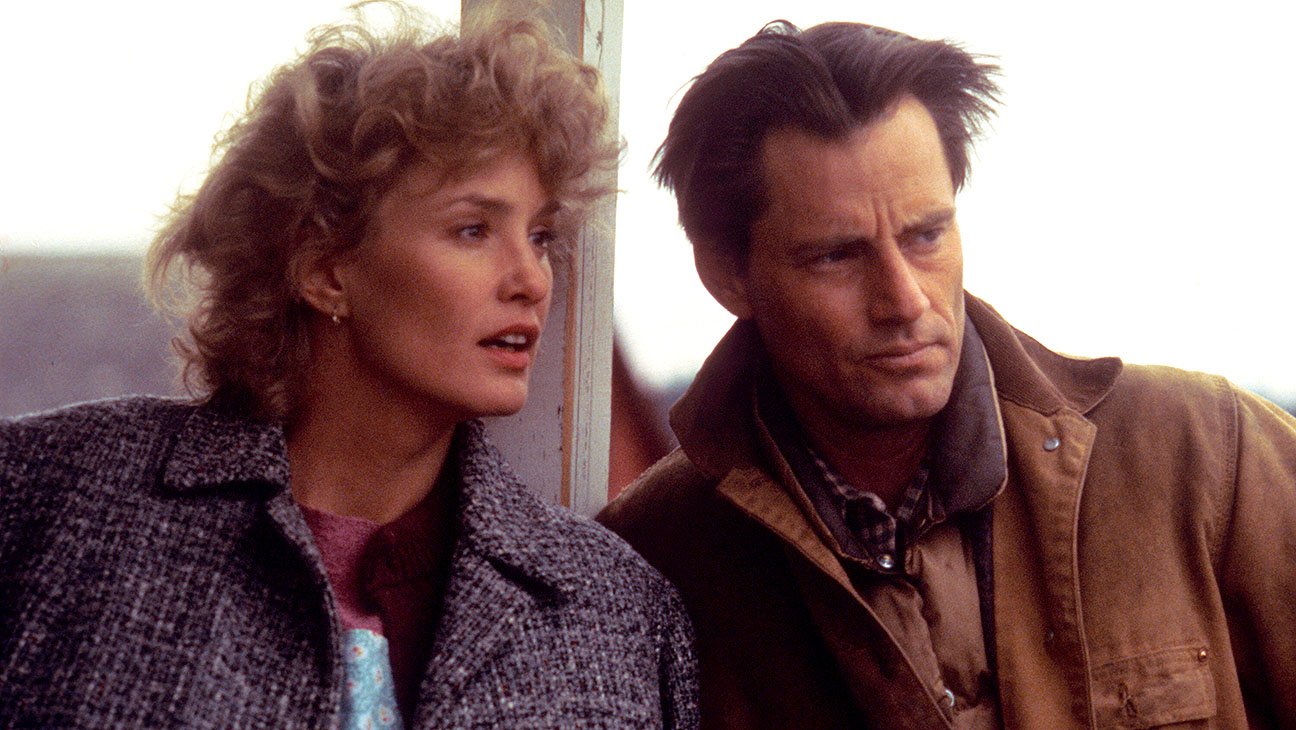
Jewel and Gil Ivey (Jessica Lange and Sam Shepard) operate an Iowa farm that has been in her family for generations. Her father Otis (Wilford Brimley) helps out, and the couple are raising teenager Carlisle, the younger Marlene, plus an infant.

Times are tough, the price of corn is low, and bankers represented by Tom McMullen (Matt Clark) apply pressure on the Iveys and adjacent farmers to start paying down debt or risk foreclosure. Gil buckles under the pressure, not helped by a drinking habit. It's left to Jewel to hold the family together and fight back to maintain control of her property.

Along with The River and Places In The Heart, Country was the third farm-based drama from 1984 featuring an A-list actress in the lead role. Jessica Lange does her part on this homestead, often looking out to the murky future somewhere in the mid-distance as she juggles an errant husband, a brooding child, a failing business, and a crusty father, all leading to drawing a line in the mud. That her final stand against evil banks is, at best, a pyrrhic victory is an apt summary of the film.

The William D. Wittliff script is more about concepts than plotting. Farming is a tough, underappreciated, and heavily leveraged way to make a living, politicians setting trade policies in faraway cities don't have a clue, and bankers are always slimy and can be downright mean in extending credit then pulling it back. The Iveys and their neighbors are plonked into these realities, and that's about it. An early tornado and later a capitulation to despair provide punch, but otherwise the family tensions arising from mounting financial pressure, exasperated by Gil's tendency to seek refuge inside beer bottles, are humdrum. 

Director Richard Pearce captures the mucky reality of life-in-boots, the sights, sounds, and almost smells of corn fields, livestock, sturdy pickup trucks, and extreme weather events jumping off the screen. Lacking dramatic thrust, Country settles for look and feel.


All Ace Black Movie Blog reviews are here.

Saturday, 28 May 2016

Movie Review: Tender Mercies (1983)


The story of a has-been country singer who hits rock bottom and has the opportunity to start climbing back up, Tender Mercies is an affecting film with its heart firmly in honest territory.

Deep in rural Texas, washed-up and divorced former country music singer and songwriter Mac Sledge (Robert Duvall) lands at the ramshackle motel owned by single mom Rosa Lee (Tess Harper) and her young son Sonny (Allan Hubbard). Mac is broke and drinking heavily, but Rosa Lee offers him a few dollars in return for helping her with odd jobs and staying sober. He sticks around, they grow attached to each other, and get married.

Mac settles uneasily into a life of sober domesticity, but the passion to write music never quite leaves him. When his ex-wife and country music star Dixie Scott (Betty Buckley) arrives on a tour stop nearby, Mac tries to reconnect with her and their teenage daughter Sue Anne (Ellen Barkin). Dixie's manager and Mac's old friend Harry (Wilford Brimley) is sympathetic, but Dixie wants nothing to do with Mac. As word of Mac's new life starts to spread to his former fans, he is drawn back to the world of music.

Directed by Bruce Beresford and written by Horton Foote, Tender Mercies is a small film with a compact story told with simple elegance. Beresford dives deep into the characters of Mac Sledge and Rosa Lee, and creates two textured characters at the crossroads of life. The film enjoys plenty of quiet moments filled with the authentic desire of life-hardened adults to get better and benefit from well-earned scars.

Making excellent use of wide open Texas scenery, Tender Mercies is beautiful to look at, and Beresford often contrasts the immense landscapes with his vulnerable characters. In this terrain there is no option not to struggle; characters like Mac and Rosa Lee will succeed or fail according to their willingness to invest in the hard work of fighting for happiness.

The film weaves in themes of religion, redemption, missing bonds between fathers and children, and the turmoil of early marriages gone wrong. None of the messages are heavy handed. Rather, Beresford allows his characters to accept the luggage on their back while looking ahead, and the film generates momentum from finding decision points where the past is either repeated or built upon. However, not all the elements quite work, and most of the scenes with young Sonny and his school friends are quite creaky.

The prevailing calm tone is best exemplified in one pivotal scene. Upset by his inability to get past Dixie's hostility, Mac goes AWOL on Rosa Lee and Sonny. They anxiously wait for him to return as he manically drives around the backroads, debating whether to drink, flee or find his way back. Should he dare go back to Rosa Lee, her reaction could determine both their futures. He does return, and the welcome he receives says everything about two adults applying life's lessons towards the potential for a better tomorrow.

Robert Duvall finally earned his Best Actor Academy Award for his understated performance as Mac Sledge. Avoiding any excess of emotions, Duvall expresses a life full of regret and a future filled with dilemmas with quiet authority, Mac emerging as a believable man not running away from neither his flaws nor his dreams. In her feature film debut, Tess Harper is a revelation, matching Duvall and portraying the resourceful and independent woman who catches a plummeting soul and tries to reset him onto an even path.

Poignant and fully respectful of its culture, Tender Mercies is as melancholy as a heartfelt country music song.


All Ace Black Blog Movie Reviews are here.


Thursday, 2 July 2015

Movie Review: Brubaker (1980)


A slow burning prison drama, Brubaker portrays a noble fight against a corrupt system but lacks the depth of character needed to sustain its weighty intentions.

In the late 1960s, a new group of prisoners arrives at the derelict Wakefield State Prison in Arkansas. Among them is a quiet man (Robert Redford) who says little and observes a lot. He witnesses crumbling infrastructure, inhumane conditions and a brutal system of prisoners designated as trustees regularly abusing inmates with whippings and torture. Meanwhile the warden and his administrators are either absent or uncaring. When he stumbles upon a detainee in solitary confinement (Morgan Freeman) threatening to start a riot, the quiet man reveals himself to be Henry Brubaker, the new reformist warden of the prison, appointed with the help of politician Lillian Gray (Jane Alexander).

The idealistic Brubaker takes over the running of the facility, sets about to improve living conditions and appoints a couple of the more dependable prisoners as trustees, including Dickie (Yaphet Kotto) and Bullen (David Keith). He uncovers a racketeering operation based out of the prison grounds, and corruption that extends well outside the prison walls: the surrounding community depends on the prison for slave labour and a steady stream of revenue from contracted projects that are shoddily delivered. By disrupting the long-established status quo Brubaker finds himself at odds with state prison board officials, including chairman John Deach (Murray Hamilton). Things get a lot worse when a long-term prisoner reveals an ever darker secret about what goes on at Wakefield.

Director Stuart Rosenberg returns to the prison milieu he helped to make famous with Cool Hand Luke, but this time it is the warden rather than a prisoner who shakes up the system. Written by W. D. Richter, Brubaker is loosely inspired by the real-life experiences of warden Thomas Murton and the 1967 Arkansas prison scandal. The film settles down to 132 minutes of oppressive drama where prison life is either bad or worse, the mood is grim and prospects bleak. Brubaker's progressive energy represents a thin ray of hope. But gradually he comes to realize that as difficult as it is to make changes within the prison walls, it's the fight against the broader community, benefitting from the prison as a source of slave labour and fraudulent contracts, that represents the greater challenge.

Within the prison the film is dominated by a large number of desperate men abandoned in dilapidating conditions, while the businessmen and politicians on the outside are determined to leave an existing economically advantageous arrangement alone. Rosenberg and Richter successfully build up a system seemingly too entrenched for one man to take on, and then let their hero loose to try and knock down a sturdy wall built on exploitation and abuse.

Cinematographer Bruno Nuytten colours the film in dark blues, greys and black, creating a bleak, grimy and frequently damp environment whether the action is inside the old buildings, on the expansive grounds, or within the depressed community. This is a film drenched in the pessimism of a broken system, and the tone rarely varies.

While mentally engaging, Brubaker rarely stirs the soul. The central character is too monotonal in his quest to do good, and little is offered in the way of character depth or evolution. Redford's performance starts and stops with a dogged determination, and does not change in the face of insurmountable odds.

The trustees and prisoners are plentiful, and that is a problem. Rosenberg is unable to carve out any individual identities beyond the most rudimentary sketches, and in the absence of characters with compelling depth, the film does drag. While David Keith as Larry Lee Bullen comes closest to finding a personality, Murray Hamilton and Jane Alexander have plenty of screen time but not many opportunities to step beyond their predictable character boxes. In addition to Morgan Freeman in his first credited role, stalwarts M. Emmet Walsh and Wilford Brimley have relatively minor appearances.

Brubaker has the right intentions and a worthwhile story, but lacks the spark needed to truly break out of the prison walls.


All Ace Black Blog Movie Reviews are here.


Saturday, 28 July 2012

Movie Review: Absence Of Malice (1981)


In the afterglow of the newspaper industry's greatest movie triumph as captured in All The President's Men, the other, darker powers of the press received a grilling in Absence Of Malice. The destructive powers of wayward journalism are examined in a partially muddled film that gets sidetracked too easily and trips over its own attempted cleverness.

Newspaper journalist Megan Carter (Sally Field) gets an inside scoop about the investigation into missing union boss Joey Diaz: the police task force is focusing on Michael Gallagher (Paul Newman), the son of a notorious underworld crime boss, as a possible suspect. Carter runs with the story, naming Gallagher despite no evidence linking him to the Diaz disappearance. With union bosses refusing to deal with him while he is under a cloud, Gallagher's legitimate business is ruined.

Intent on finding out how she got her story, Gallagher pursues Carter, but she refuses to reveal her sources. Gallagher's friend Teresa Peron (Melinda Dillon) steps forward to reveal that she can vouch for Gallagher's innocence, but a tragedy is triggered when her story is made public, further straining the relationship between Michael and Megan. Nevertheless they embark on a romance, while Gallagher hatches a plan to turn the tables on the press, the Diaz case investigators, and the District Attorney's office.

Absence Of Malice raises a few good points, grappling with serious questions as to when and why does a story become fair game, the merits of the public good against the rights to privacy, and the bumpy relationship between criminal investigations and the press.

But the film also suffers from self-inflicted wounds, director Sydney Pollack uncharacteristically allowing many distractions to reduce the overall impact. Cramming an awkward romance, lazy journalism, a Hoffa-style missing union boss mystery, a scandalous abortion, a press-triggered suicide, sprinkles of commentary about feminism, and finally a clumsy turning-of-the-tables sting results in a narrative that spreads in all directions, none of them effective.

There are long scenes of dialogue between Michael and Megan that start nowhere and spiral only downwards, with their romance artificially sparking regardless of the lack of wit and their continuous bickering. Newman and Field never find anything resembling chemistry, and that the stuttering affair between them ends up occupying the most amount of screen time is evidence of the film's lost focus.

Newman is stony-faced but at least convincing as a private man thrust into the unwanted public limelight. Field struggles throughout, simply lame as a journalist who turns opportunities into mistakes, demonstrating poor judgement at every turn. Field is equally implausible as a romantic partner for Newman, doing absolutely nothing to gain his affection after brutalizing his life.

The Absence Of Malice supporting cast is strong and helps to carry the film through its rougher patches. A highlight is Wilford Brimley as an Assistant Attorney General and designated mess cleaner, memorably bursting into the story in the final 15 minutes with a formidable energy. Melinda Dillon has a short but effectively melodramatic role, a woman with all the doors in her life already closed and the final window about to be slammed shut. Bob Balaban as the Diaz task force leader and Don Hood as the District Attorney add single-mindedness and some self-righteous sleaze.

Absence Of Malice tries to be an important film about serious topics. It succeeds sporadically, but bites off more than it can chew and chokes on some of the essential nutrients.


All Ace Black Blog Movie Reviews are here.


Tuesday, 3 July 2012

Movie Review: The Electric Horseman (1979)


A mild romance wrapped in an anti-authoritarian message, The Electric Horseman is a rather tepid third teaming of Robert Redford and Jane Fonda. The film makes its point early, and then struggles to find much momentum on the way to an obviously contrived scenario of opposites attracting.

Retired former rodeo champion Sonny Steele (Redford) is the national spokesperson and commercial face for a breakfast cereal peddled by a major corporation. To cash his cheque, Sonny has to stay sober enough to briefly ride a horse around in circles at country fairs, dressed in a hideous outfit featuring strings of lights. The CEO (John Saxon) has grander plans to expand market share by using the thoroughbred horse Rising Star as another company selling point.

At a corporate convention in Las Vegas to unveil the horse to the gathered media, Steele discovers that Rising Star is being mistreated and injected full of drugs. He decides to free the horse from its fate, and causes a stir by riding away on the Strip and into the desert. With the authorities desperately looking for Steele and the precious horse, television reporter Hallie Martin (Fonda) is the first to track him down and get his story.

The Electric Horseman takes plenty of shots at corporations milking celebrities to peddle product, and delivers an equal number of insults to has-beens who prolong their earnings by accepting endorsement cheques from the highest bidders. The anti-corporate message is the focus of the first half, but only a back-drop for the second half, which settles into standard romance fare between the simpleton cowboy with a cause and the urbane reporter seeking a story. Of course they start off as adversaries with nothing in common and plenty of fabricated tension, but gradually she falls for his spell.

Fonda essentially repeats her television reporter role from The China Syndrome, her other 1979 film. But rather than uncovering a dangerous conspiracy that could unleash a nuclear disaster, in The Electric Horseman she tracks down an ageing cowboy determined to set a horse free.  For the Fonda persona, it's an obvious downgrade in reporter assignments, but this does not prevent Fonda from munching into the role with the steadfast belief that the world should care deeply about one overpriced horse and a washed up cowboy.

Redford fares better as Sonny Steele, an early recruit into the ranks of corporate sell-outs. The problem with Steele is that he is all too aware that he has sold out, and is more than ready to drown his sorrow in the bottle. But whereas he does not mind his name becoming a joke, he draws the line at a thoroughbred horse having to suffer the ignominy of representing corporate greed. Redford finds the edge where a former champion wakes up from his slumber to champion a new cause, and combines the rough with the well-meaning to overcome his adversaries with wit and wisdom.

Director Sydney Pollack and cinematographer Owen Roizman make the most out of a Las Vegas that hosts sleazy suits and their slick profit motives, and they excel in capturing the scenic countryside as Sonny and Hallie make their way to the canyon where Rising Star is to be released. Most of the second half of The Electric Horseman is a walk-and-ride slow journey through attractive scenery, allowing plenty of time for romance to blossom, and the film at least looks good as it kills the time with not much really happening.

Valerie Perrine as Sonny's ex-wife, Wilford Brimley as a rancher who helps Sonny escape, and Willie Nelson as an old and eccentric friend make spot appearances and add some colour.

The Electric Horseman is comfortable in its predictability, harmlessly vanilla in its delivery, and with just enough star power to keep the horse amblin' along.


All Ace Black Blog Movie Reviews are here.


Thursday, 3 May 2012

Movie Review: The Thing (1982)


A gorefest in Antarctica, The Thing recreates the premise of Alien with more yuck but no soul. The result is a film that occasionally impresses by amping up the disgustometer, but otherwise disappoints with a hollow heart.

A Norwegian helicopter with two men on board desperately tracks down and tries to kill an escaping dog in the desolate snow fields of Antarctica. The dog survives and leads the chopper into a nearby American research base, where the dog takes refuge and the Norwegian scientists end up dead.

The American compound includes the stand-offish helicopter pilot MacReady (Kurt Russell) and the resident doctor Blair (Wilford Brimley), along with an assortment of scientists and technicians. They investigate the Norwegian base and find it abandoned and destroyed, and also find evidence that the Norwegians unearthed an alien spaceship, buried in the ice for ages. It turns out that an alien Thing, capable of impressive shape-shifting and extreme violence, was awoken by the Norwegians, and after killing most of the humans impersonated the dog. Now the Americans are being killed one by one, and since the Thing takes the form of its latest victim, the survivors don't know who among them is the predator.

The Thing does enjoy its moments, with plenty of explosions, fires, flame-throwers, dynamite, and sudden chills and thrills. Kurt Russell moves through the carnage with a steely-eyed intent to survive and an agility to match the murderous, all-devouring and inexplicable monster.

But in the rush to the gooey gore, director John Carpenter skips over a few essentials, such as establishing some characters and tension. Not even the most rudimentary backstory is presented for any of the main protagonists. MacReady is cool and detached just because he is, and the rest of the base residents may as well just take a number from a wall-mounted dispenser and wait to be attacked or killed. The failure to build any genuine tension is equally unforgivable, the film alternating between mundane scenes of the survivors getting on each others' nerves, stumbling around in the snow, and being suddenly devoured by the Thing with blood and guts spraying everywhere.

An Ennio Morricone music score promises much but delivers little.

The Thing is left to offer brilliant, stomach-churning special effects of dismemberment and agonizing death, but it could have delivered so much more. Although the film is technically admirable, it is as emotionally cold as the desolate setting.


All Ace Black Blog Movie Reviews are here.


Tuesday, 7 February 2012

Movie Review: The Firm (1993)


A sprawling legal epic, The Firm is a smart thriller that veers away from the excesses of the genre in favour of emphasizing the human drama. An extraordinarily deep cast succeeds in maintaining interest over the 150 minutes of running length.

The Firm has a simple premise with complex details. Young Harvard law school graduate Mitch McDeere (Tom Cruise) has his pick of job offers from all the top law firms, but the boutique Memphis firm of Bendini, Lambert and Locke make him an offer he can't refuse. Lured by a high salary, a large house and a luxury car, Mitch moves to Memphis with his wife Abby (Jeanne Tripplehorn). The firm assigns senior lawyer Avery Tolar (Gene Hackman) to mentor Mitch, and soon they are jetting off to the Cayman Islands to provide tax advice to shady characters. Mitch is seduced at the beach by a local beauty, an encounter that yields conveniently compromising photos that the firm can use against him as needed.

Mitch soon learns the firm mostly provides money laundering services to the mob. When two lawyers are blown up for planning to quit, FBI agent Wayne Terrance (Ed Harris) starts sniffing around, and Mitch is fingered as a potential inside man who can collect the evidence to bring the corrupt lawyers down. With head of security (Wilford Brimley) and his henchmen on his tail, Mitch has to plan the destruction of his employer while saving his career.

The Firm's drama centres around the conflict between three characters, brought to life by Cruise, Tripplehorn and Hackman. The relationship between Mitch and Abby McDeere is the first casualty of the firm's dominance, Mitch's long hours proving to be the lesser evil as the true nature of the client list is revealed and Mitch falls for the oldest trick in the book on the sandy beaches of the Cayman Islands. While Cruise and Tripplehorn make for a believable young couple, with Cruise's intense eyes working in his favour as the driven idealistic lawyer, Tripplehorn is slightly less convincing as Abby, both the role and the movie slightly exceeding her range.

As the McDeere marriage buckles, Avery is nurturing his relationship with Mitch, mentoring him in the fine art of tax evasion and smoothly sliding him into the role of the mob's lawyer. Hackman was born to play roles like Avery Tolar, the manipulative maverick who applies his own rules and plays both sides against the middle. The Firm makes its way to an interesting crossroads by ultimately matching Abby with Avery in a dangerous encounter pivotal to Mitch's survival, with both Abby and Avery risking everything, albeit in different ways, for the sake of Mitch's career.

Director Sydney Pollack surrounds Cruise, Tripplehorn, and Hackman with a stellar cast of stalwarts. Hal Holbrook, Wilford Brimley, Ed Harris, Holly Hunter, David Strathairn and Gary Busey flesh out every secondary character and help carry the load of a convoluted but sturdy story.

Too often, movie adaptations of legal thrillers degenerate into a rapidly mounting body count and stock chase scenes, chucking all reality to one side. While The Firm does not avoid all the pitfalls, it sidesteps most of them. The screenplay team of David Rabe, Robert Towne and David Rafiel deserve credit for adapting John Grisham's novel into a coherent movie that places characters ahead of stunts. The Firm keeps Mitch, Abby and Avery at centre stage, insecurities as prominent as abilities, and none of them suddenly develop the powers of secret agents.

At the core of The Firm is a young lawyer using his legal skills and intellect to find a way out the mess that he finds himself in, a welcome celebration of brains over brawn.


All Ace Black Blog Movie Reviews are here.


Saturday, 23 April 2011

Movie Review: The China Syndrome (1979)


Released 12 days before the nuclear power reactor incident at the Three Mile Island plant in Pennsylvania, The China Syndrome is fiction anticipating fact with chilling accuracy. It is also a well-made and thoughtful thriller, with tight pacing and excellent performances.

Reporter Kimberly Wells (Jane Fonda) and cameraman Richard Adams (Michael Douglas) are part of a local Los Angeles television crew compiling a documentary series on energy sources. While filming an informational segment at the Ventana Nuclear Power Plant, they inadvertently witness what looks like a serious incident: after an unexplained shudder, the control room staff, including shift supervisor Jack Godell (Jack Lemmon) and co-worker Ted Spindler (Wilford Brimley) are thrown into no small amount of panic as they deal with faulty valves and stuck gauges, narrowly averting a meltdown.

With another proposed nuclear power plant undergoing high-profile approval hearings, there is a rush to whitewash the incident and bring Ventana back on line. However, Godell is concerned enough to delve into the Ventana safety management procedures and uncovers falsified record keeping. Convinced that the plant will be unsafe if it is restarted, he agrees to share his findings with Wells. But Godell's life is soon in danger, as greater corporate forces move in to silence his whistle-blowing, culminating in a final confrontation between information and cover-up in the Ventana control room.

The China Syndrome sparkles with the understated cleverness of reality. Director James Bridges (who also co-wrote the script) eschews the  use of soundtrack music and never allows any of his characters to take on larger than life heroic proportions. Wells does not hide her vanity and acknowledges that although she is interested in serious stories, career climbing is just as important. Adams is a short-tempered and foul-mouthed idealist, destined to remain on the margins of influence. Even Godell, who could have been the most heroic of characters, falls apart at his critical moment.

The colourful details of life in a television newsroom are a delight, and the film avoids allowing the unfolding story to detract from the eccentricities of daily living, Wells struggling with her pet turtle as she answers the phone being typical of the depth that the film pursues to the end.

Jack Lemmon, Jane Fonda and Michael Douglas (who also produced the movie) provide a large dose of star power, and all three deliver controlled performances, staying within themselves and avoiding diva moments. The performances are key to enliven and maintain interest in what is mostly a talkfest: the brilliance of The China Syndrome lies in uncovering the threat of something horrible potentially happening at the nuclear plant -- nothing drastically wrong ever actually does happen, but lives are nevertheless lost in the battle between revealing and hiding information.

And while the nuclear angle rightfully gets all the attention, The China Syndrome not only predicted the age of nuclear power nightmares, it more tellingly foretold the era of the media cozying up ever closer to corporate interests and forgoing hard stories for soft puff pieces.

The China Syndrome is a richly successful example of one of the most difficult challenges that fictional movies can undertake: provocative investigations of potentially dangerous trends packaged in captivating entertainment.


All Ace Black Blog Movie Reviews are here.