Genre: Drama

All Ace Black Movie Blog reviews are here.

Reviews of Classic and Current Movies


In the present, the elderly Ann (Vanessa Redgrave) is near death, spending her last hours at home in bed being cared for by daughters Nina (Toni Collette) and Connie (Natasha Richardson). Nina is surprised when a semi-hallucinatory Ann recalls a man called Harris as her first love. Flashbacks reveal a seminal weekend from 50 years ago.
In the 1950's, Ann (Claire Danes) travels to a swanky Newport mansion to attend the wedding of her best friend Lila (Mamie Gummer). Ann reconnects with Lila's brother Buddy (Hugh Dancy), a frequently drunk aspiring writer who has harboured a crush on Ann since they were in college. Buddy introduces Ann to his friend Harris (Patrick Wilson), a handsome doctor. She is immediately smitten, but her romantic pursuit is complicated when she learns both Buddy and Lila may also be in love with Harris.
An adaptation of the book by Susan Minot, Evening is pretty as a postcard and just as disposable. Minot wrote the script with Michael Cunningham, and what may have worked on the page as thematic permission to seek self-kindness is cruelly exposed on the screen. Director Lajos Koltai exploits Ann's transitioning mental state to wedge trite mystical moments (stars, butterflies, a night nurse dressed in an angelic gown) into a stultifyingly inert narrative.Despite the presence of an all-star cast of women (Glenn Close and Meryl Streep also have small roles), the characters are consumed by ruinous judgment, overheated dialogue, and lethargic pacing circling the same miserable laments for two hours. The most incurable problems ironically stem from the men. Buddy is allowed to wreck multiple scenes as the obnoxious drunk heartbroken young man, and his exit, while meant to be tragic, is cheerworthy. Worse still is Harris, the doctor supposedly igniting everyone's passion reduced to a stone-faced non-presence with the personality of a brick wall.
Meanwhile back in the present, Nina (the free spirit) and Connie (the responsible homemaker) bicker according to the rules of stereotypical cinematic sisters, with an unexpected pregnancy thrown in to satisfy the circle of life. Vanessa Redgrave spends the entire movie in bed babbling about one weekend in her life and trying to separate reality from fantasy. Her fever dreams were undoubtedly more entertaining than this Evening.
All Ace Black Movie Blog reviews are here.
In Philadelphia, Rose and Maggie (Toni Collette and Cameron Diaz) are two sisters with very different personalities. When they were young, they lost their mom Caroline to suicide and were raised by their dad Michael (Ken Howard). Now Rose is a responsible adult and on a career path as a lawyer. Maggie never settled down, cannot hold a job, and relies on her looks to attract a succession of meaningless relationships.
The sisters have a serious bust-up after Maggie ruins Rose's latest relationship. Rose reassesses her priorities, becomes a dog walker, and explores a romance with former office colleague Simon (Mark Feuerstein). Maggie packs up and relocates to Florida, where she reconnects with her grandmother Ella (Shirley MacLaine), Caroline's mother. Ella lost touch with her granddaughters after Caroline's death, in part because of a dispute with Michael. Ella, Maggie, and Rose have to come to terms with the past as they try to forge new bonds.
Directed by Curtis Hanson and written by Susannah Grant (adapting Jennifer Weiner's novel), In Her Shoes is a heartwarming family mosaic. With good production values, plenty of supporting characters providing colour, and a steady stream of revelations, the 130 minutes easily breeze by. Some of the ups and downs experienced by sisters Rose and Maggie are familiar for sure, and the drive towards tidy resolutions borders on predictable, but the film does put in the work through sustained conflicts to earn the more sentimental moments.While the opening act initially hints at a flighty story, In Her Shoes quickly gains heft with sure-footed ventures into difficult topics. Caroline is only seen in photos, but her mental illness and suicide defined her daughters' childhoods, and the consequences resonate into their adulthood. Ella and Michael's contrasting attitudes towards Caroline's condition add a thony layer of complexity, while Maggie also has a reading disability stunting her ability to thrive. Hanson treats the mental health challenges with pragmatism, avoiding sappiness and allowing Rose and Maggie to come to terms with realities at their own pace.
In Her Shoes gains momentum as the characters make conscious - and internally logical - decisions to alter their trajectories. Difficult choices require somber acting, and the three leads deliver. Cameron Diaz in particular impresses, covering a wide range from shiftless to determined. Toni Collette provides an anchor as the more responsible sister but with her own emotional limits, while Shirley MacLaine delivers a restrained performance grounded in Ella's past regrets but also confidence in her ability to exert influence.
Several men ranging from dubious to promising orbit the three women, including a welcome appearance by Norman Lloyd as an elderly hospital patient who interacts with Maggie. Rose's ex-coworker Simon is more than a throwaway love interest, and demonstrates the effort required to prod Rose into genuinely believing she deserves a good partner rather than just another pair of shoes.
In Her Shoes features closets full of footwear, but is also stocked full of substance.
All Ace Black Movie Blog reviews are here.
In 1939, Stan Carlisle (Bradley Cooper) burns the body of his dead father and drifts across the land. He finds work with the traveling carnival owned by Bruno (Ron Perlman), where the main attraction is a geek show. Stan meets Zeena (Toni Collette), who runs a clairvoyant act with the perpetually drunk Pete (David Strathairn). Stan eyes the communication codes used by Zeena and Pete as his ticket to riches, and convinces performer Molly (Rooney Mara) to partner with him in both romance and business. He ignores warnings about the dangers of dabbling in the afterlife.
Stan and Molly find success with an upscale clairvoyant act in big city hotels, attracting the attention of conniving psychologist Dr. Lilith Ritter (Cate Blanchett). She agrees to an uneasy scheme, providing Stan confidential information about her wealthy clients Judge Kimball (Peter MacNeill) and the tycoon Ezra Grindle (Richard Jenkins), while he dupes them with fake seances. Molly disapproves of Stan's greed and intrusion into the spirit world, but he pushes ahead.
Directed and co-written by Guillermo del Toro, Nightmare Alley is an adaptation of the William Lindsay Gresham book, previously brought to the screen in a 1947 Tyrone Power classic. Here del Toro switches to colour, and with the help of Dan Laustsen's stellar cinematography delivers stunning beauty. Every scene is a masterpiece of picturesque framing and angular tension highlighting a noir psyche, although the glossy visuals threaten to slip into postcard artificiality.
Beyond the rich artistry, Nightmare Alley is bloated and unbalanced. The relatively simple rise-and-fall story of one man stretches to a tiresome 150 minutes, and often focuses on the wrong elements. It's a full one hour into the movie before Stan and Molly leave the carnival, and in that entire time, Zeena and Pete's show is never once presented as an effective act inspiring Stan's ambition. Once Stan and Molly achieve success, they are denied the thrill of commanding a room and instead are immediately reduced to a bickering couple. Without a reservoir of trust and affection, the rupture of their relationship loses impact.del Toro's favorite theme of monsters among us gets a good workout. The chicken-biting geek is a monstrous representation of comeuppance as a freak show with audiences marveling at how low a man can fall. Meanwhile, both Stan and Dr. Lilith struggle with insatiable urges for emotional domination and avarice, their monsters within engaged in dark battles of possession.
Cate Blanchett as Dr. Lilith adds a jolt of intrigue once she enters the movie about halfway through, finally presenting Stan with a soul more twisted than his own. But Lilith plays in a higher league: she is sophisticated, successful, and resourceful, while he is a scrappy small-timer with misguided delusions of grandeur. His initial victory in guessing the contents of her purse was never going to be anything more than beginner's luck, and she predictably designs his downfall with methodical relish.
In the lead role Bradley Cooper is adequate and charismatic without quite finding the necessary level of behind-the-eyes intensity. Rooney Mara is underutilized, and the rest of the cast includes small roles for Willem Dafoe and Mary Steenburgen.
Nightmare Alley is visually vibrant, but rarely visceral.
All Ace Black Movie Blog reviews are here.
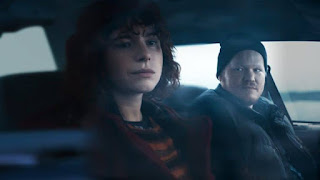
A young woman (Jessie Buckley) and her boyfriend Jake (Jesse Plemons) have been together for about seven weeks, and are now on a long drive in snowy weather to his parents' farmhouse. Although the young woman finds Jake interesting and smart, she has doubts about the relationship and is thinking of ending it. Tonight she will meet his parents for the first time over dinner. The snowstorm is expected to worsen, and the young woman is eager to return home afterwards to prepare for a busy week.
At the farmhouse, Jake's parents (Toni Collette and David Thewlis) exhibit strange behaviour, including showing up late to greet their guest. Then the young woman experiences bizarre shifts in time, the parents appearing at various stages of aging. In parallel scenes, an elderly night janitor mops the floors at a high school, while students rehearse dances from the musical Oklahoma!
An adaptation of the Iain Reid book written for the screen and directed by Charlie Kaufman, I'm Thinking Of Ending Things is an introspective and abstract reflection on expectations across time. In equal doses mesmerizing and maddening, the film meanders through an obtuse labyrinth dreamily detached from reality, enlivened by a pseudo-Gothic style hinting at horror but content with the joy of empty threats.
Kaufman weaves an often claustrophobic pattern unconcerned with familiar narrative rules. Before and after the dinner, plenty of time is invested in the car trips, and other than the incessant snow, the passing scenery is of no consequence. Instead, the young woman and Jake engage in long, often tediously self-conscious intellectual conversations and debates, the cameras zoomed in on the couple within the intimate 1.33:1 aspect ratio.Interrupting the two in-car segments is the dinner with Jake's parents, and here Kaufman reveals, in a nonchalant manner, the hallucinatory elements. A lot more is going on than just a young woman thinking of breaking up with her boyfriend, and most of it is inaccessible. The clues to the arcane psychological puzzle start with a title open to interpretation, and include cryptic fragments scattered inside the house and within the dialogue. Attempts at assembling a rational picture are doomed to frustration by intentionally convoluted perspectives.
Later, a pit-stop at an ice-cream stand prompts a detour to Jake's old high school. The couple's fraught adventure merges with the night janitor's experience, and Kaufman audaciously introduces new sharp and weird turns in both content and presentation.
Rather remarkably, the 134 minutes of running time pass by quickly, the edge of unease amplified by cautiously agitated performances from Jessie Buckley and Jesse Plemons. As the parents, Toni Collette and David Thewlis stretch into nervy territory.
Themes of compatibility, loneliness, regret, self-doubt, self-worth, and dominant cultural imprints intermingle. Ambiguously stimulating, I'm Thinking Of Ending Things welcomes free-form interpretation, with all the associated exasperation.
All Ace Black Movie Blog reviews are here.
Duncan (Liam James) is a quiet 14 year old, suffering through the getting-to-know-you phase with Trent (Steve Carell), the oily new boyfriend of his mother Pam (Toni Colette). Trent's older teenaged daughter Steph (Zoe Levin) is happy to ignore Duncan. The quartet head to Trent's summer vacation home near Cape Cod, where they meet vivacious neighbour Betty (Allison Janney) and her teenaged daughter Susanna (AnnaSophia Robb).
Trent and Pam start spending long hours with Trent's friends Kip and Joan (Rob Corddry and Amanda Peet), who own a pleasure boat. Left on his own and feeling like a complete misfit, Duncan wanders towards the cheesy Water Wizz water park where he meets carefree manager Owen (Sam Rockwell) and his co-worker/maybe girlfriend Caitlin (Maya Rudolph). Duncan's summer adventures start to improve when Owen takes him under his wing and Susanna attempts a friendship, but Trent's nauseating smarminess is never far away.
Co-written and co-directed by Nat Faxon and Jim Rash in their debut, The Way Way Back is a tender poke at that one memorable growing-up summer when misery, company and emotional growth collide. While the themes, incidents and overall mood of awkward bemusement bordering on despair are not necessarily new, Faxon and Rash mush enough cringey and hopeful moments together to build well-rounded characters.
Duncan is a mostly silent adolescent caught in the treacherously funny terrain between kid and adult, with that inherent perceptive child's ability to see right through Trent's facade and into his rotten core. That mom Pam is not ready to acknowledge her new boyfriend is a scumbag only makes Duncan more miserable, along with the indignity of being the only person having to wear a flotation device on the boat.But a summer of long days also offers unexpected opportunities for positive encounters. Owen is a man jealously safeguarding his inner teenager's attitude towards life, and recognizes that Duncan just needs a nudge of belief and surrogate fatherhood to break out of his shell. Meanwhile Susanna is attempting to avoid getting blown away by the hurricane generated by her mom Betty, and sees Duncan as a calm harbour worth exploring.
Faxon and Rash create a modest middle class beachside community teetering between fading small town charm and suburban dullness, a place where every family is broken, breaking, or patched-up, and the dilapidating water park still attracts a crowd although the beach is minutes away. In this milieu Sam Rockwell is the standout performer, having a blast as a caring man perfecting the couldn't-care-less schtick. Liam James speaks volumes with pained expressions of emotional torture and few words. Steve Carell oozes barely disguised toxins, while Allison Janney allows easily excitable neighbour Betty to take flight.
The Way Way Back zooms through the twists and turns of water park tubes, dark places to navigate on the way to a bright new splash.
All Ace Black Movie Blog reviews are here.
Private John Bartle (Alden Ehrenreich) returns from the Iraq War traumatized by what happened to his friend Private Daniel Murphy (Tye Sheridan). Flashbacks reveal the friendship between the two men developing from their training days under the guidance of Sergeant Sterling (Jack Huston) through to deployment and various difficult under-fire episodes.
Now Bartle refuses to communicate with his mother Amy (Toni Collette) and avoids Captain Anderson (Jason Patric), who is investigating what happened to Murphy. Meanwhile Murphy's mother Maureen (Jennifer Aniston) is desperate to learn her son's fate.
Battlefield mysteries and post traumatic stress disorder stories inspired by American involvement in Middle East wars have already featured in productions of various quality including Courage Under Fire (1996), Jarhead (2005), In The Valley Of Elah (2007), The Hurt Locker (2008), Stop-Loss (2008), Brothers (2009) and American Sniper (2014). Lacking anything new to say, The Yellow Birds unfortunately flies in lazy circles, unsurprisingly failing to extract any fresh drama from shrivelled material.
Director Alexandre Moors and writers David Lowery and R.F.I. Porto, adapting the Kevin Powers book, assemble the tired pieces with minimal heart and soul, resulting in a depressing and derivative tone. The time jumps between Bartle's present doldrums and his earlier training and battlefield encounters do little to camouflage the threadbare content. The resolution of Murphy's story adds to the sense of abject narrative incompetence, given the well-established value of a captured soldier in enemy hands.
The visuals are adequate, the action scenes in the dusty streets of Baghdad (filmed in Morocco) are rationally edited, and the cast members are better than their limited character definitions, with Huston and Patric particularly wasted. But despite some decent flaps, The Yellow Birds bumbles away into forgettable air.
All Ace Black Movie Blog reviews are here.