All Ace Black Movie Blog reviews are here.
Reviews of Classic and Current Movies


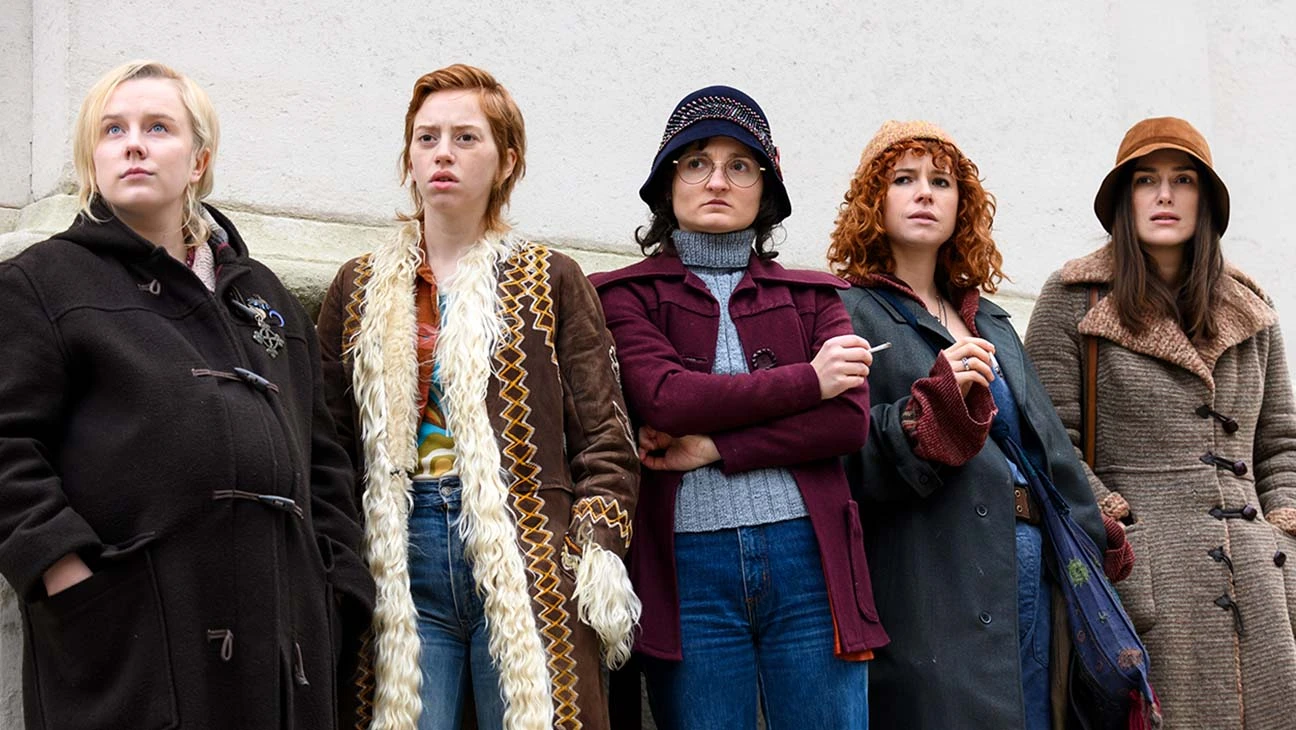
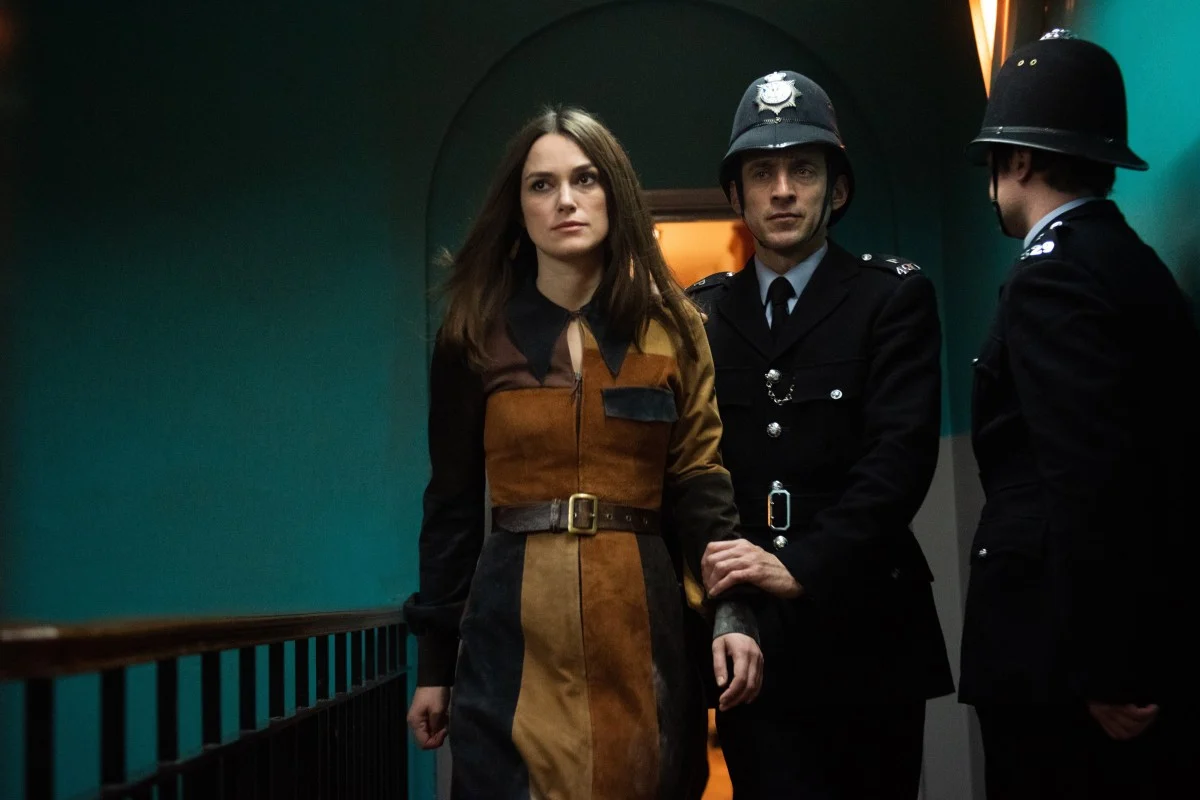
In the lead-up to the 1970 Miss World contest in London, mature college student Sally Alexander (Keira Knightley) is divorced and living with her partner Gareth and mother Evelyn. She befriends activist Jo Robinson (Jessie Buckley) and joins the fledgling women's liberation movement. Their group decides to protest and disrupt the Miss World pageant as an event that objectifies women.
Eric and Julia Morley (Rhys Ifans and Keeley Hawes) are the husband-and-wife Miss World organizing team. To counter allegations of support for apartheid, they invite South Africa to send two contestants, one Black and one white. They also add Grenada's Prime Minister as a judge, placing Miss Grenada Jennifer Hosten (Gugu Mbatha-Raw) in the spotlight. The Morleys secure the services of Bob Hope (Greg Kinnear) as host; his wife Dolores (Lesley Manville) is less than thrilled, given Bob's penchant for womanizing.
The 1970 Miss World event turned into a flashpoint for allegations of sexism, racism, and corruption. In addition to the protests by the women's liberation movement, the pageant also featured the clumsy spectacle of multiple entrants from South Africa. Most famously - and ignored by this movie - the outcome was considered a scandalous fix.In chasing after all the threads, Misbehavior is spiced with dry humour and never less than engaging. Director Philippa Lowthorpe juggles multiple perspectives, and the stellar production design recreates early 70's London and the glitzy Miss World stage, evoking a merger of the old, the new, and the soon to be ridiculed. The background context presents women as the primary audience of beauty pageants, with the chasm between Sally and her mum representing a generational fault line.
But with so much to chew on, it's understandable that writers Gaby Chiappe and Rebecca Frayn stumble. The narrative is spread too thin, with the wrong people getting too much attention. Four viewpoints compete for screen time: Sally and Jo's women's lib activities; Eric and Julia Morley organizing under a gathering storm; Bob and Dolores Hope navigating a cloud of passive aggressiveness; and Jennifer Hosten's backstage interactions with other contestants, notably Miss Africa South and frontrunner Miss Sweden.
Out of these stories, the grinding antagonism between the Hopes is out of place. Hollywood celebrities with wandering eyes is an old old and tired story, and here it just takes away from more important era-relevant events. Lawthorpe also spends unnecessary time with the Morleys and the organizers' buffoonish backstage antics. The performances are steady but confined to limited notes, with only Sally Alexander emerging from the clutter with a semblance of a backstory, while several of the other women are reduced to wallpaper. Misbehaviour captures a time and place, but with a wobbly coronation.

All Ace Black Movie Blog reviews are here.
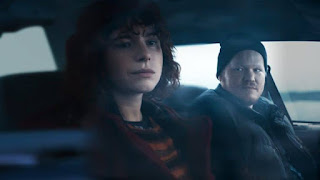
A young woman (Jessie Buckley) and her boyfriend Jake (Jesse Plemons) have been together for about seven weeks, and are now on a long drive in snowy weather to his parents' farmhouse. Although the young woman finds Jake interesting and smart, she has doubts about the relationship and is thinking of ending it. Tonight she will meet his parents for the first time over dinner. The snowstorm is expected to worsen, and the young woman is eager to return home afterwards to prepare for a busy week.
At the farmhouse, Jake's parents (Toni Collette and David Thewlis) exhibit strange behaviour, including showing up late to greet their guest. Then the young woman experiences bizarre shifts in time, the parents appearing at various stages of aging. In parallel scenes, an elderly night janitor mops the floors at a high school, while students rehearse dances from the musical Oklahoma!
An adaptation of the Iain Reid book written for the screen and directed by Charlie Kaufman, I'm Thinking Of Ending Things is an introspective and abstract reflection on expectations across time. In equal doses mesmerizing and maddening, the film meanders through an obtuse labyrinth dreamily detached from reality, enlivened by a pseudo-Gothic style hinting at horror but content with the joy of empty threats.
Kaufman weaves an often claustrophobic pattern unconcerned with familiar narrative rules. Before and after the dinner, plenty of time is invested in the car trips, and other than the incessant snow, the passing scenery is of no consequence. Instead, the young woman and Jake engage in long, often tediously self-conscious intellectual conversations and debates, the cameras zoomed in on the couple within the intimate 1.33:1 aspect ratio.Interrupting the two in-car segments is the dinner with Jake's parents, and here Kaufman reveals, in a nonchalant manner, the hallucinatory elements. A lot more is going on than just a young woman thinking of breaking up with her boyfriend, and most of it is inaccessible. The clues to the arcane psychological puzzle start with a title open to interpretation, and include cryptic fragments scattered inside the house and within the dialogue. Attempts at assembling a rational picture are doomed to frustration by intentionally convoluted perspectives.
Later, a pit-stop at an ice-cream stand prompts a detour to Jake's old high school. The couple's fraught adventure merges with the night janitor's experience, and Kaufman audaciously introduces new sharp and weird turns in both content and presentation.
Rather remarkably, the 134 minutes of running time pass by quickly, the edge of unease amplified by cautiously agitated performances from Jessie Buckley and Jesse Plemons. As the parents, Toni Collette and David Thewlis stretch into nervy territory.
Themes of compatibility, loneliness, regret, self-doubt, self-worth, and dominant cultural imprints intermingle. Ambiguously stimulating, I'm Thinking Of Ending Things welcomes free-form interpretation, with all the associated exasperation.
All Ace Black Movie Blog reviews are here.
Middle-aged literature professor Leda Caruso (Olivia Colman) of Cambridge, Massachusetts, arrives for a vacation in Greece. She takes a room at the hotel managed by grizzled American Lyle (Ed Harris). At the nearby small beach where Will (Paul Mescal) runs the concession, Leda observes vacationing young mom Nina (Dakota Johnson) struggling with her demanding daughter Elena. Nina reminds Leda of her own frustrating days as a young mom (Jessie Buckley) juggling graduate studies with caring for two daughters.
Nina is part of a vacationing family from Queens with roots in Greece. Her shifty husband Toni (Oliver Jackson-Cohen) controls businesses in the area, and is frequently absent, leaving Nina bored and interested in Will. Nina's sister Callie (Dagmara Domińczyk) is pregnant, and her direct conversational style clashes with Leda's desire for solitude. Elena briefly goes missing at the beach, causing momentary panic. Leda intervenes, inserting herself into Nina's orbit while memories of the past continue to haunt her.
An excellent directorial debut for Maggie Gyllenhaal, The Lost Daughter is a soulful treatise on womanhood and the burden of childcare. Gyllenhaal adapted the novel by the anonymous Italian writer Elena Ferrante, and with help from a mesmeric Olivia Colman focuses beautiful lyricism on often neglected topics.

The intersecting experiences of Leda, Nina and Callie explore motherhood from the multiple prisms of the past, present, and future, resulting in an impressive narrative scope. Mothers' insecurities, unsatisfied desire, and sense of inadequacy, along with the incessant demands of children, husbands getting away with doing less, and the seeming impossibility of juggling parenting with a career, all surface in haunting shadows. Leda observes Nina embarking on a familiar path, then moves from quiet bystander to a version of meddling, driven by a complex mix of caring, selfishness, arrogance, and self-righteousness. The past and present come together, Gyllenhaal interspersing the flashback scenes in just the right doses to artfully round Leda into a genuine and memorably flawed individual.The drama unfolds through powerful naturalistic behaviours and familiar human dynamics. The vacationing Leda is not much of a people person, and a lot of what happens in Greece is conveyed through silent pauses. Olivia Colman expresses a range of emotions by under-communicating, Leda pulling back into a stern stance when faced with Callie's inquisitions. Her sense of entitlement does erupt in petty self-defeating episodes, first refusing to relocate her beach position to accommodate a family's needs, later picking a fight she cannot win with a group of disruptive youth.
Sexual desire at various life stages is another common theme. Young Leda and Nina are both unsatisfied with their husbands, and as they navigate child care responsibilities, they both seek better male companionship. And now Leda finds men like Lyle and Will potentially interested in her as a project and an enigma, but not necessarily as a person.
At 121 minutes the movie is marginally over-long, some scenes repeating the same notes, others altogether unnecessary. But in the final act, Leda's motivations and self-awareness come into sharp focus. In a moving acknowledgement of frailty, The Lost Daughter couples crushing responsibility with disruption of emotional balance, the consequences rippling into the future.

All Ace Black Movie Blog reviews are here.