Showing posts with label Daryl Hannah. Show all posts

Tuesday, 2 October 2018

Movie Review: Splash (1984)


A fantasy romantic comedy, Splash succeeds in creating an unlikely love story between a mermaid and a man.

As an eight year old, Allen Bauer fell off the Cape Cod ferry and had a weird underwater encounter with a young mermaid. 20 years later Allen (Tom Hanks) is running a fruit distribution business in Manhattan with his obnoxious brother Freddie (John Candy), and not much of a believer in love. After another mishap at sea again near Cape Cod, Allen is rescued by the same, now grown mermaid (Daryl Hannah). She finds his wallet and decides to track him down, her tail turning to legs once on shore.

Allen is startled by the beautiful and initially naked woman who latches onto him, and he is blissfully unaware she is a mermaid. She learns English in one afternoon by watching television, they fall deeply in love, and he gives her the name Madison. Meanwhile, volatile scientist Dr. Walter Kornbluth (Eugene Levy) has spent his entire career trying to prove the existence of mermaids. He is hot on Madison's tail, so to speak, eager to reveal her true nature.

Directed by Ron Howard and produced by Brian Grazer, Splash sounds ridiculous, and indeed the script was roundly rejected before Disney picked it up for their new more adult-oriented Touchstone marque. And thanks to Howards' deft touch, Hanks' everyman persona and Hannah's curious innocence, the film simply clicks. Comedy and romance come together in an irresistible and most literal fish-out-of-water tale, boosted by smooth special effects and crystal quality underwater scenes.

With buoyant irreverence the film plays with the theme of love emerging from the unlikeliest of places, romance blossoming from within the ocean despite Allen being terrified of water. Other percolating ideas include New York as a city that welcomes all aliens, the unintended usefulness of useless television, and government types as military-happy incompetent meddlers (and here Splash borrows from E.T.).

Not everything about Splash quite works, and the weaker moments find Howard catering to more base instincts. The ending introduces an unnecessary chase featuring military trucks full of soldiers running around, and some of Freddie's antics belong in a more lowbrow comedy. Levy's performance is also free of any nuance. And in making Madison exceptionally libidinous Splash does surrender to the male fantasy of the beautiful, available and innocent woman draping herself all over an unsuspecting man.

But thankfully, most of the film is centred on Allen and Madison as a compatible match, and both are entranced by a sense of discovery. He is falling genuinely in love for the first time, and she is discovering life on land, and their relationship is strengthened by the shared sense of wonder about what is possible. Splash may be a fishy love story, but its tail is in the right place.


All Ace Black Blog Movie Reviews are here.


Sunday, 2 July 2017

Movie Review: High Spirits (1988)


An inane comedy, High Spirits wastes an impressive cast on a juvenile story smothered by a glut of special effects.

In Ireland, the dilapidated Plunkett Castle is facing foreclosure. In desperation, owner Peter Plunkett (Peter O'Toole) decides to leverage the castle's reputation for ghosts and sell a phoney experience to unsuspecting tourists. He trains his staff to play-act the roles of goblins and witches. The first batch of American tourists arrive, including bickering couple Jack and Sharon (Steve Guttenberg and Beverly D'Angelo), as well as a wannabe priest (Peter Gallagher), a nymph (Jennifer Tilly) and a ghost skeptic.

After the fake ghost theatrics prove disastrous, Jack encounters the real ghost of Mary Plunkett (Daryl Hannah), who was murdered on her wedding night by jealous husband Martin Brogan (Liam Neeson) 200 years ago. Jack and Mary fall in love, but have to find a way to be together.

Written and directed by Irishman Neil Jordan, who was fresh off the success of the acclaimed Mona Lisa, High Spirits is what happens when Hollywood throws too much money and influence too soon at an up-and-coming director. Jordan is allowed free reign to inject a lot of Irish and an overdose of special effects into the project, and High Spirits is an unmitigated disaster. Jordan claims the film was butchered by the studio during editing, but it's difficult to imagine any salvageable version emerging from this mess.

The level of overacting is difficult to believe, High Spirits coming across as an ill-conceived macabre play directed at children. All the actors scream their lines, over-emote to distraction, run around as if their hair is on fire, fall down the stairs in antics that stopped being funny in the 1930s, and generally act stupid. They are surrounded by a non-stop stream of cheesy and excessive special effects overused in a manner to suggest grown men were given new technology toys and lacked the basic maturity to apply them in considered doses.

Loud, boring, devoid of laughs and fundamentally lacking any redeeming moments, High Spirits is a colossal fiasco.


All Ace Black Blog Movie Reviews are here.


Friday, 25 December 2015

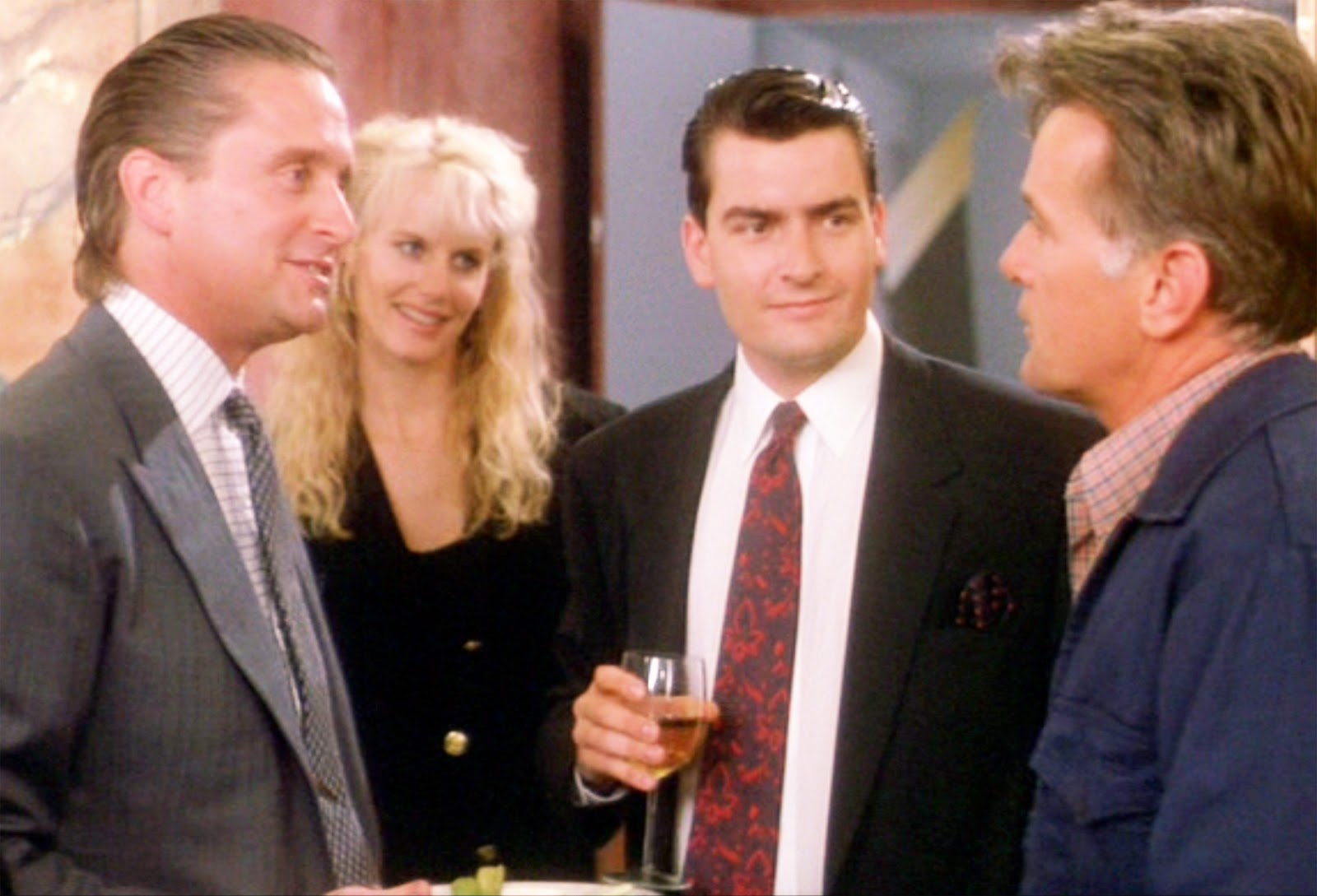
Movie Review: Wall Street (1987)


A dynamic, glitzy drama set in the world of super-rich investors, Wall Street is both a celebration and condemnation of capitalism's worst excesses. Oliver Stone creates a dazzling story of wealth gone mad, a playground for egotistical men where profits rule, the stakes are routinely measured in millions, and the careers of ordinary mortals are cheaply bought and discarded.

Bud Fox (Charlie Sheen) is a young but ambitious stockbroker at a middling Manhattan investment firm, still making cold calls to try and build up a client base. His father Carl (Martin Sheen) is a humble and honest aircraft maintenance crew chief at Bluestar, a fledgling airline. Bud's persistence finally pays off when he lands the extremely wealthy and ruthless corporate investor Gordon Gekko (Michael Douglas) as a client. Gekko likes what he sees in Bud, and takes him under his wing, exposing him to the power of inside information, the art of taking over corporations and breaking them up for great gains, and a world where obscene amounts of short-term profits can be derived from high-stakes stock price manipulation.

Gekko: The most valuable commodity I know of is information.

Bud's education includes meeting Sir Larry Wildman (Terence Stamp), an even wealthier investors and one of Gekko's chief rivals in the global corporate take-over game. Buoyed by success and fueled by Gekko's money, Bud starts tapping his college friends, including lawyer Roger Barnes (James Spader), to seek insider tips on upcoming mergers, and to set up bogus trading accounts to hide his activities from the Securities and Exchange Commission. Now very rich, Bud's life is fully transformed. He buys a swanky apartment and starts a serious relationship with glamorous interior designer Darien Taylor (Daryl Hannah). But when one of Gekko's upcoming deals threatens to hit close to home, Bud has to finally decide who he really is.

Gekko: What's worth doing is worth doing for money.

Fresh from the success of 1986's Platoon, director Oliver Stone moves from the jungles of Vietnam to the equally treacherous and shadowy terrain occupied by the manipulators of the global finance system. Wall Street is high-paced, magnetic and seductively glossy. Tracing the arc of  protagonist Bud Fox, Stone steps behind the curtain and into the offices of the power brokers who actually determine the winners and losers on Wall Street. It is a place both difficult to resist and absolutely corrupt, free of quaint principles related to morality and humanity, and driven solely by greed and profit.

Stone succeeds in making the world of Gordon Gekko fabulously attractive. For ambitious young men like Bud Fox, it's not difficult to be sucked into the promise of a life filled with limousines, lavish restaurants, expensive suits, glamorous women, high-end real estate and millions in the bank. It's a castle in the sky floating on high-stakes gambling with the odds tilted in favour of the Gekko's who profit from widespread malfeasance, and Stone builds up the allure with plenty of pizazz.  It's not easy to make financial transaction look exciting, and Stone pulls it off with energetic camera work and in-your-face scenes capturing the frenzy of the trading floors and the adrenaline rush of deal making in real time.

Gekko, talking to Bud: Wake up, will ya, pal? If you're not inside, you're outside, okay? And I'm not talking a $400,000 a year working Wall Street stiff flying first class and being comfortable, I'm talking about liquid. Rich enough to have your own jet. Rich enough not to waste time. Fifty, a hundred million dollars, buddy. A player, or nothing. Now, you had what it took to get into my office; the real question is whether you got what it takes to stay.

Not all of the film works perfectly. There are a couple of scenes, one between Bud and his father Carl and another between Bud and Gekko, where exaggerated emotions and shouting replace intelligent discourse. And Bud's awakening to the damage that Gekko and his ilk can cause is treated simplistically and rather abruptly. But overall, the script (co-written by Stone and Stanley Weiser) triumphs thanks to a treasure trove of sharp exchanges and observations, mostly courtesy of Gekko, that serve to define a caustic perspective on not just the world of capitalism, but the human condition itself.

The character of Gordon Gekko is an enduring symbol of the decade of greed, and Michael Douglas won the Best Actor Academy Award for creating a believable, even sympathetic, merchant of money. Gekko creates wealth, no matter the consequences, and Douglas' cold-eyed portrayal allows the character to make sense in a world where the limits of capitalism are unconstrained. Bud Fox may be the sympathetic core of the film, but Gordon Gekko emerges as its true voice, an unrepentant genius exploiting the system and selling his vision to anyone wishing to share the dividends.

Gekko, addressing an audience of corporate shareholders: The point is, ladies and gentlemen, that greed, for lack of a better word, is good. Greed is right, greed works. Greed clarifies, cuts through, and captures the essence of the evolutionary spirit. Greed, in all of its forms: greed for life, for money, for love, knowledge, has marked the upward surge of mankind.

Charlie Sheen does enough to carry Bud's journey without ever transcending the role. Daryl Hannah does well as the prestigious lover who comes with the money, unapologetic in her pursuit of the life that millions can buy. In addition to James Spader, the deep supporting cast includes roles for Hal Holbrook as a old-fashioned investor who still looks for long-term company value, Sean Young as Gekko's wife, and John C. McGinley as Bud's animated colleague, left behind when Bud moves into the stratosphere of investing.

Gekko: It's a zero sum game – somebody wins, somebody loses. Money itself isn't lost or made, it's simply transferred – from one perception to another. Like magic. This painting here? I bought it ten years ago for sixty thousand dollars. I could sell it today for six hundred. The illusion has become real, and the more real it becomes, the more desperately they want it. Capitalism at its finest.

Wall Street invests in quality film making and vigorous, character-driven storytelling, and achieves an exhilarating return on investment.


All Ace Black Blog Movie Reviews are here.


Tuesday, 8 October 2013

Movie Review: Steel Magnolias (1989)


A dramatic comedy with an engaging ensemble cast, Steel Magnolias is a talkfest that covers a lot of ground, but rarely achieves any significant forward momentum.

In small town Louisiana, Shelby Eatonton (Julia Roberts) suffers from severe diabetes, but is preparing to get married. Her mother Mary Lynn, better known as M'Lynn (Sally Field), is close to her daughter, and worries that Shelby's life may be in danger if she ever decides to try and have children. M'Lynn's friends are the town's hairdresser Truvy (Dolly Parton), the local wealthy sophisticate Clairee (Olympia Dukakis), and the slightly off-kilter, always frazzled Louisa, better known as Ouiser (Shirley Maclaine).

Truvy is married to the frequently absent Spud (Sam Shepard), while Ouiser has a long-running feud with M'Lynn's husband Drum (Tom Skerritt). A newcomer to the group is the young Annelle (Daryl Hannah), who gets a job at Truvy's salon despite a seemingly dark past. The women spend a lot of time talking and helping Shelby prepare for her big day. After marrying Jackson (Dylan McDermott), Shelby does indeed get pregnant, and delivers a healthy child. Meanwhile, Annelle goes through a wild period before finding religion. And suddenly, M'Lynn's world is rocked by tragedy.

Steel Magnolias is an adaptation of the play by Robert Harling, which he wrote to help cope with the real-life loss of his sister to diabetes. And the movie carries a sincere heart, depicting real women coping with the joys and tears of the real world to the best of their abilities, supporting and comforting each other through the bad times, and celebrating the good times together. In between they gossip a lot, poke fun at each other, and talk through all the issues in their lives and throughout the town.

As a women's view of middle class life in a quaint small southern town, there is little that is missing from Steel Magnolias, but the charm of life drifting by is also the film's weakness. Director Herbert Ross cannot find much impetus to push the narrative forward. Other than the central relationship between M'Lynn and Shelby, the rest is just so much fluff, and as the story waits for something to happen, the fluff gets fluffier and grows to fill all the corners of the screen. Truvy, Clairee, Ouiser and Annelle occupy a lot of time and space, but ultimately contribute very little, and their stories are truncated at both ends, their true purpose limited to just being friends of M'Lynn.

Harling and Ross do find success in opening up the play and expanding the set of characters. Outdoor scenes add colour, and many husbands and boys are introduced. Although they inject some testosterone into the flowing rivers of estrogen, Steel Magnolias remains solidly a women-dominated film, the likes of Spud, Drum and Jackson mostly serving as comic relief or dissolving into the furniture.

The cast is uniformly good, Sally Field unleashing a couple of emotional hurricanes towards the end, while Julia Roberts is more understated in facing her challenges. Dolly Parton, Olympia Dukakis and Shirley MacLaine compete for screen time in fairly one-dimensional roles, while Daryl Hannah goes through all sorts of transformations without ever quite being sure what she is doing in the movie. Hannah does, however, hit one high note opposite Field, with the two women standing at the epicentre of M'Lynn's tragedy.

A sweet visit with some great actresses, Steel Magnolias is always pleasant and sometimes poignant, if never profound.


All Ace Black Blog Movie Reviews are here.


Monday, 7 October 2013

Wednesday, 3 April 2013

Movie Review: Kill Bill Vol. 2 (2004)


The second part of Quentin Tarantino's ultimate revenge fantasy is more cerebral and less feral. Kill Bill Vol. 2 completes the story with rewarding intensity, the focus shifting from large-scale mayhem to personal mutual fury and passion between The Bride and Bill.

The Bride, now identified as Beatrix Kiddo (Uma Thurman), continues her quest for revenge. In flashback the massacre at her wedding rehearsal is more fully recounted, revealing that she and Bill (David Carradine) were lovers. Beatrix was pregnant with Bill's daughter but had left him and abandoned her profession of assassination to try and establish a normal life. She settled for the clueless Tommy as her husband-to-be. Picking up the revenge story, she now goes after Bill's brother Budd (Michael Madsen), who is broke and living in a remote desert trailer. But warned of her likely arrival after the events of the first film, Budd is ready, gets the jump on Beatrix, buries her alive, and steals her Hanzo sword.

In flashback again, the story of Bill arranging for Beatrix to be trained at the hands of master warrior Pai Mei is presented. Back to the present and while Beatrix is extricating herself from her premature grave using the skills learned from Pai Mei, Budd is arranging the sale of the sword to former colleague Elle Driver (Daryl Hannah). But the two killers turn on each other, and Beatrix arrives to mop-up. This leaves Beatrix with nothing between her and Bill: she tracks him down and arrives at his house for a final showdown, only to be surprised by an unexpected domestic scene.

Compared to Vol. 1, the second instalment settles down to a slightly more traditional pace, with a more rational, story-intensive approach.  While Vol. 1 was cultivated carnage in which not even The Bride's name was necessary, Vol. 2 fills in the gaps. The relationship between Bill and Beatrix is fleshed-out, the crucial minutes before the wedding party massacre receive eloquent black and white treatment, and Beatrix's training at the hands of Pai Mei is gracefully woven into her battle for freedom from a grave.

Finally Beatrix and Bill do meet, and it's an encounter that is more about emotional cleansing than physical violence. After all the spectacular death that was required for Beatrix to arrive face to face with Bill, their climactic meeting is a struggle of former lovers now and forever bonded by life. The confrontation will only be resolved with the unanticipated application of a lesson from the deep past.

Uma Thurman is again impressive with a brisk presence, and this time her performance is less about destructive external physicality and more about defeating her inner demons. Beatrix is a woman coming to terms with all of her life's meanings and mistakes, Bill helpfully injecting her with a truth serum so that she doesn't even lie to herself. Killer, lover, and mother, Beatrix comes to the realization that she can be any one but never all three, and Thurman allows the vulnerabilities of a ruthless killer to emerge as she races towards the biggest decisions of her life. Over the course of the two movies, Thurman's was deserving of the highest accolades, and although ridiculously ignored by the Academy Awards, she did garner two Golden Globe nominations.

David Carradine adds a dose of sanguine pretentious paternalism to the role of Bill, while Daryl Hannah and Michael Madsen are eager adversaries lining up against Beatrix - and each other. The large cast of Kill Bill Vol. 2 also includes small roles for Bo Svenson and Samuel L. Jackson as members of the ill-fated wedding party.

Tarantino floored the accelerator in Vol. 1. In Vol. 2, he eases back on the throttle and demonstrates deft handling to conclude the absorbing revenge story at an irresistibly human scale.


All Ace Black Blog Movie Reviews are here.

Thursday, 27 December 2012

Movie Review: Blade Runner (1982)


A triumph of visual style over narrative substance, Blade Runner is a magnificent sensory achievement. Director Ridley Scott creates a sombre future Los Angeles that is all too believable, and the stunning images enrich the otherwise standard story of a hunt for rogue replicants.

In 2019, the world's cities are polluted and overpopulated, and many humans live and work on other planets.  Human-like robots, known as replicants, are manufactured by the dominant Tyrell Corporation to help perform specific functions, but the powerful Nexus-6 models, built with a four-year limit on their life, are specifically prohibited from Earth due to violent tendencies. Retired Los Angeles police officer Rick Deckard (Harrison Ford) is a "Blade Runner", a specialist in tracking down and "retiring" rogue replicants. With the help of the mysteriously dark Gaff (Edward James Olmos), police chief Harry Bryant (M. Emmet Walsh) recalls Deckard to help in finding and eliminating four Nexus-6 models who have arrived illegally on Earth.

Led by Batty (Rutger Hauer), Leon (Brion James), Pris (Daryl Hannah) and Zhora (Joanna Cassidy) are searching for a way to overcome their four-year life limit. Deckard meets Dr. Eldon Tyrell (Joe Turkel) the main designer of the replicants, and Batty's primary target. Tyrell's latest experiment is Rachael (Sean Young), a replicant unaware of her status and injected with fake memories to help her believe that she is human. As a romance develops between Deckard and Rachael, Deckard tracks down first Zhora then Leon, but Batty and Pris find their way to J.F. Sebastian (William Sanderson), a genetic designer who can lead them to Tyrell.

Based on the Philip K. Dick short story Do Androids Dream Of Electric Sheep?, Blade Runner is working with limited source material, effectively a glorified but quite linear detective chase. Scott successfully fuses together a depressingly bleak future with basic film noir characteristics to create a memorably artistic tableau, rendering the actual plot quite secondary.

Blade Runner's dazzling achievement is a rich extrapolation of the present into a credible but horrendous future recreation of a large Earth city. The Los Angeles of 2019 is an overpopulated urban nightmare bathed in constant darkness, never-ending rain, persistently rising steam from unidentified cavities, and washed with the sickly glow of incessant, oversized neon corporate advertising. Mammoth, super-dense buildings dominate the cityscape, the population is mostly Asian, every inch of sidewalk is congested, and the police presence is pervasive in hovering "spinner" vehicles, their yellow beams of light adding to the suffocating environment. Every external scene in Blade Runner re-emphasizes this grim future, Scott making use of shadows and light to create a hallucinatory, recalibrated but frighteningly believable reality.

The film plays with several themes related to the essence of being human. The replicants are struggling against their unalterable built-in four-year life span, expressing the hopelessness of an existence that is certain of a termination date. Humans of course suffer the same certainty of death, but without knowledge of the expiration time, and the screenplay by Hampton Fancher and David Peoples questions the fairness of human-like creations, designed to express human emotions, but sabotaged in their ability to hope and dream, that most essential of human attributes. There are also puzzles related to Deckard (is he human or a replicant), and, ultimately, what does the future hold when the line between natural and man-made humans is blurred beyond obvious recognition.

With the film's appearance dominating the plot and characters, the performances are understandably subdued. Harrison Ford, looking to expand from the Star Wars universe, has little to work with, Deckard hard boiled enough but without the edge or wit afforded to classic film noir investigators. Rutger Hauer's Roy Batty emerges as the most dominant character, physically and emotionally imposing, a replicant who understands his role and fallibilities all too well. Sean Young wears the same sad and puzzled expression throughout, a not-so-fatale femme, Young as unassured about her performance as Rachael is about her humanity. Daryl Hannah, Joanna Cassidy, Brion James, William Sanderson and Edward James Olmos are colourfully good fits for their bizarre surroundings, but in limited roles none can benefit from any character evolution.

Blade Runner set a new standard for what a serious science fiction film could look like, in a universe where reality is not so much newly constructed as imaginatively stretched from the more austere elements of the present. It's an enduring cinematic achievement, the routine story compensated for by a dazzling package.


All Ace Black Blog Movie Reviews are here.


Tuesday, 10 July 2012

Movie Review: Legal Eagles (1986)


A clumsy legal thriller with a ham-fisted romantic triangle of sorts, Legal Eagles packs the screen with star power and little else. Robert Redford, Debra Winger and Daryl Hannah are attractive to watch, but even they cannot save a bungling story light on ideas and heavy on absurdities.

When Chelsea Deardon was a child, she survived a deliberate fire that killed her father, a famous artist. Now a young woman still living in New York City, Chelsea (Hannah) is arrested and accused of stealing artwork that used to belong to her father. To complicate matters, the theft victim is art dealer Victor Taft (Terence Stamp), her father's former business partner, and the artwork that Chelsea allegedly stole was supposed to have been destroyed in the fire.

Chelsea retains defence lawyer Laura Kelly (Winger) to represent her, and she immediately locks horns with Assistant District Attorney Tom Logan (Redford) who is prosecuting the case. Taft mysteriously drops all charges and blows up a storage warehouse in a fiery explosion, while a former police detective (Brian Dennehy) who investigated the Deardon fire pops up with all sorts of insurance fraud accusations, prompting Laura and Tom to team up and dig deeper into the case. Dead bodies soon start turning up, with Chelsea always closest to the latest crime scene. Chelsea also finds her way into Logan's bed, much to the disgust of Laura.

The few good moments in Legal Eagles revolve around Debra Winger. She brings Laura Kelly to life with sweet sincerity, an insecure woman attempting to create a tough persona to survive and compete in a man's work. Winger mixes inner tenderness and self-doubt with an awareness of the need to role-play, and delivers her performance with a sparkle sorely missing in the rest of the movie.

Robert Redford cruises through Legal Eagles playing on his irresistible charm, a man on an unimpeded path to success and capable of attracting any woman. It's a performance as predictable as it is lazy. Daryl Hannah combines the innocence of the mermaid role from Splash with her dangerous gymnast moves from Blade Runner, but she is poorly served by a script that desperately requires Chelsea Deardon to be a suspect and strains all logic to place her in peril with the law. Terence Stamp and Brian Dennehy stick to the tried and true slimy snarling of secondary characters with secrets to keep.

Other than the inflated salaries, it is hard to understand where director Ivan Reitman managed to spend the $40 million budget, a fortune by 1986 standards. The action on the screen is contrived and tepid, the romantic entanglements obvious, the attempts at comic banter uniformly flat, and the legal elements almost ridiculous. Legal Eagles should have been thrown out of court for being a frivolous waste of time and resources.


All Ace Black Blog Movie Reviews are here.

Thursday, 8 March 2012

Movie Review: Roxanne (1987)


A mild comedy that combines reasonable sophistication with some rough edges, Roxanne showcases Steve Martin's talent without breaking free of reliance on rather obvious gimmickry.

Based on the play Cyrano de Bergerac, Roxanne tells the story of small town fire chief Charlie "C.D." Bales (Martin), who has a ridiculously long nose, and is hyper sensitive about it. Respected by the community but lonely in his love life, C.D. is smitten by astronomer Roxanne Kowalski (Daryl Hannah), renting a house in town for the summer. But Roxanne only has eyes for hunky and dim firefighter Chris (Rick Rossovich).

Both Roxanne and Chris turn to C.D. as a trusted advisor to help move their romance along, and C.D. takes an active role in wooing Roxanne on behalf of the hapless Chris, feeding him lines of conversation and writing love letters for Chris to sign.

Filmed in scenic Nelson, British Columbia, Roxanne has the undeniable charm that comes with quirky characters dealing with matters of the heart in a small town setting. This is pushed too hard in some cases, with the comic antics of the volunteer firefighters more suitable for a low-brow slapstick comedy. But Roxanne does reach a few comic peaks, most notably when C.D. delights the locals at the town cafe by coming up with 20 original one-line insults about the size of his nose.

Steve Martin delivers a generally confident performance, but still defaults to unnecessary dependence on juvenile physical shenanigans rather than fully trusting the story and characters to deliver genuine warm humour. Daryl Hannah sparkles as Roxanne, the effortlessly attractive outsider who turns the heads of all the locals. Rick Rossovich leaves a trail of dangerous question marks surrounding his performance, as he is unable to convince that Chris' wooden demeanour is due to the character rather than the actor. Shelley Duvall is largely wasted as the local cafe owner.

Director Fred Schepisi matches the laid back and friendly small town vibe with a light touch on the controls. When he is not focusing on the lush rural scenery, Schepisi maximizes the visual impact of Martin's extraordinary beak from various angles, with some of the head-on camera shots cleverly concealing the nose size until just the right moment.

Roxanne sniffs out and inhales a mostly harmless and sometimes pleasing middle ground of romantic comedy aromas. It is rarely breathtaking, but it also never stinks.


All Ace Black Blog Movie Reviews are here.