Showing posts with label Diane Lane. Show all posts

Sunday, 1 March 2026

Movie Review: Judge Dredd (1995)


Genre: Science Fiction Action Thriller  
Director: Danny Cannon  
Starring: Sylvester Stallone, Armand Assante, Diane Lane, Max von Sydow, Rob Schneider, Jurgen Prochnow  
Running Time: 96 minutes  

Synopsis: In a dystopian future, humanity is packed into megacities to shelter from the devastated Cursed Earth. "Judges" act as police officers, juries, and executioners to try and keep the peace. Fearless Judge Joseph Dredd (Sylvester Stallone) is a protege of Chief Justice Fargo (Max von Sydow), whose rival Judge Griffin (Jurgen Prochnow) advocates for a stricter law-and-order agenda. Dredd is framed for murder, Fargo is sidelined, and Dredd's former partner Rico (Armand Assante) is unleashed to cause mayhem. With help from Judge Hershey (Diane Lane), Dredd has to exonerate himself and uncover a conspiracy involving his own past.

What Works Well: This comic book adaptation is packed full of special effects and quirky humour, and provides a sturdy platform for star Sylvester Stallone to deliver plenty of zingers. The plot is a familiar conflict between the light and dark sides of human aspirations, but never takes itself too seriously. Director Danny Cannon inserts action interludes at regular intervals to maintain momentum, with most of Rob Schneider's comic relief contributions landing just on the right side of the line separating entertaining from annoying.

What Does Not Work As Well: The visual style and star salaries appear to have consumed most of the budget, resulting in a short running time and a sense of muddled expediency. Ideas introduced but truncated include the complex relationship between Dredd and Rico, the rupture between Rico and Griffin, the genetic cloning sub-plot, and the role of Dr. Ilsa Hayden (Joan Chen). What remains is more a highlight reel than any attempt at serious world building or character depth.

Key Quote:
Rico (to Dredd): The only difference between us, Joseph, is you destroyed your life to embrace the law. And l destroyed the law to embrace life.


All Ace Black Movie Blog reviews are here.

Saturday, 27 April 2024

Movie Review: Untraceable (2008)


Genre: Crime Thriller  
Director: Gregory Hoblit  
Starring: Diane Lane, Billy Burke, Colin Hanks, Mary Beth Hurt  
Running Time: 101 minutes  

Synopsis: In Portland, Oregon, the FBI's cybercrimes Agent Jennifer Marsh (Diane Lane) investigates a website livestreaming a cat's death. The horror escalates when the site's next live broadcast features an abducted man's torture, with his demise accelerating with increased viewership. As word of mouth spreads, Jennifer, her colleague Griffin Dowd (Colin Hanks) and Portland Police Detective Eric Box (Billy Burke) race to uncover who is behind the well-hidden site, as the investigators also become targets. 

What Works Well: The dark but prescient premise amplifies the looming dangers of grotesque online spectacles, and challenges the audience to participate in the sadistic voyeurism being condemned. Indeed, the antagonist here recruits the public into the act of murder, with a motive behind the madness further underlining the damage of broadcasting medieval bloodlust. Diane Lane capably carries a heavy dramatic load. 

What Does Not Work As Well: As presented, the villain is exceptionally resourceful and the FBI's investigative skills are spectacularly inept. Director Gregory Hoblit invests heavily in the centrepiece torture and murder showcase scenes and shortchanges good police work. The supporting cast is underpowered, and while Jennifer is surrounded by a past (an absent spouse) and present (a young daughter and mother), the character depth is largely wasted. After an excellent climax, the ending is quite abrupt.

Conclusion: Uncomfortable, imperfect, and worthwhile.


All Ace Black Movie Blog reviews are here.

Saturday, 13 January 2024

Movie Review: Streets Of Fire (1984)


Genre: Action Musical  
Director: Walter Hill  
Starring: Michael Paré, Diane Lane, Rick Moranis, Willem Dafoe, Amy Madigan  
Running Time: 93 minutes  

Synopsis: Rock star Ellen Aim (Diane Lane) returns to her childhood neighbourhood for a concert promoted by her rich partner Billy Fish (Rick Moranis). Mid-performance, Ellen is abducted off the stage by Raven (Willem Dafoe), a thuggish motorcycle gang leader. Local girl Riva (Deborah Van Valkenburgh) appeals to her brother (and Ellen's former lover) Tom Cody (Michael Paré) for help, and he teams up with Billy and ex-soldier McCoy (Amy Madigan) to mount a rescue.

What Works Well: Director and co-writer Walter Hill gives free rein to young masculine fairy tale tendencies, labeling this effort "A Rock & Roll Fable". The intriguing and abstract aesthetic is neon-drenched vintage 1950s augmented by 1980s MTV, with streets always wet enough to glisten, the better to capture explosions from every shotgun blast. By era standards, the soundtrack is derivative but not bad, with two catchy tunes (Nowhere Fast and Tonight Is What It Means To Be Young) and a bonafide hit (I Can Dream About You). Diane Lane does not sing, but does fearlessly sell the thumping beats.

What Does Not Work As Well: The actors embrace characters fiercely loyal to two-word definitions like cool hero, ugly villain, pouty girl, and scrappy sidekick.  About 20 of the 93 minutes are occupied by musical performances, leaving scant time for what can charitably be called simple content. The drama depth and dialogue sophistication are at the middle school Grade 7 level.

Conclusion: Ambitious, audacious, and amalgamated style appended to asinine substance.


All Ace Black Movie Blog reviews are here.

Saturday, 11 December 2021

Movie Review: Let Him Go (2020)

A rural drama with tense moments of violence, Let Him Go is a story of long-lasting love accommodating obstinacy.

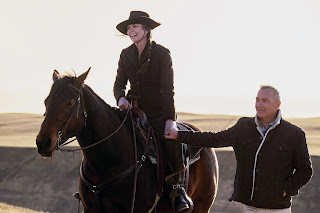
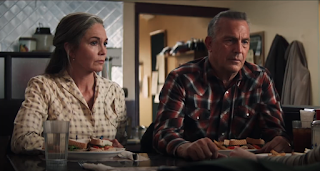
It's the early 1960s in rural Montana. Margaret and George Blackledge (Diane Lane and Kevin Costner) have been married for a long time, and run a ranch together. She is an expert at breaking horses, and George is a retired lawman. Their son James and his wife Lorna (Kayli Carter) have a young son Jimmy. The strong-willed Margaret is overbearing towards Lorna but dotes over her grandson.

An accident claims the life of James, and Lorna quickly remarries Donnie Weboy (Will Brittain). Margaret witnesses Donnie mistreating his new wife and step-son, and is then heartbroken when Donnie, Lorna and Jimmy suddenly leave town without a goodbye. She senses Jimmy is in danger and convinces a reluctant George to join her on a road trip to North Dakota, where Donnie's family comes from, to rescue the child. As they get closer to Gladstone, Margaret and George learn the Weboy family has a fearsome reputation, and reclaiming Jimmy will not be easy.

Written and directed by Thomas Bezucha, Let Him Go has plenty to enjoy, starting with the cast. Kevin Costner and Diane Lane settle into a spiritual level of marital comfort with professional ease, the two veterans forging the genuine dynamic of a couple together for a long time and keenly aware of the union's strengths and weaknesses. They are complemented by gorgeous cinematography courtesy of Guy Godfree, measured and character-defined pacing, and a sense of impending doom as Margaret and George get closer to the isolated Weboy homestead.

The narrative is propelled by the spectre of death and loss as a normalized part of Margaret's uncompromising determination to do what she believes is right, and in the way she believes is right. And so the same grandma-bear attitude that alienated Lorna comes to the fore in an increasingly dangerous mission into the soul of darkness to rescue her grandson. Margaret's true inner strength is mostly revealed through George's mirror as a husband filled with admiration for his wife's feistiness but also keenly aware of the trouble she can bring upon them.

Let Him Go starts to run into trouble once the extended Weboy family is introduced. Here Bezucha veers towards gargoylian representations of an evil redneck clan more befitting a slasher horror flick. With Lesley Manville holding court as the queen hornet, brutality is unleashed, rubbing awkwardly against the pre-established mood of dramatic lyricism.

Better intentions reside within the character of Peter Dragswolf (Booboo Stewart), an Indigenous man the Blackledges meet and befriend on the road to North Dakota. Peter has a personal story of loss, solitude, and a self-defined fresh start, reflecting some of what Margaret is experiencing. He deserved a larger share of the 114 minutes of running time.

Despite some unbalanced ambitions, Let Him Go reveals the deep roots of courage, conviction, and compromise nurturing a sturdy human bond.


All Ace Black Movie Blog reviews are here.

Friday, 16 July 2021

Movie Review: Serenity (2019)

A film noir drama, Serenity is ambitious but deeply flawed, with a dumbfounding plot twist undermining the narrative into fatal irrelevance.

In the fictional Caribbean-like enclave of Plymouth Island, where everyone appears to know everything about everyone else, Iraq War veteran Baker Dill (Matthew McConaughey) operates the Serenity as a tourist fishing boat. But instead of looking after his customers he is obsessed with catching an elusive big tuna, and he can barely afford to pay his loyal second-in-command Duke (Djimon Hounsou). Dill provides sexual favours to Constance (Diane Lane) in return for desperately needed cash.

Dill's ex-wife Karen (Anne Hathaway) arrives unexpectedly and offers him $10 million to kill her current abusive husband Frank (Jason Clarke). She urges him to commit the murder for the sake of their son Patrick, who is suffering in an abusive household. In the meantime tweedy sales rep Reid Miller (Jeremy Strong), incongruously dressed in a suit and tie, offers Dill a fish tracking device to help him snag the big tuna. Dill starts to suspect all is not what it seems.

Written and directed by Steven Knight, Serenity ought to be applauded at some level for trying something new. But unfortunately, the second half is unsalvageable, veering into weird waters and blowing a hole in its own hull. Once Knight starts to pull back the curtain on the story he really wants to tell, no worthwhile emotional investment can be justified in the characters or events.

The opening half is a decent enough modern noir mixing reasonably engaging ingredients. Dill is a sweaty and deeply flawed protagonist hiding out in an exotic locale, chasing his unattainable fish, lamenting separation from his son, and never expecting to achieve anything beyond selfish survival and control over his boat. Karen arrives with a tolerable approximation of a femme fatale, offering breathy remorse and unimaginable money in exchange for the small matter of murder. Intended victim Frank oozes slimy evil, a perfect shark food candidate if ever there was one.

Dill agonizes over Karen's offer, and the early involvement of fish-out-of-water sales agent Reid Miller is an initially edgy angle. But then all the promising metaphors and moral dilemmas dissolve into something much more obtuse and remarkably uninteresting. Serenity lists, then just sinks.


All Ace Black Movie Blog reviews are here.

Friday, 27 November 2020

Movie Review: The Glass House (2001)

A suspense drama with gaslighting elements, The Glass House repeatedly threatens to become quite good without ever delivering.

In Los Angeles, 16 year old Ruby Baker (Leelee Sobieski) and her younger brother Rhett are orphaned when a car crash claims their parents. Family lawyer Alvin Begleiter (Bruce Dern) advises Ruby she stands to inherit a large estate once she achieves adulthood. In the meantime he arranges for the children to live with Terry and Erin Glass (Stellan Skarsgård and Diane Lane), former neighbours of the Bakers who have now moved into a swish Malibu villa.

The Bakers act friendly and appear wealthy, but Ruby soon notices creepy behaviour. She and Rhett are assigned a single bedroom, Terry's behaviour towards Ruby borders on lustful, and Erin may be a drug addict. Terry's car leasing business is in financial trouble, and Ruby starts to suspect Terry is more interested in her inheritance than her well-being. She turns to Begleiter and social worker Nancy Ryan (Kathy Baker) for help, but untangling Terry's intentions will be risky.

While woman-in-distress dramas are common, The Glass House adds a twist by applying the threat to a newly-orphaned 16 year old. Not quite an adult but already quite astute, Ruby is still learning to trust her instincts, and in the hands of a doleful Leelee Sobieski she is a complex protagonist defying both victim and hero stereotypes, and the best thing about the film.

Director Daniel Sackheim is more at home in television, and here never quite settles on a tone for Wesley Strick's script. The mood erratically oscillates between routine family adaptation travails, something-is-not-quite-right suspicion, and outright suspense before jumping to violence and carnage in the final act. All the shadings are handled with decent proficiency but the whole rarely gels into an effective package.

Sackheim does deliver some polished visuals. The Glass villa is a modern artwork of - what else - glass, and the scarcity of opaque walls compromises essential hiding places. The coastal highways around Malibu provide the snaky asphalt for plenty of sleek driving misadventures. 

Apart from Ruby, the other characters are routine. Stellan Skarsgård is an effective wolf, but loses his sheep's clothing early. Diane Lane is confined to one of her much less interesting roles as Erin, while Bruce Dern is underused. Rita Wilson, Michael O'Keefe and Chris Noth have small roles. 

The Glass House is never polished enough to fully shine, but it does occasionally glisten.


All Ace Black Blog Movie Reviews are here.

Sunday, 16 August 2020

Movie Review: A Little Romance (1979)

A romantic comedy and drama, A Little Romance explores a wistful young love against scenic European backdrops.

In Paris, young teenager Daniel Michon (Thelonious Bernard) is a big fan of Hollywood movies. He meets American teenager Lauren King (Diane Lane), who is studying in Paris where her stepdad Richard (Arthur Hill) has a corporate position. Lauren's mother Kay (Sally Kellerman) is already eyeing a potential fourth husband and draping herself all over pretentious movie director George de Marco (David Dukes).

Daniel and Lauren start dating and fall in love. They meet dapper elderly gentleman Julius Edmund Santorin (Laurence Olivier), who claims to be a retired diplomat but is hiding his own secrets. Lauren is immediately fond of Julius, but Daniel is skeptical about the old man's tall stories. When Daniel falls foul of Kay and Richard announces he is relocating the family to Houston by the end of summer, Lauren and Daniel decide to make a run for Venice to kiss under the Bridge of Sighs, and they turn to Julius for help.

Director George Roy Hill takes a break from productions featuring superstars and instead tackles a small bittersweet romance about star-crossed young lovers. An adaptation of the 1977 novel E=mc2 Mon Amour by Patrick Cauvin, A Little Romance casts an alluring spell by mixing two smart teens, humour, some chasing around Europe, a couple of arguments, and a pursuit of forever idealism. A train ride and a bicycle race are thrown in for good measure.

Inspired by one of Julius' flowery life tales, an appropriate consummation target is set for 13 year old Lauren and 15 year old Daniel: a kiss at sunset in a gondola under a Venetian bridge, with church bells ringing. This is enough to trigger a cross-border adventure from France to Italy with a stop in Verona, where Romeo and Juliet receive a nod. Hill captures plenty of scenery but stays on the right side of travelogue territory.

Complementing the romance and humour, Lauren's parents introduce traces of drama and tension by frantically wondering where their daughter disappeared to and instigating a search, with doubts swirling around Julius' true intentions once his identity is revealed.

Diane Lane's screen debut is an immediate revelation, and she quickly establishes herself as the heart of the film with a mature performance. Thelonious Bernard in his one and only significant screen role struggles mightily against an uneven character, oscillating between mannerisms stolen from Hollywood movies, romantic sensibilities, a horrible wardrobe, and a bit of a mean streak and quick temper. The contrast between Lane's comfortable acting and Bernard's thrashing means she often looks older and acts calmer, and the chemistry between them is iffy at best.

Laurence Olivier is top billed, although his role is very much a secondary enabler. He is undoubtedly charming, but leans towards overplaying the elegant and well-traveled Monsieur with an unlikely story for every occasion.

A Little Romance celebrates first love as a dreamy adventure, where awkwardness and courage combine to take on the adult world - with a little help from a crafty friend.


All Ace Black Blog Movie Reviews are here.

Sunday, 8 March 2020

Movie Review: Mark Felt: The Man Who Brought Down The White House (2017)


A political drama and biography, Mark Felt lifts the curtain to reveal a glimpse of the man behind the Watergate information leaks.

It's 1972 in Washington D.C, and legendary FBI Director J. Edgar Hoover dies from a stroke. His loyal Deputy Mark Felt (Liam Neeson), a staunch defender of the agency's mission, has every expectation he will be promoted to the top job. Instead the Nixon White House appoints inexperienced bureaucrat Pat Grey (Marton Csokas) as Acting Director. Mark's loyal wife Audrey (Diane Lane) is as disappointed as her husband.

The break-in at the Watergate Hotel starts to the make the news, and Felt mobilizes the FBI to investigate. But in short order pressure mounts from the White House to wind down the probe. Felt finds it increasingly difficult to function in an FBI subjugated by politics and witch hunts, and starts secretly feeding classified information to Time reporter Sandy Smith (Bruce Greenwood) and the Washington Post's Bob Woodward (Julian Morris).

At age 91 in 2005, Mark Felt revealed his identity as the informer known as Deep Throat, and he died just three years later. The film is caught in the gap between his story as a person and his famous whistleblower actions that helped bring down President Richard Nixon. In the end director and writer Peter Landesman, adapting the books by Felt and John O'Connor, offers a middling portrait of the man and a muddled foray into the political scandal.

Mark Felt spends large chunks of time away from the Watergate drama, occupied with an inside look at the FBI's machinations, good and bad. The agency's pride, efficiency and professionalism are a firewall against political interference, and the rot starts to spread when the White House seizes the opportunity of Hoover's death to plant one of their own at the organization's head. Felt tries to defend the fort, but it's a losing battle and eventually he resorts to press leaks as a weapon of last resort.

Maybe because the men surrounding Nixon are largely absent from the narrative and the White House's perspective is conveyed in television snippets, once Watergate erupts and grips the nation, the film is surprisingly inert. Landesman skips explaining the gravity of what Felt passed on to reporters, and a rush to the end credits leaves an empty feeling.

Felt's home life is introduced through a few interactions with his wife Audrey and their shared trauma over the disappearance of their daughter Joan (Maika Monroe) presumably to the world of hippie communes. The domestic sub-plot is conflated with the bombing campaign perpetrated by the Weather Underground. While all the background adds good context, it also serves to detract from Felt's role in one of the nation's greatest political dramas.

Liam Neeson is reliable if rather monotonal as an upstanding and upright FBI agent incredulous as the agency atrophies from the top. He defines the film's suitably nondescript shade, perhaps the best tribute to the man who managed to change history and remain totally invisible.


All Ace Black Blog Movie Reviews are here.


Thursday, 4 October 2018

Movie Review: Under The Tuscan Sun (2003)


A romantic drama with hints of humour, Under The Tuscan Sun features beautiful scenery and a subtle central performance, but otherwise settles into routine rhythms.

San Francisco-based author Frances Mayes (Diane Lane) is shocked to learn that her husband has been cheating. For emotional support she leans on her best friend Patti (Sandra Oh), who is in a seemingly happy relationship with Grace (Kate Walsh). After a painful divorce Frances reluctantly accepts Patti's gift to go on a tour of Tuscany. When the tour stops in the small town of Cortona, Frances spots a 300 year old villa for sale and buys it on a whim, deciding to settle in the area.

She meets the locals, including kindly real estate agent Martini (Vincent Riotta) and eccentric aging actress Katherine (Lindsay Duncan), and hires a group of Polish immigrants, including the young Pawel (Pawel Szajda), to fix the place up. Frances snaps out of her loneliness when she meets the stunningly suave Marcello (Raoul Bova), while Patti shows up for a visit and Pawel embarks on his own romantic adventure.

Written and directed by Audrey Wells, Under The Tuscan Sun is very loosely based on the memoir by Frances Mayes. The film mixes plenty of sun-kissed travelogue-style scenery with an understated story about coping with the aftermath of divorce, loneliness, and looking for love in middle age. The film does little that is original or unexpected, but within the confines of its ambitions, this is a polished, well executed and warm experience.

Much of the credit goes to an effervescent Diane Lane, who projects a range of emotions from the emotional gut punch of losing a seemingly perfect life to the giddy excitement of finding new romance, often with magnificent subtlety. She plays a victim, a seductress, a friend, a lover and a mentor, all with a rare authenticity.

Once the film settles down in Italy the plot consists of mildly amusing episodes mixing local culture with gradual emotional recovery, of course paralleled by the house repairs. The locals are all either friendly or traditionally stereotypical, and the landscape vistas and local village festivals are never less than postcard perfect. The plight of immigrants, traditional family values and the legendary silkiness of Italian lovers are among the marginal themes touched upon lightly by Wells' inoffensive script.

And that ultimately is where Under The Tuscan Sun lands. Pretty to look at, anchored by an actress in wondrous form, and without a sharp edge in sight.


All Ace Black Blog Movie Reviews are here.


Saturday, 24 March 2018

Movie Review: Trumbo (2015)


A biographical drama, Trumbo is a sharply written story of career survival set during the post-World War Two Red Scare.

It's the late 1940s, and Dalton Trumbo (Bryan Cranston) is one of Hollywood's leading screenwriters. He is also a proud member of the Communist party, along with several other prominent film industry figures, including fellow writer Arlen Hird (Louis C.K.). Dalton is happily married to Cleo (Diane Lane) and his children include the precocious Nikola (Elle Fanning). With the Cold War taking hold, a wave of anti-communist sentiment sweeps from Washington DC to Hollywood, fanned by gossip columnist Hedda Hopper (Helen Mirren).

As a matter of principle Dalton and his fellow communists refuse to cooperate with the House Committee on Un-American Activities (HUAC). Convicted for contempt of Congress, Dalton serves time in prison, and is placed on the notorious "Hollywood 10" blacklist, barred from working for any studio. Meanwhile, other communist sympathisers including Edward G. Robinson (Michael Stuhlbarg) do testify to save their careers. Once released Dalton has to find a way to make a living, and Frank King (John Goodman), head of low-budget King Brothers Productions, offers a lifeline of endless uncredited work.

Directed by Jay Roach and written by John McNamara, Trumbo is fascinating, witty and often quite funny. Both a character study and a cautionary tale about social paranoia, the film sparkles with the cantankerous yet phenomenally smart and articulate personality of Trumbo, and the remarkable post-war U-turn when communism was transformed in the public consciousness from great ally capable of defeating fascism to a feared existential menace.

The film does not shy away from presenting Trumbo as a man full of faults and contradictions. He enjoys his success, living on a large farm with all the luxuries afforded to the fortunate by capitalism. And when the strain of making a living through round-the-clock writing becomes nearly unbearable, Trumbo lashes out at his family members, hurting those he is trying to support.

And yet intellectually he never betrays his beliefs, and finds the unlikely path to expose the witch hunt by undermining it from within. Uneducated and fear-mongering campaigns devoid of evidence wilt when exposed to the light, and Trumbo's work ethic eventually forces the hypocrisy into the open

Trumbo boasts a remarkably talented cast in top form. Bryan Cranston delivers a career-defining performance, embracing the writer's flawed humanity and happily occupying the inconsistency of a proud communist enjoying all the riches that a life of celebrity has to offer. The character of Arlen Hird is an amalgam of other communist writers, and Louis C.K. portrays the more idealistic stream of left wing thinking, more willing to resist the system rather than work within it.

Helen Mirren makes the smug Hedda Hopper an obnoxious and hate-worthy gossip, a representation of self-appointed thought police, pouring gasoline on the flames of public fear and wielding disproportionate power. John Goodman as Frank King introduces bombastic levity, and his scenes add a whole new dimension to Trumbo, providing insight into the wondrous world of successful low-budget studios. Diane Lane, Michael Stuhlbarg, and Elle Fanning all make notable contributions.

Trumbo succeeds as a portrait of a remarkable man and even more so as a critical commentary on the lunacy of fear-driven social agendas.


All Ace Black Blog Movie Reviews are here.


Thursday, 16 February 2017

Movie Review: Unfaithful (2002)


A story of lust and betrayal in an idyllic middle class suburban household, Unfaithful unfortunately abandons an ambitious exploration of human instincts and veers towards more routine and much less interesting fare.

In a tony suburb of New York City, business owner Edward Sumner (Richard Gere) lives with his wife Connie (Diane Lane) and eight year old son Charlie. The marriage appears healthy and the couple are comfortably moving into middle age. On a visit to the city on a windswept day, Connie literally bumps into handsome book dealer Paul Martel (Olivier Martinez), a much younger and irresistibly attractive man.

Unable to control her impulses, Connie arranges several follow-up meetings and soon she is carrying on a hot affair with Paul, with frequent sex sessions at his apartment. Her lies catch up to her, Edward suspects that something is wrong and hires a private detective to tail his wife. But the threat to their marriage takes an even worse turn when Edward reacts badly upon confronting Paul.

Directed by Adrian Lyne, Unfaithful boasts a promising start but a rapidly disintegrating second half. The film sets out to explore the forces that shape infidelity, and the emotional and psychological toll imposed by all the lying and deception. There is a tremendous story to be told about why a seemingly content wife decides to stray, and for a while, Unfaithful steps forward into the rich terrain of a marriage under threat of insidious erosion, with parenting as collateral damage.

Then Lyne and his screenwriters Alvin Sargent and William Broyles Jr. (adapting a Claude Chabrol film) take a left turn towards Hitchcockian suspense territory, and Unfaithful never recovers. A carpet is used to warp a body, a moody elevator breaks down just at the wrong moment, a corpse is stuffed in a car trunk then a landfill, and all the carefully built up subtle domestic tension seeps out of the screen in favour of more blatant and over-familiar thriller elements.

And in a further neck twisting change of gears, Unfaithful converts to a brooding study of a damaged couple jointly coping with cascading crises of conscience. The sharp changes in tone are disorienting, and the film appears to work extra hard to undermine its own effectiveness in any one key.

Visually Unfaithful is enriched with touches of class, and stylistically Lyne still loves to create steamy and artistic sex scenes, Olivier Martinez and Diane Lane obliging with several window-fogging private and public romps. Lane owns the first part of the film and creates a complex portrait of a happy wife and lust-seeking lover, before Gere takes over in the second and weaker half.

Unfaithful is part of a very good film, before treacherous narrative missteps betray the good intentions.


All Ace Black Blog Movie Reviews are here.

Friday, 4 March 2016

Movie Review: Inside Out (2015)


An animated drama-comedy about the inner workings of a young girl's brain, Inside Out pushes all the right emotional buttons but also suffers from Disney's frustratingly formulaic "journey" clichés.

Riley Anderson (voice of Kaitlyn Dias) is a girl from Minnesota, and her brain headquarters is controlled by five emotions. The dominant Joy (Amy Poehler) does her best to keep Riley happy, but she is often hampered by Sadness (Phyllis Smith). They are supported by occasional interventions from the combustible Anger (Lewis Black), the perpetually frantic Fear (Bill Hader) and the snooty Disgust (Mindy Kaling). Riley grows into a generally happy child who loves hockey, her family, and friends, with Joy working hard to create and store mostly cheerful memories within Riley's brain.

When Riley is eleven, her father (Kyle MacLachlan) and mother (Diane Lane) decide to relocate the family to San Francisco. This turns into a stressful experience, and Joy struggles to keep Riley positive. Sadness becomes more influential, and a struggle between her and Joy results in both of them inadvertently ejected out of the brain's headquarters and into the cavernous, complex areas of the brain where long-term memories and long-forgotten experiences are stored. Riley slips into a depression as Anger, Fear and Disgust unsuccessfully struggle to maintain control while Joy and Sadness embark on a complex journey to make their way back to HQ.


A Disney / Pixar production directed by Pete Docter and Ronnie Del Carmen, Inside Out is a polished children's tale, aimed at the pre-teen market with enough edge and humour to also keep their parents well entertained. For the intended target, the premise is relatively original and the animation imaginative, with Riley's brain proving to be expansive, rich territory to house a story about what makes us human.

Docter co-wrote the script, and does not shy away from some sensitive topics. The complications that come with major life changes, stressed parents unintentionally straining their kids, and the perils of depression come to the fore, and as much as Inside Out is a comedy, it offers avenues for serious conversations about somber challenges triggered by life's milestones.

As a movie, the first half is by far stronger. Docter has breezy fun establishing Riley's emotional-drivers and the brain's workings, finding winning metaphors in shiny globes representing memories, a vault-like system for storing core, foundational events, and suspended islands that bring to life her various personalities. Joy is the tireless leader of Riley's emotions, the pursuit of happiness usually able to dominate other, less constructive emotions. Amy Poehler delivers a dedicated and energetic voice performance to convey Joy's irrepressible attitude.

But the more serious second half gets bogged down in one of Disney's all-too-familiar journey treks, Joy and Sadness having to find their way back to HQ through the deep recesses of Riley's brain. Here events, locations and characters are much more hit-and-miss, long-lost imaginary friend Bing Bong (Richard Kind) only partially successful, a short-cut through an abstraction chamber missing the mark entirely, while a cut-out boyfriend image also drops in and out with little context. The film bogs down, intermittently tiresome and sometimes repetitive as Riley's personality islands suffer the effects of her dysfunctional emotions.

Regardless of some shortcomings, Inside Out deserves enormous credit for steering away from any kind of antagonist, both in Riley's real life and in her brain. There are no bad guys or villains; Riley's troubles are triggered by everyday events, her balance tipped by unintended pressures. The perils lie within, as do the solutions. And the film moves towards a clever, unexpected outcome, with a mature lesson about the complementary role of all that makes us function emotionally.

Inside Out peeks inside the brain and finds familiar organized chaos helping to create moments both funny and sad, and fertile ground for the human process of emotional growth.


All Ace Black Blog Movie Reviews are here.


Tuesday, 23 February 2016

Movie Review: Nights In Rodanthe (2008)


A romantic drama, Nights In Rodanthe brings two damaged souls together in an idyllic beachfront house, but the film overflows with frothy emotions at every turn.

Harried mom Adrienne Willis (Diane Lane) is separated from husband Jack (Christopher Meloni), who had an affair but now wants to get back together. Adrienne agrees to help her friend Jean (Viola Davis) look after a scenic beachfront bed and breakfast in Rodanthe, North Carolina. The only guest is handsome plastic surgeon Dr. Paul Flanner (Richard Gere), who is going through a trauma of his own. Paul had an elderly patient die on the operating table, and he is in Rodanthe to meet the deceased woman's grieving husband Robert Torrelson (Scott Glenn). Paul is also planning a trip to Ecuador to try and reconnect with his estranged son Mark (James Franco in an uncredited role).

With a storm approaching, Adrienne and Paul start to get to know each other, and then fall deeply in love. He reawakens her to life's opportunities, and she helps him to come to terms with the Torrelson tragedy. But Adrienne still has to sort out her personal life and Paul needs to embark on his South American trip, causing a painful separation.

An adaptation of a Nicholas Sparks novel directed by George C. Wolfe, Nights In Rodanthe enjoys decent production values but cannot overcome the weak source material despite a talented cast. This is a romance where characters scream at each other one moment then fall into each other's arms the next, where the storm outside mimics the histrionics inside, and all the men, women and children, from the major characters to the minor, are quick to overflow with a display of overheated fervor at every opportunity.

There are some positives. The scenery at the character waterfront house makes up for some of the runaway emoting, and the search for an ending that avoids the obvious is laudable. There are hints of good intentions in exploring a troubled but evolving relationship between Adrienne and her teenaged daughter Amanda (Mae Whitman). Viola Davis shows up as Adrienne's best friend Jean (owner of the bed and breakfast) and adds an element of flighty fun.

In the central roles Richard Gere and Diane Lane do their best with the material, but are hampered with a script that emphasizes the obvious and shuns any attempt at nuance. The moods of Nights In Rodanthe are either black and stormy or bright and sunny, in a vivid demonstration of filmmaking by thick crayons.


All Ace Black Blog Movie Reviews are here.


Monday, 4 November 2013

Movie Review: Rumble Fish (1983)


A stylistic exploration of lost youth, Rumble Fish searches for a reason to exist but finds none. The central characters are only mildly interesting, and there is hardly anything going on to create a narrative hook.

Rusty James (Matt Dillon) is a tough kid and the leader of his pack, consisting of Steve (Vincent Spano) and Smokey (Nicolas Cage), among others. Rusty harkens back to mythical old days when gangs ruled the streets, and idolizes his absentee brother Motorcycle Boy (Mickey Rourke), a former gang leader. With Rusty trying to hang on to Patty (Diane Lane) as a girlfriend of sorts despite her disapproval of his rough life, Motorcycle Boy suddenly returns to town after a trip to California.

In a rumble with an opposing gang, Rusty is injured, while police officer Patterson (William Smith) keeps a suspicious eye on Motorcycle Boy, disapproving of his return and believing him to be nothing but trouble. Both Rusty and Motorcycle Boy have to put up with a drunk of a father (Dennis Hopper), who wastes his life downing bottles of alcohol. After a few more violent skirmishes, the two brothers meet at a pet store selling colourful fish, and decide to cause some mischief in the name of freedom.

Francis Ford Coppola collaborated with author S.E. Hinton to create a screenplay out of Hinton's book, and Coppola filmed Rumble Fish immediately after the moderately more successful The Outsiders. Filmed by Coppola in crisp black and white with plenty of smoke, theatrical sets and flashy camera angles, Rumble Fish tries to be about something meaningful, but the artistry of presentation fails to mask the lack of substance.

Rusty James, Motorcycle Boy, and the rest of their cohorts have nothing new to offer. They are supposed to elicit sympathy just because they are who they are, their father is a drunk and their mother has fled. But the film stalls within a few minutes, trying too hard to make heroes out of outcasts, never giving the characters the chance to earn their place as people worth caring about. They rumble, they argue, they chase girls, and they lament their miserable parents. It's all too trite, territory that has been covered too many time in too many films dating back 30 years and more.

Coppola's directing calls attention to itself at every turn, a reasonably welcome distraction from the non-event of the plot, but creating an all too obvious case of all packaging and no package. A few small fish in an aquarium contribute the only splash of colour, and the freedom of the fish is supposed to represent Something Important. By the time Rusty James and Motorcycle Boy decide to heroically Free the Fish, any climactic cause is acceptable just to bring proceedings to a close.

The young ensemble cast of Dillon, Lane, Cage and Spano are pure intensity but no real humanity. Rourke smirks through the movie in one of his exceedingly annoying I'm-bored-so-I'll-pretend-to-smile-as-if-I'm-hiding-something-but-really-I'm-not performances. Hopper hides behind a bottle and Williams hides behind his shades, two veteran performers sticking closely to stereotypes.

Rumble Fish may look tasty, but it emits the unmistakable odour of a spoilt catch.


All Ace Black Blog Movie Reviews are here.