Showing posts with label Kevin Kline. Show all posts

Wednesday, 20 August 2025

Movie Review: The Good House (2021)


Genre: Alcoholism Dramedy  
Directors: Maya Forbes, Wally Wolodarsky  
Starring: Sigourney Weaver, Kevin Kline, Morena Baccarin  
Running Time: 114 minutes  

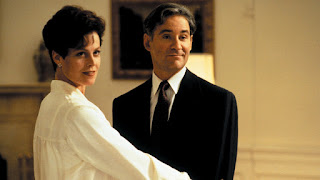
Synopsis: In picturesque Wendover, Massachusetts, Hildy Good (Sigourney Weaver) is a realtor with a drinking problem. Having lost her (also alcoholic) mother to suicide and her husband to another man, Hildy is now concealing her drinking from her two grown daughters and attempting to revive her struggling business. She attempts to sell the house of a couple with an autistic child while pursuing an opportunity to rekindle a relationship with old flame Frank (Kevin Kline). She also gets into the middle of an affair between newcomer Rebecca (Morena Baccarin) and the town's therapist Peter (Rob Delaney).

What Works Well: In this adaptation of the Ann Leary novel, Sigourney Weaver is predictably excellent as a woman lying to herself and drowning in the misconception that she is the smartest person in town. Kevin Kline adds heft as the successful local scrappy businessman hiding empathy beneath layers of grime. The gossipy everyone-knows-everything-about-everyone-else small town milieu energizes the backdrop, and the eclectic collection of secondary characters adds plenty of animation.

What Does Not Work As Well: Hildy's frequent breaking of the fourth wall is a questionable artistic decision, and ultimately this is a story steeped in familiarity.

Key Quote:
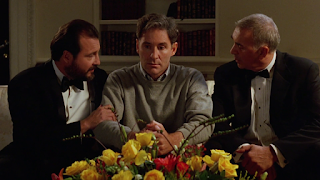
Hildy, recognizing she's walked into an intervention: Well, if we're really going to do this, I need a drink.


All Ace Black Movie Blog reviews are here.

Thursday, 28 December 2023

Movie Review: Violets Are Blue (1986)


Genre: Romantic Drama
Director: Jack Fisk
Starring: Sissy Spacek, Kevin Kline, Bonnie Bedelia
Running Time: 86 minutes

Synopsis: Renowned news photographer Gussie Sawyer (Sissy Spacek) returns to her hometown of Ocean City, Maryland, for a family visit. She bumps into her former high school sweetheart Henry Squires (Kevin Kline), now running the local newspaper. Although Henry is married to Ruth (Bonnie Bedelia) and father to Addy, passion immediately re-ignites between him and Gussie. She also gets involved in his investigation of a corrupt land deal that threatens local wildlife.

What Works Well: Ocean City is a scenic location, and a yacht race is expansively filmed.

What Does Not Work As Well: A talented cast is wasted on a miserable script by Naomi Foner. The drama defaults to awkward silences and stares-into-the-distance as adults first forget how to talk then behave with the hormone-driven immaturity of adolescents. Gussie and Henry carry on their affair in full view of a small town, and neither his impulsive decision to chuck his life and join her on foreign assignment nor the local conspiracy-against-the-ponies are remotely convincing as anything other than desperate attempts to stretch the flimsy material.

Conclusion: Selfish with a side of senseless is a bad recipe for romance.


All Ace Black Movie Blog reviews are here.

Tuesday, 1 March 2022

Movie Review: Dave (1993)

A mild comedy and low-key romance, Dave carries old-fashioned sweetness into the tale of a do-gooder who stumbles his way into presidential power.

United States President William Mitchell (Kevin Kline) is a heartless womanizer, and his marriage to Ellen (Sigourney Weaver) is a sham. His closest aides are Chief of Staff Bob Alexander (Frank Langella) and Communications Director Alan Reed (Kevin Dunn).

The good-hearted Dave Kovic (also Kline) works at a small-town temporary employment agency, and in his spare time impersonates the President at local events. Secret Service agent Duane Stevensen (Ving Rhames) spots Dave as a useful stand-in and recruits him for a walk-on appearance. 

When Mitchell is incapacitated by a stroke mid-coitus, Alexander identifies an opportunity to grab power by installing the impersonator as a puppet President. The naive Dave is duped into going along with the plan, and within a few weeks he improves the White House's public image through displays of humanity. But Dave then takes an interest in Ellen and starts to impose his views on policy decisions, undermining Alexander's agenda.

A liberal-leaning gentle satire of political machinations, Dave aims for comfortable smiles and simplifies the presidency to an almost dull routine of inconsequential appearances and bureaucratic meetings. Writer Gary Ross and director Ivan Reitman wander down the "if only a good man..." route, and emerge with a harmless - and toothless - tale of doing good by playing with a lonely kid and spending money on homeless shelters. 

Almost everything about Dave lands in the middle of the road. Alexander is the closest thing to a villain, but the worst he can come up with is a veto of a barely defined bill, and later abstract accusations of wrong-doing. The marital tension within the White House is defined by silence, and melts away on cue. The subsequent romance between Dave and Ellen barely warms the temperature to tepid levels.

Through it all Dave plays the out-of-place pragmatist getting to grips with his new surroundings and quick to cut through the nonsense of politics and towards doing the right thing. Kevin Kline spends most of the film in amiable mode as Dave, although the much shorter President Mitchell role offers better opportunities for venom. The cast also includes Laura Linney as an office assistant and the object of Mitchell's lust, Charles Grodin as an accountant and Dave's friend who helps balance the US budget in one night, and Ben Kingsley as the absent-until-the-third-act Vice President.

While the plot ambles along in an inconsequentially dreamy state, the sets look real. Reitman comfortably navigates replicas of White House exteriors and interiors (including the Oval Office) to create the illusion of location filming. 

A tolerable distraction, Dave reduces the presidency to a frivolous job, and treats it with fluffy innocence.


All Ace Black Movie Blog reviews are here.

Saturday, 29 January 2022

Movie Review: Sophie's Choice (1982)

A dark drama and romance, Sophie's Choice mixes a story of an agitated friendship with the horrors of concentration camp survival. The overextended plot is enlivened by an outstanding Meryl Streep performance.

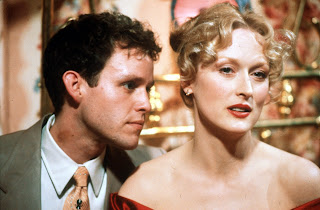
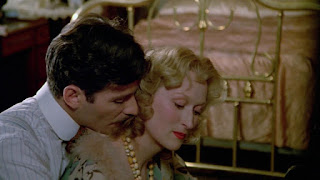
Two years after the end of World War Two, aspiring writer Stingo (Peter MacNicol) moves from the South to an apartment in Brooklyn. He meets his lively and loud upstairs neighbours, Polish immigrant Sophie Zawistowski (Streep) and her lover Nathan Landau (Kevin Kline), a Jewish biologist. The couple's relationship is tumultuous due to Nathan's wild mood swings and descents into fits of unwarranted jealousy.

Although she comes from a Catholic family, Sophie is a survivor of the Auschwitz Nazi concentration camp. After the war, Nathan and his brother, a doctor, helped her recover from malnutrition. As Stingo makes progress on his book, he develops a deep friendship bordering on love with both Sophie and Nathan. Gradually Sophie reveals her family's harrowing wartime experiences, while Stingo also discovers Nathan's secrets.

An adaptation of the book by William Styron directed by Alan J. Pakula, Sophie's Choice combines a troubled companionship triangle with heartrending flashbacks to wartime in Poland. The overarching theme addresses the far-reaching impacts of emotional and mental damage whether acknowledged or denied, the search for recovery and happiness buffeted by overwhelming dark forces.

The weighty subject matter does deserve considerate treatment, but the film clocks in at an inexcusable 151 minutes, and spends far too much time on the Brooklyn scenes. The pacing often slows to a crawl, Pakula conflating sombre moods with the need to overindulge. 

Fortunately the director is rescued by his leading actress. Meryl Streep delivers one of the most affecting performances in cinema's history, combining a Polish accent for the Brooklyn scenes with speaking in German for the flashbacks. But more critically, she conveys complex fragility and uses the faintest of expressions to hint at painful scars, omissions, and the lies Sophie has told herself just to survive. Whenever Streep is on the screen nothing else matters, her presence eradicating the plodding plot.

In his big screen debut, Kevin Kline is more broad as the erratic Nathan, full of vivacious energy and overrun by mood swings. Peter MacNicol is caught in the thankless narrator/observer/listener role, and predictably disappears into the wallpaper.

The revelations both past and present come tumbling out in the final hour, the scenes at Auschwitz soaring and hinting at the potential for a magnificent movie had the wartime events dominated. As it stands, the resonance of Sophie's experience is diluted by a barely-there backstory about her family and role as mother. Despite a yawning imbalance in narrative thrust, Sophie's Choice serves as a scintillating actress showcase, and a demonstration of a multi-generational talent in peak form.


All Ace Black Movie Blog reviews are here.

Friday, 24 September 2021

Movie Review: Trade (2007)

A hard-hitting drama, Trade is an unblinking story of sex trafficking. The nightmare of two victims is presented as harrowing journey fuelled by criminal depravity.

In Mexico City, 17-year-old Jorge (Cesar Ramos) is involved in low-level lawlessness with his buddies. But his world is turned upside down when his 13-year-old sister Adriana (Paulina Gaitán) is kidnapped by Russian sex traffickers working for vicious crime leader Vadim (Pasha D. Lychnikoff). Jorge tracks the kidnappers from a distance and learns Adriana will be transported into the US with New Jersey as the final destination.

While investigating a house used by the traffickers, Jorge bumps into Ray Sheridan (Kevin Kline), a Texas-based insurance fraud investigator. After an acrimonious introduction, Jorge and Ray team-up to search for Adriana, and uncover a sexual slavery marketplace.

Also being trafficked with Adriana is Polish single mom Veronica (Alicja Bachleda). They are escorted across the border by gang member Manuelo (Marco Perez), who is joined on the US side by driver and drug addict Alex Green (Zack Ward). The two victims endure horrible abuse with worse to come unless Jorge and Ray can improvise a rescue.

Produced by Roland Emmerich and based on the 2004 New York Times article "The Girls Next Door" by Peter Landesman, Trade is a challenging experience. German director Marco Kreuzpaintner and screenwriter Jose Rivera confront the subject matter head-on, creating a bold and uncomfortable drama largely devoid of thriller cliches. The hurt inflicted upon Adriana and Veronica is unrelenting, the perpetrators treating their victims like commodities to be exploited, transported, marketed and sold, the industry demand propelled by faceless middle-aged men hiding behind wealth and web portals.

Because the victims are everyday girls and women like Adriana and Veronica with no support from influential advocates, the sex trade thrives in the shadows. Here the casting of relative unknowns is effective: both Paulina Gaitán as young Adriana and Alicja Bachleda as Veronica are excellent in their roles, and their inconspicuousness allows them to represents multiple victims and ethnicities from two continents. Thrust together into a hell on earth, the unspoken bond that develops between the two kidnap victims is a flicker of warm humanity. 

Meanwhile Ray and Jorge are forging their own connection. The emerging but thorny father/son dynamic between the Texas investigator and scrappy Mexican teen sparks a few moments of levity. Gradually Ray reveals his backstory and personal tragedy related to a lost family member, allowing man and teen to share a common hurt only differentiated by degrees of recency. 

Despite registering some victories, Trade deliberately aims at mixed and morally vague resolutions, and intentionally places the victims themselves in positions to attempt patchwork and sometimes disastrous fixes. With sex trafficking low on the list of human-made crises receiving attention, large scale silent agonies will persist.


All Ace Black Movie Blog reviews are here.

Sunday, 2 June 2019

Movie Review: Ricki And The Flash (2015)


A family drama with comic touches and plenty of music, Ricki And The Flash offers commentary on family responsibility double standards between women and men, but is an otherwise routine story about the pursuit of individual passions.

Linda (Meryl Streep) is well into middle age and still chasing her rock star dream. Adopting the stage name Ricki Rendazzo she performs cover tunes with the band The Flash at a nondescript Los Angeles-area pub. Lead guitarist Greg (Rick Springfield) has a crush on her, but she is not sure why. Perpetually broke and on the edge of bankruptcy, Linda also works as a supermarket checkout cashier to try and make ends meet.

Her wealthy ex-husband Pete (Kevin Kline) calls from Indianapolis, requesting Linda's help to care for their grown daughter Julie (Mamie Gummer, Streep's real-life daughter) who is deeply depressed after her husband abandoned her for another woman. Linda makes the trip and improves Julie's mood, but her history of abandoning the family does not sit well with her two grown sons Joshua (Sebastian Stan) and Adam (Nick Westrate), nor Pete's wife Maureen (Audra McDonald).

Independent-minded women are judged more harshly than men when they walk out on family responsibilities and strike out to fulfil their ambitions. This is the core message from writer Diablo Cody embedded within Ricki And The Flash, and in the hands of Meryl Streep, Linda is an honest, uncompromising voice for women all too aware of their faults and the whispers of others just behind their backs.

Although well-intentioned, Ricki And The Flash is also emotionally limited by its protagonist. Despite flashes of happiness with ex-husband Pete, recovering daughter Julie and potential lover Greg, the film constructs an earthy reality of what a dead-end life looks like. Linda comes alive on stage, but an out-of-the-way pub with a few regulars is the extent of her stardom, and she does not care. This is what she has decided to offer the world, and the narrative loops back to a rather corny wedding climax with Linda gifting her brood the only thing she possesses.

The comic moments are better and build on the unwelcome mom awkwardly trying to catch up to her children's lives. A dinner scene at a swanky restaurant where every wrong thing is expressed in absolutely the wrong way is irresistibly delicious.

But in his final outing director Jonathan Demme struggles to fill out the 100 minutes of running time, and too many songs are performed in their entirety to pad the film. The quite incredible Streep, at age 66, has fun rocking out, convincingly doing her own live singing and guitar playing, but the film does sag as it searches for content.

Without ignoring the price to be paid and the sacrifices made, Ricki And The Flash salutes women carving an unconventional path, but the applause is more polite than raucous.


All Ace Black Blog Movie Reviews are here.


Friday, 1 September 2017

Movie Review: Grand Canyon (1991)


A multi-story drama about race relations, the fragility of life, the ties that bind and growing societal chasms, Grand Canyon explores the remnants of the American Dream but is never as profound as it hopes to be.

In Los Angeles, immigration lawyer Mack (Kevin Kline) experiences a late night car breakdown in a bad part of town. Black tow truck driver Simon (Danny Glover) arrives just in time to prevent Mack being mugged by five black gang members. Simon's sister Deborah (Tina Lifford) lives in the same neighbourhood, and her son Otis is getting sucked into the gang lifestyle. While out on a jog Mack's wife Claire (Mary McDonnell) stumbles upon a baby abandoned in the bushes. She takes care of the infant for nine hours before Mack arrives home and insists that they call the police.

Mack's friend Davis (Steve Martin), an action film producer, is shot in the thigh during a violent mugging, and announces that he will henceforth be shunning violence on film in favour of life-affirming movies. At his office, Mack is avoiding the attention of intern Dee (Mary Louise Parker). The had a one night stand that she took seriously, but he wants no further involvement. Mack reaches out to Simon and tries to find a way to express his gratitude and return the favour, while Claire starts proceedings to become the foster parent for the abandoned baby.

An exploration of a supposedly enlightened fabric gradually fraying, Grand Canyon stares at often ignored emotional, physical and urban scars. Directed and co-written by Lawrence Kasdan, the film is halfway successful to making its point: human life is relatively insignificant in the overall scheme of things, and anyway beneath a thin veneer of civility, families and communities are on the cusp of collapse. The clumsy density of disturbing things happening to a few people undermines the intended flow.

The suburb where Mack and Claire seemingly live an idyllic life is also a place where scary hobos hang out and people abandon babies in bushes. Their marriage appears ideal: but in reality he has cheated and she is unhinged as her motherhood phase comes to an end. The inner city is beyond salvation, Mack's mugging a white man's taste of what kids like Otis are experiencing every day. Even the glitzy world of Hollywood is not immune: Davis is shot for an ironic taste of his own medicine.

Kasdan counterbalances the fear mongering with the evolving relationship between Mack and Simon. Mack makes the effort, Simon responds and a friendship is born, although it remains an extremely awkward step across the racial divide: Mack arranges a blind date for Simon with co-worker Jane (Alfre Woodard), but only because they happen to be the only two black people Mack knows by name.

The film suffers from an overeagerness to appear weighty, the dialogue often overburdened with meaningful conflict at the television drama level, Mack seemingly unable to go one day without yet another serious encounter. Kasdan also succumbs to the obvious symbolism apparent in the film's title, including inserting shots of menacing helicopters whirring over Los Angeles at too-frequent intervals.

The stellar cast performs with the expected level of expressive solemnity, Danny Glover emerging with one of his career best roles as a seen-it-all tow truck driver possessing astute observations on the ways of the world.

Intelligent but just a touch too smug, Grand Canyon carves an interesting but sometimes shallow path.


All Ace Black Blog Movie Reviews are here.


Saturday, 10 June 2017

Movie Review: Beauty And The Beast (2017)


A musical fantasy romance, Beauty And The Beast is a well-made but superfluous live-action remake of the 1991 animated classic.

In rural France, a cold-hearted Prince (Dan Stevens) is cursed by an enchantress and turned into a frightening Beast. All the staff members of his lavish palace are turned into furniture pieces and the castle itself is plunged into a frozen darkness. Years later Belle (Emma Watson) is a restless young woman growing up in a nearby village. Unlike everyone else in her community, Belle values her independence and thirsts for books and knowledge, while fending off the attentions of the insufferably narcissistic local hunk and ace hunter Gaston (Luke Evans). Belle's father Maurice (Kevin Kline) is eccentric but loving, although he has never told Belle how her mother died.

When Maurice takes a wrong turn in the forest and is captured by the Beast, the fearless Belle bargains for her father's freedom and replaces him as the Beast's prisoner. The candelabra Lumière (Ewan McGregor), the mantel clock Cogsworth (Ian McKellen) and the teapot Mrs. Potts (Emma Thompson) are aware that the Beast's only hope to turn back into a Prince is to fall in love and have it reciprocated before all the petals fall off a magic rose. Encouraged by the staff-members-as-house-objects, a courtship ensues between Belle and the Beast, enraging the jealous Gaston.

Directed by Bill Condon, Beauty And The Beast enjoys a spirited Emma Watson performance and the expected dazzling CGI effects to bring plenty of furniture objects to life. The costumes, makeup and sets are stunning recreations of the animated aesthetics from 1991. Virtually a scene-for-scene remake, the live action version is undoubtedly polished but struggles to define its purpose. This version is over two hours of the same story told in the same way with the same songs, with many of the iconic scenes captured in the same style.

A story filled with talking, singing and dancing candles, clocks, dressers, teapots and harpsichords, not to mention acrobatic dishes and a flirtatious dust feather, is always going to be more imaginative in animated form. While young children will undoubtedly be enthralled by these objects coming to life in non-animated form, the film is more mechanical and less magical than the original.

A couple of new songs are added, but otherwise the well-loved original soundtrack comes back with spirited deliveries by the cast members. Apart from the studiously mission-oriented furniture items, Josh Gad as Gaston's sidekick LeFou adds some levity and gets some of the better laughs. Stanley Tucci and Gugu Mbatha-Raw are part of the furniture ensemble.

Thematically not much has changed. Belle was ahead of her time in 1991 and she remains here a spunky free thinker, standing up for herself, ignoring the naysayers and making her own decisions. The story continues to walk the fine line between celebrating non-superficial romance and confirming the power of the Stockholm Syndrome.

There is absolutely nothing wrong with this Beauty And The Beast, other than it has literally all been done before.


All Ace Black Blog Movie Reviews are here.


Friday, 4 September 2015

Movie Review: Definitely, Maybe (2008)


A romantic comedy with an amiable twist, Definitely, Maybe is a backstory of multiple romances leading to a divorce, as told by a father to his young daughter.

Will (Ryan Reynolds) is in the midst of a divorce. He is pressed by his 10 year old daughter Maya (Abigail Breslin), who has just had her first sex education class, to recount the story of all his serious relationships leading up to his marrying her Mom. Will agrees to do so, but hides the real names of his romantic partners to keep Maya guessing as to the identity of her mother.

As a young man Will was a political activist in Wisconsin, deeply in love with college sweetheart Emily (Elizabeth Banks). They remain committed to each other as Will moves to New York to work on Bill Clinton's first presidential campaign. In the big city he becomes friends with fellow campaign worker Russell (Derek Luke), and meets the sophisticated Summer (Rachel Weisz) and scrappy photocopy girl April (Isla Fisher). Summer was Emily's former roommate, and is now in a relationship with the much older pompous professor Hampton Roth (Kevin Kline). April is skeptical about politics but struggling to define what she is passionate about.

Will starts to develop feelings of genuine affection for April, but with Emily about to visit New York, Will prepares himself to remain faithful to his first love and propose marriage. But Emily has a surprise and all does not go according to plan. Will's future includes more complex relationships with Summer, April and Emily as Maya is kept guessing as to the identity of Mom and the ultimate destination of Dad's heart.

Written and directed by Adam Brooks, Definitely, Maybe does not stray far from the fundamental tenets of the romantic comedy genre but finds a fresh twist in packing three mini-romances into a charming puzzle as told to a child. The premise allows the film to neatly side-step the predictably of the preordained happy ending demanded by the genre. While it is certain that Will's tale will find an upbeat conclusion, the script is clever enough to conceal which partner will prove to be Maya's mother and the winner of Will's enduring affection.

The three-in-one format also allows the relationships to remain crisp and concise. Emily, Summer and April are provided with enough definition and quirkiness to come to life as individuals. Emily is the small-town girl struggling with her partner's big city political ambitions; Summer travels in literate circles and enjoys the company and mentorship of men like Hampton, and April is struggling to live up to her own potential and move beyond in-built sarcasm to constructive achievement.

All three are appealing and relatively well-rounded women, and it's easy to believe that Will can develop deep relationships with them. The film maintains interest by nurturing three complex affairs of the heart, rather than the typical struggle to maintain momentum with the artificial ups and downs of just one central romance. But in the final 30 minutes Brooks does start to push his concept beyond the limit, cycling through possibilities ever faster to turn a sweet romance into a more cheesy guessing game.

The performances are of the marginally above average variety, with Reynolds, Banks, Weisz and Fisher doing what is expected and a bit more. Fisher emerges with the most compelling portrayal as April, a woman who drifts in and out of Will's life, sometimes as a witness, sometimes as a participant, and always looking for something more meaningful for both of them, just as she is looking for her lost copy of Jane Eyre.

Definitely, Maybe is definitely bound by romantic comedy rules, but just may be bright enough to create some welcome and original wriggle room.


All Ace Black Blog Movie Reviews are here.


Sunday, 26 April 2015

Movie Review: Consenting Adults (1992)


A klutzy thriller with an uneven tone, Consenting Adults tries to convey a slick erotic vibe but then morphs into ridiculous murder territory and sinks under the weight of its misguided pretensions.

Richard and Priscilla Parker (Kevin Kline and Mary Elizabeth Mastrantonio) are a typical suburban couple, working in the music industry, raising their daughter, grappling with some debt issues, and dealing with a passion-reduced marriage. Eddie and Kay Otis (Kevin Spacey and Rebecca Miller) move in as the new couple next door. Eddie is a fast-talking, risk-taking bundle of energy, with a solution to every problem, no qualms about bending the law, and a pushy personality.

The two couples become friends, and Richard can't help but be attracted to the winsome Kay, an amateur blues singer with a husky voice. Eddie pulls an insurance scam to generate some quick money for the Parkers, and then starts to hint at a wife-swap, initially horrifying Richard. But sensing that Priscilla may be open to the experience, Richard warms up to the idea. Then a bloody murder is committed, turning Richard's life completely upside down.

Directed by Alan J. Pakula, the first 45 minutes of Consenting Adults is a fairly interesting exploration of close to middle age angst, and the pressures of work, kids, and finances as they attack the stability of a marriage and leave it vulnerable to outside temptations. Eddie is a catalyst to stir the Parker relationship, and stir he does. Eddie offers a window into an attractive lifestyle where, with just a bit of innovative skirting of societal laws, everything can be refreshed.

The first half of the film peaks with the promise of the Parkers succumbing to sexual experimentation as the next step in spicing up their lives towards the dark side, and then the film falls apart. Whether or not intended as a clumsy thou-shall-pay-the-price-for-coveting-thy-neighbour's-wife morality tale, Consenting Adults jettisons all its thoughtful content and disintegrates into cheap, large plot-hole filled murder and mayhem territory, culminating in asinine Ramboesque infiltrations and no less a weapon than an Uzi submachine gun making a late appearance to settle scores.

Kevin Kline delivers what must be one the worst performances of his career. He spends the first half of the film in a dumbfounded, dormant trance, before suddenly turning into an action hero with Bruce Willis capabilities. Kevin Spacey dominates with his excitable portrayal of Eddie, an infectious personality that devours life. But even Eddie falls off the cliff of sanity, along with the back-half of the film. Mary Elizabeth Mastrantonio and Rebecca Miller are fine, but also underutilized. Forest Whitaker as an insurance company investigator and E.G. Marshall as a crusty lawyer make late appearances before disappearing into irrelevance, making way for the flying bullets and swinging baseball bats.

Consenting Adults is frozen between attempted cerebral thriller and botched cretinous action, and is finally just caught with its pants down.


All Ace Black Movie Blog reviews are here.

Monday, 29 December 2014

Movie Review: The Ice Storm (1997)


A family drama about dysfunctionalities hidden beneath the surface of middle class normalcy, The Ice Storm uncovers emotional wreckage but fails to properly engage with its characters.

It's the early 1970s in the quaint town of New Canaan, Connecticut. Thanksgiving is approaching, winter is setting in and an ice storm is in the forecast. The Watergate scandal is brewing, and a new wind of sexual and drug experimentation sweeps through the seemingly staid suburban subdivisions. Ben Hood (Kevin Kline) is married to Elena (Joan Allen), but their marriage spark has long since extinguished, driving Ben into having an affair with married neighbour Janey Carver (Sigourney Weaver). Elena meanwhile is depressed and resorts to shoplifting. The latest adult trend is the "key party", where couples swap partners at the end of the evening through a random draw car key lottery.

The Hoods' teenaged children are Paul (Tobey Maguire), now attending college, and the younger Wendy (Christina Ricci), and they are having issues of their own. Paul has developed a crush on classmate Libbets (Katie Holmes), but his roommate Francis (David Krumholtz) always nabs whichever girl Paul is interested in. The brooding Wendy is into full sexual experimentation mode, and her targets include Janey's two boys Mikey (Elijah Wood) and Sandy (Adam Hann-Byrd). When the ice storm arrives and outdoor conditions become treacherous, the indoor drama also reaches critical levels.

Ang Lee directed this adaptation of the Rick Moody book, and while it is always salaciously irresistible to peak behind the curtains of the neighbours' bedroom windows to spy on dirty secrets, and the wintry New England setting is attractive, this is as far as the film's appeal goes. Past the sex, drugs, infidelity and misery running rampant through two generations of suburbanites, The Ice Storm offers little in the way of engagement.

Part of the problems is that the characters are reactive (or, more accurately, inactive) and living under the shroud of non-communication. They say so little that they never become rounded people. Ben and Elena are presumably at the centre of the film, but close to two hours pass and next to nothing is revealed about them, except that their marriage is in trouble. Even less is known about the Carvers as people, other than that their relationship is also broken.

Ironically, Paul and Wendy emerge as more provocative than their parents, with Wendy in particular harbouring all kinds of strange intentions, victimizing Mikey and Sandy in pursuit of her own journey of discovery. Paul's clumsy attempts to carve out private time with Libbets backfires in humourous fashion.

Other than frequent viewings of President Nixon on television and some fashion garments on the wild side, the early 1970s era is underused. The dialogue is generic, and the James Schamus screenplay is unable to convey a genuine vibe for the turbulence of the times. Kevin Kline, Sigourney Weaver and Joan Allen are strongly associated with the 1980s or later years, and not much is done with hairstyles and mannerisms to help them relocate to an earlier time.

The Ice Storm is a polished observation of a society in flux. But it remains a superficial view, as cold to the soul as the ice unleashed by nature.


All Ace Black Blog Movie Reviews are here.


Monday, 18 August 2014

Movie Review: Silverado (1985)


A valiant attempt to revitalize the Western, Silverado packs in all the genre elements but lacks the required subtlety and sophistication to craft a memorable experience.

In the wild west, Emmett (Scott Glenn) shoots dead four assailant trying to kill him. He then saves the life of Paden (Kevin Kline), who had been left to die in the desert, and the two men join forces and make their way to the town of Turley. Emmett helps his brother Jake (Kevin Costner) escape from the clutches of sheriff Langston (John Cleese), while Paden renews acquaintances with Cobb (Brian Dennehy), his former riding partner. Emmett, Paden and Jake then team up with Mal (Danny Glover), a black cowboy and expert marksman who was driven out of Turley.

The four men head to the town of Silverado, and on the way rescue a wagon train of settlers from bandits. Hannah (Rosanna Arquette), a member of the wagon train, is soon widowed and catches the eye of both Paden and Emmet. In Silverado Emmet and his new friends walk into the middle of a land dispute where Emmett's past will catch up with him, a professional gambler (Jeff Goldblum) will complicate matters, Paden will have to confront Cobb again, Mal reconnects with his father and sister, old scores are settled, and new lives are started.

Despite featuring a dream cast and boasting Kevin Costner's breakthrough role, Silverado is merely competent. The film's fundamental weakness is a simplistic good versus evil narrative that, while enjoyable as a straightforward romp, recalls the genre's earliest era, where characters were all good or all bad with no place for shadows of complexity. Silverado pretends that the 1960s and 1970s never happened when it comes to the genre's evolution, maybe in an attempt to reach out to a younger 1980s audience just looking to cheer on the good guys without straining any mental muscles.

Also contributing to Silverado's problems is a sprawling script, written by director Lawrence Kasdan and his brother Mark, that attempts to cover too much territory. The film bounces from one set-piece to another searching for all the traditional genre elements and squeezing them in, whether they belong or not, and extending the running length to a wholly unnecessary 133 minutes.

Thrown into the mix are the strangers who become allies, the canyon ambush, the wagon train in danger, the land dispute with ruthless cattlemen, the revenge story across generations, the black cowboy fighting racism, the father/son bonding, the saloon confrontation, the good girl forced to become a whore, the corrupt law officers, the expert marksman and the quick draw, the mysterious gambler, and the final shootout on the dusty main street. Silverado lines them all up and ticks them off a master checklist in what becomes an eye rolling exercise in unfocussed and soulless filmmaking.

With so much going on the characters remain superficial, the heroes and bad guys defined as such and growing only in the most predictable directions, as the film rushes to the next derivative climax. Some of the characters, including Rosanna Arquette's Hannah and Jeff Goldblum's Calvin, are quite poorly underwritten.

On the positive side, Silverado projects and maintains a jovial attitude thanks mainly to Kevin Kline's performance. Without veering into comic territory, Kline injects just enough dry humour to ensure that the film avoids taking itself too seriously. Scott Glenn, in a rare but welcome starring role, provides the counterbalance as quieter, more intense presence. Costner is a bundle of barely controlled youthful energy in a vivacious performance that launched him on a charisma-fuelled career.

Kasdan and cinematographer John Bailey bathe the film in bright yellows to create an upbeat, sun-drenched visual aesthetic, and the sets recreating Western towns are intricate if a little too polished. And the air of good intentions and professional delivery permeates the movie, with the galaxy of stars clearly having fun but also doing a fine job of bringing the disparate characters to life, Brian Dennehy a standout as the gruff Sheriff Cobb profiting from the business of being the law.

In pursuing a long-shot resurrection of a much loved genre, Silverado is difficult to dislike but also infuriatingly naive.


All Ace Black Blog Movie Reviews are here.