Genre: Dramedy

All Ace Black Movie Blog reviews are here.
Reviews of Classic and Current Movies

In 2050, time travel is a reality. Air force pilot Adam Reed (Ryan Reynolds) steals a fighter jet and travels back to 2022. He reconnects with his 12-year-old self (Walker Scobell), a 6th grader frequently bullied at school. Young Adam is mouthy, and his relationship with his mother Ellie (Jennifer Garner) has been strained ever since his father Louis (Mark Ruffalo) died in a car crash. Louis was a physics researcher who developed theories enabling time travel.
The older Adam is on a personal mission to find his wife Laura Shane (Zoe Saldana), a pilot who traveled back in time to prevent the evil Maya Sorian (Catherine Keener) from taking control of the time travel industry. With Sorian and her goons in hot pursuit, both Adams travel back to 2018 where they will try to convince Louis to stop the science of time travel before it starts.
Directed by Shawn Levy with four writers collaborating on the script, The Adam Project tries to be all things to all people, and the results are unsurprisingly middling. Ryan Reynolds delivers the expected snide comments, familial poignancy underpins the action, and Catherine Keener offers up the stock villain with evil ambitions to rule the world. For the easily impressed and attention-span challenged, CGI-enabled time travel thrills and bloodless combat action show up about every eight minutes. An invade-and-destroy-the-fort climax is a tired exercise in CGI excess.
None of this makes the film bad, just frustratingly manufactured and beset by whizz-bang flakiness. In the quiet moments between mashups of Star Wars, The Terminator, and Back To The Future, themes of loss, love, care, and absenteeism do break through. The cast is sufficiently talented to thrive away from the green screens, and the human-centred relationships between Adam, his parents, and his wife border on excellent. The older Adam imparting wisdom through a heartfelt chat with his unsuspecting mom represents a fine scene. The sacrifice Adam and his wife Laura are forced to confront adds soul to their adventure, hinting at the undefined yet keenly sensed bond of human familiarity transcending time and space.The Adam Project is noticeably numb when it mindlessly races to the next round of digital combat, and appreciably better when it pauses to reflect.

All Ace Black Movie Blog reviews are here.
In an unnamed city, residents start to experience sudden white blindness. An eye Doctor (Mark Ruffalo) is exposed to one of the victims, and wakes up the next morning also blind. But the Doctor's Wife (Julianne Moore) is immune to the fast-spreading epidemic. She pretends to be blind to join her husband in a hastily-arranged government quarantine ward. Other patients include an elderly Man with a Black Eye Patch (Danny Glover), a Woman with Dark Glasses (Alice Braga), a Thief (Don McKellar), patient zero (Yusuke Iseya), and his wife (Yoshino Kimura).
Multiple adjacent wards are soon overflowing with blind people. Dignity, hygiene, and social norms break down, and an ugly power struggle ensues. A patient with a handgun anoints himself King (Gael Garcia Bernal). With the help of a born-blind Accountant (Maury Chaykin), King takes control of the food supply using intimidation, larceny, and rape. The Doctor's Wife has to find the courage to intervene using her gift of sight, while outside the quarantine wards, society is rapidly disintegrating.
An exhausting and exhilarating drama, Blindness offers a wide-eyed threat warning within a labyrinthine, unpredictable plot. Writer (and co-star) McKellar adapts the book by José Saramago, and director Fernando Meirelles creates a rollercoaster experience with stomach-churning emotions. Violence, tenderness, filth, love, hostility, and hope all find a place within a great unraveling. Widespread sudden loss of sight stands on its own as a disaster catalyst, but can also metaphorically represent the erosion of trust in the fundamentals necessary for communities to thrive.
Blindness gains effectiveness by adhering to plausibility. Civilized society does not have many anchor points, and the sudden onset of a fast-spreading disease - physical or mental - is more than capable of upturning normalcy. The Doctor and his Wife are thrust into a new reality with scary immediacy, and no script exists for what happens next. The Wife's transformation from a happily sidelined non-entity in her own life to a grim leader of a desperate group is at the heart of the narrative, and Meirelles gains strength by carefully building to her inflection point.
The wait for a hero to rise is agonizing. The quarantine wards are initially just stark and shelter-like but perhaps necessary. Before long, worst possible tendencies are fueled by basic fear-of-hunger and survival instincts. Relationships break down at the personal and collective levels, violence is not far behind, and the scenes of humans behaving according to the laws of the jungle are difficult to watch.
The aesthetics are intentionally jarring. Meirelles plays with white washouts - and sometimes pitch black screens - to create the illusion of blindness, thrusting the audience into the disorientation experienced by the characters. And the unknown is another kinetic variable. The disease origins, how far and wide it has spread, and why the Doctor's Wife is immune are just some of the questions swirling without easy answers.
With Blindness shoving society into turmoil, the likelihood of a civilized crisis response is an obvious and early casualty as raw malice and basic decency collide.

All Ace Black Movie Blog reviews are here.
Four magicians are brought together by a mysterious benefactor for a show in Las Vegas. Illusionist Danny (Jesse Eisenberg), mentalist Merritt (Woody Harrelson), escapist Henley (Isla Fisher), and sleight-of-hand artist Jack (Dave Franco) perform as the Four Horsemen then shock their audience by seemingly stealing money from a French bank to conclude the show.
The FBI's Dylan Rhodes (Mark Ruffalo) teams up with the Interpol's Alma Dray (Melanie Laurent) to investigate, but they are forced to release the magicians due to lack of evidence. Dylan consults with magician debunker Thaddeus Bradley (Morgan Freeman), who believes the Four Horsemen have planned multiple heists. Sure enough, at their next show in New Orleans they deliver a financial shock to their sponsor, insurance magnate Arthur Tressler (Michael Caine), and humiliate Dylan in the process. He doggedly pursues them to try and stop further audacious criminal acts.
A none-too-serious affair, Now You See Me bounces off the energy generated by magic deployed to even the score. Director Louis Leterrier maintains rapid pacing and infuses the aesthetics with jazzy special effects and light shows. The Four Horsemen's performances are less about magic and more about throwing cinematic CGI and hair-raising stunts onto the screen, the outcome frivolous if never boring.
The script (by Ed Solomon, Boaz Yakin, and Edward Ricourt) introduces mystical elements related to a secret society of magicians established in ancient Egypt, but of course has no idea where to go with the hokum. Instead, Now You See Me plays fast and loose with logic while looking for traditional thrill rides like the big fight and the big car chase. Essential plot elements pop up purely to maximize the mindless entertainment quotient; hence, a massive safe containing untold millions is introduced out of nowhere moments before it becomes central to the climax. It's fairly easy to trace the outline of the big final twist, which, in retrospect, makes little sense.The talented cast members add plenty of star power but are mostly pulled along by the wild antics, all the characters remaining at the sketch level while trading spiky barbs. Woody Harrelson best manages to infuse some wicked personality traits into the mentalist Merritt, while veterans Morgan Freeman and Michael Caine add weight in relatively minor roles.
Now You See Me pulls off an old trick: dazzling with style to distract from limited substance.
All Ace Black Movie Blog reviews are here.
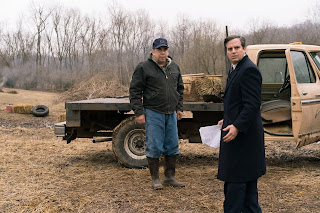
In Cincinnati, lawyer Robert Bilott (Mark Ruffalo) works for Taft, a top legal firm specializing in representing chemical companies. He is approached by farmer Wilbur Tennant (Bill Camp) of Parkersburg, West Virginia, where Robert's grandmother has lived all her life. Wilbur's cattle are being poisoned by chemicals dumped in a nearby landfill by the manufacturing giant DuPont, and no governmental agency appears interested in helping.
Robert's boss Tom Terp (Tim Robbins) approves a case. DuPont's head Phil Donnelly (Victor Garber) is initially cooperative, but turns hostile when Robert uncovers the harmful impacts of PFOA, an unregulated chemical used in the manufacturing of Teflon. The case expands to the health impacts on the whole community, consuming years of Robert's life and threatening his health and the happiness of his wife Sarah (Anne Hathaway).
Based on real events, Dark Waters is designed to cause outrage through revelations of profit-driven maleficence. Reminiscent of previous portrayals of corporate environmental negligence, here director Todd Haynes targets a large employer and respected corporation selling chemically-laden and potentially hazardous pans into every kitchen. The film strikes the expected David versus Goliath beats without ever quite soaring.
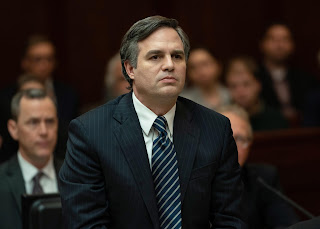
The drama is always engaging, but the emotional impact is dimmed by structural and artistic decisions. With the best of intentions the film tries to do too much, covering more than a decade of machinations. The focus meanders from a farmer's field to an elderly couple with health issues and finally a community subjected to large scale medical testing and subsequent prolonged research by a faceless panel. Rather than building to a crescendo the narrative is diluted into ups and downs, a realistic but drawn-out portrayal of a seemingly endless years-long struggle.Robert Bilott is the heart of the story and the one constant presence through all the legal wranglings. As written by Mario Correa and Matthew Michael Carnahan, this lawyer is grounded and well-intentioned, helped by humble origins. But Bilot is also presented as uncharismatic and generally dour, and Mark Ruffalo cannot do much except convey pained expressions as he endures frequent beratements by others. Faring worse is a wasted Anne Hathaway in a thankless and stock long-suffering-wife role.
The dilemmas inherent in standing up to a large employer enrich the narrative. DuPont is exposed as knowingly concealing evidence of harmful chemicals, but Dark Waters also acknowledges the backlash against challenging a company actively providing livelihoods and sustaining communities.
Haynes and his cinematographer Edward Lachman add to the downbeat mood by bathing the film in blue-grey hues, metaphorically representing the fog of forever chemicals dominating the environment. Non-stick pans place plenty of food on many tables, but the Teflon only looks clean.
All Ace Black Movie Blog reviews are here.
The setting is California, starting in 1969. A couple is shot by an unknown assailant in a Vallejo lovers' lane parking area. Months later, another couple is stabbed near a lake in Napa County. In both cases the woman dies but the man survives. A few weeks later, a taxi driver is stabbed to death in San Francisco.
The San Francisco Chronicle receives a series of letters with encrypted codes from a person claiming to be the murderer. The codes are broken and the killer is labelled Zodiac. One of his letters threatens an attack on a bus full of school children, throwing San Francisco into panic. The Chronicle's acerbic crime reporter Paul Avery (Robert Downey Jr.) covers the case, while the newspaper's introverted cartoonist Robert Graysmith (Jake Gyllenhaal) becomes obsessed with uncovering Zodiac's identity.
San Francisco's celebrated Police Inspector Dave Toschi (Mark Ruffalo) and his partner Bill Armstrong (Anthony Edwards) are placed in charge, but despite no shortage of leads and suspects they cannot find enough evidence to charge anyone. Fascination with Zodiac diminishes when his letters start to falsely claim credit for every murder in town. The years pass and the case fades from memory, but Graysmith will not give up on his quest to uncover the man behind the symbol.Directed by David Fincher and written by James Vanderbilt, Zodiac is not short on aspirational scope, tracing incidents from 1969 to 1991. The period details are carefully recreated, and the intricate dedication to details, including many investigative dead-ends, is admirable. The murder scenes are chilling and adopt the victims' perspectives, adding to the sense of mystery surrounding the assailant's identity.
But after a strong start, this is a story with a long and meandering denouement. The initial bursts of fear and apprehension triggered by the murders, followed by coded letters shoving journalists into the story and detectives jumping onto the case, all create high expectations for a cerebral thriller. But to the detriment of the film's entertainment value, Fincher remains faithful to facts that refuse to adhere to genre conventions.
The middle third starts to sag as the murders stop and limited progress is made on finding the killer. And the final third is endless: Graysmith becomes the sole focus, his obsession consuming his life over many years and long after everyone else stopped caring. The departures from cinematic expectations are admirable, but as Fincher insists on tracking every false lead (at least it feels like it), the ups and downs of an amateur investigation meld into each other with numerous side-trips to duelling handwriting experts. It's all but impossible to keep track of the muddle of names keeping Graysmith away from his long-suffering wife (Chloë Sevigny) and children.Robert Downey Jr., Mark Ruffalo and Jake Gyllenhaal take turns at centre stage as key characters fade in then out of the investigation. The three stars excel at conveying the grinding emotional and physical toll of an intractable case on different personalities, as all three men get in too deep, becoming personally involved and losing parts of their soul. Downey's too-cool-to-care attitude passes the baton to Ruffalo's celebrity detective crashing against bureaucratic ineptitude. Finally Gyllenhaal runs the last lap, a study in personal fixation.
Zodiac embraces details often ignored. The effort is unique, but also an exception that proves the rule.
All Ace Black Movie Blog reviews are here.