Showing posts with label Gary Oldman. Show all posts

Saturday, 10 August 2024

Movie Review: Criminal (2016)


Genre: Action Thriller  
Director: Ariel Vromen  
Starring: Kevin Costner, Gal Gadot, Gary Oldman, Ryan Reynolds, Tommy Lee Jones  
Running Time: 109 minutes  

Synopsis: In London, CIA Agent Bill Pope (Ryan Reynolds) is the only person who knows the location of a hacker who has seized control of military secrets. When Pope is killed, the CIA's London chief Quaker Wells (Gary Oldman) authorizes Dr. Franks (Tommy Lee Jones) to transplant Pope's memories into the brain of hardened criminal Jerico (Kevin Costner). Jerico has to grapple with Pope's recollections intruding on his consciousness as he meets Pope's wife Jill (Gal Gadot) and tangles with evil anarchist Xavier Heimdahl, who is also eager to find the hacker. 

What Works Well: This B-movie enjoys an A-list cast, and although the contributions of Tommy Lee Jones (wasted) and Ryan Reynolds (dispatched early) are limited, Kevin Costner is given a complex role to navigate. Jerico starts out as an empathy-free convict (the result of childhood abuse), but the insertion of another man's thoughts awakens him to a new world of emotions, and his quiet interactions with Gal Gadot yield the best moments. Elsewhere director Ariel Vromen keeps the pacing brisk and the action scenes coherent.

What Does Not Work As Well: The premise is built on not one but two far-fetched ideas: memory transplants and a hacker gaining full control of a superpower's military capabilities through a dark web "wormhole". From there the action layers on enough improbabilities and logic gaps to sink a fleet. Gary Oldman fares worst among the many stars on display, flailing his arms and foaming at the mouth as his character makes one bad decision after another.

Conclusion: The polished veneer activates brainless enjoyment.


All Ace Black Movie Blog reviews are here.

Saturday, 10 June 2023

Movie Review: Crisis (2021)


Genre: Crime Drama
Director: Nicholas Jarecki
Starring: Gary Oldman, Armie Hammer, Evangeline Lilly, Greg Kinnear, Michelle Rodriguez
Running Time: 118 minutes

Synopsis: Three stories related to the opioid addiction crisis are set in Detroit and Montreal: DEA agent Jake (Armie Hammer) works an undercover operation to bring down ruthless gangs involved in pill distribution and manufacturing on both side of the border; addicted mother Claire (Evangeline Lilly) investigates the sudden death of her teenaged son; and university researcher Dr. Bower (Gary Oldman) is pressured to ignore lab results that could undermine approval of the latest opioid developed by a powerful pharmaceutical company.

What Works Well: Writer and director Nicholas Jarecki creates a competent companion piece to Traffic (2000), providing each story with sharply defined characters and a good share of screen time. Artificial constructs are avoided, allowing the three plots to only lightly interact. The enforcement, personal, and business angles provide a steady stream of punctuation marks in the form of action, shock, and dilemmas both ethical and financial. Armie Hammer, Gary Oldman, and Evangeline Lilly lean-in to their roles with requisite earnestness.

What Does Not Work As Well: Underdeveloped side-characters and messy loose ends (Claire's addiction; Jake's sister; Dr. Bower's numerous colleagues and foes) create a tangle of distractions. While the core subject matter still harbours potency, the narrative is barely distinguishable from daily headlines, and is delivered with enough mechanical efficiency to double down on the inherent intractability of the crisis.

Conclusion: Cold, cogent, and capable, but not creative


All Ace Black Movie Blog reviews are here.

Saturday, 19 March 2022

Movie Review: The Laundromat (2019)

A mildly satirical comedy anthology, The Laundromat features loosely related mini-stories inspired by the murky and bizarre world of off-shore tax havens.

Lawyers Mossack (Gary Oldman) and Fonseca (Antonio Baderas) speak directly to the camera. They explain how their Panama-based law firm helps wealthy clients avoid taxes through layers of shell companies registered in tax haven countries, and run by pay-per-signature Caribbean-based "directors".

Three stories explore the industry's different angles. In New York, Ellen Martin (Meryl Streep) loses her husband in a tour boat accident that claims 21 lives. The owners of the tour boat company discover that their cheaply-purchased insurance coverage is fraudulent. Ellen learns the fraudsters are hiding beneath shell companies and impossible to track. Meanwhile, a Las Vegas condominium Ellen was hoping to purchase is snapped up by shady Russians paying in cash.

African billionaire Charles is cheating on his wife, and his daughter Simone catches him in the act. He tries to placate her by gifting her control of a shell company worth millions. But a surprise awaits both Simone and her mom.

British businessman Maywood (Matthias Schoenaerts) is in China, trying to blackmail corrupt businesswoman Gu Kailai (Rosalind Chao) into creating another shell company for his benefit. They are both in danger as China clamps down on corruption.

Inspired by real events and the Panama Papers revelations, enough spot-the-star talent features in The Laundromat to avoid a total loss. Director Steven Soderbergh can attract a quality cast, and minor roles are populated by notables like James Cromwell, Sharon Stone, Robert Patrick, Jeffrey Wright, and David Schwimmer.

But otherwise this is a half-hearted and never convincing effort to cinematically expose the lawyers, bankers, shell companies, and shady characters helping the rich avoid taxes. While 2015's The Big Short aced the combination of explaining and exposing the mortgage crisis complexities from multiple perspectives, here writer Scott Z. Burns simply flounders with dead-ended narrative fragments.

The start is strong enough, and the boating tragedy and subsequent non-insurance debacle shows promise. But even this plot meanders into a tangential real estate sub-story before being summarily abandoned in favour of the tired soap-opera featuring Charles' family. The third story in China drops in without context or purpose. 

Soderbergh loses further focus by steering towards poorly explained links between tax shelters and the need for campaign finance reform, a topic unrelated to any of the vignettes. As the narrative thrust fizzles, The Laundromat concludes with embarrassing straight-to-the-audience preachiness, landing with a hollow clank.


All Ace Black Movie Blog reviews are here.

Sunday, 21 November 2021

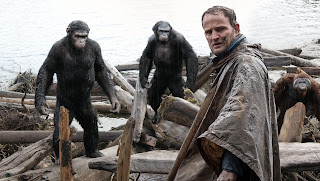
Movie Review: Dawn Of The Planet Of The Apes (2014)

A science fiction action thriller, Dawn Of The Planet Of The Apes is a festival of simian special effects. The story struggles for relevance in the rumbling rush to the next CGI-generated highlight.

Ten years after a drug intended to treat Alzheimer's disease increased ape intelligence and almost wiped-out humanity, Caesar (Andy Serkis) leads a group of apes building a growing society in the forests outside San Francisco. His son Blue Eyes is learning about leadership, while Caesar's main military leader is the aggressive Kobo (Toby Kebbell).

The apes block a small group of humans, including Malcolm (Jason Clarke) and his partner Ellie (Keri Russell), from exploring the forest to find and reactivate a hydroelectric dam. They are part of a San Francisco settlement led by Dreyfus (Gary Oldman), growing increasingly desperate for a power source. Malcolm believes he can reason with the apes and Caesar's instinct is to help. But just as Dreyfus does not believe the apes can be allies, Kobo is also suspicious and starts to agitate for war. 

The sequel to Rise Of The Planet Of The Apes (2011) starts off on a rickety foundation with a dumbfoundingly similar title, and the prolonged opening scenes are computer generated National Geographic-type explorations of apes in the forest. It takes a while, but director Matt Reeves eventually finds his footing and settles down to a basic conflict between apes and humans, with peacemakers and warmongers on both sides.

The film is adequate but never threatens to rise anywhere. Despite Andy Serkis' expressive heroics as Caesar, only so much interest can be generated by actors in monkey suits surrounded by digital monkeys hooting and hollering at each other in the forest. And large chunks of the overlong 130 minutes are exactly that.

The hawks on both sides have to get their way for the pixels to be truly unleashed, and the second half is full of bloated computer-generated combat, sometimes effective but often a confusing mess of digital firepower and destruction.

It's a tough slog when most of the human moments are not among the humans. Caesar has a family, allies and enemies, and they must have all watched The Lion King, as the dynamics of treachery and the next generation rising to the challenge play out with full predictability. In contrast Jason Clarke and Keri Russell have the thankless task of interacting with ape suits and green screens to demonstrate basic empathy.

Dawn Of The Planet Of The Apes shows good and bad intentions on both sides, and concludes apes are no better than humans in their capabilities for internecine acts of self-destruction, a thoroughly depressing prospect for all mammals on a small planet.


All Ace Black Movie Blog reviews are here.

Thursday, 19 August 2021

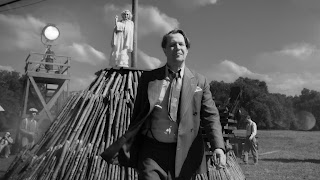
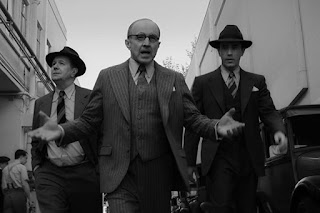
Movie Review: Mank (2020)

An inside-Hollywood drama, Mank is the story of the writer behind the legendary Citizen Kane script. The film is visually splendid but carries narrow appeal.

It's 1940, and RKO studios provide wonderkid filmmaker Orson Welles (Tom Burke) with complete artistic freedom to mount his next project. He hires washed-up and unemployed writer Herman "Mank" Mankiewicz (Gary Oldman) to pen a screenplay. Mank is recovering from a broken leg suffered in a car crash, and Welles houses him in a secluded ranch, theoretically free of booze and distractions. Mank also agrees that Welles will receive sole writing credit for the completed script.

Under pressure to deliver in 60 days and assisted by secretary Rita Alexander (Lily Collins), Mank writes a script inspired by the life of newspaper tycoon William Randolph Hearst. Flashbacks reveal Mank's history in Hollywood starting in 1930. He encounters powerful moguls Louis B. Meyer (Arliss Howard) and Irving Thalberg (Ferdinand Kingsley), as well as actress Marion Davis (Amanda Seyfried) and her much older husband Hearst (Charles Dance). Mank's principled opposition to Meyer's meddling in politics, plus his excessive drinking, gradually dim his Hollywood status.

As the Citizen Kane script nears completion, Mank recognizes it as his best ever work, and decides he does indeed deserve credit for writing it.

The geeky debate as to whether Welles or Mankiewicz are more responsible for Citizen Kane's greatness is a sub-niche topic for a small group of cineastes. Here director David Fincher, working from a script by his father Jack, attempts to transform the writing process into a flamboyant drama. The production quality is high, but predictably, the material is too thin to sustain the overly-ambitious 131 minutes. 

Mank therefore meanders into a mini history of 1930s Hollywood, throwing in mundane socialist versus capitalist political shenanigans, routine power plays by the rich and influential, and one obscure cinematographer who takes it all too seriously. The flashbacks carry casual interest but dominate what is supposed to be the main plot. In the present-day scenes Mank's writing just flows forth, and beyond a childish game about smuggling alcohol to keep the juices flowing, few genuine insights are offered into the creative process.

Gary Oldman saves the day with a performance full of self-awareness, but even he is weighed down by the incessant wittiness of a writer who has a clever retort or quip for every situation. The period details recreate a booming Hollywood filled with schemers and dreamers, and the black and white cinematography courtesy of Erik Messerschmidt is crisp and grandiose, but the intended salute to Citizen Kane's visual style overwhelms Mank's much smaller story.

Mank is beautiful to look at, but this packaging is mightier than the pen.


All Ace Black Movie Blog reviews are here.

Saturday, 10 July 2021

Movie Review: The Woman In The Window (2021)

A psychological suspense drama with horror elements, The Woman In The Window weaves a decent but logic-challenged mystery involving grief, loneliness, hallucinations, and crime.

In Manhattan, Dr. Anna Fox (Amy Adams), a child psychologist, suffers from agoraphobia and refuses to leave her house. She is separated from her husband Edward (Anthony Mackie), who looks after their eight year old daughter. Anna has a shaky friendship with her basement tenant David Winter (Wyatt Russell), a singer/songwriter/handyman, and holds weekly sessions with her therapist Karl Landy (Tracy Letts), who is tinkering with her medications. But she spends most of her days snooping on neighbours through her windows.

She quickly gets involved in the lives of new neighbours the Russells and meets their awkward teenaged son Ethan (Fred Hechinger), then his vivacious mother Jane (Julianne Moore) comes for a visit, and finally Ethan's mysterious father Alistair (Gary Oldman) briefly drops by. Anna's world in thrown into turmoil when she witnesses what appears to be a murder at the Russell house, but all may not be what it seems.

Directed by Joe Wright and written by Letts, The Woman In The Window carries ambitions to salute Hitchcock's Rear Window. And equipped with a housebound protagonist and a camera for better zoom and focus, it's a not-bad effort. Anna's fragile mental state creates a milieu where anything is possible as either reality or imagination, and Wright exploits her dark and empty house as a solid foundation for appropriate spookiness.

Anna is lonely, suicidal, mixing alcohol with medication, and watching too many old movies. The people closest to her are a good mix of slightly creepy (David) and slightly smarmy (Landy), but then the Russells arrive and give her a jolt of excitement. Anna's motherly instincts and child psychologist training immediately kick in with the troubled Ethan. Then a fun session of wine and talk appears to offer the potential for friendship with Jane, but the stern Alistair remains cold and aloof.

When the blood splatters and carnage is unleashed, the narrative initially remains strong. Anna is forced to confront her troubled life and reexamine everything she thinks she knows, Amy Adams delivering another stunningly engaging performance as a woman trying to stumble out of a mental fog. But the final act is disappointing, resorting to unworthy slasher cliches, stabbing holes in plenty of the preceding build-up and attempting to have it both ways, Anna both right and wrong on all counts.

The Woman In The Window peeks at the tantalizing world outside, but can't quite confidently stride out.


All Ace Black Movie Blog reviews are here.

Sunday, 23 May 2021

Movie Review: Hunter Killer (2018)

A submarine action thriller, Hunter Killer is a slick throwback to the era of well-made, edge-of-your-seat military movies.

Two submarines, one Russian and one American, are attacked and sunk almost simultaneously in Arctic waters. The US Navy responds by deploying the USS Arkansas to the area, under the command of new and untested Commander Joe Glass (Gerard Butler). A Navy SEAL team led by Lieutenant Bill Beaman (Toby Stephens) is also dispatched to eavesdrop on Russia's Polyarno naval base, where an unusual meeting is scheduled between Russian President Zakarin (Alexander Diachenko) and his Defence Minister Durov (Mikhail Gorevoy). 

The Arkansas has to evade an attack before rescuing Captain Andropov (Michael Nyqvist) of the sunken Russian sub. In the meantime war hawk Durov seizes power, holding Zakarin prisoner and manoeuvring for a confrontation with NATO naval forces. US Chairman of the Joints Chief of Staff Charles Donnegan (Gary Oldman) immediately seeks to escalate, but Rear Admiral John Fisk (Common) and National Security Agency senior analyst Jayne Norquist (Linda Cardellini) improvise audacious missions for Glass and Beaman to try and avert a catastrophic war.

Recalling earlier eras from the 1990s (The Hunt For Red October and Crimson Tide) and 1950s (Run Silent, Run Deep and The Enemy Below), Hunter Killer rolls back the years and overachieves. Adapting a book by Don Keith and George Wallace, co-writers Arne Schmidt and Jamie Moss deliver a solid script for director Donovan Marsh to work with. Co-produced by star Gerard Butler, this is a well-crafted and coherent geopolitical thriller, generally plausible and grounded in real-world tensions and nationalistic agendas that can tip military posturing into shooting wars.

The special effects are immersive and enhance the familiar submarine drama beats of maintaining stealth, evading attacks, and hunting enemies. But the introduction of a parallel on-the-ground mission by the four-man SEAL team is a surprisingly effective enhancement. The gritty infiltration and surveillance objectives (which eventually expand into much more) provide relief from the naturally claustrophobic underwater environs.

With Butler in typically stoic form but also conveying the requisite smarts, Commander Joe Glass is introduced as an unconventional leader who earned his way to the top. Everyone else stays within narrow limits, making way for narrative spice in the form of earned trust between Glass and Andropov, natural rivals who will have to work together to try and pull the world back from the brink of disaster.

Given the ambitious scope, some clunky and cheesy moments do creep in, Gary Oldman particularly culpable with a dismissive display of hawkishness, and shortcuts in time and space help to keep the action compact. But the two hours of running time fly by with a series of well-executed and sequentially logical action highlights, before Hunter Killer sails its way to appetizing pivot points where hunting and killing are a valid response but thinking and trusting may be more judicious actions. And global calamities hang on the small margins where such under-pressure decisions are unavoidable.


All Ace Black Movie Blog Reviews are here.

Sunday, 12 April 2020

Movie Review: Red Riding Hood (2011)


A reimagining of the children's folk tale, Red Riding Hood stumbles into a mundane who-is-it guessing game with clumsy execution and limp resolution.

In a small village at the edge of a forest, Valerie (Amanda Seyfried) is in love with dashing but penniless woodcutter Peter (Shiloh Fernandez), although her mother Suzette (Virginia Madsen) has arranged for her to marry blacksmith Henry (Max Irons). The village lives in fear of a murderous werewolf, and despite the villagers offering livestock in a monthly ritual sacrifice, Valerie's sister Lucie, who was in love with Henry, is killed by the beast.

The villagers organize a hunting party, invade the wolf's lair and claim to kill it, while Valerie visits her grandmother (Julie Christie), who lives alone inside the forest. The next day Father Solomon (Gary Oldman) and his guards arrive to proclaim that the werewolf is still alive and hiding in human form inside the village. With Valerie torn between two lovers, the werewolf bursts forth, causing carnage. Valerie is the only resident who can communicate with the beast, arousing suspicions she is a witch.

Squarely targeting the teen market enthralled by the Twilight young adult series, Red Riding Hood offers a barely interesting who-is-the-wolf mystery but otherwise reeks of a low budget theatrical production. It was maybe the intention of writer David Leslie Johnson and director Catherine Hardwicke to create an artificial milieu to channel a child's fairy tale imagination, but on the screen the film appears trapped on essentially a single set not unlike what a group of high school students would conceive.

The narrative development is equally truncated. The characters are introduced in a manic rush, Valerie's lovers and their families thrown together in a blur, two overlapping love triangles and assorted parents and a grandparent thrown onto the screen in disarray, with one character literally dead on arrival.

The scenes with special effects featuring the gigantic werewolf alternate between choppy and effective but are always dark, with the blood and gore levels kept to a minimum. The tween-appropriate breathy romance scenes between Valerie and Peter hint at a nexus between the werewolf and burgeoning sexuality, but the resolution is both more mundane and barely coherent.

With Gary Oldman given free reign to chew the limited scenery, Red Riding Hood at least commits to undisguised commentary about religion's arrival making everything worse. Father Solomon leverages fear to gain control, defines the werewolf as residing within and thereby labeling everyone guilty until proven innocent. He turns neighbour against neighbour, imposing confinement and extracting confessions, instigating witch hunts, then torturing and killing individuals in the name of the public good. The more dangerous wolf, it turns out, is the one hiding beneath clerical robes.


All Ace Black Blog Movie Reviews are here.


Sunday, 6 May 2018

Movie Review: Léon: The Professional (1994)


A thriller drama, Léon: The Professional delves into the psyche of two lost souls to unearth the humanity within.

In New York City, Léon (Jean Reno) is a low profile but efficient hitman who fulfills assassination assignments on behalf of mafia front man Tony (Danny Aiello). Léon is uneducated and lives a lonely and well regimented life, his small plant the only thing he cares for. But he is friendly towards Mathilda (Natalie Portman), the 13 year old daughter of the family living in the next door apartment.

Mathilda's father crosses corrupt and psychotic Drug Enforcement Agency agent Norman Stansfield (Gary Oldman), and in the ensuing violence Mathilda's family is wiped out. She survives by taking refuge in Léon's apartment. The hitman is reluctant to take care of his unexpected visitor, but gradually they warm up to each other. She learns of his profession and insists that he train her to also be a killer so that she can pursue revenge. Meanwhile, she teaches him to read, and for the first time in his life Léon starts to care about someone.

Written and directed by Luc Besson,  Léon: The Professional features Natalie Portman's debut, an epic Gary Oldman villainous performance and an understated Jean Reno as a uniquely introverted assassin. With elegant action and character development mixed in just the right doses, the result is a captivating, and sometimes haunting, film.

Steering far clear of typical assassin characterizations, Besson creates in Léon an almost miserable man, a stranger in a strange land, out of place in New York City, unable to read, barely ever sleeping and living diametrically opposite from the glamour and riches often associated with efficient killing machines. Léon does not even care to receive the money he earns, Tony theoretically holding it for him.

Meanwhile Mathilda is suffering through her own hell, regularly beaten up by an abusive father who has gotten himself embroiled in the drug trade. Mathilda only cares about her innocent younger brother, and when he is hurt in the Stansfield-instigated bloodbath, the 13 year old girl starts to understand the appeal of revenge as a life calling.

Most of the film is occupied in nurturing the relationship between hitman and young girl, and Besson injects the full range of emotions. Léon goes against every instinct in his body to even open the door for Mathilda to escape with her life, and his second thought is to kill her why she sleeps to save both of them the trouble of creating a bond. From there they learn to care about each other, he assumes an imperfect fatherly role and she carries her infatuation towards a girl's immature ideas of love.

But with the out-of-control Norman Stansfield always nearby, the film is not short on action, and Besson includes plenty of exquisitely executed high-tension highlights, often in cramped surroundings, culminating in an all-or-nothing climax for all three main characters. Léon: The Professional is about learning to love, and plenty of education takes place under a hail of bullets.


All Ace Black Blog Movie Reviews are here.


Saturday, 3 February 2018

Movie Review: The Fifth Element (1997)


A science fiction comedy thriller, The Fifth Element is a rollicking if sometimes messy space adventure.

A prelude shows friendly advanced aliens arriving in the Egyptian desert in 1914 and spiriting away for safekeeping four stones from a hidden chamber in the pyramids. The stones, protected by a lineage of priests, are needed along with a mysterious fifth element to ward off a force of evil that attacks Earth every 5,000 years.

In the year 2263, an unstoppable evil in the form of an indestructible energy-sucking dark massive planet is hurtling towards Earth. The allied aliens attempt to provide assistance but are intercepted by the mercenary Mangalores, working on behalf of evil industrialist Zorg (Gary Oldman). Enough organic matter survives from the destroyed alien ship for scientists to recreate the woman-like Leeloo (Milla Jovovich), an agile warrior and potentially humanity's only chance for survival, if only she can communicate in a decipherable language.

Leelo is soon on the run, and stumbles into the flying cab of Korben Dallas (Bruce Willis), a disgruntled ex-special forces member. Korben is eventually tasked with retrieving the stones, which are hidden with an opera singer performing at an elite resort planet. Zorg and the Mangalores are also chasing the stones, while Korben teams up with Leelo (who gradually teaches herself English) and high priest Father Vito Cornelius (Ian Holm) to try and save humanity.

Co-written and directed by Luc Besson, The Fifth Element is an original, highly imaginative and enjoyably campy sci-fi romp. Although the plot often makes little sense and some aspects (including most of Chris Tucker's contribution as a celebrity DJ) offer more noise than quality, the film generates enough loony energy to ride over the bumpier bits. Besson creates a fast-paced fantastical and colourful future filled with flying cars, space travel, floating cities and alien species, but with the same mostly dumb and narcissistic humans in the middle of it all.

The comedy and action are well balanced. Korben's sardonic resignation is a perfect fit for Bruce Willis' persona, while the lithe Leeloo emerges as the best thing about the film. Jovovich finds a deft comic touch as the super-smart but communication-challenged humanoid created to save Earth but nevertheless befuddled by all that is going on around her until she finally teams up with Korben. Together they not only make for an effective off-kilter buddy duo but also give The Fifth Element a beating heart amidst all the lunacy.

And Besson makes sure to also infuse plenty of action into the latter half of his adventure. When Korben tangles with Mangalores the big guns open up, and The Fifth Element becomes a surprisingly potent action thriller, but with tongue always firmly in cheek.

Wild and wacky, The Fifth Element wows.


All Ace Black Blog Movie Reviews are here.


Sunday, 7 January 2018

Movie Review: Darkest Hour (2017)


A biographical character study, Darkest Hour captures a leader rising to the challenge. Primarily a celebration of Gary Oldman's acting in the role of Winston Churchill, the film otherwise traverses overly familiar historical territory.

It's May 1940, and with the Nazis sweeping across Europe, the British Parliament loses confidence in Prime Minister Neville Chamberlain (Ronald Pickup). His conservative party reluctantly replaces him with the abrasive Winston Churchill (Gary Oldman), a decision that underwhelms King George VI (Ben Mendelsohn). Churchill's new secretary Elizabeth Layton (Lily James) bears the brunt of his acerbic attitude.

Despite the encouragement of his wife Clementine (Kristin Scott Thomas), Churchill is aware that he has achieved his life's ambition at the worst possible time: France is capitulating, Belgium and Holland cannot withstand the Nazi assault, and the British army is falling back to Dunkirk, their backs to the water with the Navy seemingly helpless to mount a rescue. With members of his cabinet arguing for a negotiated but humiliating peace, Churchill has to define a position for his fractured government and chart his nation's course through history.

Directed by Joe Wright, Darkest Hour zooms in on Churchill's first month in office. The film delves into the psyche of a man thrust into the most difficult leadership position in the free world at age 66, as western civilization crumbles under the boot of fascism and the United States stubbornly holds on to a policy of non-involvement. Churchill only became Prime Minister due to his well-known and uncompromising hatred of Hitler, and yet here he was in a position of power and being advised to sue for peace.

Wright centres the film on this deeply personal dilemma, with Churchill isolated from his own party and disconnected from the people, forced to make a literally existential decision days into his mandate. The film uses its artistic license to dramatize some pivotal moments, and Wright makes good use of a (more than likely) imagined turning point on the London subway system.

Darkest Hour touches on the actual events of the raging war with a light brush. A couple of artistically rendered scenes convey a taste of events in France, as Churchill comes to grips with an army in full retreat and the enormous responsibility of issuing orders that cost human lives. But most of the film takes place in London, in Churchill's home and in his war bunker, with Wright limiting his scope to the political, personal and national calculus going on in his head.

The film is therefore primarily composed of Churchill's often verbose conversations with his wife, his political rivals, and the King. Patience is required as the machinery of government under Churchill kicks into gear and he comes to terms with his available options. Wright tries to flesh out the drama with some pointed contributions from wife Clementine, the still-influential Chamberlain, other politicos including Lord Halifax (Stephen Dillane), secretary Layton (representing the common people) and the King, but they remain fleeting characters who barely progress beyond the most basic definitions.

An intensely personal drama demands an immersed central performance, and Gary Oldman delivers in the role of his career. Under layers of makeup, Oldman disappears into the Prime Minister and dominates the screen, humanizing the man behind the myth as burly and boorish but conflicted, not yet having hit his stride but clearly possessing an enormous if stubborn heart.

With the destination of the film never in doubt and the secondary characters not much better than window dressing, Oldman is the one reason Darkest Hour works.


All Ace Black Blog Movie Reviews are here.


Saturday, 2 September 2017

Movie Review: Batman Begins (2005)


A superhero origins story, Batman Begins kicks off the trilogy with an engrossing and cerebral character-centred experience.

In Gotham City, a young Bruce Wayne has a traumatic encounter with bats, then witnesses his parents' murder during a mugging. Wracked by guilt, Wayne (Christian Bale) abandons his family's wealth and heads out into the world, living a life of squalor and crime. Dumped into a remote prison in Central Asia, he is rescued by Henri Ducard (Liam Neeson), who oversees his combat training and inducts Wayne into the League of Shadows, an organization of elite warriors led by the mysterious Ra's al Ghul. Once Wayne learns the League's real agenda, he abandons them and returns to Gotham to fight crime on his own terms.

With help from long-time family butler Alfred Pennyworth (Michael Caine) and Lucius Fox (Morgan Freeman), head of the Applied Science Division at Wayne Enterprises, Bruce gradually adopts the crime-fighting persona of Batman. He keeps his mission a secret from childhood friend Rachel Dawes (Katie Holmes), now an idealistic Assistant District Attorney. Wayne embarks on a quest to both reclaim control of Wayne Enterprises and rid Gotham of corruption, starting with violent crime lord Carmine Falcone (Tom Wilkinson). He recruits honest police lieutenant James Gordon (Gary Oldman) and uncovers a vast psychotic drugs conspiracy involving psychologist Dr. Crane (Cillian Murphy), a villain known only as Scarecrow, and an unexpected powerful mastermind.

A big screen reboot of the Batman mythology, Batman Begins is an exquisite effort from director and co-writer Christopher Nolan. Committed to a surprisingly bright palette and an emphasis on people rather than action, Nolan creates a seminal example of what a smart comic superhero adaptation can achieve. Batman Begins first and foremost engages the mind and forgoes cheap thrills, and the origins story goes a long way towards grounding the film in the person of Bruce Wayne rather than the antics of a man in a costume.

The 140 minutes are surprisingly brisk, and despite some jumping around in time Nolan tidily breaks down the narrative into three parts. The backstory is the longest and best, rich in the details of a young Bruce experiencing the trauma of being trapped in a well, triggering a close encounter with bats, with a direct line from that experience to the death of his beloved parents. His formative years are then scattered on a life in search of any meaning in the company of other lost souls, until the intervention of Ducard and subsequent training as an elite warrior.

The second act focuses on Wayne defining his mission in life, buttressed by Alfred and supplied by Lucius on his way to assembling the raw material for what makes a Batman. Both Alfred and Lucius carry echoes of the past with strong links to the legacy of Bruce's father, and a large part of Batman Begins' appeal resides in the continued multi-generational commitment to do right. The finale is what can be expected, the true villains making themselves known and triggering an opera of mayhem with Batman improvising on the fly to save his beloved Gotham.

On the way to the transition Nolan has plenty of fun providing backstories to everything from the Batcave to the Batmobile, with detours to explain the origins of the suit, the mask and the emergency light signal. This is a true beginnings story, and nothing is left undefined.

Christian Bale slips into the role comfortably, displaying enough emotional depth to play up the emphasis on the individual rather than the role. Michael Caine, Morgan Freeman, Liam Neeson, Tom Wilkinson, Rutger Hauer (a slimy executive at Wayne Enterprises) and Cillian Murphy ensure that every key role is bolstered by a serious talent boost. Only Katie Holmes is overwhelmed, with a difficult, underwritten role and an unconvincing performance.

Batman Begins is a storytelling masterpiece, a fascinating crime fighter finally receiving his deserved high quality big screen production.


All Ace Black Blog Movie Reviews are here.


Thursday, 10 December 2015

Movie Review: Lawless (2012)


A prohibition-era action drama based on real events, Lawless mixes violence with family bonds and local skirmishes for control of the illicit alcohol trade. As three brothers from rural Virginia face off against big city criminals, there are plenty of predicable elements but also some snazzy moments of excitement.

It's 1931, and brothers Forrest, Howard and Jack Bondurant (Tom Hardy, Jason Clarke and Shia LaBeouf) are among the more successful families independently manufacturing and distributing alcohol in rural Franklin County, Virginia. Forrest is the brains, Howard the muscle, and the youngest Jack is the driver, considered by Forrest to be not-yet-ready for the serious business of intimidation and deal-making. The brothers operate under a mythology of invincibility, partially justified by Forrest's war-time adventures. The local sheriffs are friendly and kept under control with a regular supply of booze.

Maggie (Jessica Chastain), a dancer escaping from the chaos of Chicago, offers her waitressing services to the Bondurants and initiates an across-the-room relationship with Forrest. Meanwhile, Jack starts to romantically pursue Bertha (Mia Wasikowaska), the local reverend's daughter. With plenty of money to be made in the illegal alcohol trade, the big-time gangsters move into the Bondurant's turf. Special Deputy Charlie Rakes (Guy Pearce) is sent in to do the dirty work of bringing the ragtag moonshiners under the control of Chicago mobsters. Forrest is the only producer who resists, leading to increasing levels of violence as Rakes tightens the noose of intimidation and Forrest lashes back.

Lawless is based on true events as described in the book The Wettest County in the World by Matt Bondurant, Jack's grandson. Director John Hillcoat aims for a Bonnie And Clyde type vibe, with the Bondurants as 1930s outlaws to cheer for because they are likable rogues and everyone else is as bad or even more corrupt. To a certain extent the film succeeds as a romp on the backroads of the moonshine industry, with some wild but at least somewhat true episodes of throat slitting, broad daylight street gun battles, and ingeniously hidden distilleries pumping out unfathomable amounts of alcohol.

Fun as the adventures are, the film is also lacking in the necessary charm. Forrest is the closest Hillcoat comes to finding a compelling character, with Tom Hardy delivering an entertainingly gruff and mumble-filled performance. But about half way through the film his presence is sidelined for a long stretch, and the narrative momentum suffers.

The story is predominantly told through Jack's eyes, the least interesting of the brothers, and his moments of growth and development are both few and jarring when they happen. Jack's rather prolonged pursuit of Bertha fails to ignite.  Also disappointing is an underdeveloped role for Jessica Chastain as Maggie. She gets one good scene of proactive yet sensitive seduction, but otherwise settles firmly into the background.

What the protagonists may lack in flair, Special Deputy Charlie Rakes more than makes up for in over-the-top despicable smarm. Guy Pearce does not hold back in creating an easy-to-hate villain, from the ridiculous hair to the city slicker clothes and sniffy condescending attitude. The clash between Forrest and Rakes is a spicy collision between idealized rural honesty and exaggerated urbanite arrogance. Also adding some edge is Gary Oldman, who makes a couple of relatively brief but effective appearances as Floyd Banner, another well-financed gangster muscling in on the alcohol business.

The backdrops are provided by Benoît Delhomme's cinematography, and he creates a landscape only marginally disturbed by human settlement. Mountainous rural Virginia of the 1930s is a bleak, gray place, a comfortable home for the locals but relatively foreboding to outsiders, a perfect base from which an illegal industry can thrive.

Lawless achieves and maintains a middling level of engagement. Much like the moonshine itself, the quality varies by the batch but the underlying buzz is always there.


All Ace Black Blog Movie Reviews are here.