Saturday, 20 April 2024
Movie Review: The Bigamist (1953)
Saturday, 15 October 2022
Movie Review: Born To Be Bad (1950)
In San Francisco, Donna (Joan Leslie) works as an assistant for book publisher Caine (Harold Vermilyea), and is about to get married to the wealthy Curtis (Zachary Scott). Caine's niece Christabel (Joan Fontaine), who was raised poor by the ailing Aunt Clara (Virginia Farmer), comes to live with Donna while attending business school, with a plan to take Donna's position at the publishing house once Donna is married.
But Christabel has much grander ambitions. She flirts with all the men in Donna's orbit, including painter Gobby (Mel Ferrer), and starts a passionate affair with up-and-coming writer Nick (Robert Ryan). But her real objective is to cause a break-up between Donna and Curtis, by insinuating Donna only wants to get married for the money. Christable seduces Curtis, but is still not satisfied with her prize.
Four writers collaborated on the Born To Be Bad screenplay (an adaptation of a 1928 Anne Parrish novel), and the result is a 94 minute romp fueled by naked ambition and underhanded betrayals. The machinations are a scavenger class thematic companion piece to All About Eve, although here the material appears culturally stuck in the 1920s with women primarily occupied by their men. A few tasty one-line zingers pepper the drama, and director Nicholas Ray stays out of the way, allowing his willing cast to do the work.While the execution is crisp, the fundamentals are weak, all the fuss revolving around distasteful and ultimately uninteresting gratifications. Christabel's coveted prize is a jelly-spined wealthy man in the form of Curtis. He displays horrid judgment and non-existant instincts by falling into her clutches and not noticing her lust for Nick. Having worked hard to snare a rich husband, Christable then suddenly undermines all the good (bad) work by ignoring Curtis and engaging in easy-to-spot lies as she pursues sexual kicks. The shabby inconsistencies drain away any potential for engagement.
Joan Fontaine is too good to be bad, and rarely deviates from delivering lines in a hesitant purr with a sideways glance. Effective once or twice, it's beyond remarkable that Christabel can fool so many for as long as she does. Robert Ryan is the one standout in the cast, immediately seeing through Christabel and liking what he sees, at least until she assigns him the lover-on-the-side role. Joan Leslie as Donna is a non-entity and meekly succumbs to the agenda of others, her everything-is-forgiven resolution rather nauseating. One woman is Born To Be Bad, another is a bore to be bland.
All Ace Black Movie Blog reviews are here.
Saturday, 4 December 2021
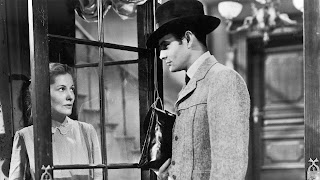
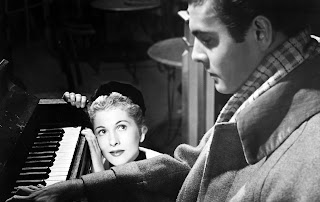
Movie Review: Letter From An Unknown Woman (1948)
In Vienna circa 1900, former star concert pianist Stefan Brand (Louis Jourdan) is now a shell of his former self. Having ill-advisedly accepted a duel-at-dawn, he plans to pack up and flee the city during the night.
But he is distracted by a long letter from a woman, with the first line proclaiming she may already be dead. He proceeds to read the letter, and in flashback the story of Lisa (Joan Fontaine) is revealed. She was a young teenager from a modest background living with her mother when Stefan moved into an adjacent apartment in the same building. She was immediately enamoured by the handsome pianist and loved listening to him practice through the walls, although he barely noticed her.
After Lisa's mother remarried and moved the family to a different town, Lisa rebuffed a suitor and returned to Vienna, where she found a job and kept tabs on Stefan's movements. As a star pianist he lived the good life with no shortage of women for company. Lisa has one brief opportunity to spend time with the man of her dreams, but fate intervenes and confines her to the status of an unknown woman.
The plot of Letter From An Unknown Woman is both constrained and aggravating. The running length of 86 minutes feels substantially longer, because the Howard Koch script has very few notes to play with. This is a weepy drama about a child who grows into a woman trapped into a dream-like state of fascination with a man who barely knows she exists. While the teenaged Lisa can be excused, her persistent capitulation to his charms as a grown woman, fully aware of his playboy reputation, is more exasperating than tragic.Director Max Ophüls and cinematographer Franz Planer elevate the scant material with touches of cinematic majesty. The camera glides across convincing sets, and beautifully choreographed long shots accompany the actors up and down the stairs and through narrow hallways. Vienna is recreated across many locations as a thriving city, frequent nighttime scenes adding to the gloom but captured in mysterious black and white. Lisa may be hypnotized by a philanderer, but Ophüls knows how to capture the look of devotion by focusing soft light on a transcendent Joan Fontaine.
Trains play a big role in Lisa's story. A couple of train station farewell scenes are stock milestones, but an amusement ride with painted backgrounds is a clever metaphor for her soaring hope and Stefan's pragmatic fakery coming together for an interlude of happiness.
The ending goes looking for layers of tragedy to pile onto the misery of misdirected love, a disease creeping into Lisa's narrative as a foreign agent of intervention. If she is unwilling to confront her hopelessly poor judgment, perhaps a convenient infection is the cure for futile infatuation.
All Ace Black Movie Blog reviews are here.
Wednesday, 15 July 2020
Movie Review: Flight To Tangier (1953)
Friday, 2 August 2019
Movie Review: Gunga Din (1939)
A military adventure epic, Gunga Din enjoys breathtaking scope and ambition, combined with a lighthearted tone and traditional themes of friendship and military honour.
It's the 1880s in India, and the British India Army in the Northwest Frontier is encountering organized attacks. Sergeants MacChesney (Victor McLaglen), Cutter (Cary Grant), and Ballantine (Douglas Fairbanks Jr.) are a close-knit hell-raising trio, and are dispatched in command of a small contingent to repair telegraph lines in the village Tantrapur. They are forced into defensive action to repel an attack by Thuggees, a blood-thirsty military cult enjoying a resurgence.
Ballantine is close to leaving the military and wants to marry his sweetheart Emmy (Joan Fontaine). But the veteran MacChesney and treasure-seeking jokester Cutter conspire to keep him on duty. Meanwhile Cutter spots loyal water carrier Gunga Din (Sam Jaffe) emulating British troop procedures and pining to be taken seriously as a soldier, with a particular fondness for the bugle. The three sergeants are again sent to Tantrapur, this time at the head of a much bigger force to flush out the Thuggees. But the enemy is well-prepared, and the British are lured to a gold-embossed temple for a showdown.
Enjoying a mammoth budget and high production values, Gunga Din goes searching for expansive adventure in exotic lands (or at least the best studio sets money can buy). Produced by RKO Pictures and directed by George Stevens, the film is written for the screen by Ben Hecht and Charles MacArthur and inspired by a Rudyard Kipling poem (a Kipling character makes a small appearance at the end of the film as a reporter).
The result is a rousing story of enterprising soldiers loving life in the brotherhood of the army, with bloodthirsty action mingling with episodes played purely for laughs. The humour is understandably dated and the scenes setting up the jokes seem to take forever, notably antics related to using elephant medication to spike a bowl of punch.
But all is forgotten and forgiven when the action kicks into high gear, and Stevens orchestrates two breathtaking and prolonged combat scenes, drawing on the colourfully dubious history of the Thuggee cult. First the small British contingent is attacked by the Thuggees and has to improvise a defence. The second action set-piece is the climax and starts with a trap, imprisonment and torture before breaking into an impressive all-out battle between multiple large armies.
In the interludes between the business of combat, Hecht and MacArthur have fun with tense travel exploits across hazards including a rickety bridge. The film salutes the ingenuity of British soldiers but also wields the double-edged sword of local water carrier Gunga Din entranced by the foreign army and proving his worth by playing a crucial role in battle. The humble local and loyal servant is instrumental in the White Saviors' quest to tame the land, for better or for worse.
McLaglen, Grant and Fairbanks share decent chemistry and pull off the raucous friends routine where arguments, fisticuffs and pranks are just as likely as acts of valour. They are less than convincing as soldiers of any sort, but with the military combat scenes staged on a broad canvas, they don't need to be. Joan Fontaine gets a couple of scenes as the token fiancée, here reduced to a symbol of naggy disruptiveness, but is otherwise wasted. Montagu Love is the gruff base commander Colonel Weed, and Robert Coote is the pantomime frenemy as the stuffy and unpopular Sergeant Higginbotham.
Well staged and infinitely enthusiastic, Gunga Din defines cheeky escapism.
All Ace Black Blog Movie Reviews are here.
Saturday, 13 April 2019
Movie Review: The Constant Nymph (1943)
A love triangle featuring a subdued underaged romance, The Constant Nymph offers plodding treatment of a controversial subject.
In Belgium, classical music composer Lewis Dodd (Charles Boyer) learns that his most recent composition was performed in London and flopped. In need of fresh inspiration, he relocates to the rural Swiss mountain farm of his friend and music aficionado Albert Sanger (Montagu Love). Albert is in ailing health, but his four spirited teenaged daughters are excited to welcome Lewis. In particular, Tessa (Joan Fontaine) harbors a deep crush, and hopes that one day Lewis will notice her, although she suffers from a weak heart and fainting spells.
But Lewis meets Tessa's sophisticated older cousin Florence Creighton (Alexis Smith) and they quickly get married, crushing Tessa's hopes. The extended family relocates to the London home of Florence's wealthy father Charles (Charles Coburn). Tessa and her sister Paula (Joyce Reynolds) are hustled off to a boarding school, while Lewis starts resenting Florence's conceited lifestyle and friends. When Tessa moves back into the Creighton house, the smoldering passion between her and Lewis becomes undeniable, igniting Florence's fury.
An adaptation of a novel and play by Margaret Kennedy, The Constant Nymph was out of general circulation for close to 70 years after initial release. Turner Classic Movies reached agreement with Kennedy's estate and the restored film re-emerged for broadcast in 2011. This 1943 version was already Hollywood's third take on the book, after adaptations in 1928 and 1933.
With the Lolita-like difficult subject matter of a fourteen year-old girl-woman dreamily lusting after a much older man who eventually awakens to her love and reciprocates (here in words only), director Edmund Goulding deserves credit for steering a steady path away from sordid implications. An overall sense of blandness helps, and Boyer rather flatly portrays Lewis as mostly oblivious to Tessa's passion until late, generally treating her as a younger ardent sister.
Fontaine, at 26 years old, does her best with unconstrained physical mannerisms to portray a barefoot farm-raised young teenager, but she can only do so much. On the screen Tessa is never anything other than an accomplished actress pretending to be a girl.
A stage director before moving to films, Goulding settles for lumbering theatricality and uninspired camerawork. Many of the scenes slowly sink due to length and listless talkiness. Somewhat saving the day is Alexis Smith in fine form as Florence Creighton. Finally here is a woman who knows what she wants and how to get it, but who also pays the price for the hurriedness with which she snags Lewis. Florence emerges as the most emotionally involved woman, and her struggle to control her rage and not lose her man gives The Constant Nymph some verve.
The cast also includes Brenda Marshall as Tessa's oldest sister Toni, and a rather wasted Peter Lorre as Toni's shifty suitor then husband Fritz.
Kennedy infuses the relationship between Tessa and Lewis with an inspirational subtext to soften the troublesome age difference. Wise well beyond her years and inspired by her father, Tessa deduces Lewis will only unleash his musical creativity when he finds true love and experiences heartache. The Constant Nymph follows a predictable narrative path to misery as a gateway to inspiration. Pity the film itself is more stilted than imaginative.
All Ace Black Blog Movie Reviews are here.
Saturday, 19 September 2015
Movie Review: Jane Eyre (1943)
An adaptation of the classic Charlotte Brontë novel about an orphan's awakening into adulthood, Jane Eyre is an exquisitely constructed dramatic romance. After creating a bleak shroud of physical and emotional foreboding, the film punctures through the despair with a story of love against all the odds.
England, 1830. Ten year old Jane Eyre (Peggy Ann Garner) is an orphan child, living with her cold aunt Mrs. Reed (Agnes Moorehead). Jane brightens up when she thinks that she is being sent to school, but in fact Mrs. Reed dispatches her to live at the nightmarish Lowood Institution, run by religious zealot and strict disciplinarian Reverend Brocklehurst (Henry Daniell). Her only friends are another young girl called Helen (an uncredited Elizabeth Taylor) and the kindly Dr. Rivers (John Sutton).
At 20 years old, Jane (Joan Fontaine) rejects a teaching position at Lowood and strikes out on her own. She secures a job as the governess for a young girl called Adele (Margaret O'Brien), living at the isolated, massive Thornfield estate, owned by the frequently absent Edward Rochester (Orson Welles).
Jane finally meets Edward on the foggy moors, accidentally knocking him off his horse. He is gruff, rich and mysterious, but Jane cannot help fall in love with him. Gradually, she starts to discover the layers of secrets in Edward's life, including his relationship with beautiful socialite Blanche Ingram (Hillary Brooke). Most worryingly, Jane starts to suspect that there are others who live in the closed-off mansion towers, as horrifying screams and hysterical laughter echo through the night. Then an intentional fire suggests that Edward Rochester's Thornfield is not just mysterious, but potentially deadly.
Directed by Robert Stevenson, Jane Eyre is a presented as a gothic romance between deeply damaged lovers. Set against a stunning backdrop of a dreary England enveloped by seemingly perpetual darkness, fog and rain (and all filmed on a Hollywood soundstage), the film brilliantly succeeds in creating a visual aesthetic that matches the psyches of Jane and Edward.
In different ways and through different circumstances, both are tortured by their pasts and carry deep scars. Jane's story is known before they meet; Edward's story becomes the focus of the second part of the film, and Jane will learn it is indeed possible for the rich and privileged to suffer just as much as she did as a poor orphan.
At just 97 minutes, Jane Eyre proceeds at a crisp pace without sacrificing character depth. Once Stevenson makes his dramatic points he does not linger, quickly moving on to the next chapter. This being fundamentally the story of two characters discovering an unlikely pathway to happiness through each other, there are plenty of dialogue passages between Jane and Edward, but they are handled with a welcome briskness and lack of melodrama.
Helped by the cinematography of George Barnes and a magnificent Bernard Herrman music score, Stevenson creates several memorable moments to highlight Jane's journey. At Lowood a young Jane is made to stand on a stool, alone, punished by Brocklehurst and labelled a liar. Then Helen quietly approaches with an extended hand of friendship and some food: there is kindness in the world.
The first meeting between Jane and Edward is bravado filmmaking at its best. Jane is out for a walk in the nighttime fog. A barking dog, galloping hooves, a startled, falling horse, and Edward emerges from the ground behind her like a dark monster out of the deep. He is in his own hell, and maybe she is his salvation. Later Jane finds herself caring for an unexpected patient in the isolated tower of Thornfield. A locked wooden door behind her starts to rattle and vibrate. Someone violent is trying to invade her room. She is not to let them in, and will need to endure the violently shaking door all night.
After Rebecca and Suspicion, Joan Fontaine was on a winning streak portraying women involved in dark, mysterious and potentially dangerous relationships, and she does not disappoint. She allows Jane to maintain an inner steeliness borne from life as an orphan, combined with an openness to embrace whatever good life will send her way. Orson Welles is domineering as Edward Rochester, carrying unspoken agonies behind his eyes and shielding his vulnerabilities with a coarse, uncompromising exterior attitude, with just the occasional hint of the potentially tender man underneath. Among the supporting cast, Henry Daniell is worth a mention as Reverend Brocklehurst. It's difficult to imagine a more uncaring, abhorrent man, hiding within the cloak of authority and religious righteousness.
Visually rich and emotionally satisfying, Jane Eyre is a sumptuous achievement.
All Ace Black Blog Movie Reviews are here.
Thursday, 7 May 2015
The Movies Of Joan Fontaine
All movies starring Joan Fontaine and reviewed on the Ace Black Movie Blog are linked below:
Gunga Din (1939)
The Women (1939)
Rebecca (1940)
Suspicion (1941)
This Above All (1942)
The Constant Nymph (1943)
Jane Eyre (1943)
Letter From An Unknown Woman (1948)
Monday, 16 March 2015
Movie Review: Serenade (1956)
A comeback showcase for tenor Mario Lanza, Serenade is a galumphing story of music melding into complicated romances, enlivened by many interludes of extraordinary operatic singing.
In California, Damon Vincenti (Lanza) is a humble field worker with a remarkable talent for singing. Through family connections he gets an opportunity to perform at Lardelli's, a San Francisco restaurant, where he is quickly spotted by the well-connected Charles Winthrop (Vincent Price) and rich society girl and arts patron Kendall Hale (Joan Fontaine). Winthrop introduces Damon to legendary vocal coach Maestro Marcatello (Joseph Calleia), who hones Damon's talent and sets him on the course to stardom. Meanwhile, Damon is very much falling in love with Kendall and uses her as his inspiration, but she remains aloof.
On Damon's grand debut with the New York Opera, all goes wrong, and his career appears to be finished before it starts. Damon retreats to Mexico in a depressed state, where he meets Juana Montes (Sara Montiel), the feisty daughter of a deceased bullfighter. She revives his spirits, but Damon has unfinished business back in the United States, including a reputation to repair and the relationship with Kendall to resolve.
Directed by Anthony Mann as an adaptation of a steamy James M. Cain novel (but excluding most of the sexual escapades that would have been too complicated for a 1950s film audience), Serenade amplifies the melodrama and layers on emotional catastrophes. The film about an opera singer takes on the grand airs of an on-screen opera, with themes of infatuation, betrayal, depression, confrontation and redemption all played at the highest possible volume and in the most vivid colours. The overflowing broth is both the film's charm and limitation. It's impossible to take any of it too seriously, and it's equally easy to surrender to its husky spell.
While the passion and fervour are consistently engrossing, Mann is unable to achieve an even tone, and the film's resonance fluctuates wildly. The singing interludes are packed into bunches, and there are long stretches devoid of Lanza doing what Lanza does best. The two halves of the film almost play out as two separate stories. The first US-based portion is all about the rural boy doing good, while the second Mexico-set segment is an arduous journey of recovery. The final 15 minutes, with the two women in Damon's life finally confronting each other, oscillate recklessly and feature rampant cattiness and pointy swordplay before collapsing into an unsatisfactory heap.Lanza is much better as a singer than an actor, and he unsuccessfully struggles to convince that he can carry off dramatic scenes. His line delivery is stiff and hesitant, his lack of comfort when not singing painfully apparent. Joan Fontaine is adequate, but she is not a natural self-centered vamp. Fontaine does not disgrace herself as Kendall Hale, but neither is she fully convincing. She also disappears for a long stretch once Damian relocates to Mexico. Sara Montiel and Vincent Price emerge with the best performances. Montiel gives Juana a genuine passion for life, while Price gets the snappiest lines and best attitude as the worldly Charles Winthrop.
Serenade is never dull; it's just smothered with the thick sauce of operatic excess.
All Ace Black Blog Movie Reviews are here.
Sunday, 15 March 2015
Movie Review: This Above All (1942)
A World War Two propaganda romance set in England, This Above All is a more heavy-handed companion piece to Mrs. Miniver.
The war is raging, France has surrendered, and England stands alone, subjected to daily German bombing raids. The rich Cathaway family is part of English aristocracy, suffering through the war through the prism of moaning about the inconvenience of it all. But daughter Prudence (Joan Fontaine) is more connected to the common people, and she breaks ranks to enlist with the Women's Auxiliary Air Force (WAAF) as a lowly recruit rather than using family connections to join as an officer.
Through a friend, Pru meets and starts a romance with the mysterious Clive Briggs (Tyrone Power). He is rugged, handsome, but also appears to be harbouring a deep dark secret. When Pru gets a week's leave, she decides to spend it with Clive at a seaside resort. She discovers he used to be a soldier and was evacuated at Dunkirk. But it is only when army buddy Monty (Thomas Mitchell) shows up that Clive's true predicament is revealed.
Directed by Anatole Litvak and based on a book by Eric Knight, This Above All is designed to elicit sympathy for the British, at a time when the Unites States was still uncertain about joining the war. The film delivers its message effectively but also tilts towards the crude side. This is a talk fest that lays bare the schisms in Britain's class system, but then issues a loud and emotional rallying call that England is a wonderful place and well worth saving, warts and all. Everything from the cliffs of Dover to the rolling countryside hills and the magic of Shakespeare are pressed into service, with the simple message of save the country now, and fix its society later.
The film moves slowly but steadily, and Litvak conjures up several magical moments. Pru unloading on her stuffy family's attitude at dinner time is a cathartic highlight. The first meeting between Pru and Clive occurs fully in the dark as a blacked-out England tries to avoid the German bombers, the faces of the would-be lovers only occasionally visible in the light of matches. And when Pru and Clive settle down for a week at a quaint seaside town, they eventually land at a pub and inn straight out of Dickens, a perfectly executed manipulative trick to drench the romance in old world charm.
Less impressive is the brooding Clive Briggs as played by a stiff Tyrone Power, not even trying to be English. Power sticks to the one note of passive anger with intermittent flare-ups, derailing the romance into a rescue mission for Pru. She appears to stick by her man as a mission of mercy to save his soul and make him better, and because she admits to being tired of being surrounded by nothing but women at WAAF, rather due to any obvious reasons to actually fall in love.
Joan Fontaine emerges as the main reason to watch the film. She does manage to keep all her make-up on despite WAAF regulations, and Fontaine captures the tender heart of the film, the bridge between classes, a woman in touch with her country's urgent needs and willing to make any sacrifice to survive and support the men who need to fight. In addition to Thomas Mitchell as a salt-of-the-earth soldier, the cast of characters includes small roles for Nigel Bruce as the innkeeper, Philip Merivale as Pru's father and Gladys Cooper as the haughty aunt.
This Above All may lack some subtlety, but in desperate times, some calls to action are best delivered bluntly.
All Ace Black Blog Movie Reviews are here.
Monday, 16 December 2013
Movie Review: The Women (1939)
A stylish view of life through the eyes of an all-female cast of characters, The Women is a whirlwind tour of what occupies New York's upper class. And for the women of high society, the main topic of obsession is men.Mary Haines (Norma Shearer) is sweet and trusting, the loyal wife of Stephen (none of the men are ever seen or heard) and mother of Little Mary (Virginia Weidler). Mary's cousin Sylvia Fowler (Rosalind Russell) visits the beauty salon to get the latest Jungle Red nail colour, and learns from the gossipy manicurist that Stephen is having an affair with department store perfume seller Crystal Allen (Joan Crawford). The news spreads rapidly, and eventually reaches Mary. Initially Mary is respectful of the wishes of her mother (Lucile Watson) to keep her marriage intact, but eventually she confronts Crystal and then Stephen before deciding to get a divorce.
Mary travels to Reno, where divorces are quickly handed out to women marching out of their marriages. On the train she meets Countess de Lave (Mary Boland), who has divorced numerous husbands, the spirited Miriam (Paulette Goddard), and the delicate Peggy (Joan Fontaine). In Reno they all stay at the ranch house of the outspoken Lucy (Marjorie Main), who readily doles out advice to her guests. As Mary moves into a new phase of her life as a single woman, there is a nasty surprise in store courtesy of Stephen and Crystal, while Sylvia gets a shock of her own, leading to new alliances among the ladies of New York.
Directed by George Cukor, working to earn his title as a "women' director", The Women is a talky, often boisterous movie. Based on Clare Boothe Luce's play, this is a story set in the salons, gyms, kitchens, department stores, fashion boutiques and living rooms occupied solely by women. And the ladies talk and talk and talk, sometimes too quickly, often interrupting each other, at other times screaming in delight or anger. Nothing happens in the film other than what is talked about, in person or over the phone, and the stories of failing marriages, sordid affairs, divorces, pregnancies and revenge are all recounted through shared gossip or conversations often delivered at a rapid pace.
And ironically for this man-free zone, the lives of the women are almost solely preoccupied by their men. Mary and her friends are obsessed with the thoughts, actions, feelings of their husbands and lovers. Liberated as they are by 1939 standards, the lives of these upper class women are dominated by continuous plans to win, please, defend, support, seduce or punish their men. Other than one gossip columnist, none of the women appear to have any jobs worth mentioning, and the precocious Little Mary requires limited parenting, leaving the women plenty of time to exchange sharp barbs and hatch men-related schemes.At more than 130 minutes in length, The Women is packed with...women. If the film has a weakness, it's in the large number of characters, often introduced in a hurry and proceeding to contribute a ton of verbiage. It's sometimes difficult to keep track of - or care about - all the multitudes of women who have to have their say. And inserted into the middle of the film is a technicolour fashion show sequence that is both jarringly out of place and a welcome respite from the overflowing rivers of estrogen.
The performances of the lead actresses are bright, energetic and catchy. Shearer gets the most extended and sympathetic role, and is generally closest to the relative sanity of reality. Russell is larger than life, sassy, funny and ensures that Sylvia is unable to control her urge to gossip, the girl who makes the world go round until it smacks her in the face. Crawford has few scenes, but Shearer's real-life rival vamps up the screen with a claws-out performances full of naked, marriage-wrecking ambition. Goddard and Fontaine also shine in smallish roles.
The Women gently takes some humorous pokes at its heroines while celebrating their emotional strength, resourcefulness and determination. These women may need their men, but they certainly also know how to thrive in their man-free havens.
All Ace Black Blog Movie Reviews are here.
Monday, 8 July 2013
Movie Review: Rebecca (1940)
An opulent adaptation of the Daphne du Maurier novel, Rebecca is a masterpiece of understated suspense. Alfred Hitchcock constructs an intricate psychological thriller built upon mysterious past events haunting the promise of the present.In Monte Carlo, a young and naive woman (Joan Fontaine), working as a travel companion to the insufferable Mrs. Edythe Van Hopper (Florence Bates), meets the rich but troubled Englishman Maxim de Winter (Laurence Olivier). Maxim is the master of the extravagant and expansive Manderley estate, and also a widower, having recently lost his first wife Rebecca in a boating accident. After a whirlwind few days of romance, Maxim asks the young woman to marry him, and she agrees.
Now known as the Second Mrs. de Winter, the young woman arrives at Manderley to find a massive mansion, still dominated by Rebecca's personal belongings, and full of servants who remain unusually faithful to their dead former mistress. In particular, the stern housekeeper Mrs. Danvers (Judith Anderson) appears obsessed with Rebecca, and makes no secret that the Second Mrs. de Winter is not worthy of the title. Rebecca's cousin, the sleazy Jack Favell (George Sanders) makes a surreptitious appearance at Manderley, raising more questions about the past. As her dream life starts to turn into a nightmare of awkwardness and fear, the Second Mrs. de Winter learns that while Rebecca was glamorous and sophisticated, there was much more to her life and death, and the true story of Maxim's anguish is significantly more complicated that it first appeared.
Rebecca was Alfred Hitchcock's first American project and his first film working with producer David O. Selznick. It is a grand production filled with larger than life people, places and events, coming together in a collision of hopes and anxiety. The story provides the perfect frame for Hitchcock to fill in exquisite touches of lurking evil.
From the opening scene of a destroyed and abandoned Manderley, and working with gleaming shades and shadows of grey and black, Hitchcock fills the film with unforgettable images that collectively contribute to pure dread. Maxim resisting an invisible force encouraging him to jump to his death in Monte Carlo; a dog guarding the door to the chambers of the dead Rebecca; Mrs. Danvers appearing and disappearing with ghost-like abilities, the better to strike a chill in the soul of the overwhelmed Second Mrs. de Winter; a weather-beaten old man appearing unexpectedly out of a waterfront cabin: Rebecca is a treasure trove of ominous master strokes. Hitchcock was nominated for a Best Director Academy Award, but had to be satisfied with winning Best Film, the only time one of his movies captured that honour.
Rebecca boasts three celebrated living characters, and a fourth who is dead. Maxim is the hot-tempered catalyst, but generally he is the eye of the storm, with the furious winds circulating around him. Olivier's performance becomes the foundation of the movie, but not it's most sparkling element. Joan Fontaine, in her breakout performance, is simply stunning. Her nameless heroine deals with love, an overwhelming new environment, hostile and mysterious people and surroundings, and an idealized image of a dead woman that is almost impossible to compete with. Fontaine finds the space where despair creeps in on aspiration, and places her performance perfectly in the arms of a turmoil that the Second Mrs. de Winter can either succumb to, or seize and convert to her advantage, should she ever find the courage.
But it is Mrs. Danvers who emerges as the most unforgettable character in the movie. Judith Anderson creates an icy personification of obsessed passive aggressiveness, a stern, unblinking look on her face revealing the agitation created by continued service to a dead woman. Anderson's physical appearance is ancient and otherworldly, a woman displaced in time and space, not playing with the rules of the present, and therefore free to set her own parameters about right and wrong. Olivier, Fontaine and Anderson were all nominated for Academy Awards.The fourth and most dominant character is Rebecca herself, an invisible presence who dominates the lives of Maxim, his new wife, Mrs. Danvers, and all the hallways of Manderley. Rarely has a dead characters exerted such an omnipotent pull on a movie, but here Rebecca and her letter R are everywhere: in Maxim's thoughts, on the stationary, on the napkins, on the embroidered beddings, and in Mrs. Danvers' soul.
Rebecca haunts Manderley, a mansion mistress surviving her own demise. Evicting her will require an innocent young woman without a name to vanquish a name without a woman.
All Ace Black Blog Movie Reviews are here.
Thursday, 7 February 2013
Movie Review: Suspicion (1941)
A rather clumsy Alfred Hitchcock thriller, Suspicion suffers from a miscast Cary Grant unable to generate any evil intent, and a psychological drama that unfolds in fits and starts. The story of a woman suspecting her husband may be up to no good manages some limited tension but is ultimately at least as burdensome as it is appealing.Bookish Lina McLaidlaw (Joan Fontaine) meets the suave but mysterious Johnnie Aysgarth (Grant), and he immediately sets about pursuing her romantically. Initially not interested, Lina changes course and impulsively marries Johnnie when she overhears her parents wondering if she will ever find a man. Soon after they get married, Lina realizes that Johnnie has no job and is carrying substantial debt. In fact, he may have married her mostly for family money, hoping she will receive a good inheritance once her father General McLaidlaw (Sir Cedric Hardwicke) dies.
When confronted, Johnnie pretends to get a job; but he actually spends his time gambling. The more Lina finds out about her husband, the more she suspects she has married an outright scoundrel. Johnnie then tries to enter into a get-rich-quick land deal with his wealthy but dim friend Beaky (Nigel Bruce), but Lina wonders if Johnnie may resort to murder to secure the money he desperately needs.
But a fundamental problem with Suspicion is that Lina marries Johnnie without bothering to find out anything about him. She rushes into the marriage not knowing what her husband does for a living, how he earns his money, what hobbies he has, who his friends are, and what plans he may have for the future.The brazen doltishness by a supposedly smart woman undermines sympathy, and Hitchcock spends most of the movie chasing a caring connection with Lina's frazzled emotions. Fontaine won a Best Actress Academy Award for her performance, and she is fine in portraying a wife full of apprehension about her man's motives, but her character could, perhaps, have displayed better inquisitive judgement to begin with.
Cary Grant smiles his way through the movie with a smarminess that suggests either blissful contentment or lazy craftiness, but he never finds the hint of hard malice required to convince as a true merchant of purposeful harm. An early scene where Johnnie physically grapples with Lina is inexplicably crude, neither Grant nor Fontaine able to translate the preadolescence scuffle into meaningful adult behaviour. The film is further hampered by an ending imposed by Grant's screen persona, and the rushed climax leaves a rather acrid aftertaste.
Suspicion is more watchable than it is convincing, the damsel in potential distress elements reasonably efficient, the overall effort honest but suspiciously lacking a cutting edge.
All Ace Black Blog Movie Reviews are here.