Showing posts with label Emma Stone. Show all posts

Friday, 20 March 2026

Movie Review: Bugonia (2025)


Genre: Science Fiction Drama Thriller  
Director: Yorgos Lanthimos  
Starring: Emma Stone, Jesse Plemons  
Running Time: 118 minutes  

Synopsis: Conspiracy theorist Teddy Gatz (Jesse Plemons) and his none-too-bright cousin Don (Aidan Delbis) kidnap pharmaceutical executive Michelle Fuller (Emma Stone), believing her to be an alien and part of a conspiracy to control the human race. They shave her head (because hair is a means of communication with the mother ship) and hold her captive in their basement. To regain her freedom Michelle first attempts to rationalize with her captors then tries to manipulate them, but Teddy is prepared to fight for his cause.

What Works Well: Stellar performances by Emma Stone, Jesse Plemons, and Aidan Delbis create a tightly wound collision between sharp intelligence and damaged minds, and director Yorgos Lanthimos (adapting a South Korean film) steers this conflict towards intriguing explorations of the human psyche. In what becomes searing societal commentary, Michelle needs all her wits to try and wriggle free, but smarts alone may be insufficient to defeat deeply-held warped beliefs. Teddy and Don's occupation as beekeepers provides a parallel subtext about a well-structured community's collapse, and the backstory of Teddy's mother adds texture to his mental state.

What Does Not Work As Well: The final act is unworthy, ditching cerebral jousting for inconsistent and outlandish resolutions fortified by far-fetched coincidences. 

Key Quote:
Teddy: Welcome to the headquarters of the human resistance.


All Ace Black Movie Blog reviews are here.

Saturday, 13 September 2025

Movie Review: Superbad (2007)


Genre: Raunchy High School Comedy  
Director: Greg Mottola  
Starring: Jonah Hill, Michael Cera, Christopher Mintz-Plasse, Seth Rogen, Emma Stone, Bill Hader  
Running Time: 113 minutes  

Synopsis: The excitable Seth (Jonah Hill) and the more circumspect Evan (Michael Cera) are best friends approaching high school graduation. Seth is obsessed with the idea of having sex, and thrilled when hot classmate Jules (Emma Stone) invites him to her house party believing he can use the fake ID of dorky unwanted friend Fogell (Christopher Mintz-Plasse) to bring alcohol. With Evan also sensing an opportunity to get intimate with classmate Becca (Martha MacIsaac), an evening of hunting for booze on the way to the party disintegrates into chaos.

What Works Well: Written by Seth Rogen and Evan Goldberg based on their high school experiences (with the two lead characters named after them), this is an unapologetically raunchy and often hilarious high school misadventure. With all events taking place on one day followed by a wild night, the  personalities of Seth and Evan are quickly established, and the script proceeds to capture a hormone-defined period in life when libidos, alcohol, the imperative to be popular, and end-of-high school disorientation collide. Hitherto unquestioned friendship codes are tested by diverging priorities, surprising behaviours emerge, and no matter how the night ends, not much will be the same afterwards. Christopher Mintz-Plasse achieves legendary status in adopting the fake ID "McLovin" (no first name) persona, while Seth Rogen and Bill Hader as less-than-upstanding cops add zesty sauce to the carnage.  

What Does Not Work As Well: With the profanity dial set on high throughout, this is very much a male-focused representation of teenaged awkwardness. Despite good work by Emma Stone and Martha MacIsaac, the girls are sketch representations.

Key Quote:
Evan: Stay calm, okay? Let's not lose our heads. It's... it's a fine ID; it'll... it's gonna work. It's passable, okay? This isn't terrible. I mean, it's up to you, Fogell. This guy is either gonna think 'Here's another kid with a fake ID' or 'Here's McLovin, a 25 year-old Hawaiian organ donor'. Okay? So what's it gonna be?
Fogell: I am McLovin!


All Ace Black Movie Blog reviews are here.

Sunday, 6 October 2024

Movie Review: Poor Things (2023)


Genre: Fantasy Dramedy  
Director: Yorgos Lanthimos  
Starring: Emma Stone, Mark Ruffalo, Willem Dafoe, Ramy Youssef  
Running Time: 142 minutes  

Synopsis: In Victorian London, eccentric scientist Dr. Godwin Baxter (Willem Dafoe) reanimates suicide victim Bella (Emma Stone) after implanting the brain of her unborn baby in her head. Bella makes quick progress re-learning to walk and talk, and Godwin recruits medical student Max McCandles (Ramy Youssef) to monitor her development. Bella discovers sexual pleasure, and Godwin suggests that Max should marry her. Unscrupulous lawyer Duncan Wedderburn (Mark Ruffalo) swoops in and lures Bella into joining him on a sex-filled adventure starting in Lisbon, but he gets more than he bargained for.

What Works Well: The adaptation of Alasdair Gray's novel is a fantastical journey into societal what-ifs. Writer Tony McNamara combines macabre humour with serious themes discarding the politeness shaping women's behaviour and allowing unconstrained discovery of the human condition. Uninhibited and unprogrammed, Bella rejects the men attempting to confine and control her behaviour, gravitating instead to what interests her physically, intellectually, and economically. Director Yorgos Lanthimos and his cinematographer Robbie Ryan create stunningly artistic visuals combining surrealism with a cyberpunk aesthetic, mixing colour, black and white, fish-eye lenses, keyhole perspectives, gloomy skies, and impressionist backgrounds into audacious dynamism. Emma Stone's evolution from awkward child-in-a-woman's-body to a confident sophisticate is a delight.

What Does Not Work As Well: A 20 minute trim would have tightened the narrative, while Bella's sexual appetite is allowed to dominate at the expense of other adult pursuits.

Key Quote:
Bella: If I know the world I can improve it.


All Ace Black Movie Blog reviews are here.

Sunday, 7 November 2021

Movie Review: Ghosts Of Girlfriends Past (2009)

A romantic comedy with a fantasy twist, Ghosts Of Girlfriends Past borrows from Charles Dickens on the way to predictable destinations. 

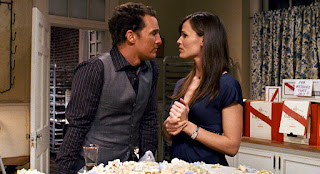
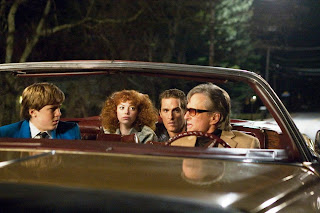
In New York City, Connor Mead (Matthew McConaughey) is a celebrity fashion photographer, enjoying a hedonistic lifestyle, plenty of sex, and no commitments. He travels to the lavish New England estate of his deceased Uncle Wayne (Michael Douglas), where Connor's younger brother Paul (Breckin Meyer) is getting married to Sandra (Lacey Chabert). The wedding party includes doctor Jenny Perotti (Jennifer Garner), Connor's one true love from childhood and the only woman who punctures his Lothario act.

Connor does all he can to sabotage Paul's wedding, including delivering drunken tirades about the futility of love, hitting on Sandra's mother Vonda (Anne Archer), and exposing Paul's past infidelities. But then he is visited by the ghost of Uncle Wayne and the ghost of his first sexual partner Allison (Emma Stone), who guide him on a tour of his past, present and future to demonstrate the consequences of his actions.

A stellar cast and sense of flighty fun elevate Ghosts Of Girlfriends Past beyond the mundane. Co-writers Jon Lucas and Scott Moore deliver a polished script maximizing concept enjoyment and packed with sharp humour, and the stars do the rest, diving into their characters with committed playfulness. The scenes with a ditzy Emma Stone whizzing Connor around his past on a time-traveling bed are a particular delight.

As usual with rom-coms, the peripherals help make or break the experience, and here director Mark Waters has plenty to work with. Wealthy and fun-loving Uncle Wayne was the perfectly enticing bad example on Connor's early life, setting him on a path of selfish gratification. The thorny dynamic between married-couple-to-be Paul and Sandra is a source of steady laughs, as are Sandra's parents "Sarge" (Robert Forster) and the cougar Vonda.

The necessary moments of pathos also register, the brotherly bond between Connor and Paul deployed to good effect, and the eternal but often denied passion between Connor and Jenny an underpinning for both their lives.

Despite the welcome streak of quality, typical genre pitfalls are also on full display. There is never any doubt about the outcome, and Connor's transformation abruptly arrives just in time for the requisite wrapping up of all loose ends. Obvious go-to devices include the destroyed wedding cake, drunken revelations, desperate bridesmaids, and doofus best men.

Ghosts Of Girlfriends Past does enough to justify a breezy trip through time, but still arrives at all the familiar conclusions.


All Ace Black Movie Blog reviews are here.

Saturday, 8 May 2021

Movie Review: Aloha (2015)

A romantic comedy with convoluted but irrelevant sub-plots, Aloha never shakes the impression that a bunch of actors took a dream vacation and cobbled together a platitudinous project to write-off the expenses.

Army veteran and now private contractor Brian Gilcrest (Bradley Cooper) returns to Hawaii to negotiate a land access agreement with a native chief. Brian is working for tycoon Carson Welch (Bill Murray), who is operating a satellite business with murky ties to the military. Air Force Captain Allison Ng (Emma Stone) is Brian's liaison, and he also reconnects with his ex-girlfriend Tracy (Rachel McAdams), now married to man-of-few-words Major John "Woody" Woodside (John Krasinsky).

The land negotiations go reasonably well, with Allison (who is one quarter Hawaiian) entranced by the natives' spiritual connection to the sky, whereas Brian remains more grounded. Allison's all-business facade starts to melt in the presence of Brian's charisma, but he is more intrigued by the potential of rekindling the passion with Tracy. But when the real cargo of Carson's latest satellite project is revealed, Brian has to decide where his loyalties lie.

A lacklustre outing by writer and director Cameron Crowe, Aloha meanders in and out of several storylines with no conviction. Riding on the laid-back star power of Cooper, Stone, McAdams, Murray plus Alec Baldwin in a glorified cameo, the plot has traces of romantic comedy, a barely-there side-story about evil corporations desecrating the sanctity of the land, and an overly familiar damaged and cynical man making half-hearted attempts to right past wrongs.

The talented cast and decent island scenery offer some enjoyment, and to give Crowe his due, he pulls out a final father-daughter scene that belongs in another, much better movie. But the rest of the narrative never justifies itself as a story that needed to be told. The script lacks wit and edge, and gets worse at it goes along, choking on cliches of women falling for a flawed man they want to fix in between unconvincing debates about spirituality and pragmatism. By the time a kid's photograph reveals a weapons secret and one guy with a laptop reprograms a satellite on the fly, all credibility is lost.

The big familial reveal is telegraphed in the opening five minutes and comes as no surprise among all the other no surprises. It is left to John Krasinski to try and salvage a few moments of humour as a stoic husband who says plenty by not talking. He's a man who knows who he is, whereas Aloha suffers from  both an identity crisis and impostor syndrome.


All Ace Black Movie Blog Reviews are here.

Thursday, 4 March 2021

Movie Review: Irrational Man (2015)

A drama, comedy, romance, and crime mystery, Irrational Man is a bright Woody Allen outing with a judicious mix of ingredients.

Preceded by a reputation for rampant womanizing and heavy drinking, philosophy professor Abe Lucas (Joaquin Phoenix) starts a new job at picturesque Braylin College in New England. He immediately attracts the attention of two women: married chemistry professor Rita Richards (Parker Posey), and his student Jill Pollard (Emma Stone), who has a serious boyfriend Roy (Jamie Blackley).

Both women find Abe depressed and lacking a purpose in life, and Rita soon discovers he is also suffering from erectile dysfunction. Jill persists with a friendship that evolves towards love, although Abe resists her sexual overtures. But when they overhear a stranger's story about corrupt family court Judge Thomas Spangler, Abe decides killing the judge will provide him the spark he needs in life.

Written and directed by Allen and clocking in at just 95 minutes, Irrational Man is a breezy mix of existential angst, blossoming love, and crime most foul. Focusing on just the three characters but surrounding them with an idyllic milieu at a relaxed college campus where anything seems to go, Allen is free to explore themes of depression, motivation, infatuation and ultimately how far friendship and loyalty can be tested, all with sly humour.

When Abe is in his initial gloomy state, the philosophical babble about life's futility is kept short and on the accessible side, although Allen can't resist having even Jill profoundly familiar with dense references to philosophers, poets and artists. The narrative delightfully curves to a reawakening of Abe's soul and spirit, thanks to a Hitchcockian murder plot carrying winks towards both Strangers On A Train and Dial M For Murder. Instead of escaping dysfunctional relationships, here murder is a tool to break away from psychological hopelessness, and Abe's transformation triggers cascading consequences for Rita and Jill.

Joaquin Phoenix loosens a floppy belly and transitions between Abe's two modes with light switch efficiency. Emma Stone gets the more complicated role and is radiant as the smart student, already in a relationship but gradually drawn into a lustful emotional rescue mission.

The ending is a bit abrupt and perhaps a stretch even for Abe's warped sense of passion, but with a Randy Lewis soundtrack providing a bouncy jazz soundtrack, Irrational Man provides smooth unpredictability.


All Ace Black Movie Blog reviews are here.

Saturday, 29 December 2018

Movie Review: The Favourite (2018)


A British royal drama and comedy, The Favourite delves into a three-way power struggle in the court of Queen Anne.

It's the early 1700s, and Queen Anne (Olivia Colman) is in poor health as England is engaged in a war with France. Her confidant and advisor Sarah Churchill (Rachel Weisz) is the real power behind the throne, and takes charge of all important decisions, including issuing instructions to leading politician Sidney Godolphin (James Smith) and opposition leader Robert Harley (Nicholas Hoult).

Sarah's cousin Abigail Hill (Emma Stone) secures a job as a kitchen servant at the palace, and soon graduates to Sarah's personal assistant after demonstrating initiative in helping treat the Queen's painful gout. But Abigail has grander ambitions, and once she uncovers exactly how close Sarah is to Anne, she sets out to displace her cousin as the Queen's favourite.

Directed by Yorgos Lanthimos and written by Deborah Davis and Tony McNamara, The Favourite is inspired by history, but adds plenty of embellishment. This is a story of ambition and a grab for power and social status, peppered with hefty doses of politics and illicit lust. And it's a narrative dominated by women, here holding the reigns and seeking advancement, the men reduced to navigating around them with varying levels of success.

While the story is original and the invented sexual zip adds shock value to the staid royal surroundings, the film is an in-your-face stylish marvel. Lanthimos uses fisheye lenses set in room corners to achieve voyeuristic perspectives, and often fills the screen with wide spaces but not many people to convey a sense of grand places and the burdens of monarchy. A few women are making all the decisions in this court, and they will discover, in turn, that it is lonely at the top.

Natural, candle and backlighting complete the unique visual aesthetic, while the music score is equally inventive, often irritating, but never subdued. The dialogue is injected with unexpected doses of modern brashness, serving as lighting strikes of humour but also bringing the characters down to earth from their traditional contemptuous royal airs.

The words are brought to life by three actresses in top form. Olivia Colman displays vulnerability as the hobbled Queen barely able to walk, her determination to actually rule functioning only sporadically. Rachel Weisz dominates as Sarah, her performance a study in the single-minded understanding of manipulation. And Emma Stone gets the most complex role, starting out as the wide-eyed mud-covered servant girl and methodically working her way towards the power nexus.

The combination of an unbecoming palace squabble and idiosyncratic presentation results in a weird cinematic experience, oscillating between awkward, bizarre and fascinating. Lanthimos' drive to be different is not always on target, but it is never dull.


All Ace Black Blog Movie Reviews are here.


Sunday, 16 September 2018

Movie Review: The House Bunny (2008)


An empowerment comedy, The House Bunny makes the grade thanks to an above-average script and two committed lead performances.

Abandoned at an orphanage at birth, Shelley (Anna Faris) blossoms into a beauty and finds a home at the Hugh Hefner (playing himself) Playboy mansion. Just after her 27th birthday party she receives an eviction notice presumably because she is too old. Out in the real world for the first time, Shelley stumbles onto the Zeta Alpha Zeta sorority house on a university campus, and finds seven misfit girls themselves facing eviction because they cannot attract any new pledges.

The Zeta girls include the brainy Natalie (Emma Stone), who gets tongue tied in front of her crush Colby, and the piercings-happy Mona (Kat Dennings). Shelley installs herself as the housemother and proceeds to rejuvenate the residents, encouraging them to express their sexuality and organize parties. She also meets and develops an attraction towards Oliver (Colin Hanks), who volunteers at a seniors' care home. The reinvigorated Zeta girls take the campus by storm, antagonizing their prissy adversaries at the Phi Iota Mu sorority.

Directed by Fred Wolf and co-produced by Faris and Adam Sandler, The House Bunny occasionally carries the whiff of cheap Sandler productions, with some stiff supporting acting, scenes that just don't work, perfunctory directing and unpolished first-draft dialogue. The story about campus eccentrics struggling to fit in, coupled with strong echoes of Snow White and the Seven Dwarfs, is out-of-the-box stale.

And yet the film often clicks, thanks mainly to the two lead actresses. Anna Faris brings just the right touch of self-deprecating innocent bewilderment to Shelley and convinces as a woman who may be much more capable than she thinks she is. And Emma Stone, in an early career role, adds plenty of zest as the smart cookie who just needs a nudge to develop better social skills. Together Faris and Stone propel several scenes towards excellent comic territory, helped by a periodically sparkling script.

Elsewhere the film avoids vulgarity, nudity and body fluid jokes, and marches purposefully towards a predictable non-judgmental message of celebrating individuality, with all the mean antagonists finding their harmless comeuppance. Even the folks back at the Playboy mansion turn out to be not so bad after all. The House Bunny is an altogether better than expected wholesome happy hop.


All Ace Black Blog Movie Reviews are here.


Sunday, 8 October 2017

Movie Review: Battle Of The Sexes (2017)


A biography of tennis legend Billie Jean King around the time of her famous showdown with Bobby Riggs, Battle Of The Sexes reveals the tumult behind the headlines but doesn't quite achieve the intended emotional heights.

It's 1973, and 29 year old Billie Jean King (Emma Stone) is on top of the tennis world. When tournament organizer Jack Kramer (Bill Pullman) refuses to close the gender pay gap, King leads a renegade group of players in the establishment of the Women's Tennis Association, with her friend Gladys (Sarah Silverman) as manager. Although married to Larry (Austin Stowell), King meets and starts a secret lesbian affair with hairdresser Marilyn (Andrea Riseborough).

Meanwhile, former tennis champ Bobby Riggs (Steve Carell) is now 55 years old, a compulsive (but successful) gambler much to the disdain of his wife Priscilla (Elisabeth Shue). He is also a self-professed male chauvinist pig. Sensing an opportunity to make money and reclaim the spotlight, Riggs tries to goad King into a publicity-grabbing "battle of the sexes" televized tennis match. She refuses, but Riggs does find an opponent in Margaret Court (Jessica McNamee). The outcome of that game forces King into accepting Riggs' challenge, although her private life is in turmoil.

Directed by the duo of Jonathan Dayton and Valerie Faris, Battle Of The Sexes takes on plenty of weighty topics. The early 1970s witnessed the confluence of turbulent currents that had been building up over a decade, and finally feminism, sexuality, money, broadcasting and politics started to fully come together.

The specific tennis match between Bobby Riggs and Billie Jean King was just that: a one-off, made-for-television stunt event, but it also carried the winds of change: if the reigning queen of women's tennis, carrying the torch of pay equity, could not defeat a loudmouth overweight over-the-hill sexist man in his mid-50s, the cultural setbacks would have propagated far from the tennis court.

Dayton and Faris, working from a script by Simon Beaufoy, are workmanlike in capturing the events of the times, but the central character's spirit eludes them. The film largely focuses on King as she helps form the WTA, meets Marilyn and awakens to her sexuality. Despite a focused Emma Stone performance, King's energy and societal drivers are notably missing. The film meets her at the peak, a woman demanding change while grappling with fundamental personal changes. How and why King got here are absent, an unfortunate gap in a biographical film.

Riggs is very much a supporting character, a caricature battling his middle-age demons and refusing to grow up because his wealth means he does not have to. The rest of the characters are fleeting. Marilyn remains an ethereal partner, more a muse than a person. Riggs' wife Priscilla and WTA organizer Gladys drop in and mostly out of the story.

The match itself forms the climax of the film, and is well presented as an inflated media circus, King cutting a lonely figure as she singularly enters a noisy arena in a world tilted against women's equality. Her on-the-court public showdown contrasts well with her private life, King compelled to keep her relationship with Marilyn a secret despite the whispers, the battle to come for gay rights already visible, but for now still ahead.

Battle Of The Sexes is a good serve, but misses the ace.


All Ace Black Blog Movie Reviews are here.


Monday, 9 January 2017

Movie Review: La La Land (2016)


An original modern musical, La La Land is an instant masterpiece. Director and writer Damien Chazelle crafts a loving homage to the classic Hollywood musicals and the town that created them, and modernizes the genre by combining pragmatic sensibilities with an enthralling infusion of magic.

In Los Angeles, Mia (Emma Stone) is a fledgling actress still waiting for her big break. Sebastian (Ryan Gosling) is a pianist dreaming of opening his own jazz bar. Mia is getting disillusioned, working at a coffee shop on a studio lot, attending countless auditions and getting no callbacks. Sebastian is also getting despondent, playing bland tunes in featureless lounges to an uncaring audience.

Mia and Sebastian meet at a party and their relationship gets off to a rocky start, but gradually they fall in love and enter into a deep relationship. Their courtship includes a visit to the Griffith Observatory, inspired by the scene from Rebel Without A Cause. Sebastian's career seems to catch a break when band leader Keith (John Legend) invites him to be part of his emerging ensemble, combining jazz with a more modern pop and synthesizer sound. Meanwhile Mia attempts to write and perform a one-woman play. Sebastian's touring obligations take him further away from both Mia and his dream, while Mia has to decide if she will ever make it as an actress.

With an evocative music score by Justin Hurwitz, La La Land is a daring gem. A modern-day romance, grounded in the reality of careerism and a city that promises much only to deceive, set to original music and featuring song and dance numbers by actors not known for their singing and dancing, La La Land sounds like the farthest thing from an interesting film. Out of that premise Chazelle creates a magical experience, capturing the flighty charisma of the best Hollywood musicals but modernized for a world firmly rooted in pragmatism born out of disillusionment.

Mia and Sebastian have their limits, and have been kicked around enough. Having tasted too many false dawns both are now just as likely to pursue their dream as abandon it, Sebastian ready to sell out in pop land and Mia one bad audition away from retreating to her family home. Somewhere within the increasingly pessimistic milieu of dream chasing they have to maybe fit in a romance, love as another ethereal pursuit, either helping or hindering lifelong ambitions. The film's dogged tenacity in holding on to what defines success in a city that manufactures fantasies sets a unique platform for Mia and Sebastian, and from that skewed starting point Chazelle can and does take their couplehood in unexpected directions.

To set this story to music, Hurwitz fills the film with a catchy, show-stopping piano tuned for poignancy and playfulness. City of Stars is the signature tune, its title already hinting at the potential for competing objectives. Mia and Sebastian's Theme makes regular appearances and is an old fashioned tune dripping with irresistible melancholia, while Mia finds her voice, her purpose and salutes the people of her adopted city with the tender yet unforgettably resilient The Fools Who Dream.

Stylistically Chazelle insists on fluid, long and continuous takes, and old fashioned musical framing with Gosling and Stone always filmed full length when dancing. The film is saturated in colour, dark blues punctuated by yellows featuring prominently as La La Land celebrates a Los Angeles that lives by night and loves its stars.

Ryan Gosling and Emma Stone reunite for the third time after Crazy, Stupid, Love and Gangster Squad, and they enjoy an easy chemistry allowing them to mix squabbling with honesty in romance. Stone does the heavier lifting when it comes to acting, while Gosling gets away with just being himself but does throw in some well-timed comic mannerisms.

Chazelle bookends La La Land with two sequences of breathtaking majesty, both destined to be remembered for generations. The opening song and dance extravaganza on the freeway to the tune of Another Day In The Sun is 4 minutes of single-take wizardry, a celebratory number that sets the stage, introducing the city, the stars, the colour and the attitude.

Not satisfied with one scene for the history books, Chazelle just goes ahead and ends the film with a stupendous knock-out punch, an eight minute epilogue of heartbreaking imagined happiness holding hands with giddy sorrow, dreams fulfilled and lost, connections made only across the room, definitely within hearts, and in time eternal for two people. The audacity of the epilogue in echoing a re-imagined past, refusing to surrender to the obvious, and yet finding a uniquely satisfying conclusion within the context of a romance set in the land of fantasy elevates La La Land from a simply brilliant movie to a remarkable artistic achievement for the ages.


All Ace Black Blog Movie Reviews are here.


Sunday, 2 October 2016

Movie Review: Magic In The Moonlight (2014)


A romantic comedy set in the world of magicians and psychics, Magic In The Moonlight lacks wit, charm, chemistry and charisma.

Europe, the 1920s. England's leading magician Stanley Crawford (Colin Firth) performs under the elaborate stage disguise of the mysterious Wei Ling Soo. Engaged to Olivia (Catherine McCormack), Stanley is a pragmatist who refuses to believe that there is a God or any mystical forces in the world. His friend and fellow magician Howard Burkan (Simon McBurney) pleads with Stanley to travel with him to the south of France to help debunk young American Sophie Baker (Emma Stone), who is stunning rich families with her psychic powers and an apparent easy ability to communicate with spirits.

Stanley agrees and connects with Sophie and her mother (Marcia Gay Harden). Sophie is already being hotly pursued by the love-smitten Brice (Hamish Linklater), the son of a wealthy socialite seeking Sophie's help to connect with her dead husband. Sophie immediately impresses Stanley with her psychic abilities, and he is unable to discern any untoward tricks. He starts to believe that maybe there are mystical forces in the world, while falling in love with Sophie. An unfortunate incident with Stanley's Aunt Vanessa (Eileen Atkins) proves to be an unexpected turning point.

Written and directed by Woody Allen, Magic In The Moonlight hints strongly that Allen's tank is beginning to run on empty. There is never any moment in this film that does not appear contrived, and the actors don't appear to even be trying to pretend that they are anything other than modern day performers having a frolic in 1920s costumes.

The script is shorn of any intellect, humour, or even substance, descending quickly into lazy monotony, with Stanley repeating about half a dozen times his treatise about disbelieving in anything mystical. And when he falls in love with the doe-eyed Sophie, his transformation into a walk-on-air believer in all things spiritual is sudden to the point of ridiculous, Firth unable to do anything with the blunt material except ham it up into embarrassing over-emotion.

Allen may be trying to say something about existentialists being naturally miserable and the extraordinary benefits of believing in greater powers: why mess with spiritual beliefs if they achieve happiness among the believers, and isn't love the greatest proof of something beyond life's mechanics. It's a decent message, but delivered with an abject absence of finesse.

There is enough talent among the cast to salvage a few droll moments, and the countryside settings and cinematography look idyllic and appealing. But unfortunately, Magic In The Moonlight's greatest trick is making 97 minutes feel twice as long.


All Ace Black Blog Movie Reviews are here.


Thursday, 15 January 2015

Movie Review: Birdman (2014)


A semi-surreal portrayal of an actor's virtuous struggle to redeem his reputation, Birdman is a triumphant achievement. Filmed with smooth intensity by Alejandro González Iñárritu and boasting a committed Michael Keaton performance, Birdman delves into the cruel world of atonement, where the greatest impediments lie within.

Riggan Thomson (Keaton) used to be a famous Hollywood superstar, achieving glory and recognition for his portrayal of the superhero Birdman in a film franchise. Now, many years later, Riggan is considered a has-been. Desperate to prove his acting talent, he is preparing to act and direct a Broadway adaptation of a Raymond Carver short story. As rehearsals start and opening night beckons, not much goes according to plan.

Big-name Broadway actor Mike Shiner (Edward Norton) brings prestige to the production, but his ego threatens to derail the show. Riggan's daughter Sam (Emma Stone) is trying to be a helpful production assistant, but she is suffering from the damage of a neglected childhood. Co-stars Lesley (Naomi Watts) and Laura (Andrea Riseborough) both have issues with Riggan, Lesley remaining insecure about her ability to perform on Broadway and Laura unleashing untimely news. Riggan's wife Sylvia (Amy Ryan) shows up to remind him what else he has wrecked in his life, while theatre critic Tabitha (Lindsay Duncan) is waiting to pounce with her scathing pen. With Birdman himself regularly nibbling away at Riggan's confidence, the production careens towards a very uncertain opening.

Directed and co-written by González Iñárritu, Birdman or (The Unexpected Virtue of Ignorance) is an artistic treasure, filled with humour, hubris and humanity. Edited into the illusion of single take despite taking place over several days, the film brilliantly captures the mad intensity of live theatre, where there are no second takes and no second chances, just actors baring the souls and risking their reputations in front of a demanding audience.

González Iñárritu nimbly snakes his cameras through the tight confines of backstage hallways and dressing rooms, chasing Riggan as he frantically tries to prepare for either his greatest triumph or his worst nightmare. In a cinematic and theatrical articulation of Murphy's Law, everything that can go wrong with the production does go wrong, and Riggan, stressed-out to begin with, begins to seriously lose his grip. But high stress comes with the territory of Broadway theatre, and the preparations for the show are also Riggan's test for the big time. He will have to survive the ordeal of life hurtling towards a catastrophe to earn the chance of redemption on the stage.

The film surrounds Riggan with an assortment of colleagues, friends and family who each represent their own on-going drama to be navigated, side-stepped or at least tolerated before the show can even open. Daughter Sam is the visible, proximate reminder of Riggan's pathetic failure as a father, and here she is now, snuggly by his side to remind him how spectacularly he can fail. Mike is either the saviour of the show, or its destroyer. His easy mastery of stage craft is an inspiration, but his arrogant antics endanger Riggan's sanity and threaten to steal his moment glory.

González Iñárritu enjoys picking at the scabs of discontent that exist between Hollywood and Broadway, giving both sides the opportunity to vent. Theatre critic Tabitha articulates the perception of film actors as nothing but pampered pretty faces, while Riggan easily encounters the absolute hubris that seeps from every pore of the theatre community.

Michael Keaton, former Batman himself, finds the soul of a man on an agitated mission to save himself from a winged past, out on a limb, overwhelmed and almost certain he is on a quick path to proving his own inability to rise to an occasion of his own making. Keaton does not miss a beat when Riggan encounters the more extraordinary creations of his mind, and combines mental exhaustion with physical energy, self-doubt with self-belief, and bravado with bullying in a career-defining performance. The supporting cast is uniformly outstanding with Stone and Norton leading the way, although no character other than Riggan is provided with much of a progressive arc.

Birdman succeeds as a sharp study of a man desperate to prove that he is more than he once was, and struggling most of all against his own insecurities. Riggan's story resonates by capturing the most human attribute of always wanting to be better. He finally finds true heroism through the sheer determination to not settle, to stare down his doubters, to push ahead, and finally, finally, to soar for real.


All Ace Black Blog Movie Reviews are here.