Showing posts with label George Peppard. Show all posts

Friday, 30 September 2022

Movie Review: The Carpetbaggers (1964)

A business-and-romance drama, The Carpetbaggers is fueled by a tortuously obsessed personality.

In the 1920s, Jonas Cord Jr. (George Peppard) inherits his father's chemical business, and proceeds to build an audacious empire centred on the burgeoning airline and film industries. His long-term associates include ex-cowboy Nevada Smith (Alan Ladd), who raised Jonas from a young age, level-headed lawyer McAllister (Lew Ayres), and airplane pilot Buzz Dalton (Ralph Taeger).

A driven workaholic, Jonas also has a tumultuous lustful relationship with his father's young widow Rina Marlowe (Carroll Baker), and eventually turns her into a movie star. He marries - then ignores - Monica Winthrop (Elizabeth Ashley), before courting starlet Jennie Denton (Martha Hyer). Along the way Jonas tangles with sleazy agent Dan Pierce (Bob Cummings) and studio boss Bernard Norman (Martin Balsam). 

Inspired by Howard Hughes, The Carpetbaggers adapts Harold Robbins' novel into an effective cinematic experience. John Michael Hayes wrangles a cohesive but still epic 150 minute screenplay out of the book, and Edward Dmytryk hustles the sprawling narrative along, never dawdling or pausing to contemplate. The outcome is a sustained rhythm mixing business compulsion with warped romance, both propelled by voracious character traits.

The film tackles business issues head-on, and presents Jonas as never likeable but nevertheless fascinating, a demanding cut-throat overachiever and impossible boss, but also a willing and constant learner. The emotional underpinnings for his behaviour are only hinted at, until the suitably bombastic final act revelations. George Peppard fits the role well, his stone cold expressions capturing an antipathy only satisfied when exerting control and achieving domination, consequences be damned.

Dmytryk infuses the aesthetics with the gaudy look of greed and lust, and most of the romantic scenes are dripping with undertones of conquest and egomaniacal seduction. With a lot of ground to cover, the editing demonstrates a preference for bold brevity bordering on choppiness, powered by Elmer Bernstein's brass-and-drums dominated music.

The supporting cast is impressive, from the friendly stoicism of Lew Ayres to the scheming of Martin Balsam and Bob Cummings. Carroll Baker (manipulative), Elizabeth Ashley (hopeful), and Martha Hyer (opportunistic) create a triangle of naturally flawed women grappling with Jonas' troubled psyche. Most notable is Alan Ladd in his final screen role, providing the one robust anchor in a stormy life.

Embracing boardroom and bedroom lubriciousness, The Carpetbaggers crackles with connivance.


All Ace Black Movie Blog Reviews are here.

Monday, 21 February 2022

Movie Review: The Groundstar Conspiracy (1972)

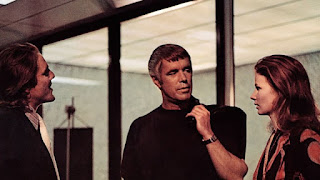
A surveillance thriller with a romantic sub-plot, The Groundstar Conspiracy enjoys decent-enough start and end points, but meanders for a long stretch in-between.

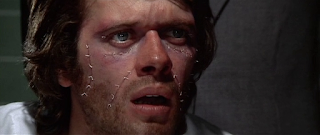
A series of explosions at the government's top secret Groundstar research facility leaves six people dead. Employee David Welles is suspected of causing the carnage to cover his attempted theft of computer files. Welles is badly disfigured by the explosions, but makes his way to the nearby weekend cottage of Nicole Devon (Christine Belford) before collapsing and being arrested.

Groundstar security director Tuxan (George Peppard) recovers the stolen files, takes charge of the investigation, and orders the reconstruction of Welles' mangled face. Once Welles (Michael Sarrazin) wakes up from surgery, he claims to remember nothing about his past or the plot, despite Tuxan's persistent interrogation. Tuxan sets Welles free to track his movements, and the accused criminal immediately makes his way to Nicole's house. A romance ignites, with Tuxan's surveillance team keeping close watch.

An adaptation of the book The Alien by L.P. Davies, The Groundstar Conspiracy combines smart elements with slipshod treatment. The Douglas Heyes script contains large skips, jumps and leaps over logic, and Lamont Johnson's rough directing hints at squeezing every last dollar out of a limited budget. Location filming does make the most of the brutalist Simon Fraser University campus and Vancouver's waterfront.

The opening sequence of explosions and bloody escape is messy yet still stylishly pulled together. But then little is revealed about the importance of Groundstar and the stolen files, and the film settles down as a relatively static struggle to overcome amnesia. Tuxan is sure Welles and maybe also Nicole are hiding something, and the middle act is all about the romance between Welles and Nicole as she helps him grapple with disjointed memory snippets.

Shadowy military, civilian, and political operatives hover in the background anxiously awaiting the truth, but these angles are poorly defined. Johnson gains better traction sprinkling only marginally paranoid observations about national security and the long reach of surveillance, Tuxan a vocal advocate for a form of government with unchecked ability to invade every bedroom and bug every phone.

The acting is of the stiff variety, perfectly suited to George Peppard in full hyper-confident mode. The climax does perk up with a good double twist, far-fetched for sure, but so is almost everything else here. The Groundstar Conspiracy does not lack ambition, but common sense and polish go missing in those opening blasts.


All Ace Black Movie Blog reviews are here.

Saturday, 24 November 2012

Movie Review: Operation Crossbow (1965)


A World War Two action movie centred on the development of the German rocket program and the Allied attempts to disrupt it, Operation Crossbow gets lost in Sophia Loren's expansive almond eyes and George Peppard's unconvincing antics. There are some good moments in the fictionalization of the strategic and scientific calculations behind the war over rocket technology, but the movie awkwardly oscillates between flight altitudes and ultimately lands a bit short.

As Winston Churchill (Patrick Wymark) tasks his minister Duncan Sandys (Richard Johnson) with uncovering and disrupting the German rocket program, German scientists are attempting to finalize the design of a ramp-launched rocket bomb. Due to a design fault, the auto-pilot system cannot control the flight path, and the lives of several pilots are sacrificed before ace flyer Hannah Reitsch (Barbara Rütting) is able to pin-point the fault and the design is perfected. Although Sandys and his team eventually locate the German test sites, the British bombing raid is too late: rocket bombs soon start raining down on London.

With aerial surveillance suggesting the Germans are developing an even more powerful rocket, Sandys recruits multilingual agents with scientific backgrounds to infiltrate the ranks of German engineers. Curtis (Peppard), Henshaw (Tom Courtenay) and Bradley (Jeremy Kemp) are selected for the mission and assume the identities of supposedly dead German and Dutch engineers. But a muddle ensues after the men are dropped behind enemy lines. Henshaw is picked up by the police and Curtis tangles with Nora (Loren), the wife of the man he is impersonating. Curtis and Bradley eventually make it into the rocket factory. Vastly outnumbered and outgunned, they have to find a way to stop the rocket development program before a devastating weapon, termed the "New York" rocket due to its range, is perfected.

Operation Crossbow gets off to a bright start, exploring the war rooms of an England desperate to uncover German military secrets while Germany is working hard to maintain a technological edge. Having the Germans speak in German is always a plus, and the film tantalizes by revealing weaknesses on both sides. The English are distracted by a pompous Professor Lindemann (Trevor Howard), who refuses to believe that the Germans can be anywhere near developing a functional rocket. Meanwhile, the Germans are struggling to identify and rectify a design flaw hampering progress.

But then Operation Crossbow loses its way. The middle third of the movie slips into an almost comically miserable sequence of musical hotel rooms, Curtis and Henshaw trying to avoid capture while Sophia Loren drops in for a ridiculously under-written role. Producer Carlo Ponti secured a few scenes for Loren and gave her top billing for what amounts to a glorified cameo, all in the interest of improved marketing potential. In their scenes together, neither Peppard nor Loren appear to actually know why they are there, and instead of generating sparks, Loren's presence dissolves into embarrassment.

The movie's climax at the secret German rocket facility reclaims some balance, but without finding either unusual intensity or bold realism. Peppard's performance is simply too shallow and underdeveloped to be convincing, as he is caught in the gap between James Bond-type cocky light-heartedness and the required authenticity of a World War Two narrative inspired by real events.

The supporting cast is a who's who of British and European character actors, the likes of Trevor Howard, John Mills, Anthony Quayle and Paul Henreid lending their authority to the minor roles. Director Michael Anderson enjoys the big explosions, but does little to develop the characters beyond the most basic profiling.

Never entirely fizzling but also never quite soaring, Operation Crossbow flies in the right general direction but lacks the grace needed to accurately deliver its payload.


All Ace Black Movie Blog reviews are here.

Saturday, 25 June 2011

Movie Review: Breakfast At Tiffany's (1961)


A cultural and stylistic landmark, Breakfast At Tiffany's is a timeless classic, capturing a society moving into a decade of enormous change, and doing it with panache.

When Holly Golightly (Audrey Hepburn) is depressed, she eats breakfast on the sidewalk looking through the Tiffany's store window in New York. Living with her cat (named Cat) but otherwise very alone in her apartment, Holly's life is a series of encounters with men who seek her company and pay well for it. She classifies them as rats or super-rats, depending on how loathsome they are. Holly is desperately seeking happiness, fulfilment and riches; but she is unwilling to surrender her heart or her life to any true relationship. She even stoops to the level of getting paid to visit a locked-up crime boss, oblivious she is being used to transmit his commands.

Struggling author Paul Varjak (George Peppard) moves into another apartment in the same building. Women find him attractive, particularly Mrs. Failenson (Patricia Neal), a decorator willing to pay Paul for his calculated affection. Holly wants to keep Paul strictly as a friend, and does her best to deny their growing connection. Her former husband Doc (Buddy Ebsen) shows up in New York pleading with her to return to Texas, but Holly prefers a life of independent struggle to the comfort of anonymity. Eventually she reaches a critical decision point: her prospects look grim, unless she lowers the fence around her heart.

Holly Golightly is a representative icon for women rocketing from the predictability of the 1950s into the uncertain 1960s: sexually liberated, seeking love on her terms, forging an independent identity, making new connections in a freedom-obsessed society, and pressured to revert to the old but safe environment. And there are no playbooks to guide her, only instincts and self-belief. 

That Holly grapples with the big decisions in life so stylishly is a big part of Breakfast At Tiffany's appeal. The ridiculously oversized cigarette holder; the Givenchy dresses; the hats, sunglasses, and  jewellery: rarely has a single film had such an indelible impact on fashion. Craving unaffordable luxury also starts here: Holly never has any money, and she nevertheless looks gloriously fashionable wondering where the next dollar is going to come from.

Working from the novella by Truman Capote and a script by George Axelrod, director Blake Edwards assembles all the pieces of Breakfast At Tiffany's into a dazzling tapestry. He augments the visual appeal of his stars and setting with Henri Mancini's music, the spine-tingling theme song Moon River instantly claiming a place among the classic tunes of Hollywood. Edwards elegantly inserts the song throughout the movie without overexposing it. Humour is also judiciously deployed, the party scene in Holly's apartment a chaotic joy. 

Despite being cast against her wholesome image, Audrey Hepburn pulls off the role magnificently while enshrining her quiet grace and beauty, combining Holly's fun-loving innocence with a hard edged determination to keep her heart secure. George Peppard is adequate as Paul, never catching fire but holding his own. Mickey Rooney's portrayal of upstairs comic relief neighbour Mr. Yunioshi is an unfortunate yellowface misfire amplifying Asian stereotypes.

Breakfast At Tiffany's is soulful, hopeful and pragmatic. The prize is on the other side of the window, tantalizingly within reach, but at what cost.


All Ace Black Blog Movie Reviews are here.

Thursday, 30 December 2010

Movie Review: How The West Was Won (1962)


A well-intentioned flag-waving epic, How The West Was Won unfortunately falls flat. The film has all the narrative sophistication and character depth of an amateur high school play, with a script devoid of texture and intelligence. All the characters spout their lines convinced they are playing a part in the grand scheme of unfolding history, resulting in an endless succession of overly-dramatic, theatrical, wooden, and sometimes sadly comical scenes.

A series of sketches chronicling the history of America over about 60 years in the heart of the 1800's, How The West Was Won generally follows the adventures of the Prescott family. After tangling with bandits and being saved by mountain man Linus Rawlings (James Stewart), Ma and Pa Prescott are killed in a rafting accident making their way west. Their down-to-earth daughter Eve (Carroll Baker) marries Linus and establishes a homestead at the site where her parents died. The other daughter, free spirited singer/dancer Lily (Debbie Reynolds), continues west, joins a wagon trail to California, and marries compulsive gambler Cleve Van Halen (Gregory Peck). Lily and Cleve settle in San Francisco where they make and lose many fortunes.

The Civil War erupts, Eve's son Zeb (George Peppard) joins the Unionists and has a serendipitous encounter with General Grant. After the war Zeb stays in the army and attempts to keep the peace between the expanding rail companies and the native tribes whose land is being seized. Disillusioned, Zeb eventually becomes a Marshall, helping to bring law and order to the wild land, and eventually tangling with bandit Charlie Gant (Eli Wallach).

In How The West Was Won the good guys are all-good, the bad guys are all-bad, and good always triumphs over bad. The film presents a most naive, sugar-coated and earnest view of the old world. Despite the sophomoric storytelling, some reasonable highlights do emerge: the Civil War scenes are impressively staged and the unleashing of a buffalo stampede as a weapon against the rail companies is memorable. The stunt work during the final train heist also deserves recognition.

The all-star cast includes a few walk-on roles for the likes of John Wayne and Henry Fonda. Gregory Peck and James Stewart play their parts with little conviction and an ever-present smirk. Debbie Reynolds and George Peppard have the most prominent roles, and they are far from capable of holding the film together. John Ford, Henry Hathaway and George Marshall directed the various segments, preventing any coherent vision from permeating through the movie.

How The West Was Won fails to resonate, and has a ghastly ending that suddenly jumps to the present and trumpets American freeways, interchanges and concrete jungles as the most prominent signs of triumph. The times have indeed changed.


All Ace Black Blog Movie Reviews are here.