Showing posts with label Rita Moreno. Show all posts

Saturday, 13 January 2024

Movie Review: The Four Seasons (1981)


Genre: Romantic Comedy  
Director: Alan Alda  
Starring: Alan Alda, Carol Burnett, Len Cariou, Sandy Dennis, Jack Weston, Rita Moreno, Bess Armstrong  
Running Time: 107 minutes  

Synopsis: Middleclass married couples Jack and Kate (Alan Alda and Carol Burnett), Nick and Anne (Len Cariou and Sandy Dennis), and Danny and Claudia (Jack Weston and Rita Moreno) are long-term friends and always vacation together. During a spring cottage vacation, wealth-obsessed Nick reveals his desire to divorce Anne, a pensive artist. The couples meet again for a summer yachting trip, and Nick shows up with new young girlfriend Ginny (Bess Armstrong), disrupting the friendship rhythms.

What Works Well: Director and writer Alan Alda efficiently introduces a set of individuals with credible traits, and wraps them in a blanket of easy friendship. Dynamics are expressed through banter, familiar avoidance, truncated conversations, quiet judgment, silence, and stares. Aided by sharp writing, Jack (the over-analytical lawyer), Nick (the vain insurance agent), and Danny (the obsessive dentist) slip into a steady current of humour. Alda opens each of four chapters with beautiful landscapes and good use of Vivaldi's The Four Seasons.

What Does Not Work As Well: The three husbands are notably better defined than their wives, with Rita Moreno's Claudia suffering the most neglect. The travails of rich people are of ultimately little relevance. 

Conclusion: Friendship ups and downs through the lens of laughs.


All Ace Black Movie Blog reviews are here.

Wednesday, 23 March 2022

Movie Review: West Side Story (2021)

A remake of a beloved classic, the 2021 version of West Side Story applies updates with a light touch.

In 1957, the west side of New York City is being redeveloped to make way for new theatres and expensive condominiums. On streets cluttered with the rubble of buildings being knocked down, two gangs vie for control. The Jets are led by Riff (Mark Faist) and represent descendants of Polish immigrants. Bernardo (David Alvarez) heads The Sharks, made up of more recently arrived Puerto Ricans. Officer Krupke (Brian d'Arcy James) and Lieutenant Schrank (Corey Stoll) try to keep a lid on the violence.

Bernardo lives with his girlfriend Anita (Ariana DeBose) and his sister Maria (Rachel Zegler). The Jets' co-founder Tony (Ansel Elgort) recently served time in prison for nearly killing a man. He is now trying to steer clear of gang life, and working at Doc's drug story, operated by Doc's widow Valentina (Rita Moreno).  

Tony and Maria meet at a school dance and fall in love, infuriating Bernardo, who will not allow his sister to have a romance with a rival gang member. Riff and Bernardo agree to a mass-rumble between the two gangs at midnight. Maria tries to convince Tony to intervene and stop the fight, but emotions are running high on all sides.

Directed by Steven Spielberg (his first musical) and written by Tony Kushner, West Side Story knows better than to mess with a good thing. This faithful remake keeps the foundations, spirit, and themes of the 1961 version intact, and at 156 minutes, clocks in at almost the exact same running time. The tweaks are relatively minor. The sequence and context of a few songs are rearranged, some settings are changed, the choreography is more pointed, and the references to violence are edgier. The actors' ethnicities are a better fit (but still not perfect), and more Spanish dialogue (without subtitles) is allowed to flow. 

Spielberg does find opportunities to apply stylistic signatures, most notably in the stellar visuals. From the mesmerizing opening scene of a landscape being reordered by wrecking balls to a breathtaking entry into a gym teeming with dancers, the cinematography is often sparkling. Tony stands in a pond of rainwater reflecting majestic lights while singing to Maria, and the long shadows of gang combatants merge into each other, a foreboding representation of what is to come.

Switching Doc's role to his widow Valentina is the one major character change, and placing the sprightly Rita Moreno (who also served as Executive Producer) in the role is a masterstroke of cross-generational casting. Ariana DeBose brings energetic confidence to Anita and Rachel Zegler is a revelation as Maria. They are complemented by the confrontational swagger of David Alvarez as Bernardo and Mark Faist as Biff.  Only Ansel Elgort falls well short as Tony, never appearing comfortable whether acting, singing, or dancing.

The familiar musical numbers by Leonard Bernstein (with lyrics by Stephen Sondheim) remain short and sharp, enhancing the drama without getting in the way. Justin Peck modernizes the choreography but salutes Jerome Robbins' balletic intent. The spine-tingling America registers as the absolute highlight, here relocated to a vibrant streetscape in bright daylight. 

The narrative themes are retained: this is a Romeo and Juliet story, surrounded by commentary about the immigrant experience, youth lost to the ravages of broken homes and absentee parents, and a city embracing a glitzy future by razing the organic past. The West Side Story of 2021 is just as good as the West Side Story of 1961. The new version dazzles, but without delivering a coherent argument for why it was ever needed.


All Ace Black Movie Blog Reviews are here.

Saturday, 29 August 2020

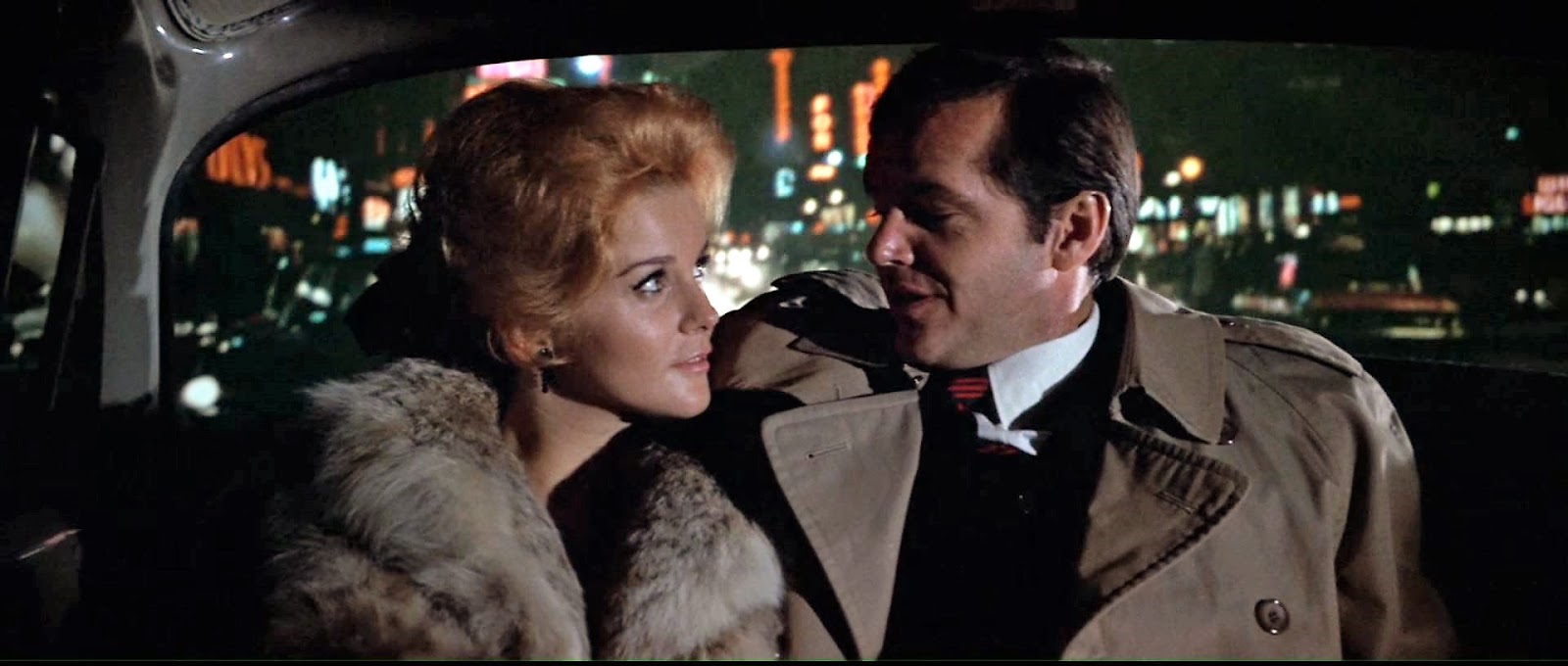
Movie Review: Carnal Knowledge (1971)

A drama about the various sexual adventures of two friends over many years, Carnal Knowledge plugs into the post-free love 1960s era to explore the consequent opportunities and disillusionments. 

Jonathan (Jack Nicholson) and Sandy (singer Arthur Garfunkel) are best friends entering college, and obsessed with women and sex. Jonathan is selfish, judges women by their looks, seeks the thrill of the chase and has no desire to settle down. Sandy is more sensitive and interested in finding and falling in love with a soul mate. After a tentative start Sandy makes progress with fellow college student Susan (Candice Bergen), but Jonathan swoops in and starts to also date Susan on the side.

Years later the men are professionals and Sandy is married to Susan, although the passion has seeped out of the relationship. Jonathan is very much single and for his next conquest pursues part-time actress Bobbie (Ann-Margret), who has the dream shapely figure he has always coveted. Fuelled by sex their relationship peaks early and starts a slow descent, Bobbie craving the long-term commitment that Jonathan is not interested in. Meanwhile Sandy moves on from Susan, and starts a relationship with Cindy (Cynthia O'Neal).

Fairly shocking for its era due to a singular obsession with frank discussions about sexual desires, Carnal Knowledge helped usher in brazen and turbulent on-screen depictions of sex and lust among adults. Written by cartoonist and author Jules Feiffer and directed by Mike Nichols, the film features plenty of profanity, scenes of frollicking and lovemaking, and some risque nudity, as the evolving male perspective on sexual relationships gets a rigorous test.

As far as content and plot, Carnal Knowledge has a one-track mind and gets bogged down in prolonged talky scenes more suitable for the stage. The focus on Jonathan and Sandy is tight, the women in their orbit often unceremoniously dumped as the men move on. In a few scenes the emotions run high and tempers boil over, Nicholson and Ann-Margret engaging in an exhausting shout fest as their union circles the drain.

Nichols enlivens the dialogue with innovative camera work, the background and foreground often equally important, the talking sometimes occurring off-screen and the passive but interested listeners given prominence.

Carnal Knowledge continued Jack Nicholson's rise to prominence as one of the most exciting and edgy talents in Hollywood. Brash and fully aware of his narcissism, Nicholson portrays Jonathan as an emotional risk methodically shunning opportunities for his own happiness. In one his rare movie outings Garfunkel is not bad, but definitely overshadowed. 

With plenty of bravura oscillating from the highs of sexual fulfillment to the lows of depression, Ann-Margret matches Nicholson is one of her best career performances. Carol Kane and Rita Moreno arrive late with telling contributions, Moreno leaving a searing impression as the only remaining destination once burnout edges out titillation.

Sexual adventurism veering far away from monogamy carries a buzz, but at a cost. Carnal Knowledge meanders to the place where selfishness folds in on itself, what was once easy pleasure now in need of sordid mind tricks and expert but passionless help.


All Ace Black Movie Blog reviews are here.

Wednesday, 26 August 2020

Movie Review: Marlowe (1969)

An adaptation of Raymond Chandler's The Little Sister, Marlowe is a spry if borderline incomprehensible murder-and-mayhem thriller.

In Los Angeles, private investigator Philip Marlowe (James Garner) is hired by Orfamay Quest (Sharon Farrell) of Kansas to find her missing brother Orrin. Poking around Orrin's last known address at a seedy motel, Marlowe meets front desk clerk Haven Clausen and sleazy guest Grant W. Hicks (Jackie Coogan): both are soon dead with icepicks planted in their necks. 

Marlowe uncovers a blackmail plot targeting glamourous actress Mavis Wald (Gayle Hunnicutt), who is carrying on a potentially scandalous affair with master criminal Sonny Steelgrave (H.M. Wynant). Other suspicious characters include Mavis' personal assistant Dolores Gonzáles (Rita Moreno) and the shifty Doctor Vincent Lagardie (Paul Stevens). After Sonny's goon Winslow Wong (Bruce Lee) tries to buy-off Marlowe's interest in the case, the dead body count multiplies and police Lieutenant Christy French (Carroll O'Connor) starts hounding Marlowe.

In typical Chandler fashion, Marlowe features a dizzying number of characters popping in and out of scenes, many of them falling foul of murder in quick order. Director Paul Bogart, working from a Stirling Silliphant script, just about manages to maintain a basic level of logic, although the threads between all the devious motives are sometimes lost amidst the rush to the next dead body.

Mood may matter more than plot in such thickets of evil, and Bogart unfortunately lives down to his television comfort zone. The film is visually flat, unable to generate an essential sense of place. The action is set in Los Angeles, but may as well be in any generic city. The lighting, shadows and set designs are equally bland.

Which is a pity, because James Garner is surprisingly good as Marlowe. He finds his own niche, grounded in the 1960s, away from undue heroics but still quick with a quip. In support Gayle Hunnicutt is adequate as a blackmail victim and reluctant client, but as a femme fatale her role is underwritten. Bruce Lee gets two scenes and makes a big impression. His introduction into the movie, unilaterally rearranging the decor in Marlowe's office, is hilariously unforgettable.

The pacing is brisk and Bogart wraps up the complexities in 96 minutes. The ending is suitably rushed and clumsy, Marlowe happy to make a quick exit as soon as the final set of corpses hit the ground.


All Ace Black Movie Blog reviews are here.

Saturday, 13 July 2019

Movie Review: The King And I (1956)


A musical drama and romance, The King And I enjoys a larger-than-life Yul Brynner performance and a couple of good musical numbers, but otherwise sags under the weight of a turgid production.

It's the 1860s, and British teacher Anna Leonowens (Deborah Kerr) and her young son arrive in Siam. She has accepted the position of educator to the children of King Mongkut (Yul Brynner), but is disappointed to learn from Prime Minister Kralahome (Martin Benson) that the King has reneged on a promise to provide her with a private house outside the castle.

Anna finds the King a stern but intriguing man, the arrogant father of numerous children but keenly interested in expanding his knowledge of science and international politics. She establishes a good rapport with her students and also meets Tuptim (Rita Moreno), the Burmese slave wife of the King who is still secretly in love with her beau Lun Tha (Carlos Rivas). Anna gradually establishes herself as a capable advisor to the King, but their relationship remains complex.

Based on the 1951 Broadway musical which in turn was an adaptation of the 1944 book Anna and the King of Siam by Margaret Landon, The King And I features the music of Richard Rodgers and Oscar Hammerstein II and Yul Brynner's career defining performance. Recreating the role he made his own on the stage, Brynner dominates the screen with a restless, authoritative fists-on-hips display of power.

While Kerr (with her singing dubbed by Marni Nixon) adequately grounds Anna in predictable British mannerisms, most of the rest of the film does not live up to Brynner's energy level. Getting To Know You and Shall We Dance? are superlative set-pieces, but the rest of the musical numbers are eminently forgettable. And for a film drawn out to 133 minutes, the supporting characters are close to nonexistent. Anna's son Louis appears at the start and end and otherwise disappears entirely, while Prime Minister Kralahome is equally underutilized. The lingering romance between Tuptim and Lun Tha is reduced to the simplest of fallow sketches.

The King And I features a bewildering play-within-a-play, an artistically staged eastern version of Uncle Tom's Cabin, converted by Tuptim into a condemnation of the King's attachment to wife enslavement. The sequence is both enchanting and distracting, a misfit in the overall narrative arc but nevertheless captivating in its simplistic beauty.

Director Walter Lang confines the action to a few studio-created sets representing various mammoth rooms within the King's castle. Captured in CinemaScope, the set design is impressive and colourful, but the film never threatens to escape its stage origins. Meanwhile the core story suffers from a tired west-is-best mentality, and is further hindered by a hideous make-up job to unconvincingly transform white and Hispanic cast members into Asians.

The King And I enshrines Brynner's forceful screen persona, but is an otherwise confounding royal encounter.


All Ace Black Blog Movie Reviews are here.

Sunday, 14 April 2019

The Movies Of Rita Moreno


All movies starring Rita Moreno and reviewed on the Ace Black Movie Blog are linked below:


All Ace Black Movie Blog reviews are here.
The Movie Star Index is here.

Monday, 1 August 2016

Movie Review: West Side Story (1961)


A groundbreaking musical, West Side Story is a spectacular story of love and violence, delivered with high energy performances, superb choreography and audacious staging.

Two gangs of teenagers vie for control of the streets on New York City's west side. Riff (Russ Tamblyn) leads the Jets, made up of American offspring of Polish immigrants. Bernardo (George Chakiris) leads the rival Sharks, who represent the recently arrived Puerto Rican community. Lieutenant Schrank (Simon Oakland) and Officer Krupke (William Bramley) struggle to keep a lid on the violence.

Riff decides to stage a once-and-for-all brawl to decide who rules the streets, and reaches out to Jets co-founder Tony (Richard Beymer) to help plan the clash. Although Tony is trying to leave gang life behind and now has a legitimate job at the drugstore owned by Doc (Ned Glass), he reluctantly agrees to support his friend.

At a gym dance on neutral territory attended by both gangs and their girlfriends, Tony meets and falls in love with Maria (Natalie Wood), Bernando's younger sister. Their relationship across gang lines is forbidden, but they push on regardless. Bernando's girlfriend Anita (Rita Moreno) is also Maria's best friend, and she is torn between supporting Maria's secret affair and staying loyal to her man. Maria pleads with Tony to put a stop to the violence, but as the big showdown approaches, there is plenty of ill intent on all sides.

Co-directed by Robert Wise and choreographer Jerome Robbins, West Side Story is the adaptation of the hit Broadway musical, which in turn was inspired by Shakespeare's Romeo And Juliet. The screen version was years ahead of its time for a cinematic musical, and set standards for staging visually dynamic group dance numbers, all the violence stylized into dancing, the story propelled by a succession of classic songs.

Working with cinematographer Daniel L. Fapp, Wise and Robbins continuously find innovative perspectives to capture the dance sequences. With sharp editing, the camera alternates between broad shots capturing the full troupe to fluid motion close-ups embedded within the dancers. The actors are captured from various perspectives, with Wise always finding reasons to look up, look down, or look beyond, and cleverly playing with lights, shadows and visual effects. The use of colour to distinguish the gangs is exemplary, the Jets decked out in lighter yellows and browns, their girls in bright pastels, while the Sharks and their women are all about dark purple, dark red and black.

The songs are generally short and pointed, and do enough to highlight the prevailing emotions without getting in the way. The highlights are many, and include the raucous America, encapsulating all that is good and bad about the immigrant dream; the trio of love ballads Maria, Tonight and Somewhere, and more fun interludes like Gee, Officer Krupke and I Feel Pretty. Wise keeps the action moving to various locations, and does an excellent job escaping stage trappings. The back lane fire escape becomes an iconic home for romance to blossom between Maria and Tony, the railings creating a cage of limitations not of their own making.

The film's themes are eternal and remain relevant, the "us" and "them" mentality mixing with the aimlessness of abandoned youth, and some of the lyrics starkly pointing to failures at home catapulting kids onto the street. No parents are ever seen in the film; they are an absentee presence, their flawed offspring littering the sidewalks and unequipped to navigate life without resorting to insults and assaults.

Natalie Wood does well as a Puerto Rican girl flowering into a woman and landing in the middle of gang warfare, Wood's sprightly innocence allowing her to overcome the ethnic mix-up in her casting. Rita Moreno is the other stand-out performer, bringing the most conflicted passion to the role of Anita. The men are more about the collective rather than the individual, Richard Beymer, Russ Tamblyn and George Chakiris lacking star quality as actors but therefore allowing the gangs to shine as central entities, as they should in a story about individuals only having courage when part of a faceless mob.

West Side Story is a stellar achievement, an unblinking look at a street-level romantic tragedy turned into one of Hollywood's all-time best musicals.


All Ace Black Movie Blog reviews are here.