Showing posts with label Bette Davis. Show all posts

Saturday, 4 June 2022

Movie Review: The Letter (1940)

A crime mystery, The Letter surrounds a devious woman with an exotic locale and noir aesthetics.

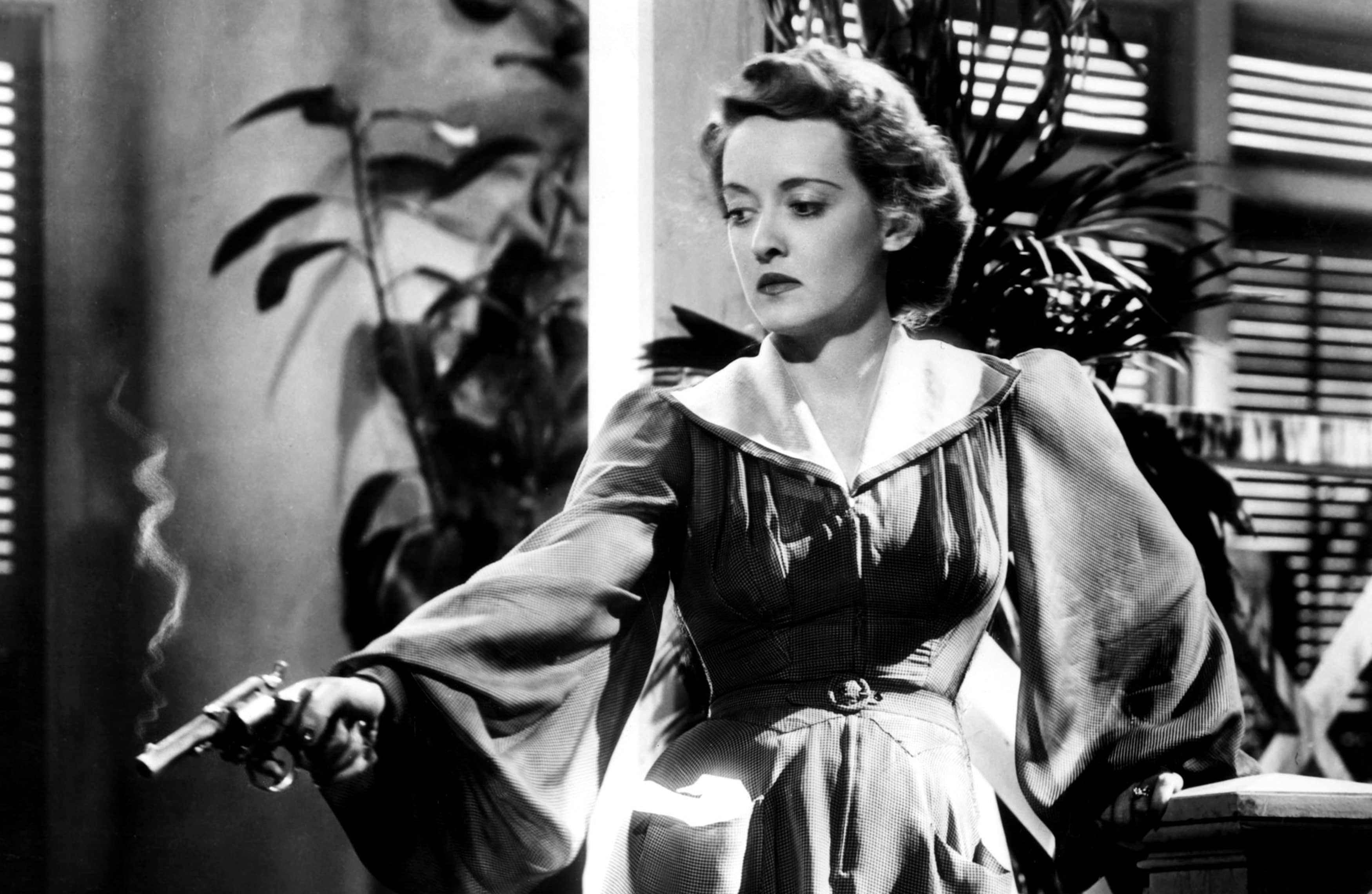
Late at night on a Singapore rubber plantation, Leslie Crosbie (Bette Davis) shocks the local workers by calmly emptying a pistol into her visitor Mr. Hammond. Leslie is the wife of the plantation manager Robert (Herbert Marshall), who rushes back from a work site to be with his wife. Leslie explains to her husband and their lawyer Howard Joyce (James Stephenson) she shot and killed her unexpected guest after a physical altercation as she fended off his unwanted advances.

Leslie awaits her trial, with Howard confident he will secure her release by proving she acted in self defence. But then he becomes aware of new evidence: Leslie wrote a letter inviting Hammond to her house on that fateful night, a fact she conveniently skipped in her recollection of events leading to the shooting. Now Mrs. Hammond (Gale Sondergaard) is in possession of the letter, and threatening to expose Leslie's lies.

Based on a W. Somerset Maugham play, The Letter draws tension from a central character both sympathetic and calculating. Bette Davis dominates as Leslie Crosbie, introduced in the very first scene as ruthlessly capable of killing, and not satisfied with just felling her victim but pumping all available bullets into him. She composes herself and has a good story to tell a worried husband and astute lawyer: her victim was imposing himself on her and did not take no for an answer.

From that stark opening writer Howard E. Koch and director William Wyler craft a tasty mystery built on lies, threats, and immorality. Wyler creates a moody nighttime Singaporean vibe filled with horizontal shadows and stark lights as Leslie meets her match in the spectral Mrs. Hammond, and drags the lawyer Howard towards unprofessional conduct to try and bury damaging evidence. Meanwhile Howard's ever-smiling assistant Ong Chi Seng (Sen Yung) orchestrates a dangerous game of blackmail leading to a labyrinthian Chinatown district and a crushing East is East cross-cultural demonstration of power.

The revelations of treacherous secrets are accompanied by impressive but overdone shots of dark clouds rolling over the moon, and Wyler encourages Davis' wide-eyed over-dramatizations. The final act is still potent, but also reaches for hyperbolic representations of all-devouring guilt assuming station at the soul's doorstep. Despite favoring symbolic showmanship over subtlety, The Letter effectively exposes the dead-end of insincerity, written words more powerful than the gun.


All Ace Black Movie Blog reviews are here.

Saturday, 24 February 2018

Movie Review: Jezebel (1938)


A melodrama and romance set in the deep south, Jezebel features a captivating story and an unforgettable central character.

New Orleans, 1852. Julie Marsden (Bette Davis) is a young and headstrong woman from a rich family, engaged to banker Preston Dillard (Henry Fonda). Julie is not beyond using eligible bachelor Buck Cantrell (George Brent) to make Preston jealous. When Preston misses a date due to a business meeting Julie feels particularly snubbed. She plots to cause a scandal at a social event to force him to prove his commitment. Preston calls her bluff, causing her great embarrassment. Tired of her antics he breaks off the engagement and leaves New Orleans to New York.

A year later an epidemic of yellow fever is sweeping through New Orleans, while talk of an impending civil war begins to dominate social circles. Julie is delighted to hear that Preston is coming back to town, and she plans to apologize for her past behaviour and win back his love. She organizes a welcome party at the family's Halcyon Plantation, but when Preston arrives, a bitter surprise awaits Julie.

Directed by William Wyler and co-written by John Huston, Jezebel is based on the 1933 Owen Davis play. The film is a compelling cinematic experience, Wyler comprehensively breaking free of any stage constraints and delivering a visually rich 103 minutes. The pacing is brisk and the energy level high, thanks in large measure to the main character of Julie Marsden. She is substantively ahead of her time, extending the feisty southern belle convention towards a streak of rebellious female independence that would only emerge in broader society more than 100 years after the film's setting.

And Julie is brought to life by Bette Davis in one of her defining performances. Davis earned the Best Actress Academy Award as she runs across the full spectrum of emotions. Julie is never far from cold, conniving and calculating, but she can also be anxious, giddy, playful, excited, seductive and crestfallen. Helped by Wyler's clever shot selection, Davis nails every transition, perfectly marrying her passions to the story's shifting societal and personal dynamics.

The plot is filled to the brim with issues and events. In addition to the romance, Jezebel features helpings of business, politics, and even a pistols-at-dawn duel. The yellow fever epidemic emerges as a major sub-plot in the final third, and Wyler does not shy away from showing the impact of a rampant deadly virus in an urban area.

The dialogue is crisp, and the exchanges short and sharp. The lavish sets are complemented by a series of stunning gowns worn by Davis. Many of the secondary characters make meaningful contributions, including Donald Crisp as a doctor and Preston's friend and mentor, Richard Cromwell as Preston's brother, and Fay Bainter as Julie's aunt.

Julie's stubborn impulsiveness is both her charm and her flaw, and her unique spirit propels Jezebel into a captivating orbit.


All Ace Black Blog Movie Reviews are here.

Saturday, 6 August 2016

Movie Review: The Private Lives Of Elizabeth And Essex (1939)


A historical costume drama, The Private Lives Of Elizabeth And Essex is a stage-bound talk-fest. Bette Davis delivers a powerhouse performance, but is severely undermined by an emotionally schizophrenic script.

The elderly Queen Elizabeth (Davis) is feeling old and lonely, but she is very much in love with the young and handsome war hero Robert Devereux, the Earl of Essex (Errol Flynn).  As much as Elizabeth loves Essex, she recognizes his naked ambition and his desire to seize the crown for himself. Essex professes to also love the Queen, and does not hide his aspiration to be King, leading to a deep rift between them. Francis Bacon (Donald Crisp) is friends with both Elizabeth and Essex, but even he cannot arrange a reconciliation.

Meanwhile the young and ravishing Lady Penelope Gray (Olivia de Havilland) wants Essex for herself, while Essex's rivals Sir Robert Cecil (Henry Daniell) and Sir Walter Raleigh (Vincent Price) actively plot against him. A rebellion in Ireland under the leadership of the charismatic Earl of Tyrone (Alan Hale, Sr.) gives Elizabeth reason to again call upon Essex's military services, but healing their relationship will not be easy.

Directed by Michael Curtiz as a glossy and colourful adaptation of the play Elizabeth The QueenThe Private Lives Of Elizabeth And Essex has very few sets, many exceedingly long scenes, and interminable dialogue that circles the same topics for eternity.

The plot hinges on whether or not the love between the Queen and Essex can survive his obvious ambition and her fierce determination to rule. And this point is debated endlessly, the laboriously long exchanges between them suffering from stunning emotional dissonance. Within seconds the two move from lovingly laughing and kissing to serious threats of treason and decapitation, and then back again. This whiplash-inducing pattern undermines any credibility in the characters and is repeated several times, the same themes on replay at the beginning, middle and end of the film.

Elsewhere there is an underdeveloped palace conspiracy to undermine Essex's power, an objective that he appears quite capable of achieving on his own. A brief sojourn into a battle in Ireland is laughably constrained to a small sound stage.

The fictional character of Lady Penelope Gray is introduced to give Errol Flynn and Olivia de Havilland another screen outing, but instead further erodes the narrative's integrity: de Havilland is stunningly fetching as Lady Gray, and the dashing Essex looking past her to expound love for the hideous Queen beggars belief. Lady Gray's actions should have also landed her neck on the chopping block within 20 minutes, but she somehow never earns the Queen's true wrath despite endless conniving.

What remains are plenty of lavish costumes and a Bette Davis performance that ages her about 30 years, with the ugliest possible hair and make-up combination. She owns the role and commands the film with the same ferocity Elizabeth demonstrated in bossing her country. In contrast all the other performances fade into insignificance, including a flighty Errol Flynn. He looks absolutely dashing in tights and fighting gear, but is simply too lightweight to convince as the Queen's lover and rival.

The Private Lives Of Elizabeth And Essex may have been intriguing, but the film lands squarely in the stodgy zone.


All Ace Black Movie Blog reviews are here.

Wednesday, 23 September 2015

Movie Review: All About Eve (1950)


The story of jealousy, backstabbing, ageing and the desperate climb to the top among Broadway's elite actresses, All About Eve is a breathlessly magnificent view of the raw human desire to succeed, often by knocking others out of the way.

The film starts with Eve Harrington (Anne Baxter), the latest sensational star of the theatre world, accepting the distinguished industry award for best actress under the watchful eye of caustic critic Addison DeWitt (George Sanders). In flashback, the story of Eve's remarkable rise to the top is revealed.

Just eight months previously, Margo Channing (Bette Davis) is the reigning queen of Broadway, although age is catching up with her. Margo is starring in the latest hit play produced by Max Fabian (Gregory Ratoff), written by celebrated playwright Lloyd Richards (Hugh Marlowe), and directed by Bill Sampson (Gary Merrill), who is romancing Margo. A dedicated fan, Eve attends the play every day to study Margo's performance.

Lloyd's wife Karen (Celeste Holm), who is also Margo's close friend, notices Eve outside the theatre and eventually brings her into the dressing room to meet Margo. Eve's story of humble Wisconsin origins, dedication to the theatre, and losing her husband to the war touches Margo, who takes Eve in as her dedicated assistant, although Margo's helper and confidant Birdie (Thelma Ritter) is skeptical.

Lloyd (about Eve): I like that girl, that quality of quiet graciousness.

Eve quickly proves herself extremely capable, organizes every detail of Margo's schedule, and becomes an indispensable and essential part of her life. But Eve's behaviour also borders on obsessive and controlling, and she does not hesitate to flirt with Bill, fanning the flames of jealousy within Margo. When Eve manipulates Karen to gain the part of Margo's understudy, the hostilities break out into the open, with Margo feeling deeply threatened while Bill, Lloyd and Karen are caught between loyalty to Margo and the sparkle of Eve's undoubted talent. The patiently observant Addison, meanwhile, tries to manage the situation to his advantage.

Addison: We all have abnormality in common. We're a breed apart from the rest of humanity, we theatre folk; we are the original displaced personalities.

Written and directed by Joseph L. Mankiewicz, All About Eve boasts a sharp wit, a spry pace, and a prickly attitude. The film drops in on a small group of characters and exposes the destruction caused when naked ambition collides with self-doubt. It's a breathtaking jaunt through the world of Broadway's elite, where the rarefied air only serves to heighten the tension between those seeking a way up and those clinging on with their fingernails to avoid sliding down.

Margo: Fasten your seatbelts, it's going to be a bumpy night.

Mankiewicz's dialogue is filled with legendary zingers. Whether fuelled by alcohol, spite, or in the case of Addison DeWitt, a self-applied sense of supremacy, the characters are children of the theatre, and they don't hold back. Whether the insults are veiled or explicit, they are delivered with zeal. Only Karen, being the semi-outsider, resents Margo's frequent descent into verbal prickliness. Lloyd and Bill are not only used to it, they depend on it. In the cocktail party scene to celebrate Bill's return from a Hollywood trip, Mankiewicz creates a legendary piece of cinema, a prolonged battlefield where words are bullets, attitudes are fortifications, and visible emotions are deployed as chemical weapons.

Margo: Funny business, a woman's career. The things you drop on your way up the ladder so you can move faster. You forget you'll need them again when you get back to being a woman.

While there are at least three important male characters in the cast, the heart of the movie is all about women, as suggested by the title. Mankiewicz creates a triangle consisting of Margo the queen, Eve the plotter, and Karen the unwitting enabler. (The three do parallel Caesar, Cassius and Brutus). The film rides on the energy of three ladies fighting intertwining battles, Margo for survival, Eve for power and Karen for friendship. It's a fascinating conflict, and through it Mankiewicz comments on what really constitutes success, the sacrifices to stay at the top, the insecurities that come with professional ambition, and the price that has to be paid in stressed and ruined relationships.

Margo: Nice speech, Eve. But I wouldn't worry too much about your heart. You can always put that award where your heart ought to be.

The performances in All About Eve are mythical in their greatness. In her storied career, it is doubtful whether Bette Davis ever had a role as good as Margo Channing, and she bites into it with absolute relish. This was also likely Anne Baxter's finest moment, and she is simply chilling as the innocent-looking schemer, always about 10 steps ahead in a brutal game of chess, while disarming all around her with an innocuous attitude.

Celeste Holm, George Sanders, Hugh Marlowe and Gary Merrill also find career peaks in the jungle of the theatre world. Thelma Ritter plays her typical self, before surprisingly disappearing from the second half of the film. Marilyn Monroe gets her first significant role as wannabe actress Miss Casswell, hovering around the edges of the elite crowd, looking for a break.

Eve: If nothing else, there's applause... like waves of love pouring over the footlights and wrapping you up.

Shining with the timeless bright lights of Broadway, All About Eve is an absolute gem of an achievement.


All Ace Black Blog Movie Reviews are here.


Wednesday, 23 April 2014

Movie Review: The Petrified Forest (1936)


A single-location drama set at a remote diner on the edge of the desert, The Petrified Forest enjoys an engaging cast doing plenty of talking about life, love and death. The film often veers into pretentious territory, but does so with good intentions.

Jason Maple (Porter Hall) runs a small diner and gas station in the Black Mesa area near the Petrified Forest and the desolate Arizona desert. His passionate and intellectual daughter Gabrielle (Bette Davis) is the waitress, and her grandfather "Gramp" (Charley Grapewin) entertains the dusty guests with tall tales, especially the time Billy the Kid took a few shots at him and missed. Boze (Dick Foran) is the muscular hired help, and he has his eyes on Gabrielle.

Into the diner walks failed writer and endless pontificator Alan Squier (Leslie Howard). His worldly stories impress Gabrielle, who quickly fall in love with the sophisticated traveller, while Boze becomes jealous. But the tension at the diner is about to get a lot worse. Gangster Duke Mantee (Humphrey Bogart) is on a crime spree in the region, and along with his men they arrive at the diner to wait for accomplices. Gabrielle, Gramp, Boze, Alan and a few other customers find themselves held at gunpoint by Duke, while a sand storm rages outside.

In adapting the Robert E. Sherwood stage play, director Archie Mayo plays to the strength of the source material and does not try to expand the film beyond its sheltered confines. The Petrified Forest is a cozy drama that generates power from its isolated locale, and a collection of sturdy characters.

The film simmers on many fronts. The first act introduces the characters, with Boze lusting after Gabrielle as she perhaps starts to be tempted by the idea of settling for the energetic but unrefined gas jockey. But then Alan arrives and opens her eyes to a romantic world of opportunity, and the second act is the blossoming of their relationship and the awakening of Gabrielle towards seeking much more out of life. And then Duke and his men barge in on the solitude of the desert, forcing Alan to live up to his operatic ideals as he searches for a higher purpose. Gabrielle finds her future transforming in front of her eyes, while the tired but still potent Duke exerts his influence and ponders his fate.

Alan is the sort of character who can exist often on the written page, but rarely in real life. His dreamy, lyrical prose, drawn from a life of grand adventure and failed expectations, is flowery and entertaining, but also overwrought. Leslie Howard plays his role straight and Alan is certainly the most interesting character at the diner, but also closer to a mythical presence than a believable man.

Bette Davis gives Gabrielle a breezy but practical personality, at her best when opening up to Alan about her absentee French mother. Alan's worldliness activates in Gabrielle her latent desire to burst out of her father's shack, and Alan finds in her a spirit that he can help launch into the world to compensate for his perceived failure to achieve his potential.

Once Duke Mantee makes his appearance, Humphrey Bogart takes over the movie, and becomes a star. Recreating his stage role at Howard's insistence, Bogart turns Duke into a weary but didactic gangster, almost tired of his life but still willing to aggressively fight for it. Duke has no time for the unrefined Boze, but is more than happy to indulge Alan, as the writer dreams up a remarkable exclamation point to his personal story.

The Petrified Forest ends with a gun battle and a hail of bullets, but for Gabrielle, Alan, and a cornered Duke, only one shot will count, as it marks a promise kept, an appropriate final chapter and a hopeful new beginning.


All Ace Black Blog Movie Reviews are here.


Friday, 18 April 2014

Movie Review: What Ever Happened To Baby Jane? (1962)


A psychological thriller with horror elements, What Ever Happened To Baby Jane? burrows into the dark days when stardom fades and reality bites, with two aging sisters gnawing at each other.

In 1917, vaudevillian child star "Baby" Jane Hudson captivates audiences with a song and dance routine, but driven by her manager and father Ray (Dave Willock), she's an egotistical brat. By the 1930's Jane's sister Blanche (Joan Crawford) is the one who has achieved stardom in the movie business, with Jane (Bette Davis) fading fast and lacking the talent to succeed on film. In a sudden tragedy, Blanche breaks her back and is paralyzed in a car crash apparently caused by Jane. Both their careers come to an abrupt end.

25 years later, the sisters are living together in a modest Hollywood house, Blanche confined to a wheelchair and to her upstairs room, with the increasingly erratic Jane looking after her sister but drinking heavily and harbouring misguided dreams of a return to show business stardom. Living with the guilt of causing her sister's paralysis but beginning to lose touch with reality, Jane starts to psychologically torture Blanche, cutting her off from the outside world and starving her. Housekeeper Elvira (Maidie Norman) is Blanche's only ally, while Jane recruits struggling pianist Edwin Flagg (Victor Buono) as an accompanist as she starts to plan an unlikely return to the stage.

A comeback project for both Crawford and Davis, who carried on a legendary off-screen feud, What Ever Happened To Baby Jane? is an engrossing exploration of the unsavoury side of sibling rivalry long after the spotlights have faded. The story of Jane and Blanche progresses from sad to macabre, two women who both tasted the heights, never got along, and are now forced to deal with each other while wallowing in the scrapheap of show business.

Working from a Lukas Heller screenplay adaptation of the Henry Farrell book, director Robert Aldrich gradually tracks Jane's journey into heinous delusion. Her destruction of Blanche is just another step towards a return to glamour that exists only in Jane's twisted mind. Jane impersonates Blanche's voice, forges her signature, and starts to serve her nasty surprises in her food, all to gain the upper psychological hand and break loose from Blanche's moral superiority. Filmed in black and white and mostly confined to the house shared by the sisters, the claustrophobic visual experience, featuring frequent close-ups, mimics Blanche's physical helplessness and Jane's mental entrapment.

Everything about the film is downbeat to reflect the sisters' mounting misery, from the caked-on make-up that Jane wears in a failed attempt to stave-off ageing to Blanche's inability to move around in her own house. Even the secondary characters are gloomy, Elvira a perpetually serious housekeeper, increasingly suspicious of what Jane is plotting, while the man-giant Edwin is a picture of clueless desperation, still living with his mother and looking for any break. The talentless Edwin sees through Jane's lunacy, but he plays along in pursuit of easy money.

Both Bette Davis and Joan Crawford turned back the years and reignited their careers. Davis received her tenth and final Best Actress Academy Award nomination for her fearless portrayal of Jane. While the madness part is relatively easy, the genius of her performance is in keeping Jane just barely on the edge of reason, able to function well enough to advance her contorted plans. Crawford gets the more sympathetic and stable role, portraying Blanche as attempting to maintain some level of normalcy while being at the mercy of her sister and worried that Jane's grip on reality is loosening.

As it turned out, what happened to Baby Jane was a sad, twisted and riveting drama. This kid is definitely not alright.


All Ace Black Blog Movie Reviews are here.

Wednesday, 9 April 2014

Movie Review: The Bride Came C.O.D. (1941)


A romantic comedy with two stars operating out of their normal zone of comfort, The Bride Came C.O.D. is vaguely likeable but rarely sparkles.

In Los Angeles, heiress Joan Winfield (Bette Davis), daughter of tycoon Lucius K. Winfield (Eugene Pallette), agrees to marry bandleader Alan Brice (Jack Carson), much to the disgust of her father. Looking for a scoop, gossip reporter Tommy Keenan (Stuart Erwin) convinces the couple to fly to Las Vegas and elope. Financially strapped independent airline operator Steve Collins (James Cagney) strikes a deal with Lucius: Steve will kidnap Joan to prevent the marriage and deliver her back to her father in exchange for a much-needed monetary reward.

The plan goes sideways when Steve's plane, with the kidnapped Joan on board, crash lands into the desert near the border between California and Nevada. Steve and Joan make their way to the almost-abandoned mining town of Bonanza, where they find "Pop" Tolliver (Harry Davenport), the one remaining resident. As Lucius, Alan, Tommy and police authorities scramble to make their way to Bonanza, some to proceed with the wedding, others to prevent it, and the cops to arrest Steve for kidnapping, a thorny romance blossoms between Joan and Steve.

The Bride Came C.O.D. is a pleasant diversion, with some good dialogue, passable comedy and an efficient running time of just over 90 minutes. Joan frequently tangles with cactus, the detour to an abandoned town is a fresh angle, and the character of Pop, making up the population of one, instills a healthy dose of caustic humour.

But casting the queen of drama and the king of gangsters in a romantic comedy was always going to be a risky proposition, and The Bride Came C.O.D. does not escape the predictable pitfalls. Davis and Cagney do their best, and are never less than engaging, but the required chemistry simply never materializes, and the lack of heat is not helped by pedestrian character sketching.

At least three writers had a hand in the slight script, which nevertheless forgets to flesh out Joan and Steve. She's a flighty heiress fighting for independence from Daddy, he's a scrappy pilot fighting to save his business, and that's all that Davis, Cagney and director William Keighley have to work with. As they stumble through the desert and then tangle with Pop and the mine tunnels of Bonanza, precious little else is revealed about the supposed lovers. Joan and Steve have to end up together because they are the two lead characters, and not because they ever come close to finding true feelings for each other.

The film ends with some prolonged confusion regarding the exact location of Bonanza: whether it's in California or Nevada may decide if Steve can be arrested and whether Joan and Alan can get legally married. The Bride Came C.O.D. is similarly caught straddling the fence, with some good elements but not enough momentum to decisively stake out its territory.


All Ace Black Blog Movie Reviews are here.


Wednesday, 29 January 2014

Movie Review: Now, Voyager (1942)


An impossible romance set against the psychological drama of a convoluted mother-daughter relationship, Now, Voyager is an opus of grand emotions, elevated by a perfect Bette Davis performance.

In Boston, the wealthy and widowed Mrs. Windle Vale (Gladys Cooper) rules her household with an icy grip, and torments her youngest daughter Charlotte (Davis) into emotional oblivion. Mrs. Vale treats Charlotte like a lowly servant, dictating every detail of her life and preventing her from blossoming into an adult. On the verge of a nervous breakdown, Charlotte is rescued by psychologist Dr. Jaquith (Claude Rains), who admits her into his mental treatment facility. After many weeks of therapy Jaquith instills in Charlotte the self-confidence to become her own person.

On a South American cruise to explore her new-found independence, she meets Jeremiah (Jerry) Duvaux Durrance (Paul Henreid), an unhappily married father of two. Jerry and Charlotte spend many days getting to know each other, and endure a memorable taxi mishap on a remote mountain rode in Brazil. They fall deeply in love, but he has to return to his wife and daughters, while the now empowered Charlotte has to return to Boston and establish new rules for the relationship with her mother.

The well-meaning but bland Elliot Livingston (John Loder) soon emerges as a serious suitor for Charlotte's heart, but it will not be easy for her to forget Jerry, who has family troubles of his own, with his young daughter Tina (Janis Wilson) suffering from extremely low self-esteem.

Now, Voyager does go on, the final 30 minutes of the two hour running time stretching into what starts to feel like a serialized, crisis-of-the-week drama, while the ending gropes for a resolution to the doomed but eternal love. By introducing Tina late in the third act, the Casey Robinson script (adapting the book by Olive Higgins Prouty) is keen to show that Charlotte now has the wisdom and confidence to know how a mother is supposed to love, breaking the generational chain of emotional abuse. But in striving for a bittersweet ending, Dr. Jaquith, earlier established as a man of wisdom, is dumbed down and allowed to make some bewildering decisions, releasing Charlotte to secure part, but not all, of what she yearns for.

While imperfect, the ending cannot diminish the overall quality of the film. Director Irving Rapper assembles an engrossing examination of a woman in transition, Charlotte progressing from bullied daughter to hesitant adult and then confident society hostess, guided by Dr. Jaquith's sage advice and the healing power of love. From the lowly status of a blatantly unloved daughter, Charlotte earns her small victories as her emotional health is gradually reconstructed, and the film thrives on the challenges of the long emotional journey to recovery.

Robinson finds the best moments in Charlotte's return to her mother's house, the daughter having to walk the finest possible line between respecting her frail mother and asserting her own independence. Using Dr. Jaquith's techniques, Charlotte avoids the route of angry confrontation and instead explores the area where assertiveness and civilized refinement intersect.

Davis finds all the junctures of inflection in Charlotte's transformation, delivering a flawless performance where emotion is conveyed by fleeting but poignant expressions that pass across her face. Cooper, as Charlotte's crusty mother, is perfectly despicable. A selfish mother feeding her miserly needs by degrading her daughter's mental health, Cooper drips delicious self-absorption and expert manipulation.

Henreid is capable if slightly bland as Jeremiah, but his overall acting is overshadowed by the lighting-two-cigarettes-in-the-mouth trick, a signature move that Jerry develops (and repeats often) to light his and Charlotte's cigarette simultaneously. Henreid's silky execution of the sexy hand-off is all that needs to be remembered about his performance. Rains is reliably good as the well-meaning Dr. Jaquith.

Now, Voyager crosses the oceans in search of the ingredients that can transform Charlotte into a complete human being. Some ports naturally remain just out of reach, but the expedition is a deeply enriching experience.


All Ace Black Blog Movie Reviews are here.

Sunday, 29 December 2013

Movie Review: Dark Victory (1939)


A life-in-the-face-of-death drama, Dark Victory is enlivened by a radiant Bette Davis performance but otherwise marches straight ahead to its inevitable conclusion.

Popular society girl Judith Traherne (Davis) enjoys the Long Island rich life of upper class parties, friends, suitors and business associates, including wealthy potential suitor Alec Hamm (Ronald Reagan). Her secretary Ann King (Geraldine Fitzgerald) is also her best friend and close confidant. Even stablehand Michael (Humphrey Bogart) is infatuated with her. When Judith has a riding accident caused by blurred vision and a persistent headache, Ann expresses her concern and insists that Judith consult with a doctor.

Judith's family doctor Parsons (Henry Travers) concludes she needs expert help and connects her with brain specialist doctor Frederick Steele (George Brent). He accepts the case although he is about to close his practice and move to Vermont to concentrate on the growing field of brain disease research. Steele pushes past Judith's denial and diagnoses her with a brain tumour. He successfully operates and she recovers, but Steele's subsequent diagnosis indicates that the tumour will return and Judith will lose her eyesight and die within a few months. Steele is falling in love with his patient, and decides to not tell her about her fate in an attempt to give her some months of happiness.

A straight-ahead weepy drama, Dark Victory builds up to a melodramatic ending on the shoulders of Davis' performance. She dominates the film as Judith comes to terms with her fate, journeying from denial to hope after the first operation, then anger, love and acceptance. Director Edmund Goulding carefully constructs the film around his leading lady, and she sets the emotional tone on the journey to a prolonged, melancholy (and quite blatantly manipulative) denouement designed to release the floodgates of tears, at least for the audiences of the day, not yet exposed to the myriad of disease-of-the-week television productions.

Of the rest of the cast, Fitzgerald as best friend Ann provides a stable point of reference for Judith's ordeal. George Brent is adequate, and provided with reasonable depth as a doctor ready to move away from his practice but finally finding a compelling case and an enthralling patient to delay his career move into research.

Not much else happens in Dark Victory, as the characters of Michael (a gruff Humphrey Bogart on the cusp of stardom) and Alec (Ronald Reagan trying for smooth but achieving awkward) are sketched in but given relatively little to do. There is a minor sub-plot involving Judith and Michael engaging in a running debate about the potential of Challenger, one of Judith's horses, but that story never seems to leave the stable.

Dark Victory establishes modest goals and attains them easily, not as much a stunning victory as a typically polished achievement for Ms. Davis.


All Ace Black Blog Movie Reviews are here.

Monday, 3 December 2012

Movie Review: Marked Woman (1937)


One of Humphrey Bogart's earlier good-guy roles finds him as a prosecutor trying to help "nightclub hostesses" including Bette Davis escape the tyranny of their gangster boss. Marked Woman may be missing some style and complexity, but it is notable for grim realism and an openly sympathetic portrayal of prostitutes.

Mary (Davis) is one of several hostesses working at a New York nightclub when new boss Johnny Vanning (Eduardo Ciannelli) takes over the establishment. Vanning is a feared crime lord and demands absolute loyalty as he introduces gambling and drives up profit. Business booms, but when a naive customer spends the evening with Mary drinking, dancing and gambling and is unable to settle his large bill, he is summarily killed. Prosecutor David Graham (Bogart) spots the opportunity to damage Vanning's business by convicting a couple of his henchmen for murder, but from the witness stand Mary helps Vanning embarrass Graham and the case falls apart.

Mary's innocent sister Betty (Jane Bryan) comes to town, and soon Betty gets herself involved with sordid characters and is embroiled with Vanning's crowd.  Things go from bad to worse for Betty, and soon Mary and the other hostesses have a choice to make: cooperate fully with Graham to help convict Vanning while placing themselves in personal danger, or continue to meekly play the role of victims under a gangster's thumb.

With real-life characters Lucky Luciano and Manhattan crime-fighting District Attorney Thomas Dewey providing inspiration for Vanning and Graham respectively, Marked Woman attains that coveted ripped-from-the-headlines feel. And despite the script (co-written by Robert Rossen) tip-toeing all around Mary's profession, describing the girls as drinking and dancing companions and avoiding any explicit mention of sexual favours, there is undeniable sympathy for the struggles of the prostitutes, caught between unsympathetic law enforcement and uncompromising gangsters, and never far from being arrested or abused.

Davis gives Mary plenty of heart and spirit, without shying away from responsibility for her life's choices. Mary is actually comfortable under Vanning's wing, and needs to be pushed hard to think of turning against him. Davis is exemplary in portraying the bleak struggle against men on both sides of the law out for their own agendas, for although Graham offers an escape road, he is not so much after saving Mary as nailing Vanning. The other girls (including Estelle, portrayed by Mayo Methot, the soon to be Mrs. Bogart) are provided with basic but strictly defined supporting roles.

Bogart is slightly monochromatic, portraying David Graham as single-minded in his pursuit of Vanning, and only demonstrating empathy in brief flashes. Graham as a character is fixated on badgering Mary to testify and has relatively few other choices to make, and Bogart's persona would later thrive once confronted with an array of complex decisions to untangle.

Director Lloyd Bacon (with the uncredited help of Michael Curtiz) maintains brisk control of the pacing, avoiding any deviation from the shortest path and delivering the package in about 90 minutes.

Marked Woman unflinchingly avoids an overtly triumphant conclusion. Mary and the other nightclub hostesses struggle to find the strength to make the brave decision, and once they take charge of their destiny, there are thankfully no guarantees of sappy happiness waiting on the other side.


All Ace Black Blog Movie Reviews are here.