Showing posts with label Hope Lange. Show all posts

Sunday, 22 January 2023

Movie Review: Peyton Place (1957)


Genre: Small Town Drama
Director: Mark Robson
Starring: Lana Turner, Lee Philips, Hope Lange, Diane Varsi, Arthur Kennedy, Lloyd Nolan, Russ Tamblyn
Running Time: 157 minutes

Synopsis: The setting is 1941 in the New England town of Peyton Place. Emotionally cold widow Constance MacKenzie (Lana Turner) is raising her 18 year old daughter Allison (Diane Varsi), who has her eye on quiet classmate Norman (Russ Tamblyn). Allison's best friend Selena (Hope Lange) is suffering abuse from her alcoholic stepfather Lucas (Arthur Kennedy). Batchelor Michael Rossi (Lee Philips) is the new school principal, and attempts to romance Constance. Businessman Harrington (Leon Ames) runs the local garment factory and does not approve of his son Rodney dating the school's sauciest girl Betty (Terry Moore). The level-headed Dr. Swain (Lloyd Nolan) knows everyone in town, and faces his biggest dilemma when a violent death shocks the community.

What Works Well: Director Mark Robson and writer John Michael Hayes deftly wrestle the Grace Metalious book into an era-suitable screen epic revealing secrets behind well-kept lawns. The characters are efficiently introduced, and Robson quickly teases out intertwined themes related to parenting, generational gaps, family secrets, abuse, and love and lust at life's various stages. The narrative threads are held together by the collective psychology of a one-industry small town, a great place to leave for any young person with ambition. Although billed in secondary roles, Hope Lange and Diane Varsi carry the dramatic load and excel in surfacing the complexities of growing into adulthood. 

What Does Not Work As Well: The running time is marginally excessive, padded by an unnecessarily long Labour Day country fair segment. Plucked into a major production for his first role, newcomer Lee Philips does his best but is far from bringing any heft or charisma to a starring role. Some of the climactic courtroom procedures appear to break basic justice system tenets.

Conclusion: Engrossing behind-the-curtain peak at the myriad personal challenges that constitute a perfectly flawed community.


All Ace Black Movie Blog reviews are here.

Monday, 15 February 2021

Movie Review: The Young Lions (1958)

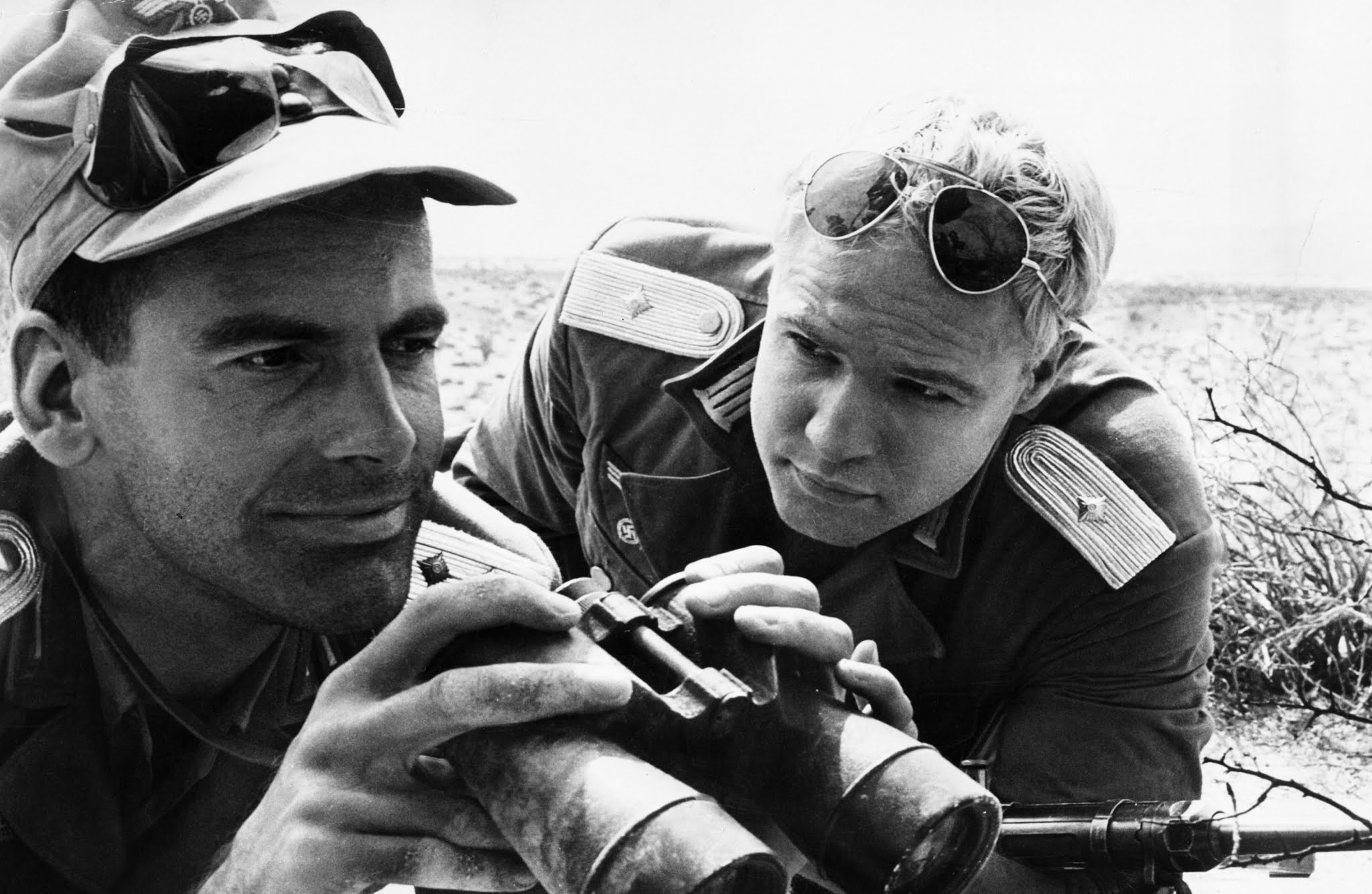
An epic World War Two drama spiked with notable action, The Young Lions explores the intense personal and military experiences of three memorable characters, one German and two Americans.

On New Year's Eve of 1938, German ski instructor and shoemaker Christian Diestl (Marlon Brando), an idealist seeking a better future, romances American vacationer Margaret Freemantle (Barbara Rush). She is repulsed by the growing wave of German expansionism and returns to the United States and her boyfriend Michael Whiteacre (Dean Martin), a Broadway entertainer. 

When America enters the war, Michael meets store clerk Noah Ackerman (Montgomery Clift) at the Army draft office. Michael labels himself a coward and tries to avoid service, but Noah, a Jew, calmly accepts conscription. Michael introduces Noah to Brooklyn girl Hope Plowman (Hope Lange). Their courtship starts with a commuting odyssey, then Noah has to win over her father (Vaughn Taylor), who had previously never met a Jew. 

Christian becomes a Lieutenant in the German army occupying Paris under the command of the merciless Captain Hardenberg (Maximilian Schell). He meets Parisienne Francoise (Liliane Montevecchi), then has a torrid encounter with Hardenberg's wife Gretchen (May Britt). Both Christian and Hardenberg are reassigned to the North African front lines. Meanwhile Michael and Noah go through basic training together, and Noah is exposed to bullying.

Once the liberation of Europe starts, Michael has to decide if being a coward is what he really wants, Noah will experience the chaos of combat, and Christian's idealism will be severely tested.

An adaptation of Irwin Shaw's novel, The Young Lions earns its 167 minute length with a focus on rich character development as well as a few scenes of short and sharp war action. The Edward Anhalt script is eloquent, ably maintaining control of multiple story lines from late 1938 to the end of the war in Europe. Edward Dmytryk keeps the scenes relatively short and the pacing brisk, pausing when necessary but never dragging. The result is a gourmet cinematic experience.

With abundant content comes a few weaknesses, and The Young Lions is not immune. A plausible argument can made that each of Brando, Clift and Martin (at 34, 38 and 41 years old respectively) are older than their "young" characters, with Clift perhaps visually least convincing as a budding man. Martin's character Michael Whiteacre is prominent early and late, but disappears for long stretches in the middle and is afforded relatively few scenes to navigate his arc. And a motorcycle escape sequence is kneecapped by rudimentary rear projection and flirts with unintended comedy.

But in the context of the film's scope, these are quibbles. The Young Lions soars to majestic heights of dramatic involvement by investing in people from different backgrounds, the war shaping who they are and what they stand for, the three central characters evolving into compelling men through complex growth journeys. 

Christian starts with a vision of a more equitable Europe where shoemakers can break free from the shackles of classism. His disillusionment rises as he awakens to the evils of the Nazi party and the brutal tactics employed by men like Hardenberg. Noah has the most to fight for, starting in Brooklyn where a Jew is treated with suspicion, then at training camp where survival means confronting bullying. And Michael is a man of music and cocktail parties, perhaps capable of pulling a few strings to secure a cozy desk assignment but aware of the implications to his sense of self.

Anhalt and Dmytryk are not satisfied with just the central stories and extend their focus to other fascinating characters surrounding the three men. Captain Haldenberg rides his rigid adherence to the principles of an implacable invading army from the highs of photo opportunities in Paris to unimaginable lows. And while Margaret and Hope are relatively static, Hardenberg's wife Gretchen, in just a couple of scenes, emerges as an unforgettable representative of the elite and decadent Berlin set, her behaviour and fate mirroring that of her Captain. In occupied Paris, the feisty Francoise is torn between fury at the German invaders, fear of fraternizing with the enemy, and the enticing prospects of a European project with men like the attractive Christian at the helm.

The cast sparkles with acting talent. A blond Marlon Brando brings a German accent to his sometimes mumbled internally anguished introspection. Montgomery Clift is committed as the outsider used to coping with a lowly status, instinctively aware a world war can change all societal dynamics. In one of his earliest dramatic roles Dean Martin is not in the same talent class, but is never less than serviceable. Maximilian Schell, in his first Hollywood feature, remarkably matches Brando with a dominant portrayal of regime loyalty.

The action scenes inject well-timed jolts of energy and allow the characters to further define their psyches and earn battlefield legacies. The best is a commando attack in North Africa demonstrating the double sword of ingenuity and cruelty.

Monumentally ambitious and grandly substantive, The Young Lions is an impressive roar.


All Ace Black Movie Blog reviews are here.

Monday, 19 August 2019

The Movies Of Hope Lange


All movies starring Hope Lange and reviewed on the Ace Black Movie Blog are linked below:


All Ace Black Movie Blog reviews are here.
The Movie Star Index is here.

Monday, 4 April 2016

Movie Review: Death Wish (1974)


A modest action film, Death Wish launched the urban vigilantism sub-genre and captured the unspoken mood of a national psyche looking for easy answers to escape the trauma inflicted by rampant crime.

Middle-aged architect Paul Kersey (Charles Bronson) lives in New York with his wife Joanna (Hope Lange), and works for a large corporation that invests in real estate development projects. His daughter Carol (Kathleen Tolan) is married to the mild mannered Jack (Steven Keats). Although the city is gripped by violent crime with muggings and murders at an all time high, Paul is liberal in his views and empathizes with the socially disadvantaged. His family is torn apart when three thugs invade his house, killing Joanna and raping Carol, who is traumatized and left in a vegetative state.

To escape his nightmare, Paul accepts a temporary assignment to work on a project in Tucson, where land developer Ames Jainchill (Stuart Margolin) reintroduces him to simpler rural societal laws, where gun ownership is the norm and law and order still rule the streets. Paul rediscovers his childhood love for guns, and starts to ponder his role in avenging his wife's death. Back in New York, Paul begins to invite encounters with muggers, and it does not take him long to get addicted to the rush of eliminating street thugs wherever he can find them. His acts of vigilantism quickly capture the imagination of the public and the media, causing a headache for police Lieutenant Frank Ochoa (Vincent Gardenia).

With urban centres grappling with an increasingly violent wave of crime, Death Wish sparked debate and controversy upon its release. The 1972 book by Brian Garfield carried an anti-revenge theme, but the screenplay by Wendell Mayes is much less ambiguous: not only are Paul Kersey's actions cathartic (his life brightens up considerably), his crusade of violent retaliation single-handedly drives down the rate of crime. The vigilante becomes a local legend, his mysterious identity only helping to elevate his stature to that of comic book superhero.

As for the film itself, it's a relatively unassuming Dino De Laurentiis production, directed by Michael Winner and made much better that it needed to be thanks to a careful, deliberate approach. Mayes' script takes its time to set the the context and portray the Kerseys as a normal, loving couple. The interlude in Tucson is an essential inflection point as the distance from New York provides Paul with a new perspective on how things can be, rather than just accepting what they are. Even when Paul starts his quest to confront the evil that lurks around every street corner, his emotions range from horror at his own actions to sheer exhilaration, and Winner allows each of these moments to play out.

The action scenes are handled well and occur mostly in the shadow of the night with locations including Central Park, back alleys, subway stations and on-board subway trains. Winner places Bronson squarely in his zone of comfort as a man of few words but many bullets, and few things are as good as Bronson shooting bad guys first and forgetting the part about asking any questions.

The supporting cast includes Hope Lange in the small but pivotal role as the primary victim Joanna, while Vincent Gardenia chews his subordinates, his superiors and the surrounding scenery as the police lieutenant not liking what he's up against but determined to crush it nevertheless. Less effective is a forgettable performance from Steven Keats, overwhelmed by his own hair as Kersey's son-in-law. Jeff Goldblum, Olympia Dukakis, and an uncredited Denzel Washington appear in small pre-stardom roles, as do Christopher Guest and Marcia Jean Kurtz.

Death Wish manages to be both an enjoyable action rout and a thought-provoking social commentary. And with Bronson holding the gun, any debate about the efficacy of vigilante justice is settled with deadly efficiency.


All Ace Black Movie Bog reviews are here.

Friday, 29 March 2013

Movie Review: A Nightmare On Elm Street 2: Freddy's Revenge (1985)


The first sequel to the 1984 slasher flick immediately drops into routine territory and bland execution. A Nightmare On Elm Street 2: Freddy's Revenge is neither scary nor fun, just pointless.

Five years after the events of the original film, the oblivious Walsh family has moved into the house where a teenager was terrorized by deadly nightmares featuring Freddy Krueger (Robert Englund). High school teenager Jesse Walsh (Mark Patton) now starts to experience horrific dreams, Freddy coming to him and insisting that Jesse needs to kill in real life at Freddy's behest. Jesse's parents Ken and Cheryl (Clu Gulager and Hope Lange) don't believe him, and initially, neither do his friends Lisa (Kim Meyers) and Ron (Robert Rusler).

People around Jesse start to die, including his abusive athletics coach Schneider (Marshall Bell). Freddy is able to take control of Jesse's body to commit gruesome acts, and both Ron and Lisa are endangered. Lisa tries to help by exploring the old power plant where Freddy used to work, and Freddy then crashes Lisa's pool party, leading to a final confrontation where Lisa tries to help Jesse regain control of his body and evict Freddy.

A desperate mishmash of ideas leading nowhere, Freddy's Revenge lacks any style and innovation, and suffers from a brain-dead script by David Chaskin and awful performances by an inept cast. Allowing Freddy to leap into the waking world through Jesse's body undermines the whole premise of the first movie. Some of the targets that Freddy chooses to harm, such as Schneider, are also incomprehensible if Freddy's intent is to avenge the community of parents who originally burned him to a crisp by killing off their kids.

Youngsters Patton, Myers and Rusler read their lines with studied amateurishness, while Gulager (13 years on from The Last Picture Show) and Lange get to discover how low Hollywood's career ladder can descend. Director Jack Sholder can't come close to matching Wes Craven's relative artistry, and instead delivers rehashed scenes that fail to generate any sense of suspense.

Stretching to a tiresome 91 minutes, A Nightmare On Elm Street 2: Freddy's Revenge is a dish served bored.


All Ace Black Blog Movie Reviews are here.