Genre: Epic Drama
Saturday, 28 June 2025
Movie Review: The Brutalist (2024)
Genre: Epic Drama
Saturday, 11 March 2023
Movie Review: Blonde (2022)

All Ace Black Movie Blog reviews are here.
Friday, 11 November 2022
Movie Review: The Darjeeling Limited (2007)
Three American brothers reunite on the Darjeeling Limited train in India. The trip is organized by oldest brother Francis (Owen Wilson), a micromanaging control freak still bandaged up after a severe motorcycle crash. Peter (Adrien Brody) is a laid back expectant father, but has a tendency to take things that are not his. Jack (Jason Schwartzman) is going through a divorce and looking for sexual thrills.
The brothers lost their father about a year ago, and have not seen their mother since she abandoned the family and became a nun at an Indian village. Francis intends the trip to culminate in a reunion with mom, but little will go as he planned.
Directed by Wes Anderson, The Darjeeling Limited rolls down the tracks with clever joy bordering on knowing smugness. Anderson co-wrote the script with Schwartzman and Roman Coppola, and the antics of the three brothers remain just to the side of authentic. The visual splendor is filled with vivid colors and the sights and smells of a train trip through an exotic land, although this is a vision of India more staged than organic.
Anderson's signature artificiality is intentional, but the foundational narrative supports are shaky. The three brothers are more quirky sketches than real people, and none are particularly likeable. The overarching theme of discarding unnecessary luggage to rediscover familial love through the thicket of annoying personality traits is well-intentioned but far from profound.Still, the humour is dry and consistent, and the journey is enlivened by unexpected twists, including Jack finding a libidinous partner and the brothers experiencing a tragic-heroic encounter with children near a village. Owen Wilson, Adrien Brody, and Jason Schwartzman are quietly effective at finding all the right individual irritating behaviours while still sneaking in the commonalities of brotherhood. Bill Murray shows up early and Anjelica Huston shows up late to boost the star power.
The Darjeeling Limited is a curated ride, finely crafted but more cerebral than heartfelt.
All Ace Black Movie Blog reviews are here.
Tuesday, 1 March 2022
Movie Review: The Pianist (2002)
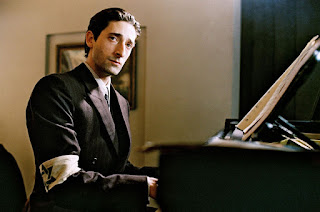
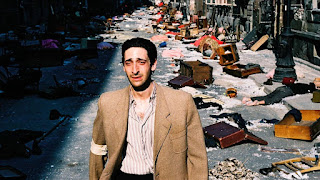
In Warsaw of 1939, the career of celebrated Jewish piano player Wladyslaw Szpilman (Adrien Brody) is interrupted when the army of Nazi Germany marches into Poland. The humiliation of the city's Jewish community starts with the enforced wearing of Star of David arm bands, then all the Jews are forcibly relocated to walled-off sections of the city. Throughout the ordeal, Szpilman does his best to support his parents and siblings, and refuses invitations to join collaborators in the form of guards.
Nazi atrocities multiply, and countless Jews are unceremoniously murdered in the streets. The Szpilmans and thousands of others are herded towards trains destined for the concentration camps. Fate intervenes and Wladyslaw avoids boarding the train, although he is separated from his family. He joins a group of prison labourers working under Nazi guards in Warsaw. Szpilman awaits an opportunity to slip away, although many horrors still await.
An adaptation of Szpilman's book written for the screen and directed by Roman Polanski, The Pianist is an unblinking look at the human capacity for evil. The film packs an almost physical punch, the Nazi atrocities unleashed on Warsaw's Jewish population presented in a stark, fearfully matter-of-fact style. Dignity disappears, life is cheapened, and death salivates over a population selected for extermination by monstrous men.
This is a story of war, but not about soldiers, armament, strategies, politics, or battlefields. Instead, Szpilman's personal window (and sometimes his literal windows) frame all events. Family members, acquaintances, employers, local guards, collaborators, and most importantly, non-Jewish Poles who risked everything to save their neighbours, move in and abruptly out of the film in accordance with Szpilman's experiences. Historical moments, like the Ghetto Uprising and later the Warsaw Uprising, unfold through Szpilman's eyes, as he clings to the concept of existing.From a narrative perspective, this is a drama where the protagonist is simply tasked with refusing to give up, and The Pianist hunkers down in the deep trenches of an individual's will to survive against overwhelming adversity. In an unforgettable performance Adrien Brody as Szpilman is the one constant over 150 minutes, portraying physical and mental erosion due to despair and malnutrition as Polanski underlines the ravages of near-starvation.
Musical interludes offer the briefest respites, whenever Szpilman finds a piano and either plays it for real or in his imagination. The final chapter finally features the faintest ray of hope, as Captain Wilm Hosenfeld (Thomas Kretschmann) of the now clearly about-to-be-defeated German army comes face to face with Szpilman, and chooses a path other than immediate violence.
Polanski exposes a twisted regime's barbarism without ever elevating suffering into faux heroism. And in a city annihilated by ideological hate, The Pianist seeks the human heart, stubbornly throbbing.
All Ace Black Movie Blog reviews are here.
Friday, 7 May 2021
Movie Review: King Kong (2005)
In New York City of 1933, discredited film director Carl Denham (Jack Black) plans an audacious ending to his latest cinematic project. He wants his cast and crew to sail to the uncharted Skull Island and capture unique footage. Carl ropes star Bruce Baxter (Kyle Chandler) and celebrated writer Jack Driscoll (Adrien Brody) into the project, and plucks struggling vaudevillian Ann Darrow (Naomi Watts) out of poverty to play the female lead.
They set sail on the Venture with German Captain Englehorn (Thomas Kretschmann) in charge. Once on Skull Island, violent natives immediately seize Ann and offer her as a sacrifice to King Kong (Andy Serkis, motion captured), a huge ape and the dominant beast on the island. Kong takes a liking to the feisty Ann and does not harm her, but has to engage in vicious battles with dinosaur rivals to keep her safe. Meanwhile Carl, Bruce, Jack and Englehorn need to rescue their leading lady, while Carl starts considering the financial rewards of capturing King Kong and bringing him back to New York.
Essentially the same story told in 100 minutes in the classic original is here expanded into a disorienting 188 minutes. Directed by Peter Jackson, this version of King Kong is a technological marvel, and subdues its length with engrossing visuals, a distinct sense of place, and enough scurrying people and rampaging monsters to maintain momentum. The island is a breathtaking and foreboding place, its natural balance contaminated by the arrogant new arrivals, and King Kong is a beautifully rendered beast, Andy Serkis bringing the monster to life and ever so gradually allowing emotions to surface.King Kong achieves some stupendous and overwhelming action highlights. Rational editing seamlessly stitches the actors into the CGI-enhanced environment, even during the wildest sequences. Jackson (who also co-wrote the screenplay) injects the best shriek-inducing scenes with a mean streak of sly humour. A Brontosaurus stampede walks the thin line between plain silly and ridiculous fun, and later Kong's battle with multiple Tyrannosaurus rex is vicious and viciously funny.
For better or for worse, Jackson goes big and never goes home. His main command must have been "more", every scene and every sequence extended beyond what is necessary, computers whirring and pixels crashing onto the screen in a race to impress. The insistence on adding by addition means the monsters just keep on coming, effectiveness and shock value eroded with every new species.
In a thankless role confined for long periods in an ape's hand, Naomi Watts manages to provide Ann with spirit and personality. The rest of the cast members trundle through the jungle with good intentions to battle mortal but virtual hazards.
The final 45 minutes take place back in New York, the 1930s lovingly recreated with romantic details as King Kong makes his final stand atop the Empire State Building. His howl is nature's fury at human hubris, loud, large, and often unheeded.
All Ace Black Movie Blog reviews are here.
Tuesday, 29 October 2019
The Movies Of Adrien Brody
Saturday, 3 November 2018
Movie Review: Third Person (2013)
A multi-story drama and romance, Third Person explores themes of loss and trust. While enjoying a spectacular cast in fine form, the pacing is lackadaisical and the narrative commonalities emerge too late.
The film presents three seemingly unrelated stories set in three different cities. At a Paris hotel, Michael (Liam Neeson) is a Pulitzer Award winning writer working on his latest book. He is separated from his wife Elaine (Kim Basinger) as they both deal with a family tragedy. Michael is joined in Paris by his lover Anna (Olivia Wilde), a vivacious aspiring writer. The relationship between Michael and Anna is passionate and tumultuous as she deals with a secret of her own.
In Rome, Scott (Adrien Brody) is an underhanded garment businessman, specializing in stealing and copying haute couture designs. Scott is still grieving a personal loss, and at bar he meets single mom Monika (Moran Atias). She needs money to rescue her daughter from human smugglers, and Scott finds himself irresistibly drawn to her plight.
In New York, Julia (Mila Kunis) is a perpetually late mother desperately working with her lawyer Theresa (Maria Bello) to win back the right to visit her young son. Julia was accused of harming her child, a charge she denies, but her artist husband Richard (James Franco) now has sole custody. Julia accepts a job as a hotel maid to make ends meet and to prove to a court psychologist that she deserves a chance to spend time with her son.
Written and directed by Paul Haggis, Third Person is tantalizingly close to being a good film, but unfortunately lands on the wrong side of emotionally static. The exploration of loss, yearning and the search for healing is worthwhile and handled with sensitivity. But all three stories start saddled with the heavy baggage of guilt, misfortune and grief, and that is where they stay. A few revelations work their way into the narratives, but the overarching cloud of gloom settles in early and never yields.
Given the prevailing lack of forward progression, at 137 minutes the film is too long. Haggis labours towards a final twist knotting the three stories together, but this is a case of genuinely bad timing. The final revelations tumble forth a few minutes before the end credits, and while the resolution is decent, it arrives well past the point of rescue.
Michael's fierce relationship with Anna is the central story, and works its way to the film's one startling moment. Scott's descent into Monika's world is more of a slow burn and a protracted case of who is playing who, and suffers from too much repetition. With more dedicated exposition, both chapters could be imagined as the basis for fine stand-alone films. In contrast Julia's struggle to prove herself worthy of visiting her son is remarkably slight and a relative mismatch in depth and quality.
The cast almost rescues the film, and the one benefit of the long running time is that many of the stars get to sink their teeth into the characters. Neeson and Wilde are most prominent, but Brody, Atias and Kunis all grab the substantive opportunities to shine.
Third Person looks for balms to help heal open wounds of guilt and regain lost trust. Regrettably, the long-winded routes to salvation prove to be tortuously dour.
All Ace Black Blog Movie Reviews are here.
Saturday, 3 October 2015
Movie Review: The Thin Red Line (1998)
A lyrical World War Two drama, The Thin Red Line explores the psychology of soldierhood in the context of the Guadalcanal campaign. The film mixes intense battle action with slow moving, narration-driven introspection scenes to create a unique but not always successful experience.
A collection of soldiers are thrust into battle when the United States mounts an invasion of Guadalcanal to halt the Japanese plans to control the south Pacific. The men include Witt (Jim Caviezel), who is thoughtful and philosophical about the war's purpose and always one step away from wandering off on unauthorized leave; Welch (Sean Penn) a no-nonsense down to earth soldier's soldier; and Staros (Elias Koteas), a Captain who cares about his men, perhaps too much.
The hard-driving Lieutenant Colonel Tall (Nick Nolte) is the local commander, and he is eager to make up for lost time after being passed over for promotions throughout his career. Captain Gaff (John Cusack) is Tall's loyal second-in-command. The soldiers engage in fierce combat to dislodge the Japanese from a strategic hilltop, and then push on towards the Japanese rear positions. But territory is gained at a high cost, and each man has to deal with the chaos of war in his own way.
At times, The Thin Red Line represents war as wall paper with a soundtrack of pensive poetry. The visuals may be impressive, and the narration a morose and thoughtful reflection of soldiers' thoughts, but the pace, particularly in the opening and closing 45 minutes, is as close to watching paint dry as a movie can get. Terrence Malick directs with his trademark disregard for what may be popular, opting instead to focus on the beauty of a Pacific paradise being invaded by the ugliness of war. With a running time of close to three hours, the film occasionally rewards patience, but also tests it to the limit.
The action scenes, when they come, are heart-pounding, all the more so thanks to the contrast with the languid pace of the set-up. The middle of The Thin Red Line is an absorbing, meat-grinder of a battle in three phases. The US soldiers are first pinned down and picked off by unseen Japanese troops dug into the hillside. The middle phase finds a small group of soldiers charging at the key Japanese fortification to try and force a breakthrough. The final phase involves a rout of the Japanese
rear lines.
Malick matches Spielberg's Saving Private Ryan (also from 1998) in capturing the agony and ecstasy of war, the pulsating kill-or-be-killed calculus quickly disposing of human pauses once the battle is joined. This is a war film that is not afraid to show fighting men as confused, terrified and error-prone. When heroes do step forward, they do stand out, although in their rush to claim glory, commanders like Tall also find ways to cheapen the achievements earned on the battlefield.
Less successful is the attempt to humanize the soldiers. Despite the mammoth running length, there are just too many individuals cluttering up the front lines, and too many actors given too little to do. With Malick endlessly focusing his cameras on wildlife and still life, the soldiers are shortchanged into insignificance. The likes of Adrien Brody, Woody Harrelson, John C. Reilly and Jared Leto are reduced to little more than extras in the context of a three hour film. John Travolta and George Clooney are each on screen for about 30 seconds. Nick Nolte, Jim Caviezel, Sean Penn and, to lesser extent, John Cusack are treated marginally better, but the film is definitely stained with the mark of name actors slipped into meaningless roles to try and salvage box office.
The movie offers up two half-hearted character conflict points, and they are both overdrawn. Tall and Staros clash about battle tactics, with Staros refusing to obey orders that would have put his men in harm's way. The stand-off between the two men is prolonged to the point of exhaustion. Meanwhile, in a bizarre chase for dramatic tension that goes nowhere, the loyal Gaff dares to demand from Tall that the men be supplied with water as they fight. Ponderously spouted narration about the futility of war does not make up for the lack of genuine narrative substance.
Flawed as it is, The Thin Red Line is a worthwhile and cerebral addition to the catalogue of war epics that care more about damage caused than territory gained. The film may choose aesthetics over content, but it never loses sight of the losses on all sides.
All Ace Black Blog Movie Reviews are here.
Saturday, 23 August 2014
Movie Review: Midnight In Paris (2011)
A fantasy romance inspired by the confluence of wistful time and divine place, Midnight In Paris finds Woody Allen at his best, crafting a love letter to a city rich with passion and history.Successful Hollywood screenwriter Gil Pender (Owen Wilson) still dreams of becoming a respected book author. On vacation in Paris with his fiancée Inez (Rachel McAdams), Gil finds himself inspired by the city's rich heritage and starts to muse about living there permanently, an idea that Inez dismisses. With Inez enjoying sightseeing and partying with pompous professor Paul Bates (Michael Sheen) and his wife Carol (Nina Arianda), Gil starts to take midnight walks on his own.
He stumbles into an alternate reality of Paris in the 1920s, inhabited by the likes of F. Scott Fitzgerald, Ernest Hemingway and Gertrude Stein. They interact with him naturally, inviting him to parties and Stein even offering to review a draft of his novel. Gil moves back and forth between Paris of today with Inez in the daytime and the 1920s on his own after midnight, where he eventually meets Pablo Picasso's lover, the mysteriously attractive Adriana (Marion Cotillard). She is also seeking her true destiny in the company of her contemporaries, and an impossible romance flickers to life.
Midnight In Paris celebrates the city's charming magic, and toys with the nostalgia of the past always glowing brighter than the reality of the present. It is among Woody Allen's best films, finding the sweet spot where his favourite themes intersect: troubled love enriched by an enchanting cityscape prompting an examination of a man's path in life.
The opening montage, showing iconic Parisian scenes, noticeably lingers on for a good minute longer than the usual introduction, Allen sending the message that the city is one of his main characters. And throughout the film, Allen bathes the Paris of the past and the present, whether at night or during the day, with warm, comforting hues dominated by reds and yellows. Even the rainfall feels mild and soothing, while the numerous bistros emit an ever welcoming glow at all hours.
And Gil is drawn into this mystique, finding in the city the perfect match for his romantic soul. Gil is most at home when walking the streets of Paris alone, and he gradually realizes that his connection with the city will define his happiness much more so than his relationship with Inez.
Allen, who also wrote the screenplay, does not bother to explain Gil's frequent sojourns into the past, allowing the time shifts to be as natural as the human imagination. The theme, however, is clear. The glorious past is an inspiration for the present and the future, but pining to live there is an emotional cul-de-sac. The past is always the present for its generation, with the business of living and loving a constant and dominant requirement. Wistful sentimentality is what yesterday feels like, but only from today's vantage point.
Midnight In Paris is populated by a perfect cast, Wilson creating in Gil an articulate man still seeking his place in life. McAdams breaks away from her traditional perkiness to provide Inez with a pushy edge, a modern woman trampling over her man's tender vulnerabilities. Marion Cotillard ghosts into the movie as Gil's muse, his most direct expression of love for the past, and also the signpost for the future.
Michael Sheen, Carla Bruni and Léa Seydoux have small but memorable roles in Paris of the present, while Adrien Brody (Salvador Dali), Kathy Bates (Gertrude Stein), Corey Stoll (Ernest Hemingway) and Tom Hiddleston (F. Scott Fitzgerald) have a ball bringing the past to life. Picasso, Toulouse-Lautrec, Gauguin, Degas, Matisse, T.S. Eliot and Luis Buñuel are other celebrities of previous eras that cross paths in the dreamy mists of the night.
Embroidered with delicate humour, Midnight In Paris is a whimsical masterpiece.
All Ace Black Blog Movie Reviews are here.
Saturday, 15 October 2011
Movie Review: Hollywoodland (2006)
A muddled attempt to create a story where there may be none, Hollywoodland stumbles around looking for a cool gumshoe vibe but emerges with a dull mess.
The real death of actor George Reeves at age 45 in 1959 of a gunshot wound to the head was ruled a suicide, but suspicions remain that maybe he was killed. Reeves was television's Superman, but at the time of his death was comprehensively underemployed and likely depressed. It is understandable that Superman committing suicide is a hard story to swallow, but Hollywoodland does the conspiracy theories no favours.
The film centres around low-level private detective Louis Simo (Adrien Brody), desperate for any client, pursuing the rumour that there was more to the death of Reeves (Ben Affleck) than the official story. Simo's ineffective bumbling around the events of Reeves' death are mixed with flashbacks of the actor's career.
The script by Paul Bernbaum works hard to create a villain out of MGM executive Eddie Mannix (Bob Hoskins), whose wife Toni (Diane Lane) carried on an open affair with Reeves for many years. Rumours and legends have long swirled around Mannix, for his alleged gangland connections and unofficial role as one of MGM's "fixers", arranging cover-up stories for the studio stars when their behaviour landed them in more trouble than was helpful for their careers. Hollywoodland labours to float theories that either Mannix or his wife may have purposefully or accidentally caused Reeves death. But director Allen Coulter back pedals meekly, conjecturing a full circle and tepidly parking the film where it started.
Affleck surprisingly emerges as the best thing in the movie, thanks to his human portrayal of Reeves as a gentleman, a modest acting talent seeking a better opportunity in the glamorous movie business, but pigeonholed as a kids' superhero on a cheesy TV show. The lovingly recreated scenes of Reeves portraying Superman and his interaction with the young fans of the show suggest that there was an intention of a whole other type of movie somewhere along the line: the detective Simo angle emits the foul odour of a hastily slapped together narrative to convert a lightweight homage into a failed mystery.
There are plenty of sordid tales to tell from the history of Hollywood. Hollywoodland targets the wrong legend and fumbles it.
All Ace Black Blog Movie Reviews are here.