Showing posts with label Robert Vaughn. Show all posts

Friday, 6 May 2022

Movie Review: How To Steal The World (1968)

A low-budget spy adventure, How To Steal The World is devoid of wit but stocked full of bad special effects and disinterested acting.

Near Macau, UNCLE agents Napoleon Solo (Robert Vaughn) and Ilya Kuryakin (David McCallum) fail to capture THRUSH leader Mr. Webb (Peter Mark Richman), who escapes with the help of Margitta Kingsley (Eleanor Parker). She is the wife of UNCLE agent Robert Kingsley (Barry Sullivan), who soon disappears. Solo and Kuryakin are dispatched to investigate.

From his headquarters in the Himalayas, Robert has hatched a well-intentioned plan to eliminate world violence by releasing a docile gas. He assembles seven renowned scientists to help perfect the formula, and hires General Harmon (Leslie Nielsen) to provide base security. Unbeknownst to Robert, Mr. Webb and Margitta are monitoring his every move on behalf of THRUSH, waiting to pounce and usurp his world domination plans.

The eighth and final feature film cobbled together from television episodes of The Man From UNCLE, How To Steal The World is a tired affair, operating well past the series' best-by date. The hallmark joie de vivre is gone, replaced by a sense of fatigue. Vaughn and McCallum go through the motions with robotic indifference, Solo and Kuryakin rarely actually doing anything other than offering themselves as targets. The clever banter and winks of humour are replaced by long stretches of silence, the Norman Hudis script apparently not even trying. 

The rest of the cast members operate in bland or over-animated modes, while Eleanor Parker manages both, lounging on her back when she's not vamping for the camera. Leslie Nielsen as the general eager to create peace through violence is too far removed from reality to classify as either intentionally funny or unintentionally awful.

The story is an over-complicated and still nonsensical control-the-world plot cluttered by too many scientists donning monk robes (?), while THRUSH adds a muddled conspiracy on top of a conspiracy. Worse of all are the truly atrocious visual effects, director Sutton Roley frequently inserting stock footage whenever a shot is too expensive for the television-level budget. The discontinuous, jarring, and cheesy results start to carry dangerous echoes of none other than Plan 9 From Outer Space

Lacking even Jerry Goldsmith's music, How To Steal The World is a lesson in incompetent opportunism.


All Ace Black Movie Blog reviews are here.

Saturday, 30 April 2022

Movie Review: The Venetian Affair (1966)

A dour spy drama, The Venetian Affair boasts attractive locations but is hampered by soulless characters and a logic-challenged script.

In Venice, American diplomat Prentiss detonates an explosive at a peace conference, killing himself and many others. Heavy drinking newswire reporter and ex-CIA agent Bill Fenner (Robert Vaughn) is dispatched to cover the incident, and encounters researcher Dr. Pierre Vaugiroud (Boris Karloff), who is about to release a damning report about the bombing. Fenner also tangles with his former boss at the CIA Frank Rosenfeld (Ed Asner), who wants to locate Fenner's ex-wife Sandra Fane (Elke Sommer). 

She is a suspected communist agent and the reason Fenner lost his agency job. More recently, Sandra was believed to be Prentiss' lover, and may have information about the bombing. Fenner does locate Sandra, and is soon confronted by the evil Robert Wahl (Karlheinz Böhm), a villainous businessman intent on disrupting world peace efforts.

An adaptation of a Helen MacInnes novel directed by Jerry Thorpe, The Venetian Affair deserves some credit for investing in one place, and targeting a downbeat mood. In an era when globe-hopping and a glib attitude went hand in hand with spy adventures, here all events are centred on Venice, and there is not a snarky comment nor a silly gadget to be found.

Unfortunately, after an explosive opening Thorpe and his writer and co-producer E. Jack Neuman are unable to meaningfully dig into the material. The weaknesses are many, starting with a plot that cannot withstand the most basic scrutiny, and an urbane leading man in Robert Vaughn failing to generate the necessary emotional heft despite a perpetual bad-shave look. The villains and their motives are kept hidden for too long, resulting in plenty of superficial cloak-and-dagger action interrupted by opportunistic bed-hopping.

An attempt is made to generate genuine passion between Sandra and Bill, but her character is too poorly defined to matter. Karlheinz Böhm finally injects spirit with his late appearance as the antagonist, but he too falls foul of poor plotting and absent motivation. The Venetian Affair is handsome to look at, but fails to navigate out of narrow canals.


All Ace Black Movie Blog reviews are here.

Friday, 11 March 2022

Movie Review: One Spy Too Many (1966)

A lightweight spy adventure, One Spy Too Many mixes thrills with wit on a low budget.

A United States military base is infiltrated by henchman Parviz (David Sheiner). He helps his megalomaniac industrialist boss Alexander (Rip Torn) steal a new chemical weapon that eliminates the will to fight. Agents Napoleon Solo (Robert Vaughn) and Illya Kuryakin (David McCallum) of the United Network Command for Law and Enforcement (U.N.C.L.E.) are dispatched by their boss Waverly (Leo G. Carroll) to investigate and retrieve the stolen gas.

They cross paths with Alexander's soon-to-be-ex-wife Tracey (Dorothy Provine), who is also hunting down Alexander to have him sign divorce papers and retrieve a million dollars he owes her. Tracey tags along with Solo and Kuryakin on a journey to Greece, where they encounter shady archaeologist Kavon (David Opatoshu), and uncover Alexander's plot to subjugate an Asian country as a first step towards ruling the world.

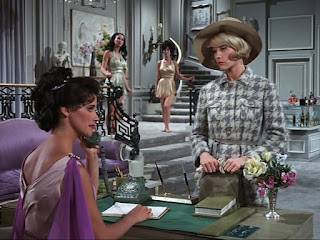
Director Joseph Sargent mushes together two episodes from The Man From U.N.C.L.E. television series, adds some saucy scenes of sexy flirtation, and emerges with a James Bond knock-off theatrical release. The third in the U.N.C.L.E movie series, One Spy Too Many never takes itself seriously, and the lighthearted attitude works. This is a fun adventure with bright ideas and sharp elbows, despite all the shortcomings.

The television origins are obvious, starting with the boxy aspect ratio. The sets look cheap, the evil plot is barely explained and jumps around between various disconnected objectives, and the action scenes are clumsily staged. The threat of violence is always more implied than real, and indeed Solo and Kuryakin make it through the film with a minimal infliction of bodily harm.

But plenty of fun can be found in many corners. Rip Torn is a worthy villain as Alexander (wanting to be Great), his low-key performance doing more with less, and Alexander's obsession with violating the Ten Commandments is a nice touch. His sidekicks and fellow bad guys are memorable, including the resourceful Parviz and muscleman Ingo (Cal Boulder). A life-sized chess match between Alexander and Solo using human pieces is clever. Solo and Kuryakin find themselves in plenty of good and humorous mortal danger: Solo is tied to a table in readiness for bifurcation, while Kuryakin first has to dodge lethal farm equipment then endures mummification.

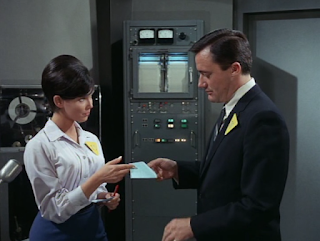
Dorothy Provine is intentionally irritating in a Doris Day-type role as the extra and unneeded spy. The true infusion of sex appeal arrives courtesy of Yvonne Craig as U.N.C.L.E's omnipresent "control", intent on attracting Solo's attention, and Donna Michelle as a seductive princess. 

One Spy Too Many lacks polish, but embraces scrappy swagger.


All Ace Black Movie Blog reviews are here.

Thursday, 18 March 2021

Movie Review: The Young Philadelphians (1959)

An epic family drama, The Young Philadelphians is a sprawling story of romance and ambition. Undoubtedly sudsy, it is also undeniably engrossing.

On her wedding night, Kate Judson (Diane Brewster) is abandoned by her new husband William (Adam West) of the highly respected Lawrence family. She seeks comfort with her other lover, construction company owner Mike Flanagan (Brian Keith), and conceives a son. Kate ensures her newborn carries the Lawrence name to improve his societal standing. 

Tony Lawrence (Paul Newman) grows up under the watchful eyes of Kate and Mike. As a young man studying law he befriends playboy Chet Gwynn (Robert Vaughn), who is in line to inherit a large trust fund but is having difficulties with his stodgy guardians. Tony's first love is Joan Dickinson (Barbara Rush), but her father Gilbert (John Williams), a respected lawyer, delays their impetuous marriage plans by promising to mentor Tony after he graduates. A distraught Joan marries Carter Henry (Anthony Eisley) instead.

Tony adopts a more ruthless streak and secures a position with John Marshall Wharton (Otto Kruger), who runs the most prestigious law firm in Philadelphia. He navigates the passionate advances of Wharton's younger wife Carol (Alexis Smith). After serving in the Korean War and helping a severely wounded Chet, Tony makes a name for himself as a tax lawyer. Still to come is a difficult reunion with Joan, and a court case involving Chet that threatens everything Tony has achieved.

An adaptation of the Richard P. Powell book, The Young Philadelphians is two hours and twenty minutes of captivating storytelling. Producer James Gunn also the wrote the screenplay, and embraces the chapter-like structure with brisk pacing, trusting the audience to keep up with the many ups and downs experienced by Tony Lawrence. Director Vincent Sherman is more functional than flamboyant, but does infuse the narrative with a sense of elegant quality. 

The episodes are held together by several overarching themes. Mom Kate and secret dad Mike nurture their son from a distance, trying to influence and help Tony without revealing his true lineage. The passion between Tony and Joan sparks early, and after she marries someone else they have various encounters over the years, two individuals who understand each other best to the point of inflicting both pain and joy.

But the narrative's most persistent thread is Tony's perfect imperfection, his pursuit of prestige and career glory sometimes causing him to trample on others, but also creating opportunities to help and exert expanded influence. Tony learns early a certain ruthlessness is required to climb the ladder, then has to modulate in accordance with his moral code.

The final chapter is a court case gathering up all the accumulated complexities of Tony's life. Gunn and Sherman demonstrate courage to present the complicated trial in sufficient detail to heighten the drama, although the ability of a tax lawyer to shine in a high profile criminal case begins to stretch credibility.

Paul Newman is a mixture of easy intensity and marginal over-emoting, but carries the load lightly. Robert Vaughn earned a Best Supporting Actor Academy Award nomination for a pivotal role full of churning anguish. Alexis Smith, in a small role, leaves an indelible mark as a younger wife looking for adventure, and Barbara Rush adds a sparkle as Joan, although she is less prominent after the opening third.

The Young Philadelphians enjoy lives and loves full of twists and turns, most of them delivered with aplomb.


All Ace Black Movie Blog reviews are here.
Saturday, 4 August 2018

Movie Review: The American Side (2016)


A neo-noir detective thriller, The American Side has stylish intentions but is over-plotted and under-produced.

In the Buffalo and Niagara Falls area, crooked small-time private investigator Charlie Paczynski (Greg Stuhr) is stunned when his partner Kat (Kelsey Siepser) is shot and killed during a seemingly routine entrapment operation targeting Tom Soberin (Harris Yulin). Charlie starts to ask questions and kick down doors, only for Soberin to turn up dead in the river. Distraught scientific researcher Nikki Meeker (Alicja Bachleda) was also looking for Soberin and approaches Charlie for help.

Charlie's investigation leads him to competing industrialists Borden Chase (Matthew Broderick) and Sterling Whitmore (Robert Forster), who are both looking for a secret design by famous inventor Nikola Tesla that could alter human destiny. Borden's sister Emily (Camilla Belle) may have her own agenda, government Agent Barry (Janeane Garofalo) is tracking down the bad guys, local police detectives are chasing shadows, and a group of Serbian thugs are just as intent on getting their hands on Tesla's drawings.

Directed by Jenna Ricker and co-written by Stuhr, The American Side is an independent, low-budget production, aiming to recreate classic noir style and mood. Attempting to breathe deeply from the Buffalo setting and the energy of the roaring Niagara Falls, the film is unfortunately just plain hokey, an almost laughably amateurish juxtaposition of 1940s attitude and dialogue with an incongruous modern setting seemingly devoid of cell phones and computers.

Borrowing heavily from films like The Maltese Falcon, Kiss Me Deadly and The Third Man, The American Side never finds its own voice, and remains a mishmash of ideas barely held together by a poorly developed, derivative and over-burdened plot full of holes, inconsistencies and loose ends. Despite the presence of talent like Broderick, Forster, Yulin, Garofalo and none other than Robert Vaughn, the acting is uniformly wooden and the lines of dialogue are read with little conviction.

Some of the visuals capture the noir spirit, a few of the snarky lines do land effectively, and with better direction and a polished script Greg Stuhr can be imagined as an effective and seedy anti-hero. But here the action is clunky, good intentions slipping into the waterfall, drowning in the whoosh of an unforgiving talent deficit.


All Ace Black Blog Movie Reviews are here.


Tuesday, 8 May 2012

Movie Review: The Delta Force (1986)


One of the more ambitious Cannon Film efforts, The Delta Force teams veteran Lee Marvin with expressionless Chuck Norris, throws a lot of once-famous names at the screen, and achieves some engagement by taking its time to develop a story and a dose of drama prior to the machine guns opening up. But once the shooting starts, it quickly disintegrates into the mind-numbing excesses that made most Golan - Globus productions infamously bad.

Two terrorists led by Abdul Rifi (Robert Forster) hijack an American Travelways flight from Athens. The plane is diverted to Lebanon, where terrorist reinforcements arrive to bolster the hijackers. The Jewish passengers (including Martin Balsam and Joey Bishop) are taken off the plane and held captive in Beirut prison cells. Also on board are three US Navy sailors who are singled out for rough treatment, with one eventually killed. Throughout, flight attendant Ingrid (Hanna Schygulla) does her best to calm the tense situation and avoid further violence. After some traipsing across the Middle East, the plane returns to Lebanon and all the hostages are taken off the aircraft and stashed in a Beirut terrorist stronghold.

The elite counter-terrorist Delta Force, under the command of Colonel Alexander (Marvin) and Major McCoy (Norris) is dispatched to mount a rescue. Alexander and McCoy were part of the shambolic 1980 operation that spectacularly failed in an attempt to extract the American embassy hostages in Iran. Determined to make amends, the Delta Force launches a daring mission within Beirut to rescue the hostages and retrieve the hijacked plane.

Inspired by the true 1985 hijacking of a TWA airliner (the real Delta Force was readied but not deployed), The Delta Force may have represented the peak of achievement for Menahem Golan and Yoram Globus. Directed by Golan, it was the first major Cannon production filmed at the GG Israel Studios in Jerusalem, and it also turned out to be the only high profile film to make use of the facility before the company collapsed. Shelley Winters, George Kennedy, Robert Vaughn, Bo Svenson, and Susan Strasberg are among the once somewhat famous actors who get smallish parts in The Delta Force, and despite triggering a game of spot the has-been, they collectively add interest to the film.

The movie does exhibit an increased level of professionalism and care. Scenes and characters are given appropriate time to breathe and develop, and the earlier part of the hijacking saga hits some promising notes in building the on-board tension between assailants and victims. But the final third of the film retreats to the Neanderthal cave where most of Cannon's action films dwell. Norris' McCoy character in particular contributes to an elevated amount of nonsense, killing hordes of terrorists on a motorcycle filled with an endless supply of lethal rockets, and an uncanny ability to never miss a single target.

But saddest of all is Lee Marvin's frail appearance in The Delta Force. In his farewell performance, he undoubtedly elevates the movie with an injection of distinguished talent and sheer presence. But he is also undeniably fragile and too old for the role, going through the motions in almost visible discomfort.

The Delta Force is not without its point of interest, but the production's limited tool set confines the experience to the cramped economy class, near the dank rear of the plane.


All Ace Black Blog Movie Reviews are here.


Wednesday, 29 December 2010

Movie Review: Bullitt (1968)


Bullitt has quite a few things going for it: the coolness of Steve McQueen, the chic glamour of Jacqueline Bisset, the attractive locations of San Francisco, the muscle of a Ford Mustang, and the thrills of a prolonged, legendary car chase. Yet somehow, all the pieces of the jigsaw do not make a complete picture.

San Francisco Police Lieutenant Frank Bullitt (McQueen) is personally selected by sleazy politician Walter Chalmers (Robert Vaughn) to protect Senate Sub-Committee witness Johnny Ross, who is stashed in a dumpy motel waiting to give testimony that will damage a Chicago criminal syndicate.

But Bullitt and his team are too easily penetrated; Ross and a member of the police protection team are severely wounded. Bullitt soon realizes that all is not what it seems, a larger conspiracy is at play possibly with the aid of inside informers, and he has to reassemble the puzzle pieces to sort out the plot.

Director Peter Yates struggles with a lightweight script that relies too much on style at the expense of any character and dialogue sharpness. Sure, McQueen and Bisset look great, but they say very little of substance and are comprehensively drowned out by the roaring Mustang and the bustling streets of San Francisco.

Not having much character-driven drama to work with, Yates does the next best thing by keeping the camera work and framing interesting and highly kinetic. He delivers the rightfully highly-regarded car chase between McQueen's Mustang and the bad guys in a Dodge Charger. A total of 16 cylinders and more than 700 horsepower roar around - and often fly over - the insanely steep streets of San Francisco, burning rubber and smoking tires in a scene that set the standard for all future serious movie car chases.

And Yates ends the film by taking the action to San Francisco Airport for an elongated and almost dialogue-free climax, including Bullitt and his foe crossing active runways and mingling with giant jets getting ready for take-off.

But even by thriller movie standards, Bullitt has massive plot holes. Why do the assassins not finish-off Ross and his protection detail at the motel? Why do the assassins decide to run from Bullitt to instigate the car chase -- when they were the ones tailing him? How exactly does Bullitt uncover the destination of the phone calls that were made from a phone booth? Just by going to the same phone booth? At the climax, why does the prey give away his location by firing at a very distant Bullitt? And why is there a massive line-up and ticket-check to leave the airport? And can Bisset's character really be that clueless about the life of a police lieutenant? Does she not go to the movies?

Bullitt also suffers from the "unkonwn villain" syndrome, where the focus of the chase continuously shifts and finally lands on barely defined baddies. Since the movie provides very little reason to know or despise the enemy, a lot of the tension steadily seeps out over the final 30 minutes.

Ultimately, Bullitt is all about the visuals, but beneath the admittedly shiny surface, there is little substance.


All Ace Black Movie Blog reviews are here.