Showing posts with label Linda Darnell. Show all posts

Sunday, 17 March 2024

Movie Review: Fallen Angel (1945)


Genre: Noir Crime Romance Drama  
Director: Otto Preminger  
Starring: Dana Andrews, Linda Darnell, Alice Faye, Anne Revere, Charles Bickford, John Carradine  
Running Time: 97 minutes  

Synopsis: In California, penniless drifter Eric Stanton (Dana Andrews) is thrown off the bus in the small town of Walton. At the local cheap diner, he finds server Stella (Linda Darnell) alluring, but she is tired of men who don't commit and demands marriage and a house. Eric makes some money promoting a show for traveling spirit medium Professor Madley (John Carradine), and in the process meets unmarried wealthy sisters Clara and June Mills (Anne Revere and Alice Faye). To secure the funds needed to satisfy Stella, Eric plots to separate June from her money through seduction, but unexpected twists await. 

What Works Well: Director Otto Preminger and star Dana Andrews re-team after the success of Laura and land within a seedy milieu of drifters, hucksters, and desperates. Eric Stanton fits right in, and Andrews nails the dubious protagonist as a survivor susceptible to troubled charms. The second half transitions into a tough whodunnit with unconventional interrogation tactics, Stanton's convoluted plotting sucking him into a murder case with ex-New York cop Judd (Charles Bickford), love rival Atkins (Bruce Cabot), and even barkeep Pop (Percy Kilbride). Linda Darnell as Stella carries the weight of wasted years behind her eyes, a contrast with Alice Faye's June, whose so-far sheltered existence is an easy target.

What Does Not Work As Well: On the seemingly perpetually dark streets of Walton, most characters are singularly obsessed with self-interest, depriving the drama of a sympathetic core.

Conclusion: This town welcomes the scammers, the scammed, and the soon-to-be-scammed.


All Ace Black Movie Blog reviews are here.

Thursday, 16 June 2022

Movie Review: No Way Out (1950)

A racism drama set in the world of medicine, No Way Out tackles prejudice through the story of a doctor forced to defend his reputation. 

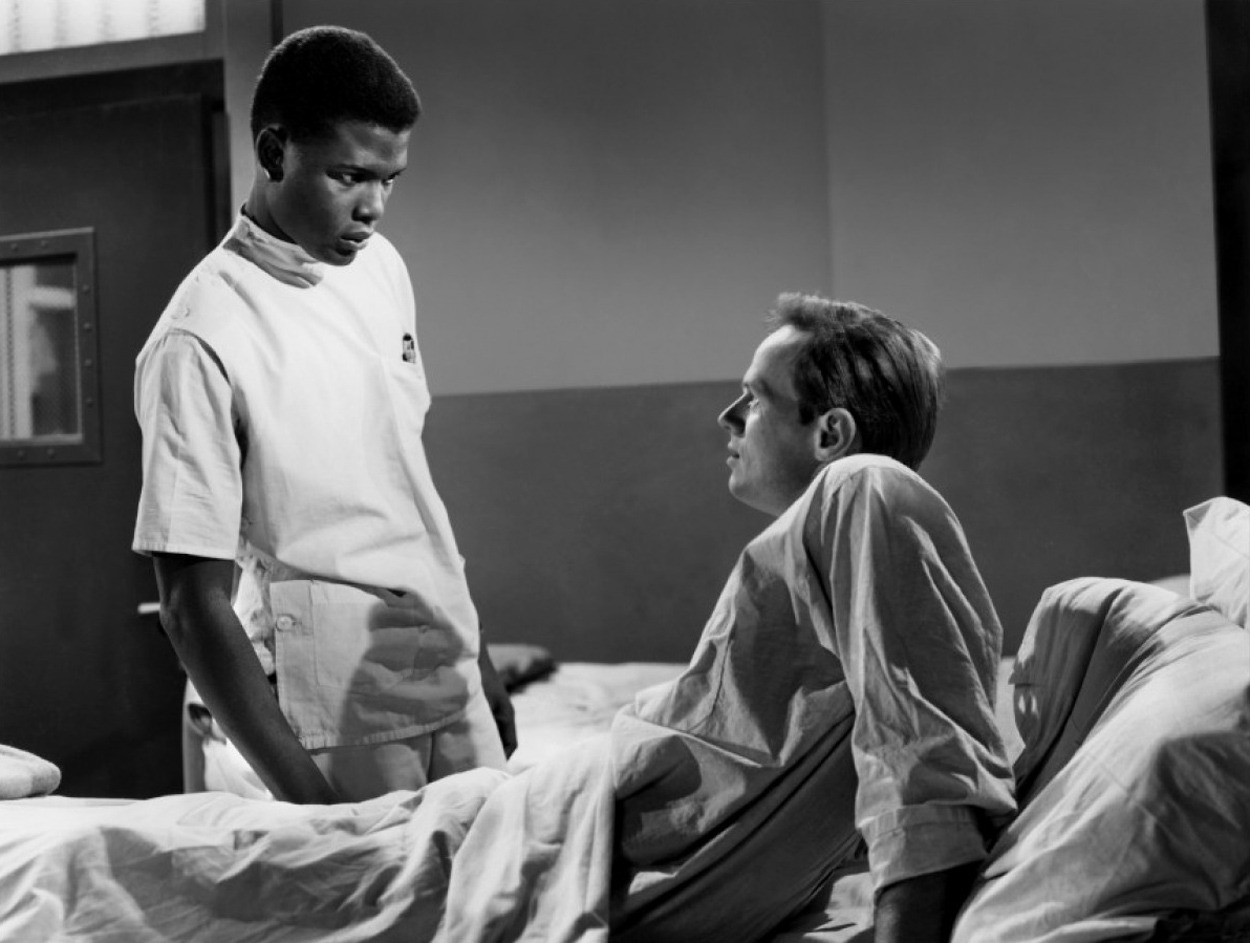
Dr. Luther Brooks (Sidney Poitier) is the first black doctor at a respectable hospital. His mentor Dr. Dan Wharton (Stephen McNally) assigns Luther to the prison ward, where the racist criminal Ray Biddle (Richard Widmark) and his brother Johnny are admitted with gunshot wounds. 

Johnny dies while Luther is trying to save his life, but Ray insists his brother was murdered by the doctor and refuses to authorize an autopsy that would prove the cause of death. Luther and Wharton turn to Johnny's ex-wife Edie (Linda Darnell) for help, but she is manipulated by Ray, who wants to spark racial riots between adjacent white and black neighbourhoods.

Sidney Poitier's first major screen role is a powerful, sometimes painful, commentary on poisonous white supremacy. Ray Biddle is a despicable character who makes no attempt to hide his blind hatred of blacks, and in the hands of director Joseph L. Mankiewicz, No Way Out becomes a searing examination of what Dr. Brooks is forced to endure. Despite the robust support of his mentor Dr. Wharton, Luther is surrounded by eyes loaded with suspicion, doubt, or outright contempt.

While always impactful, No Way Out suffers from some needless meandering. The script (by Mankiewicz and Lesse Samuels) goes searching for a larger story about inter-neighbourhood strife in an attempt to expand from the personal to the collective. Scenes of goons from adjacent communities prodded into street battles are impressively staged, but stray away from the compelling central characters and individual conflicts.

Better are the representations of Dr. Brooks' home life, and the emphasis on his family's normality. In portraying a black family striving towards the common American dream, Mankiewicz succeeds in isolating Ray Biddle as the outlier somehow expressing contempt for the nation's most admired traits.

Caught in the middle is the character of Edie Johnson, representing internal turmoil between a tainted past and a potentially better future. She intuitively knows she must distance herself from the toxicity of former brother-in-law (and illicit lover) Ray, but is still susceptible to his fake charms and false narratives. Poitier, Richard Widmark, and Linda Darnell add plenty of streetwise grit in the three central roles, investing in deeply uncomfortable and emotionally draining scenes.

Ray and Johnny Biddle have a third brother, the deaf and mute George. He is observant, conniving, and an eager enabler of prejudice, virulent bigotry thriving in the shadow of silence.


All Ace Black Movie Blog reviews are here.

Saturday, 18 September 2021

Movie Review: A Letter To Three Wives (1949)

A drama about relationship ups and downs in a leafy small town, A Letter To Three Wives is a spry snapshot of post-war middle class domesticity.

Deborah (Jeanne Crain), Rita (Ann Sothern), and Lora Mae (Linda Darnell) are friends and neighbours, and about to chaperone a community children's picnic. Just before departing for the day, they receive a letter from common acquaintance Addie (voice of Celeste Holm) informing them she has run off with one of their husbands, but not disclosing which one. In separate flashbacks, the women review the state of their marriages.

Emotionally fragile Deborah met husband Brad (Jeffrey Lynn) when they both served in the navy. He is from a wealthy and respected family, while she is from humble origins. Deborah always felt inferior and a misfit with the country club crowd. Brad fuels her insecurities whenever he mentions the vivacious Addie.

Brassy Rita has a successful career as a radio theatre writer, while husband George (Kirk Douglas) is a proud but low-paid school teacher. He looks down upon her commercial brand of writing, and the tension between them rises when Lora Mae nudges him to consider a career change. George knows Addie from college and she is more aligned with his love for the arts.

Confident Lora Mae grew up in a poor household on the wrong side of the tracks. While working at a department store she caught the eye of the wealthy owner Porter Hollingsway (Paul Douglas). He pursues her but she does not yield to his affections until he proposes marriage. They are never truly in love but always honest with each other, including Porter expressing his admiration for Addie.

An adaptation of a story that appeared in Cosmopolitan, A Letter To Three Wives boasts a clever structure, three casually related mini relationship portraits, and a mean streak of humour to punch-up the drama. Director Joseph L. Mankiewicz also wrote the screenplay, and delivers an entertaining summary of first-world problems lurking in the households of the haves and want-to-haves.

Addie provides mischievous narration without making an appearance, instead hovering over the lives of others as a cunning plot device to cut through the facade of marital bliss. The three stories expose a range of women's emotions and intentions, including Deborah's deep-seated self-doubt and desperate desire to fit in, Rita's well-intentioned but misplaced attempt to elevate the earning potential of her husband, and Lora Mae's singular focus on snaring a wealthy man.

The men here are mostly static beings, war-winning objects to be captured, cared for, manipulated, improved and jealously guarded. In turn, the revealed lives of Deborah, Lora Mae and Rita revolve fully around their husbands, and even working woman Rita insists on muddling her career with her marriage.

The performances are lively, Jeanne Crain, Ann Sothern and Linda Darnell quickly creating distinct and memorable personalities. They receive equal screen time and ample opportunities to navigate a range of man-instigated crises. Mankiewicz's writing is human-centred: despite their different backgrounds, it's easy to believe these women are friends. In the supporting cast, Thelma Ritter has a significant but uncredited role as a housekeeper.

Although the ending settles for a relatively quick wrap and lacks zing, A Letter To Three Wives remains a savvy peek into three couples' lives.


All Ace Black Movie Blog reviews are here.
Friday, 17 September 2021

Friday, 26 June 2020

Movie Review: Slattery's Hurricane (1949)


A drama, thriller and romance, Slattery's Hurricane packs plenty of incident into a short running length, but adheres to obvious and superficial tones.

With a hurricane rapidly approaching Miami, retired Navy man Will Slattery (Richard Widmark) steals a plane and flies towards the storm. In flashback, he recalls recent events with regret.

Both Slattery and his girlfriend Dolores (Veronica Lake) are employed by chocolate importing tycoon R.J. Milne (Walter Kingsford), Slattery as a pilot and Dolores as a secretary, and they both turn a blind eye to their employer's drug-running side-business. Slattery bumps into his old buddy Hobson (John Russell), who now flies for the Navy's weather monitoring service. Slattery quickly rekindles a passion for Hobson's wife Aggie (Linda Darnell), who was Slattery's old flame.

By pursuing a torrid affair with Aggie Slattery betrays both Hobson and Dolores, and his life is further complicated when he gets inadvertently involved in a drug run. The Navy reconnects with Slattery to right an old wrong, and as Dolores slips away from him, he recommits to fixing his life.

Filmed with the cooperation of the Navy and the Weather Bureau, Slattery's Hurricane wraps a gritty story of illicit romance, betrayal, crime and atonement around a salute to the men flying dangerous missions to track hurricane trajectories. Despite a running length of just 83 minutes, many scenes feature actors bouncing inside fake cockpits and airplanes flying through clouds. Director Andre DeToth adopts a direct, no-nonsense approach to storytelling, colouring the characters with blunt crayons, breathlessly bringing the Herman Wouk story to life with rapidfire intensity but minimal depth.

As a result, only Slattery emerges as a somewhat rounded individual, and even he borders on incredulous. Richard Widmark is in fine uncompromising form portraying Slattery as an egocentric man with several chips on his shoulder. He is sore at the Navy for ignoring his heroics and never emotionally recovered from Aggie abandoning him (after he repeatedly ignored her). And so Slattery's me-first mentality is impressively dismissive of both Dolores and Hobson as he selfishlessly maneuvers to win back Aggie. His late-in-the-day attempts at redemption are sudden and seemingly inconsistent with his core.

The other major characters barely rise above cursory. Dolores is plain, Veronica Lake (also Mrs. DeToth at the time) missing her trademark hairdo and unable to reignite her career. She was shortchanged once the script ran afoul of the Production Code, DeToth forced to punt a subplot about Dolores' ailment. Aggie and Hobson remain empty vessels for Slattery to take advantage of, and the villains are barely defined.

Despite the shortcomings Slattery's Hurricane boasts undeniably engaging fury, the stormy rains and winds combining with Slattery's bulldozer attitude to create incessant forward momentum. The duration is brief, but the passion palpable.


All Ace Black Blog Movie Reviews are here.


Monday, 18 February 2019

Movie Review: Blood And Sand (1941)


A bullfighting drama, Blood And Sand is a melodramatic but nevertheless absorbing cautionary tale about fame's fickleness.

In Seville, young and confident Juan Gallardo comes from a humble family and dreams of following in his father's footsteps and becoming a great matador. His still-grieving mother Señora Angustias (Nazimova) worries her son will one day die in the ring, like his father. Juan travels to Madrid with a group of friends to seek his fortune. Ten years later, Juan (Tyrone Power) returns to Seville as an up-and-coming but still raw matador, and influential bullfighting critic Curro (Laird Cregar) remains sceptical about his talent.

But Juan marries his childhood sweetheart Carmen Espinosa (Linda Darnell) and within a couple of years becomes the best and most celebrated bullfighter in the country. With the world at his feet, Juan is entranced by the alluring beauty of the wealthy and spoiled Doña Sol des Muire (Rita Hayworth). He starts a steamy affair with the seductress and loses his edge, placing at risk all he has worked for, and soon his supremacy in the ring is challenged by his friend Manolo (Anthony Quinn).

Based on the book by Vicente Blasco Ibáñez, Blood And Sand presents the sport as a futile celebrity machine designed to distract young men away from their more cerebral potential. The overriding theme is the sport's bloodthirsty and uncaring attitude, with the matadors lured in by dreams of riches, abandoning their education to pursue glory, exploited at the top and then discarded either to a gored death or poverty when their skills decline. The heartless core of building up and spitting out heroes applies to many sports, but here is sharpened by the mesmerizing pull of dancing with arena death every weekend.

The rise and fall of Juan is paralleled by the women in his life. Carmen's true purity propels him to his greatest achievements while Doña's adulteration paves a gilded pathway to ruin. Doña embodies in one person the allure and spoils of reaching the very top, as well as the capricious nature of celebrity. She will ensnare the next top matador as her lover when the time comes, and won't give a second thought about the has-been.

Tyrone Power throws himself fearlessly into the role of Juan, the actor finding the single-minded passion needed to seek fame jousting with angry bulls. Doña is Rita Hayworth's breakout role, although her undisguised and ravishing huntress mannerisms operate within a narrow range.

For a movie about bullfighting there is surprisingly little in-arena action. Director Rouben Mamoulian, working from a Jo Swerling script, builds up to one central showpiece event towards the middle of the film, but otherwise focuses on characters and allows all the emotions to pour out unconstrained by any attempts at nuance. With animated settings and earthy tones, Juan's journey is vivid, colourful and committed, Blood And Sand spelling out its messages in bold letters against the bloodied and shifting stadium soil.


All Ace Black Blog Movie Reviews are here.


Sunday, 17 July 2016

Movie Review: My Darling Clementine (1946)


A loose retelling of events leading up to the gunfight at the O.K. Corral, My Darling Clementine is a gorgeously filmed but curiously paced Western. The black and white images are stylish and evocative, but the story gets bogged down in lengthy nothingness for surprisingly long stretches.

Former lawman and now cattleman Wyatt Earp (Henry Fonda) and his brothers tangle with Newman "Old Man" Clanton (Walter Brennan) and his sons on the outskirts of Tombstone. When Wyatt's brother James is killed and his cattle stolen, Wyatt accepts the offer to serve as Marshal of Tombstone. He imposes law and order, including reigning in the coarse behaviour of resident gambler and local legend "Doc" Holliday (Victor Mature).

Doc's former love Clementine Carter (Cathy Downs) unexpectedly shows up in town having traveled all the way from Boston, much to the disgust of Doc's current girl Chihuahua (Linda Darnell). Wyatt takes a romantic interest in Clementine, but his attention turns back to the Claytons when proof emerges that they were involved in James' death.

Directed by John Ford, My Darling Clementine is a feast for the eyes but a strain on the concentration. Ford invests heavily in look and feel, and captures a lyrical, poetic vision of the west, with carefully constructed framing and astute use of lighting. The scenes unfold at a leisurely pace and linger long enough to luxuriate in saturated beauty.

Less impressive is the narrative thrust and character definitions. Despite the shortish 97 minutes of running time, Ford struggles to find a focus. The Clantons effectively disappear almost entirely from the heart of the film, leaving Wyatt Earp to tangle off and on with Doc Holliday, and it's never clear if the men settle down to being friends, rivals or something vague in-between.

Clementine plays a big role in the title but barely contributes to the actual events of the film. She and Chihuahua represent two versions of the west, Clementine a more civilized future and Chihuahua a more earthy present, but they are more catalysts than well-defined characters, standing to the side as the men sort out their conflicts. Little is known about any of Earp's brothers, and the Clantons remain faceless bad guys with no objective except to cause harm.

Henry Fonda makes for a serious, respectful Wyatt Earp, Fonda's screen persona as the stand-up guy in the group ensuring that Wyatt is all good and fully on the side of due process and the law. As usual Doc Holliday is the more nuanced and interesting character, and Victor Mature is fine in interpreting the once-doctor (he was actually a dentist) and now hard-drinking, harder-coughing gambler with appropriate complexity.

The final showdown, once it arrives, jerks the film back into its center of gravity, and the gunfight at the O.K. Corral is well handled, if far removed from historical outcomes. Clementine may be a darling, but the film works better when the good guys get down to the business of tangling with the bad guys in the west's most famous horse enclosure.


All Ace Black Blog Movie Reviews are here.