All Ace Black Movie Blog reviews are here.
Reviews of Classic and Current Movies


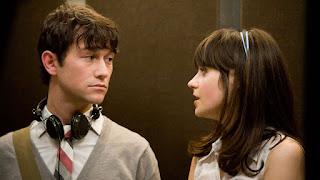
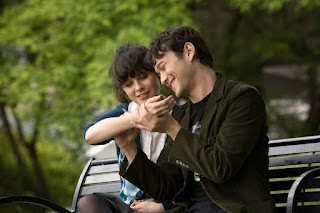
Working at a small greeting card company in Los Angeles, Tom (Joseph Gordon-Levitt) spots Summer (Zooey Deschanel), the new office assistant. They bond over music and he expresses interest in a relationship, but she does not believe in love and just wants to be friends, although after a few outings they start enjoying moments of intimacy. Summer encourages Tom to pursue his passion for a career in architecture.
As the relationship goes through ups and downs, Tom remains more invested than Summer. Exasperated by her mixed signals and the undefined nature of their relationship, his work suffers and he seeks advice from his young sister Rachel (Chloë Grace Moretz) and best friend McKenzie (Geoffrey Arend). A break-up and potential reunion beckon.
An independent production with a simple story of boy meets girl, boy loves girl, boy maybe loses girl, 500 Days Of Summer is made to appear more intriguing with plenty of time hopping. Tom and Summer's story takes place over 500 days presented non-linearly, every scene introduced by a number between 1 and 500. Director Marc Webb also rides good chemistry between a winsome, low-key couple played with appealing brightness by Gordon-Levitt and Deschanel.Adding to the chic quotient is an eccentric soundtrack celebrating non-mainstream musicians (including The Smiths) popular among the throngs eager to be labeled non-mainstream, the independent if questionable attitude underlined by Summer proclaiming Ringo as her favourite Beatle. Another brow-raising cultural oddity emerges through expressed appreciation for architectural landmarks in Los Angeles.
Writers Scott Neustadter and Michael H. Weber otherwise navigate typical relationship challenges including a mismatch in commitment levels, twangs of jealousy, and misaligned communication styles. But try as it might, 500 Days Of Summer cannot escape most of the genre's contrivances, and Summer's "just friends with occasional benefits" stance is a rickety foundation from the outset. A misguided scene featuring the random public shouting of a body part name is cringey bad, and the final chapter is weak, contaminated by deceitful behaviour unbecoming of friends.
With a mix of good days, bad days, and weird days, the outcome is bang on average.
All Ace Black Movie Blog reviews are here.
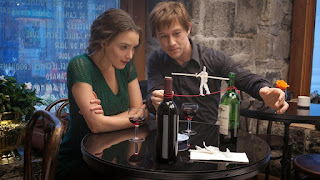
In 1973, Parisian street performer and aspiring tightrope walker Philippe Petit (Joseph Gordon-Levitt) spots a magazine article about the construction of the mammoth World Trade Centre twin towers in New York City. He decides he must walk a tightrope between the two buildings, and starts planning to make his audacious dream a reality.
He embarks on a romance with fellow street performer Annie (Charlotte Le Bon), befriends photographer Jean-Louis (Clément Sibony), and seeks mentorship from crusty circus tightrope artist Papa Rudy (Ben Kingsley). With the construction of the buildings nearing completion, Philippe relocates to New York for intensive reconnaissance and logistics preparations, and gathers a ragtag group of accomplices. He sets August 6, 1974 as the date of his unsanctioned stunt, but on the big day little will go according to plan.
Directed and co-written by Robert Zemeckis based on Petit's book, The Walk is an exquisite recreation of a bold act of mad artistry. Gordon-Levitt as Petit narrates his story directly to the screen from atop the Statue of Liberty with the twin towers in the background. This playful narrative device mimics Petit's cheerful but seriously determined approach to his craft, and the film is infused with a maverick's spirit.The opening chapters provide an interesting-enough but familiar backstory, Petit the only character provided with context, while Annie, Papa Rudy and the ever-expanding group of accomplices remain at the basic sketch level. Petit's personality is revealed through fairly mundane scenes from his humble family origins, early tourist performances, and interactions with Papa Rudy in the big tent.
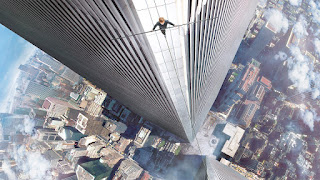
The final third is dedicated to the walk itself, and soars to a whole other elevation. Petit and his crew have to execute a heist-like sequence to avoid security guards and set-up the rope without anyone noticing. Then with majestic elegance, Zemeckis, cinematographer Dariusz Wolski and their special effects team master the dual challenges of buildings that no longer exist and creating the illusion of an actor walking a tightrope more than 400 metres in the air. The cinematic adventure in the void between the towers' two corners is one long astounding and heart-stopping sequence.
Running through the experience is the fundamental question of what drives an individual to absorb such risks. Remarkably, The Walk demonstrates an answer of exhilarating freedom. By the time Petit is near the clouds, his attitude is pure detachment from earthly constraints, and eternal oneness with two great buildings and a rope.
All Ace Black Movie Blog reviews are here.
In New Orleans, the new drug Power hits the streets, providing users with an exhilarating jolt of individualized superhuman characteristics for 5 minutes. Young Robin (Dominique Fishback) and her cousin Newt (Colson Baker) become street-level peddlers. Police detective Frank (Joseph Gordon-Levitt) is one of Robin's customers, unapologetic about upgrading his stamina, speed and resiliency to apprehend pumped-up criminals.
The mysterious Major (Jamie Foxx) arrives in town intent on identifying the source of the drug. He tracks down Newt then Robin, and identifies a conspiracy by shadowy government types to test the drug in successive cities. The Major has personal reasons to investigate the drug epidemic, but will have to team up with the scrappy Robin and sceptical Frank to stop the carnage.
Project Power finds the reputable Jamie Foxx and Joseph Gordon-Levitt, who should both know better, slumming it in a generically gratuitous thriller. While some of the cinematography is slick and a kernel of interest may reside in the idea of illegal drugs evolving to provide the ultimate high of superpower abilities, the Mattson Tomlin script is not interested in anything cerebral.
Instead the objective is to check-off a succession of unlikely action set-pieces, and these are often derivative, poorly structured and horribly edited into incomprehension. Every pill causes a different outcome depending on the individual user, triggering a ghastly "guess the next monster" parlour game. Co-directors Henry Joost and Ariel Schulman mechanically hustle the action along without explaining any aspect of whatever evil plot may be unfolding, the bad guys barely introduced and remaining essentially faceless and nameless.
The attempts at injecting some humanity through Robin's character and the Major's personal quest register as perfunctory, confirming Project Power as a disappointing short circuit.
All Ace Black Movie Blog reviews are here.
August 1968 is approaching and various groups of anti-Vietnam War protesters plan to descend on Chicago for the Democratic Party National Convention. The Mayor's office responds with a large police presence and a National Guard deployment. Five months later, the Nixon administration assumes power and new Attorney General Mitchell directs federal prosecutor Schultz (Joseph Gordon-Levitt) to prosecute seven activists for the events of August 1968 on charges of cross-state conspiracy to invoke violence.
With Judge Julius Hoffman (Frank Langella) presiding, the defendants include Abbie Hoffman (Sacha Baron Cohen) and Jerry Rubin (Jeremy Strong) of the Youth International Party, Tom Hayden (Eddie Redmayne) of the Students for a Democratic Society, and Dave Dellinger (John Carroll Lynch) of the National Mobilization Committee to End the War in Vietnam. They are represented by defence counsel William Kunstler (Mark Rylance). Bizarrely thrown into the same courtroom is Black Panthers leader Bobby Seale (Yahya Abdul-Mateen II), but without a lawyer to represent him.
From the outset the trial proceedings descend into farce, with Judge Hoffman obviously prejudiced against the defendants and taking every opportunity to exasperate Kunstler. And over the long trial duration, underlying tensions between Abbie Hoffman and Tom Hayden bubble to the surface.
While delving into events from a different societal era, The Trial Of The Chicago 7 provides piercing commentary on the misuse of power as a cautionary tale applicable in a modern context. Writer and director Aaron Sorkin deploys his usual sharp dialogue exchanges and witty retorts to enliven infamous court proceedings from the late 1960s, but the contemporary message hides in plain sight: one vindictive Attorney General and one intolerant judge are all it takes to threaten basic freedoms and destroy lives.
The script generally excels in both words and dynamism, skipping from pre-convention preparations straight to the trial, then circling back to the Chicago clashes between police and protesters in often gripping, tension-filled flashbacks as part of the testimony. The fine margins between protests and riots are defined by the briefest of words and actions and become key turning points in activist history.But with the charges clearly trumped up and the judge on a one-man quest to pervert justice, this is starkly delineated right and wrong storytelling. The few arguments between Abbie Hoffman (revolution through dope and hippies!) and Tom Hayden (revolution through politics and policies!) don't disguise the absence of meaningful intrinsic moral dilemmas. Sorkin also displays a tendency to twiddle the manipulative knobs to eleven, and on a few occasions the music soars to schmaltzy registers while the courtroom histrionics abandon theatre in favour of opera.
The ensemble cast members contribute plenty of talent but enjoy few opportunities to shine. The defendants are efficiently drawn, although the characters are static. Mark Rylance as the lawyer Kunstler carries the heaviest dramatic weight, while Frank Langella's Judge Hoffman is the pantomime villain. Joseph Gordon-Levitt as the lead prosecutor starts strong but fades almost into insignificance, while Michael Keaton contributes a small but key role as a prominent defence witness. Important female roles are conspicuous by their absence.
It may be too well-intentioned, but The Trial Of The Chicago 7 nevertheless carries timeless lessons about the slippery slopes threatening all democracies: the system only functions when the guardians care enough to protect it.
All Ace Black Blog Movie Reviews are here.