Showing posts with label Jeff Daniels. Show all posts

Monday, 6 April 2026

Movie Review: Something Wild (1986)


Genre: Romantic Comedy Adventure  
Director: Jonathan Demme  
Starring: Melanie Griffith, Jeff Daniels, Ray Liotta  
Running Time: 113 minutes  

Synopsis: In New York City, Charlie (Jeff Daniels) is a recently promoted corporate VP. On a whim, he jumps into the car of the free-spirited Lulu (Melanie Griffith). After she robs a New Jersey liquor store, they have sex at a cheap motel. In Pennsylvania, Lulu reveals her real name is Audrey and introduces Charlie as her husband to her mother Peaches. But the wild adventure takes a dark turn when Audrey's ex-husband Ray (Ray Liotta), a career criminal recently released from prison, shows up at her high school reunion party.

What Works Well: A companion piece to other mid-eighties men-out-of-their-element adventures like After Hours and Into The Night, Something Wild joins a suit-and-tie corporate type as he jettisons caution and surrenders to the erratic desires of a compelling stranger. Melanie Griffith brings a buzz of energy to Lulu/Audrey, and hints at a complex backstory that deserved more attention. Ray Liotta immediately introduces menace and tension, although he enters the story late.

What Does Not Work As Well: None of the behaviour on display carries any whiff of realism, degrading events into episodes of irresponsible silliness. Given his lack of judgment it's difficult to imagine in what context Charlie becomes a Vice President of anything, and any deep-seated motivations or explanations driving his acquiescence and Lulu's impulsiveness are studiously ignored. The final act veers towards crime and violence inconsistent with the preceding vibe.

Key Quote:
Charlie: Look, if you don't turn around and take me back, you're gonna make me do something that I don't wanna do.
Lulu: I can hardly wait, Charlie.


All Ace Black Movie Blog reviews are here.

Sunday, 9 August 2020

Movie Review: The Purple Rose Of Cairo (1985)

A fantasy, romance and comedy, The Purple Rose Of Cairo is a bittersweet celebration of movies as essential escapism.

The setting is New Jersey during the Great Depression. Cecilia (Mia Farrow) is trying to hold a job as a waitress while stuck with a useless husband in Monk (Danny Aiello). The movies are her one escape from a drudgerous life, and she studiously follows all the Hollywood gossip and watches every movie multiple times.

The latest show at the local theatre is the adventure romance The Purple Rose Of Cairo, featuring exotic foreign settings and swish Manhattan cocktail parties. Cecilia is impressed by charismatic star Gil Shepard (Jeff Daniels) playing the role of adventurer Tom Baxter. During one showing Tom notices Cecilia's dedication and walks off the screen and into the theater, insisting he wants to break free from the confines of his scripted existence and spend time with her instead. The other characters in his movie are left in limbo waiting for Tom to come back.

While Tom and Cecilia enjoy a whirlwind romance, the film's Hollywood producers and the actor Gil panic and descend on New Jersey, with Gil worried the runaway Tom will ruin his burgeoning reputation. Now Gil and Cecilia explore a romance, but Tom remains intent on winning the girl and finding a happy ending.

Writer and director Woody Allen conjures up a funny, romantic and magical story of the loving relationship between movies and their fans. In a compact 82 minutes, The Purple Rose Of Cairo captures all that cinema can represent in providing a bright spark and sometimes the only source of positivity during the worst of times.

Cecilia's marriage is a cycle of abuse and poverty and her menial job is about to crash with her next dropped dish. With the whole country drowning in an economic abyss, hope for a better future is in short supply. The dark movie theatre and films like The Purple Rose Of Cairo take her away from all that, to mysterious Egypt where a group of handsome rich friends meet dishy archeologist Tom Baxter, and they all come back to the bright lights and nightclubs of the big city. 

While all the joviality may as well be on a different planet from Cecilia's corner of New Jersey, the affordable silver screen images offer the perfect break from her misery.

Of course Hollywood needs Cecilia as much as she needs the entertainment, and once Tom steps off the screen and into her world, Allen embarks on a teasing run to outline the symbiotic relationship. Despite the mutual dependence, bridging the divide between fans in search of fantasy and characters in search of reality is no straightforward matter.

Allen cleverly introduces the complication of actor Gil protecting his reputation from his own creation. An unlikely love triangle takes shape, but when one lover is a fictional character and another is a professional actor pursuing stardom, the heartache risk is substantial.

But in the meantime the humour is persistent, most of it drawn from the stranded characters up on the screen, flummoxed by one of their own walking into the real world and with nothing to do except await his return. Meanwhile Tom Baxter knows only what his character knows, and his naive view of the world includes expecting a fade-out after kissing Cecilia.

And in the central role of Cecilia, Mia Farrow is elegantly soulful, carrying the weight of a depressed nation on her slender shoulders. Farrow sells the film's wild premise with ease, mixing incredulous fun with starstruck fandom while Cecilia's struggle in a grim and inescapable real world casts a long shadow.

Jeff Daniels is engaging in a dual role as an actor and his character. The supporting cast includes Van Johnson as one of the frustrated on-screen co-stars, and Dianne Wiest as a local tart who gets to teach the clueless Tom about brothels.

The Purple Rose Of Cairo is a mischievous love letter to a flicker of light connecting reality with fantasy, sustaining dreams through the darkness.

All Ace Black Blog Movie Reviews are here.


Saturday, 25 July 2020

Movie Review: Speed (1994)


A supercharged thrill ride, Speed rides a far-fetched plot at manic velocity. 

In Los Angeles, SWAT team members and best buddies Jack Traven and Harry Temple (Keanu Reeves and Jeff Daniels) foil the elevator hostages-and-bombing extortion plot of madman Howard Payne (Dennis Hopper). Believed to be dead, Howard remerges and quickly hatches his next atrocity, rigging a transit bus to explode if it slows below 50 mph and demanding a $3.6 million ransom.

Jack makes it onto the bus while it's in motion, and when the driver is accidentally shot passenger Annie Porter (Sandra Bullock) jumps behind the wheel. Harry tries to uncover the bomber's identity and location while Jack has to keep Annie driving above the threshold speed while figuring out a way to rescue the passengers and avoid an explosion.

A ridiculously simple "Die Hard on wheels" premise delivers exactly what it promises: a thrill every five minutes, acts of selfless heroism, a hissing villain, stunts galore, and a romance blossoming behind the steering wheel. Of course none of it makes the least bit of sense and the laws of physics are kicked off the bus early, but the sense of wild fun is infectious.

Jan de Bont steps up from cinematography duties and easily slips into the director's chair, infusing the film with vivid colours and bursting energy. Whenever faced with a choice between restraint and wild abandon, the quick answer in Graham Yost's script is more is better. This does lead to a protracted second climax on a subway rail car, unfortunately abandoning the bus focus in a case of not knowing when enough is enough.

A speeding bus crashing into everything from a stroller (no babies were hurt in the making of this movie) to an airplane and jumping over freeway gaps is no place for in-depth character exposition, and so Keanu Reeves, Dennis Hopper and Sandra Bullock default to shorthand definitions. Reeves gives Jack Traven an earnest boy scout gloss, Bullock's Annie starts and ends at gum-chewing feistiness, and Hopper's bomb expert is mad at a world he believes shortchanged his career. All three are good enough to complement the non-stop mayhem.

Speed is a jolt of undemanding visceral entertainment, as unpretentious in its intentions as the humble transit bus.


All Ace Black Blog Movie Reviews are here.

Sunday, 17 June 2018

Movie Review: Steve Jobs (2015)


An honest portrayal of a deeply flawed genius, Steve Jobs presents the portrait of the man through a unique structure, revealing his passion, obsession, and distinctive character traits.

The film is divided into three chapters, each depicting the anxious period just before a key product launch in the remarkable career of Jobs (Michael Fassbender). The same group of people interact with him prior to each presentation:
  • Joanna Hoffman (Kate Winslet), his marketing executive and chief confidant. 
  • Steve Wozniak (Seth Rogen), the Apple co-founder, seeking recognition for Apple's early success and navigating a strained relationship with Jobs.
  • John Sculley (Jeff Daniels), the executive brought into Apple by Jobs, as well as Jobs' mentor and sometime nemesis.
  • Andy Hertzfeld (Michael Stuhlbarg), a long-term member of the Apple technical design team.
  • Chrisann Brennan (Katherine Waterston), Jobs' former girlfriend and the mother of his daughter Lisa.
  • Lisa herself, from child to young adult.
The three product launches are the Apple Macintosh in 1984, which Jobs predicted would be a mass market success (wrong) and revolutionize the industry (eventually right); the first NeXT computer in 1988 after Jobs was ousted from Apple; and the Apple iMac in 1998, after he returned to the company and embarked on a remarkable run of success that transformed Apple into one of the largest and most successful business behemoths in history.

Directed by Danny Boyle, written by Aaron Sorkin and based on the Walter Isaacson book, Steve Jobs is an exhilarating talk fest. A series of rapid fire conversations in the build-up to high-stakes product launches, the film succeeds in highlighting the exhausting essence of a detail-obsessed man who both saw and defined the future of consumer electronics, and never yielded to what was convenient in pursuit of his vision.

The three-chapter structure traces Jobs' nuanced transformation as he ages and is buffeted by the realities of the business world. Although his core beliefs never change, he softens around the edges, listening just a bit more to the often exasperated Joanna, growing more accepting of Lisa's role in his life, and mending a few, if not all, damaged fences, notably with Sculley.

Sorkin's script is brilliant, the prose sharp but not overwhelming. The dialogue, while essentially made up, teases out all aspects of Jobs' insecurities and obstinacy, and the collision of his quirks with his objectives. Sorkin and Boyle never shy away from Jobs' stubborn obsessiveness with details that may not matter to anyone else, with Hertzfeld a regular victim, nor from Jobs' unwillingness to ever share the limelight or open a crack of recognition coveted by Wozniak.

The film also reveals Jobs' streak of ruthlessness in navigating the unforgiving waters of high stakes business, sometimes losing out in a big way (his ouster from Apple), and at other times charting a devious course back to glory (hyping an essentially empty NeXT cube to win an invite back to run Apple).

All the performances are perfect, with Fassbender getting into Jobs' skin and projecting a layer of arrogant confidence covering up a mass of complex unresolved issues. Winslet matches him word for word, comfortably finding Hoffman's courage in recognizing her role as the one person who can sometimes reach an often impossible man.

Steve Jobs is a worthy homage to a reluctant father, dismissive boss, traumatized orphan, friend to very few, unapologetic ideas poacher, and a legend possessing a laser focus on the concept of closed-system designs that would go on to dominate the world.


All Ace Black Blog Movie Reviews are here.


Saturday, 3 February 2018

Movie Review: The Squid And The Whale (2005)


A social drama with biting humour, The Squid And The Whale is a clear-eyed look at the devastating consequences of middle-class divorce.

It's the 1980s in Brooklyn, and the marriage of Bernard (Jeff Daniels) and Joan (Laura Linney) finally disintegrates. He is a middle-aged and already has-been pompous academic who can no longer find a publisher, while she is an emerging writer. Their 16 year old son Walt (Jesse Eisenberg) idolizes his dad and quickly takes his side, particularly when he learns that Joan has been carrying on a long-term affair. The younger twelve year old Frank (Owen Kline) is simply traumatized and starts to act out in all the wrong directions.

Bernard moves out of the family house and rents a derelict place of his own, and the boys are forced to shuttle between parents. Walt finds a girlfriend in sweet Sophie (Halley Feiffer), but his father's advice interferes with their relationship. The sexual tension amps up when Bernard's college student Lili (Anna Paquin) moves in and stirs the pot with both Bernard and Walt. Meanwhile Joan finds herself a new lover, accelerating Frank's anxiety.

Written and directed by Noah Baumbach, The Squid And The Whale is an adept 81 minutes of cutting social commentary. The semi-autobiographical script never blinks: this is a small family thrust into a full-blown crisis, four members running in different directions, doing their best to hurt each other, lives broken and altered forever.

And as ugly as the debris looks, Baumback also finds the dry humour. Bernard wallows in a legend of his stature that exists only in his mind. He pontificates about literature several leagues above his capabilities, only for Walt to mimic his father with even less credibility. Joan is no better, having long since given up on her husband, wrecking the marriage with her affairs and quickly moving on to the next lover, this one even more damaging to the family, as soon as Bernard moves out.

Underneath the daily anguish is a prevailing sense of sadness and waste as two boys are led astray. Walt is quick to internalize his father's fake arrogance, with consequences both at his school music competition and with potential girlfriend Sophie. The more sensitive Frank's dissolution borders on tragedy, his cries of help emerging in the form of alcohol consumption and uncontrolled sexual exhibitions.

The four lead cast members are all excellent, but Jeff Daniels deserves the most credit. His take on Bernard as a failed husband, failed father and failed author who still thinks he is somehow superior to everyone else is a classic example of unchecked egotism.

Baumbach struggles to elegantly land his film, which ends with partial resolutions but enough abruptness to suggest that money, time or ideas ran out. But The Squid And The Whale is nevertheless an impressive peek at the often overlooked carnage caused by broken domesticity.


All Ace Black Blog Movie Reviews are here.

Wednesday, 28 October 2015

Movie Review: The Martian (2015)


A space survival and rescue drama, The Martian is an epic odyssey. The film celebrates science, resiliency and innovation under pressure, in a graceful, visually rich package.

In the relatively near future, the crew members of the Ares III mission, under the command of Melissa Lewis (Jessica Chastain), have established a temporary base on Mars and are conducting scientific experiments. An unexpectedly severe Martian storm descends on them suddenly, forcing a quick evacuation. In the darkened confusion, crew member Mark Watney (Matt Damon), the mission botanist, is struck by debris, assumed dead, and left behind. But Mark is very much alive, just temporarily knocked out, his space suit damaged to falsely indicate no vital signs. He is completely alone on Mars.

Once Mark takes care of his puncture wound, he realizes that he will soon run out of food, and starts the process of planting his own nutrition. He puts his botanist skills to use, creates soil from packets of human waste, water by mixing hydrogen and oxygen, and is soon harvesting new potatoes. He eventually re-establishes contact with NASA back on Earth. NASA Director Teddy Sanders (Jeff Daniels) has to explain to an astounded public why a man was abandoned on Mars. Sanders then gets to work with Mars Mission Director Vincent Kapoor (Chiwetel Ejiofor), Flight Director Mitch Henderson (Sean Bean) and a team of scientists and contractors to concoct an on-the-fly resupply plan until a manned rescue mission can be prepared. Meanwhile a debate rages as to whether Lewis, her pilot Rick Martinez (Michael Peña), and the rest of the Ares III crew, still on the return flight to Earth, should be told that Mark is alive.

Director Ridley Scott again returns to space to create another cinematic classic. An adaptation of the Andy Weir book, The Martian is a grand, feel-good, gorgeously filmed space adventure, celebrating the human spirit and ingenuity in the face of adversity. Cinematographer Dariusz Wolski and the special effects team create an astoundingly beautiful yet desolate Mars, while Matt Damon and the rest of the cast bring to life unforgettable characters.

At over 140 minutes, this is an interplanetary story told with both breadth and depth. For the most part Scott takes his time to explain what Mark is up against on Mars and the science behind every step he takes to survive, while similarly tracking NASA's frantic efforts back on Earth to first get to grips with the situation and then devise an extraordinary rescue. Some plot points are glossed over, but overall, the film exudes the confidence of an adventure that soars in space but is grounded by reality.

The story of The Martian mixes familiar elements from other excellent films where individuals face great tests of survival. The abandonment theme in a strange environment with minimal resources carries echoes of Cast Away (2000), the lost-in-space premise was explored in Gravity (2013), the small group risking everything to save one of their own was the central premise of Saving Private Ryan (1998), and space mission innovation under pressure was highlighted to great effect in Apollo 13 (1995).

But The Martian creates its own identity thanks to a smart script by Drew Goddard, firmly grounded in science and steering well clear of any antagonists. There are no melodramatics in The Martian, no evil plots, conspiracies or even hostility on any planet surface. Mars just is what it is, Mark just is where he is, and the story of adaptation and rescue unfolds with simplicity and minimal fuss.

In 3D, the film is marvel to look at, with awe-inspiring red Marsscapes, Mark and his meagre equipment often a dot set against a vast, empty, quiet and beautiful expanse. But despite the majestic scenery, Scott keeps the focus firmly on the people, and The Martian is a straightforward narrative of one man, first innovating to fend off starvation, then innovating to survive long enough to give his rescuers a half chance. The deployment of science expands from Mark alone, to Mark assisted by NASA, and then unexpected allies are found in the unlikeliest of places, and the effort to save one man spans the multicultural globe. It is a hopeful, perhaps idealistic stance, but the film is unapologetic in presenting the best that humanity can offer, from individual strokes of genius to nations sweeping away mistrust and offering a helping hand - or rocket.

Matt Damon acts on his own for most of the film, and delivers one of his career-defining performances. Generally speaking to inanimate cameras, Damon is perfect in bringing to life Mark Watney, an enduring film hero facing unimaginable loneliness and the near certainty of death, but who simply refuses to yield to a seemingly insurmountable survival challenge.

The rest of the cast is sound, with Jessica Chastain and Michael Peña exploding to life in the final third as Mark's crewmates take it upon themselves to execute an audacious rescue mission. Kristen Wiig as a NASA communications advisor, Kate Mara as a member of Lewis' crew, Donald Glover as a scrappy astrodynamicist and Mackenzie Davis as a NASA satellite tracker get small but still prominent and sometimes crucial supporting roles.

The climax of the film is thrilling, but also pushes towards the edges of credibility, as the pace of on-the-fly problem solving accelerates to almost manic levels. But despite all the technology, elegant space crafts and silent planets, at the end it is the human connection that triumphs. The Martian finds deliverance with an elegantly clumsy dual pirouette and then a small bump in space, humans reconnecting, eliminating the distance between them, and embracing the closeness that makes us stronger together.


All Ace Black Blog Movie Reviews are here.


Monday, 25 May 2015

Movie Review: Terms Of Endearment (1983)


A family life drama-comedy with spectacular acting performances by a dream cast, Terms Of Endearment is a masterpiece of authentic emotions.

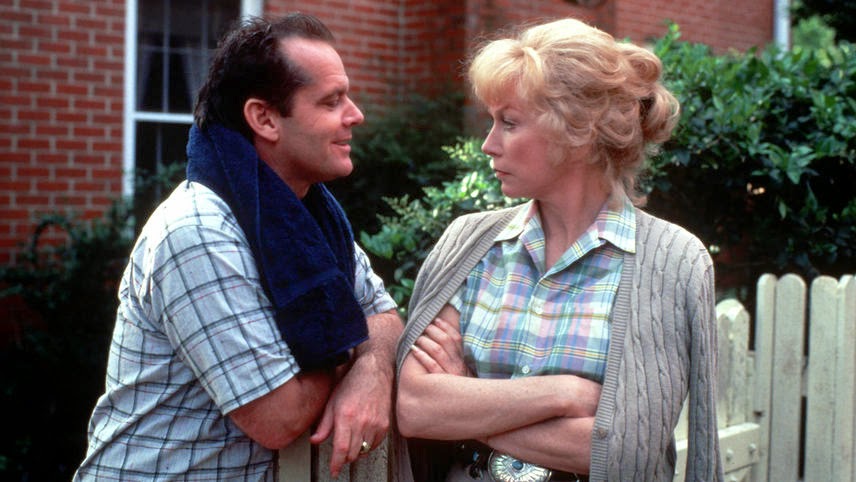
In Texas, Aurora Greenway (Shirley MacLaine) has always been slightly paranoid and definitely overprotective of her only daughter Emma. Aurora was widowed at a young age, leaving her relationship with Emma as the one true connection in her life. When Emma (Debra Winger) grows into a young woman and decides to marry school teacher Flap Horton (Jeff Daniels), Aurora certainly does not approve, believing Flap to be unworthy. Around the same time, retired astronaut Garrett Breedlove (Jack Nicholson) moves into the house next door. A party-loving, womanizing and free-spirited bachelor, Garrett is a man denying his age.

Emma and Flap push ahead and get married anyway, and eventually start a family and move to Des Moines. As the years pass Aurora remains in close touch with her daughter, the two sharing their lives over frequent phone calls, and despite plenty of arguments and no shortage of agitation, their love and commitment to each other never wavers. Seeking physical closeness, Aurora finally works up the courage to start a relationship with Garrett, about 15 years after he became her neighbour. With three kids to raise and Flap's limited earning power causing a financial burden, Emma's marriage starts to seriously fray, and both she and Flap are subjected to extramarital temptations. The threat of another relocation and a serious illness are yet to come.

Directed and written by James L. Brooks in his directorial debut, and based on the Larry McMurtry book, Terms Of Endearment is a perfectly polished gem. For the full 131 minutes, not a scene is wasted, Brooks trusting his audience to keep up as the film gallops through the years using short, often funny and frequently poignant scenes. Chronicling the bond between Aurora and Emma from birth and through about 40 years of life, Brooks nails the ups and downs that define the unique cycles of frustration and happiness between mother and daughter, with undying love providing the sturdy foundation upon which two lives are lived.

Brooks' singular achievement is in creating uniquely memorable characters and then treating them with utmost realism. Aurora, Emma and Garrett are a simply unforgettable trio, three people living life on their own stubborn terms but yet behaving fully within the normal rules where selfishness, sacrifice and life's surprises require a steady stream of critical decisions. There are no heroics in Terms Of Endearment; just happiness and heartache generated by the life's little successes and failures.

And because laughs and tears punctuate life's milestones, Brooks includes plenty of both. The emotions are always there, but even at the darkest moments they rarely veer towards exaggerated agitation. In a peak moment of frustration Aurora does let loose at a hospital nurse station, but it's a scene that is equally funny and heartbreaking, capturing a devoted mother willing to move mountains for her daughter.

Terms Of Endearment features astounding acting from the three principals. Shirley MacLaine and Jack Nicholson deliver some of their best work in their long and celebrated careers. MacLaine won the Best Actress Academy Award for what may have been her last great performance, bringing to life Aurora as a proud woman of the South dealing with the changing times and her own evolving needs. Nicholson took a step back from the madness and murderous urges that had began to define him after The Shining and The Postman Always Rings Twice, and nabbed the Best Supporting Actor Academy Award as Garrett the astronaut, a man determined to turn his past celebrity into a life of irresponsible pleasure.

And Emma was undoubtedly Debra Winger's finest on-screen moment. Winger celebrates Emma as a feisty woman full of love, laughter and a singular determination to meet life on her own terms while forging friendships, sharing every moment with Aurora and adoring and tolerating Flap in equal measures. It's a performance for the ages, and Winger was also nominated as Best Actress but lost out to MacLaine.

In addition to Daniels, Danny DeVito as Aurora's long-time admirer and John Lithgow as Emma's amorous banker round out the cast.

Towards the end of Terms Of Endearment, Emma and Aurora share a moment. It's a brief locking of the eyes, without a word being spoken, Winger and MacLaine pouring their characters into a few seconds representing a lifelong bond, a breathtaking ending, a sorrowful beginning, a heartfelt thank you, and the meaning of love itself. It's an unforgettable instant in an enduring treasure of a movie.


All Ace Black Blog Movie Reviews are here.

Wednesday, 1 April 2015

Movie Review: RV (2006)


A family comedy that is marginally better than it could have been, RV offers little that is new but does ride star Robin Williams' talent to some funny moments.

Bob Munro (Williams) is struggling to hold his typical suburban family together. Teenaged daughter Cassie (JoJo Levesque) is in full blown rebellion mode, and her young brother Carl (Josh Hutcherson) is struggling with self-esteem issues due to his relatively short stature. Bob takes his wife Jamie (Cheryl Hines) for granted as he slaves away at a corporate job, working for heartless boss Todd (Will Arnett). When Todd demands yet another immediate report and a client meeting in Colorado, Bob decides to not tell his family that he again has to put work first, and instead converts the family's Hawaii vacation to an RV trip with a fortuitous destination of Colorado.

Renting a garish green RV, the deeply disgruntled family hits the road with Bob hoping to secretly steal away work moments. The Munros soon run into trouble with their RV's plumbing system, and are helped by the eternally happy Travis and Mary Jo Gornicke (Jeff Daniels and Kristin Chenoweth). The Gornickes are a seemingly simple family who have made RVing their life, and as far and fast as Bob and Cassie try to get away from them, the Gornickes always seem to be there. With Bob's attempts to combine work with the vacation stymied at every turn, the family trip threatens to implode into a full-blown disaster.

Directed by Barry Sonnenfeld and written by Geoff Rodkey, RV is as predictable as a road trip comedy can be. A stressed out family is forced by cramped circumstances to reconnect, rediscovers the meaning of life, and Dad recalibrates his priorities, all in a brisk 99 minutes of running time. The movie's destination is clear from the opening few minutes, and it's just a matter of how many laughs Williams can generate along the well-marked road.

He achieves a success rate of roughly 50 percent. Some moments are funny, if not quite original. Bob tangles with the RV's backed-up sewer system, and it's quite obvious where the all the yucky human waste will end up, but Williams makes the scene hilarious. A battle with a family of raccoons also registers on the funny meter. Less successful are the tiresome runaway excursions through the Colorado wilderness, and the numerous encounters with the Gornickes are quickly tiresome. Williams does occasionally let loose with some ad-libbed riffing, and again is only partially successful.

The supporting cast members are stuck in singular notes. After establishing their characters' identities the likes of Jeff Daniels, Cheryl Hines and Kristin Chenoweth have little to work with in the way of development. Singer JoJo Levesque emerges with the most prominent performance as pouty daughter Cassie, overflowing with enough adverse attitude to flood the RV in a swamp of negativity. Will Arnett plays the inevitable oily corporation man, the mortal enemy of a healthy family life.

RV is unable to negotiate any sharp or original turns, but it does offer the snug comforts of home and the still potent talents of a master comic.


All Ace Black Blog Movie Reviews are here.

Saturday, 4 October 2014

Movie Review: The Hours (2002)


A dense multi-era drama inspired by the life and works of Virginia Woolf, The Hours is a slow moving three character study revolving around depression and death.

After opening with Woolf (Nicole Kidman) committing suicide by drowning, the film alternates between three separate stories. In the early 1920s, Woolf is miserable living in the British countryside, struggling with writer's block and depression as she tries to write the novel Mrs. Dalloway. Her husband Leonard (Stephen Dillane) bears the brunt of her anti-social behaviour, while a visit from her sister Vanessa (Miranda Richardson) makes matters worse.

In Los Angeles of the early 1950s, Laura Brown (Julianne Moore) is a depressed housewife reading Mrs. Dalloway. Laura is pregnant with her second child, stuck in bland suburban hell, and no longer in love with husband Dan (John C. Reilly). Laura has a sensitive and precocious five year old son (Jack Rovello), and a glamorous neighbour Kitty (Toni Collette) who is facing her own hell.

And in New York City of 2001, Clarissa Vaughn (Meryl Streep) is busy organizing a celebration and party for her lifelong friend and former lover Richard Brown (Ed Harris), a renowned author and poet suffering miserably with the late stages of AIDS. When they were lovers, Richard bestowed the title Mrs. Dalloway on Clarissa. Now Richard is deeply depressed, and forces Clarissa to question her approach to life. Clarissa's partner Sally (Allison Janney) and daughter Julia (Claire Danes) watch as Clarissa's big day disintegrates, and the appearance of Richard's former lover Louis Waters (Jeff Daniels) does not help.

Directed by Stephen Daldry, The Hours wallows in a misery of its own creation. While the three lead performances are perfect, with Kidman nabbing the Best Actress Academy Award, the film is a lengthy, unrelenting treatise on lives stalled at the dead end of severe depression. The Hours starts in a dark place and walks, slowly, into pitch blackness.

All three stories unfold over the course of one day, and Daldry cleverly weaves the emotional strings linking the three women, from the depression and death themes to visual parallels and dialogue, with Mrs. Dalloway serving as the common foundation. A vague strand of unexplored lesbian lust also oscillates across the three stories. A more physical connection ultimately emerges between Laura and Clarissa, and overall the film does just enough to maintain interest through the thick fog of despair.

Through the dense thicket of tangled negative emotions, relief comes only in the enjoyment derived from Kidman, Moore and Streep, actresses at the top of the craft bringing to life three women struggling against greater forces. Kidman sacrifices her looks with a harsh nose to simulate the common image of Woolf. Her subdued performance is filled with internal struggle and external iciness, a woman content to let her misery drip out and contaminate those closest to her.

Moore gets to reveal the least about Laura Brown, a character with hardly any other adults around her to talk to. Brown's day is centred on one major decision, a choice between seeking immediate relief or longer term opportunity. Her son appears to know more about his mother's mental state than most boys his age. Streep's Clarissa is trying to be positive, and she does her best to fend off Richard's choking negativity and carry on. But when misery comes knocking it can be relentless, and Clarissa's big day will see black clouds move across her sun.

Ultimately The Hours only finds resolution in various forms of emotional escape rather than difficult confrontation, all three women ending the day staring at future prospects that are at least as gloomy as they appeared in the morning. There are only glimmers of light, and the passing hours serve more to confirm the gathering storm of dejection.


All Ace Black Blog Movie Reviews are here.


Wednesday, 7 September 2011

Movie Review: Dumb And Dumber (1994)


A celebration of idiocy, Dumb And Dumber actively seeks and happily steers onto every low road. Some moments are funny, but many are just too stupid to be enjoyable.

Lloyd Christmas (Jim Carrey) is a confirmed idiot, and his roommate and buddy Harry (Jeff Daniels) is equally dense. Working briefly as a limousine driver in Providence, Rhode Island, Lloyd gets to deliver Mary (Lauren Holly) to the airport. Mary is rich and beautiful, and Lloyd is immediately smitten. At the airport, Lloyd notices that Mary has abandoned a briefcase; he retrieves it but not in time to return it to Mary, who has boarded her flight to Aspen.

Unbeknownst to Lloyd, Mary was actually making a drop: the briefcase was a ransom payment intended for criminals Joe (Mike Starr) and J.P. (Karen Duffy), who have kidnapped her husband. Lloyd convinces Harry to embark with him on a long road trip from Providence to Aspen, and they are soon hotly pursued by Joe and J.P. on a journey that rapidly degenerates from misinformed to chaotic. Once they make it to Aspen, Lloyd and Harry need to find Mary and return the briefcase, but with two idiots in control of a lot of money and kidnappers in control of a high society member, all hell can be expected to break loose in the Aspen snow.

Jim Carrey is suitably farcical and by far the best thing about Dumb And Dumber, elevating an otherwise potentially irksome film into reasonable entertainment. But Lloyd Christmas is among Carrey's most forgettable characters. Yes, he gets himself into continuous trouble that is occasionally funny, but stupid is also predictable, and predictability kills comedy. Once it is established that Lloyd will make the stupidest decision available at every turn, he is rarely capable of springing genuinely amusing surprises.

Jeff Daniels plays Harry as just slightly more world-weary and a lot shaggier than Lloyd, but he also is entertaining just in patches, his dumbness eventually blanketing any sparks of originality. Harry's excessive dogmobile ride is a good indication of the film's ability to deal in subtleties.

Mary spends plenty of time humoring Lloyd and Harry because the script demands it, but Lauren Holly does little to answer the question as to why Mary would tolerate the dimwits for any longer than it would take to slam the door in their face. Holly at least got something out of the film: she became Mrs. Jim Carrey in 1996, a union that lasted for all of two years.

Brothers Peter and Bobby Farrelly keep the cameras pointing at Carrey's face to maximize use of their main asset, but the shallowness of the character eventually makes even his mug tiresome. Dumb And Dumber recalls the days of lowest common denominator, Laurel and Hardy style slapstick comedy. Yes, morons are funny, but some sharp wit would have been appreciated, if for no other reason than to demonstrate acknowledgement of screen comedy evolution.


All Ace Black Blog Movie Reviews are here.