Saturday, 18 January 2025
Movie Review: The Last Boy Scout (1991)
Saturday, 14 January 2023
Movie Review: Perfect Stranger (2007)
Saturday, 19 March 2022
Movie Review: Executive Decision (1996)
US Special Forces under the command of Lieutenant Colonel Austin Travis (Steven Seagal) fail to recover stolen nerve gas canisters during an operation in Italy. Months later, jihadists led by terrorist Nagi Hassan (David Suchet) seize control of a Boeing 747 flight out of Athens. Hassan demands the release of a captured terrorist leader and a safe landing in Washington DC. Flight attendant Jean (Halle Berry) stays calm as the hijacking unfolds.
US Army Intelligence consultant Dr. David Grant (Kurt Russell) concludes Hassan's real intention is to detonate a bomb attached to the nerve gas over the United States, causing a mass casualty event. To avoid blowing the airliner out of the sky and the death of 400 innocent passengers, Travis activates a plan to insert his unit onto the 747 using a modified stealth attack aircraft and untested latching technology. Accompanied by Grant and aeronautics engineer Dennis Cahill (Oliver Platt), Travis' squad embarks on the dangerous mission, but nothing will go according to plan.
Superficially, Executive Decision appears to be a straightforward Die Hard-style rip-off, set in the skies. But writers Jim and John Thomas and director Stuart Baird have other ideas, and produce a wildly entertaining, remarkably taut and mostly original thriller. Of course expectations of realism have to be set aside, but full enjoyment can be found within the script's internal logic, with clever surprises awaiting at every turn.The edge-of-your-seat thrills start early, with the wacky concept of transferring an elite group of soldiers from a stealth jet onto a 747 through a hatch below the cockpit. Baird and his special effects team make the unreal seem real, culminating in an unexpected expiration, signalling loudly that this thriller is not content to play according to pre-established rules. The action then boards the mammoth airliner, and here the film teases by delaying the rush to a direct confrontation. Instead, a deliciously elaborate and tense hide-and-seek, cat-and-mouse preparatory game unfolds. The special forces assisted by civilians Grant and Cahill stealthily organize in the plane's bowels, while the terrorists command the cabin and flight deck.
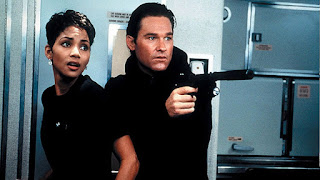
Exemplary highlights are derived from sequential crises, as every time one problem is solved, another, worse complication arises. One matter of urgency is finding and diffusing the bomb attached to nerve agent cannisters, a task made much more difficult due to a serious injury suffered by bomb disposal expert Sergeant Campbell "Cappy" Matheny (Joe Morton). Cahill has to overcome his fears and learn all about bomb de-activation literally on the fly.In parallel with the bomb countdown, Baird leverages the claustrophobic horizontal and vertical spaces to excellent effect. Grant and Captain Carlos "Rat" Lopez (Joe Leguizamo) manoeuvre through cramped utility shafts, installing spy cameras to track the terrorists' movements, and secretly recruit flight attendant Jean as their mole within the cabin. With the clock ticking down towards the airliner entering US airspace and being shot down, more dramatic surprises await as Grant and Rat have to think fast and act faster to avert disaster.
The one main disappointment arrives at the climax, an overly familiar and unnecessary land-the-stricken-plane routine not in keeping with the preceding quality. But in producing a fiendishly canny and rowdy thrill ride, Executive Decision earns its wings.

All Ace Black Movie Blog reviews are here.
Sunday, 23 October 2016
Movie Review: The Call (2013)
A high concept thriller with some horror elements, The Call carries echoes of the 1990s in its basic simplicity, but delivers better than expected entertainment.
In Los Angeles, Jordan Turner (Halle Berry) is a 911 operator. She receives a frantic call for help from a girl threatened by a home invasion in progress. Despite Jordan's best efforts the girl is murdered, sending Jordan into a depression. Months later, Jordan receives a cell phone call from Casey Welson (Abigail Breslin), another young girl who has just been abducted by an unknown assailant and stuffed into the trunk of a car, now speeding down the freeway.
Jordan has to pull herself together, face her demons and try to help Casey avoid a horrible fate. The cell phone is a disposable unit lacking a locator signal, so Jordan prompts Casey to attract attention in various ways, including kicking out the car's taillight. Gradually emergency responders, including Jordan's police officer boyfriend Paul Phillips (Morris Chestnut), start zeroing in on the moving car, but the kidnapper Michael Foster (Michael Eklund) is a deeply disturbed and dangerous man, with abominable plans in store for Casey.
An independent production directed by Brad Anderson, The Call carves out refreshingly original territory in the tired woman-in-distress thriller genre. The heroine is a 911 dispatcher, and the command centre is "the Hive" where all the calls come in and operators deal with brutal levels of stress on a daily basis. The film humanizes what is often a dispassionate, peripheral voice in all other cop movies, and Jordan Turner gives heart and emotion to the people exposed in real time to society's worst crises.
The first two thirds of the film stick close to the trauma of Jordan dealing with the crushing blow of the opening murder, and then crawling over the shards of her self doubt to try and help Casey survive long enough for a rescue to be mounted. The bond between 911 operator and kidnap victim is at the core of the film, and Anderson does an excellent job creating palpable edge-of-panic on both sides of the phone. Jordan is Casey's only hope to live, and Casey is Jordan's only chance at redemption, and the two women establish an unspoken but potent pact of mutual dependence.
From there the film dances with the dark edges of outright horror, as the perpetrator Michael Foster is coloured in and emerges as quite the monster, with a deranged mind and a twisted past. But Anderson eventually surrenders to the pull of more routine fare. Jordan leaves the Hive to get personally involved, the film abandons its creative premise in favour of a familiar climax, complete with typical plot holes and all the cliches that emerge when a vulnerable woman clashes with a manic killer.
Halle Berry and Abigail Breslin make for an effective screen pairing, both unleashing satisfying doses of consternation, fury and resiliency without crossing the line into ridiculous heroics. Neither of their characters is provided with too much depth, but together they carry the torch for women willing to fight back as best as they know how.
The Call may evoke an earlier generation of thrillers, but carries enough honesty to stay on the line.
All Ace Black Black Blog Movie Reviews are here.
Thursday, 25 February 2016
The Movies Of Halle Berry

All movies starring Halle Berry and reviewed on the Ace Black Movie Blog are linked below:
The Rich Man's Wife (1996)
Swordfish (2001)
Monster's Ball (2001)
Die Another Day (2002)
Perfect Stranger (2007)
New Year's Eve (2011)
Movie 43 (2013)
The Call (2013)
All Ace Black Movie Blog reviews are here.
The Movie Star Index is here.
Friday, 13 November 2015
Movie Review: The Rich Man's Wife (1996)
A floundering damsel-in-distress thriller, The Rich Man's Wife is an incompetent mess. Despite the presence of Halle Berry and Clive Owen, the story of a woman accused of planning the murder of her husband barely rises above bad TV movie standards.
Josie (Berry) is being interrogated by police detectives, and the movie unfolds as one long flashback. Josie's marriage to hard-drinking businessman Tony (Christopher McDonald) is in trouble, with both of them having affairs on the side. Her lover is Jake (Clive Owen), a restaurant owner frustrated at waiting for Josie to leave Tony. In an attempt to reignite the passion in her marriage, Josie suggests to Tony a vacation getaway, and they head to a secluded cabin in the woods. But Tony's business interferes, he return to the city and she stays behind, feeling angry and abandoned.
At the local bar Josie meets and flirts with the rough-around-the-edges local man Cole (Peter Greene), and after drinking heavily, she suggests that she would not mind seeing her husband dead. Cole suggests that he may be able to oblige. Josie is horrified, and then has to fend off Cole when he tries to rape her. She returns to the city and tries to mend the relationship with Tony, but all goes wrong when Cole re-emerges, guns down Tony, and starts to extort Josie.
Directed and written by Amy Holden Jones, The Rich Man's Wife fails on all counts. By starting the movie with Josie safe and sound albeit in police custody, she is effectively shielded from any serious harm throughout the flashback. Therefore all the scenes that throw her into danger lose most of their dangerous bite. But the trouble with the film runs much deeper. The script is simply inept, with lines of dialogue at the juvenile level, and the story never shakes the stench of a really cheap Strangers On A Train rip-off.
The characters are provided with the shallowest of backstories, if at all, and this is a film where every logical course of action by Josie is studiously avoided in favour of the worst possible decision to get herself into deeper trouble.
Jones tries to have it all ways with her heroine, portraying Josie as a victim, a seductress, an adulteress, and a conniver. Despite Halle Berry's decent efforts, the mix simply does not work, and Josie never evolves into a credible woman. A final-scene supposed twist in the tail involving lover Jake's ex-wife Nora (Clea Lewis) is stunningly misguided, and makes matters much worse for the characters' credibility. The three supporting male performances by Greene as the sneering bad guy, Owen as the sensitive lover and McDonald as the over-stressed husband, are strictly stereotypical.
The Rich Man's Wife gives the impression of having started life as a bad network TV movie-of-the-week premise. Despite adding a couple of violent scenes and two promising stars in Berry and Owen, the film falls far short of rising above what should have been its natural habitat.
All Ace Black Blog Movie Reviews are here.
Wednesday, 7 October 2015
Movie Review: Monster's Ball (2001)
In Georgia, Hank Grotowski (Billy Bob Thornton) and his son Sonny (Heath Ledger) are both prison guards at the local penitentiary. They live with Hank's father Buck (Peter Boyle), a loudmouthed racist and himself a retired prison guard. Hank is a widower and has inherited his dad's racist tendencies.
Lawrence Musgrove (Sean Combs) is a black death row prisoner about to be executed, with Hank and Sonny charged with overseeing his capital punishment by electric chair. Lawrence leaves behind his wife Leticia (Halle Berry) and obese son Tyrell (Coronji Calhoun). Sonny does not handle the execution well, unleashing Hank's wrath. Meanwhile, Leticia is penniless, and about to lose her house, her car and her job. Tragedies strike both Hank and Leticia, and a chance encounter brings them together for an unlikely relationship.
A compact two character study, Monster's Ball delves into the soul-shaking impact of loss on the psyche. Directed by Marc Forster with a measured pace and an eye for detail, the film refuses to take any easy short cuts. Neither Hank nor Leticia are necessarily likeable characters, and the calamities that befall them are shocking. Both of them rightfully hold themselves at least partially responsible for their losses, and the film distinguishes itself by staring at gaping, self-inflicted emotional wounds.
The film invests heavily in both characters to set the individual contexts. Hank and Leticia start their relationship approximately halfway through the film, and by then, both have been rounded into genuine people, products of their environment and their choices. The parallels between their independent lives are compelling. Hank abuses Sonny because he believes him to be weak; Letitia berates Tyrell for being overweight. Hank is already a widower; Leticia becomes one, with Hank an active participant in Lawrence's state-sanctioned demise. And as much as fate has a hand in the losses that they will experience, the spectre of personal responsibility hovers over both.
When they finally meet and engage, Foster charts a relationship course that is at once fragile and intense. The fierce intimacy between Hank and Leticia is more about physical release than mutual tenderness. They tentatively get to know each other while already relying on the relationship, Hank shocking himself by starting to care about a black person while discharging himself from the vestiges of his old life. Meanwhile, Leticia wonders if his financial, physical and moral support will actually help heal her anguish and guilt.
The film is fully dependent on the two central performances, and both Billy Bob Thornton and Halle Berry deliver. Thornton stays well within himself, portraying Hank as a man's man, his father's son, more influenced by the despicable attitudes of the old man than he cares to show or acknowledge. Berry became the first black woman to win the Best Actress Academy Award. She keeps Leticia real, human and impressively pragmatic.
The film ends with Leticia facing yet another unwanted surprise, and another potentially life-altering decision point. Again Monster's Ball quietly chooses the more difficult road, Leticia representing real people forced to make wrenching trade-offs just to be able to shake hands with life.
All Ace Black Blog Movie Reviews are here.
Thursday, 4 September 2014
Movie Review: New Year's Eve (2011)
A frivolous waste of time, New Year's Eve is an excuse for a large number of star names to cash cheques in return for about 10 minutes of screen time each, as about eight insipid micro-stories unfold on the big night.
All the events occur in and around New York City as midnight approaches. Claire (Hilary Swank) is responsible for the Times Square ball-dropping ceremony, and faces a crisis when the ball-lifting mechanism fails. Stan (Robert De Niro) is on his deathbed at a nearby hospital, being cared for by nurse Aimee (Halle Berry). Stan's dying wish is to observe the ball-dropping ceremony one last time from the hospital roof deck. Rock superstar Daniel Jensen (Jon Bon Jovi) is scheduled to perform at a party being catered by his ex-fiancée Laura (Katherine Heigl). Jensen hopes to win Laura back. Aspiring comic book artist Randy (Ashton Kutcher) has no interest in the frivolities of New Year's Eve, and gets stuck in his apartment elevator with Elise (Lea Michele), one of Jensen's back-up singers.
Ingrid (Michelle Pfeiffer) is depressed, quits her job, and convinces courier Paul (Zac Efron) to help her fulfil a long wish list. Divorced mom Kim (Sarah Jessica Parker) is having trouble controlling her 15 year old daughter Hailey (Abigail Breslin), who wants to spend the big night with her friends at Times Square. Young couple Griffin (Seth Meyers) and Tess (Jessica Biel) compete for the financial prize of having the first baby born in the new year with another competitive couple. Businessman Sam (Josh Duhamel) has a car crash on his way to delivering a speech in New York City, and has to hitch a ride with a noisy family travelling - slowly - in a large RV.
Produced by the same team and following the same template as Valentine's Day (2010), New Year's Day manages to lose any sweet spirit and just piles on the fake emotions. The stories are routine, the characters are stock, the laughs are lame, and the vapid call for love, delivered on live television no less, just reeks.
Of course some of the stories intertwine at the edges, but director Garry Marshall is unable to develop any of them past the point of childish two-sentence treatments. Of the stars on parade, De Niro, Swank, Berry and Pfeiffer are a league apart, and despite the lack of substance demonstrate the gulf in talent compared to the many lightweights like Kutcher, Heigl, Efron, Parker and Duhamel. Marshall manages to stretch out proceedings to two excruciating hours, padding the thin material with Bon Jovi performing two songs. Presumably to attract the young demographic, television starlet Michele also gets to belt out her own number. On this New Year's Eve, midnight really can't come soon enough.
All Ace Black Blog Movie Reviews are here.
Wednesday, 4 May 2011
Movie Review: Swordfish (2001)
Choose a random clutch of movie stars lacking in any chemistry, cast most of them in the wrong roles, mix in a limp and incomprehensible technobabble-heavy script, garnish with superfluous action sequences and over-the-top violence, sit back and cringe as the mess unfolds.
It is difficult to imagine how a film featuring John Travolta, Halle Berry, Hugh Jackman and Don Cheadle (not to mention Vinnie Jones and Sam Shepard) could be botched so badly, but director Dominic Sena, in way over his head, embraces the incompetence with aplomb. Sena, whose normal pool depth is the shallow waters of music videos, disappeared from directing movies for eight years after Swordfish, presumably to allow memories to fade.
Gabriel Shear (Travolta) is some sort of mega-rich, ultra-shady and uber-cool manipulator, operating outside the law with wild abandon. Stanley Jobson (Jackman) is a down-and-out expert computer hacker just released from jail and desperate to regain custody of his daughter. Gabriel uses his mistress Ginger (Berry) to lure Stanley into accepting a $10 million assignment involving hacking into some government database to siphon off billions of somehow abandoned dollars. Agent Roberts (Cheadle), who threw Stanley in jail to begin with, is curious about what Gabriel is up to, while Ginger is revealed as a Drug Enforcement Agency agent. There is also a sinister Senator Reisman (Shepard) attempting to influence events using fake smiles and contrived dialogue.
After endless scenes of computer screens displaying nonsense, fingers tap-tap-tapping furiously at keyboards, manic car chases and midnight street shoot-outs, events climax in a ridiculous bank heist that is then topped-off by an even more farcical bus-dangling-from-a-helicopter fiasco.
Travolta tackles the role of Gabriel Shear with unbridled relish bordering on satanic intensity. Jackman sleepwalks through the movie in mock earnestness, while Berry's attempt at a sultry seductress falls flat, and never flatter than in her much touted topless scene.
The script by Skip Woods makes half-hearted attempts at explaining the hacking world, but quickly gives up and settles for images of what looks like a kid's plan for a simple Lego structure self-assembling on a black-and-green screen as a surrogate for Something Really Important going on. Swordfish equally makes an unconvincing attempt to provide Gabriel Shear with motivation for the carnage that he is causing by introducing yet another top-secret government anti-terrorism agency, and this just makes the story more ludicrous.
Compared to Swordfish, any James Bond movie would be elevated to a highly intellectual artistic masterpiece, and this falsely magnified appreciation of other films must remain as Swordfish's only achievement.
All Ace Black Blog Movie Reviews are here.
Saturday, 18 December 2010
Movie Review: Die Another Day (2002)
Just like it did in Moonraker in 1979, the James Bond series takes a very wrong turn towards the outer reaches of technological boundaries, stretching what is already an incredible premise into the realm of the ridiculous.
Die Another Day, the 20th Bond movie adventure, features human recreation using DNA technology; an invisible car; a battle between two cars packed with enough missiles to obliterate a small country; a killer satellite capable of zapping earth with laser weapons; and a most awful computer-generated Bond escape involving surfing with a parachute. Bond is always expected to be outlandish; Die Another Day unintentionally crosses into the territory of cheesy science fiction, and the cheese does not smell so good.
In Pierce Brosnan's fourth and final outing as Bond, he is captured, held prisoner and tortured in North Korea. Exchanged for another spy, Bond is deactivated by MI6 and strikes out on his own to seek revenge on those who betrayed him.
His quest leads him from London to Cuba and then on to Iceland and back to North Korea, all on the trail of Sir Gustav Graves (Toby Stephens), a mysterious and wealthy diamond baron intricately connected to bad guys from the secretive North Korean regime. MI6 agent Miranda Frost (Rosamund Pike) has already infiltrated Graves' organization and is working with M (Judi Dench) using less lethal tactics than Bond. Also pursuing Graves is the agent known as Jinx (Halle Berry), who both hinders and helps Bond before she finally teams up with him to bring down Graves. Jinx and Frost take turns sharing Bond's bed, as he wastes no time making up for the female deprivation he suffered during his time as a guest of North Korea's prison system.
Graves as a villain is exaggerated to comic book proportions. The dialogue exchanges between Bond and Jinx are embarrassingly sophomoric. And Frost is one of the blandest ladies ever to catch Bond's attention. Director Lee Tamahori brings a couple of interesting artistic touches with effective use of brief slow motion tactics, but mostly he seems to be lost among all the outrageous technology. And both the opening sequence and the title song, by Madonna, are weak.
Die Another Day forced another reboot of the series with an new lead actor and a back-to-basics ethic in Casino Royale (2006). Some of the films in the series may be duds, but Agent 007 always lives to fight another day.
All Ace Black Movie Reviews are here.


