Showing posts with label Amy Adams. Show all posts

Friday, 18 February 2022

Movie Review: Doubt (2008)

A drama about possible misconduct involving a priest, Doubt boasts a talented cast but is firmly trapped in sterile stage origins.

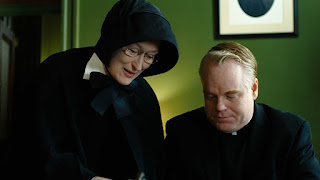
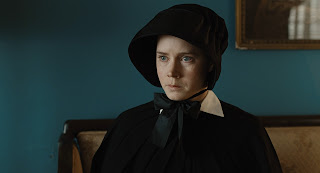
The setting is 1964 in the Bronx. At a Catholic church also serving as a school for the community, the stern and old-fashioned principal Sister Aloysius Beauvier (Meryl Streep) keeps a close watch on the children's behaviour. She also notices when Father Brendan Flynn (Philip Seymour Hoffman) delivers a sermon about doubt, and airs her thoughts to the younger Sister James (Amy Adams), the school's eighth grade history teacher.

Sister James then observes Flynn interacting, perhaps inappropriately but she is not quite sure, with the school's only black child, altar boy Donald Miller. She confides in Sister Beauvier, who decides to confront Flynn and accuse him of improper behaviour. He denies any wrongdoing. Sister Beauvier continues to investigate, and reaches out to the boy's mother Mrs. Miller (Viola Davis) to better understand his home environment.

Directed and written by John Patrick Shanley based on his play, Doubt is a series of verbal clashes all taking place in and around the Catholic school. Barely rising above the status of a filmed play, Doubt leans heavily on the Seriousness of the Topic and the star actors to salvage some level of cinematic drama.

Streep, Hoffman, Adams, and Davis (who gets just the one scene) step forward and offer their theatrical best, but it's not enough. Shanley endlessly circles the same drain of Beauvier having her doubts about Flynn's behaviour but not quite the evidence she needs, and so they spar, then spar again, and then spar some more, repeating the same couched accusations and the same offended denials. Her rage and his defensiveness both escalate, but the power dynamics are wayward and the words fail to spark.

Sister James and Mrs. Miller are relegated to side-characters and observers, their attitudes perhaps indicative of the era but still far from helpful. Sister James naively bends with the wind, and Mrs. Miller hints her son should tough it out and accept mistreatment as long as he graduates.

The running time is padded with irrelevant details from Sister James' classroom, featuring boys and girls trying to be boys and girls but stifled by rigid codes of conduct enforced with relish by Sister Beauvier.

Almost as a late afterthought Doubt works its way to the rot eating away at a Catholic church allowing serial offenders to thrive, and the futility of women speaking out against a centuries-old male-dominated hierarchy. The topic is of tragic importance, here fumbled into cold, static discourse.


All Ace Black Movie Blog reviews are here.

Saturday, 27 November 2021

Movie Review: Leap Year (2010)

A numbingly predictable romantic comedy, Leap Year layers cultural stereotypes and travelogue blandness onto a meager premise.

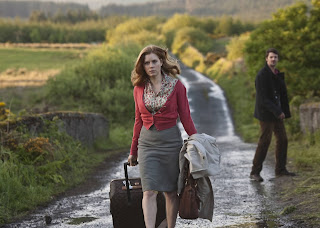
In Boston, real estate stager Anna (Amy Adams) is disappointed when her boyfriend of four years Jeremy (Adam Scott), a cardiologist, fails to propose marriage and heads to a conference in Dublin. Her father Jack (John Lithgow) tells a tall tale about a tradition of Irish women proposing to their men on February 29. She decides to chase after Jeremy and pop the question.

Severe weather interferes and Anna finds herself stranded in the tiny coastal community of Dingle. The local bar owner/taxi driver Declan (Matthew Goode) needs the money and offers to drive her to Dublin for €500. They immediately clash, her desire to control everything rubbing against his laid-back attitude. But with nothing going well on the long trip, sparks of romance eventually emerge.

Written by Harry Elfont and Deborah Kaplan with a conspicuous absence of wit and creativity, Leap Year washes up on the Irish coast like rotten seaweed. Director Anand Tucker mistakes caricature representations for cultural references, and reduces the country to old men debating superstitions and muddy country roads blocked by cows. Some of the scenery is good, but far from sufficient to distract from the overriding sense ineptness.

Into this dross a ridiculous attempt at a romance is inserted, Anna and Declan actually bickering throughout the whole movie, their incessant quarrelling only turning to manufactured affection in the final 15 minutes when the happy ending demands attention. Along the way they endure car trouble, a night at a bed and breakfast where married couples are unwelcome, and uncooperative train schedules. For good measure they gate crash a wedding and proceed to wreck the bride with flying shoes and spilled wine.

Some moments of humour do survive, and Amy Adams heroically battles against an unappealing character and all the contrived surroundings. She is the only thing worth watching, as this Leap Year is one day too long and otherwise woefully short.


All Ace Black Movie Blog reviews are here.

Saturday, 10 July 2021

Movie Review: The Woman In The Window (2021)

A psychological suspense drama with horror elements, The Woman In The Window weaves a decent but logic-challenged mystery involving grief, loneliness, hallucinations, and crime.

In Manhattan, Dr. Anna Fox (Amy Adams), a child psychologist, suffers from agoraphobia and refuses to leave her house. She is separated from her husband Edward (Anthony Mackie), who looks after their eight year old daughter. Anna has a shaky friendship with her basement tenant David Winter (Wyatt Russell), a singer/songwriter/handyman, and holds weekly sessions with her therapist Karl Landy (Tracy Letts), who is tinkering with her medications. But she spends most of her days snooping on neighbours through her windows.

She quickly gets involved in the lives of new neighbours the Russells and meets their awkward teenaged son Ethan (Fred Hechinger), then his vivacious mother Jane (Julianne Moore) comes for a visit, and finally Ethan's mysterious father Alistair (Gary Oldman) briefly drops by. Anna's world in thrown into turmoil when she witnesses what appears to be a murder at the Russell house, but all may not be what it seems.

Directed by Joe Wright and written by Letts, The Woman In The Window carries ambitions to salute Hitchcock's Rear Window. And equipped with a housebound protagonist and a camera for better zoom and focus, it's a not-bad effort. Anna's fragile mental state creates a milieu where anything is possible as either reality or imagination, and Wright exploits her dark and empty house as a solid foundation for appropriate spookiness.

Anna is lonely, suicidal, mixing alcohol with medication, and watching too many old movies. The people closest to her are a good mix of slightly creepy (David) and slightly smarmy (Landy), but then the Russells arrive and give her a jolt of excitement. Anna's motherly instincts and child psychologist training immediately kick in with the troubled Ethan. Then a fun session of wine and talk appears to offer the potential for friendship with Jane, but the stern Alistair remains cold and aloof.

When the blood splatters and carnage is unleashed, the narrative initially remains strong. Anna is forced to confront her troubled life and reexamine everything she thinks she knows, Amy Adams delivering another stunningly engaging performance as a woman trying to stumble out of a mental fog. But the final act is disappointing, resorting to unworthy slasher cliches, stabbing holes in plenty of the preceding build-up and attempting to have it both ways, Anna both right and wrong on all counts.

The Woman In The Window peeks at the tantalizing world outside, but can't quite confidently stride out.


All Ace Black Movie Blog reviews are here.

Sunday, 3 January 2021

Movie Review: Hillbilly Elegy (2020)

A drama about working class family struggles and the challenges of a tumultuous upbringing, Hillbilly Elegy enjoys fine performances and a rich, though-provoking narrative.

The events predominantly unfold in two time frames. As a law student at Yale, J.D. Vance (Gabriel Basso) is supported by his girlfriend Usha (Frieda Pinto) as he goes through the stressful intern placement interview process. His sister Lindsay (Haley Bennett) calls from Ohio with news their mother Bev (Amy Adams) has overdosed and is hospitalized.

In flashbacks J.D. recalls his turbulent upbringing. His grandparents Mamaw and Papaw (Glenn Close and Bo Hopkins) moved from ramshackle roots in rural Kentucky to Middletown, Ohio, but life for young J.D. was always tough. His single mother Bev was unstable, moving from man to man, getting into opioids and losing her nursing licence. Abusive towards J.D. but also loving and supportive when lucid, Bev was always an accident waiting to happen. Mamaw provides a place of refuge and has to decide whether to intervene to give J.D. a chance at a better life.

Now J.D. drives back to Middletown to help Lindsay deal with the latest overdose crisis, his mother's behaviour again threatening to derail his future.

Based on real events as recounted in Vance's 2016 memoir, Hillbilly Elegy is a clear-eyed look at the vicious cycle of poverty, lack of education and abuse entrapping the disadvantaged. Without glamourizing or belittling the resultant hardscrabble life, screenwriter Vanessa Taylor and director Ron Howard also seek the strength instilled by family ties, and Bev's struggle to improve despite deep-rooted flaws.

Mostly steering clear of stand-and-gawk storytelling and resisting the strong temptation to give up on exasperating behaviour, Taylor's script focuses on origins, good and bad, forging J.D. into who he is. His upbringing meant he grew up in a hurry and faced decisions no child should be forced to make, but his mother and grandmother, sometimes despite themselves, also charted his tricky path to Yale. And so J.D. defends his family in front of slick suited lawyers at the risk of being perceived a bumpkin. With Lindsay's help he digs deep to find the good in Bev, looking past the in-progress self-destruction to the potential for a better future.

The rags-to-respectability journey is mostly composed of familiar elements, but Howard finds a pleasing rhythm between the current and flashback scenes, and delivers a coherent package in just under two hours. Flashback snippets to different experiences (Mamaw and Papaw as a younger couple, J.D.'s stint with the Marines) are less relevant. 

Amy Adams and Glenn Close deliver dedicated, intense performances. Adams is sometimes nothing less than scary in finding the suddenly unhinged moments of a mother unleashing fury at her son. Close redefines crusty, her face etched with years of struggle and no shortage of determination, the obvious creases hiding the still unknown agonies Mamaw endured with an abusive drunk of a husband. In a less showy role, Gabriel Basso succeeds as the level-headed anchor remarkably still capable of forgiveness. 

A story of potential hiding within suffering, Hillbilly Elegy differentiates between acknowledging grim shortcomings and accepting their permanence.


All Ace Black Blog Movie Reviews are here.

Monday, 16 December 2019

Movie Review: Junebug (2005)


A quirky drama and comedy, Junebug delves into the gulf between social classes and the untold secrets casting shadows on family dynamics.

Chicago art gallery owner Madeleine Johnsten (Embeth Davidtz) hears about eccentric Civil War artist David Wark living in rural North Carolina. She travels with her husband of six months George (Alessandro Nivola) to try and sign Wark to an exclusive contract.

George is originally from the area, and after visiting Wark the couple head to George's nearby family home, where his parents Peg and Eugene (Celia Weston and Scott Wilson) live with George's brother Johnny (Ben McKenzie) and his pregnant wife Ashley (Amy Adams). The Johnstens are simple rural folks, and Madeleine's sophistication is out of place. Johnny never finished high school, and he is brooding for vague reasons. Ashley is bubbly and excited about her forthcoming baby and tries to befriend Madeleine, who starts to learn she really knows little about her husband.

Appropriately featuring no music soundtrack and strategic pregnant pauses with no dialogue and no sound of any kind, Junebug is most interested in the quietness of what is left unsaid. Director Phil Morrison and writer Angus MacLachlan focus their drama on a base level of tension arising from unresolved conflicts and lingering dissatisfaction within families, including the chasms so deep and wide no bridging efforts need be attempted.

While Ashley puts on a happy face her hubby Johnny is not shy about fully displaying his doldrums. He may blame Ashley for evolving their relationship too quickly and preventing him from finishing high school, but may never quite say it. Johnny also resents his brother's transformation into a city slicker and landing the worldly Madeleine as a wife.

Meanwhile their mother Peg instinctively knows Madeleine does not belong in this family, but is careful about confrontations and instead tries to recruit the generally passive Eugene to do her awkward work.

And finally the family visit exposes the superficial relationship that passes for a marriage between Madeleine and George. She learns more about him in a couple of days than the prior 6 months, and although the sex is great they now both have reasons to doubt their compatibility. When Ashley goes into labour and Madeleine's courtship of the artist Wark is jeopardized, the vulnerabilities of their relationship are exposed with no words exchanged.

In her breakout role Amy Adams sparkles, especially in the film's first half. With Ashley genuinely excited and eager to connect with and learn from the refined Madeleine, Adams allows her character's genuineness to radiate with pure positive energy throughout the otherwise restive household. The rest of the cast members are suitably encased within the prevailing passive aggressiveness.

Cinematic exposés of family dynamics are often quick to resort to exaggerated histrionics and displays of loud emotion. Junebug is a refreshing rejection of theatrics. Morrison stays closer to real interactions, where the gritting of teeth is the norm, tense smiles are plastered on to get through the day, and difficult conversations are best avoided. None of this necessarily leads to satisfactory resolutions, but then life rarely comes with prepackaged tidy outcomes.


All Ace Black Blog Movie Reviews are here.


Thursday, 12 September 2019

Movie Review: Sunshine Cleaning (2008)


A quirky dramedy, Sunshine Cleaning delves into the lives of working class America through the story of two sisters struggling to get by, and finds good intentions mixing with bad decisions.

In Albuquerque, single mom Rose Lorkowski (Amy Adams) works hard as a maid while raising her eight year old son Oskar, and carries on an affair with police detective Mac (Steve Zahn). In high school she was the cheerleading team captain and he was the star quarterback, but Mac chose to marry someone else and Rose's life never recovered. Meanwhile, her younger sister Norah (Emily Blunt) cannot hold a job, and has not yet processed the sudden death of Rose and Norah's mother. Their father Joe (Alan Arkin) is kindly but always in pursuit of the next misguided business venture.

When Rose has to raise money to place Oskar in private school, Mac suggests she gets into the lucrative biohazard cleaning business, mopping up body fluids at scenes of accidents, crimes and suicides. Rose drags Norah into the business she calls Sunshine Cleaning. Gradually they learn the proper procedures with help from supply store owner Winston (Clifton Collins Jr.). Meanwhile Norah finds artefacts left behind by a suicide victim, and goes looking for the woman's daughter Lynn (Mary Lynn Rajskub), a blood bank technician.

Striking the perfect chord between poignant and peculiar, Sunshine Cleaning is a non-judgmental view of lives sidelined on the difficult side of the tracks. Elegantly written by Megan Holley and directed with understated charm by Christine Jeffs, the film avoids emotional high and lows, instead achieving a steady and internally consistent ascent towards messy personal growth.

Holley starts from a place of deep loss for all her characters: Rose lost her high school sweetheart to another woman, Norah never got past the childhood trauma of losing her mother, and Joe lost his wife a long time ago. Winston has lost an arm in suitably unexplained circumstances, and Lynn lost her mother but, as far as Norah can tell, may not even know it.

For Rose, Norah and Joe the losses create internal barriers and promote self-defeating actions such as Rose's affair, Norah's could-care-less attitude, and Joe's pursuit of futile middleman deals. The film then charts an enjoyable, unlikely and bumpy path towards self-betterment built on the icky premise of cleaning up splattered blood and dead body fluids. Rarely has a film about mopping up the messes of the past found such an apt metaphor.

The sisters' journey towards confronting their internal demons and emotionally relocating to a better place is far from smooth sailing. Rose has to juggle her burgeoning new business with confronting her continued dependency on Mac caring for an out-of-school Oskar. Without quite knowing why, Norah pursues Lynn in a quest that softly veers into unexpected territory. And while Joe does his best to support his daughters, his wacky business ventures and propensity for overpromising and under-delivering cause mounting frustration.

Sunshine Cleaning enjoys sparkling performances from two of the finest actresses of their generation. Amy Adams and Emily Blunt humanize Rose and Norah and stay true to their flawed origins, grounding the film in the rough and tumble world of every two forward steps being met with at least one misstep. With the right tools every stain can be cleaned or disposed of, but sometimes the mess can be inadvertently made bigger before the cleanup begins.


All Ace Black Blog Movie Reviews are here.


Monday, 22 April 2019

Movie Review: Nocturnal Animals (2016)


A social drama with an embedded crime thriller, Nocturnal Animals is a complex and gripping multi-layered experience.

Susan Morrow (Amy Adams) manages an art gallery and is trapped in an icy cold and disintegrating marriage with the cheating Hutton (Armie Hammer). She receives a book manuscript titled Nocturnal Animals from her ex-husband Edward (Jake Gyllenhaal). Intrigued to find the book dedicated to her, she starts reading.

The novel recounts the fictional story of Tony Hastings (also Gyllenhaal), his wife Laura (Isla Fisher) and teenaged daughter India (Ellie Bamber). While on a long road trip in rural western Texas they tangle on the highway with a group of thugs led by Ray Marcus (Aaron Taylor-Johnson). The horrifyingly violent episode ends with Tony humiliated and separated from his abducted family. Detective Bobby Andes (Michael Shannon) is assigned to find the two missing women and apprehend the perpetrators.

Susan is entranced by the novel, and recalls her relationship with Edward from initial courtship to the stress of a young marriage, finding parallels between the novel and their troubled history.

Seamlessly unfolding within three different frames, Nocturnal Animals weaves multiple interlinked stories with effortless ease. Director and writer Tom Ford displays a deft touch to stretch delicate threads between Susan's current and past lives and the fiction in her hands written by her ex-husband. The film is both a baroque composition and a revenge thesis, and works brilliantly in both contexts.

While superficially Susan's marriage-gone-wrong should have little in common with a crime-most-foul and a lust for revenge in the Texas desert, she senses the unsettling connection early. The raw power in Edward's story revealing the insecurities and anguish in alter ego Tony's heart carry unmistakable resonance, leading Susan to question where and how she steered her life. She carries guilt related to how the relationship with Edward ended, and the novel creates an opportunity to both make amends and rediscover her soulmate's trajectory.

Ford portrays Susan's current status in soulless darkness, and uses blues, blacks, shiny surfaces and not an item out of place to convey a perfectly empty life. In contrast Tony Hastings' nightmare burns in the Texas sun, grand skies, yellows and reds engulfing the rage at his own weakness and a passion to finally step forth and be counted.

Nocturnal Animals features four outstanding performances. Amy Adams covers plenty of terrain from a young woman in love to an emotionally stifled gallery manager passing the point of caring about her second husband's cheating antics. Jake Gyllenhaal plays two separate but related roles as the sensitive first husband Edward and the flawed family man Tony.

Michael Shannon stands as tall as Texas, a detective with unique methods and a personal agenda. And finally Aaron Taylor-Johnson creates a cinematic monster for the ages in Ray Marcus, barely in control of any emotion and willing to improvise his actions on the fly in response to juvenile provocations real or perceived. Together the four actors create unforgettable dynamics and textured characters feeding off each other's strengths and weaknesses.

Ford plays with the theme of personal growth towards directions predicted and potentially unwanted. Susan's worst nightmare is to grow into her calculating mother (Laura Linney, expertly stealing her one scene), but there she is, giving up on her dreams and seeking the shallow pampered life at the expense of happiness. Edward was always the romantic type, just as likely to live in poverty as he is to write a seminal novel, and his brilliance now rests in Susan's hands. She both gave up on him and inspired his greatest achievement, and his creativity will again seep into her life, and not always as she expects.


All Ace Black Blog Movie Reviews are here.


Saturday, 5 January 2019

Movie Review: Vice (2018)


A biography of former US Vice President Dick Cheney, Vice is too glib for its own good and ultimately an inelegant hack job.

A prologue shows Cheney (Christian Bale) hustled into a White House safe room during the September 11 2001 terrorist attacks and issuing an order to shoot down any threatening aircraft. The film then starts with Cheney as a blue collar worker in Wyoming circa 1963, more interested in getting drunk and starting fights than supporting his wife Lynne (Amy Adams). She issues an ultimatum, he shapes up, and by 1969 is a White House intern assigned to Donald Rumsfeld (Steve Carell).

A savvy politician and advisor to President Nixon, Rumsfeld teaches Cheney the ropes. By the 1980s Cheney himself is elected to Congress as a Wyoming representative and in the Reagan and Bush Senior eras establishes his power base as an influential Republican politician. Lynne and Dick are supportive when their daughter Mary announces she is gay. He retires from public life and becomes CEO of Halliburton, living a wealthy and comfortable life. Until George W. Bush calls, asking Cheney to be his running mate in the 2000 presidential election.

Director Adam McKay hit the bull's eye with 2015's The Big Short, skewering the 2008 financial crisis with a brash and irreverent style. But while The Big Short was based on an excellent book, McKay himself wrote Vice, and his more outlandish tendencies are unconstrained, stepping out of bounds early and often.

"We tried our f***cking best", proclaims the bro-level opening credit in reference to the difficulty portraying Cheney's secretive life, and faux-credits start to roll with a musical flourish halfway through the film, as the Cheneys enjoy their idyllic life before the vice presidency comes calling. Dick and Lynne are portrayed exchanging Shakespearean prose as he mulls over the possibility of accepting Bush's offer. By the end of the film, everything from the inner city opioid crisis to global warming, passing through the international refugee crisis, has been laid at Cheney's feet.

More troublesome is McKay's inability to bring anything new to understanding his subject. Even for those just vaguely familiar with Cheney's reputation as a shady right-wing politician will learn precious little from Vice. His transformation from blue collar bumpkin to White House intern happens off-screen, as does his ascendancy to Halliburton's top ladder. Whatever events shaped his thinking and policies, dark as they are, are left unattended.

Instead McKay's introduces an undefined narrator, and then dallies for many minutes on irrelevant heart surgery and fishing details (Cheney hooks and reels in his political targets, presented in colour-by-numbers with monosyllabic instructions for the slower members of the audience).

The better moments include the two scenes of interaction with Bush, as Cheney senses his opportunity to move close to the nexus of power, and a menacing Christian Bale performance, making use of a jaw dropping physical transformation and Darth Vader as inspiration. Amy Adams and Sam Rockwell are largely wasted and reduced to sideshows, both slowly disappearing from relevance.

Vice takes aim at an easy target, but misses with a combination of insolence and arrogance.


All Ace Black Blog Movie Reviews are here.


Saturday, 23 December 2017

Movie Review: Talladega Nights: The Ballad Of Ricky Bobby (2006)


A sports satire, Talladega Nights: The Ballad Of Ricky Bobby skewers the world of NASCAR racing with a rusted tie rod.

Ricky Bobby is born in the backseat of a car to semi-professional racer and heavy pot user Reece Bobby (Gary Cole), a mostly absentee father, and his wife Lucy (Jane Lynch). Ricky grows up idolizing his Dad, and adopts Reece's throwaway line "if you ain't first, you're last" as his life's mantra. A grown up Ricky (Will Ferrell) finds work as a NASCAR pit crew member on the circuit's worst team owned by Larry Dennit Sr. (Pat Hingle) and his son Jr. (Greg Germann). When the Dennit driver goes AWOL, Ricky jumps into the car and achieves third place.

Ricky quickly establishes himself as the best driver in the field and starts accumulating wins and championships. He forms a formidable "Shake 'n Bake" partnership with his teammate and childhood friend Cal Naughton Jr. (John C. Reilly), although Ricky never lets Cal win. Ricky gains immense wealth, a trophy wife in Carley (Leslie Bibb), and two bratty young boys. But when ex-Formula One champion and openly gay Frenchman Jean Girard (Sacha Baron Cohen) invades NASCAR, Ricky's life starts to fall apart.

The world of racing where the cars only ever turn left in big circles may be an easy target, but director Adam McKay, who co-wrote the film with Ferrell, bites into it with venom. Talladega Nights features none-too bright drivers married to buxom gold-digging beauties doing battle for dimwitted owners married to perpetually tipsy wives in a modern version of chariot racing dominated by sponsors. While the laughs are plenty and the characters goofy if not stupid, McKay and Ferrell also handle the subject with enough affection to avoid outright meanness.

McKay wisely stays away from too many actual racing scenes, the sport a primarily boring exercise in going round and round until someone crashes. When Talladega Nights does go to the track, it is to generate over-exaggerated crashes and big laughs, including Ricky's infamous mental meltdown prompting a stripdown to his undies. It's a wild enough sequence that deserves the encore that duly arrives, as the film's second half focuses on Ricky's long road to redemption.

Off the track the film circles back to Ricky's family, and to McKay's credit the story gets better when dad Reece and mom Lucy re-enter Ricky's life. What the young boy lacked in proper upbringing he will receive from his parents through the pixelated lens of an already warped adulthood, and the film motors its way to a satisfying conclusion where men stumble upon their improved selves.

Will Ferrell has rarely been better in a straight comedy, with the strong material allowing him to ride the story without appearing to try too hard. The characters of Cal Naughton Jr and Jean Girard are the catalysts who steer events in Ricky's life, and both John C. Reilly and Sacha Baron Cohen are perfect in providing support. Reilly ensures that Naughton is the perfect side-idiot, while Baron Cohen somehow keeps a straight face playing the arrogant Frenchman sipping macchiatos inside the racing car while waiting for someone - anyone - to challenge him at the front.

The three lead actors engage in plenty of sharp improvisation, and the lines of dialogue frequently veer wildly off-topic, prolonging some scenes beyond what is necessary but adding to the satirical wackiness.

Amy Adams gets a small role but makes a big impression as Ricky's mousy assistant who turns into a tiger helping Ricky fight his demons. Talladega Nights: The Ballad Of Ricky Bobby burns rubber with enthusiasm, but of course it's the big career wreck and subsequent recovery that grabs all the attention.


All Ace Black Blog Movie Reviews are here.


Monday, 2 January 2017

Movie Review: Arrival (2016)


A low-key alien-contact film wielding enormous power, Arrival is a superlative experience, transcending the genre and transforming the mystery of communication into a private and yet monumental journey.

Linguistics professor Louise Banks (Amy Adams) experiences the cancer-induced death of her teenaged daughter and separation from her husband. When twelve alien spacecraft suddenly land at various locations across Earth, Colonel Weber (Forest Whitaker) of the US Army recruits Louise to the Montana landing site to try and decipher the aliens' communications.

Louise joins forces with theoretical physicist Ian Donnelly (Jeremy Renner) and together they lead a team of scientists entering the alien spaceship at regular intervals and attempting to understand the intentions of the visitors. Teams at the other landing sites, including China and Australia, are doing the same. The aliens are revealed to be seven-legged gigantic "heptapods" with a sophisticated language written in circular imagery. Louise makes good progress in deciphering the alien language, but when the heptapods seemingly start to make reference to weapons, the Chinese are panicked into an aggressive stance, jeopardizing all communications.

Directed by Denis Villeneuve and written by Eric Heisserer, Arrival is an exceptionally thoughtful treatment of an eternal question: how will humans react when aliens appear within our midst? With mistrust across national borders and tensions simmering closer to home between militaristic and scientific approaches to problem solving, the likelihood of a successful interaction with aliens starts with a low probability and stumbles on from there. The human propensities for doubt, fear, mistakes and misunderstandings always tilt the odds towards violence.

Villeneuve and Hessler balance the film on this knife's edge early on and leave it there for the two hour duration. The aliens' intentions are unknown. They clearly possess incredibly advanced technology, and the implications to humanity could range from annihilation to a transformative leap forward. The military types represented by Weber and CIA Agent David Halpern (Michael Stuhlbarg) create just enough space and time for the civilians to do their work, but the threat of a turn to brutality hovers over Louise and Ian.

And it is never a certainty that peaceful interaction is the appropriate response when human survival is at stake. Louise is in a race against time to burst through the language barrier, and every time she has to argue that "weapon" maybe means "tool", the level of skepticism rises.

Arrival does not yield to cushy best-of-humanity-coming-together tendencies. Although there is tentative cooperation between the world powers grappling with the same aliens, the collaboration is tenuous at best. As the story unfolds, Louise realizes that the challenge of communicating between humans will be as critical as connecting with the aliens.

Stylistically, the film triumphs with a muted, almost dour aesthetic representative of a hurried human response to a seminal event, punctuated by the elemental beauty of the alien spacecraft. The interactions between the human characters and across the species divide are difficult and slow. There are no quick breakthroughs, as there is no hasty bonding between Louise and Ian.

The majesty of Arrival resides in Louise's mental awakening, a journey represented by flashes and visions she experiences as her immersive interactions with the aliens' language grow more intense. There are tantalizing but still opaque clues as to where her journey will end, and Villenueve builds the narrative to a breathtakingly magnificent climax, a resolution both deeply personal for Louise and comprehensively holistic for humanity.

Amy Adams delivers a haunting performance, filled with the apprehensions of a woman thrust into an equipment-heavy world at the pointy end of historic events. Adams allows Louise to be at once determined, full of self-doubt, and wrestling with overwhelming events both within the alien craft and in her increasingly lucid consciousness.

Broad in scope and yet profoundly intimate, Arrival takes its place among the great cinematic achievements imagining humanity's initial contacts with other beings.


All Ace Black Blog Movie Reviews are here.


Sunday, 5 June 2016

Movie Review: Catch Me If You Can (2002)


A light-hearted chase drama inspired by real events, Catch Me If You Can is treat for the eyes and the mind. The story of master con artist and cheque fraudster Frank Abagnale Jr. is a breezy tale told with a bouncy spirit.

In New York of the early 1960s, 16 year old Frank Abagnale Jr. (Leonardo DiCaprio) grows up idolizing his father Frank Sr. (Christopher Walken), an independently-minded businessman who constantly runs into money problems. When Frank Sr.'s marriage to passionate Frenchwoman Paula (Nathalie Baye) falls apart due to his financial difficulties and her infidelity, Frank Jr.'s life is shattered and he goes on the run. Having inherited his father's instincts for charming people into parting with money, Frank survives by cashing fraudulent cheques at various banks.

Frank Abagnale Sr.: Two little mice fell in a bucket of cream. The first mouse quickly gave up and drowned. The second mouse, wouldn't quit. He struggled so hard that eventually he churned that cream into butter and crawled out. Gentlemen, as of this moment, I am that second mouse.

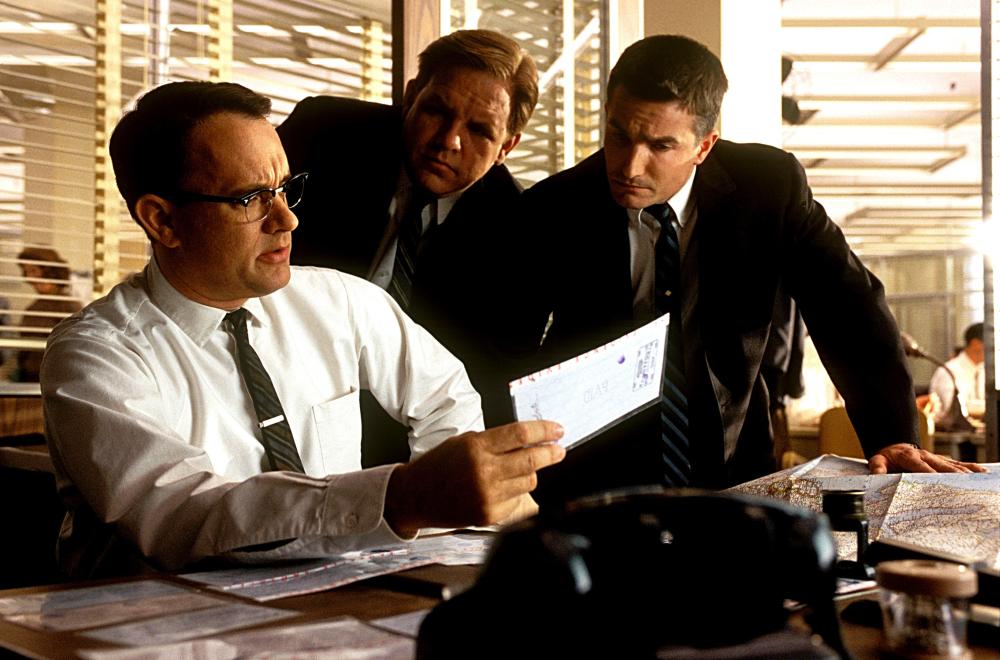
Wanting more, driven by a desire to recover all that his Dad lost, and appreciating the power of a slick uniform, Frank pretends to be a Pan Am co-pilot. He starts forging payroll cheques, and is soon flying around the country, amassing a fortune in cash, and leaving a long trail of victimized banks in his wake. His exploits grab the attention of FBI bank fraud agent Carl Hanratty (Tom Hanks), who starts a years-long pursuit. But the FBI man is always half a step behind the con artist, and Frank has more tricks up his sleeve and new personas to disappear into.

Directed by Steven Spielberg and based on the book by the same name co-written by Abagnale, Catch Me If You Can is an engaging, remarkably entertaining film. Approximately 80 percent based on reality (according to Abagnale himself), the film focuses on one kid on the run possessing extraordinary self-confidence and one dour FBI agent determined to catch up to him. By avoiding all buddy movie and action cliches that could have crept into the narrative, Spielberg and his screenwriter Jeff Nathanson produce an original, funny and character-driven film, with the momentum generated by intellect and the human condition.

Frank Sr.: You know why the Yankees always win, Frank?
Frank Jr.: 'Cause they have Mickey Mantle?
Frank Sr.: No, it's 'cause the other teams can't stop staring at those damn pinstripes.

It's takes a perpetrator and a victim to run a successful con, and the film delights in showing the various ways Frank is able to either get what he wants or escape from sticky situations using confidence and the razzle dazzle of image and props. He's both the struggling mouse and the Yankees in pinstripes. Whether it's a Pan Am pilot's outfit, a doctor's white coat, a shiny pendant, or a wallet full of junk, he distracts and sweet talks in equal measure. He succeeds to the tune of millions in cash, even conniving to get a high class call girl to pay him for a night of pleasure.

Compared to real events the film overplays the two key relationships in Frank's life, and that's quite excusable because Spielberg knows what makes a good screen drama. Frank is provided with regular touch points with his father, whose life is on an endless downward spiral that only he fails to see. Frank Jr.'s motivation is to set all that went wrong in his dad's life, but for Frank Sr. the struggle is the life, and he takes joy not in escaping the bucket, but watching his son churn for another day.

The in-pursuit relationship between Frank and Carl is also enriched for cinematic purposes (and to provide Tom Hanks with more to do). The film features Christmas time phone calls between the two men to affirm the emptiness and broken homes they share, and to build a bond that comes to fruition in the final act.

Leonardo DiCaprio and Tom Hanks are both excellent, smoothly building complex characters continuously longing for something just out of reach. Christopher Walken gives Frank Sr. the doomed air of a smart man determined to fight a system that merciless crushes him into nothingness, but that is no reason for him to stop the fight.  The rich cast also features small but telling roles for Martin Sheen, James Brolin, Amy Adams and Jennifer Garner.

Catch Me If You Can features a stunning throwback opening credit sequence by Kuntzel+Deygas that recalls the best of Saul Bass. A whimsical, curious John Williams progressive jazz music score enhances the 1960s vibe.

Cool, creative and captivating, Catch Me If You Can is a cat and mouse game at its finest.


All Ace Black Blog Movie Reviews are here.

Friday, 16 January 2015

Movie Review: Big Eyes (2014)


A biography of artist Margaret Keane during her time with conniving husband Walter, Big Eyes is an amiable drama with elements of comedy. The film is engaging, but also limited by the ultimately small scope of the story.

It's the 1950s, and Margaret Ulbrich (Amy Adams) finds herself a divorced mother of young daughter Jane. She moves to San Francisco and pursues her hobby of painting sad children with big eyes, a singular motif in dozens of poses. Margaret meets fellow struggling artist Walter Keane (Christoph Waltz), who claims to be trained in Paris. They fall in love and quickly get married.

Walter has a slick hustler's attitude and an ability to sell anything. He starts to peddle Margaret's paintings, and once they start to generate interest, he claims them as his own. He convinces Margaret to go along with the ruse, on the basis that women artists are not taken seriously, and she agrees, signing the paintings simply Keane. The images of melancholy big eyed children become a cultural sensation, and Walter mass-markets the art through television appearances, prints, posters and postcards. The Keanes become extremely wealthy, but with Walter becoming more erratic and the love evaporating, the marriage heads towards trouble.

Director Tim Burton takes a break from his typical dark and brooding aesthetics, and dabbles in something altogether more routinely domestic. Big Eyes is a relatively straightforward but also true story of a snake oil salesman taking advantage of a vulnerable woman to peddle schlocky pop art. Everybody gets rich and for a while, a bit happy, until the fad passes and greed consumes the money machine.

Big Eyes has a bright and cheery look, celebrating 1950s faux chic with vivid colours and a sense of West Coast street optimism. The film never wallows for too long at any point in Margaret's journey from divorcée to maligned artist seeking redress, Burton keeping the pacing brisk and the focus firmly on the central couple's evolving relationship.

Throughout its second act, the film portrays Margaret as a victim suffering in silence and reluctantly going along for the ride, although never comfortable with Walter's misrepresentations, especially when it comes to lying to her daughter. But her years of acquiescence, squeamish as it may have been, cannot help but seep away sympathy from her corner. Combined with the redundant hokum of her artwork, Margaret is a difficult character to fully cheer for.

This takes nothing away from Amy Adams' committed performance. In a reserved but ultimately steely display, Adams conveys Margaret as full of quiet self-doubt, uncertainty and mounting suspicion that the man she hurriedly married is both less and more than what he initially appeared to be. Christoph Waltz gradually but steadily goes over the top, starting out with Walter as a smooth persuader and ending the film as a joke of a man, desperate to hang on to his castles in the air, his big eyes for unearned wealth having created an empire built on the fault line of mass deception.


All Ace Black Blog Movie Reviews are here.

Wednesday, 7 January 2015

Movie Review: Charlie Wilson's War (2007)


Based on real events, Charlie Wilson's War is the remarkable story of one US Congressman adopting the cause of the Afghanistan resistance during the Soviet occupation, ultimately hastening the end of the Cold War.

Texas Congressman Charlie Wilson (Tom Hanks) is known more for parties than policies, but he does sit on the powerful defence appropriations committee. Joanne Herring (Julia Roberts) is one of the richest women in Texas, and sees the fight against communism as a Christian duty. Through a smooth combination of seduction and badgering she convinces Wilson to pay attention to the plight of the mujahideen who have taken up arms against the Soviets after the 1979 invasion and occupation. She arranges a trip to the region, and Wilson meets the Pakistani president and experiences the plight of the Afghan refugees and their commitment to fight.

Back in the US Wilson uses his influence to gradually increase the funding allocated to the mujahideen, and then teams up with gruff CIA agent Gust Avrakotos (Philip Seymour Hoffman) to convince Israel, Egypt and Saudi Arabia to help in the fight by channeling better weaponry to the rebels. The turning point comes when Stinger missiles are secured, finally giving the mujahideen a weapon to counter the fearsome Soviet aerial threat. But Wilson has troubles of his own, as his partying habits make him the target of a larger investigation into congressional misconduct just as the war is heating up.

In exactly 100 minutes, director Mike Nichols packages the story of the last Cold War battle. Charlie Wilson's War is the truth-is-stranger-than-fiction adventure of an unknown politician who engineered a war halfway around the globe and brought the Soviet empire to its knees. Based on the George Crile book, the film is frequently funny, always sharp and filled with larger than life characters who happen to be real.

With a peppy style reflecting Wilson's personality, Nichols wastes no time in introducing the politicians and power elites who make deals in the hallways and between the bedsheets. Seduction, persuasion, cajoling and power mix easily in Washington DC and various Middle East capitals as strange bedfellows are created, the principle of "the enemy of my enemy is my friend" uniting unlikely allies to take the fight to the Soviet war machine. Wilson's affable style makes it all happen, as he prods financiers, agents and politicians towards the common goal. By the end of the 1980s the mujahideen are transformed from a ragtag militia to a fighting force capable of routinely destroying the best tanks and helicopter gunships that the Soviets could throw into the battlefield.

The arming and empowering of the Afghan fighters coupled with the US turning its back on the region once the Soviets were defeated sowed the seeds for a new era of terrorism that erupted a decade later. The film does not shy away from the unintended but predictable consequences, as one war begats another.

Charlie Wilson may be one of Tom Hanks' last great roles. He captures a happy Congressman enjoying life and adopting a cause once he experiences the pain of the refugees, but always maintaining a light attitude towards his mission. Hanks glides through the film bringing to life Wilson's astounding deal making skills and calmness under pressure. Some of the film's best moments occur in the chaos of Wilson's office, as he coolly juggles the erupting corruption scandal while holding an interrupted meeting with Gust, while the bevy of beautiful assistants scamper in and out of the office.

And Philip Seymour Hoffman is unforgettable as the straight talking and never smiling CIA agent with the foulest of mouths, looking for the next global cause to adopt and finding in Wilson a partner in surreptitious warmongering and secret deal making. Amy Adams as Wilson's administrative assistant and Ned Beatty as the Chair of the defence appropriations committee round out the main cast members.

Charlie Wilson's War celebrates the craziness of making war by proxy, and the man who recognized the new front line, took on communism, and won.


All Ace Black Blog Movie Reviews are here.



Friday, 17 January 2014

Movie Review: Her (2013)


A dazzling commentary on the ever more complex human dependence on computers, Her projects into the near future and finds the emotional lines between people and machines blurring into new realities.

In Los Angeles, Theodore (Joaquin Phoenix), a creative writer of love letters on behalf of customers who can't be bothered to express their own feelings, is ironically introverted, lonely, and suffering through the final stages of a painful divorce from Catherine (Rooney Mara), his lifelong sweetheart. Theodore's neighbour and aspiring documentary film-maker Amy (Amy Adams) is one of the few people he is comfortable talking to. When he installs a new, interactive and intuitive computer operating system who calls herself Samantha (voice of Scarlett Johansson), she becomes his constant companion, organizing his life, responding to his emotions, and helping him talk through his issues.

After Theodore's evening with a blind date (Olivia Wilde) goes sideways, Samantha starts to gain self-awareness and human-like passion, and the relationship between her and Theodore evolves into love. Amy also goes through a relationship break-up, and befriends her new operating system. As Theodore works through finalizing his divorce, complications in the relationship between man and operating system introduce a new layer of unexpected challenges.

Her is a subtle but brilliant extrapolation of the human-machine interface. Director and writer Spike Jonze takes a Siri-like presence and infuses her with the next level of emotional intelligence, able to read and interpret emotions, and react to them with empathy. Samantha becomes a companion, then a friend, then a lover, engaging in spectacular VOIP sex that Jonze turns into a masterpiece of visual simplicity to emphasize the rich vocal connection.

Samantha's self awareness creates a presence that allows Theodore to invest genuine emotions into a machine, Jonze tracing the human affinity for attachment to its logical next evolutionary step. Her opens up the question of what is love's true nature, and explores the potential for love to thrive in the absence of physical presence, although Samantha does not stop trying to find innovative ways to manifest herself as a physical, human presence in Theodore's life.

The film moves towards a reawakening hidden inside a relationship breakdown, Samantha proving to be much more astute than even Theodore could imagine. The operating system's mandate is to help, and Samantha not only uncovers Theodore's need to feel again but provides his emotional rescue, reigniting his passion for life.

Joaquin Phoenix is the singular visual focus of the film, most scenes consisting of Theodore conversing with Samantha, many in close-up with minimal movement. Phoenix conveys the sadness of a life at an ebb, stiff in his motions, uncomfortable in his skin, desperately pining for Catherine, his better half and lifelong companion. Jonze makes the most of Phoenix's craggy face, embellished with a robust moustache. Scarlett Johansson provides a voice to get lost in, her performance a rare example of an actress leaving a lasting impression without her character ever appearing on the screen. Amy Adams gets a small but crucial role, providing the parallel clues that other operating systems are busy helping their owners recover from loss in a variety of intricate ways.

With the quirkiness of the near future replacing Japan's cultural uniqueness Her achieves the tender, wistful feel of Lost In Translation, Johansson again playing one part of the essential, soul-saving relationship that can never be. Unconventional and thought-provoking, Her is a love story with byte.


All Ace Black Blog Movie Reviews are here.