Showing posts with label Richard Harris. Show all posts

Saturday, 8 July 2023

Movie Review: The Wreck Of The Mary Deare (1959)


Genre: Marine Mystery Drama
Director: Michael Anderson
Running Time: 104 minutes

Synopsis: During a storm in the English Channel, salvage boat Captain John Sands (Charlton Heston) stumbles upon the drifting and seemingly abandoned cargo ship Mary Deare. He clambers onboard and is surprised to find Captain Gideon Patch (Gary Cooper) alone and still trying to maneuver the vessel. Patch refuses to share his agenda with Sands, but an inquiry involving the ship's owners and Second Officer Higgins (Richard Harris) awaits once the two men make it back to shore.

What Works Well: Gary Cooper (despite his ailing health and in his penultimate role) and Charlton Heston demonstrate commendable agility and forge a robust partnership at the adventure's heart. Joseph Ruttenberg's cinematography in stormy and underwater conditions is stellar, particularly the opening encounter between the Mary Deare and Sands' salvage boat, and the closing scuba diving sequence.

What Does Not Work As Well: The plot is constipated by Patch's refusal to reveal his motivations. By the time the drama moves to dry land, it's too late to float the tell-but-don't-show insurance fraud conspiracy. The Higgins character is a stock henchman; the real villains remain shadowy and barely defined, robbing the movie of tension. The logic holes are plentiful, including why the bad guys never ditched Patch overboard, or why they conveniently left one lifeboat behind.

Conclusion: Quite wet, but just about salvaged by star power.


All Ace Black Movie Blog reviews are here.

Monday, 4 July 2022

Movie Review: Juggernaut (1974)

A terrorism crime thriller, Juggernaut contains standard defuse-the-bomb drama but little else.

With Captain Alex Brunel (Omar Sharif) at the helm and 1,200 passengers and crew on-board, the ocean liner SS Britannic sets sail into the North Atlantic. As the vessel encounters rough seas, a terrorist calling himself Juggernaut informs the ship's owner Nicholas Porter (Ian Holm) that seven sophisticated barrel bombs are on-board. He demands £500,000 within hours in return for information on how to deactivate the devices.

Porter is pressured by British government types to not pay, while a Navy bomb disposal team led by Lieutenant Commander Anthony Fallon (Richard Harris) is airlifted onto the Britannic. Fallon and his men start the dangerous work of attempting to deactivate the bombs, while Superintendent John McLeod (Anthony Hopkins) of the London police, whose wife and children are on the ship, races to uncover Juggernaut's identity.

A British production directed by Richard Lester, Juggernaut is ambitious but unsophisticated. Even allowing for some wacky plot points - such as refusing to consider a passenger evacuation in rough seas (because vessels are only evacuated in calm waters?) - the script by Richard Alan Simmons and Alan Plater is several drafts away from generating genuine thrills. The fault lies in too much emphasis on barrels and not nearly enough attention allocated to people. 

The list of passengers who are supposed to matter is exceptionally short. McLeod's wife (Caroline Mortimer) spends her time rolling her eyes at two unruly kids; a US politician-type (Clifton James) has a couple of gruff what's-going-on-here lines; and Shirley Knight floats around as a barely defined Captain's mistress. Meanwhile the ship's director of entertainment Curtain (Roy Kinnear) is the irritating clown-in-residence and the most prominent character (this is a bad thing). Whether any of them lives or dies is of no consequence, and an increasingly uneasy sense that maybe the entire premise is intended as a shaky satire starts to creep in. 

Back on shore, the investigative elements are also short-changed, Anthony Hopkins caught is his own sea of grey suits pursuing an uninteresting villain.

Richard Harris as bomb expert Anthony Fallon does his usual heavy-drinking I'm the best but dammit all to hell schtick, his audience consisting of a flummoxed Omar Sharif who never appears sure what he is supposed to be doing. Lester finally abandons most human context and focusses ever more tightly on the hardware, mass of wires, and trigger devices within the barrel bombs. The red wire or the blue wire, that is the question.


All Ace Black Movie Blog reviews are here.

Friday, 12 June 2020

Movie Review: The Heroes Of Telemark (1965)


A World War Two action film based on real events, The Heroes Of Telemark depicts attempts by Norwegian resistance fighters to disrupt Germany's atomic bomb development.

It's 1942, and Norway is occupied by Nazi Germany. In the Telemark region, Norwegian scientist Nilssen (Ralph Michael) runs an industrial facility producing heavy water. The Nazis press him to ramp up production to support the manufacturing of an atomic bomb. Nilssen smuggles information to local resistance leader Knut Straud (Richard Harris), who connects with physics professor Dr. Rolf Pedersen (Kirk Douglas). 

Initially reluctant to get involved, Pedersen eventually agrees to help and reunites with his ex-wife Anna (Ulla Jacobsson) and her Uncle (Michael Redgrave), who are already helping the resistance. With assistance from Allied leadership in London a plan is hatched for 50 British commandos to storm and destroy the facility. When this operation goes wrong Straud and Pedersen attempt a dangerous raid with just a few men, but knocking out the heavily guarded facility will prove exceptionally difficult.

A worthy addition to the cannon of World War Two mission movies, The Heroes Of Telemark is a British production based on books by Knut Haukelid and John Drummond. With filming locations in England and Norway, the plot outline is based on historical events, but the usual moviedom liberties are applied for cinematic spicing purposes. 

Director Anthony Mann, delivering his penultimate film, extends the script by Ben Barzman and Ivan Moffat to 130 minute. The engrossing material is sufficient to justify the length, but Mann, perhaps chilled by the often frigic Nordic surroundings, is cold and calculating rather than intense. Many chase and infiltration sequences, although never less than well-executed in snowy terrain and often dark conditions, go on for longer than necessary.

Three distinct centrepiece action scenes occupy the core of the film, and Mann opts for silence as a powerful weapon. Driven by the imperative of stopping the Germans from winning the race to develop a devastating weapon, a commando-style assault, an air-raid, and finally an attack on a ferry are all meticulously constructed with cohesive editing and minimal talk, the unfolding action speaking louder than any words.

Less successful are the interpersonal relationships. The cold-and-hot antics between divorced couple Rolf and Anna Pedersen represent a classic romantic subplot insertion where none was needed. The drama between Knut and Rolf is also clunky, both Richard Harris and Kirk Douglas more detached than usual and standing outside their characters. Douglas' portrayal of Rolf Pedersen has to survive a lack of exposition on how a professor transitions to a fearless all-action hero complete with knowledge of weaponry and explosives.

But The Heroes Of Telemark ski jumps over some flaws to deliver a rousing salute to wartime heroism in a picturesque but otherwise little known corner of Europe, where the world's destiny may well have been decided.


All Ace Black Movie Blog reviews are here.

Tuesday, 9 April 2019

Movie Review: Hawaii (1966)


A historical epic about Christian missionaries, Hawaii aims for a spectacular scope but has to settle for competently stodgy.

It's 1819 in New England, and the strictly idealistic Calvinist Reverend Abner Hale (Max von Sydow) heeds the call from Hawaii's Prince Keoki (Manu Tupou) and volunteers for a Christian mission to the islands. The Reverend Dr. Thorn (Torin Thatcher) insists that Abner first get married, and connects him with the eligible Jerusha (Julie Andrews), the daughter of church member Charles Bromley (Carroll O'Connor).

Jerusha is still nursing a heart broken by whaler Captain Rafer Hoxworth, who loved her and abandoned her. After a brief and awkward courtship she agrees to marry the stiff and clumsy Abner. They travel to Hawaii on an arduous sea journey including traversing the Magellan Strait. Upon arrival they are welcomed by Keoki's mother Malama (Jocelyne LaGarde), the local ruler considered sacred by the natives.

As per tradition to preserve the purity of bloodlines Malama is married to her brother Kelolo (Ted Nobriga), one of many examples of adultery and incest that Abner immediately starts raging against. Jerusha is more patient and teaches Malama how to write, while Abner builds his first church and slowly starts to exert influence, although changing deeply entrenched local customs proves difficult. Abner and Jerusha start a family, but further complications arise when Captain Hoxworth (Richard Harris) appears in Hawaii and reinitiates his romantic pursuit of Jerusha.

An adaptation of one chapter from James A. Michener's 1959 book, Hawaii is ambitious in scope and proficient in execution but hamstrung by dry subject matter and an aloof protagonist. The beautiful scenery and grand Elmer Bernstein music score ensure a base level of entertainment. But the story of humourless missionaries browbeating locals into redefining themselves as worthless sinners is grating.

While Julie Andrews receives top billing after achieving stratospheric success in The Sound Of Music, Jerusha is very much the secondary character. Instead the script by Daniel Taradash and Dalton Trumbo chooses Reverend Abner Hale as the focal point. His uncompromising view of the world and Bible-thumping attitude defines the fire and brimstone style of proselytizing, and makes for an exceptionally dour central character. Three hours is a long time to spend with anyone, but three hours with Abner are more than enough to capitulate and buy whatever he is selling just to avoid his continued wrath.

Relatively unknown at the time, director George Roy Hill replaced Fred Zinnemann and was himself reportedly fired and rehired several times during the course of the troubled production. To his credit, Hill does tease out the agonies (including loss of culture and rampant diseases) experienced by the natives due to the missionary invasion, and raises questions as to whether the locals ultimately benefited from welcoming and trusting the social and religious fundamentalists.

With Max von Sydow in full preacherman mode, it is left to Andrews to prove she can handle dramatic roles. She effortlessly passes the test in the two key scenes, first Jerusha explaining to Abner intimacy's place in marriage, and much later awakening him (somewhat) to the power of love over dogma.

Native Tahitian Jocelyne LaGarde earned an Academy Award nomination for her one and only screen role as Malama, who injects much needed spirit whenever she is on the screen despite LaGarde not knowing any English and reciting her lines phonetically. As Abner will spend a lifetime learning, sometimes what matters is not what needs to be said, but how the message is conveyed.


All Ace Black Movie Blog reviews are here.

Tuesday, 12 September 2017

Movie Review: The Bible: In The Beginning...(1966)


The Book of Genesis brought to life in an American-Italian co-production, The Bible: In The Beginning... is a ponderous adaptation of some of ancient history's most famous stories.

God creates Adam (Michael Parks) and then Eve (Ulla Bergryd) in the Garden of Eden. After they eat the forbidden fruit God condemns them to a life of toil. Their son Cain (Richard Harris) kills his brother Abel (Franco Nero). Generations later, God decides to reset humanity with a massive flood and asks Noah (John Huston) to build the Ark to help restart all forms of life. Hundreds of years later the Tower of Babel is built under the leadership of the overly-arrogant King Nimrod (Stephen Boyd); God punishes his conceit by giving each man a different language and scattering humanity.

Abraham (George C. Scott), a descendant of Noah, follows God's command and leads his followers towards a promised land. His wife Sarah (Ava Gardner) cannot conceive, but she offers her Egyptian handmaiden Hagar (Zoe Sallis) to Abraham and she provides him with a son Ishmail. In the meantime the Cities of Sodom and Gomorrah become havens of corruption. God sends his Angel (Peter O'Toole) to oversee their destruction, but Abraham's nephew Lot (Gabriele Ferzetti) is spared. Sarah finally does conceive the child Isaac, but the elderly Abraham still has to face God's most difficult test.

Produced by Dino De Laurentiis and directed by John Huston, The Bible: In The Beginning arrived at the tail end of Hollywood's obsession with religious historical epics, and captures all that was bad with the bloated genre. Overly serious, with plastic characters and a complete absence of nuance, the film is unequivocal, overly reverential and way too long. It's The Bible set to slow moving albeit sometimes pretty images, with every episode prolonged well past what is needed, inflating the running time to a tiresome 174 minutes.

In addition to directing, Huston narrates, provides the voice of God, and has fun in the role of Noah. And it is the Ark episode, while still overextended, that is peppiest. Huston's twinkle in the eye introduces an element of human levity sorely missing from the rest of the film.

The Adam and Eve and Abraham stories get the bulk of the rest of the film. The Creation is a narration-dominated 30 minute opening interlude awash in the hazy colours of an imagined Eden, kicking off the film on a dull note. Despite a dedicated George C. Scott performance channeling his inner Charlton Heston, Abraham's story is rather botched. The Christopher Fry script shortchanges the man and his mission and devolves into a sordid drama about who will provide him with an offspring and when. The rivalry between Sarah and Hagar sets the precedent for catty television soap operas just a few thousand years later.

Surrendering too easily to earnest intentions, The Bible: In The Beginning never finds the flint needed to spark inspiration and creativity.


All Ace Black Movie Blog reviews are here.

Friday, 2 October 2015

Movie Review: Gladiator (2000)


An epic drama set in the glory days of the Roman Empire, Gladiator is a rousing story of one noble warrior's quest for revenge against the evil forces of a corrupt Emperor. Director Ridley Scott reinvigorated the grand historical epic genre, while star Russell Crowe established himself as a charismatically intense hero, comfortable in any epoch.

The Roman Empire, in 180 AD. Ageing Emperor Marcus Aurelius (Richard Harris) is in poor health and reaching the end of his life. His army, under the command of General Maximus (Crowe), crushes the Germanic tribes and the Empire stands unchallenged. Marcus has a power-hungry but weak, unworthy and immoral son Commodus (Joaquin Phoenix), and a clever daughter Lucilla (Connie Nielsen), who long ago was Maximus' lover. Maximus is a phenomenally skilled warrior and strategist, but longs to return to his farm in Spain, where his wife and son are waiting.

Maximus, preparing to give the battle order: At my signal, unleash hell.

With corruption running rampant through Rome, several Senators, including Gacchus (Derek Jacobi) and Gaius (John Shrapnel), are disillusioned with the Emperor and seek the creation of a Republic. Marcus regrets a life preoccupied with warfare, and decides that the respected and honourable Maximus should succeed him as Emperor to bring political stability and good governance back to the Empire. Before Marcus can publicly announce his decision, Commodus kills him and seizes power and orders the death of Maximum.

Maximus escapes, but his wife and son are brutally killed by Commodus' men. The former general is sold into slavery, eventually becoming the property of Proximo (Oliver Reed), who owns a stable of gladiators in the far reaches of the Empire. Maximus proves himself a popular killing machine, and establishes a reputation among the blood thirsty crowds as "the Spaniard". He also befriends fellow slave gladiators Juba (Djimon Hounsou) and Hagen (Ralf Möller).

In Rome, Commodus struggles to rule, while Lucilla is caught between loyalty to her brother, worry about his intentions towards her young son, and the restless Senators. Commodus tries to improve his popularity by sponsoring 150 days of games, including returning gladiator battles to the Colosseum. Eventually Proximo and his men are invited back to compete, allowing Maximus to return to Rome. He is single-mindedly determined to find his revenge against Commodus, but first has to survive the brutal gladiator battles.

Maximus, revealing his identity: My name is Maximus Decimus Meridius. Commander of the Armies of the North. General of the Felix Legions. Loyal servant to the true Emperor, Marcus Aurelius. Father to a murdered son, husband to a murdered wife – and I will have my vengeance, in this life or the next.

Inspired by actual history but very much a work of fiction, Gladiator offers more than 150 minutes of rollicking action and tumultuous human conflict. The film is unrelenting in offering up awe-inspiring scenes of combat and carnage interspersed with healthy doses of character development driven by themes of loyalty, mistrust, ambition and cold revenge. At its core the film is about a conflict between two men who both insist on having their own way with history, and neither will settle until the other is destroyed.

The battle scenes deliver tense excitement, Scott able to mix close combat with enough strategic perspective to maintain coherence. Whether the death and destruction is unleashed deep in the Germanic forests or the relatively tighter confines of the Colosseum, Scott and cinematographer John Mathieson adopt an often jerky soldier's eye view of battle, with just enough wider shots to provide context. There is plenty of blood, gore and dismemberment to convey ferocity, with individuals who matter frequently placed in harms way to ensure that the danger registers.

But the strength of the film lies ultimately with character depth rather than stacks of corpses. As simple as the story is, it is also undoubtedly compelling. Maximum is as pure and humble as a man as he is merciless as a battle warrior, a loyal soldier who kills Rome's enemies as needed but always yearns to return to the peacefulness of home. Commodus is his antithesis, morally bankrupt, power hungry despite being undeserving, and caring much less about the glory of Rome than personal adulation. Heroes and villains don't come much more white and black than what Gladiator offers, but both men are presented as unyielding and flawed. Maximus allows his quest for revenge to consume him, while Commodus becomes obsessed with the need to publicly usurp and humiliate the popular gladiator once he returns to Rome.

In the wings are two other characters facing moments of truth. Lucilla is forced to navigate the treacherous path where her brother is an unworthy Emperor, her young son is heir apparent and therefore in mortal danger, and her former lover is intent on causing mayhem in the hallways of power. Proximo's story is much more modest: a former gladiator himself, Proximo finds himself in possession of the purest killing machine that can provide him with unlimited riches. But Proximo grows to realize that the Spaniard is destined for a higher purpose, and men like Proximo get to choose their side of history, but don't get to shape the outcome.

Proximo, to Maximus: Then listen to me. Learn from me. I wasn't the best because I killed quickly. I was the best because the crowd loved me. Win the crowd, and you will win your freedom.

Visually, Scott offers a spectacular recreation of Rome in all its glory, including breathtaking views of a reconstructed Colosseum brought back to raucous life. Many scenes feature seemingly thousands of extras, with live actors blended seamlessly with CGI effects. And in one battle, a few angry tigers enter the fray to join in the bloodletting. In the middle of it all, Russell Crowe commands the action with unflappable self-belief, oozing star power with the confidence of a man on a mission he believes to be absolutely righteous. Joaquin Phoenix manages the unenviable task of creating a hateable villain, his Commodus consisting of insidious lies, barely concealed deceit, and soulless betrayal in the pursuit of power.

Oliver Reed and Connie Nielsen offer commendable support in the main secondary roles. Reed passed away partway through filming, and his scenes where completed with the help of doubles and imaginative computer trickery. Djimon Hounsou gets a rather underwritten role as another gladiator in Proximo's stable who befriends Maximus.

Gladiator is a towering achievement, a celebration of the clash between the worst and the best that manhood offers: from pathetic selfish self-aggrandizement to saving the soul of an Empire.


All Ace Black Blog Movie Reviews are here.


Wednesday, 12 March 2014

Movie Review: The Cassandra Crossing (1976)


A prosaic disaster movie, The Cassandra Crossing is filled with familiar names struggling against a mundane plot and listless execution.

In Geneva, terrorists break into the United States sector of the International Health Organization and attempt to blow up the building. They are thwarted, but not before releasing a secret strain of plague. One terrorist comes in contact with the disease and quickly becomes sick then dies. His partner is infected but escapes, and boards the train to Stockholm. U.S. Colonel Stephen Mackenzie (Burt Lancaster) sets up command at the IHO to respond to the emergency.

On board the train with the escaped terrorist is Dr. Jonathan Chamberlain (Richard Harris) and his ex-wife Jennifer (Sophia Loren), the elderly Herman Kaplan (Lee Strasberg), undercover detective Haley (O.J. Simpson), the very rich Nicole Dressler (Ava Gardner) and her toy boy Robby (Martin Sheen), a group of young travelers including folk singer Susan (Ann Turkel), and the conductor Max (Lionel Stander). As the disease spreads among the passengers, Chamberlain tries to control the outbreak, while MacKenzie plots a way to isolate the train and cover-up the whole incident. He orders that the train be diverted to an isolation camp in Poland, which will require using a dangerous, unmaintained bridge known as the Cassandra Crossing.

Co-produced by England's Sir Lew Grade and Italy's Carlo Ponti, The Cassandra Crossing collects former A-List stars in a career lull (Lancaster, Loren, Gardner, Harris) and mixes them with B-List wannabes (Simpson, Turkel) and adds just the single star-to-be (Sheen). There is enough talent on display to maintain a bare minimum of interest and engagement, the likes of Lancaster and Loren taking the project seriously enough to marginally compensate for the prevailing absurdity.

The script by Tom Mankiewicz, Robert Katz and director George Pan Cosmatos conjures up a sophomoric disaster idea from the tired segment of the cycle. This is a film in which none of the important plot points are actually explained. Among the many questions left to the imagination are the reasons behind the opening raid on the International Health Organization, a description of the actual substance causing the plague, and the lines of authority that could possibly allow MacKenzie to be the only one handling a crisis involving a thousand people, dozens of nationalities, and the borders of several sovereign nations.

Rather than delve into substance, Cosmatos passes the time with plenty of artistic shots of the train streaking through the European scenery, because not much is going on inside the train. The plague spreads and passengers get sick, and this simple premise has to sustain the narrative for about 90 minutes. There are no rescue attempts or heroics, just MacKenzie seemingly intent on ensuring that the train heads to the most derelict bridge on the continent, and Chamberlain running from car to car on the train trying to appear useful.

Cosmatos tries to stir up some tension with limp on-board subplots, like the horny couple trying to make out, the detective hounding a drug smuggler, the Holocaust survivor who does not want to return to Poland, and most unconvincingly, the banter between the Chamberlains. A kid and a nun are thrown in to complete the set of stereotypes. None of it takes hold, and the passengers remain a collection of actors thrown together with the promise of a pay cheque at the end of the trip.

The film's final 30 minutes veer towards the ridiculous, the train turning into a war zone as passengers take on moon suit equipped soldiers in an old-fashioned automatic rifle fight. The demise of the train cannot come quickly enough, and when it does, the special effects are toy set quality. The Cassandra Crossing, as it turns out, can barely carry its own weight.


All Ace Black Movie Blog reviews are here.

Wednesday, 7 August 2013

Movie Review: The Wild Geese (1978)


A mercenary war adventure in Africa, The Wild Geese finds a groove during the action scenes, but otherwise demonstrates a wide crevasse between good intentions and quality execution.

In London, Colonel Faulkner (Richard Burton) is hired by well-connected politician Sir Matherson (Stewart Granger) to lead a group of mercenaries into Africa on a mission to rescue imprisoned President Limbani (Winston Ntshona). Faulkner assembles his officer team to include his old friends Lieutenant Fynn (Roger Moore), the reluctant Captain Janders (Richard Harris), and Lieutenant Coetzee (Hardy Kruger). Janders has a young son and wants to put military adventurism behind him, but Faulkner convinces him to undertake this one final mission.

Faulkner recruits and trains 50 men for an operation that will require an air-drop into enemy territory, storming an army barracks, freeing Limbani from his captors, and seizing an airport to rendezvous with the escape plane. The mission initially goes well, but evil forces are soon at play, and Faulkner and his men find themselves stranded and having to fight overwhelming forces in a desperate attempt to survive.

A British independent production lovingly assembled by Euan Lloyd at great personal cost, The Wild Geese is an adaptation of the unpublished book The Thin White Line by Daniel Carney (the book was eventually released with the film's title). Conceived in the mold of great war film adventures such as The Guns Of Navarone (1961)and Where Eagles Dare (1968), The Wild Geese is at an immediate disadvantage due to the absence of a defining war to serve as an anchoring backdrop.

While the vague backstory of rival African leaders being courted to sign copper exploitation contracts with British industrialists is mildly interesting, the film has to work that much harder to build and maintain sympathy. When it succeeds, it is thanks to a cast filled with talent and turmoil. Confirmed hell-raisers and alcohol consumers Burton and Harris both had to commit to stay dry for the duration of the shoot. They did so, and along with Moore at the peak of his Bond years the threesome lend considerable charisma and star power to the movie.

Burton and Moore were both north of age 50 at the time of filming, but still bring the necessary appeal. Burton's Allen Faulkner is world weary, a man tired of his own life but with nothing else to turn to except the next fat pay-cheque from dubious sources to complete missions that no one else will touch. Moore almost makes the mistake of importing his entire Bond persona into The Wild Geese, but settles for cool and rugged instead of cool and suave. Richard Harris is provided with the most well-rounded character as Rafer Janders, a life-long soldier trying to retire from soldiering, desperate to reorient his life around his son. He is the one main character with a personal life outside the mission, and gives the film much of its humanity.

Criticized for filming in South Africa during the apartheid era, The Wild Geese tries to make amends by including an awkward stretch of dialogue between President Limbani, presented as popular and well-meaning, and Lieutenant Coetzee, a no-nonsense South African mercenary. Limbani tries to convince Coetzee that a successful future can only be achieved when blacks and whites learn to work together. While the quality of the exchange is at the basic grade school level, the message not only rings true but came to pass half a generation later.

When the shooting starts in earnest, director Andrew V. McLaglen takes the shackles off and delivers rollicking entertainment, deploying a simple formula where bullets multiplied by explosions raised to the power of opposing enemy forces maximizes the action. The editing is sharp and coherent, the cameras keep up with the action, and the immediate next objective is kept clear.

The Wild Geese runs into more trouble trying to strive for credibility in the surrounding story, as the backroom power plays in London before and after the mission come across as amateurish and sometimes painfully outlandish rather than slick. But the biggest stumble comes with an atrocious theme song, Joan Armatrading's Flight of the Wild Geese striving for a James Bond-style signature tune but landing painfully in derivative territory, covered with a thick layer of goose droppings.

The Wild Geese flaps loudly and often, and despite the cacophony of sometimes uncoordinated noise, it does enjoy moments of graceful flight.


All Ace Black Blog Movie Reviews are here.


Sunday, 24 October 2010

Movie Review: Major Dundee (1965)


A sprawling and ambitious western, Major Dundee suffers from meaningless meandering, ill-advised side-trips, and a severe lack of focus. 

Stories abound of director Sam Peckinpah being frequently drunk and incoherent on the set of Major Dundee, with star Charlton Heston having to step into the director's chair to keep the production on track. The resulting mess included a legendary, never-seen version of the movie that extended for 4 hours and 30 minutes. The released version is just over two hours, although it sometimes feels like four hours.

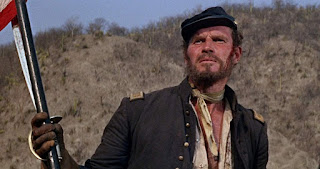
Major Dundee is a work of fiction, but very loosely inspired by some real-life skirmishes where Confederate prisoners joined Union soldiers in Texas to battle Indians. In the movie, as the American Civil War draws to a close, a group of Apaches under the leadership of Chief Charriba mount a series of raids and massacres against both Union and Confederate troops in and around New Mexico. The Union's Major Dundee (Heston) has accumulated a patchy war leadership record, and is assigned the somewhat demeaning command of a jail near the Mexico border. He takes it upon himself to assemble a rag-tag force of prison guards (including Black soldiers) and prisoners, including his bitter Confederate rival Captain Tyreen (Richard Harris), to go after Chief Charriba and his men.

Rather than focusing on their mission, Dundee's soldiers spend a lot of time threatening to kill each other as tensions between North and South, Black and white, and jailer and jailed simmer and sometimes boil over. With Dundee mounting an unconvincing pursuit, the Apaches soon take refuge in Mexico, where the French Army has assembled troops, setting up a triangular climactic conflict between Dundee's men, the Apaches and the French.

While there is enough going among all the galloping horses to maintain a rudimentary level of viewer attentiveness, the characters in Major Dundee are neither interesting nor sympathetic enough to ignite the movie. The conflict between Dundee and Tyreen, which should have given the film its centre of gravity, is drawn in crayons. Charlton Heston gives Dundee the same over-the-top higher calling that powers his biblical roles, while Harris looks like he just stepped out of a movie about those magnificent men in their flying machines. James Coburn wanders in and out of the action in an under-used role as Sam Potts, a one-armed half-breed who helps Dundee track the Apaches.
Santa Berger all of a sudden shows up in the unlikely role of a stunningly gorgeous European woman stranded in a tiny Mexican village. She further clogs up the progress of the movie by batting her eyelashes and contriving a romance with Dundee that mostly serves to prove her poor judgement and the ease with which he gets distracted.

The action scenes are a mixture of the sloppy, the bloody, and the confusing, with Peckinpah looking for but not yet finding artistry in cinematic violence. Although full of potential, Major Dundee is as flawed as its ragtag collection of characters. 


All Ace Black Movie Blog reviews are here.