Showing posts with label Natalie Portman. Show all posts

Sunday, 3 December 2023

Movie Review: May December (2023)


Genre: Psychological Drama
Director: Todd Haynes
Starring: Julianne Moore, Natalie Portman, Charles Melton
Running Time: 117 minutes

Synopsis: Actress Elizabeth Berry (Natalie Portman) arrives in Savannah, Georgia to spend time with Gracie Atherton-Yu (Julianne Moore) and her much younger husband Joe (Charles Melton). Elizabeth is due to play Gracie in an upcoming movie exploring her sensational story: Gracie and Joe fell in love when she was 36 and he was 13. She had his children in prison, and they were married upon her release. Now Gracie is close to 60 and Joe is 36 and their twin children are about to graduate from high school. Elizabeth is more than just curious, and starts to add turmoil to Gracie's family dynamics.

What Works Well: Loosely inspired by the life of Mary Kay Letourneau, director Todd Haynes and writer Samy Burch craft a sly human drama searching for the impulses behind notoriety. Revealing secrets through Elizabeth's not-purely-neutral outsider's perspective, the layers of complexity residing within Gracie are gradually peeled away, but there is always another shell protecting the core, perhaps even from Gracie herself. Meanwhile Elizabeth is quick to assess the relatively simple men in Gracie's life, with Joe not even aware of the multiple webs surrounding him. The intriguing contest between notorious woman and ambitious actress allows both Julianne Moore and Natalie Portman to exquisitely hint at quiet reservoirs of turmoil mixed with inner strength, accompanied by a playfully tense music score.

What Does Not Work As Well: The scars inflicted on Gracie's children are introduced in tantalizing doses, and could have benefited from broader exposition.

Conclusion: Life's real dramas reside well away from the headlines.


All Ace Black Movie Blog reviews are here.

Thursday, 17 February 2022

Movie Review: No Strings Attached (2011)

A clunky romantic comedy, No Strings Attached combines a clumsy premise with cursory characters and a cluttered cast.

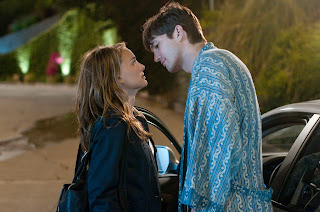
Friends since childhood, Emma (Natalie Portman) and Adam (Ashton Kutcher) meet again in their twenties. She is a medical student and not interested in a relationship. He is a television show production assistant. They agree to be sex friends with no commitments.

But Adam does care for Emma and develops an emotional attachment. He is also dealing with the awkward complication of his father Alvin (Kevin Kline), a famous television personality, now dating Adam's ex-girlfriend Vanessa (Ophelia Lovibond). When Emma's sister Katie (Olivia Thirlby) announces her wedding plans, the sex-only deal between Emma and Adam is tested. 

A tin-eared rom-com trying hard to be hip and failing miserably, No Strings Attached offers no redeeming qualities. Star Portman and director Ivan Reitman multiply their embarrassment with producer credits for a feeble, dead-on-arrival effort, sunk by an Elizabeth Meriwether script stocked with plastic characters, fabricated emotions, and not a hint of genuine comedy, romance, or authenticity.

Emma and Adam litter their dialogue with vulgarity in the script's misguided over-reach for raunchiness, all the cringey juvenile antics landing awkwardly in the laps of characters who ought to know better. Emma is supposed to be a medical student but never acts or talks in a manner consistent with her chosen profession. Meriwether can hardly be bothered to even explain the single obstacle placed in front of the lovers-to-be: Emma does not like commitments. Just because.

Portman is orders of magnitude better than the material, but even her spirited performance is consumed by the dross. She gets no help from a messy collection of supporting characters and side-plots, too many friends, roommates, and family members failing to obscure a lack of substance. The likes of Cary Elwes, Greta Gerwig, Lake Bell, Olivia Thirlby, and Mindy Kaling drift through the background to little effect.

The 108 minutes feel twice as long, as Reitman agonizingly trudges towards the pre-determined conclusion. No Strings Attached should have been cut adrift at the first draft.


All Ace Black Movie Blog reviews are here.

Friday, 3 September 2021

Movie Review: Lucy In The Sky (2019)

A mental stress drama, Lucy In The Sky explores trauma prompted by a literal out-of-this-world experience. The film evokes a mood of psychological bewilderment but frustratingly fails to follow through.

NASA astronaut Lucy Cola (Natalie Portman) returns to Earth after a space shuttle mission, feeling exhilarated but disoriented. Suddenly her old life with perpetually cheerful husband Drew (Dan Stevens), a space program marketing specialist, appears small and insignificant. All her life Lucy was driven to overachieve by her Nana (Ellen Burstyn), and now all she can think of is qualifying for a future mission and returning to space. 

She starts a torrid affair with fellow astronaut Mark Goodwin (Jon Hamm), who understands her feelings but may also just be looking after his own needs. Lucy is competing with younger astronaut Erin Eccles (Zazie Beetz) for a spot on a future mission, but program director Frank Paxton (Colman Domingo) notices Lucy's increasingly erratic behaviour, leading to a crisis.

Inspired by the true story of astronaut Lisa Nowak, Lucy In The Sky is perhaps overly constrained by real-life events. The screenplay by Brian C. Brown, Elliott DiGuiseppi, and director Noah Hawley contains tantalizing hints of a compelling drama, and Hawley plays with aspect ratios and weaves trance-like imagery into Lucy's daily life to capture her memories of space and sense of loss amidst earthly minutia. Natalie Portman contributes with a gritty and committed performance.

And yet with all the raw material in place to explore a brilliant overachieving mind going to pieces after exposure to space's grandeur, the film refuses to step into the difficult conversations. Crucially, the script never allows Lucy to express herself, leaving it to others to explain what she is experiencing. She remains stranded in a manic search for meaning, while Joe Hamm as Mark Goodwin gets a couple of scenes to eloquently describe the disconnect between the thrill of riding a rocket and the pettiness of day to day life. 

Most tellingly, Mark's repeated viewing of a seminal disaster tape on the eve of his next mission provides a blood-chilling emotional highlight. By sidelining the protagonist from any such moments, Lucy In The Sky appears to lack conviction in its own core.

Instead Lucy spirals towards a poorly defined Quixotic cross-country journey with her niece Blue Iris (Pearl Amanda Dickson) in tow. Her lunatic drive does represent a mind in the throes of crashing and burning, but Lucy In The Sky is satisfied with demonstrating a mental collapse, but not genuinely discussing it.


All Ace Black Movie Blog reviews are here.

Saturday, 2 January 2021

Movie Review: Vox Lux (2018)

A music-and-terrorism drama, Vox Lux offers a slick visual style and the interesting seeds of an idea, but fails to expound.

In 1999, 14 year old Celeste (Raffey Cassidy) survives a school shooting in New Brighton, Staten Island, but with a bullet lodged in her spine. Supported by her sister Ellie (Stacy Martin), Celeste performs a heartfelt song at the televised memorial service and is catapulted to national attention. Her parents hire a manager (Jude Law) to guide her career, and Celeste is soon on the way to global stardom, her early experiences punctuated by the September 11, 2001 terrorist attacks.

In 2017, Celeste (Natalie Portman) is a cynical, foul-mouthed diva, strung out on drugs and alcohol and dealing with the consequences of another tragedy, this one of her own making. Her teenaged daughter Albertine (again Raffey Cassidy) is mainly in the care of Ellie, although the sisterly bond between Celeste and Ellie has all but ruptured. Celeste is preparing to launch her newest album with a hometown concert, but a terrorist attack on a Croatian beach overshadows the preparations.

A visually rich style and hip, understated presentation featuring Willem Dafoe narration cannot hide the deep issues bedevilling Vox Lux. Director and co-writer Brady Corbet posits a provocative concept conflating terrorist acts with celebrity culture, but is unsure where to go with it. The film spends too much time on incidental scenes then lurches forward with uncoordinated pacing towards a tedious ending.

Celeste's rise to stardom and her redeeming adult qualities are skipped over in the gap between 2001 and 2017. As a result, and ironically when Natalie Portman enters the movie, the grown-up Celeste is an insufferable prima donna with all the pointy behaviours of a narcissist addict, an expert at belittling others and blaming them for it. Her inept handling of media questions about the Croatia terrorist attacks confirms her foul personality. Portman's performance is appropriately edgy, but her character deserves no sympathy or emotional investment, and leaves behind a catastrophic void at the heart of the film.

The final 15 minutes settle down to a bad concert, Portman as Celeste belting out a string of near-awful pop tunes with stiff dance moves underlining the garish spectacle. Lurking amidst all the bad costumes is commentary about a vacuous celebrity-worshipping society busily eroding itself while terrorists accelerate the job, but it's all lost in the on-stage muddle.


All Ace Black Blog Movie Reviews are here.

Sunday, 26 April 2020

Movie Review: Jane Got A Gun (2015)


A traditional western but with a female protagonist, Jane Got A Gun does everything right but nothing too special.

The setting is an isolated home in New Mexico of the 1870s. Bill "Ham" Hammond (Noah Emmerich) is shot-up by the Bishop brothers, but makes it back to his wife Jane (Natalie Portman), warning her the Bishops are continuing their pursuit. With Ham now bedridden, Jane turns to her ex-fiance Dan Frost (Joel Edgerton) for help. He is still sore about how their relationship ended and reluctant to get involved.

As Jane steels herself to confront John Bishop (Ewan McGregor), his brother Vic (Boyd Holbrook) and henchman Fitchum (Rodrigo Santoro), in flashback her history with Dan, Ham and the Bishops before and after the chaos of the Civil War is revealed.

Overcoming a troubled production history, Jane Got A Gun is a sturdy western, checking off many prerequisite elements without necessarily shining in any. Director Gavin O'Connor delivers an auspicious tale with multiple layers of revenge, a love triangle, a looming backs-to-the-wall showdown featuring outnumbered heroes, and a post-Civil War backdrop contributing to unmet expectations.

The film attempts to invest in characters and avoids headlong rushes into action. Pleasing Mandy Walker cinematography, judicious use of flashbacks, and a level-headed tone convey a cautious approach to frontier-inspired human struggles.

The feminist perspective is appropriately modulated for the era. Natalie Portman is in suitably humourless form and the Brian Duffield story sustains its intent for a headstrong woman to drive the narrative. Jane's story pulls together the threads between Dan, Ham and John Bishop, but O'Connor avoids any jarring anachronisms and Jane eventually receives crucial help to improve the odds.

The compact running length of 98 minutes is admirable, but a couple of areas fall short. The nighttime climactic confrontation between good and evil suffers from jerky camerawork, frustrating editing and a general sense of confused visuals. The clipped definition of lead antagonist John Bishop is the most obvious shortcoming. O'Connor does conjure up impressive if illogical vistas of the Bishop gang riding aimlessly enmasse in hostile desert terrain, but Ewan McGregor gets precious few scenes to make an impact, leaving the movie with a dark side void.

Jane not only gets a gun, she also gets herself a satisfyingly old-fashioned if not wholly inspiring western.


All Ace Black Blog Movie Reviews are here.


Sunday, 3 March 2019

Movie Review: The Other Woman (2009)


A domestic drama, The Other Woman adopts the perspective of the homewrecker but gets hopelessly lost in numerous emotional sub-plots.

In New York City, Emilia (Natalie Portman) is the second wife of lawyer Jack Woolf (Scott Cohen). She was a junior associate at his firm, they had a torrid affair and she broke up his admittedly unhappy marriage to respected doctor Dr. Carolyn Soule (Lisa Kudrow), who nevertheless remains deeply resentful about Emilia stealing her domestic life.

But Emilia is now having troubles of her own. She is still grieving the death of the newborn girl she conceived with Jack, and having trouble connecting with Jack's eight year old son William (Charlie Tahan). Emilia is also harbouring anger at her father Sheldon (Michael Cristofer), who cheated on her mother Laura (Debra Monk) and then abandoned the family. Although Emilia makes some progress with William, the numerous tensions threaten to overwhelm her happiness with Jack.

An adaptation of the Ayelet Waldman book Love and Other Impossible Pursuits (the movie is also known by this alternate title), The Other Woman is an overclocked and over-emotive melodrama about the problems of rich people. It's not much of an oversimplification to summarize the film as Emilia saying or doing the wrong thing, aggravating everyone around her, apologizing profusely, then purposefully striding into the next idiotic blunder. The kid William, irritating as he is, frequently demonstrates the more mature behaviour compared to his step-mom.

The film jumps from one emotional arc to another, loading Emilia with overwhelming distractions. Her various roles include homewrecker, grieving mother, hapless stepmother, helpless victim of the angry first wife, and angry daughter clueless that she is mimicking her father's behaviour. While in book form the multiple agonies may work, script writer and director Don Roos is unable to find a cohesive focus for a 100 minute movie, his central character sent spinning in numerous directions and getting exactly nowhere.

Some level of watchability is maintained by Portman and Kudrow. Both battle gamely against the inherent weakness of the material, and occasionally shine in portraying the gamut of emotions as two women unwittingly caught on either side of the same man. Scot Cohen is unfortunately a relative blank slate.

The Other Woman tries to carry too many burdens, and drops most of them in an uncoordinated clang.


All Ace Black Blog Movie Reviews are here.


Sunday, 4 November 2018

Movie Review: Annihilation (2018)


A science fiction horror film, Annihilation offers plenty of original material without quite reaching the profound heights it aims for.

Lena (Natalie Portman), a cellular biology professor and former army soldier, is in quarantine and being debriefed as the only survivor of a treacherous mission. In flashback, she recounts her story. She was grieving the disappearance of her husband Kane (Oscar Isaac), a Special Forces soldier missing for 12 months, when he suddenly reappears at home in a daze and suffering severe internal injuries. They are both whisked away to a secret military and scientific base in a large isolated natural reserve.

With Kane sedated and under treatment, psychologist Dr. Ventress (Jennifer Jason Leigh) explains to Lena that they are on an edge of an ever-growing area occupied by "the Shimmer", an alien phenomenon that crash landed onto Earth. All previous missions into the area have been annihilated, and Kane is the first survivor to ever walk out. Lena joins Ventress and four other women scientists preparing to enter the Shimmer, including Thorensen (Gina Rodriguez), Radek (Tessa Thompson) and Sheppard (Tuva Novotny).

Written and directed by Alex Garland, Annihilation is a beautifully photographed, glossy and innovative film. Capably blending human psychology with science and no shortage of horror and gore, Garland introduces plenty of thought-provoking material. The emphasis on a group of women scientists is refreshing, as is the premise of women scientists deployed to fulfill a mission where military men have previously failed. The fantastical imagery is seamlessly produced, and the monsters contribute moments of effective horror.

However, the film does suffer from an unfortunate inattention to important details, including an almost total disregard for basic scientific and military discipline. Garland decides to bypass some seemingly critical explanations, such as how a group of scientists are equipped with military rifles, why they proceed to touch and take samples within the Shimmer without any protective equipment, and according to what logic are guards posted on vulnerable open ground instead of on a readily available watchtower.

Garland does better on the more intellectual elements. One fundamental question emerging within the Shimmer is the reconstruction of nature, including humans, according to new cellular compositions, and the film asks whether markedly reimagined natural rules could possibly be a good thing. And the in-built human propensity to deconstruct as an escape and coping mechanism becomes a common thread in the lives of the women on the expedition.

While Garland does try to give each of the scientists a backstory, other than Lena and Ventress, they remain relatively featureless.

The final climactic resolution weaves together threads of renewal emerging from the pre-existing condition, and contains beauty, potential and mystery. Garland leaves most of the interpretation up for discussion, and while Annihilation is far from perfect, the Shimmer offers plenty of wonders to ponder.


All Ace Black Blog Movie Reviews are here.


Sunday, 6 May 2018

Movie Review: Léon: The Professional (1994)


A thriller drama, Léon: The Professional delves into the psyche of two lost souls to unearth the humanity within.

In New York City, Léon (Jean Reno) is a low profile but efficient hitman who fulfills assassination assignments on behalf of mafia front man Tony (Danny Aiello). Léon is uneducated and lives a lonely and well regimented life, his small plant the only thing he cares for. But he is friendly towards Mathilda (Natalie Portman), the 13 year old daughter of the family living in the next door apartment.

Mathilda's father crosses corrupt and psychotic Drug Enforcement Agency agent Norman Stansfield (Gary Oldman), and in the ensuing violence Mathilda's family is wiped out. She survives by taking refuge in Léon's apartment. The hitman is reluctant to take care of his unexpected visitor, but gradually they warm up to each other. She learns of his profession and insists that he train her to also be a killer so that she can pursue revenge. Meanwhile, she teaches him to read, and for the first time in his life Léon starts to care about someone.

Written and directed by Luc Besson,  Léon: The Professional features Natalie Portman's debut, an epic Gary Oldman villainous performance and an understated Jean Reno as a uniquely introverted assassin. With elegant action and character development mixed in just the right doses, the result is a captivating, and sometimes haunting, film.

Steering far clear of typical assassin characterizations, Besson creates in Léon an almost miserable man, a stranger in a strange land, out of place in New York City, unable to read, barely ever sleeping and living diametrically opposite from the glamour and riches often associated with efficient killing machines. Léon does not even care to receive the money he earns, Tony theoretically holding it for him.

Meanwhile Mathilda is suffering through her own hell, regularly beaten up by an abusive father who has gotten himself embroiled in the drug trade. Mathilda only cares about her innocent younger brother, and when he is hurt in the Stansfield-instigated bloodbath, the 13 year old girl starts to understand the appeal of revenge as a life calling.

Most of the film is occupied in nurturing the relationship between hitman and young girl, and Besson injects the full range of emotions. Léon goes against every instinct in his body to even open the door for Mathilda to escape with her life, and his second thought is to kill her why she sleeps to save both of them the trouble of creating a bond. From there they learn to care about each other, he assumes an imperfect fatherly role and she carries her infatuation towards a girl's immature ideas of love.

But with the out-of-control Norman Stansfield always nearby, the film is not short on action, and Besson includes plenty of exquisitely executed high-tension highlights, often in cramped surroundings, culminating in an all-or-nothing climax for all three main characters. Léon: The Professional is about learning to love, and plenty of education takes place under a hail of bullets.


All Ace Black Blog Movie Reviews are here.


Thursday, 6 July 2017

Movie Review: Where The Heart Is (2000)


A drama about life and love, Where The Heart Is finds most of the right notes in the story of an underprivileged young woman determined to carve a life for herself.

Seventeen years old, penniless and pregnant, Novalee Nation (Natalie Portman) is abandoned by her scummy boyfriend Willy Pickens (Dylan Bruno) at a Sequoyah, Oklahoma WalMart. The kindly Thelma Husband (Stockard Channing), a recovering alcoholic, extends a welcoming hand, but with nowhere to go Novalee surreptitiously starts to sleep at the WalMart by night while wandering around the community during the day. She meets store photographer Moses Whitecotton (Keith David) as well as town librarian Forney Hull (James Frain), an awkward young man whose college education was interrupted.

Novalee gives birth to a daughter she calls Americus, with Forney instrumental in the midnight delivery at the WalMart. While recovering at the hospital she meets nurse Lexie Coop (Ashley Judd), a vivacious unmarried mother of four who easily attracts all the wrong men. Meanwhile, Willy heads to Nashville in search of a music career and connects with talent agent Ruth Meyers (Joan Cusack). After an unsavory encounter with her no-good mother Lil (Sally Field), Novalee moves in with Thelma to start assembling something that resembles a life, and there are plenty of ups and downs ahead in the pursuit of happiness.

An adaptation of the Billie Letts novel of the same name, written for the screen by Lowell Ganz and Babaloo Mandel, and directed by Matt Williams, Where The Heart Is establishes a methodical one-crisis-per-10-minutes pace and does not stray far from the formula. And yet the film executes its mandate with admirable proficiency, and wins its audience with a heartfelt and well-intentioned portrayal of the human spirit hard at work.

Films populated entirely by relatively poor people are few and far between, and there is no knight in shining armour or rich saviour of any kind in Where The Heart Is. Nor is this a class warfare story glamorizing the poor but morally upright masses. Rather, this is a tale of gaining inches in the marathon of life. Novalee starts with literally nothing and the deck stacked against her, and works her way to something through sheer force of will and an always positive disposition.

Along the way she meets women of the same ilk, Thelma and Lexie fighting their own battles (against various addictions and insufferable men respectively) but just as determined as Novalee to fight back on their own terms of kindness.

Williams energetically works the film through the obstacle course of abandonment, poverty, abuse, natural disasters and awkward relationships, sprinkling enough small wins and moments of love and laughter to ensure Novalee always has the motivation and glimmers of hope to carry on. The outcome is a film that despite its sentimentality capably mirrors life's ups and downs.

All of 18 at the time of filming, Natalie Portman holds the film together and convincingly portrays Novalee from 17 to 22, adding textures of experience as the character ages. Ashley Judd is equally irresistible as Lexie, smiling at a life that serves her up a succession of adorable children but also a series of less than useless sperm donors.

Where The Heart Is finds a place that is honest and comfortably familiar, rich soil to help a young woman grow.


All Ace Black Blog Movie Reviews are here.


Thursday, 8 June 2017

Movie Review: V For Vendetta (2005)


A dystopian political conspiracy thriller, V For Vendetta is a satisfyingly complex comic adaptation, delivered with plenty of vigour and bold style.

A near-future England is ruled by a fascist anti-immigration homophobic government under High Chancellor Adam Sutler (John Hurt). The rest of the world has disintegrated into chaos with a civil war raging in the United States. On Guy Fawkes night in London, a mysterious masked man known only as V (Hugo Weaving) initiates a surprise bombing of the Old Bailey, takes over the British Television Network and invites citizens to join him a year later at the demolition of the Houses of Parliament.

V's actions are partially witnessed by Evey Hammond (Natalie Portman), a young BTN employee, and he takes her into his hideout, a cavern filled with historical artwork. Head of New Scotland Yard Eric Finch (Stephen Rea) sets out to investigate, identify and capture V and Evey, while Sutler's head of security Peter Creedy (Tim Pigott-Smith) favours more repressive measures to put a stop to V's plans. With the big night approaching Finch gets closer to uncovering V's background, and in the process discovers a mammoth conspiracy at the origins of England's descent into dictatorship.

Directed by James McTeigue and co-written by the Wachowskis as an adaptation of a limited comic book series, V For Vendetta threads the needle to park its loyalties with counter-revolutionaries, bombers, and freedom fighters all in the name of a fight for justice against an oppressive regime. A film that remarkably gains in relevance with the passing years, V For Vendetta is brimming with plot and characters, 132 breathless minutes counting down to one defining midnight.

The movie almost suffers from too much going on, but it's all relevant, and incendiary themes abound. V launches a one-man campaign of terrorism, hoping to reignite the passion of a nation. Chancellor Sutler spreads his hateful anti-immigration and homophobic poison through propagandist television talking heads, including  the "Voice of London" Lewis Prothero (Roger Allam), all in the name of protecting the country against foreign turmoil. The Stockholm Syndrome is at the heart of the relationship between Evey and V.  A secret bioweapons program, human experiments and the creation of false crises are gradually revealed as dark plots at the heart of societal transformation, and even within a totalitarian regime, there are rivalries to be exploited.

In lesser hands the story could have spiraled out of control, but McTeigue allows the threads to intertwine with reasonably effortless beauty. V, Evey and Finch each get the necessary time to evolve and contribute, the film gaining in power as it glides towards a stunning climax.

Aesthetically V For Vendetta is a perfect comic adaptation, centred on a masked crusader and surrounding him with a grim city suffering through its darkest days. The film remains grounded in characters and real world physics and avoids ruinous excessive special effects, and even the grand ending is more about people than events.

Hugo Weaving dominates with his silky booming voice from behind a mask, a literate poet crusader unafraid to destroy in order to rebuild. Natalie Portman plays Evey as a victim and an inspiration, a young woman destined to first witness and then play a role at the crossroads of history.

Despite some oversaturation at the margins, V For Vendetta is rich in both spirit and provocation.


All Ace Black Blog Movie Reviews are here.


Friday, 30 December 2016

Movie Review: Jackie (2016)


A drama focusing on the week after the assassination of President John F. Kennedy, Jackie is the personal story of a wife and mother forced to grieve in front of the entire, shocked world.

A week after the assassination, Life reporter Theodore H. White (Billy Crudup) is summoned by Jackie Kennedy (Natalie Portman) to the Kennedy's Hyannis Port, Massachusetts estate for a private interview. In flashback, the events immediately before, during and after the harrowing assassination in Dallas are presented from her perspective.

Jackie has to contend with the sudden death of her husband, her young children losing their father, making funeral arrangements with the leaders of the world attending, and the incoming Johnson administration, all while adjusting to the end of her life as First Lady. She uses the interview to help shape President Kennedy's legacy as an idyllic Camelot-like brief but shining period in US history.

Directed by Pablo Larraín, Jackie focuses on the other victim of November 22, 1963. While the nation lost a leader, a woman lost her husband and her life as she had planned it came to an appalling end. The film intercuts interview scenes, with Jackie and Theodore sitting face to face and staring straight at the camera, with flashbacks to the events of the past week. Jackie's imperative to gather herself in a calculated manner while in the glare of the world's spotlight translates somewhat to the film, and a sense of theatre sometimes stands in the way of human warmth. The machinations behind Jackie planning JFK's funeral procession also receive inordinate attention.

The film is otherwise an intense personal experience, delving into the soul of a woman still processing a massive shock, forced to transition instantaneously from a world of elegance to cleaning the blood and brains of her husband from her face and pink Chanel suit. The interview scenes reveal a steely-eyed but still shaken former first lady intent on framing her husband's tenure in the best possible light. Theodore takes the brunt of her decompressing attitude, as she unloads her emotions with a mixture of haughtiness and raw anger at the injustice befalling her family.

The flashbacks look slightly to the side of world-shaping events, Jackie the unwilling secondary character in a tragedy that kills her husband, his bloodied head in her lap, and forces her to witness a change in administration and the inevitable pressure to move out of her White House all while maintaining poise in front of her children and the world.

Natalie Portman is excellent in a controlled performance, and is ably supported by Crudup as White and Peter Sarsgaard as Bobby Kennedy. John Hurt appears as a pragmatic priest comforting Jackie as she processes her losses.

Larraín uses Jackie's redecoration of the White House, as featured in a groundbreaking February 1962 television documentary special, as a framing device to emphasize her passion for history and understanding of the continuum represented by successive Presidents. Misconstrued as a vanity project, Jackie wanted to bring to life the real men behind the legends who occupied the people's building.

Now she has to hurriedly add her husband, prematurely, to the ranks of leaders who contributed to nation building. His youth, enthusiasm, love for the arts and sense of idealistic optimism leads Jackie to the Camelot metaphor, ironically helping to create a legend out of a short-lived presidency. As one former first lady departs centre stage, the power of the media to shape a national narrative emerges from the margins, in readiness for more turmoil in the decades ahead.


All Ace Black Blog Movie Reviews are here.


Sunday, 3 May 2015

Movie Review: The Other Boleyn Girl (2008)


A fast-paced romp through the politics of sleeping with King Henry VIII, The Other Boleyn Girl plays fast and loose with history but is an undeniably enjoyable film.

It's the 1500s in England, and the Boleyn family are at the fringes of the royal circle. Thomas and Elizabeth Boleyn (Mark Rylance and Kristin Scott Thomas) have daughters Anne and Mary (Natalie Portman and Scarlett Johansson), who are both attractive and looking to get married. The older Anne is more outspoken and independent, while Mary is more demure and marries William Carey (Benedict Cumberbatch). The girls' uncle is the Duke Of Norfolk (David Morrissey), and he is aware that the marriage of King Henry VIII (Eric Bana) to Catherine of Aragon (Ana Torrent) is in trouble, since she cannot bear him a son.

The power hungry Duke spots an opportunity to gain influence by arranging for the King to take Anne as a lover. But the plan is quickly knocked off course when Henry falls under the spell of Mary instead, and takes her into his inner court as his mistress. Anne feels deeply betrayed, and a rift develops between the two sisters. Anne is hustled off to France to prevent her from interfering with the Boleyn family's growing influence. But Anne will not settle for being the "other" Boleyn girl, and soon her opportunity arrives to influence not just the King but the entire history of England.

Based on the novel by Phillippa Gregory and directed by Justin Chadwick, The Other Boleyn Girl does not pretend to be a historical record. Rather, this is a satisfying history lite story of naked ambition, sibling rivalry, and the little events that cause big ripples in the destiny of nations. That all the characters are based on real people and similar events actually did happen is just an intriguing bonus.

Proximity to the King is the crackling current feeding the cascading torrent of passion. For the Duke of Norfolk, tempting Henry with Anne is a pathway to influence. For Mary, acting as the King's lover is a duty not to be questioned. And for Anne, gaining the King's affection is a game of naked personal ambition and family one-upmanship. Only Elizabeth Boleyn, the mother unapprovingly witnessing her family's grab for power, attempts to resist the prevailing tide, but hers is a voice that will be prophetic rather than heeded. The thrust to satisfy the King's lust ends with fragments of discontent littered all over the family's destiny. And at a national level, Henry's manic drive to divorce and remarry creates an entirely new religious reality in Europe.

The Other Boleyn Girl is sharply edited to the point of abruptness. Breaking with the tradition of costume dramas requiring prolonged scenes of languid conversation, the better to linger on lavish dresses and impressive set designs, Chadwick instead aims for a snappy pace and keeps his scenes deliberately concise. The briskness ensures the film never descends into the heavy sands of weightiness for the sake of history; but is does come with some unusually snappy character decisions and some significant time compression between key events. Some seemingly critical incidents are skipped altogether and just commented on, including Henry's fall during the fox hunt and Anne's time in Paris.

Natalie Portman and Scarlett Johansson are a delight to watch, and they carry the emotional weight of the film. Portman has the showier, more intense role, but Johansson holds as much influence with an understated and ultimately more complex performance. Eric Bana offers a unique take on King Henry VIII, emphasizing the frenzy caused by the absolute need to father a son, at any cost. One or the other of the Boleyn girls will provide his heir to the throne, but not in any manner that the King would have predicted.


All Ace Black Blog Movie Reviews are here.


Sunday, 19 April 2015

Movie Review: Closer (2004)


A dramatic four-character study, Closer attempts to delve into relationship and dependency issues but is torpedoed by a histrionic, stagey script.

On a London sidewalk, obituary writer and aspiring novelist Dan (Jude Law) stumbles into recently arrived young American ex-stripper Alice (Natalie Portman). They start a relationship, and Dan writes a book, using Alice as his muse. Dan then meets photographer Anna (Julia Roberts), and they are immediately attracted to each other. Although initially they don't act on their impulses, Dan starts to stalk Anna.

At a bizarre aquarium encounter semi-arranged by Dan through an anonymous sex-chat encounter, dermatologist Larry (Clive Owen) meets Anna, and they become a couple and eventually get married. But Dan and Anna cannot stay away from each other, and they finally start a prolonged affair. But Larry will not easily give up on his marriage, and neither will Alice surrender the only man she ever cared for.

Directed by Mike Nichols and written by Patrick Marber as an adaptation of his play, Closer never finds its cinematic feet. The fundamental problem is that most of the dialogue sounds like it's coming from the imagination of a writer rather than the inspiration of real life. While the intensity of a stage play can sometimes carry a succession of over-burdened, melodramatic shouting matches, raw emotive exchanges and devious mind games obsessed with sexual power plays, when displayed relentlessly on film it all starts to sound oh so fake.

The four characters seem incapable of talking about anything other than sex, passion and their relationships. They exist in a void for the sole purpose of melodramatically interacting among each other, and the sparsity of the surrounding narrative catches up with the film and consumes it. By the end of 104 minutes very little is known about Dan, Alice, Larry and Anna except that they are rather deficient when it comes to controlling their lustful impulses. Certainly, none are too appealing as characters to care about.

Nichols does his best with the material, and at least he is able to open up the play somewhat to make good use of London locales. The film takes place over a few years with some use of flashbacks, and Nichols maintains some interest by not announcing the passage of time, allowing the content to hint at the sequence and time lag between milestones.

Natalie Portman emerges with the best performance, primarily because Alice is the most vulnerable and introverted character, keeping most of her emotions just beneath the surface. Law, Roberts and Owen are never less than watchable, but are hampered by overblown characters with next to no lust control.

Closer aims to explore intimacy, but takes a wrong turn and heads towards a convoluted hormonal overdose.


All Ace Black Blog Movie Reviews are here.


Friday, 11 April 2014

Movie Review: Beautiful Girls (1996)


A character-rich study with a focus on growing up and finding the right relationship, Beautiful Girls is a winsome slice of small-town life.

Sensitive piano player Willie (Timothy Hutton), now based in New York City, return to his snowy small hometown of Knights Ridge, Massachusetts, for a high school reunion. Willie reconnects with his old school buddies who never left town, and are now all in their late twenties: Tommy (Matt Dillon), Mo (Noah Emmerich), Paul (Michael Rapaport), Kev (Max Perlich), and Stanley (Pruitt Taylor Vince).

Tommy ("Birdman") was the school football star, and he never grew up. Now running a small snowplow company, Tommy is seeing Sharon (Mira Sorvino), but carrying on an affair with his married high school sweetheart Derian (Lauren Holly). Mo is happily married to Sarah (Anne Bobby), and is the most settled of the group. Paul is also a snowplower and has not moved beyond the supermodel pin-up phase nor learned to deal with real women. He is having trouble letting go of former girlfriend Jan (Martha Plimpton), who is now dating someone else. Kev is Tommy's sidekick, while hardworking Stanley ("Stinky") is operating his own restaurant.

As Willie catches up with the lives and loves of his buddies, he meets and befriends his neighbours' daughter, precocious 13 year old Marty (Natalie Portman), and contemplates his future with long-term New York girlfriend Tracy (Annabeth Gish). The town's wisemouth hairdresser Gina (Rosie O'Donnell) dishes out advice to anyone who listens, while Stinky's stunningly beautiful cousin Andera (Uma Thurman) arrives in town, and causes a stir among the guys.

A film with no heroes, villains, central romance, irony or glib humour, Beautiful Girls is simply about people trying to assemble the puzzle of adulthood. With echoes of Mystic Pizza (1988), Beautiful Girls excels at creating rounded, flawed characters worth caring about. Director Ted Demme, working from a fine script by Scott Rosenberg, quickly establishes the guys, the girls and the complex dynamics between them, bringing the tapestry of life to the quiet streets of Knights Ridge.

The film glides easily between the no less than 16 friends and relatives who make up Willie's ecosystem, and just as Willie drops into the lives-in-progress of his friends, the film catches all the relevant stories mid-stream. Paul is struggling to cope with Jan leaving him behind, Tommy is caught between the devoted Sharon and the lusty Derian, while Mo and Stinky are just getting on with lives that have traded glamour for maturity.

The catalysts are the outsiders and newcomers. Young Marty brings an inquisitive mind and an open heart into Willie's life, their chats developing into a credible crush that is intellectually impossible but emotionally real. Andera, with her big-city outlook and no nostalgic attachments to Knights Ridge, sees things for what they are, piercing through Paul's amateur attempts at making Jan jealous, immediately reading Tommy's immaturity, and finding in Willie the one man worth nudging towards the right side of the commitment fence.

To drive the narrative forward, Rosenberg does allow the members of Willie's circle to quickly open up and talk through their issues. Guys like Tommy and Paul may be stuck in teenage mode and unable to grapple with what it means to be men, but they are nevertheless not shy about talking through their thoughts, emotions and viewpoints. This ability to share is at odds with the often emotionally stilted reality of relatively immature guys.

The performances from the ensemble cast strike a perfect tone, the characters all translated into real people navigating the choppy waters of small town living and mismanaged expectations. Hutton, Dillon, and Rapaport form the strongest bond at the heart of the many friendships, but Natalie Portman, all of 14 during filming, steals the movie with a stunning performance, finding the thin edge between child and adult, smart but not sassy, sensitive but not sentimental. Her relationship with Willie becomes a trigger for a better future: he sees himself through her eyes as a man worth living up to the name. The most beautiful girl, as it turns out, is also the youngest, and her beauty radiates through her belief in tomorrow's possibilities.


All Ace Black Blog Movie Reviews are here.