Showing posts with label Joaquin Phoenix. Show all posts

Saturday, 21 February 2026

Movie Review: Two Lovers (2008)


Genre: Romantic Drama  
Director: James Gray  
Starring: Joaquin Phoenix, Gwyneth Paltrow, Vinessa Shaw, Isabella Rossellini, Elias Koteas  
Running Time: 110 minutes  

Synopsis: In Brooklyn, Leonard (Joaquin Phoenix) is bi-polar, suicidal, and living with his parents Ruth and Reuben (Isabella Rossellini and Moni Moshonov). They arrange for him to meet Sandra (Vinessa Shaw), the daughter of Reuben's business partner. She is willing to try a relationship, but Leonard is distracted by Michelle (Gwyneth Paltrow), the more glamorous upstairs neighbour. Michelle is a troubled party girl and having an affair with a married lawyer (Elias Koteas), but Leonard nevertheless grows increasingly attached to her.

What Works Well: This is a refreshingly organic romance featuring imperfect people flailing within messy lives. Leonard has failed to launch and is close to imploding, director and co-writer James Gray introducing his protagonist with a jump-off-a-low-bridge half-hearted suicide attempt. Sandra may be a saviour but Michelle is compelling, her maelstrom of clubs, ecstasy, and infidelity shrouding her ability to pursue any rational future. Bypassing romantic movie cliches, the drama seeks next-best options when ideal resolutions are far out of reach. 

What Does Not Work As Well: The commitment to stripped emotions exposes gaps in realism, judgement, and avoided conversations. After the introduction, Leonard's mental health is relegated to an afterthought, and the script conveniently ignores the future prospects of a relationship with the equally fragile Michelle. The stable Sandra is aware of what she may be getting herself into, suggesting a misdirected mothering instinct rather than true passion. The final act reaches for a superficially satisfactory ending riding on a brittle foundation.

Key Quote:
Sandra (to Leonard): I wanna take care of you. I feel like I understand you.


All Ace Black Movie Blog reviews are here.

Saturday, 8 November 2025

Movie Review: Signs (2002)


Genre: Suspense Drama  
Director: M. Night Shyamalan  
Starring: Mel Gibson, Joaquin Phoenix, Cherry Jones, Rory Culkin, Abigail Breslin  
Running Time: 106 minutes  

Synopsis: Widower Graham Hess (Mel Gibson) lives on a farm in rural Pennsylvania with his children Morgan and Bo (Rory Culkin and Abigail Breslin), as well as his younger brother Merrill (Joaquin Phoenix). Graham was the former local priest, but lost faith when his wife was killed in a car crash. Strange crop circles start appearing within Graham's corn fields, followed by reports of similar crop patterns from around the world and then alien spaceships in the skies above multiple cities. As a seemingly cataclysmic event draws near, Graham has to find ways to protect his family.

What Works Well: In this intimate exploration of faith and belief, writer and director M. Night Shyamalan zooms in to the family level at a single location as Earth-threatening events approach. While there are moments of suspense and unsettling encounters with aliens (counterbalanced with touches of humour), the narrative is free from elaborate special effects and large-scale scenes of destruction. Instead the focus is on scarred emotions, internal conflicts, and the invisible lines connecting past events with future opportunities. The dialogue is often unusually thoughtful and heartfelt, seeking core human attributes where fear, resignation, familial love, and hope interact.

What Does Not Work As Well: The background story of the extra-terrestrial threat is no more than a sketched-in catalyst, and this unfortunately extends to the less-than-plausible weaknesses of this supposedly advanced invading force.

Key Quote:
Graham: Is it possible that there are no coincidences?


All Ace Black Movie Blog reviews are here.

Saturday, 15 February 2025

Movie Review: To Die For (1995)


Genre: Satirical Crime Dramedy  
Director: Gus Van Sant  
Starring: Nicole Kidman, Matt Dillon, Joaquin Phoenix, Casey Affleck  
Running Time: 106 minutes  

Synopsis: The small town of Little Hope, New Hampshire is scandalized by the arrest of local television weather girl Suzanne Stone (Nicole Kidman) for plotting her husband's murder. In flashbacks and witness interviews, Suzanne is revealed as ambitious, vain, and obsessed with being on television. She marries Larry (Matt Dillon) but is always more interested in her career. After securing a job at a local cable station, she starts work on a documentary featuring underachieving high schoolers Jimmy, Russell, and Lydia (Joaquin Phoenix, Casey Affleck, and Alison Folland). When Larry attempts to constrain Suzanne's ambitions, she initiates a marriage escape plan through a nefarious seduction of the particularly dim Jimmy.  

What Works Well: Inspired by the Pamela Smart story, writer Buck Henry adapts Joyce Maynard's book into a sly mockumentary packed with astute celebrity culture observations. Director Gus Van Sant wades through the toxic combination of ambition, narcissism, and obsession with fame, and adds femme fatale sex-as-a-weapon noir shadings. Suzanne, Jimmy, Lydia, and Larry's sister Janice (Illeana Douglas) expand on their side of the story straight to the camera, stirring manipulation and victimization into a frothy mix. Nicole Kidman achieves a career highlight conveying the complex contradiction of limited smarts and sexual allure colliding with over-confidence and self-delusion.

What Does Not Work As Well: Given the comprehensive character investments, the resolutions are abrupt, including a barely-there investigation and a frigid mop-up. Suzanne's lack of forethought after she wriggles free of marital shackles is inconsistent with the preceding level of connivance.

Key Quote:
Suzanne: You're not anybody in America unless you're on TV. On TV is where we learn about who we really are. Because what's the point of doing anything worthwhile if nobody's watching? And if people are watching, it makes you a better person.


All Ace Black Movie Blog reviews are here.

Saturday, 26 August 2023

Movie Review: You Were Never Really Here (2017)


Genre: Crime Drama
Director: Lynne Ramsay
Starring: Joaquin Phoenix, Judith Roberts, Ekaterina Samsonov
Running Time: 90 minutes

Synopsis: Military veteran Joe (Joaquin Phoenix) was abused as a child. Now he lives with his mother (Judith Roberts) and works as a lumbering and violent fixer for shadowy operatives with political connections. Joe's next assignment is to rescue Nina (Ekaterina Samsonov), a senator's daughter who has been abducted for sex trafficking. But the case takes an unexpected turn and Joe becomes a suspect as the body count mounts.

What Works Well: The cinematography, lighting, and grimy locations contribute to a moody and bleak aesthetic, and director Lynne Ramsay is always looking for artistic compositions. In a physically domineering performance, Joaquin Phoenix translates abject despair into soulless efficiency. 

What Does Not Work As Well: The villains are barely defined, and the logic-defying plot is borderline incomprehensible as narrative coherence is sacrificed for style. The flashback snippets frustratingly remain just that, and despite the short duration, ponderous pacing results in lackadaisical energy.

Conclusion: A strong central character is lost in indulgent abstractions.


All Ace Black Movie Blog reviews are here.

Saturday, 17 June 2023

Movie Review: Hotel Rwanda (2004)


Genre: Biographical Genocide Drama
Director: Terry George
Starring: Don Cheadle, Sophie Okonedo, Nick Nolte, Joaquin Phoenix, Jean Reno
Running Time: 121 minutes

Synopsis: It's 1994, and Paul Rusesabagina (Don Cheadle) is a manager at the prestigious Belgian-owned Hôtel des Mille Collines in Kigali, Rwanda. Ethnic tensions erupt into genocide as majority Hutu militias unleash death on the Tutsi minority. Paul and his wife Tatiana (Sophie Okonedo) offer refuge at the hotel to anyone escaping the carnage, eventually sheltering more than 800 people. Paul has to keep his guests safe from a bloodthirsty militia leader and an army general, while the understaffed United Nations peacekeeping mission under Colonel Oliver (Nick Nolte) struggles to get the world's attention.

What Works Well: Based on actual events, director Terry George and his co-writer Keir Pearson chisel a story of personal courage out of the horrors of human brutality. Avoiding gore and side-stepping sentimentality, the narrative traces a country's harrowing disintegration and Rusesabagina countering with resourceful kindness in the face of adversity. Don Cheadle bundles audacity and quick thinking into a masterful portrayal of initiative under extreme pressure, and Nick Nolte provides crusty support as the UN commander loosely inspired by Canadian General Romeo Dallaire. The film spares no shame in exposing the value of black African lives in the world's calculus.

What Does Not Work As Well: The depiction of a genocide that took 800,000 lives in three months is primarily confined to bloodless abstract victims.

Conclusion: Delivers individual hope and collective despair in equal measures.


All Ace Black Movie Blog reviews are here.

Wednesday, 22 June 2022

Movie Review: C'mon C'mon (2021)

An uncle-nephew drama, C'mon C'mon appears to have important things to say but never quite gets there.

Radio journalist Johnny (Joaquin Phoenix) is on a cross-country assignment interviewing young teenagers about their thoughts on the future. After finishing a stint in Detroit, he travels to Los Angeles to visit his sister Viv (Gaby Hoffman) and her 9-year-old son Jesse (Woody Norman). Johnny and Viv are close but their relationship was tested during their mother's difficult final days a year earlier.

Now Viv needs to travel to Oakland support her husband Paul (Scoot McNairy), who is suffering from mental health issues. Johnny agrees to care for Jesse, who has peculiar habits and anxieties related to his father's condition. Uncle and nephew start to bond, and Jesse learns to use Johnny's sound recording equipment. When Viv's stay in Oakland is prolonged, Johnny takes Jesse to his next set of interviews in New York.

Written and directed by Mike Mills, C'mon C'mon looks gorgeous. Robbie Ryan's sharp black and white cinematography evokes a simpler era consistent with a child's perspective, and both the interiors and street-level exteriors glow with stark possibilities.

Unfortunately, the aesthetics are more engrossing than the content. A large chunk of the film is occupied by random young adolescents expressing their hopes for the future and advising adults on how to be better adults. Potentially interesting as discussion material for a junior college freshman class, here the snippets become cinematic dead space. Johnny's morose descriptive narration does not help.

Mills does better with young Jesse's quirky behaviour in the form of angled curiosity and signs of a troubled psyche stemming from a father's sickness and mother's stress. As he gets to know his uncle, Jesse enjoys interacting with an engaged and healthy surrogate father figure, and Johnny experiences joys and responsibilities he has otherwise missed out on. Warmth permeates their bonding process.

Increasingly missing his mother, Jesse starts to test boundaries, and in the absence of a committed and present parent to bounce off, his arc's possibilities are truncated. The ideas predictably dry up and the pacing slows to a crawl, Mills defaulting to the awful crutch scene of screaming-obscenities-in-the-wilderness as a clunky metaphor for emotional release. 

Fragments of more interesting adult issues do surface, including Johnny's regrets in life and the tension between him and Viv, but these are barely exploited. C'mon C'mon teases with possibilities, but chooses kidspeak instead.


All Ace Black Movie Blog reviews are here.

Wednesday, 22 September 2021

Movie Review: The Sisters Brothers (2018)

A chase western, The Sisters Brothers features a character-rich tale of greed, science, shifting alliances, and plenty of killing.

In the American West of the 1850s, brothers Eli and Charlie Sisters (John C. Reilly and Joaquin Phoenix) are assassins-for-hire doing the dirty work for Oregon-based industrialist The Commodore (Rutger Hauer). Brash younger brother Charlie is an expert gunslinger but also frequently drunk. The older Eli is more circumspect.

With the California gold rush in full swing, their next assignment is to catch-up with detective John Morris (Jake Gyllenhaal), who is supposed to find and apprehend prospector Hermann Kermit Warm (Riz Ahmed). Morris does find Warm on the way to California, but they become partners once Morris learns about Warm's chemical discovery. The Sisters brothers now doggedly chase down both men, and more surprises await when the pursuers find the pursued.

An adaptation of the Patrick DeWitt novel, The Sisters Brothers is an often engrossing western with a twisty plot. French Director and co-writer Jacques Audiard draws inspiration from classics like The Treasure Of The Sierra Madre (the greedy pursuit of gold subsuming everything else) and Butch Cassidy And The Sundance Kid (the endless chase, here flipped twice), and adds spikes of humour and frequent shoot-outs to some visually magnificent landscapes.

The film's strength is drawn from four sharply drawn characters. In this story, the nasty cold-blooded assassins are the central protagonists. Eli and Charlie have a backstory fuelling their relaxed relationship with death, while an uneasy dynamic crackles between the two men. They actually rarely agree on anything, but they also always look after each other and combine their strengths to repeatedly get out of impossible jams.

Meanwhile, Morris is a thoughtful and soulful detective using his diary to chronicle his travels. An expert at finding men but with no interest in killing them, Morris has no difficulty finding Warm and sidling up to him. But the prospector is a shifty character and probably the smartest of the lot. A misfit and penniless chemist seeking a wild west fortune, he is a man with a different plan to get rich quick. And once Morris and the Sisters brothers find out what Warm is up to, all the agendas are shuffled. But greed is an all-consuming monster, tearing alliances apart as easily as they are forged, with the added misery of rapid physical and psychological degeneration.

The characterizations are boosted by interludes of short and sharp action, Audiard finding mixed success in seeking innovative ways to demonstrate the brothers' calculated bravura as they confront numerically superior enemies. Some of the nighttime scenes are brilliantly staged, while others are a muddle of indistinct shadows.

Small details round out The Sisters Brothers, mostly swirling around Eli. A small bug causes an inconvenient sickness; a middling but resilient horse becomes a precious companion; and a scarf from a long-ago liaison carries the symbolism of a life never to be experienced. Heartless gunslingers plagued the west, but they too were once men with hopes, dreams, and scars.


All Ace Black Movie Blog reviews are here.

Thursday, 4 March 2021

Movie Review: Irrational Man (2015)

A drama, comedy, romance, and crime mystery, Irrational Man is a bright Woody Allen outing with a judicious mix of ingredients.

Preceded by a reputation for rampant womanizing and heavy drinking, philosophy professor Abe Lucas (Joaquin Phoenix) starts a new job at picturesque Braylin College in New England. He immediately attracts the attention of two women: married chemistry professor Rita Richards (Parker Posey), and his student Jill Pollard (Emma Stone), who has a serious boyfriend Roy (Jamie Blackley).

Both women find Abe depressed and lacking a purpose in life, and Rita soon discovers he is also suffering from erectile dysfunction. Jill persists with a friendship that evolves towards love, although Abe resists her sexual overtures. But when they overhear a stranger's story about corrupt family court Judge Thomas Spangler, Abe decides killing the judge will provide him the spark he needs in life.

Written and directed by Allen and clocking in at just 95 minutes, Irrational Man is a breezy mix of existential angst, blossoming love, and crime most foul. Focusing on just the three characters but surrounding them with an idyllic milieu at a relaxed college campus where anything seems to go, Allen is free to explore themes of depression, motivation, infatuation and ultimately how far friendship and loyalty can be tested, all with sly humour.

When Abe is in his initial gloomy state, the philosophical babble about life's futility is kept short and on the accessible side, although Allen can't resist having even Jill profoundly familiar with dense references to philosophers, poets and artists. The narrative delightfully curves to a reawakening of Abe's soul and spirit, thanks to a Hitchcockian murder plot carrying winks towards both Strangers On A Train and Dial M For Murder. Instead of escaping dysfunctional relationships, here murder is a tool to break away from psychological hopelessness, and Abe's transformation triggers cascading consequences for Rita and Jill.

Joaquin Phoenix loosens a floppy belly and transitions between Abe's two modes with light switch efficiency. Emma Stone gets the more complicated role and is radiant as the smart student, already in a relationship but gradually drawn into a lustful emotional rescue mission.

The ending is a bit abrupt and perhaps a stretch even for Abe's warped sense of passion, but with a Randy Lewis soundtrack providing a bouncy jazz soundtrack, Irrational Man provides smooth unpredictability.


All Ace Black Movie Blog reviews are here.

Thursday, 23 January 2020

Movie Review: Joker (2019)


A mental anguish drama, Joker is a disturbing origins story infused with a dark mood.

In a dilapidating Gotham City, Arthur Fleck (Joaquin Phoenix) suffers from mental issues, including uncontrollable bouts of awkward laughing. He works as a clown-for-hire, and lives with his mother Penny (Frances Conroy), who speaks highly of mayoral candidate Thomas Wayne (Brett Cullen). Arthur has unrealistic hopes of a career as a stand-up comic, and admires late night television talk show host Murray Franklin (Robert De Niro).

Arthur is assaulted by a group of thugs, then budget cuts curtail the social services available to him. A colleague provides him with a gun, presumably for self defence. He meets his neighbour, single mom Sophie (Zazie Beetz), but then loses his job and sinks deeper into despair. While wearing clown makeup Arthur tangles with a group of obnoxious men on the subway, and Wayne's glib reaction to the incident sparks class warfare street protests. Arthur starts to discover shocking secrets about his mother and his past, pushing him over the edge of sanity.

The primary villain in the Batman universe receives his own background story, and Joker is a gloomy descent into despondency. Director and co-writer Todd Phillips conceives of soulless wickedness emerging as a reaction to an uncaring world filled with rampant bullying, where a fragile man like Arthur Fleck does not so much fall through the cracks as is shoved through them.

Colleagues make fun of him, goons kick him in the street, and budget cuts take away his limited opportunities for subsidized help. Unfit for any meaningful work and unable to control his embarrassing laughter to even perform as a comic, Arthur is close to unsalvageable. Once he peels away the layers of his mother's secrets and with a gun in his hand, he turns into something much more dangerous.

The joys of evil cause a rare twinkle in his eye. Arthur notices how his subway incident brings a sense of power, media attention and people to the streets. The celebrity he craves by dreaming of an appearance on the Murray Franklin show is now within reach, but along a twisted pathway littered with victims.

Arthur's gradual transformation from societal victim to murderous freak is the film's sole obsession to the exclusion of any other plot elements, and as a result all the secondary characters are thinly defined. But in the title role Joaquin Phoenix dominates, delivering a haunting performance filled with coiled intensity. He alternates between pitiful, willing and menacing, dark eyes burning with building hatred at a world singularly lacking in empathy for men like him.

Phillips freely borrows aesthetics and themes from Scorsese's Taxi Driver and The King Of Comedy as he steers Joker to several visual highlights, Phoenix physically throwing himself into statuesque posturing and scenes of urban landscape dominance through sheer presence. The costumes and make-up are chilling and build to a classic look as Joker finally introduces himself to a large television audience. The man looks funny, but he will now ensure no one else is laughing.


All Ace Black Blog Movie Reviews are here.


Tuesday, 13 February 2018

Movie Review: Walk The Line (2005)


A musical biography, Walk The Line chronicles the career and personal life of country singer Johnny Cash.

As a child growing up on a cotton farm in rural Arkansas, Johnny is traumatized by the accidental death of his older brother Jack, and never overcomes his strict father Ray (Robert Patrick) believing the wrong son died. After a stint in the army stationed in Germany, Cash (Joaquin Phoenix) marries his sweetheart Vivian (Ginnifer Goodwin). They settle in Memphis and start a family. He is useless as a salesperson and instead dreams of a music career.

With unpaid bills and eviction notices mounting, he records his first song, local success follows and he starts touring. On the road John meets vivacious country singer June Carter (Reese Witherspoon) and is immediately smitten. They are both married to others, but start a deep friendship that goes through ups and down as Cash's fame spreads with a succession of hits. June refuses to become romantically embroiled while Johnny is married. He is soon addicted to drugs and alcohol, and both his career and his health start to suffer.

Directed and co-written by James Mangold, Walk The Line is a satisfying mix of biography, romance and drama. The film covers Cash's life from childhood in the mid-1940s to the late 1960s, and Mangold finds some good anchors to hang the story on. The death of beloved older brother Jack is a childhood trauma that resonates throughout John's life, and the strained relationship with his father Ray is another long-running source of tension.

But it's the love story between Cash and June that emerges as the defining relationship in John's life, and Mangold is able to portray the aching longing between two performers meant for each other but held back by personal circumstances. June is the more thoughtful adult in this couple, doing the math and concluding that as long as John is married there is no payoff in yielding to his desperate appeals for deep commitment. Their journey towards finding each other is long, painful and convoluted, but Mangold nails the resolution in the film's emotional highlight (which takes place on stage, of course).

In terms of Cash's musical career, the film features many of his most famous hits, delivered with conviction by Phoenix in a series of performances in various venues, ranging from tiny school auditoriums to massive stadia. Folsom Prison Blues, I Walk The Line, Ring Of Fire, and Home Of The Blues all make an appearance. The film starts with Cash's legendary show inside Folsom Prison, and loops back much later to reveal the event's place in his legacy.

Joaquin Phoenix finds all the different facets of Cash, from fresh faced and eager to washed up and worn down by all the pills and alcohol. Reese Witherspoon won the Best Actress Academy Award as June Carter, an energetic entertainer with a remarkably firm grip on reality despite the craziness of life on the road as a mother of young kids.

At well over two hours the film does drag, and the scenes of moping and personal disintegration caused by substance abuse do soldier on long after the point is made. But overall Walk The Line is a heartfelt and worthy tribute, both to the man himself and the woman standing by his side through good songs and bad.


All Ace Black Blog Movie Reviews are here.


Monday, 12 September 2016

Movie Review: Inherent Vice (2014)


A loose stoner crime drama, Inherent Vice is an incomprehensible mess, an assortment of ideas, characters and events thrown into a jumble and left to die on the vine of fake profundity.

It's Los Angeles in 1970, and perpetually stoned private detective Larry "Doc" Sportello (Joaquin Phoenix) gets a surprise visit from his ex-girlfriend Shasta Fay Hepworth (Katherine Waterston). She wants Doc to investigate a plot against her current illicit lover, development tycoon Mickey Wolfmann (Eric Roberts). Doc is also contacted by ex-con Tariq Khalil (Michael K. Williams), who wants Doc to recover money from Glen Charlock, one of Wolfmann's guards. Before long both Shasta and Wolfmann have disappeared, Charlock is dead, and Doc is the main murder suspect, being harassed by legendary Detective Christian "Bigfoot" Bjornsen (Josh Brolin).

With help from his lawyer Sauncho Smilax (Benicio del Toro) Doc stays free, and is soon investigating the curious case of Coy Harlingen (Owen Wilson), a police informant seemingly embroiled over his head with white supremacists. Doc also uncovers a shadowy organization called Golden Fang, which may be a front for an international drug trafficking cartel involving creepy dentists. As Doc continues to poke his nose into the various cases, his own life comes under threat.

An ill conceived marriage of Chinatown and The Big Lebowski, Inherent Vice is director and writer Paul Thomas Anderson finding a putrid nadir as he tries to adapt a novel by Thomas Pynchon. With a production environment variously described as chaotic, crazy and devoid of a goal, the on-screen product appears to confirm that no one really knew what they were doing, least of all the director and actors. At an overlong 149 minutes, the film is excruciatingly tedious, before finally tripping into the unintentionally funny territory occupied by ridiculous narcissists.

Every scene introduces new characters in name or in person, and most of them then appear for one or two scenes and then disappear for good. Plot points come and go at random, and the synopsis presented above is just a starting point from which multiple threads end up dangling, none of them remotely coherent. By the end of the film Doc is held hostage and is then killing random bad guys for reasons that are never entirely clear. Flatfoot is either an ally or an opponent, Shasta and Wolfmann have undisappeared but no one seems to really care, drug deals are going down, and somehow Doc decides that it's important to trade for the freedom of informant Coy.

Anderson fails miserably to build empathy for any of the characters, a fundamental requirement to save an excessively dense plot. Instead all of the events are opaque and unresolved, and the movie is littered with guest appearances representing superficial and phony characters of no ultimate consequence. Anderson confuses long stretches of stoned dialogue involving Doc, Shasta and Coy for a deep delving into backgrounds and motivations, but the conversations are esoteric to the point of self-obsessed gibberish.

A case of an emperor caught decisively with no clothes on, Inherent Vice is inherently a disaster.


All Ace Black Blog Movie Reviews are here.


Thursday, 12 November 2015

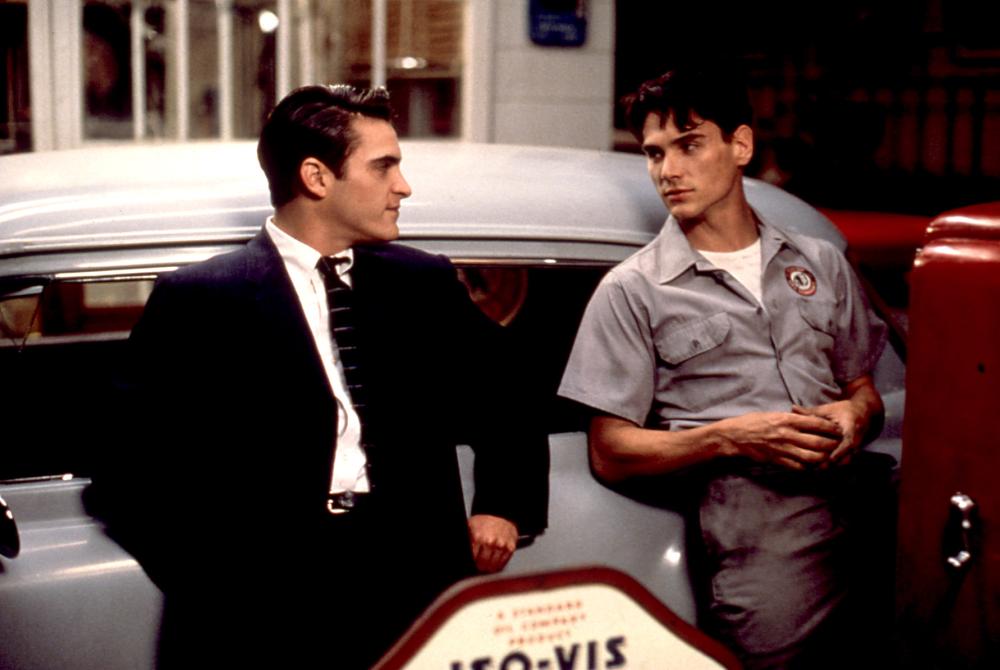
Movie Review: Inventing The Abbotts (1997)


A coming of age drama, Inventing The Abbotts has good intentions and decent characters, but also gets bogged down in a narrow narrative scope that veers towards the tiresome.

The small Midwest town of Haley, Illinois, in the 1950s. Teenaged brothers Jacey (Billy Crudup) and Doug Holt (Joaquin Phoenix) are brought up by single mom Helen (Kathy Baker), their father having died a long time ago. Jacey is intense, driven and determined to move ahead in life. Doug is much more mellow and awkward. Haley is dominated by the rich Abbott family, presided over by patriarch Lloyd (Will Patton).

The three Abbott daughters are objects of fascination and desire. Alice (Joana Going) is about to get married. The wild Eleanor (Jennifer Connelly) does all she can to irritate her father, including carrying on an affair with Jacey. The more timid Pamela (Liv Tyler) has eyes for Doug, but he is also infatuated with Eleanor. As Jacey and Doug transition from high school to college, Jacey runs afoul of Lloyd's anger, Eleanor disappears from town, Doug has an on-again, off-again relationship with Pamela, and the complicated history involving Lloyd, Helen and the boys' dead father emerges.

A slice-of-life drama and romance, Inventing The Abbotts aims for a poignant vibe, nurtured by a love and anger in a small town milieu. Director Pat O'Connor occasionally succeeds in touching the tender chords of young hearts evolving into adults. But as the film progresses into its second half, the story (originally a Sue Miller novel) narrows down to Jacey's soulless obsession with all things Abbott, while Doug and Pamela discover new ways to hurt each other. Instead of seizing opportunities to become adults, the boys' behaviour more often than not appears to regress, confining the film into a limited emotional box.

In its better moments, the film does offer tastes of flavourful topics. There are intertwined themes of classicism, with the Holts inherently seeing themselves as subsidiary to the rich Abbotts, but the Abbott girls also struggling against their own family's reputation. The shadows cast by fathers, present or missing, also provide rich grounds for exploration, with Lloyd Abbott and Helen's deceased husband sharing a history that will be painfully and gradually revealed. The relationship between the two brothers Jacey and Doug is fraught with minefields, and the film takes no shortcuts towards brotherly reconciliation.

The performances are consistent with the material, and the limited character growth means that the acting need only be satisfactory rather than stellar. Joaquin Phoenix occupies the emotional centre of the film, and provides Doug with the awkwardness of small town youth beginning to grapple with adult problems. Billy Crudup infuses Jacey with bitter fervor as a young man who believes that the world owes him, but Crudup is most hampered by a script that forgets to allow Jacey to grow up.

Among the girls, Jennifer Connelly succeeds in making Eleanor an object of boyhood fantasy but then disappears from the film for a long period. Liv Tyler is honest as the down-to-earth Pamela, living in her sister's shadow. As the parents Kathy Baker and Will Patton are adequate in support, but again their characters remain at a steady state. Michael Keaton provides uncredited narration as the grown-up Doug.

Inventing The Abbotts is sometimes pleasingly wistful, and just as often, painfully wasteful.


All Ace Black Blog Movie Reviews are here.


Friday, 2 October 2015

Movie Review: Gladiator (2000)


An epic drama set in the glory days of the Roman Empire, Gladiator is a rousing story of one noble warrior's quest for revenge against the evil forces of a corrupt Emperor. Director Ridley Scott reinvigorated the grand historical epic genre, while star Russell Crowe established himself as a charismatically intense hero, comfortable in any epoch.

The Roman Empire, in 180 AD. Ageing Emperor Marcus Aurelius (Richard Harris) is in poor health and reaching the end of his life. His army, under the command of General Maximus (Crowe), crushes the Germanic tribes and the Empire stands unchallenged. Marcus has a power-hungry but weak, unworthy and immoral son Commodus (Joaquin Phoenix), and a clever daughter Lucilla (Connie Nielsen), who long ago was Maximus' lover. Maximus is a phenomenally skilled warrior and strategist, but longs to return to his farm in Spain, where his wife and son are waiting.

Maximus, preparing to give the battle order: At my signal, unleash hell.

With corruption running rampant through Rome, several Senators, including Gacchus (Derek Jacobi) and Gaius (John Shrapnel), are disillusioned with the Emperor and seek the creation of a Republic. Marcus regrets a life preoccupied with warfare, and decides that the respected and honourable Maximus should succeed him as Emperor to bring political stability and good governance back to the Empire. Before Marcus can publicly announce his decision, Commodus kills him and seizes power and orders the death of Maximum.

Maximus escapes, but his wife and son are brutally killed by Commodus' men. The former general is sold into slavery, eventually becoming the property of Proximo (Oliver Reed), who owns a stable of gladiators in the far reaches of the Empire. Maximus proves himself a popular killing machine, and establishes a reputation among the blood thirsty crowds as "the Spaniard". He also befriends fellow slave gladiators Juba (Djimon Hounsou) and Hagen (Ralf Möller).

In Rome, Commodus struggles to rule, while Lucilla is caught between loyalty to her brother, worry about his intentions towards her young son, and the restless Senators. Commodus tries to improve his popularity by sponsoring 150 days of games, including returning gladiator battles to the Colosseum. Eventually Proximo and his men are invited back to compete, allowing Maximus to return to Rome. He is single-mindedly determined to find his revenge against Commodus, but first has to survive the brutal gladiator battles.

Maximus, revealing his identity: My name is Maximus Decimus Meridius. Commander of the Armies of the North. General of the Felix Legions. Loyal servant to the true Emperor, Marcus Aurelius. Father to a murdered son, husband to a murdered wife – and I will have my vengeance, in this life or the next.

Inspired by actual history but very much a work of fiction, Gladiator offers more than 150 minutes of rollicking action and tumultuous human conflict. The film is unrelenting in offering up awe-inspiring scenes of combat and carnage interspersed with healthy doses of character development driven by themes of loyalty, mistrust, ambition and cold revenge. At its core the film is about a conflict between two men who both insist on having their own way with history, and neither will settle until the other is destroyed.

The battle scenes deliver tense excitement, Scott able to mix close combat with enough strategic perspective to maintain coherence. Whether the death and destruction is unleashed deep in the Germanic forests or the relatively tighter confines of the Colosseum, Scott and cinematographer John Mathieson adopt an often jerky soldier's eye view of battle, with just enough wider shots to provide context. There is plenty of blood, gore and dismemberment to convey ferocity, with individuals who matter frequently placed in harms way to ensure that the danger registers.

But the strength of the film lies ultimately with character depth rather than stacks of corpses. As simple as the story is, it is also undoubtedly compelling. Maximum is as pure and humble as a man as he is merciless as a battle warrior, a loyal soldier who kills Rome's enemies as needed but always yearns to return to the peacefulness of home. Commodus is his antithesis, morally bankrupt, power hungry despite being undeserving, and caring much less about the glory of Rome than personal adulation. Heroes and villains don't come much more white and black than what Gladiator offers, but both men are presented as unyielding and flawed. Maximus allows his quest for revenge to consume him, while Commodus becomes obsessed with the need to publicly usurp and humiliate the popular gladiator once he returns to Rome.

In the wings are two other characters facing moments of truth. Lucilla is forced to navigate the treacherous path where her brother is an unworthy Emperor, her young son is heir apparent and therefore in mortal danger, and her former lover is intent on causing mayhem in the hallways of power. Proximo's story is much more modest: a former gladiator himself, Proximo finds himself in possession of the purest killing machine that can provide him with unlimited riches. But Proximo grows to realize that the Spaniard is destined for a higher purpose, and men like Proximo get to choose their side of history, but don't get to shape the outcome.

Proximo, to Maximus: Then listen to me. Learn from me. I wasn't the best because I killed quickly. I was the best because the crowd loved me. Win the crowd, and you will win your freedom.

Visually, Scott offers a spectacular recreation of Rome in all its glory, including breathtaking views of a reconstructed Colosseum brought back to raucous life. Many scenes feature seemingly thousands of extras, with live actors blended seamlessly with CGI effects. And in one battle, a few angry tigers enter the fray to join in the bloodletting. In the middle of it all, Russell Crowe commands the action with unflappable self-belief, oozing star power with the confidence of a man on a mission he believes to be absolutely righteous. Joaquin Phoenix manages the unenviable task of creating a hateable villain, his Commodus consisting of insidious lies, barely concealed deceit, and soulless betrayal in the pursuit of power.

Oliver Reed and Connie Nielsen offer commendable support in the main secondary roles. Reed passed away partway through filming, and his scenes where completed with the help of doubles and imaginative computer trickery. Djimon Hounsou gets a rather underwritten role as another gladiator in Proximo's stable who befriends Maximus.

Gladiator is a towering achievement, a celebration of the clash between the worst and the best that manhood offers: from pathetic selfish self-aggrandizement to saving the soul of an Empire.


All Ace Black Blog Movie Reviews are here.