Showing posts with label Joanna Cassidy. Show all posts

Sunday, 9 April 2023

Movie Review: The Package (1989)


Genre: Cold War Thriller
Director: Andrew Davis
Starring: Gene Hackman, Tommy Lee Jones, Joanna Cassidy, John Heard, Dennis Franz
Running Time: 108 minutes

Synopsis: In Berlin, the US and the USSR agree to sign a nuclear disarmament treaty, but secretly, generals on both sides want to torpedo the deal. US Army Sergeant Johnny Gallagher (Gene Hackman) tangles with the shadowy Colonel Whitacre (John Heard), and is then ordered to escort a prisoner (Tommy Lee Jones) from Germany to the United States. In Washington DC the prisoner escapes, and Johnny turns to his ex-wife and army colonel Eileen (Joanna Cassidy) for help. They uncover the threads of an assassination conspiracy planned for the treaty signing ceremony in Chicago, but Johnny and Eileen are soon being framed and hunted.

What Works Well: Released less than three months before the fall of the Berlin Wall, writer John Bishop's ambitiously complex plot enjoys good production values and multiple characters carrying the load of heavy borrowings from the John F. Kennedy assassination (including the conspiracy angles) and The Day Of The Jackal. The cast is rich in talent, with Gene Hackman, Tommy Lee Jones, John Heard, and Dennis Franz (as a Chicago police commander) all in fine form. Director Andrew Davis maintains primary focus on plot tensions and keeps the action scenes relatively short and sharp.

What Does Not Work As Well: With a plot encompassing multiple bad guys from two countries spread out in several cities, the logic gaps are often startling, best exemplified by the early multiple murder of high-ranking US military men that passes without comment. Joanna Cassidy's role becomes increasingly redundant as the plot moves along, and the breathless racing-around scenes in the third act could have been trimmed in favour of heftier plot justifications.

Conclusion: The Package never threatens to ignite, but still delivers a solid-enough addition to the Cold War thriller subgenre.


All Ace Black Movie Blog reviews are here.

Tuesday, 18 January 2022

Movie Review: The Fourth Protocol (1987)

A Cold War thriller, The Fourth Protocol features a slick bombing plot but weak characterizations and derivative details.

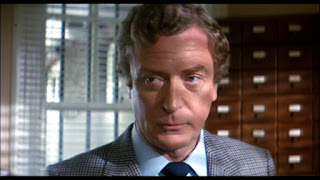
In London, MI5 agents John Preston (Michael Caine) and Sir Nigel Irvine (Ian Richardson) uncover government official Berenson as a spy. They turn him to feed false intelligence to Irvine's KGB rival Karpov (Ray McAnally). In the USSR, Karpov is not aware his power-hungry boss Govorshin (Alan North) has recruited agent Valeri Petrofsky (Pierce Brosnan) for a false flag mission to detonate an atomic bomb at a NATO base in the UK. Karpov eventually gets wind of the plan from his ally Borisov (Ned Beatty).

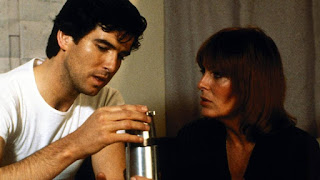
Petrofsky travels to the UK, rents an apartment near a NATO base, and starts to collect the bomb components from Soviet courier agents. Preston suspects a plot is unfolding when he intercepts a detonator and locates a Soviet communications hub on English soil transmitting suspicious messages. KGB agent Irina Vassilievna (Joanna Cassidy) arrives to help Petrofsky assemble the bomb, as Preston races to connect the dots.

Based on the book by Frederick Forsyth, The Fourth Protocol carries a threat and teases out admirable tactical details, but is essentially a distilled version of The Day Of The Jackal. Here Petrofsky is the silent assassin going about his business with grim-faced efficiency as his counterpoint Preston scrambles to gather clues. Despite expansive direction by John Mackenzie, making excellent use of dreary English locations, the action ticks by rather soullessly.

Apart from the title barely being explained, a central problem is Petrofsky's nominal role in his own plot. Deploying a singular glare, Pierce Brosnan is left stranded, his character hired to push a button and otherwise reduced to a courier zooming on his motorcycle this way then that to collect pieces of the bomb, but not even tasked with assembling the components. Petrofsky has to kill a few people to keep the plot on course, but most of his victims are extras.

Much better is John Preston, navigating the bureaucracy of the British secret service and dealing with a buffoon of a careerist boss (Julian Glover as a suitably despicable pencil pusher). Michael Caine never needs to stretch, but ensures sustained watchability as the political Cold War subtext is presented with potent urgency. Public opinion in Britain is portrayed as turning against militarization, and especially opposed to the deployment of American bombers equipped with nuclear weapons. Govorshin of course times the detonation to coincide with thousands of protesters gathering at the NATO base.

Serviceable but not quite notable, The Fourth Protocol offers adequate ticks and borrowed tocks.


All Ace Black Movie Blog reviews are here.

Wednesday, 14 October 2020

Movie Review: Under Fire (1983)

A tense drama set within Nicaragua's civil war, Under Fire captures the bracing chaos faced by journalists trying to make sense of a revolution in progress.

After covering the civil war in Chad, photojournalist Russell Price (Nick Nolte), and reporters Claire (Joanna Cassidy) and Alex (Gene Hackman) relocate to Nicaragua, where a leftist revolution is threatening to overthrow the US-backed regime of President Anastasio Somoza (René Enríquez). Alex then returns to the US to accept a job as anchor, breaking off a strained relationship with Claire and allowing her to pursue a passionate romance with Russell.

The Nicaraguan rebels, inspired by reclusive leader Rafael, are quickly advancing through the countryside and capturing key towns. Russell meets well-connected French businessman/spy Jazy (Jean-Louis Trintignant), as well as mercenary Oates (Ed Harris). American public relations expert Hub Kittle (Richard Masur) tries to burnish the President's reputation, despite Somoza's infatuation with Miss Panama (Jenny Gago) while the country burns. When rumours of Rafael's death threaten the rebels' progress, Russell and Claire are forced to make decisions that could alter the war's trajectory.

Filmed in Mexico, Under Fire recreates a country convulsing under the pressure of a Cold War fueled revolution. The script by Clayton Frohman and Ron Shelton lends sympathy to the rebels at the expense of the Somoza dictatorship, but is also under no illusions. Frenchman Jazy, at the point of losing everything, is blunt in his assessment of the country's prospects, under any regime.

Meanwhile director Roger Spottiswoode brilliantly evokes the horrific sights and smells of a furious conflict consuming the country. Under Fire captures the disorienting reality of deserted streets littered with destroyed equipment and abandoned dead bodies, civilians sheltering from the horror, the warring factions barely in control of opposite sides of small towns, the combatants themselves unsure where the front lines are. In one scene Russell and Claire, desperate to find a path to safety, encounter two rebels stationed at a street corner who just shrug in disinterested ignorance when asked whether the revolutionaries control that neighbourhood.

As the death count rises, Russell and Claire witness increasing atrocities. Their objectivity erodes and they enter the danger zone where the appeal of taking sides rises. With his cameras and photographs emerging as potent weapons, Russell's exhausted psyche is put to the test, seemingly in a position to wield power but also unaware of his status as a pawn. Alex's unexpected return to Nicaragua threatens to elevate all of Russell's risks into disasters, but just like the endless neighbourhood mazes, more twists await. 

At a running length of 128 minutes, Spottiswoode allows the drama to breathe with adequate time and space afforded for both character development and taut on-the-street action. Nolte, Cassidy and Hackman are provided enough context to round their characters into believable war correspondents, although the romantic entanglements are predictably clunky. Ed Harris as the mercenary Oates has a small but chilling role, the misery of nations providing gainful employment for men happy to kill for a living.

Unblinking, harrowing and riveting, Under Fire radiates with the intensity of infernal combat and impossible dilemmas.


All Ace Black Blog Movie Reviews are here.

Thursday, 27 December 2012

Movie Review: Blade Runner (1982)


A triumph of visual style over narrative substance, Blade Runner is a magnificent sensory achievement. Director Ridley Scott creates a sombre future Los Angeles that is all too believable, and the stunning images enrich the otherwise standard story of a hunt for rogue replicants.

In 2019, the world's cities are polluted and overpopulated, and many humans live and work on other planets.  Human-like robots, known as replicants, are manufactured by the dominant Tyrell Corporation to help perform specific functions, but the powerful Nexus-6 models, built with a four-year limit on their life, are specifically prohibited from Earth due to violent tendencies. Retired Los Angeles police officer Rick Deckard (Harrison Ford) is a "Blade Runner", a specialist in tracking down and "retiring" rogue replicants. With the help of the mysteriously dark Gaff (Edward James Olmos), police chief Harry Bryant (M. Emmet Walsh) recalls Deckard to help in finding and eliminating four Nexus-6 models who have arrived illegally on Earth.

Led by Batty (Rutger Hauer), Leon (Brion James), Pris (Daryl Hannah) and Zhora (Joanna Cassidy) are searching for a way to overcome their four-year life limit. Deckard meets Dr. Eldon Tyrell (Joe Turkel) the main designer of the replicants, and Batty's primary target. Tyrell's latest experiment is Rachael (Sean Young), a replicant unaware of her status and injected with fake memories to help her believe that she is human. As a romance develops between Deckard and Rachael, Deckard tracks down first Zhora then Leon, but Batty and Pris find their way to J.F. Sebastian (William Sanderson), a genetic designer who can lead them to Tyrell.

Based on the Philip K. Dick short story Do Androids Dream Of Electric Sheep?, Blade Runner is working with limited source material, effectively a glorified but quite linear detective chase. Scott successfully fuses together a depressingly bleak future with basic film noir characteristics to create a memorably artistic tableau, rendering the actual plot quite secondary.

Blade Runner's dazzling achievement is a rich extrapolation of the present into a credible but horrendous future recreation of a large Earth city. The Los Angeles of 2019 is an overpopulated urban nightmare bathed in constant darkness, never-ending rain, persistently rising steam from unidentified cavities, and washed with the sickly glow of incessant, oversized neon corporate advertising. Mammoth, super-dense buildings dominate the cityscape, the population is mostly Asian, every inch of sidewalk is congested, and the police presence is pervasive in hovering "spinner" vehicles, their yellow beams of light adding to the suffocating environment. Every external scene in Blade Runner re-emphasizes this grim future, Scott making use of shadows and light to create a hallucinatory, recalibrated but frighteningly believable reality.

The film plays with several themes related to the essence of being human. The replicants are struggling against their unalterable built-in four-year life span, expressing the hopelessness of an existence that is certain of a termination date. Humans of course suffer the same certainty of death, but without knowledge of the expiration time, and the screenplay by Hampton Fancher and David Peoples questions the fairness of human-like creations, designed to express human emotions, but sabotaged in their ability to hope and dream, that most essential of human attributes. There are also puzzles related to Deckard (is he human or a replicant), and, ultimately, what does the future hold when the line between natural and man-made humans is blurred beyond obvious recognition.

With the film's appearance dominating the plot and characters, the performances are understandably subdued. Harrison Ford, looking to expand from the Star Wars universe, has little to work with, Deckard hard boiled enough but without the edge or wit afforded to classic film noir investigators. Rutger Hauer's Roy Batty emerges as the most dominant character, physically and emotionally imposing, a replicant who understands his role and fallibilities all too well. Sean Young wears the same sad and puzzled expression throughout, a not-so-fatale femme, Young as unassured about her performance as Rachael is about her humanity. Daryl Hannah, Joanna Cassidy, Brion James, William Sanderson and Edward James Olmos are colourfully good fits for their bizarre surroundings, but in limited roles none can benefit from any character evolution.

Blade Runner set a new standard for what a serious science fiction film could look like, in a universe where reality is not so much newly constructed as imaginatively stretched from the more austere elements of the present. It's an enduring cinematic achievement, the routine story compensated for by a dazzling package.


All Ace Black Blog Movie Reviews are here.